.png)
.png)

BLOG

香港德國文化協會
The German Cultural Association
How to Start Learning the German Language
You are not here for a hobbyist's version of German. You are here because German now sits inside a real decision. An exam target. A university application. A visa route. A career move. Or a parent's decision to give a child a serious language option in Hong Kong instead of drifting into another generic enrichment class.
That changes how you should start.
In Hong Kong, the biggest problem is the immersion gap. You live in a city where German is useful, but you do not hear it on the street, at work, or in school unless you build that exposure on purpose. At the same time, many learners here are under exam pressure. IB, A-Level, IGCSE, Goethe, and university admissions all reward structured progress, not casual interest. If you begin with random apps, scattered grammar notes, and vague promises about “picking it up naturally”, you will waste time.
Start with the outcome and the timeline. Then choose a method that matches both.
Interest in German has clearly grown among Hong Kong learners, especially among students and families who want a language with academic and career value. For that reason, a structured course matters more here than in places where daily immersion happens by default. GCA's own student results page reports strong public exam outcomes for its learners, which is exactly the kind of benchmark serious families should check before committing to a programme: German Cultural Association Hong Kong student results.
The right start is rarely the easiest start. It is the one that gives you a clear level target, regular feedback, and a plan you can sustain in Hong Kong's school and work routine. That is the difference between “learning some German” and reaching a level that helps you get into a programme, pass an exam, or use the language with confidence.
Your Journey to German Fluency Starts Here
Hong Kong learners usually fall into one of four groups. You're a professional who wants access to German-speaking markets. You're a parent planning ahead for IGCSE, A-level, IB, or Goethe exams. You're a student targeting study abroad in Germany. Or you have no interest in casual learning. You want a method that works.

German is worth learning in Hong Kong because the motivation is concrete. Germany is Hong Kong's 4th largest trading partner, with bilateral trade exceeding HKD 200 billion in 2024, and German remains Europe's most widely spoken native language according to the same Facts about Germany reference. If your goal is academic or career-focused, that matters far more than romantic ideas about language learning.
Most beginners make the same mistake. They ask, “Which app should I use?” before they ask, “What level do I need?” That's backwards. If your target is a basic travel level, your plan should look different from someone preparing for TestDaF, IB oral work, or business meetings.
Start with the outcome, not the textbook
If you want to know how to start learning the German language in Hong Kong, define the endpoint first.
- For travel and everyday survival: Aim first for A1 to A2
- For conversational independence: Work towards B1
- For business use and stronger functional communication: Target B1 to B2
- For university admission in Germany: Expect an advanced exam path, often around C1
That single decision will save you time, money, and frustration.
Practical rule: Don't study “general German” forever. Study for the life you actually want to live in German.
The Hong Kong reality matters
Learners in HK are busy. Adults juggle long workdays and commuting. Teenagers already carry DSE, IB, IGCSE, A-level, or university preparation pressure. Parents don't want a hobby course. They want a clear return on effort.
That's why structure matters more here than in places where learners can casually pick up the language around them. In Hong Kong, your progress depends on organised input, speaking opportunities, and accountability. If your learning plan doesn't include those three things, it will stall.
German is absolutely learnable. But it isn't effortless. You need consistency, correction, and a sequence that makes sense. Get that right at the beginning, and the language becomes manageable. Get it wrong, and you'll spend months memorising words you can't use.
Where Do I Begin Learning German in Hong Kong
A Hong Kong learner usually hits the same wall early. You download two apps, save a few YouTube videos, buy a grammar book, study hard for a week, then work, school, commuting, or exam pressure takes over. A month later, you know scattered words but cannot introduce yourself cleanly or hold a basic exchange.
That start wastes time. German rewards sequence, correction, and repetition. In Hong Kong, where daily exposure to German is limited, beginners need a clearer system than learners in Berlin or Munich. You do not have ambient immersion here. You have to build progress on purpose.

The right place to begin is with a realistic beginner plan. That means one target, one course path, and weekly speaking from the start. If you are studying for IB, A-level, IGCSE, Goethe, or a future university route to Germany, treat German as a structured subject, not as casual content consumption.
Start with the outcome you actually need
Hong Kong learners often say they want to “learn German” when they mean one of four things: pass an exam, prepare for study abroad, improve career options, or handle travel and relocation. Those are different jobs. They need different timelines and different levels of precision.
Use this as your starting map:
| Goal | Sensible starting target |
|---|---|
| Short trips, basic interactions | A1 |
| Daily life basics, simple conversations | A2 |
| Independent everyday communication | B1 |
| Business use and stronger professional range | B1 to B2 |
| University admission pathway | C1-related exam preparation |
Set the target first. Then choose the method.
Build your foundation in the right order
Beginners in Hong Kong do best with a sequence that removes confusion early. Start with pronunciation and sentence control before you chase volume. If your sounds are weak and your word order is unstable, adding more vocabulary just creates mess.
A practical starting sequence looks like this:
Get the sound system under control
Learn umlauts, vowel length, ch, r, and stress patterns early. Clear pronunciation helps listening as much as speaking.Learn high-frequency words with articles
Do not memorise nouns naked. Learn der Tisch, die Frage, das Kind. Gender mistakes become habits fast.Write and speak simple personal information
Name, age, nationality, school, work, family, routine. These are the first building blocks of real communication and oral exams.Add core grammar in usable chunks
Present tense, basic word order, question forms, negation, common modal verbs, then cases through useful phrases rather than abstract tables alone.Start guided speaking early
A beginner who speaks every week with correction progresses faster than one who only recognises words on a screen.
A methodology reference on beginner language study notes that structured programmes can produce much stronger early exam outcomes than solo app-based learning. The reason is simple. Beginners need correction, pacing, and repetition. Apps help with exposure. They do not replace live feedback.
Speak early, even if your German is basic. Silence does not build fluency.
Your first week in Hong Kong should look like this
Keep the opening week tight. Do not build a complicated study setup you will abandon by next Monday.
Choose one main course path
One teacher or one class track. Not a pile of disconnected resources.Study pronunciation before memorising long word lists
Ten words pronounced well beat fifty words you cannot recognise when spoken.Start an SRS deck for basic vocabulary
Greetings, numbers, days, countries, common verbs, and nouns with articles.Write five to ten short sentences about yourself
This gives you material for class speaking, oral practice, and early confidence.Book a real lesson
In Hong Kong, the immersion gap is real. If you do not schedule speaking, it usually does not happen.
Avoid the common Hong Kong beginner trap
A lot of learners here stay stuck in preparation mode. Teenagers spend months collecting notes for Goethe or school assessments without enough live speaking. Adults watch videos on the MTR and call it progress. Parents enrol children in a course with no clear pathway and then wonder why nothing sticks.
Use online content as support, not as your whole plan.
Here's a useful explainer to support your early listening and beginner orientation:
Pick a structured start, then stick to it
The strongest first step for serious beginners in Hong Kong is a structured class path with regular speaking, correction, and a fixed syllabus. That matters even more if your goal is exam performance or a later move into IB, A-level, Goethe, or study-abroad preparation. If you want help comparing formats before enrolling, read this guide to finding the right German class in Hong Kong.
At GCA, that structure is built into the learning path. You know what to study, when to study it, and what comes next. That clarity saves Hong Kong learners from the usual beginner drift and gives you the cleanest route to usable German.
Choosing Your Ideal Learning Path in Hong Kong
The wrong learning format will waste your budget faster than the wrong textbook. In Hong Kong, most learners choose between three paths: structured classes, private tutoring, or self-study with apps. Each can work. But they do not work equally well for every goal.
If you're serious about exams, study abroad in Germany, or consistent speaking progress, you need to judge each option by structure, correction, interaction, and sustainability. Convenience alone is a poor filter.
German learning methods in Hong Kong compared
| Factor | German Cultural Association (GCA) | Private Tutor | Self-Study (Apps) |
|---|---|---|---|
| Curriculum structure | Fixed CEFR-aligned pathway | Depends heavily on tutor | Usually fragmented |
| Teacher quality consistency | Native-speaking faculty, standardised approach | Varies by individual | No live teacher |
| Group interaction | Small-group format with interaction | Limited unless arranged | Minimal or none |
| Exam preparation | Built for Goethe-Zertifikat, TestDaF, IGCSE, A-level, IB | Possible, but depends on tutor experience | Weak for formal exam strategy |
| Schedule flexibility | In-person and Zoom options | Can be flexible | Most flexible |
| Error correction | Regular and systematic | Strong if tutor is skilled | Limited automated correction |
| Motivation support | Built-in class rhythm and attendance expectations | Good if tutor is demanding | Often weak |
| Cost control | Balanced for guided learning | Often higher per hour | Lowest upfront cost |
| Best fit | Learners who want progression and accountability | Learners with narrow personal goals | Casual beginners testing interest |
Structured classes suit most Hong Kong learners
For adults, parents, and teens in HK, structured classes are usually the most efficient choice. They create pace. They force continuity. They stop the common beginner problem of “studying only what feels easy”.
Small-group learning also solves a hidden issue. It gives you speaking pressure without the full intensity of one-to-one tutoring. That matters for shy learners, teenagers preparing for oral assessments, and busy professionals who need regular output but don't want every lesson to feel like a performance.
One practical option in this category is the German Cultural Association Hong Kong, which offers CEFR-based group and private courses, in-person classes near Tsim Sha Tsui and Causeway Bay MTR, plus Zoom lessons. The useful detail is the format: small groups of up to six, native-speaking teachers, and programmes that include exam preparation rather than treating exams as an afterthought.
Private tutors are useful, but uneven
A strong private tutor can accelerate progress. That's especially true if you need help with a specific oral exam, a business presentation, or a weak skill area such as writing.
The problem is inconsistency. In Hong Kong, private tutors vary widely in training, planning discipline, and exam familiarity. Some are excellent. Some are conversational partners with no real progression system. If you choose this route, ask direct questions:
- Which levels do you teach regularly
- Do you prepare students for Goethe, TestDaF, IB, IGCSE, or A-level
- How do you track progress
- What do you assign between lessons
- How do you correct pronunciation and grammar
If the answers are vague, move on.
A pleasant tutor isn't automatically an effective tutor. German requires method, not just friendliness.
Apps are fine as support, not as your entire strategy
Apps are useful for review, vocabulary repetition, and habit building. They are not enough for most HK learners with real goals.
Why? Because apps don't care whether you can answer a teacher, survive an oral exam, or write under pressure. They reward recognition more than production. That creates false confidence.
Use apps for:
- Vocabulary review
- Quick drills on commute time
- Sentence repetition
- Pronunciation support
Don't rely on apps alone for:
- Speaking confidence
- Exam technique
- Writing correction
- Real conversational flexibility
Choose by goal, not by convenience
If your child needs long-term exam preparation, choose structure. If you need a short burst of targeted oral practice, a tutor can help. If you're only exploring whether German interests you, start with self-study, but don't stay there too long if your goals are serious.
The best path is the one you can follow consistently in Hong Kong's real conditions. That means manageable travel, realistic scheduling, proper teacher feedback, and a course design that moves you forward instead of letting you drift.
Which German Exam Should I Take
A Hong Kong student spends months on the wrong German exam, then realises the certificate does not help with university admission, school grading, or a Germany study plan. That mistake is common, and it is avoidable.
Start with your end goal. Then choose the exam that serves it.
In Hong Kong, the exam question is rarely academic. It is tied to something concrete: IB points, A-Level performance, a Goethe certificate for work, or entry to a German university. The city also has an immersion gap. You cannot rely on daily German exposure to carry you through. Exam preparation needs to be deliberate, structured, and matched to the format you will face.

The main exam pathways
Here is the practical breakdown.
Goethe-Zertifikat
Goethe is the standard general German proficiency route, from A1 to C2. It suits learners who need recognised proof of level for work, migration, personal development, or steady progression over time.
- A1 to A2: early proof that you can handle basic communication
- B1: a strong benchmark for functional, independent use
- B2 and above: better for formal goals that require stronger reading, writing, and speaking control
For many Hong Kong learners, Goethe is the cleanest starting point because the level system is clear and widely recognised.
TestDaF
Choose TestDaF if your target is university study in Germany. It is built for academic German, not everyday conversation alone.
That means reading under time pressure, understanding lectures and interviews, producing organised written responses, and speaking in an academic register. If that is your path, prepare for TestDaF early and train for the format directly. General lessons alone will not carry you.
DSH and Telc Deutsch C1 Hochschule
These exams also matter for higher education. DSH is often linked to specific universities. Telc Deutsch C1 Hochschule is another accepted academic option for applicants who need advanced language certification.
For Hong Kong learners, these usually become relevant after you have confirmed the admission route and language requirement for your chosen institution.
School-based learners need a different strategy
If your child is taking IGCSE, A-Level, or IB German, do not assume a general German class is enough. School exams reward very specific skills: set text handling, oral response style, writing formats, and mark scheme discipline.
Families in Hong Kong lose time here. They prepare for German in a broad sense, but not for the paper the student will sit.
Passing a German exam and using German well are connected, but they are not identical. Serious learners train for both.
This is one reason structured programmes matter. At GCA, students preparing for school exams, Goethe levels, or university pathways need different correction, different task types, and different pacing. A one-size-fits-all course usually wastes effort.
Match the exam to the goal
| Goal | Most relevant exam path |
|---|---|
| Early proof of progress | Goethe-Zertifikat A1 or A2 |
| Practical everyday German | Goethe-Zertifikat B1 |
| University study in Germany | TestDaF, DSH, or Telc Deutsch C1 Hochschule |
| School performance in Hong Kong | IGCSE, A-Level, or IB-aligned preparation |
| Career development with recognised certification | Goethe-Zertifikat, usually B1 or above |
If you are comparing formats, scoring, and use cases, read this detailed guide to Goethe-Zertifikat, TestDaF, and other German exams.
Some industry blogs suggest bilingual professionals can command higher salaries in certain roles, but that should not drive your exam choice. Pick the certificate that gets you through the next gate first. Admission, graduation, visa paperwork, and credible proof of level matter more than vague career promises. The same discipline applies in other languages when learners try to overcome French language plateau without a clear milestone or assessment target.
Choose the exam that matches the door you want to open. Then prepare for that exam properly.
Building a Practical Study Routine That Fits Your Life
It is 8:10 a.m. in Hong Kong. You are on the MTR, answering work messages, and telling yourself you will study German properly tonight. Then overtime happens, or school work piles up, and the plan disappears again. That is the routine problem most HK learners face. The issue is rarely motivation. The issue is building a system that still works during busy weeks.
Your routine needs to match your actual life, not your ideal one.
German improves through repeated contact with four skills: listening, speaking, reading, and writing. Ignore one for too long and the weakness shows up fast. Many Hong Kong learners become good at recognition because they spend too much time on notes, apps, and grammar explanations. Then they struggle to answer simple questions out loud.
Build all four skills every week
Listening
Use dead time well. Commutes, walks, and short breaks are enough for focused listening. At beginner level, repetition beats novelty. Replay short audio until you can catch the structure, not just a few familiar words.
Speaking
Start early. Speaking is not something you postpone until you “know more German.” It is the training that helps you keep what you learn. Even 10 to 15 minutes of guided output each week is better than waiting for confidence to appear on its own.
Reading
Choose material that feels manageable. Short dialogues, learner texts, captions, and graded readers work far better than forcing your way through content that is too advanced. If you stop every line to translate, lower the difficulty.
Writing
Write small, useful things. Self-introductions, daily routines, short opinions, WhatsApp-style messages, and simple summaries all build control. Writing also exposes the grammar you only half understand.
A routine that works for busy professionals in Hong Kong
If you work full-time, stop designing study plans that require two free hours every evening. Short, fixed blocks work better.
Monday to Friday
- Commute: 15 to 20 minutes of listening
- Lunch break or evening: 10 minutes of vocabulary review
- Three days per week: 15 minutes of sentence building, grammar drills, or short writing
- One or two evenings: live class or speaking practice
Weekend
- One longer session: reading, writing, and review
- One speaking block: tutor session, pair practice, or class participation
This structure suits Hong Kong adults because it respects energy limits. It also reduces the immersion gap. You are unlikely to get natural German exposure in daily life here, so your schedule has to create repeated contact on purpose.
A methodology blog on learning German efficiently suggests starting with high-frequency vocabulary, then using that vocabulary in sentence patterns and practical scenarios. That advice is sensible. The order matters. Learn useful words, practise them in context, and say them out loud under light pressure. That is far more effective than collecting grammar notes you never use.
A better routine for students and exam-driven learners
Students in Hong Kong often have more flexible time, but they also waste more of it. If you are preparing for IB, IGCSE, A-Level, Goethe, or a university application target, your week needs clear separation between review, skill practice, and timed output.
Sample weekly structure
- Monday: vocabulary and pronunciation
- Tuesday: grammar and short writing
- Wednesday: listening and oral response
- Thursday: reading and correction review
- Friday: speaking drills or class
- Saturday: timed task or mock paper
- Sunday: light revision and reset
This works because each day has a job. You stop guessing what to do, and you stop spending all your time on the easiest task.
If you need extra support materials between classes, use this list of free German learning resources in Hong Kong. Pick a few and use them consistently. Do not build a resource pile you never finish.
Fix plateaus early
Plateaus usually come from one problem. Too much passive input, not enough active retrieval.
Learners keep reading, highlighting, and reviewing flashcards, but they avoid producing full answers. Then speaking stalls. The same pattern shows up in other languages. Anyone trying to overcome French language plateau will recognise it immediately.
The correction is straightforward. Increase guided output. Add more short speaking tasks, more sentence production, and more teacher correction. At GCA, this is one reason structured classes help serious learners in Hong Kong. They give you pacing, feedback, and regular speaking pressure, which self-study plans often fail to provide.
If you can only recognise the answer, you do not control it yet.
Keep the routine realistic. A plan you can follow during deadline season is worth far more than a perfect timetable you abandon after two weeks.
How to Create Immersion in a Non-German City
“Just immerse yourself” is lazy advice in Hong Kong. There is no natural German-speaking environment around most learners here. You're not going to step out in Tsim Sha Tsui and suddenly conduct your day in German.
That's why generic immersion advice often fails HK learners. As this discussion of immersion limits for Hong Kong learners points out, organic immersion is often unrealistic in a non-German-speaking city, and learners in that context benefit most from social accountability and structured group learning. Those aren't optional extras in Hong Kong. They're core infrastructure.
Build a personal immersion bubble
You need to create exposure on purpose. Think of it as a controlled environment, not a fantasy of living in Berlin from your flat in HK.
Use a simple weekly setup:
One anchor class each week
This becomes your dedicated German zone.One speaking partner or tutor slot
Keep it regular so speaking doesn't become something you “mean to do later”.A German media layer
Short videos, learner podcasts, subtitles, music, and short texts.A visible accountability system
Study tracker, class attendance target, or peer check-in.
Replace impossible immersion with repeated contact
The goal is repeated contact across the week, not dramatic exposure once in a while. Fifteen focused minutes every day beat an occasional three-hour binge.
Here are the most practical HK-friendly options:
Use time-zone-friendly online exchanges
Don't choose tandem partners whose schedules constantly clash with yours.Join organised learning groups
Group learning creates commitment that solo learners often lack.Curate your digital environment
Change your phone language settings selectively, follow German learner channels, and save useful sentence patterns.Turn media into study material
If you watch German video clips, transcribing short segments can sharpen listening. Tools discussed in this guide to video transcription for content creators can also be useful for language learners who want to slow down speech, catch missed words, and build custom review notes.
Community matters more than most learners admit
Motivation drops fast when nobody around you cares whether you continue. That's why isolated learners often quit, even when they started enthusiastically.
A class, peer cohort, or regular speaking circle does something apps can't do. It makes German part of your calendar, not just part of your intentions.
In Hong Kong, immersion isn't something you find. It's something you design.
If you accept that early, your strategy becomes much more realistic. You stop waiting for perfect conditions and start building useful ones.
Ready to Start Your German Language Journey
If you've been waiting until you “have more time”, stop waiting. German rewards organised effort, not perfect timing.
The smartest way to begin is simple. Pick a real goal. Choose the correct level path. Study on a fixed weekly rhythm. Add speaking early. Don't rely on apps alone. And if exams matter, prepare for the exact exam you'll sit, not a vague version of “German”.
For Hong Kong learners, the biggest advantage comes from structure. You need a system that fits work, school, commuting, and family life. You also need proper correction, not just exposure. That's what keeps pronunciation clean, grammar manageable, and motivation intact long enough for results to show.
If you're a parent, don't wait until your child is close to an exam year. If you're a professional, don't delay speaking practice until after you've “finished the basics”. If you're planning to study abroad in Germany, build your exam pathway now, not at the last minute.
Learning German takes effort. But it becomes far more straightforward when the sequence is right.
If you're ready to move from planning to action, German Cultural Association Hong Kong(GCA) offers a practical next step. You can book a trial class, speak with an advisor about the right course for your level and goal, or check the latest schedule for in-person and online options. If you want a structured route for German lessons Hong Kong or a clear plan to Learn German HK, start with a course path that gives you regular speaking, native-teacher correction, and exam-focused progression.
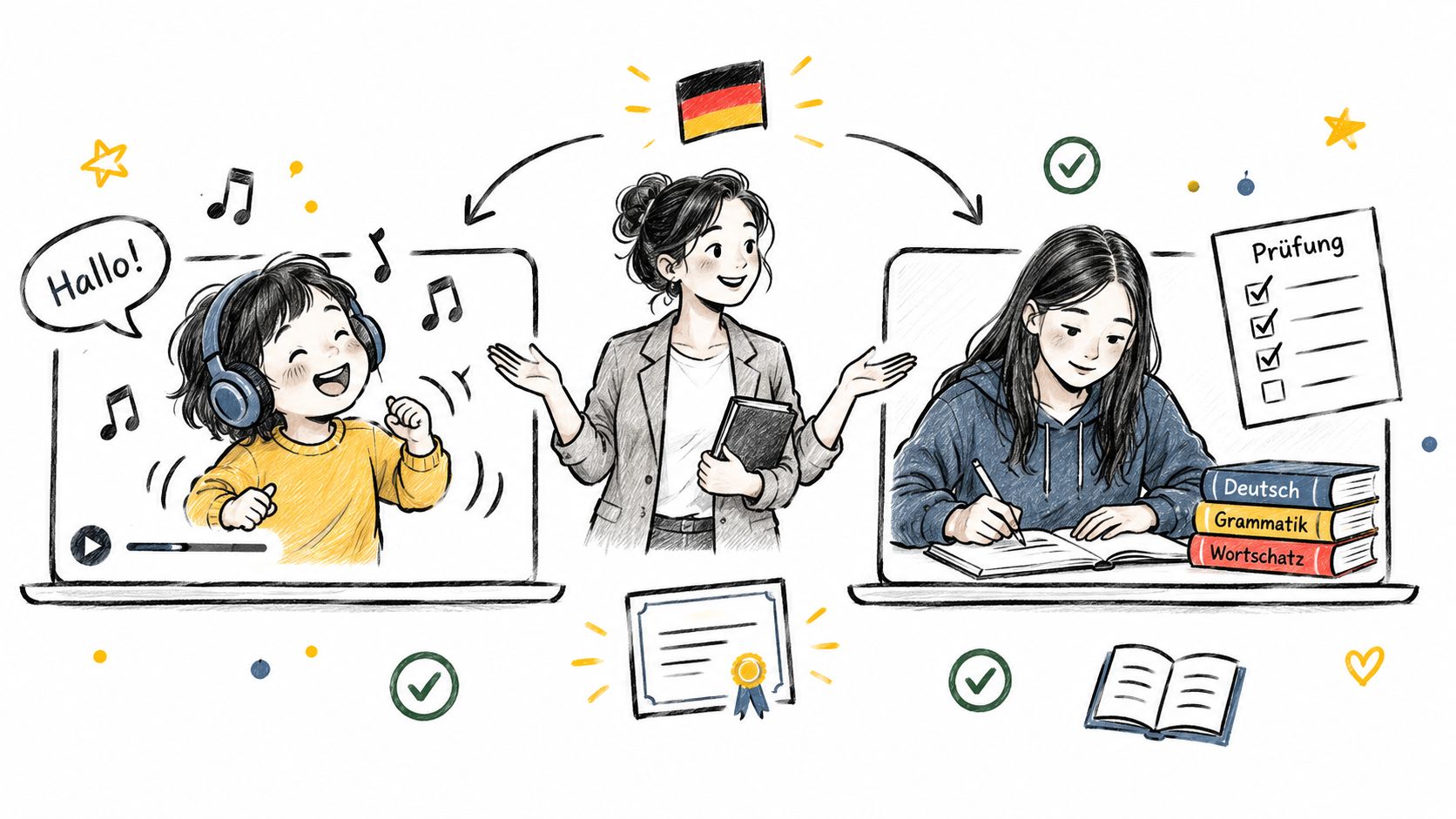
Online German Classes for Kids and Teens: Do They Actually Work?

Beginner German for Teens: A Starter Roadmap for Ages 12-18


