.png)
.png)

BLOG

香港德國文化協會
The German Cultural Association
Das Explained: German Gender Guide for HK Learners 2026
You've memorised Buch = book, Tür = door, Mädchen = girl. Then the exercise starts and everything slows down. Is it der Buch, die Tür, das Mädchen? One wrong article turns into the wrong adjective, then the wrong pronoun, then a sentence that looks shaky in an exam script.
That's where most HK learners get stuck. Adults studying after work, secondary students handling IB or IGCSE, and parents trying to support a child's German all hit the same wall. German gender looks random at first, especially if your first language doesn't use articles in the same way.
It isn't random enough to give up on. Das Explained: German Gender Guide for HK Learners 2026 works best when you stop treating der, die, das as three labels to memorise blindly and start treating them as a system with patterns. Once you do that, article choice becomes easier, reading speed improves, and exam writing becomes far more controlled.
Struggling with Der Die Das You Are Not Alone
A common scene in Hong Kong looks like this. A working professional has evening German class after Central office hours, or a student has Goethe practice after school, and both can remember vocabulary lists quite well. But once articles enter the sentence, confidence drops.
They know Haus, Zeit, Kind. They don't know whether to say das Haus, die Zeit, das Kind quickly and accurately under pressure.
That frustration is normal. German asks you to learn each noun as a package, not as an isolated dictionary item. If you learn Tisch without its article, you haven't really learnt the noun fully.
Why learners feel blocked so early
The problem isn't just memory. It's that article errors spread.
- In speaking: the sentence sounds uncertain because hesitation appears before the noun.
- In writing: one wrong article often leads to another mistake in adjective endings.
- In listening and reading: learners miss signals that help them understand who or what the sentence refers to.
For HK learners aiming at Goethe-Zertifikat, IB, IGCSE, school support, or study abroad in Germany, this matters very quickly. Gender isn't an advanced topic you can postpone. It appears from beginner level onward.
A practical truth: if you keep asking “Why is German doing this to me?”, progress stays slow. If you ask “What pattern is this noun following?”, progress gets faster.
A better way to think about it
Treat German gender like traffic rules, not like chaos.
You won't predict every noun perfectly from day one. But you can learn the high-yield patterns first, recognise the common endings, and build habits that reduce guessing. Busy learners in Hong Kong need that approach because time is limited and exam performance depends on accuracy under pressure, not on abstract grammar knowledge alone.
Why Does German Grammatical Gender Matter for HK Learners
A Hong Kong learner can know the vocabulary in a reading paper and still lose marks because of gender. You write die Problem instead of das Problem, or hesitate in an oral exam because you cannot remember which pronoun follows the noun. The meaning may still be partly clear, but the grammar signal is wrong, and examiners notice it immediately.
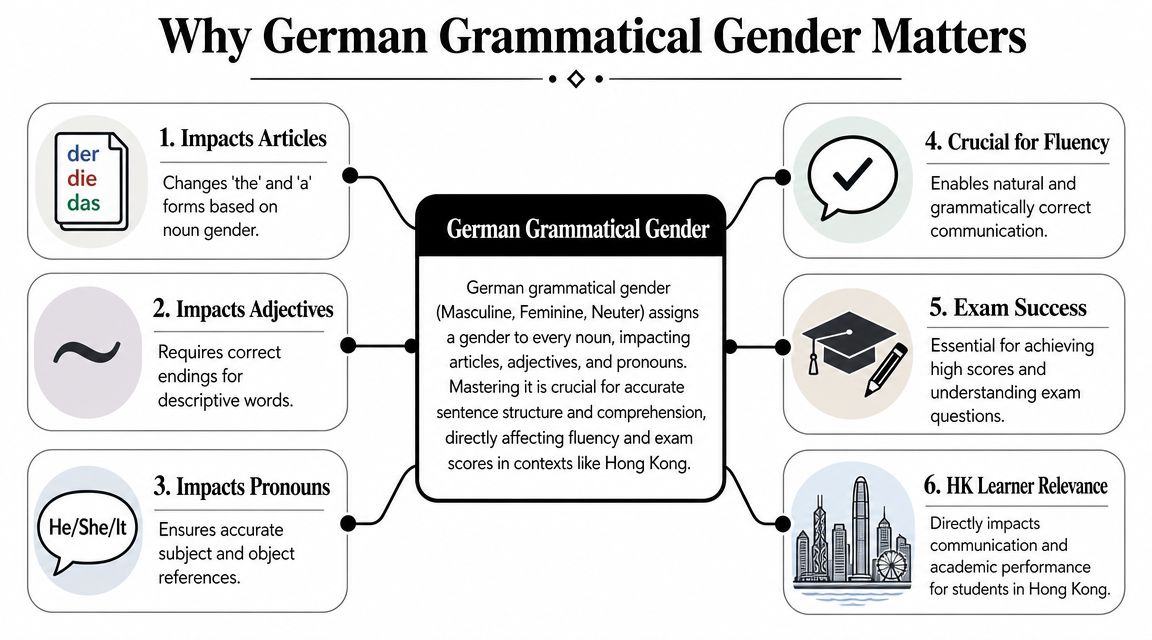
German grammatical gender means every noun belongs to one of three categories: masculine, feminine, or neuter, shown by der, die, or das. This affects articles, adjectives, pronouns, and overall sentence accuracy, so learners in Hong Kong need it for exams, professional writing, and everyday communication.
For busy learners in Hong Kong, this topic matters because gender is not an isolated grammar point. It is built into sentence construction. If the noun gender is wrong, the article is wrong first. Then adjective endings, pronouns, and sometimes case forms can go wrong after it. One small error at the noun level often spreads across the whole sentence.
It affects more than the word “the”
Many beginners first notice gender through the article. That is only the front door.
Look at this pair:
- das Buch ist interessant.
- die Buch ist interessant.
The second sentence is easy for a teacher or examiner to spot as wrong. In real conversation, listeners may still understand you, but your German sounds uncertain from the very first noun phrase.
The same noun then controls other choices:
- Ich habe ein interessantes Buch.
- Ich habe eine interessante Tasche.
Here, the adjective ending changes with the noun phrase. Later, pronouns follow the same logic:
- Wo ist das Buch? Es ist hier.
- Wo ist die Tasche? Sie ist hier.
This is why strong teachers in Hong Kong keep asking students to learn the noun and article together. The article is a label attached to the noun. Remove the label, and the rest of the sentence becomes harder to build correctly.
Why this matters in Hong Kong
HK learners are usually studying with a deadline. Goethe exam dates, IB assessments, IGCSE coursework, school tests, university plans, or work-related goals all put pressure on accuracy and speed.
Gender matters when you:
- Write exam answers and need accurate noun phrases under time pressure.
- Read quickly and use articles and pronouns to follow who or what the sentence refers to.
- Speak in oral exams or interviews without pausing before every noun.
- Write emails, applications, or forms where repeated article mistakes make your German look weak.
For that reason, a solid base in articles belongs with other high-frequency grammar skills in a beginner-friendly German grammar guide for Hong Kong learners.
Why Teachers Insist on Articles
Students often ask a fair question. If the listener understands Auto, why does das Auto matter so much?
Because in German, the article carries usable grammar information. It tells you how the noun behaves later in the sentence. Learning Auto gives you meaning only. Learning das Auto gives you meaning plus structure.
That difference saves time. It helps in exams when you meet unfamiliar vocabulary and need to make a sensible choice quickly. It also helps in daily communication, where hesitation before simple nouns can break your rhythm. For Hong Kong learners balancing school, work, and limited revision time, article-first learning is one of the highest-yield habits you can build early.
The Core Rules for Masculine Feminine and Neuter Nouns
A Hong Kong student in a Goethe reading paper sees die Entscheidung, das Gebäude, and der Vergleich in the same paragraph. The vocabulary may be new, but the articles are not random. German gender follows enough patterns that you can train your eye to make faster, more accurate choices under exam pressure.

The key is to stop treating every noun as a separate problem. Articles work better as pattern families. Once you notice the family, you reduce the amount you have to memorise.
Masculine nouns with der
Masculine nouns often show themselves through meaning or ending. Male people are usually masculine, so you get der Mann and der Vater. Many common noun endings also point strongly to der, especially -er, -ling, -or, and -ismus.
Examples:
- der Computer
- der Frühling
- der Motor
- der Tourismus
Time words also help at beginner and intermediate level. Months, days of the week, and seasons are commonly masculine, so learners meet forms like der Montag and der Sommer early.
This matters for exam technique. If you spot -ismus in a reading task, you should hear a mental alarm bell for der straight away. That is faster than searching your memory word by word.
Feminine nouns with die
Feminine nouns give busy learners some of the highest-return patterns in the whole topic because several endings are very reliable. If you learn these well, you improve accuracy across school texts, oral exams, and unseen passages.
High-frequency feminine endings include:
- -ung → die Zeitung, die Wohnung
- -heit → die Freiheit
- -keit → die Möglichkeit
- -schaft → die Freundschaft
- -tion → die Situation
- -ei → die Bäckerei
- -tät → die Universität
- -ik → die Musik
These endings appear again and again in formal vocabulary, academic topics, and opinion-based writing. That is why they are so useful for Goethe, IB, and IGCSE preparation. A learner who knows -ung and -tion already has a strong first guess for many nouns that appear in essays and reading papers.
A practical rule is simple. If you recognise -ung, -heit, -keit, or -tion, test die first.
Neuter nouns with das
Neuter nouns often feel harder because the patterns are less obvious at first glance. Still, a few are dependable and worth learning early.
Common neuter signals include:
- Diminutives ending in -chen: das Mädchen, das Brötchen
- Diminutives ending in -lein: das Fräulein
- Nouns made from infinitives: das Essen, das Leben
- Common endings such as -ment and -tum: das Apartment, das Zentrum
One pattern deserves special attention. When a verb turns into a noun, German usually uses das. So lesen becomes das Lesen, and schwimmen becomes das Schwimmen. Students in Hong Kong often meet this structure in reading comprehension and discussion topics, so it is worth making automatic.
Learn noun families, not isolated words
A good learner does not store die Meinung as one lonely item and die Wohnung as another. A better method is to file both under the same ending pattern. That works like sorting papers into labelled folders. Retrieval becomes faster.
| Pattern | Example | Gender |
|---|---|---|
| -ung | die Meinung | Feminine |
| -keit | die Möglichkeit | Feminine |
| -chen | das Mädchen | Neuter |
| verb as noun | das Schwimmen | Neuter |
| -ismus | der Realismus | Masculine |
This is the habit that saves time. You are not memorising hundreds of separate article decisions. You are learning a smaller set of repeatable signals, then applying them to new words in class, in exams, and in real conversations.
If you need a wider grammar base alongside article work, this beginner guide to core German grammar for Hong Kong learners fits well with this pattern-first approach.
Smart Shortcuts and Patterns to Guess Genders Correctly
Sometimes you won't know the noun. That happens in reading papers, listening tasks, and real conversations. The goal isn't perfection. The goal is to make an educated guess based on form and structure.
The compound noun rule saves time
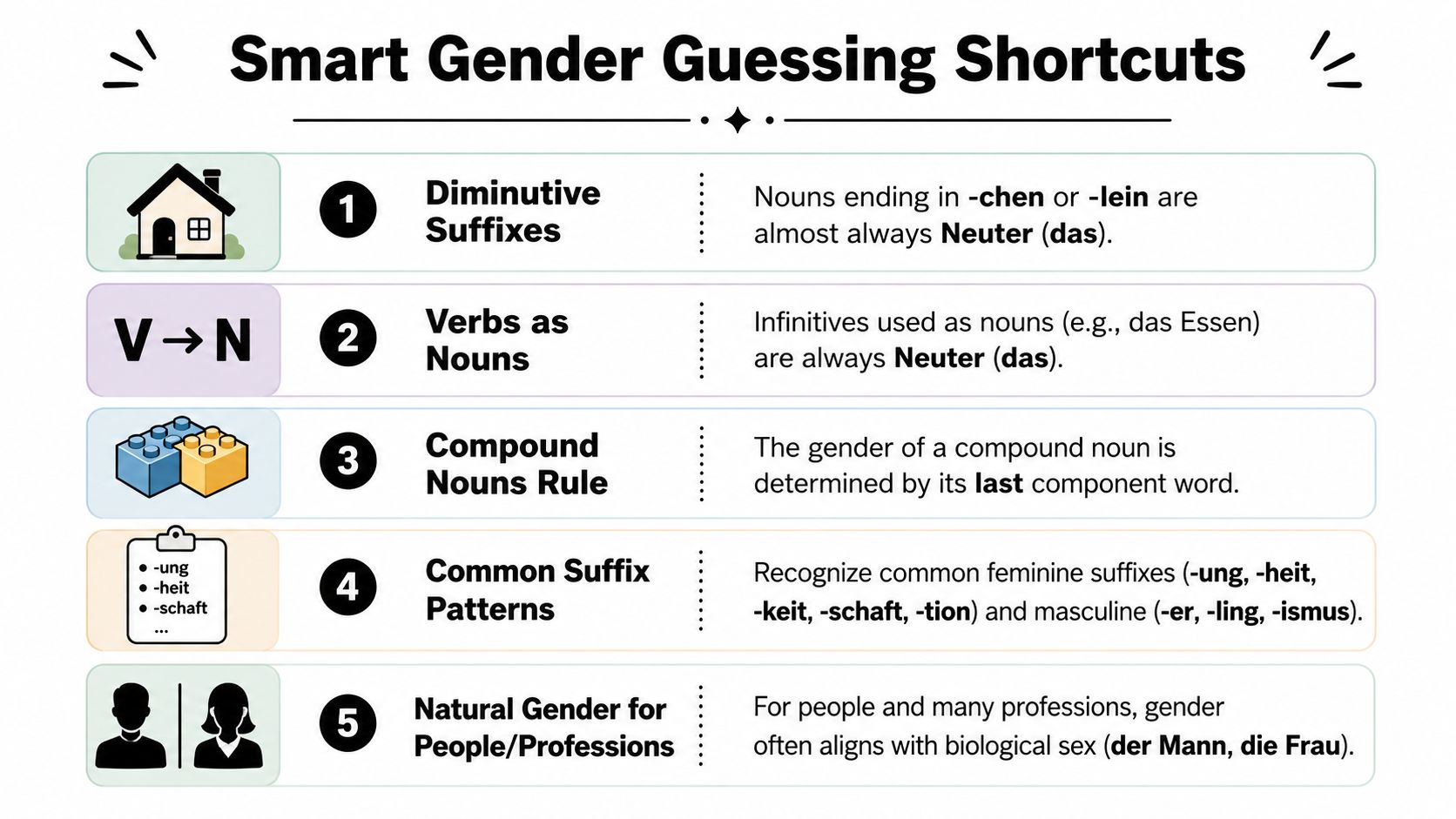
German noun gender is not random. One widely used rule set identifies compound nouns by the gender of the last component, which helps learners improve article accuracy on unfamiliar vocabulary and reduces guesswork in exam reading and listening compound noun gender rule in German.
This is one of the most useful shortcuts in the language.
Examples:
- das Haus + die Tür = die Haustür
- der Kaffee + die Tasse = die Kaffeetasse
- die Schule + das Buch = das Schulbuch
The last noun decides the gender. Not the first one.
For HK learners, this matters a lot because exam texts often contain long nouns that look intimidating. If you can break them apart, you can often recover the article logic.
Five shortcuts worth using every week
- Watch for diminutives: nouns ending in -chen or -lein are strong signals for das.
- Spot verbs used as nouns: when an infinitive becomes a noun, it takes das, such as das Essen.
- Scan the ending first: suffixes often tell you more than the meaning does.
- Use natural gender carefully: for many people and professions, male aligns with der and female aligns with die.
- Read compounds from the back: in a long noun, the ending unit is often the key.
When you see a long German noun, don't freeze. Split it, identify the final noun, and test the ending pattern.
A memory method that works for busy adults
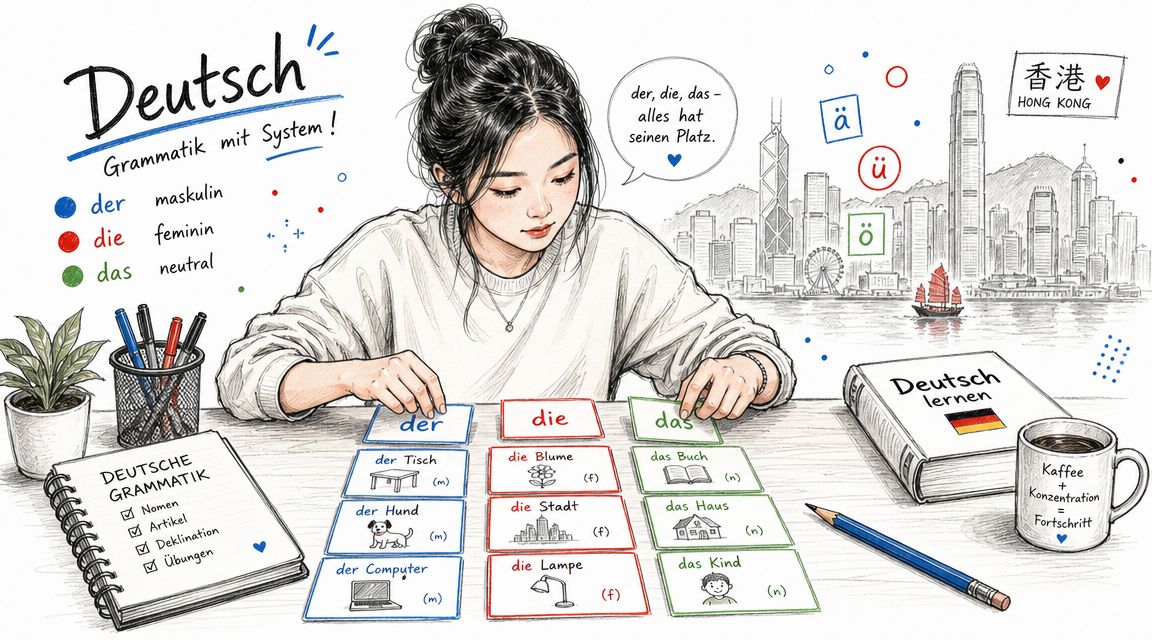
Use colour and sound together.
For example:
- Blue card for der
- Red card for die
- Green card for das
Then say the noun aloud as one chunk:
- die Entscheidung
- das Gespräch
- der Beruf
For many learners in Hong Kong who study late at night after work or revision sessions, fast, repeatable methods beat complicated note systems.
Build guessing skill without becoming careless
A shortcut is not a replacement for learning. It's a bridge.
Use shortcuts when:
- you meet a new word in reading
- you need a fast answer in an oral task
- you revise vocabulary in sets
Don't use shortcuts as an excuse to avoid memorising high-frequency nouns properly. The strongest learners combine both habits. They memorise common noun packages and use patterns for new or complex ones.
Common Exceptions That Break the Gender Rules
Honest German teaching includes the awkward cases. Some nouns break the pattern you expect, and pretending otherwise only makes learners distrust the rules.
The good news is that exceptions are learnable because they tend to be memorable once explained clearly.
Why exceptions happen
Sometimes word form overrides natural meaning. That's why a noun referring to a female person may still be grammatically neuter. The grammar follows the word ending, not the biological identity.
The classic example is das Mädchen. It refers to a girl, but the ending -chen makes it neuter.
You don't need to like every exception. You just need to recognise which rule is stronger in that word.
Common German nouns that break gender rules
| Noun (with Article) | Expected Gender (Based on Common Rule) | Actual Gender |
|---|---|---|
| das Mädchen | Feminine, because it refers to a girl | Neuter |
| das Fräulein | Feminine, because it refers to a female person | Neuter |
| der Name | Neuter or masculine guess may confuse learners because of the final -e | Masculine |
| das Ende | Many learners guess feminine because of the final -e | Neuter |
| die Person | Masculine or feminine by real-world sex, depending on who is meant | Feminine |
| das Herz | Masculine guess is common because of usage patterns in other languages | Neuter |
These are worth revising separately because they show up often in textbooks and beginner to intermediate materials.
How to handle exceptions without losing confidence
Use a two-part approach:
- Keep the main rule. Rules still do most of the heavy lifting.
- Create a separate exception bank. Don't mix them into your ordinary lists.
A short handwritten page called “Trap Nouns” works well. Review it before tests and oral practice.
If article confusion keeps repeating in written work, this roundup of common mistakes Hong Kong students make when moving from English to German is useful for spotting patterns in your own errors.
How to Practice German Genders for Exam Success in Hong Kong
Knowing the rules isn't enough. You need practice that matches the way exams and real communication work in Hong Kong.
Train with noun packages, not single words
Always record vocabulary like this:
- der Beruf
- die Prüfung
- das Formular
Not like this:
- Beruf
- Prüfung
- Formular
That small habit changes everything. It prepares you for article choice, adjective endings, and pronoun reference at the same time.
A simple weekly system works well:
- Monday: review new nouns by article group
- Midweek: write short sentences using each noun
- Weekend: test yourself without looking at notes
Use exam-style drills
For Goethe-Zertifikat, IB, and IGCSE, article accuracy usually appears inside larger tasks. Practise in context.
Try these:
Gap fill
- Ich suche ___ Bahnhof.
- Wir besuchen ___ Museum.
- Sie liest ___ Zeitung.
Adjective ending drill
- Das ist ein gut__ Buch.
- Ich habe eine neu__ Tasche.
Pronoun follow-up
- Wo ist die Lampe? ___ ist im Zimmer.
- Wo ist das Handy? ___ liegt auf dem Tisch.
- listen to one sentence
- pause
- repeat it aloud with the article
- write the noun phrase from memory
- Ten minutes: flashcards by article
- Ten minutes: one short writing drill
- Ten minutes: listening or shadowing
- learn nouns with their articles
- recognise high-frequency endings
- use compound logic when the word is unfamiliar
- review exceptions deliberately
- practise under exam-style conditions
- native-speaking teachers
- a structured curriculum
- exam preparation experience
- enough interaction for active correction
- scheduling that fits Hong Kong work and school life
For learners targeting beginner certification, this guide on how to pass the A1 German exam is a practical companion because it connects grammar habits to actual test performance.
Make listening practice pull double duty
Listening is an underrated way to improve gender. When native speakers use articles naturally, you start hearing noun patterns repeatedly.
If you revise with audio or recorded speaking tasks, a transcription tool can help you slow down and inspect article use. Resources such as WhisperAI für deutsche Transkripte can be useful when you want written text from spoken German for close grammar review.
After that, try shadowing:
Add guided correction to self-study
At-home practice helps, but feedback matters. Learners often repeat the same article mistakes because they don't notice them.
One structured option in Hong Kong is German Cultural Association Hong Kong(GCA), which offers German lessons Hong Kong students and adults can take in small groups or private format, online or face to face. That kind of setup is useful when you need repeated correction on article choice, especially for exam preparation and school support.
Here's a short explainer that can reinforce your article review from another angle:
A realistic practice routine for busy HK schedules
If you're balancing work, school, or family, keep it compact.
That routine is manageable, and it keeps gender active every week instead of pushing it into last-minute revision.
Ready to Master German Genders with Confidence
German gender feels difficult when you meet it as a list of arbitrary words. It becomes much more manageable when you study it as a pattern system, practise it in context, and keep exceptions separate.
That's the shift that matters most. Stop treating der, die, das as a memory trap. Start treating them as signals that help you build correct sentences faster.
What steady progress looks like
You don't need to know every noun immediately.
You do need to:
For learners who like structured study systems, ideas from educational design used for improving training retention can be helpful. The useful takeaway isn't hype. It's that repetition, feedback, and clearly organised progress make hard material easier to retain.
Why support matters
Many learners in Hong Kong can study hard but still plateau because nobody corrects the same article error early enough. Native input, organised progression, and regular feedback make a visible difference, especially for Learn German HK students preparing for Goethe, IB, IGCSE, school support, or practical communication before moving abroad.
If you want a clear path, look for classes with:
Small-group teaching is especially useful here because article mistakes are easier to catch and fix in live use than on passive worksheets alone.
If you want help turning rules into confident usage, German Cultural Association Hong Kong(GCA) offers native-led German lessons for children, teens, and adults in Tsim Sha Tsui, Causeway Bay, and online via Zoom. Stop memorising and start understanding. Book a trial class or contact an advisor to find a course that fits your level, schedule, and exam goals.

German Verb Tenses Overview: Präsens Made Simple
German Passive Voice (Passiv): Formation Guide


