.png)
.png)

BLOG

香港德國文化協會
The German Cultural Association
Germany Schengen Visa from Hong Kong 2026: Complete Guide
You've booked the flights, arranged leave from work, and started planning the family itinerary. Then someone asks whether you need a Germany Schengen Visa from Hong Kong 2026, and the uncertainty begins. For many Hong Kong travellers, the answer is no. For others, the wrong visa category, incomplete evidence, or a late appointment can disrupt an otherwise sensible plan.
The first decision is simple but essential: identify your passport, habitual residence, travel purpose, and intended length of stay. This guide gives Hong Kong adults, parents, students, and professionals a practical route through the rules, documents, appointment process, ETIAS planning, and long-stay options.
Table of Contents
Who Actually Needs a Germany Schengen Visa from Hong Kong
You may hold an HKSAR passport, book a short holiday in Germany, and spend hours preparing a visa file you do not need. For eligible Hong Kong travellers, the first check is visa exemption, not paperwork. HKSAR, BN(O), and Macau SAR passport holders generally do not need a Schengen visa for tourism or other short visits of up to 90 days in any 180-day period, provided they do not work. Germany's Consulate General in Hong Kong explains the local exemption and visa jurisdiction.
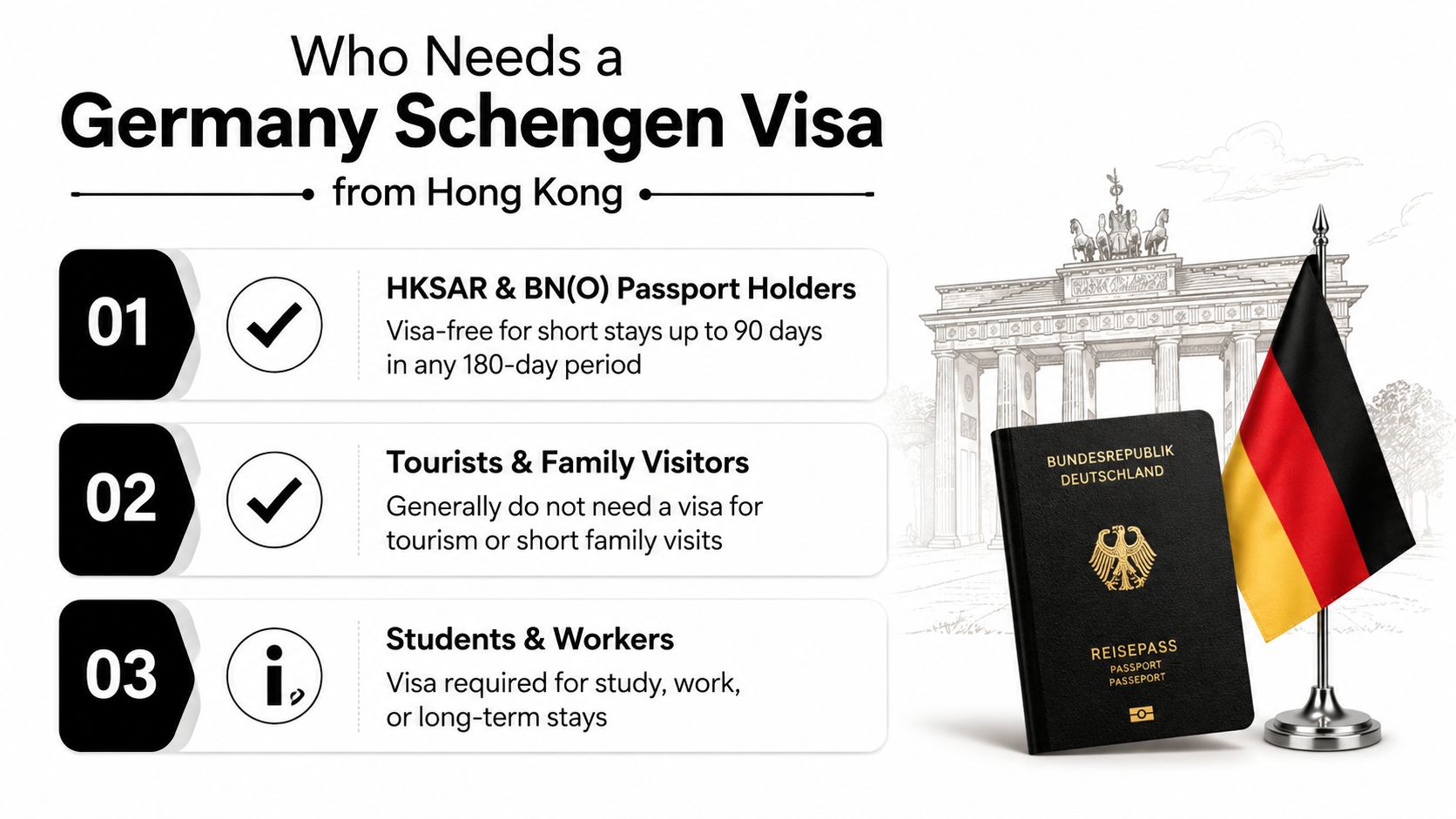
Use this four-part self-test
- Passport: Are you travelling on an HKSAR, BN(O), or Macau SAR passport, or another nationality's passport?
- Residence: Is your habitual residence in Hong Kong or Macau? The German visa section in Hong Kong handles applicants who habitually reside in that consular area.
- Duration: Will the entire Schengen stay remain within 90 days in any 180-day period, or will it exceed that limit?
- Purpose: Is the visit tourism, a family visit, or business activity without employment? Study, employment, and family reunification require the correct prior approval, even where visa-free entry normally applies.
A PRC, Filipino, Indian, Pakistani, or other non-exempt passport holder living in Hong Kong may need a short-stay Type C Schengen visa for a qualifying visit. A student, researcher, au pair, employee, or family member planning a longer stay will usually need a national Type D visa, not a tourist visa.
The main-destination rule still applies. Submit a German application only when Germany is the principal destination under the Schengen rules. A visa does not authorise paid employment, and visa-free entry does not permit someone to begin work or study.
ETIAS also belongs in your 2026 planning. Visa-exempt travellers should check the latest entry requirements before departure, while visa-required travellers still need the appropriate visa. Do not treat ETIAS as a substitute for a Schengen visa.
Hong Kong students considering a longer route can review this guide to study in Germany. Match the route to your passport, residence, purpose, and stay length before booking an appointment.
Document Checklist for Hong Kong Applicants
A convincing file lets the consular officer understand the trip quickly: who is travelling, why, how it will be funded, where the applicant will stay, and why the applicant will return to Hong Kong. Every document should support the same itinerary and personal circumstances. Inconsistencies between the form, reservations, employment letter, and bank statements create avoidable questions.
HKSAR passport holders usually do not need a short-stay visa for ordinary tourism. This checklist is mainly for non-exempt passport holders and applicants applying for a long-stay category. Visa-exempt travellers should still keep their entry documents, accommodation details, insurance, and return arrangements organised, particularly as 2026 travel planning includes the coming ETIAS requirements.
Core documents for a short stay
Prepare these documents in the correct category and in the same name and date format used on the application form:
- VIDEX application form: Complete the online form accurately, then print the final version for signature. Check passport numbers, travel dates, destinations, and the stated purpose before printing.
- Biometric photographs: Provide two recent photographs measuring 35 x 45 mm, with a white background.
- Passport: Submit the original passport, valid for at least three months beyond the planned return, with two blank pages.
- Hong Kong residence evidence: Include the HKID and supporting proof such as a utility bill or tenancy agreement. Applicants who do not hold permanent Hong Kong status should add their relevant Hong Kong residence visa printout.
- Employment or student letter: Obtain a signed letter on official letterhead confirming the role or enrolment, approved leave, and current employment or academic status.
- Financial evidence: Provide bank statements covering the most recent three months and showing funds that fit the trip. The suggested planning range is EUR 45 to EUR 60 per day. Explain unusual deposits instead of relying on a large unexplained balance.
- Transport reservation: Include a round-trip flight reservation. Do not commit to non-refundable tickets before the decision.
- Accommodation: Cover the full stay with hotel bookings or a host invitation. If formal sponsorship applies, include the German Verpflichtungserklärung.
- Travel insurance: The policy must provide at least EUR 30,000 medical cover and remain valid throughout the Schengen area.
- Minors: Add the child's birth certificate and consent letters from both parents where required.
| Document | Tourist or business | Long-stay D | Notes |
|---|---|---|---|
| VIDEX form | Required | Required | Use the form for the correct visa category |
| Passport and photographs | Required | Required | Check validity, blank pages, and photo specifications |
| HK residence evidence | Required where applicable | Required | Non-residents should show their HK residence permission |
| Employment or student proof | Strongly relevant | Required where relevant | Explain leave, enrolment, or professional purpose |
| Financial evidence | Required | Required | Match funds to the stated purpose and stay |
| Accommodation or host documents | Required | Required where relevant | Cover the entire intended period |
| Insurance | Required for the applicable category | Category-dependent | Check the policy wording carefully |
| Birth and consent documents | For minors | For minors | Include translations where necessary |
Use sworn translations for Chinese-language documents. English originals usually suffice, but an informal translation may not be accepted where the document affects identity, finances, custody, or the stated purpose. Keep originals and copies together, and label supporting documents in the same order as the checklist.
Booking Your Appointment at the German Consulate in Hong Kong
The German Consulate General in Hong Kong requires an online appointment for visa services. Applicants attend in person, submit biometric data, and pay the fee when they submit the application. The consulate's visa appointment guidance should be checked before you select a slot.
Short-stay applicants use the consulate's own online appointment system rather than assuming that an external application centre will handle the file. Long-stay applicants should use the relevant appointment route for the D visa category.
Book in the right order
- Confirm the category first. Don't book a tourist appointment for study, employment, or family reunification.
- Confirm Germany is the main destination. The responsible mission depends on the itinerary, not on the country where you first land.
- Complete the online form. Keep names, passport details, dates, and travel purpose identical across the form and supporting documents.
- Reserve the appointment. Availability can become tighter in peak spring and summer periods, so leave scheduling slack.
- Avoid risky bookings. Don't purchase non-refundable flights merely to create an itinerary.
The consulate's published information is more reliable than informal appointment rumours. A slot that looks convenient may not suit a school calendar, employer notice period, or long-stay processing requirement.
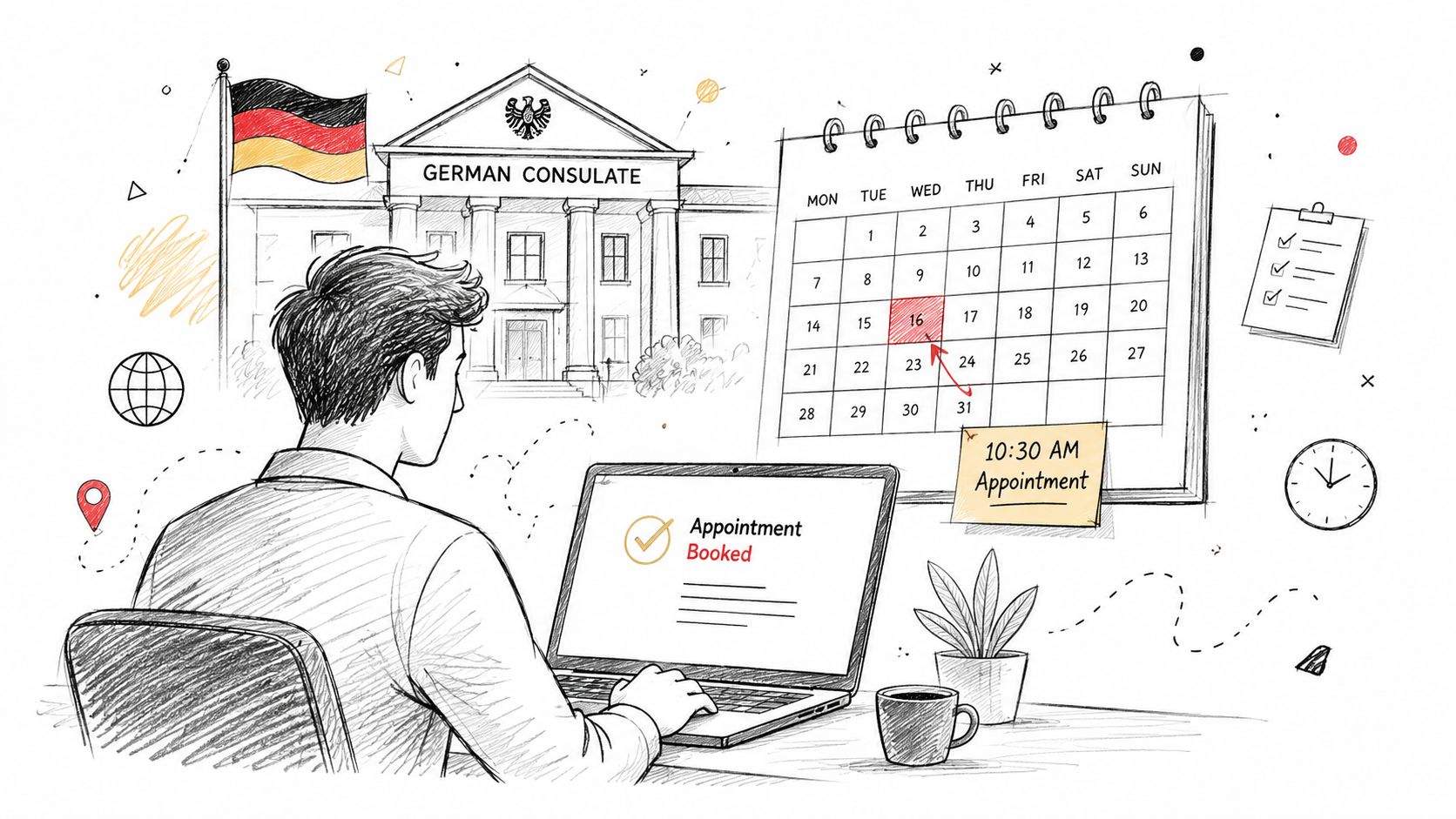
Prepare for the appointment itself
Bring the appointment confirmation, passport, originals, copies, and the application in the order requested by the checklist. Expect document submission, biometric capture, payment, and questions about your trip, accommodation, finances, and reasons for returning to Hong Kong.
A calm, direct interview is more useful than a rehearsed speech. If the officer speaks partly in German, a simple greeting and clear answer can help establish rapport, but never use German to hide uncertainty about the itinerary.
Fees, Insurance, and Processing Times
For Hong Kong applicants, the fee creates a practical planning blind spot. The German Consulate General in Hong Kong requires payment in cash in HKD only, and the exact amount depends on the exchange rate. Bring the current local amount, not an assumed conversion. The local tourism and business checklist gives the published fee and payment detail.
For short-stay Schengen applications, the fee is EUR 90 for applicants aged 12 and above and EUR 45 for children aged 6 to 11. The local guidance does not set a fixed HKD conversion, so confirm the amount before attending.
Cost planning table
| Item | Amount | Notes |
|---|---|---|
| Standard short-stay fee | EUR 90 | Applicants aged 12 and above |
| Child short-stay fee | EUR 45 | Children aged 6 to 11 |
| Payment method | HKD cash | Exact amount depends on the exchange rate |
| Travel insurance | Policy-dependent | At least EUR 30,000 medical cover and Schengen-wide validity |
| Flights and accommodation | Trip-dependent | Use reservations where possible before the decision |
| Translation or document certification | Provider-dependent | Chinese documents may need sworn translation |
| ETIAS for eligible visa-free travellers | Check the current official requirement | Separate from a visa and not a replacement for a D visa |
Travel insurance must cover at least EUR 30,000 in medical expenses and remain valid throughout the Schengen area. HKSAR passport holders are already visa-free for eligible short stays, but ETIAS changes the preparation calculation in 2026. Check the current ETIAS requirement separately. It is not a visa and does not replace a long-stay D visa.
Budget for the consular fee first. Do not assume courier, premium-lounge, or biometric service-centre charges unless the relevant provider confirms them. The published local guidance supports the cash payment method, fee structure, and insurance requirement, but it does not establish those extra charges.
Processing is not the same as appointment availability
Official German guidance normally allows decisions within 15 calendar days, while local Hong Kong information describes standard processing as approximately 5 to 10 working days after a complete submission. These are processing references, not a promise of an immediate appointment. Read Germany's official visa-service guidance together with the consulate's local instructions.
Applications may be submitted as early as six months before travel. Use that window, especially for family trips and professional travel during busy periods. Submit only when the itinerary, insurance, funds, and supporting documents tell the same story.
Biometrics, Interview Day, and What to Expect
Appointment day is procedural. Applicants attend in person, pass security, submit the file, provide biometric data, answer questions, and pay the fee. The smoother your folder is, the less time you'll spend explaining avoidable gaps.
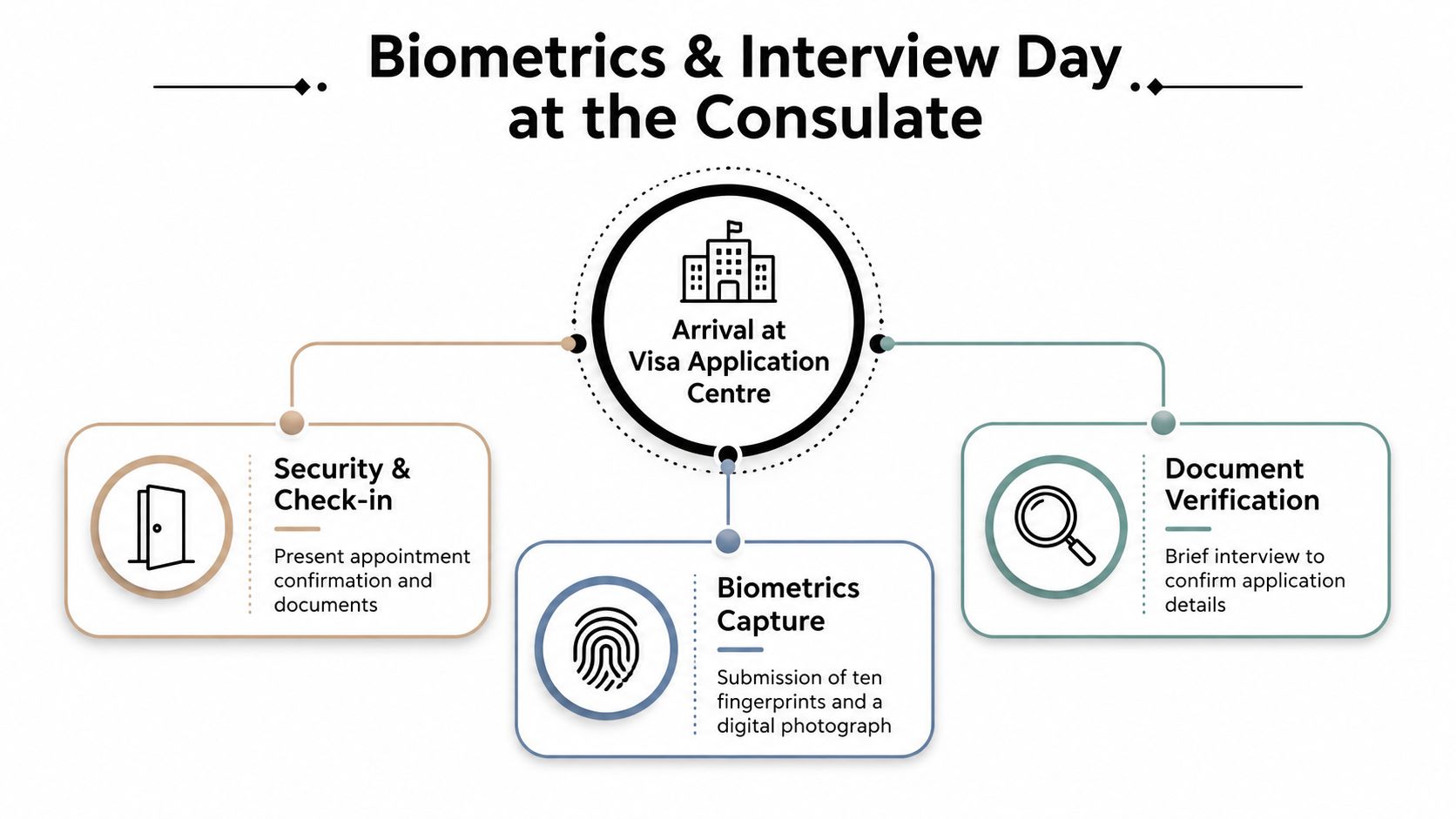
Arrival and submission
Arrive with your appointment confirmation and requested originals. Security screening comes first, followed by check-in and document handling. Keep your papers accessible rather than packing everything into separate bags that slow down the queue.
The consulate requires applicants to attend in person and submit biometric data. Fingerprints and a digital photograph are captured during the application process, so a representative can't normally replace your attendance.
Practical rule: Bring only what the checklist asks for, plus clear supporting evidence that resolves a genuine question. Extra paperwork doesn't compensate for contradictions.
A child, parent, and professional may all submit the same basic identity evidence, but the story behind the file differs:
- Student: Show the admission or study purpose, funding arrangement, accommodation, and the correct long-stay route if the stay exceeds the short-visit limit.
- Parent visiting family: Make the host relationship, accommodation, financial responsibility, and return plan easy to verify.
- Working professional: Match the business invitation, employer letter, meeting purpose, and approved leave. A business visit isn't the same as taking up employment in Germany.
Before attending, review practical cultural details in this guide to German culture and etiquette. A polite greeting, precise answers, and punctual conduct are sensible preparation, not performance.
Questions the officer may ask
Expect questions that test whether the documents and answers align:
- Why are you travelling to Germany?
- Where will you stay for each part of the trip?
- Who will pay for the visit?
- What work or study commitments bring you back to Hong Kong?
- Have you previously travelled within the Schengen area?
- Why does the itinerary include several destinations?
Answer the question asked. Don't provide a complicated explanation that introduces new inconsistencies. If a sponsor pays for the trip, say so clearly and provide the sponsor evidence rather than presenting the funds as your own.
The appointment isn't a language examination. Use English if that is the clearest language for the interview, and use German only when you can answer accurately.
A short-stay visa application also isn't required for an ordinary visa-exempt HKSAR or BN(O) tourist. Those travellers still need to respect entry conditions, the 90/180 rule, and any new travel authorisation requirements.
ETIAS and the 90/180 rule
Current travel guidance indicates that visa-exempt Hong Kong passport holders are expected to need ETIAS registration from 2026. The Hong Kong ETIAS requirements overview explains this developing requirement, but travellers should verify the live status before departure because implementation details can change.
ETIAS is not a visa. It won't authorise employment, long-term study, family reunification, or a stay exceeding 90 days. Those purposes require the relevant national route, normally a German D visa where Germany is responsible.
The 90/180 rule is rolling. For every entry date, look backward across the preceding 180-day window and count all days spent in all Schengen states together. The maximum is 90 days, not 90 days per country.
Consider a Hong Kong professional making quarterly business trips. A trip may seem short in isolation, but several visits can accumulate across the rolling window. The traveller should record entry and exit dates for every Schengen country rather than relying on calendar quarters or separate country totals.
A digital nomad also needs special caution. Working remotely while physically present in Germany can raise questions that visa-free tourism doesn't answer. If the activity amounts to work, don't treat ETIAS or visa-free entry as a substitute for immigration approval.
Common Rejection Reasons and How to Avoid Them
Germany's refusal risk is unusually low for Hong Kong applicants in the official historical data. In the European Commission's 2024 consulate-level statistics, the German post in Hong Kong handled 2,344 short-stay applications, issued 2,333 visas, and recorded 10 refusals, implying a refusal rate of about 0.43% and a success rate of roughly 99.6%. The European Commission's 2024 consulate statistics provide the most authoritative historical benchmark for 2026 planning.
That profile doesn't make weak applications safe. Most avoidable problems come from a file that fails to explain money, purpose, accommodation, or return intention.
| Common refusal reason | How to remedy it |
|---|---|
| Financial evidence doesn't support the trip | Add recent bank statements, explain unusual credits, and provide a clear sponsor letter where someone else pays |
| Weak ties to Hong Kong | Include employer or school confirmation, approved leave, ongoing commitments, and a concise explanation for any employment gap |
| Itinerary doesn't match the evidence | Cover every night, destination, and major movement with coherent reservations or host documents |
| Insurance is unsuitable | Confirm at least EUR 30,000 medical cover, Schengen-wide validity, and appropriate emergency and repatriation wording |
| Previous overstay or travel concern | Explain the history honestly and provide evidence of compliant departures where available |
A refusal isn't fixed by submitting the same folder again. Strengthen the evidence, correct the inconsistency, and address the stated concern directly.
If you believe the decision is wrong, follow the consulate's remonstration or appeal instructions and observe the applicable deadline. Don't rely on an unverified fixed appeal period unless the refusal notice itself states it.
Your 2026 Application Timeline and Next Steps
The safest schedule works backwards from departure. Don't treat the consular decision period as your whole planning period, because appointment availability, document translation, insurance, and school or employer approvals all sit before submission.
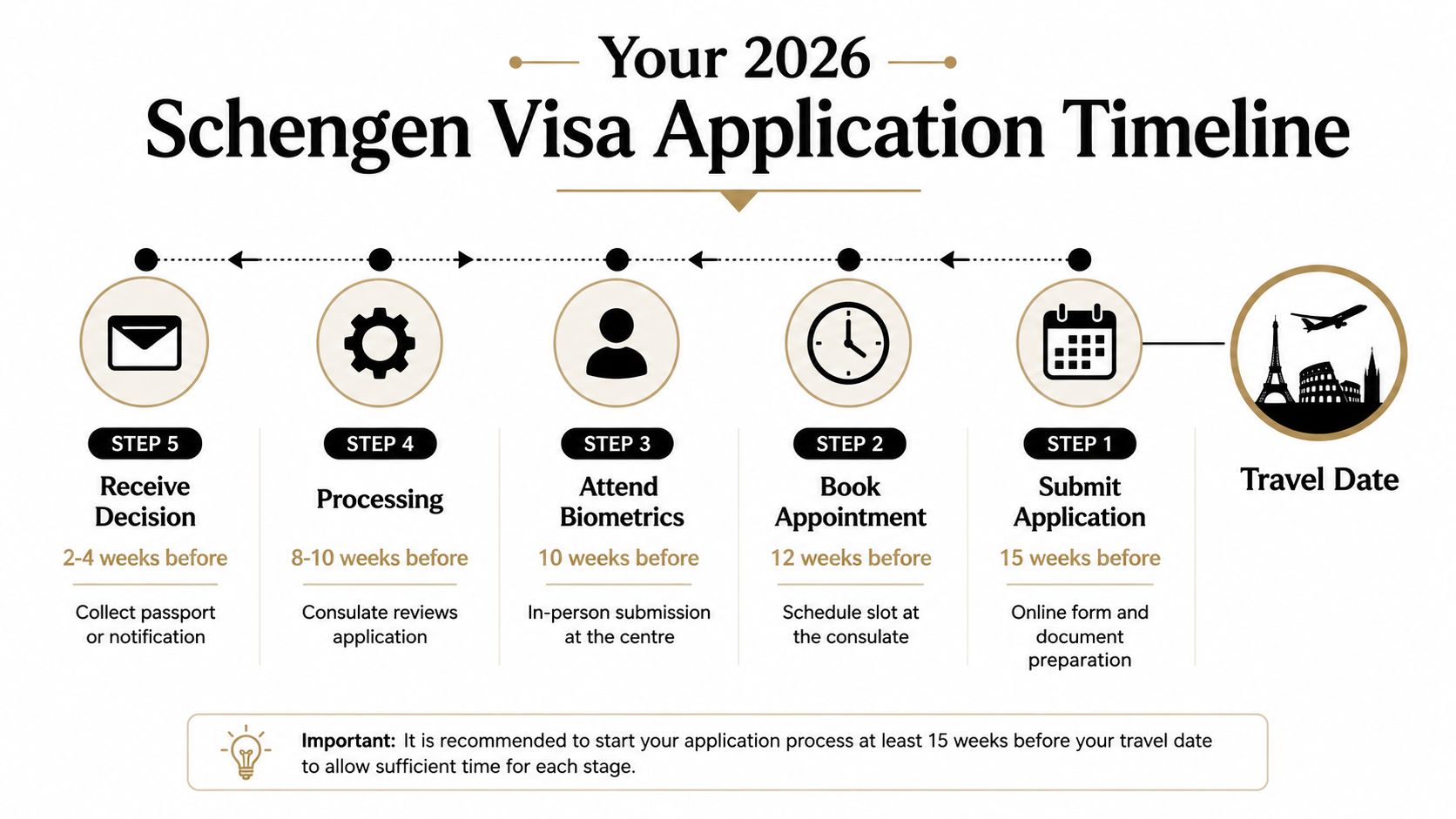
Build the file around your traveller type
For students
- Confirm whether the programme is a short visit or a long-stay study route.
- Secure admission, funding, accommodation, and insurance evidence.
- Start German preparation early if the programme, daily life, or future employment requires it.
- Coordinate the application with the academic calendar rather than waiting for the last available holiday.
For parents and family visitors
- Confirm the host's address and responsibility for accommodation or costs.
- Collect consent and birth documents for minors.
- Check that every traveller's passport category is assessed separately. One family member may be visa-exempt while another needs a Type C application.
- Keep the itinerary realistic and easy to follow.
For working professionals
- Obtain a company letter and approved leave confirmation.
- Ensure the invitation explains meetings or business activity without suggesting unauthorised employment.
- Track previous Schengen days before planning repeat travel.
- Keep enough time for appointment scheduling during busy travel periods.
Reverse-engineer the preparation
Begin by confirming the main destination and visa category. Then complete VIDEX, gather identity and residence evidence, request employer or school letters, prepare financial records, arrange accommodation and flight reservations, and obtain compliant insurance.
Book the appointment before paying for non-refundable travel. Set aside HKD cash for the consular fee, check every translated document, and place originals and copies in the order requested.
A Hong Kong applicant who may later study abroad in Germany or Spain should treat a short trip as only one part of the planning picture. German language ability won't replace immigration documents, but it can support a more credible long-term preparation plan for study, work, and integration. Use a realistic learning path rather than an implausible promise, as explained in this German learning timeline from A1 to C1.
Check the latest consulate information shortly before submission. Rules, appointment instructions, exchange rates, and ETIAS implementation details can change, while your responsibility remains the same: submit the correct category with a complete, internally consistent file.
German Cultural Association Hong Kong(GCA) offers native-speaker German lessons Hong Kong learners can use for travel, study, business, and long-term Germany plans, with structured courses and preparation for Goethe-Zertifikat, TestDaF, IGCSE, A-level, and IB exams. Visit German Cultural Association Hong Kong(GCA) to book a trial class, speak with an advisor, and check the latest in-person and online course schedule.

German Accusative Case Explained: When and How to Use Akkusativ

German Small Talk: 30 Phrases for Meeting People and Making Friends


