.png)
.png)

BLOG

香港德國文化協會
The German Cultural Association
Mastering German Umlauts & SS: Pronunciation & Typing Guide for HK
You're on the MTR, replying to a German client, and you suddenly realise you can't type the ü in Müller. Or your child is revising IB German in Hong Kong and keeps reading schön as if it were plain English. These are small details, but they cause real problems in exams, applications, and everyday communication.
That's why Mastering German Umlauts & ß: Pronunciation & Typing Guide for HK matters. In Hong Kong, learners often juggle English, Chinese, and German across phones, school devices, office laptops, and application portals. If you want a broader roadmap for learning German in Hong Kong, start there. If your immediate problem is pronunciation and typing accuracy, this guide is the practical fix.
Your Guide to German Language Success in Hong Kong
A common HK scenario looks like this. A working professional drafts an email to a contact in Berlin, knows the correct spelling of the person's name, but sends it without the umlaut because the keyboard layout is unfamiliar. The message still goes through, but it doesn't look polished, and in formal contexts that matters.
Parents run into the same issue differently. A child preparing for German reading, dictation, or oral work sees ä, ö, ü, and ß and assumes they're decorative marks. They're not. These characters affect pronunciation, spelling, and sometimes meaning.
Practical rule: If a character changes the word, it isn't optional. Treat it as part of the word from day one.
In Hong Kong, this challenge is sharper because most learners don't study German on a German keyboard. They switch between Cantonese input, English typing, and mobile messaging all day. That means the true skill isn't just “knowing” umlauts. It's producing them accurately when you're under time pressure.
Three groups feel this most quickly:
- Exam candidates: Errors show up in dictation, reading aloud, and written work.
- Parents supporting students: Homework becomes frustrating when nobody is sure how the word should sound or appear on screen.
- Professionals and applicants: Names, emails, records, and forms need consistency.
The good news is that this is fixable. Once you know how these sounds are formed, and once you have a reliable typing method for each device, the problem usually stops being a barrier.
Why Do Umlauts and ß Matter for Learners in Hong Kong
A Hong Kong student can know the right word, understand the grammar, and still lose marks by writing schon when the task requires schön. A working professional can send a German name without the umlaut and look careless, even if the message itself is polite. In this city, where people switch between Chinese input, English typing, and mobile keyboards all day, these mistakes happen for practical reasons. They still count as mistakes.
German umlauts and ß are part of standard spelling, not optional accents. German uses the same 26 basic Latin letters as English but adds ä, ö, ü, and ß, making 30 letters in common teaching descriptions, and these forms appear in exams, textbooks, and formal documents (Remitly's German alphabet guide).

Hong Kong's multilingual setting makes accuracy harder and more important at the same time. Learners often revise German on an iPhone set to Traditional Chinese, then type homework on a Windows laptop in English, then message classmates on WhatsApp. If the typing method is slow or unclear, students start dropping characters. That habit causes trouble later in dictation, reading aloud, spelling tests, and formal writing.
They affect sound, spelling, and sometimes meaning
An umlaut changes the vowel. It is not decoration.
For teaching purposes, I explain them this way:
- Ä: often close to the English e in “bed”
- Ö: a rounded front vowel that English does not really have
- Ü: a rounded version of ee
- ß: pronounced like English s
That simple description is enough to show why accuracy matters. If a learner keeps replacing ü with u, or ignores ö completely, the word no longer sounds right. For a fuller breakdown of how these sounds are produced, this guide to German pronunciation for HK learners is a useful companion.
They show up in the tasks HK learners actually face
In Hong Kong, German is usually studied with a purpose. Students prepare for school assessments, IB or IGCSE-style language tasks, university applications, exchange plans, or careers linked to Europe. Adults often need German for client communication, CVs, names on documents, or relocation paperwork.
That is why I correct these characters early.
A learner who treats ä, ö, ü, and ß properly from the start usually reads more accurately, spells more confidently, and types faster under pressure. A learner who postpones them usually builds workarounds, and those workarounds become habits.
They matter even when people can guess what you mean
German readers can sometimes infer the intended word from context. That does not make the spelling acceptable in an exam script, application, or professional message.
This is a trade-off HK learners need to understand clearly. In casual texting, a substitute spelling may get you through the conversation. In graded work or formal communication, correct characters show control. If you want to hear how small sound differences affect real German words, Meowtxt's capabilities for German audio can help you compare what you typed with what German sounds like.
They are part of basic German literacy
Serious learners should treat these letters the same way they treat verb endings or word order. They belong to the language system. You will see them in textbooks, forms, surnames, place names, and official writing.
For learners in Hong Kong, the practical rule is simple. Learn the sound, learn the spelling, and learn how to type the characters on your actual devices. That saves time, marks, and correction work later.
Pronouncing German Umlauts Like a Native Speaker
The fastest way to improve your German accent in Hong Kong isn't chasing advanced vocabulary. It's cleaning up your vowels early. Umlauts sit right in that zone. If you pronounce them loosely, your German sounds foreign even when your grammar is fine.
This visual helps many learners with the most difficult sound first.

Start with what your mouth is already doing
HK learners usually come from English, Cantonese, or both. That creates two predictable issues.
- English speakers often replace German umlauts with the nearest English vowel.
- Cantonese speakers often hear the difference more clearly than they can physically reproduce it at first.
The fix is mechanical. Don't think only in terms of letters. Think in terms of lip shape, tongue position, and tension.
How to say ä correctly
Ä is often taught as close to the e in “bed”.
That's a useful starting point, but don't overdo it. Many learners make it too broad and too English. Keep the vowel clean and short unless the word clearly calls for length in context.
Try this method:
- Say the e in “bed”.
- Keep the jaw relaxed.
- Avoid turning it into an English diphthong.
Common HK mistake: making ä sound exactly like a flat English “a”. That usually comes from interpreting the spelling too directly.
How to say ö without guessing
Ö is where many learners lose confidence because English doesn't offer a neat equivalent. It is taught as a rounded front vowel. In practice, that means your tongue sits more forward than for a normal “o”, while your lips stay rounded.
A practical drill:
- Start as if you are going to say e
- Keep that front vowel feeling
- Round your lips as if preparing for o
If that feels awkward, good. At first, it should. New mouth positions often feel exaggerated before they become normal.
Listening test: If your ö sounds like plain “o”, your lips are doing the work but your tongue is too far back.
How to say ü properly
Ü is commonly taught as a rounded version of an ee sound. This is the sound HK learners most often replace with you or plain u. Both are wrong.
Use this sequence:
- Say ee as in “see”.
- Freeze the tongue position.
- Round the lips forward.
- Keep the sound steady, not gliding.
That tension between a forward tongue and rounded lips is the key. If you say you, you're adding an English glide. German ü should be cleaner.
For extra listening and repetition work, some students find Meowtxt's capabilities for German audio useful when they want quick sound references between lessons.
After you've watched the mouth movement once, hear it in context.
What to do with ß
ß is simpler in pronunciation. It sounds like English s.
The problem isn't usually saying it. The problem is recognising it instantly while reading, and not hesitating. In oral exams, hesitation makes a bigger impression than many learners realise.
A short drill routine that works
Use a small loop rather than a long, tiring practice block.
- Listen first: Hear the word before saying it.
- Repeat in pairs: Alternate the plain vowel and the umlauted vowel.
- Read aloud slowly: Accuracy first, speed later.
- Record yourself: You'll catch habits you miss in real time.
If you want more detailed sound work beyond umlauts, this complete guide to German pronunciation is a useful next step.
One practical option in Hong Kong is to work with a teacher who can stop you the moment the vowel shifts incorrectly. That's where a structured class can help. The German Cultural Association Hong Kong(GCA) offers German courses and private lessons with native German-speaking teachers, which is directly relevant for pronunciation feedback.
The Ultimate Typing Guide for Umlauts and ß
Pronunciation gets you through speaking. Typing gets you through real life.
Most learners in Hong Kong first notice this when they need to send an email, fill in a university form, or type a German name correctly on an English keyboard. If you don't have a system, you waste time hunting online for copy-and-paste characters.
The fastest Windows solution
On Windows, standardised Alt codes are reliable for core characters (Berlitz on German umlaut meaning and letters):
- ä = Alt+0228
- ö = Alt+0246
- ü = Alt+0252
- Ä = Alt+0196
- Ö = Alt+0214
- Ü = Alt+0220
- ß = Alt+0223
This works well when you're on a standard office keyboard and can use the numeric keypad. It's less convenient on compact laptops without one.
German Character Keyboard Shortcuts
| Character | Windows Alt Code | macOS Shortcut | Fallback Spelling |
|---|---|---|---|
| ä | Alt+0228 | Hold the vowel key and select the umlauted form | ae |
| ö | Alt+0246 | Hold the vowel key and select the umlauted form | oe |
| ü | Alt+0252 | Hold the vowel key and select the umlauted form | ue |
| Ä | Alt+0196 | Hold the vowel key and select the umlauted form | Ae |
| Ö | Alt+0214 | Hold the vowel key and select the umlauted form | Oe |
| Ü | Alt+0220 | Hold the vowel key and select the umlauted form | Ue |
| ß | Alt+0223 | Hold the relevant key or use the character viewer if needed | ss |
What works on Mac
Many HK learners using MacBooks rely on press-and-hold character options because it's fast and visual. If you hold down the vowel key, macOS commonly presents accented and modified options, including umlauted vowels. For occasional German typing, that's usually enough.
For heavier use, add a German keyboard layout. That's better if you write longer passages, class assignments, or frequent emails.
When ae, oe, ue, and ss are acceptable
The fallback transliteration strategy is widely used when special characters are unavailable. That means:
- ä → ae
- ö → oe
- ü → ue
For ß, learners often use ss if necessary.
This fallback is useful, but don't apply it blindly.
Use transliteration when:
- A system won't accept special characters
- You're typing quickly in a basic text field
- You're dealing with a technical limitation
Don't rely on it when:
- A person's official name is shown with the original character
- A visa or university form expects exact matching
- An exam or formal written submission requires proper spelling
Working rule: If the form is official, try to enter the actual character first. Use transliteration only when the system clearly forces you to.
A practical way to train this is to create your own cheat sheet and practise typing your own sample names, addresses, and email phrases. Some teachers even build simple visual drills or mock keyboard demos. If you want to make your own animated typing explanations for students or staff, tools for hyper-realistic AI video creation can help you produce custom walkthroughs.
Your HK-Specific Device Guide for German Characters
Generic typing guides usually assume one keyboard, one language setting, and one calm environment. That isn't how people in Hong Kong work. Most learners switch between WhatsApp, Gmail, Google Docs, school platforms, office systems, Chinese input, and English layouts all in the same day.
That's why the phone matters as much as the laptop.
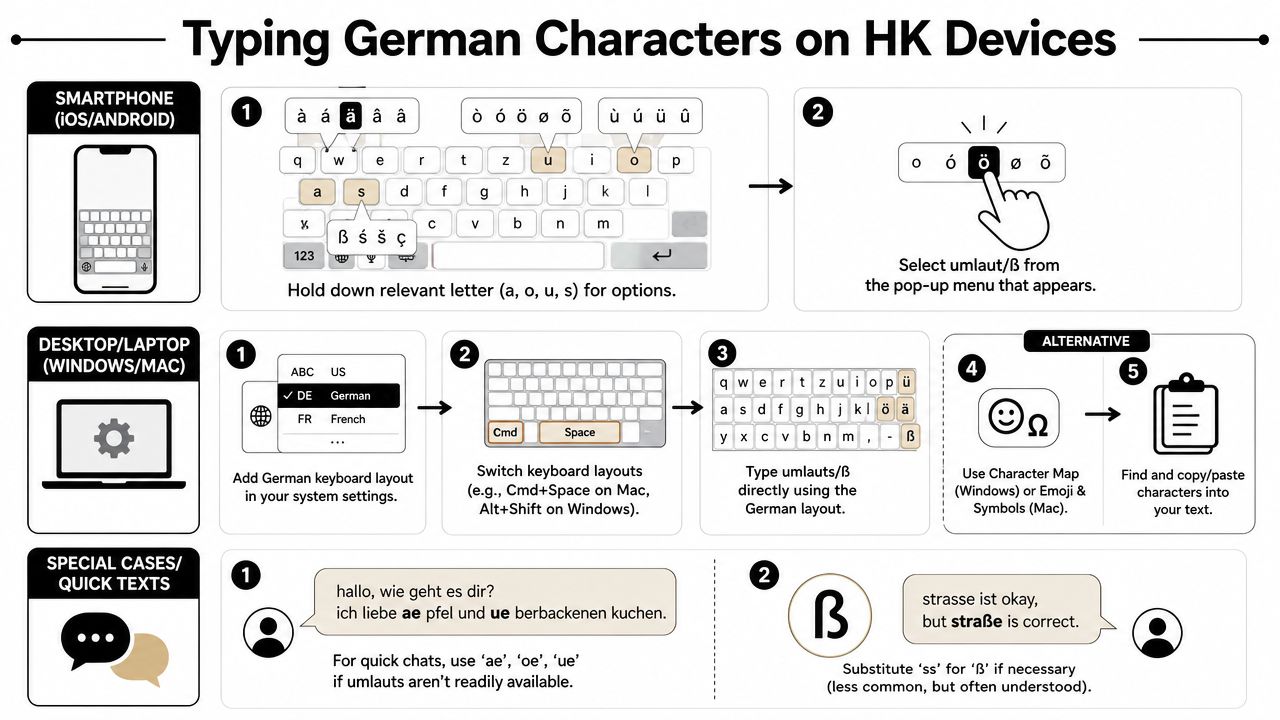
Guidance focused on German learning also notes that, for learners in Hong Kong, device diversity is high, and a cross-device strategy matters more than a single desktop shortcut. It also highlights mobile long-press input and adding a dedicated German keyboard as especially practical (Learn German Easily on German umlauts).
On iPhone and iPad
For most HK users, the easiest method is the long-press.
Do this:
- Open the keyboard.
- Press and hold a, o, or u.
- Wait for the pop-up character menu.
- Slide to ä, ö, or ü.
For regular German use, add a German keyboard in settings. Then switch between keyboards as needed. This is much faster if you're writing more than a few words.
What usually works well in Hong Kong:
- Quick chat: long-press is enough
- Homework or notes: add the German keyboard
- Forms: enter the character if the field allows it
On Android phones
Android also commonly supports long-press on the base letter. The exact layout depends on the keyboard app and device brand, but the practical habit is the same. Hold the letter, select the character, and don't assume the English keyboard will show everything immediately.
If you use Gboard or another multilingual keyboard, add German once and keep it available. That saves a lot of friction.
On school-managed and office-managed devices
HK learners often get stuck here. You may not be allowed to install layouts or change settings freely.
Use this decision order:
- First choice: built-in long-press or keyboard switcher
- Second choice: built-in character viewer or symbols panel
- Third choice: fallback spelling such as ue or oe if the system blocks the proper character
That's also why it helps to practise on the exact device you'll use most. A method that works at home on your own MacBook may not help on a school laptop or office desktop.
Don't wait until an application deadline to test German character input. Test the actual device and actual form early.
Some learners also benefit from voice tools when checking whether a typed word matches the word they intended to say. For those exploring speech-to-text support, KI Spracherkennung Software is one example of the kind of tool category worth reviewing.
If you're building your own low-cost study system, these free resources to learn German in Hong Kong can help you combine pronunciation, reading, and typing practice.
Ready to Master German in Hong Kong?
Small errors with ä, ö, ü, and ß often reveal a bigger issue. The learner hasn't yet built a reliable system. Once that system is in place, German becomes less frustrating and far more usable in daily life.
For adults in Hong Kong, that means cleaner emails, more confident document handling, and fewer avoidable mistakes. For students, it means stronger reading, dictation, and oral accuracy. For parents, it means homework support becomes practical instead of stressful.
The trade-off is simple. You can keep improvising with copy-and-paste, rough pronunciation, and inconsistent spellings, or you can make these characters automatic. The second path takes some focused practice, but it saves time every week afterwards.
A good routine usually includes:
- Short pronunciation drills: especially for ö and ü
- Device-specific typing habits: phone, laptop, and school platform
- Official-form awareness: know when fallback spelling is risky
- Regular correction: catch mistakes before they harden
If your goal is German exam preparation, study abroad in Germany, or professional use in Hong Kong, accuracy at this level isn't extra polish. It's part of being ready.
If you want structured support with pronunciation, typing habits, and exam-focused German in Hong Kong, German Cultural Association Hong Kong(GCA) offers native-speaker-led German courses for children, teens, and adults, with in-person and online options. You can check the latest course schedule, contact their advisors, or arrange a trial class to find the right starting point.

Living in Germany as a Hongkonger: Anmeldung Made Simple
How Many Hours to Reach B2 German? CEFR Guided Learning Hours Explained


