.png)
.png)

BLOG

香港德國文化協會
The German Cultural Association
German Playgroup Hong Kong: What Happens in Class and How to Choose
You're standing on a crowded MTR platform with a bilingual toddler, a packed workday ahead, and one more weekly activity to fit into the family calendar. The question isn't whether German sounds useful. It's whether a German playgroup in Hong Kong will give your child meaningful interaction, fit your commute, and connect to a credible school or exam pathway later.
A good class should make that decision easier. You should be able to see what happens in the room, understand how often your child needs exposure, compare Tsim Sha Tsui, Causeway Bay, and Zoom options, and judge whether the programme is education or just supervised play.
Table of Contents
- 1. The group allows the teacher to notice each child
- 2. German returns throughout the week
- 3. The teacher provides credible German input
- 4. Activities lead to interaction
What a German Playgroup Actually Looks Like in Hong Kong

A German playgroup is a small, play-based early-years class where children hear and use German through routines, movement, songs, stories, crafts, and guided social play. It isn't a kindergarten, because it doesn't replace a child's broader early-years education, and it isn't a traditional tutorial class built around worksheets, spelling, or grammar drills.
That distinction matters in Hong Kong. German is a niche third language in most households. Only 0.6% of people aged 5 and above speak German as their usual spoken language, while local language profiles show 18.5% speak Cantonese, English and another language, and 29.6% speak Cantonese and English, according to this Hong Kong parent language checklist.
The basic terms parents should know
- Session: One class meeting, often organised around a predictable sequence of arrival, play, guided activity, story, and goodbye.
- Term: A group of sessions delivered over a defined school-period schedule.
- Trial class: An observation opportunity for the family and teacher to assess comfort, participation, and suitability.
- Level: A broad indication of the child's previous exposure and readiness, not necessarily a formal exam level.
For ages 2 to 5, a Hong Kong German playgroup is commonly designed as a small-group, hands-on class with a maximum of 12 children, lasting 2 hours per session and meeting 2 to 5 times a week. The developmental purpose combines language with cognitive, social, and physical development, rather than treating German as a list of words to memorise. See the local description of German playgroup structure for those parameters.
Practical rule: Choose a class that gives German a repeatable place in your child's week, not one that relies on occasional entertainment to create progress.
At the first enquiry, ask about the child's age, school year, previous language exposure, preferred days, and whether the class is designed for complete beginners. Those details help a provider place your child appropriately and help you judge whether the programme fits your family's actual routine.
Inside the Classroom: What Happens in a Typical Session
A child arriving at a German playgroup in Hong Kong may first hear their name at the door, then meet the same welcome song and opening gestures used each week. That familiar sequence works like a map. Before children can explain the words in English, Cantonese, or German, they can follow what comes next and join through eye contact, movement, or a short response.
The room then opens into play. At a toy-food station, a block table, or a puppet corner, the teacher repeats short phrases that match what children are doing. A child may listen for several sessions before speaking. The teacher's job is to turn that listening into a small action, such as choosing an object, copying a sound, taking a turn, or answering with one word.
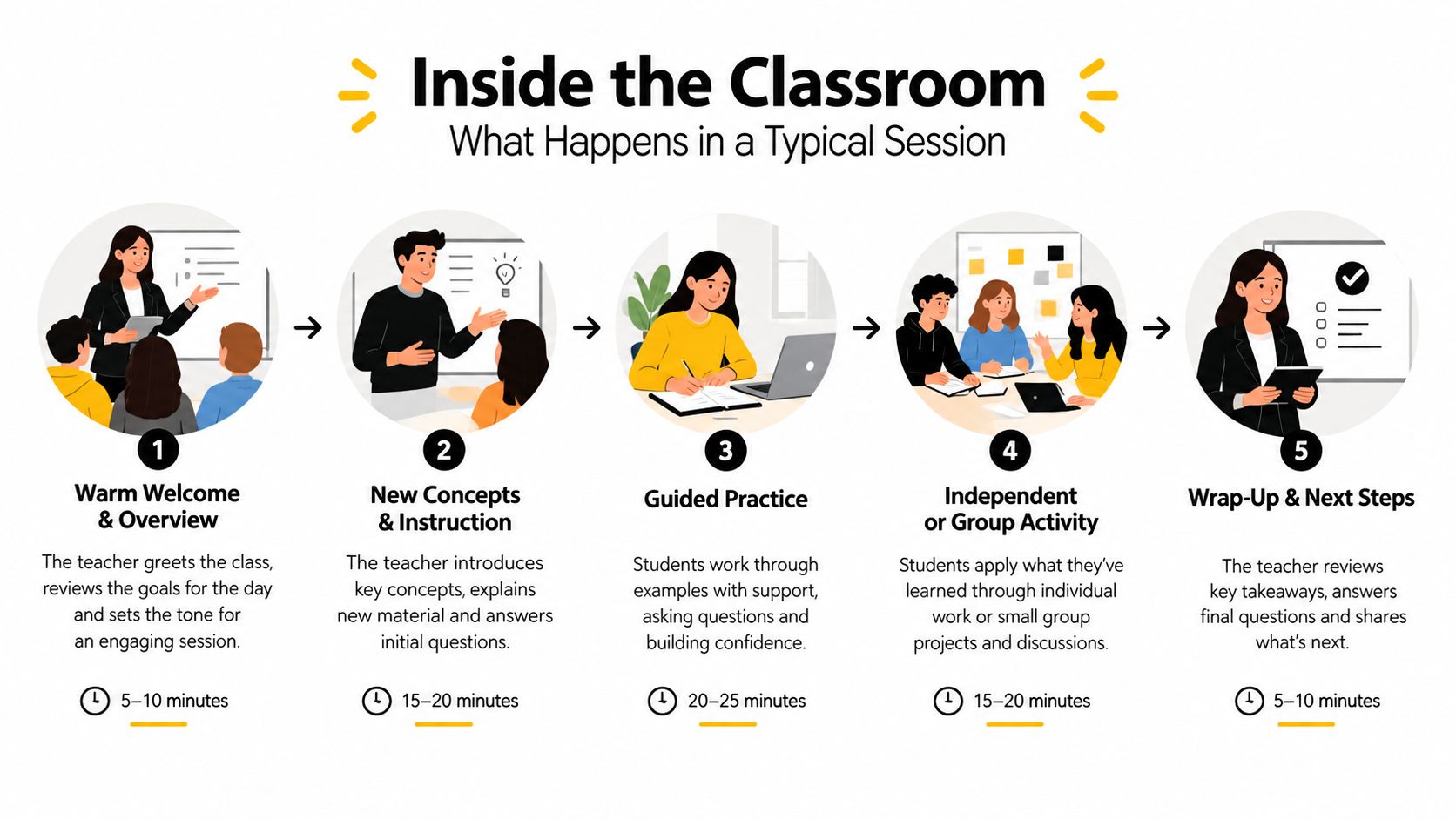
How the two-hour rhythm works
A session may unfold like this:
- Arrival and greeting: The teacher welcomes each child, names familiar objects, and begins the first German routine.
- Song and movement: Children clap, jump, march, or follow simple instructions. Movement gives meaning to words without requiring translation.
- Guided free play: Children choose activities while the teacher models phrases, supports turn-taking, and responds to their interests.
- Craft or sensory work: A seasonal picture, colour task, or hands-on project gives children repeated reasons to hear and use related language.
- Snack, story, and goodbye: Eating, sharing, sitting, listening, and leaving create manageable social language before a familiar closing song or phrase.
The order may change, yet multiple chances for interaction should remain. A child who only watches the teacher is receiving language input, not practising communication. Families can use interactive German games for children to understand the kind of playful response a good class encourages.
Snack and story time often reveal the quality of the teaching. Children can request, wait, choose, point, and respond because the situation is clear. Those small exchanges matter later, whether a family is considering a German-language school pathway such as GSIS, Goethe-Zertifikat preparation, or German needed for a study-visa application.
The following clip shows a German early-years session, including the welcome song and transitions between play-based activities described above:
A skilled teacher keeps the routine while adjusting the pace. A shy child may join through movement first, while a child with prior German exposure may answer independently. Both should have a place in the same class, rather than being separated into private-lesson patterns.
Four Quality Signals That Separate a Strong Class From Babysitting
A colourful room and cheerful teacher aren't enough to prove educational quality. During a trial, watch what the teacher does with children's attention, how often children respond, and whether the activities have a clear language purpose.
1. The group allows the teacher to notice each child
A smaller group makes it easier for a teacher to hear pronunciation attempts, support a hesitant child, and prevent one confident child from answering every question. A class capped at 12 children can still work when the session is well organised, but parents should ask how many teachers are present and how participation is managed.
A group of six may allow more individual turns than a group of twelve, especially when children are at different developmental stages. The useful question isn't just “How many children are enrolled?” Ask, “How does each child get a chance to respond?”
2. German returns throughout the week
A single weekly class can introduce a child to German, but families seeking a stronger routine should consider whether the schedule provides enough repeated contact. Local early-language guidance places a particularly useful learning window at roughly ages 4 to 8, while stressing that early German shouldn't displace the child's mother tongue. The guidance on bilingual and trilingual playgroups supports age-appropriate, oral-first learning.
3. The teacher provides credible German input
Native German-speaking teachers can model natural pronunciation, rhythm, and everyday classroom language. That doesn't remove the need for pedagogical skill. A strong teacher also knows how to simplify language, use gesture, wait for a response, and support children who aren't ready to speak.
Ask whether teachers have formal academic or teaching credentials, how they plan sessions, and how they communicate progress to parents. “Native speaker” should be one quality signal, not the entire selection process.
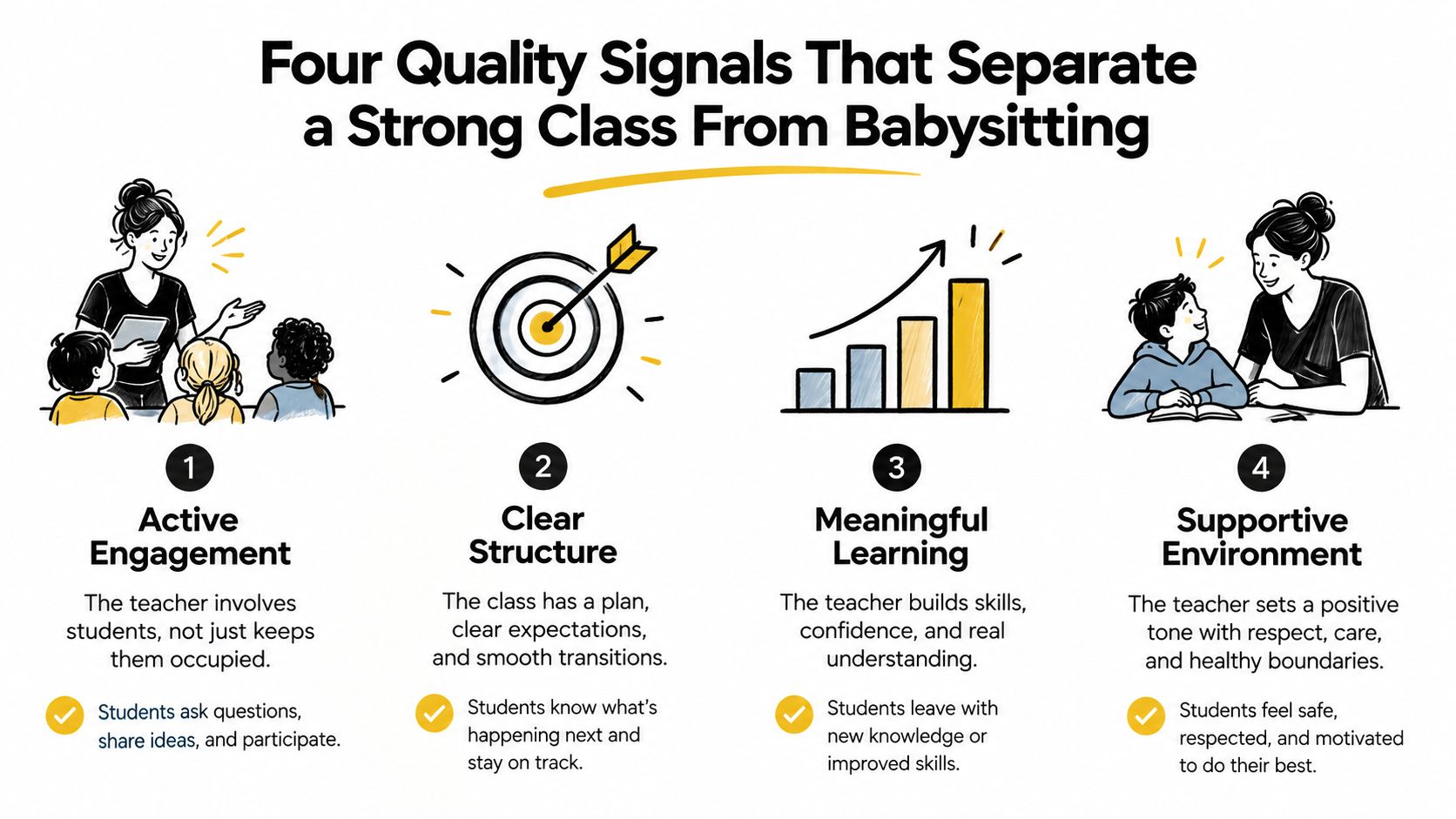
4. Activities lead to interaction
Crafts, songs, and stories work when they create reasons to communicate. During a craft activity, the teacher might model colours, shapes, requests, and turn-taking. During a song, children might follow instructions rather than merely listen to recorded audio.
Watch the children, not the decorations. If they respond, move, choose, imitate, and take turns, the activity is doing language work.
Red flags include long periods of passive screen viewing, worksheets designed for older learners, unclear transitions, and a teacher who translates every phrase before giving children time to infer meaning. A class can be playful and still be carefully structured.
Format Comparison In-Person Versus Online and Small Group Versus Large Class
Hong Kong families rarely choose between a perfect class and a poor one. They choose between different trade-offs. A family travelling from Sai Kung may value Zoom, while a family near the Island Line may prefer a short journey to a central classroom.
| Format | Typical class size | Commute impact | Best fit |
|---|---|---|---|
| In-person small group | Small, often capped by the provider | Requires travel to a centre, but may be practical near Tsim Sha Tsui or Causeway Bay MTR | Children who learn through movement, objects, and peer interaction |
| In-person centre-based class | Varies by provider | Can be efficient for families already travelling through a central district | Children who enjoy a busier room and group routines |
| Live online class | Varies by provider | Removes the MTR journey and works from home | Families outside central catchments or children comfortable with guided Zoom interaction |
How to judge the trade-off
In-person small groups usually offer the richest access to physical materials. A teacher can hand a child a puppet, guide a turn-taking game, or notice body language more easily. The cost is travel, changing after-school logistics, and the need to protect the class time from Hong Kong's traffic and weather.
Larger in-person groups may provide more peer energy, but parents should ask how often each child speaks. A lively class isn't automatically interactive if several children remain observers.
Live online lessons remove commute pressure and can be useful for families living far from the centre. For children aged 3 to 5, parents should check whether an adult needs to remain nearby, whether the lesson uses physical objects away from the screen, and how the teacher manages attention.
A virtual preview can also help families understand a centre before travelling. Resources about AI-powered educational virtual tours offer useful context for institutions presenting learning spaces digitally, although a virtual tour can't replace observing a live trial lesson.
Choose the format that your child and family can sustain. A theoretically ideal class that conflicts with school pick-up or a difficult commute won't create a dependable learning routine.
A Practical Checklist for Choosing the Right German Playgroup
A child who is three and new to German needs a different starting point from a five-year-old who hears German at home or a six-year-old preparing for a school transition. Begin with that difference, then fit the class around the child rather than fitting the child to a convenient timetable.
GCA's preschooler playgroups are designed for children aged 3 to 5. Its 2026/27 preschool German classes cover children aged 3 to 6, with in-person options near Tsim Sha Tsui and Causeway Bay, plus interactive Zoom classes, according to the preschool German class intake information.
Use this decision sequence
- Confirm the age band. Ask whether the group matches your child's age, attention span, and developmental readiness. A broad “children's German” label does not provide enough detail.
- Describe the home language profile. Tell the provider whether your child mainly hears Cantonese, English, both, or another language. If German is a third language, the teacher needs to know what your child already understands.
- State the family goal. Heritage connection, general enrichment, a future international school, DSE, IB, or IGCSE preparation, and eventual study abroad in Germany will lead to different choices. A family considering a German-medium school or later Goethe-Zertifikat preparation should say so early.
- Check the weekly rhythm. Ask how often the group meets, what happens after an absence, and whether home practice is realistic for a young child. A routine that fits school, childcare, and MTR travel is easier to maintain.
- Ask about teachers and class size. Confirm who teaches, what qualifications they hold, whether lessons are led by native German speakers, and how many children attend. The relevant question is how much individual participation each child receives.
- Book a trial and observe behaviour. Watch for comfort, curiosity, turn-taking, and recovery after shyness. Book two trial sessions where possible, then compare your child's willingness to join in on both days before deciding.
Questions to copy into your enquiry email
- What is my child's age band and starting level?
- How much German exposure should we describe?
- Who teaches the class, and are lessons led by native German speakers?
- What is the maximum group size?
- How long is each session, and how frequently does the class meet?
- Are classes available near Tsim Sha Tsui, Causeway Bay, or online?
- What happens after the preschool stage?
- How does the programme support later Goethe-Zertifikat, IB, IGCSE, or other exam goals?
A provider that asks for your child's age, school year, previous German exposure, and preferred days is collecting useful placement information rather than treating every enquiry alike. Parents can also use this parent checklist before enrolling in German class to organise conversations with different providers.
Budget still matters. Compare usable learning time, teacher attention, travel from the nearest MTR station, and the likelihood that your child will attend consistently, not only the headline fee. A lower-cost class that is often missed may offer less value than a well-timed class that becomes part of the weekly routine.
From Playgroup to a Real German Pathway in Hong Kong
A child who starts with songs near Tsim Sha Tsui or a short online session may later need German for school choices, exams, or university. Parents should therefore judge a playgroup by its next step, not only by whether the weekly class feels enjoyable.
The German Swiss International School is widely regarded as Hong Kong's main German-language international school, serving 1,260 pupils from kindergarten through upper secondary. Its German stream leads to the Abitur in Year 13, while its English stream leads to the IB, as described in this Hong Kong German programme overview.
A useful pathway can develop in stages:
- Early years: Playgroup and kindergarten build listening habits, confidence with classroom routines, and positive associations with German.
- School years: Families may later consider German-medium or bilingual international-school options, subject choices, and structured after-school learning. Age-based German after-school classes for children in Hong Kong can help parents compare the kind of support needed at each stage.
- University preparation: Students considering German-taught university programmes may eventually work towards qualifications such as Goethe-Zertifikat or TestDaF.
- Study-visa planning: The German Consulate in Hong Kong requires proof of German language knowledge, financial documentation, and residency evidence for study visas, according to its student visa information document.
A playgroup will not prepare a preschool child directly for TestDaF. Its contribution comes earlier: the child becomes comfortable hearing German, responding to familiar routines, and using another language in ordinary social situations.
Ask the provider to describe the route after preschool. For a family weighing DSE, IB, or IGCSE, a sensible programme should explain how speaking and listening can later develop into reading, writing, exam technique, and independent study. For providers, coordinating age groups requires careful records; for parents, the practical question is simple: can the class explain what comes next? Administrative tools such as language school software may support that coordination, but the provider still needs to communicate the pathway clearly.
How the German Cultural Association Hong Kong Fits as a Playgroup Option
A family living near Tsim Sha Tsui or Causeway Bay MTR may find the German Cultural Association Hong Kong(GCA) practical because its preschool playgroups are available close to both stations. The programme is designed for early German exposure, with the 2026/27 preschool offering described for children aged 3 to 6. Families outside these areas can consider the interactive Zoom option instead of planning a cross-harbour journey.
Class size creates a clear difference. Where the general Hong Kong playgroup norm can run up to 12 children, GCA caps its groups at 6 students. That smaller group gives the teacher more opportunities to hear each child, respond to individual confidence levels, and bring quieter children into songs, stories, movement, and craft activities.
The programme uses native German-speaking teachers, so children hear consistent pronunciation and natural classroom language. Activities are organised to build oral confidence before formal literacy work. The wider programme also supports later Goethe-Zertifikat, TestDaF, IGCSE, A-level, and IB pathways. A playgroup cannot prepare a preschool child directly for an exam, but it can establish the listening habits and comfort with German that later study requires.
The enrolment questions are useful rather than merely administrative. GCA asks about the child's age, school year, previous German exposure, and preferred days, then uses that information to identify a suitable age and level group where possible. Parents should also check whether the timetable works with the family's school calendar, MTR route, and preferred lesson format.
Other options serve different needs. A private tutor suits a child with an irregular schedule or a highly specific learning need. A university extension course fits an older student who prefers an academic classroom, such as a teenager beginning preparation for TestDaF. An alternative centre may be the better choice when location or class time matters more than continuity with a wider German programme.
At a trial, ask how the teacher would place your child, what the first term develops, and which class or age band follows. Those answers show whether GCA fits a real German pathway, rather than functioning only as a weekly activity.
Ready to Start Your Child's German Journey
Make the decision practical. This week, take three steps:
- Book a trial lesson and observe whether your child joins songs, follows movement, responds to the teacher, and settles into the group.
- Check the 2026/27 schedule against your school calendar, work commitments, MTR route, and preferred class format.
- Speak with an advisor about age, school year, previous exposure, preferred days, and the next suitable level.
You don't need to promise your child a distant exam before starting. You do need to choose a class that respects early development, protects the home language, and leaves a credible route towards later German study, Goethe-Zertifikat, IB, IGCSE, or university goals.
A good German playgroup in Hong Kong should fit both the child in front of you and the pathway your family may choose later.
German Cultural Association Hong Kong(GCA)offers native German-led preschool playgroups, small-group classes, in-person options near Tsim Sha Tsui and Causeway Bay, and interactive Zoom lessons. Visit German Cultural Association Hong Kong(GCA) to book a trial, check the latest 2026/27 schedule, and discuss the right age and level placement for your child.
German Playgroup Hong Kong: What Happens in Class and How to Choose

German Activities for Kids at Home: 15 Games and Crafts for Ages 3-10


