.png)
.png)

BLOG

香港德國文化協會
The German Cultural Association
Bilingual & Trilingual Playgroups in Hong Kong: Are They Worth It?
Bilingual and trilingual playgroups in Hong Kong are worth the money only when input quality, teacher language proficiency, and classroom structure meet a clear minimum standard. Otherwise, the same budget spent on rich Cantonese interaction at home and later structured exposure is likely to deliver better value.
A parent in Mid-Levels may be deciding whether to enrol a two-year-old in a trilingual class costing around HK$1,500 for a package of lessons, or to wait until the child is older. The pressure is familiar across Hong Kong. Commutes are long, domestic routines are tightly scheduled, and many families still hear the same message from schools, relatives, and social circles: earlier is better.
That advice is too blunt. A playgroup can give a child enjoyable contact with English and Putonghua, but a high fee doesn't guarantee useful language learning. A class where teachers switch languages randomly may offer less value than a Cantonese-rich home filled with conversation, songs, stories, and responsive play.
Parents also need to separate enrichment from childcare. Hong Kong's subsidised child-care centres charge HK$16 for a two-hour session, HK$32 for a half-day session, and HK$64 for a full-day session under the Social Welfare Department's child-care service rates. A private playgroup is a premium learning product, not a comparable substitute for subsidised care.
For practical toddler routines at home, these simple language activities for toddlers can help parents create more meaningful interaction without turning the home into a classroom.
By the end, you should be able to answer three questions:
- Does my child need a multilingual playgroup now?
- What level of quality justifies the fee?
- Would a bilingual, trilingual, or different language option make better sense for our family?
Table of Contents
- Step one is to measure current exposure
- Step two is to identify the gap language
- Step three is to match the format to the gap
- Step four is to trial before committing
Why Hong Kong Parents Are Asking About Playgroups Now
Hong Kong parents aren't buying extra entertainment. They're trying to prepare children for a school system that values Chinese and English literacy, while Cantonese, English, and Putonghua are all part of daily life.
The 2021 Population Census found that 88.7% of children aged five and over could read and write both Chinese and English. It also found that 95.6% could speak Cantonese, 91.1% could speak English, and 69.9% could speak Putonghua according to the Census and Statistics Department's children report.
Those figures explain the appeal of playgroups. English and Putonghua aren't foreign additions in the same way they might be in a less multilingual city. They extend an environment that many Hong Kong children already encounter through school, family networks, media, domestic helpers, and community life.
The difficulty is that parents often have to make the decision under pressure. A family in Kowloon may finish work late, collect a child from nursery, and still face a cross-harbour journey for a class. A family on Hong Kong Island may pay for a convenient location because the alternative is losing the entire evening to transport.
Practical rule: A class only creates value if your child arrives rested enough to participate and your family can attend consistently.
The government's language policy aims to develop biliterate and trilingual citizens, which makes early language exposure relevant to later schooling. But policy ambition doesn't tell you whether a particular playgroup is well taught.
The useful question isn't, “Is trilingual education good?” It's, “What exactly happens during the session, who delivers it, and how does my child respond?” That is the standard I use when advising parents through enrolment decisions.
What Bilingual and Trilingual Playgroups Actually Mean in HK
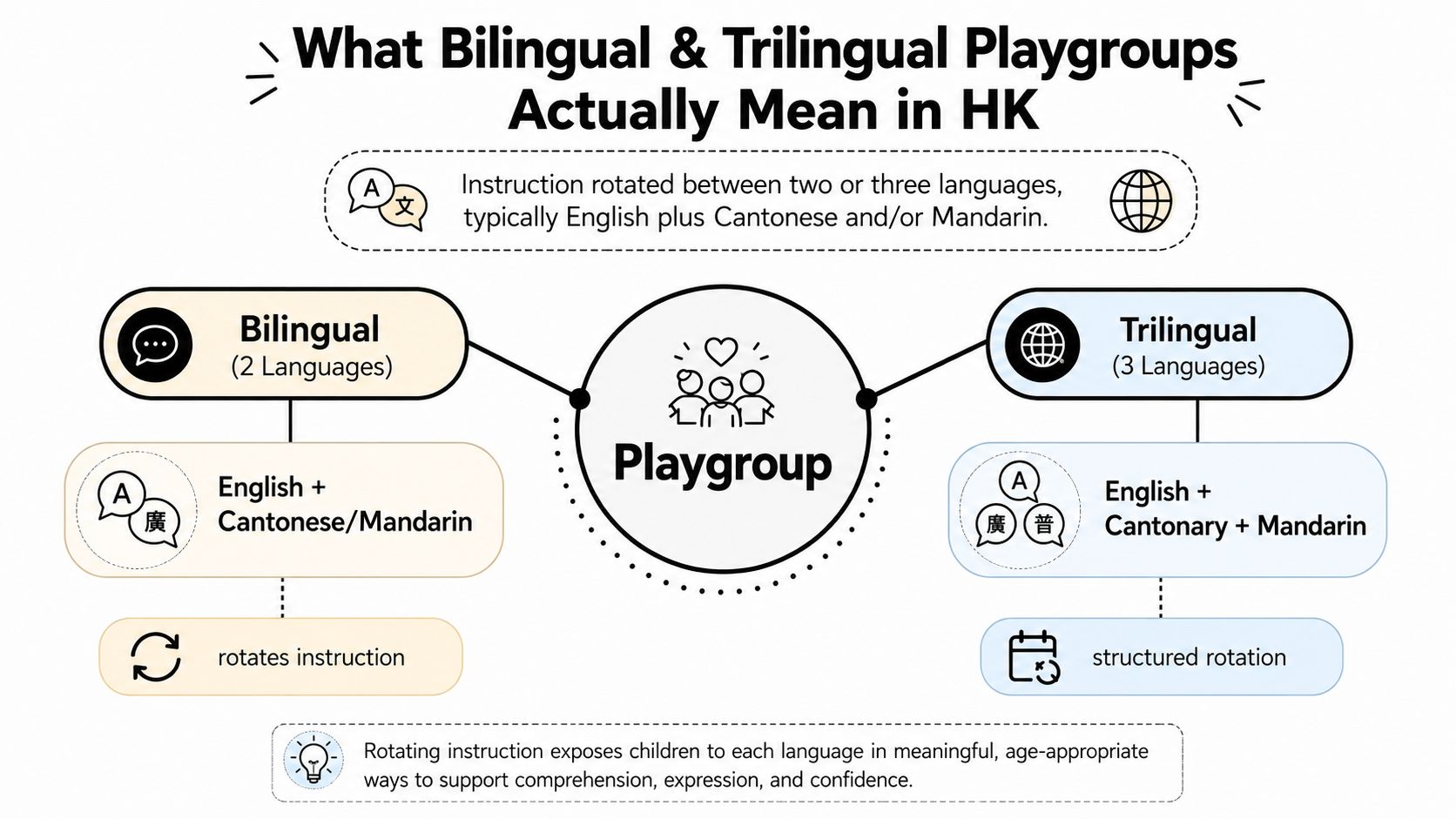
A bilingual playgroup in Hong Kong usually rotates instruction between two languages, commonly English plus Cantonese or English plus Putonghua. A trilingual playgroup integrates English, Cantonese, and Putonghua in one session, ideally through planned activities, vocabulary, routines, and teacher roles rather than random switching.
The label matters because providers use “immersion” in different ways.
Four terms parents should separate
- Bilingual rotation: Two languages appear in a planned sequence or through separate activities.
- Trilingual rotation: English, Cantonese, and Putonghua are all included in one programme.
- Language immersion: A teacher or activity operates mainly in one target language.
- Co-teaching: Teachers with distinct language expertise share responsibility, often with each teacher modelling a particular language.
A trilingual class isn't automatically stronger than a bilingual one. If three languages are squeezed into a short session without repeated vocabulary or meaningful interaction, each language may receive too little depth.
Hong Kong already has a multilingual baseline. Among children aged five to 11, 88.9% could speak English and 64.5% could speak Putonghua in the 2021 Census. Among children aged 12 to 17, the figures were 93.8% for English and 76.5% for Putonghua Census data on children's language ability.
That doesn't mean every child has equal exposure or confidence. It does mean a playgroup should be judged as a structured extension of Hong Kong's language environment, not as a miracle solution that introduces multilingualism from nothing.
Parents should also consider the social side of the class. Language is used during turn-taking, sharing, problem-solving, and emotional regulation. Resources on social-emotional learning for early grades are useful because a child who feels secure and involved will usually participate more actively than one who is overwhelmed by unfamiliar instructions.
What Hong Kong Research Says About How Trilingual Classrooms Work
Strong trilingual classrooms coordinate topics, vocabulary, sentence patterns, and classroom routines across English, Cantonese, and Putonghua. They do not assign a different language to each part of the timetable.
A University of Hong Kong study of five kindergartens found that teachers aligned these elements across languages to help children form cross-language connections the HKU study on trilingual kindergarten classrooms. During a food-themed activity, for example, a teacher might revisit the same objects, actions, and sentence structure in more than one language.
This approach creates repetition without turning play into drilling. Children learn that one concept can be expressed in different ways, while teachers build on familiar knowledge when the classroom language changes.
Design beats language count
| Feature | Better-designed bilingual class | Better-designed trilingual class |
|---|---|---|
| Planning | Activities connect the two languages | Topics and language targets connect across three languages |
| Teacher input | Concentrated exposure can support depth | Specialist delivery matters because the language load is higher |
| Interaction | Children use the target language during play | Children shift languages with a clear purpose |
| Risk | One language may dominate | Each language may become too brief or superficial |
| Parent test | Ask how vocabulary is revisited | Ask for the exact language map for a typical session |
A Hong Kong preschool study also recorded children using translanguaging, shifting among languages during inquiry-based interaction to manage peer relationships the ERIC record on trilingual participation. For parents, the distinction is practical. A child switching languages to invite a peer into play is using language socially. A teacher changing languages every few minutes without a clear learning purpose is adding noise.
Research on implementation in Hong Kong primary schools found no agreed method for implementing trilingual education. The study covered 155 Hong Kong primary schools and reported average instructional time of 27.64% for Chinese and 23.21% for English the study of trilingual education implementation in Hong Kong primary schools.
Use that evidence when judging a provider. Ask which teacher handles each language, how often key vocabulary returns, and whether children have a reason to use each language with one another. A carefully planned bilingual class can provide more useful exposure than a trilingual class that divides a short session into three thin segments.
The parent decision is simple: count the design, not the languages.
The Age Question, Pros, and Real Limits of Starting Before Four
Parents often ask, “If I wait, will my child miss the opportunity?” In Hong Kong, that fear is overstated.
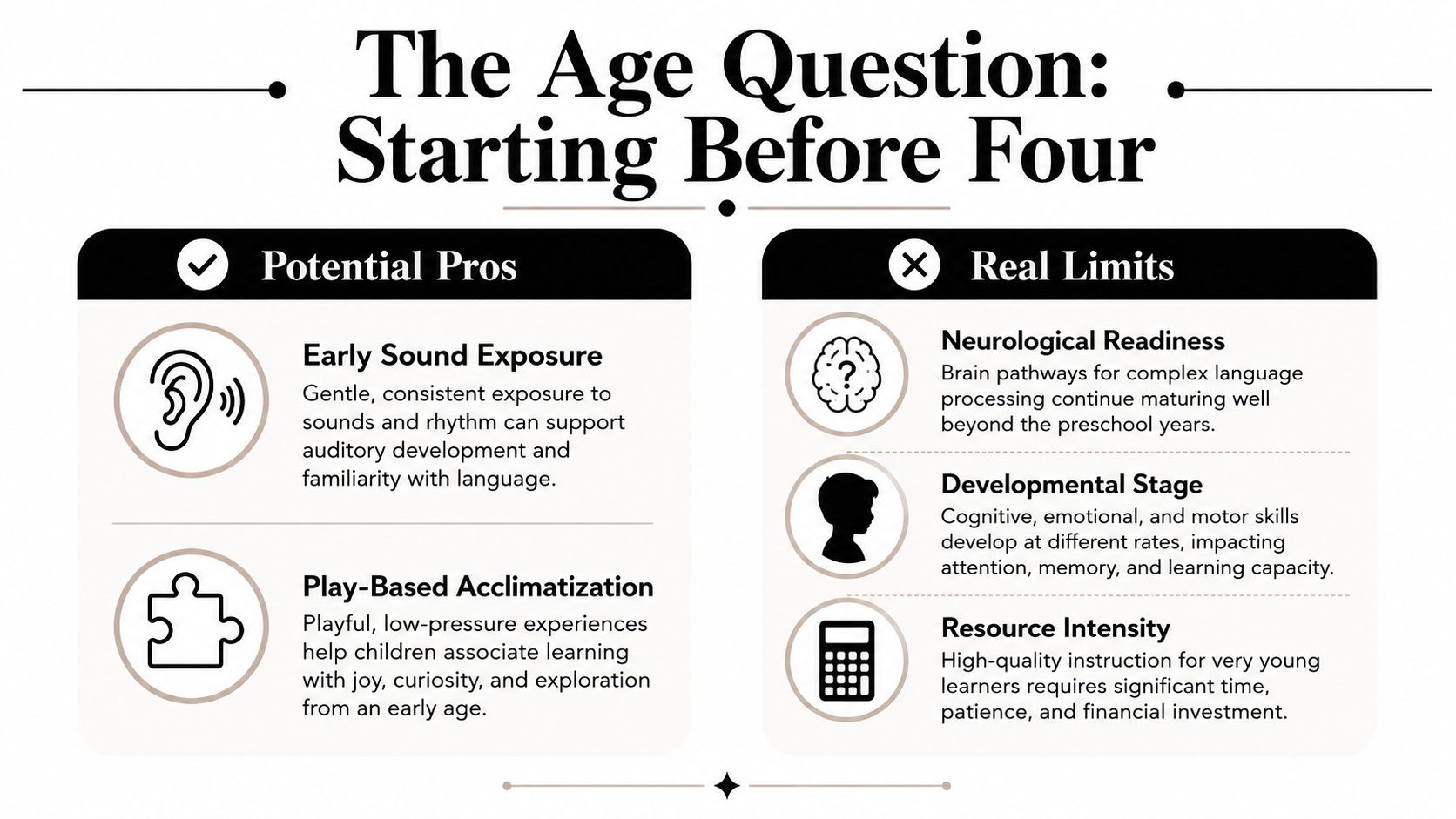
Policy guidance identifies the strongest language-learning window as roughly ages four to eight, while also stating that a child's mother tongue should take precedence at pre-primary level. English and Putonghua can be introduced when suitable teachers are available and the approach remains informal and pressure-free the Hong Kong language education policy review and action plan_with%20cover.pdf).
That guidance doesn't argue against early exposure. It argues against forcing a young child into a language programme because the marketing says earlier is better.
What an early playgroup can do well
A good class can make unfamiliar sounds feel normal. It can help a child associate English or Putonghua with songs, movement, stories, and friendly routines rather than with correction or tests.
It can also support:
- Sound familiarity: Children hear pronunciation and rhythm during playful activities.
- Social confidence: Children practise joining groups and responding to teachers who use another language.
- School routines: Songs, tidy-up instructions, and turn-taking can make later classroom transitions less abrupt.
- Positive association: The child learns that another language belongs in enjoyable shared experiences.
Where early enrolment falls short
Before age four, developmental readiness varies widely. A child may enjoy songs in a new language but still be unable to sustain attention, follow group instructions, or communicate comfortably with unfamiliar adults.
The opportunity cost matters too. A long commute, rushed meals, and an exhausted child can reduce the value of the entire afternoon. Weak teacher input creates another problem. If the adult's language proficiency is limited, the child may receive repeated errors, isolated vocabulary, or mostly background exposure.
For babies and toddlers, age-appropriate baby playgroup options in Hong Kong should be assessed as social and play experiences first, language programmes second.
A relaxed Cantonese-speaking home with rich conversation is not a failure to provide English or Putonghua. It may be the strongest foundation available to your child right now.
My recommendation is direct. Before age four, enrol only if the child enjoys the setting, the teacher input is strong, and the family can attend without sacrificing sleep, free play, or warm home interaction.
Bilingual vs Trilingual Compared Across Five Parent-Relevant Criteria
Parents comparing formats need more than the words “bilingual” and “trilingual” on a brochure. The relevant question is how much useful contact your child receives, how clearly the class is organised, and whether the fee reflects genuine specialist input.
| Criterion | Bilingual Playgroup | Trilingual Playgroup |
|---|---|---|
| Language load per session | Two languages allow more repetition and depth | Three languages create broader exposure but less time per language |
| Teacher expertise | Strong proficiency in both languages is essential | Specialist competence across all three languages is harder to provide |
| Classroom design | Activities can be easier to sequence | Concepts, vocabulary, and routines need deliberate mapping |
| Hong Kong usefulness | Often fits a family's immediate English-Cantonese or English-Putonghua gap | Mirrors the city's three-language policy and school environment |
| Fee structure | Often lower when input is more concentrated | Premium pricing is justified only by stronger staffing and design |
Independent Hong Kong playgroup listings show trilingual programmes advertised at HK$1,100 to HK$1,560 for four lessons, while another trilingual programme charges about HK$360 to HK$550 per class, depending on age band and package length Sassy Mama Hong Kong's playgroup listings.
Those figures are not a universal market rate. They're reference points showing why parents should ask what they're purchasing. A higher fee may pay for specialist teachers, a carefully planned curriculum, or a convenient district. It may also pay for branding and premises without improving language contact.
When bilingual is the sharper choice
Choose bilingual when one language is clearly weaker, when your child needs more repetition, or when the provider can demonstrate stronger teacher quality in the two selected languages.
For many families, English plus Cantonese or English plus Putonghua is enough. A focused programme can give children more chances to understand instructions, answer questions, and reuse vocabulary during play.
This is why English playgroups in Hong Kong can make sense for parents who want a narrower, more concentrated target rather than maximum language variety.
When trilingual earns its place
A trilingual class is worth considering when all three languages are delivered by proficient teachers, the same concepts recur across the session, and the child is comfortable participating. Co-teaching or specialist-language instruction is a strong positive signal.
If the third language appears only in a greeting song, don't pay a premium for a trilingual label. You're buying an impression of breadth, not meaningful exposure.
Practical Logistics That Decide Value
A strong curriculum can still be poor value if the schedule drains the family. A class in Central may look attractive until the journey from Kowloon cuts into dinner, bedtime, and regular attendance. In Hong Kong, consistency usually matters more than prestige.
Start with the commute. Choose a centre your family can reach without turning the day into a race. Location also determines whether a parent can observe the session and repeat useful routines at home. Compare convenience before comparing curriculum claims with this district-by-district guide to playgroups in Hong Kong.
Check the learning conditions
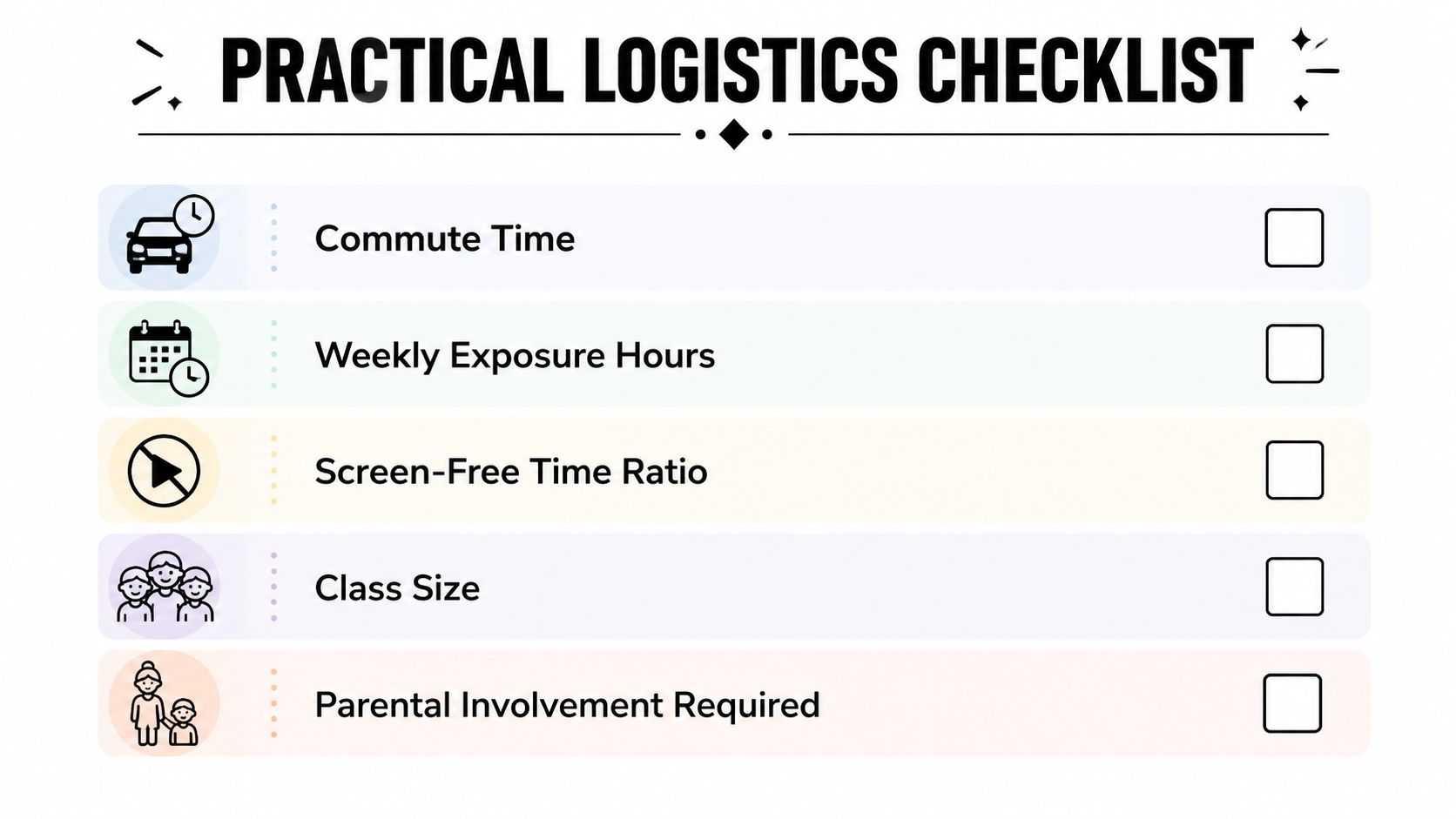
Use this checklist before paying:
- Commute time: Can your family reach the centre without rushing?
- Weekly exposure: How much time involves genuine teacher-child interaction rather than administration or waiting?
- Screen-free time: Does the class use movement, objects, books, music, and peer play?
- Class size: How often does each child speak, respond, and receive feedback?
- Parental involvement: Can you repeat the songs, phrases, and routines at home?
Ask the provider to describe a normal session in concrete terms. “Full immersion” says little on its own. Ask how teachers use the target languages during instructions, free play, stories, songs, transitions, and parent communication. This reveals the exposure your child will receive, not just the label on the brochure.
Teacher quality deserves equal scrutiny. A native-speaker label does not guarantee effective teaching, and an accent does not prove proficiency. Look for adults who respond naturally to children, manage behaviour, extend vocabulary, and maintain the target language without making the child feel tested.
The HK$16 for two hours, HK$32 for half a day, and HK$64 for a full day cited for subsidised child-care centres are childcare rates, not enrichment fees Social Welfare Department child-care service information. For a private playgroup, calculate the fee against meaningful language contact, class participation, teacher quality, and the number of sessions your family can attend consistently. A higher fee earns its place only when those conditions are stronger.
A Four-Step Framework for Deciding What Your Family Actually Needs
A sensible decision starts with the child's actual language environment, not with a brochure. Use this four-step audit.
Step one is to measure current exposure
For one ordinary week, note when your child hears and uses:
- English, through school, books, caregivers, media, and play.
- Cantonese, through family conversation and daily routines.
- Putonghua, through relatives, nursery, songs, or structured activities.
Don't chase perfect figures. The purpose is to identify whether your child lacks listening contact, opportunities to speak, or confidence in a particular setting.
Step two is to identify the gap language
The gap may be Putonghua for a school transition, English for broader classroom participation, or a future language connected to your family plans.
Some Hong Kong families are considering study abroad in Germany or Spain, while others are planning possible education in Austria or Switzerland. For these families, German can be a strategic additional language, but it shouldn't be piled onto a young child to collect labels.
Step three is to match the format to the gap
A trilingual playgroup is justified when the child is ready to participate, the programme has clear co-teaching, and all three languages receive purposeful use. If the main weakness is English or Putonghua, a focused bilingual class may provide better depth.
Once a child has a secure Cantonese-English-Putonghua foundation, a structured German track can extend the profile without pretending that every language must be taught through the same playgroup. Look for small groups, native teachers, and certificate milestones rather than vague promises of fluency.
Parents comparing providers should also think about choosing the right education philosophy, especially whether the classroom values play, inquiry, repetition, and responsive interaction.
Step four is to trial before committing
A single visit can reveal the atmosphere, but it can't show whether the teacher-child match will hold. Treat one month as the minimum trial period for judging attendance, child response, teacher consistency, and what your family can realistically reinforce.
My view is firm: don't enrol in a trilingual programme because you fear being late. Enrol because the format solves a specific gap better than home interaction or a focused alternative.
Questions to Ask Providers and Your Next Step
Take these questions to the trial or admissions call. A reputable provider should answer clearly, without hiding behind broad terms such as “international environment” or “natural immersion”.
- Who teaches each language, and what are their qualifications?
- Are the English, Cantonese, and Putonghua teachers native or highly proficient speakers?
- How many minutes of the session are allocated to each language?
- What happens during free play, story time, music, transitions, and snack time?
- What is the class size, and how often does each child receive individual interaction?
- How much time is child-led play compared with teacher-directed instruction?
- Does the same concept, vocabulary, or sentence pattern appear across languages?
- What home materials will parents receive, and are they practical for busy HK households?
- What are the attendance, make-up, cancellation, and refund policies?
- Does the curriculum map to an external framework or a clearly defined learning progression?
A provider that can't show a sample session plan may not have a coherent language model. A provider that promises fluency from occasional exposure is making a claim you shouldn't trust.
For families whose local environment already supports Cantonese, English, and Putonghua, the next question may be whether a different language adds strategic value. German Cultural Association Hong Kong(GCA) offers small-group German classes with a maximum of six students, native German-speaking teachers, in-person centres near Tsim Sha Tsui and Causeway Bay MTR, and online Zoom options. Its curriculum includes preschool learning, school pathways, and preparation for qualifications such as Goethe-Zertifikat, IGCSE, A-level, and IB.
That makes a structured German option more relevant for children preparing for international education, families considering German-speaking universities, or parents who want a clear progression beyond general play exposure. It also suits adults and professionals who need business or travel German, rather than a child-focused playgroup.
German Cultural Association Hong Kong(GCA) offers native-led, small-group German learning for preschoolers, children, teenagers, and adults, with classes near Tsim Sha Tsui and Causeway Bay MTR plus Zoom options. If your family wants to add German after establishing a strong local language foundation, visit German Cultural Association Hong Kong(GCA) to book a trial class or speak with an advisor about the latest course schedule.

German Storybooks and Readers for Kids: 12 Titles by Age and Level
German for Children Aged 3-6: Realistic Expectations for the First Year


