.png)
.png)

BLOG

香港德國文化協會
The German Cultural Association
Preschool German Classes 2026/27 (Ages 3-6): Small-Group Intake & Trial Lessons
Your child's kindergarten timetable is already full. There's the school run, a Mandarin or English activity, perhaps swimming, and the daily question of whether another class is worth the transport across Hong Kong. If German is on your family's list for 2026/27, Preschool German Classes 2026/27 (Ages 3-6): Small-Group Intake & Trial Lessons should begin with a fit test, not a long commitment.
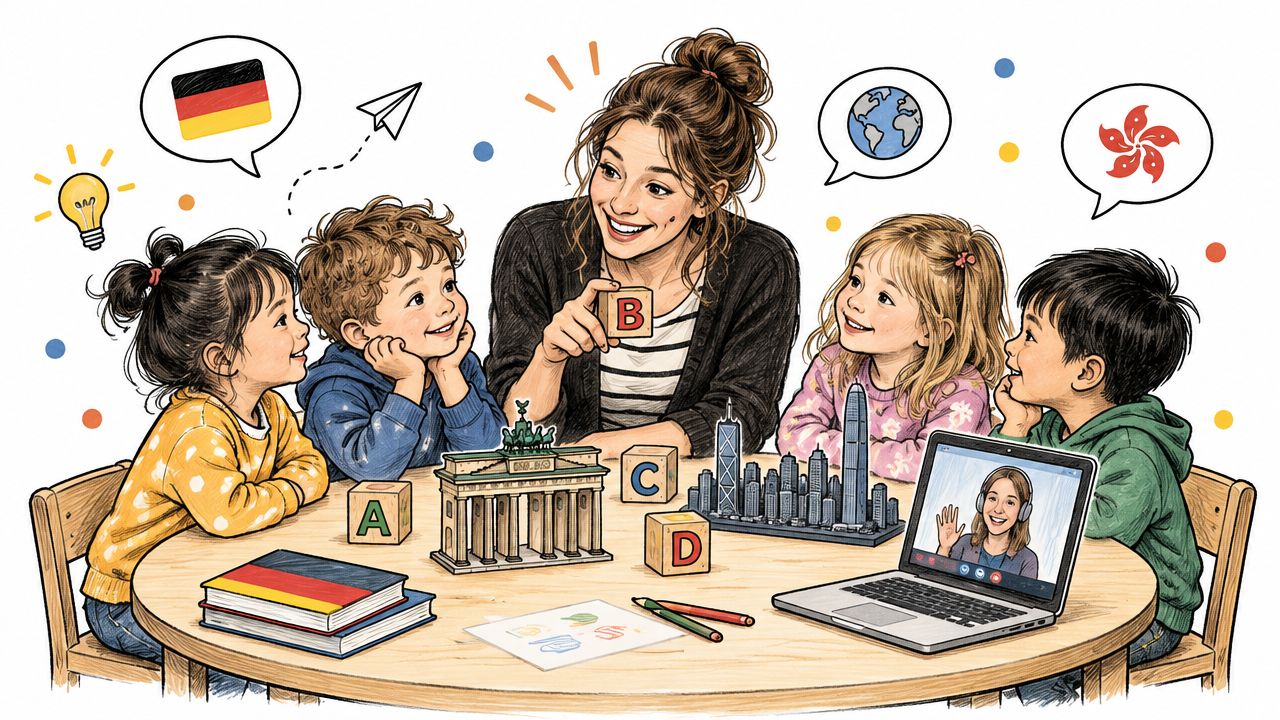
For families comparing options in HK, the practical answer is simple. A small group capped at six children gives a teacher enough opportunity to observe attention, curiosity, confidence, and interaction through guided play. A 30- to 60-minute trial lesson can then show whether German suits your child's personality and weekly routine.
A parent travelling from Tsim Sha Tsui to Causeway Bay may reasonably ask whether a niche language is worth adding at ages 3 to 6. My advice is to treat the first class as a low-risk decision point. You're not trying to prove proficiency. You're checking whether your child engages with the teacher, enjoys the sound of German, and can manage the class environment.
The guide to the best age for children to start learning German can help with the broader age question, but the right starting point still depends on the individual child. GCA's model uses native German teachers, a structured curriculum, and groups of no more than six, with later progression available for families who want a more formal route towards Goethe-Zertifikat preparation.
Hong Kong's preschool market is substantial but changing. The official government factsheet records about 113,200 kindergarten enrolments in the 2025/26 school year, while around 720 kindergartens, about 97% of eligible kindergartens, joined the Kindergarten Education Scheme. Hong Kong's Education factsheet also confirms that kindergarten education serves children aged 3 to 6.
For 2026/27, that makes careful class formation important. The sections below explain who can join, why six is a useful maximum, what happens in a trial, and how to choose between casual enrichment and a longer German pathway.
Table of Contents
- Guided play creates useful language moments
- Six supports observation without turning play into testing
- Use this enrolment checklist
- Preschool and CEF funding are different questions
- GCA Preschool German 2026/27 At a Glance
Is Preschool German Right for Your Child in Hong Kong
A child may finish kindergarten tired but still light up during a song, story, or unfamiliar sound. That response is a useful starting point for deciding whether preschool German belongs in the family timetable. It can suit children who enjoy social learning, families interested in German-speaking education later, or parents seeking cultural enrichment before primary school.
A full pathway does not need to be chosen now. At ages 3 to 6, the practical question is whether your child engages with a native-led, interactive setting. A trial lesson provides evidence that a brochure cannot: how your child enters the room, responds to the teacher, joins activities, and copes with transitions.
Look at the learning environment, not just the language
Hearing German in a large playgroup is only one part of learning. The teacher also needs to see whether a child listens, participates, remembers routines, and accepts guidance. In a group capped at six, the teacher can adjust repetition, movement, reassurance, or prompts to the child in front of them.
The small group works like a short fit test. It shows whether German holds your child's attention without asking your family to commit immediately to a longer programme.
That matters in Hong Kong, where school hours, homework, meals, transport, and family time already compete for space. German is often considered alongside English-Mandarin or English-Putonghua activities, so the class should earn its place through a clear learning experience and a schedule your family can maintain.
A practical decision for busy families
Ask yourself:
- Does your child enjoy group interaction? Watching first is fine if the teacher offers a safe way to join.
- Can your family manage regular attendance? Familiar routines help young children, even in playful classes.
- Is your goal enrichment or progression? Both are valid, but progression needs steadier attendance and clearer expectations.
- Are you exploring future school choices? Preschool German builds familiarity with the language and classroom experience. It does not guarantee admission or a later exam result.
The government describes kindergarten education in Hong Kong as optional but nearly universal for children aged 3 to 5. The official education factsheet provides context for viewing a German trial as one enrichment choice within an established preschool routine.
For families still considering the starting point, this guide to the best age for children to start learning German explains why readiness matters alongside age.
Practical rule: Use the trial to check comfort, interaction, attention, and scheduling fit. Do not treat it as a test of whether your child can already speak German.
For 2026/27, contact the school early. A maximum-six class depends on matching compatible ages, confidence levels, and availability. The right group may matter more than the nearest time slot, because a well-matched first experience gives families a clearer basis for deciding whether to continue by the hour.
Who Can Join and When Intake Happens for 2026/27
Preschool German Classes 2026/27 are small-group German sessions for children aged 3 to 6 in Hong Kong, covering nursery, lower kindergarten, and upper kindergarten. They use songs, stories, movement, and guided play to introduce German, with trial lessons available before families decide on ongoing enrolment.
The Hong Kong age bands
Hong Kong preschool children are commonly organised into three year bands:
- Nursery: 3 years 0 months to 3 years 11 months
- Lower kindergarten: 4 years 0 months to 4 years 11 months
- Upper kindergarten: 5 years 0 months to 5 years 11 months
This locally recognised framework is described in the Hong Kong early development and learning report. It helps parents compare a German class with the child's existing school year rather than relying on a vague label such as “toddler” or “young learner”.
A child near the beginning of nursery may need more movement, repetition, and transition support. A child in upper kindergarten may be ready for longer exchanges, simple instructions, and more consistent classroom routines. The age band is a starting point, not a complete placement decision.
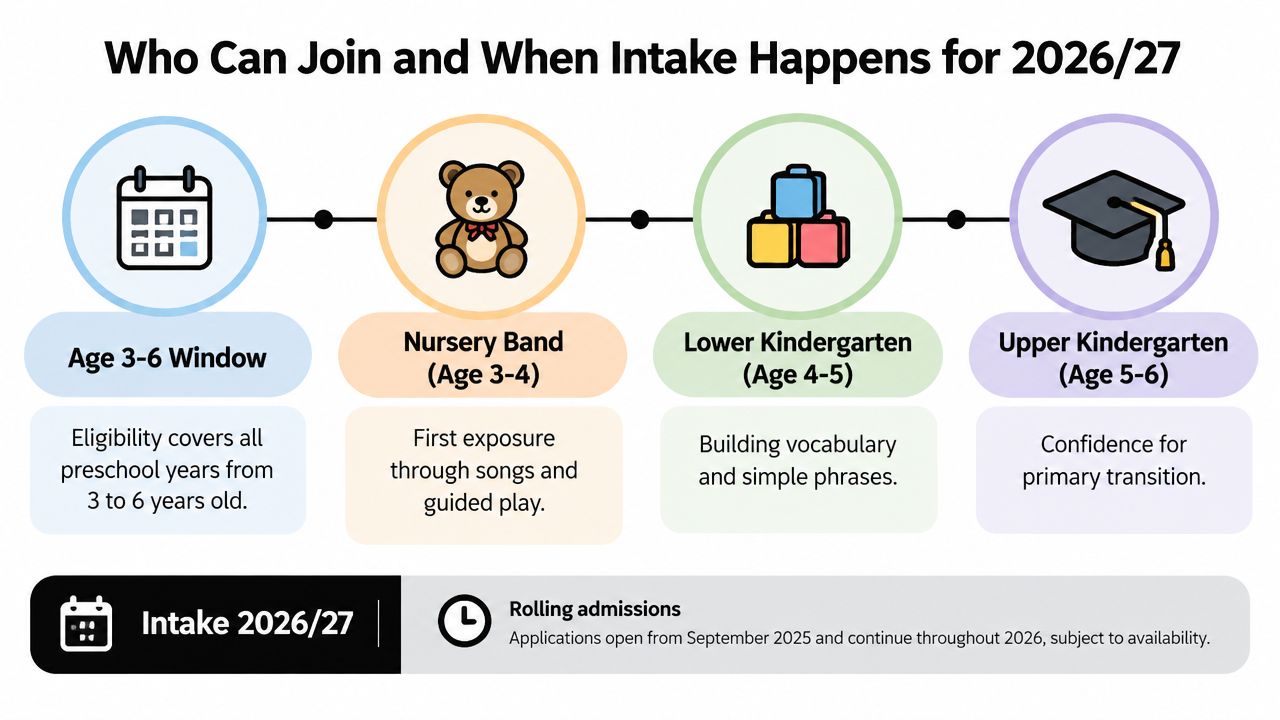
How rolling intake works
A small-group programme may form classes around:
- Age and developmental readiness
- German exposure, including no prior experience
- Comfort with group activities
- Family availability and centre location
- The pace already established by the group
A trial lesson should happen before a long-term commitment whenever possible. It lets the teacher assess whether the child can settle, follow a playful sequence, respond to German cues, and take a turn without pressure.
Parents can also use the 2026/27 Hong Kong German class intake guide to organise questions about dates, locations, and progression. Availability changes as groups form, so ask for the latest schedule rather than assuming that every age band has an open class at every time.
Quick eligibility checklist
Your child is likely to be suitable for a trial if:
- Age: They fall within the 3 to 6 preschool window.
- Routine: They can participate in an age-appropriate group activity.
- Interest: They respond to songs, stories, play, or new sounds.
- Family plan: You can consider regular attendance if the trial feels right.
- Practical fit: The route to Tsim Sha Tsui, Causeway Bay, or Zoom works for your household.
The aim isn't to select the most advanced child. It's to form a group in which every learner can participate comfortably.
Why Small Groups of Six Work Best for Ages 3 to 6
A child arrives after a full Hong Kong school day, watches a puppet, hears a German phrase, and decides whether to join the game. That first response matters. Preschool German develops through faces, actions, repetition, and turn-taking, so the learning environment affects how often meaningful interaction can happen.
Research comparing children aged 3 to 6 in German and Hong Kong kindergartens found significant differences across the observed play categories. Both groups spent the most time in non-play behaviour, while the German children showed somewhat higher levels of social and cognitive play. The study linked these differences to teachers' views of play and curriculum design, as reported in the Hong Kong and German kindergarten play research.
Guided play creates useful language moments
With a maximum of six children, the teacher can turn an ordinary action into a short German exchange:
- A child picks up a red object and hears the colour word.
- A movement game gives a simple instruction to follow.
- A puppet asks for an item, giving the child a reason to respond.
- A child repeats a phrase while taking a turn.
- The group hears familiar language within a predictable routine.
The point is not to make every child speak constantly. It is to give the teacher enough space to notice whether a child is processing the phrase, waiting for a peer, or feeling overwhelmed. Parents comparing formats can also review this comparison of 1-on-1 and small-group German lessons.
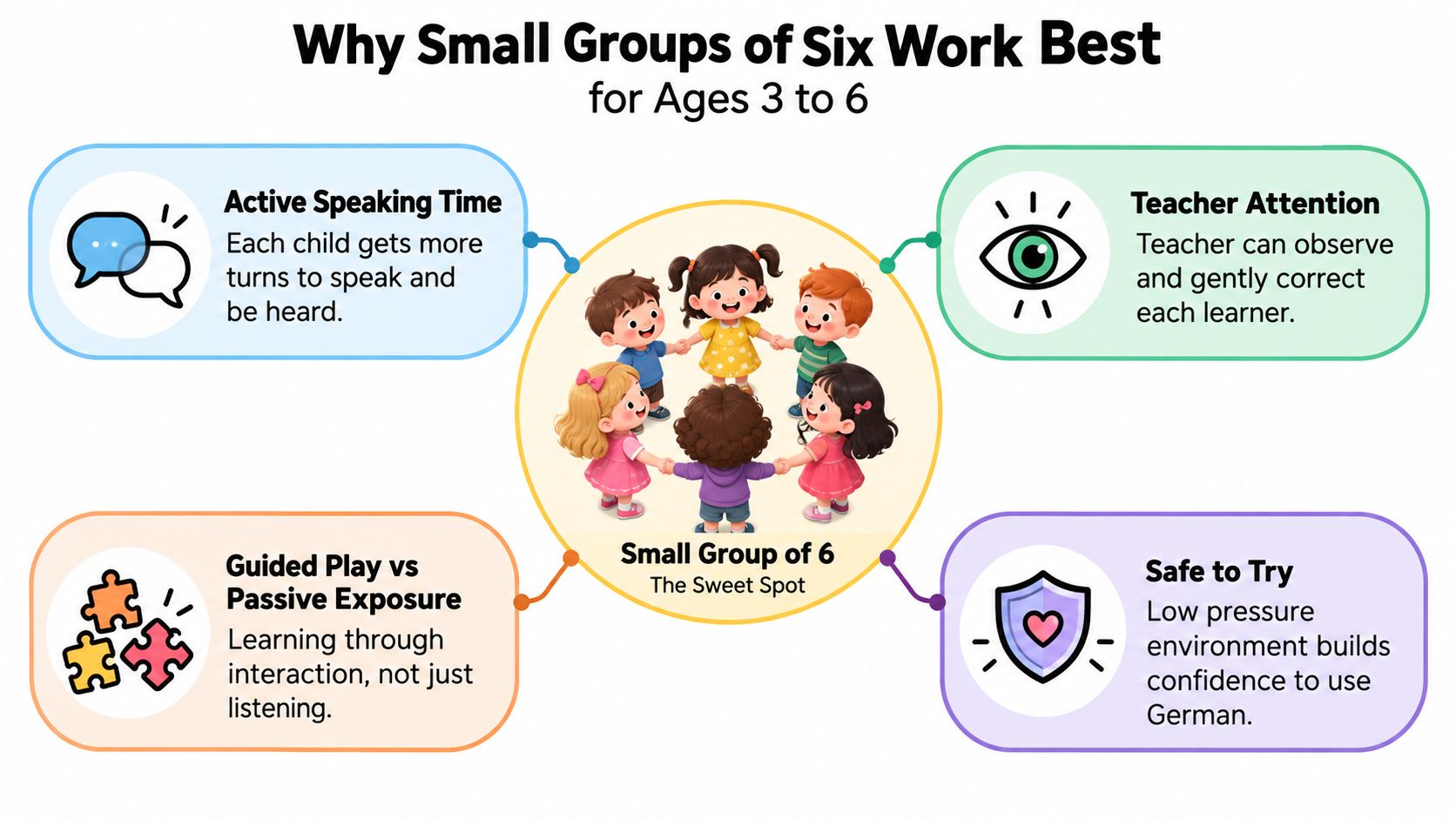
Six supports observation without turning play into testing
A Hong Kong-focused dissertation found equivalent executive-function measurement across Hong Kong and Germany, with no significant performance difference between the groups. The dissertation on executive functions in preschool children supports a careful approach. Teachers should respond to the child in front of them, rather than assume that culture determines ability.
A maximum-six class lets the teacher observe:
- Attention: How long the child stays with an activity
- Working memory: Whether the child remembers a repeated instruction
- Self-regulation: How the child waits and changes activities
- Social confidence: Whether the child watches, joins, or initiates
- Language response: Whether the child copies a sound, gesture, or phrase
A small group does not make German effortless. It makes the teacher's response more precise.
That precision gives parents a useful fit test within a crowded 3-to-6 timetable. GCA's small-group model uses interactive activities, while native German teachers with academic credentials adjust tasks for different confidence levels. Families considering German lessons Hong Kong should ask how many children are enrolled and how the teacher uses each child's participation to recommend the next hour-based pathway.
What to Expect in Your Trial Lesson and How to Book
A preschool trial lesson should feel like a normal introduction to the classroom, not an exam interview. At GCA, the trial format is designed as a fit test, with sessions lasting 30 to 60 minutes according to the published class arrangement and the child's age and readiness.
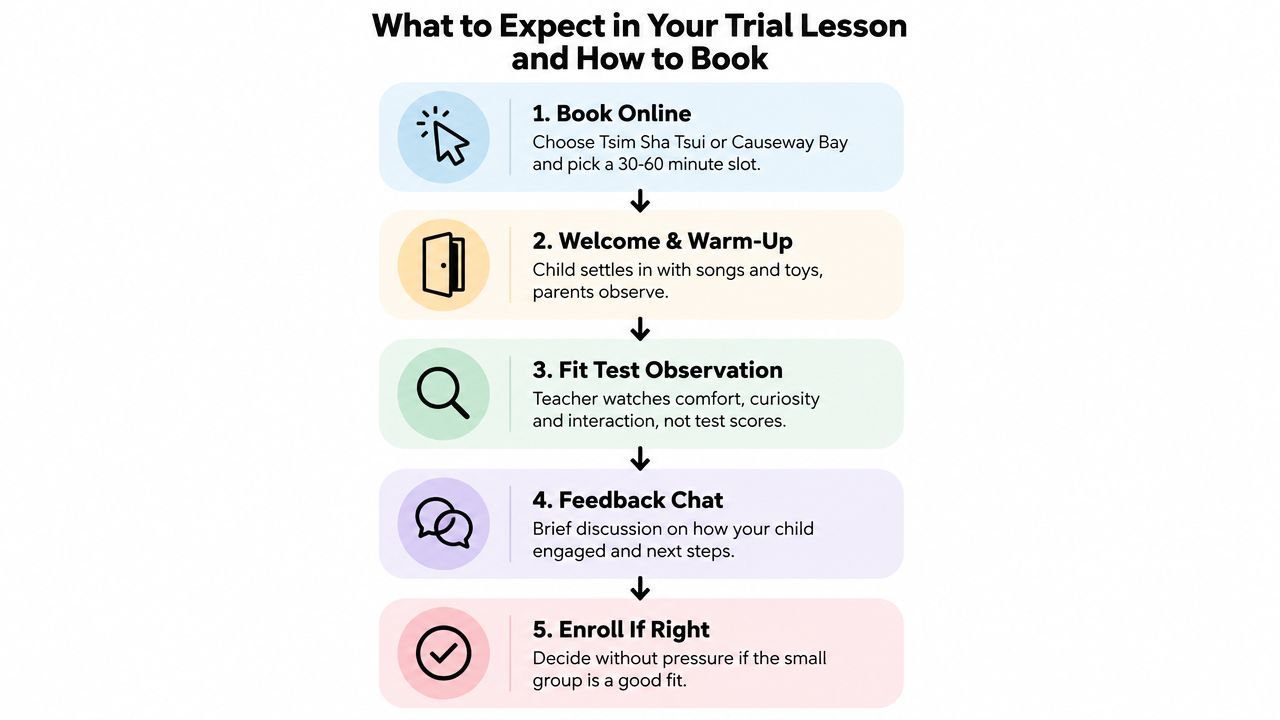
Follow a simple booking flow
- Choose a format. Select an in-person class near Tsim Sha Tsui or Causeway Bay, or ask about an interactive Zoom option.
- Share basic information. Provide your child's age, school year, previous German exposure, and preferred days.
- Select a trial slot. The advisor matches the child with a suitable age and level group where possible.
- Attend without over-preparing. Bring your child comfortably, with no need to memorise vocabulary in advance.
- Review the feedback. Ask whether the teacher recommends joining the existing group, waiting for a better match, or considering another format.
The route matters for Hong Kong families. A short MTR journey may be manageable on a weekday, while Zoom can be useful during heavy school periods, illness, or difficult cross-district travel. Flexible rescheduling is also practical when kindergarten events or family commitments change.
Watch for these classroom signals
During the session, the teacher may observe:
- Settling: Does your child become comfortable after the warm-up?
- Curiosity: Do they look at the materials and follow the activity?
- Turn-taking: Can they participate alongside other children?
- Response: Do they react to tone, gesture, repetition, or simple German?
- Recovery: Can they rejoin after distraction or hesitation?
Your child doesn't need to answer every question. A quiet child may show strong learning potential through careful observation and gradual participation.
The parent conversation should clarify the proposed group, lesson rhythm, learning materials, location, and next step. Ask directly whether the class is intended mainly for cultural enrichment, regular language habit-building, or a foundation for a more structured programme.
This approach is especially useful as Hong Kong's preschool cohort becomes smaller. The Education Bureau reported that kindergarten enrolment fell by 22% over five years to 136,095 in 2023, described as a 50-year low, as recorded in the Legislative Council paper on kindergarten education. A trial helps families and providers check class fit before a place is committed.
Choosing Between Enrichment and a Longer German Pathway
Parents often ask whether preschool German is a cultural activity or an early step towards a future school and examination route. It can be either, but the outcomes aren't identical, and a trial lesson cannot promise admission, exam success, or future fluency.
Three legitimate reasons to begin
Cultural enrichment suits families who want their child to hear German, enjoy songs and stories, and become comfortable with another European language. The commitment can remain light while parents observe whether interest grows.
School alignment may matter to families considering the German stream at German Swiss International School. Public information identifies kindergarten as an age-3 intake point and describes continuity through its German stream, but a private preschool class should be viewed as preparation and exposure, not a guaranteed feeder route. The overview of German kindergarten options in Hong Kong is useful for comparing these distinct pathways.
Long-term progression is more suitable when German connects to future study, family relocation, or formal qualifications. HKU SPACE's German progression references approximately 230 to 250 hours of prior study for upper-intermediate entry and about 350 to 370 hours for advanced entry, as shown on its Certificate in German upper-intermediate page. Those hour bands illustrate why preschool classes are an introduction to a longer sequence, not a substitute for sustained study.
Match the goal to the commitment
| Family goal | Suitable approach | What to measure |
|---|---|---|
| Cultural curiosity | Trial plus short enrichment programme | Enjoyment and willingness to participate |
| Early language habits | Consistent small-group lessons | Recall of routines and comfort responding |
| Possible German-school alignment | Regular exposure with careful pathway research | Readiness, family commitment, and school requirements |
| Future Goethe-Zertifikat preparation | Preschool foundation followed by structured progression | Attendance, developing skills, and later level placement |
German is a niche choice in Hong Kong's crowded multilingual market. That can be an advantage when the class has a clear identity, but parents should still weigh lesson time against transport, school demands, and the child's rest.
For a broader perspective on how play, rhythm, independence, and teacher-led learning differ, parents may find this parent's guide to education philosophies helpful. It can clarify whether a particular German class matches your family's view of early learning.
How Enrolment Pricing and Certificates Work at GCA
The sensible enrolment sequence is trial first, confirmation second. Before paying, ask for the latest 2026/27 schedule, class size, lesson duration, materials policy, make-up arrangements, and the total fee for the selected format.
GCA offers in-person centres near Tsim Sha Tsui and Causeway Bay MTR stations, as well as Zoom lessons. Its stated operating model combines native German teachers, a structured curriculum, small groups capped at six, and easy online rescheduling.
Use this enrolment checklist
- Trial: Attend the agreed session and review the teacher's feedback.
- Placement: Confirm the age band, group level, teacher, location, and available schedule.
- Fees: Request a written breakdown of tuition, materials, registration charges, and any applicable administrative costs.
- Attendance: Check the procedure for absence, rescheduling, and group changes.
- Certificate: Understand that GCA's structured certificate system requires 80% attendance, according to the publisher information.
- Documents: Keep the child's basic identification and contact details ready if the centre requests them.
- Payment: Confirm accepted payment methods and the refund or transfer policy before settling fees.
Preschool and CEF funding are different questions
Parents sometimes connect a preschool German class with CEF funding because adult German courses may later qualify for reimbursement. The Continuing Education Fund is relevant to eligible Hong Kong residents who hold the right of abode, right to land, or right to remain without restriction, or who hold a One-way Permit. For courses commencing after 1 August 2022, the upper age limit was removed and the subsidy ceiling was raised to HK$25,000 per person, while applicants must be at least 18 when the reimbursable course begins. The official CEF eligibility rules set out those conditions.
That doesn't mean a preschool class is automatically CEF-eligible. The fund's provider guidance states that German language proficiency courses require at least 110 contact hours, while eligible face-to-face or online courses generally need at least 30 total contact hours, excluding exams, self-study, and other non-interactive activities. The CEF provider guide is the right reference for later adult planning.
GCA Preschool German 2026/27 At a Glance
| Item | Details |
|---|---|
| Age range | Preschool children aged 3 to 6 |
| Group format | Maximum 6 students |
| Teaching approach | Native-led songs, stories, movement, and guided play |
| Trial format | 30- to 60-minute fit-test lesson |
| Delivery | In-person near Tsim Sha Tsui or Causeway Bay MTR, plus Zoom |
| Progression | Structured learning pathway, with later exam preparation options |
| Certificate policy | Certificate requires 80% attendance |
| CEF note | Preschool eligibility must be checked separately, adult German routes have published contact-hour requirements |
Ask for the current fee schedule rather than relying on old listings. Class availability and group composition can change as families confirm their places.
Ready to Start Learning Book Your Trial Today
A good preschool German decision doesn't require a five-year plan. It requires a clear purpose, a manageable route, and enough teacher attention to see whether your child is ready to participate.
For ages 3 to 6, a maximum-six group offers a practical balance between peer interaction and individual observation. Songs, movement, stories, and guided play can make German feel natural without turning an early class into exam preparation.
Parents should also keep the outcome realistic. A trial lesson can reveal comfort, curiosity, and classroom fit. It can't establish proficiency or predict a future school place, Goethe-Zertifikat result, DSE outcome, IB performance, or IGCSE grade.
Before you reserve a place
Check these points with an advisor:
- Purpose: Decide whether you want cultural enrichment, regular language exposure, or a foundation for a longer pathway.
- Age fit: Confirm whether the group suits nursery, lower kindergarten, or upper kindergarten.
- Travel: Compare Tsim Sha Tsui, Causeway Bay, and Zoom against your actual weekly routine.
- Class size: Confirm that the group remains capped at six.
- Teacher feedback: Ask what the trial teacher observed and what format they recommend.
- Next step: Request the latest 2026/27 timetable, fees, attendance terms, and rescheduling policy.
GCA's mission is to “Simplify Language Learning”, using flexible scheduling, native German teachers, structured courses, and preparation for qualifications such as Goethe-Zertifikat. The publisher also reports a 96% recommendation rate and states that over 90% of students rank in the top 10% of public examinations, based on its own published results information. These claims describe the wider organisation and shouldn't be treated as preschool outcome guarantees.
If your child is already asking about German words, enjoys structured play, or needs a gentle introduction before a larger educational decision, a trial is the most responsible place to begin. You can make the decision with your child's actual response in front of you, rather than guessing from a timetable or advertisement.
German Cultural Association Hong Kong(GCA)offers native-led preschool German classes in small groups capped at six, with trial lessons for families comparing enrichment and longer-term pathways in Hong Kong. Visit German Cultural Association Hong Kong(GCA) to check the latest 2026/27 schedule, contact an advisor, and book a suitable trial lesson.
Preschool German Classes 2026/27 (Ages 3-6): Small-Group Intake & Trial Lessons
German Courses for Teens 2026/27: Ages 12-18 New Term Classes & Exam Pathways


