.png)
.png)

BLOG

香港德國文化協會
The German Cultural Association
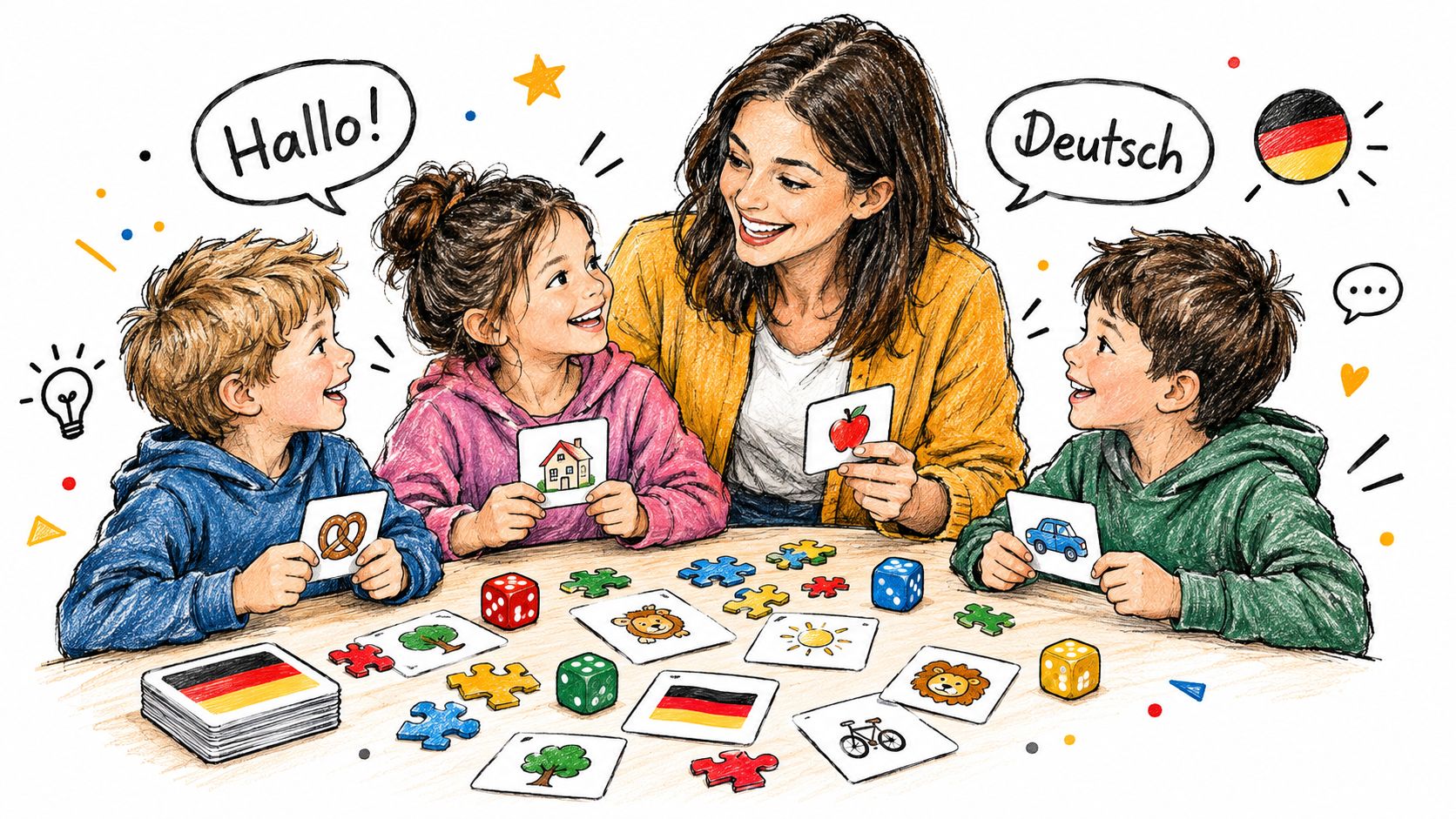
Interactive German Classes for Kids: Games
A child may need German for schoolwork, future travel, confidence in speaking, or a planned study-abroad route, yet a worksheet can lose their attention before the practice becomes useful. In Hong Kong, families also need activities that fit small homes, busy after-school schedules, school requirements, and online lessons.
This roundup of Interactive German Classes for Kids: Games gives parents and teachers seven classroom-ready ideas. Each game includes a language objective, suitable age range, materials, timing, sample phrases, differentiation, Zoom and classroom adaptations, and a simple way to check progress.
The German Cultural Association of Hong Kong, or GCA, combines native-speaking teachers with a structured curriculum, groups of up to six students, private sessions, in-person classes near Tsim Sha Tsui and Causeway Bay MTR stations, and online Zoom options. That flexibility matters when children need regular practice alongside school, DSE, IGCSE, A-level, IB, or longer-term plans to study abroad in Germany or elsewhere in Europe.
The strongest activities also follow the principles behind designing interactive educational content: children make decisions, receive feedback, and use language for a clear purpose rather than merely repeating isolated vocabulary.
Table of Contents
1. What is vocabulary bingo with cultural themes?
Vocabulary bingo turns recognition practice into an active listening task. Children mark German words after hearing a definition, picture clue, translation, rhyme, or action. With themes such as food, animals, household objects, German festivals, numbers, or simple mathematics, the game builds vocabulary while encouraging children to listen carefully and connect language with meaning.
For younger learners, use large images and words such as der Apfel, die Karotte, and die Banane. A teacher might say, “Es ist gelb und lang,” or show a picture, and the child finds the matching square. GCA's German words for Hong Kong beginners can help teachers select manageable vocabulary for an introductory set.
Classroom setup and language targets
- Recommended ages: 4 to 10
- Materials: Picture cards, word cards, bingo boards, counters, and optional cultural images
- Timing: A short round can take about 10 to 15 minutes
- Targets: Listening comprehension, noun recognition, articles, pronunciation, and topic vocabulary
- Sample phrases: “Was ist das?”, “Ich habe es!”, “Bingo!”, “Zeig mir den Apfel.”
Use a Fruit and Vegetable Bingo round for A1 learners, then add German holiday vocabulary such as Weihnachten and Ostern for cultural context. Older children can solve simple maths clues in German, such as identifying sieben after hearing a number problem.
Differentiation and assessment
Give younger children image-only boards, while older learners receive written words and longer spoken clues. Add a wild-card square for a child who can use one target word in a sentence.
In a classroom, teams can compare answers before the teacher confirms them. On Zoom, place children in breakout rooms for team rounds, share digital boards, or ask them to hold up the matching picture. For assessment, record whether each learner can identify target words from an image, an English clue, and a German definition. A child who recognizes the picture but not the spoken German needs more listening exposure, not just a larger vocabulary list.
Include a small German cultural reward or a class milestone board if it motivates the group, but praise accurate listening and clear pronunciation above winning.
2. How does German Simon Says develop listening?
“Simon says: stand up.” A child hears Simon sagt: Steh auf!, decides whether the cue is present, and responds with movement. German Simon Says, or Kommandos folgen, therefore links sound, meaning, and action without requiring translation after every phrase. It gives teachers a quick way to practise body parts, action verbs, classroom routines, emotions, and careful listening.
Start with three commands, such as Spring!, Setz dich!, and Berühre deine Nase! Demonstrate each one once, then reduce the gestures. Children should gradually rely on the German words, just as a learner first uses picture clues and later reads independently.
Use the game in stages:
- Preschool stage: Practise greetings, colours, body parts, and simple actions.
- Primary stage: Add objects, locations, and two-step commands.
- Older learner stage: Let children create instructions and include negation.
- Sample phrases: “Simon sagt: Steh auf!”, “Berühre deinen Kopf!”, “Geh zur Tür!”, “Mach das nicht!”
For a Magic Simon round, remove the usual cue and ask children to decide whether to move. Combine emotion and movement with Ich bin glücklich, hüpf! At beginner level, accurate listening matters more than perfect grammar. Later, learners can distinguish word order, verb forms, and negative commands.
Practical rule: Demonstrate meaning first. Remove gestures gradually so children show understanding of the German itself.
The activity needs little equipment. In class, clear a safe space and add a ball, scarf, or toy animal. At home, a parent can give instructions involving familiar furniture. On Zoom, children can use seated gestures, stay within their camera frames, or lead a short round themselves.
Differentiate by command length. Beginners follow one-step instructions and copy a model. Stronger learners combine a verb, body part, and location, such as Berühre mit der linken Hand dein rechtes Knie. For assessment, record receptive and productive skills separately: can the child follow the instruction, and can they give one to a classmate? This evidence helps teachers plan practice for school lessons, Goethe-Zertifikat preparation, or later IGCSE, A-level, and IB language work.
3. Can a story chain improve sentence building?
On a rainy afternoon in a Hong Kong classroom, one child begins with Am Samstag geht Lina in den Wald. A second adds Sie sieht ein kleines Haus. Each learner then extends the same adventure. This Kettengeschichte, or German story chain, turns separate vocabulary into connected sentences while requiring children to listen for meaning and continuity.
Picture prompts, character cards, and location cards give hesitant speakers something concrete to use. For ages 7 to 9, provide sentence frames, pictures, and present-tense verbs. Ages 9 to 12 can add past-tense narration, sequencing words, and adjectives. Teenagers can work within a chosen tense, introduce a plot twist, or connect ideas with a more complex clause.
Useful prompts include Dann…, Plötzlich…, Danach…, and Was passiert als Nächstes? A Mystery Adventure Chain practises locations and the past tense. A fairy-tale remix based on Rotkäppchen or Rapunzel supplies a familiar plot while allowing modern settings and characters. With teacher support, A2 or B1 learners preparing for IGCSE or IB can add conditional or subjunctive forms.
Give children a pass option, so a pause does not become a public failure. Think-Pair-Share also improves preparation: partners plan one sentence before each learner speaks to the class. The result is more deliberate speaking, rather than fast guessing.
Adapt the activity for class, home, or Zoom
In person, place picture cards on the floor and let children move a character through the story. On Zoom, display shared slides and have each learner add a sentence beside an image. At home, a parent can offer three objects or locations as prompts. Keep the chain short enough for every child to contribute.
Assessment can measure both accuracy and independence. Record the story, then select sentences for a follow-up lesson. Highlight one success, such as verb position, and set one next step, such as improving past-tense accuracy. Count completed sentences, check whether each one connects to the previous idea, and ask the learner to retell the story with fewer prompts.
For parents seeking a clear explanation of additional-language development, see how children pick up a third language. Regular evidence from this game can guide classroom practice and later Goethe-Zertifikat, IGCSE, A-level, or IB preparation.
4. Why use memory matching for German sentence building?
Memory matching becomes a sentence workshop when children must find cards and place them in a correct German order. Instead of recalling isolated vocabulary, they connect a subject, verb, object, article, preposition, or subordinate clause. The cards act like train carriages: each part has a place, and the complete sentence only works when the carriages are coupled correctly.
Start with a picture of breakfast. An A1 learner can match Der Junge, isst, and einen Apfel, then read the sentence aloud. Colour coding makes the pattern visible: blue for subjects, red for verbs, and green for objects. Children turn over cards, remember positions, and assemble the sentence after finding the required parts.
Adjust the challenge by language goal
Use the same game frame while changing the grammar target:
- Beginner: Subject, verb, and object with picture support
- Developing: Articles, adjective endings, and common prepositions
- A2: Dative structures and prepositions that require the dative case
- B1: Subordinate clauses and more complex word order
- Sample phrases: “Ich habe ein Buch.”, “Die Frau kauft den Käse.”, “Ich helfe dem Kind.”
A Dative Adventure can place the cards in family or travel situations. A Sentence Complexity Chain asks learners to connect two clauses. Food, routines, school life, and travel keep the memory rules familiar while changing the vocabulary.
This practice supports Goethe-Zertifikat, IGCSE, and A-level preparation by placing word order and case choices inside meaningful sentences. It should sit alongside direct teaching and written work. After a round, ask which rule explains the correct arrangement. For IB learners, invite them to justify a choice or revise the sentence for greater detail.
Make learning visible
In a classroom, use magnetic cards on a whiteboard or floor. On Zoom, place movable cards on a shared slide, or have learners hold up colour-coded cards. Beginners can receive complete noun phrases. Advanced learners choose the article and ending themselves.
Assessment should check more than memory. Ask the child to explain a card's position, then create a new sentence with the same structure. A correct match followed by an original sentence shows whether the learner can transfer the pattern. Record common errors, such as verb position or dative endings, and use them to plan the next lesson.
5. Which role-play scenarios work for children and teens?
A café order, train question, doctor visit, or interview introduction gives German a clear purpose. Learners must listen, select suitable language, and respond to another person. Rollenspiele mit Szenariokarten therefore connect speaking practice with cultural awareness and confidence.
Start with a simple goal rather than a script. In a café, one learner orders while another serves. At a station, the traveller buys a ticket and asks about the platform. Older students can introduce themselves in an interview, answer follow-up questions, and explain an interest or future goal.
Choose the scenario by level
- A1 café: “Ich möchte ein Wasser, bitte.”
- A2 station: “Wann fährt der Zug ab?” and “Auf welchem Gleis?”
- A2 to B1 doctor visit: Describe symptoms and answer questions.
- B1 teen practice: Introduce yourself, discuss interests, and explain a goal.
- Useful response language: “Gern.”, “Leider nicht.”, “Können Sie das bitte wiederholen?”
Model one exchange, then let learners adapt it. A small phrase bank reduces memory pressure, while props such as menus, tickets, or appointment cards make the situation easier to understand. After the first round, add a change: the train is delayed, the café has run out of a drink, or the patient reports another symptom. Learners then practise flexible responses instead of repeating memorised lines.
Turn speaking into evidence of progress
Rotate roles so each child speaks and listens. Ask learners to name one phrase they used successfully and one they would improve. In a classroom, use a preparation corner and a performance area. On Zoom, place pairs in breakout rooms and visit each room briefly.
For Goethe-Zertifikat preparation, track task completion, intelligibility, interaction, and politeness. For IGCSE, A-level, and IB learners, require an opinion, reason, comparison, or follow-up question. A teacher can record these outcomes on a simple checklist, showing whether playful practice is building the spoken control needed for later exam tasks.
6. How can a German scavenger hunt teach vocabulary?
A child hears Finde etwas Rotes, scans the room, brings back an object, and says Das ist ein roter Ball. This simple sequence connects listening, movement, vocabulary recall, adjective endings, and sentence formation. The hunt therefore works like a bridge between recognising a word and using it independently.
For younger learners, begin with a Color Hunt using picture clues and familiar objects. An animal hunt can use toy animals, while a seasonal version can introduce Christmas vocabulary. Older A2 learners might locate family photographs and describe relationships, such as Das ist meine Schwester. Choose one clear language target, then add a second only after children can complete the first confidently.
Build the hunt around level and evidence
Prepare clue cards, vocabulary cards, a hunt sheet, pencils, objects, and optional photographs. A short hunt suits a lesson starter; a longer sequence can become the main activity. Targets may include colours, nouns, adjectives, prepositions, listening, and sentence formation.
Use colour-coded clues to differentiate. Beginners follow a picture or direct instruction. Stronger learners interpret a location phrase, solve a short riddle, or describe the object they find. Useful phrases include “Finde etwas Blaues.”, “Es ist unter dem Tisch.”, and “Ich habe es gefunden!” A bonus card can ask learners to compare two objects or explain where they found one.
Photograph the room before hiding items, so younger children have visual support. Hide duplicate objects when possible. A Lost and Found station adds another speaking turn: children return each item while naming it or stating its location.
Adapt the task for school, home, and Zoom
In class, mark safe areas clearly and pair children to reduce congestion. At home, a parent can hide cards in one room. On Zoom, provide families with safe household categories, give clues live, and ask children to show an object on camera or describe its position.
Record progress through the hunt sheet, then ask each child to produce one sentence about a found item. For Goethe-Zertifikat preparation, check comprehension, vocabulary accuracy, and intelligibility. For IGCSE, A-level, and IB pathways, add a reason, comparison, or follow-up question. German activities and games for children offers further adaptation ideas for different ages and topics.
7. How can board games become German lessons?
A board game becomes a German lesson when each move creates a clear speaking purpose. A race can practise numbers, a card draw can trigger a sentence, and a negotiation can require polite language. Children focus on communication because the rules are already familiar. Teachers can adapt a commercial game or let learners design one, choosing language that matches their level and exam pathway.
Try a modified Uno game. Assign each colour a verb tense, then ask the player to say a sentence before placing a card. A German cities board game can practise numbers, directions, geography, and negotiation. A destination challenge can combine culture cards with questions about travel and everyday communication. These activities work well in short classroom rounds, at home with a parent, or online with a shared board and virtual dice.
Choose one language target first
Use one mechanic for one objective:
- Numbers and movement: Say the number in German before moving.
- Grammar cards: Conjugate a verb or turn a statement into a question.
- Negotiation turns: Ask politely, agree, disagree, or explain a choice.
- Culture cards: Identify a city, food, tradition, or travel situation.
- Sample phrases: “Ich möchte tauschen.”, “Du bist dran.”, “Ich stimme zu.”, “Warum?”
A beginner might name a colour or ask for a turn. A stronger learner can justify a choice, describe a past event, or respond to an unexpected problem. Place model phrases on the table first, then remove them as confidence grows. This keeps the game moving while making progress visible.
Let learners build the game
A child can design a board square, write a challenge card, or explain the rules to classmates. The task develops written accuracy, vocabulary selection, and awareness of how German sentences work. In class, groups can teach their game to another group. At home, families can make cards from paper. On Zoom, use a shared digital board, virtual dice, and chat-based prompts.
Use a simple checklist for sentence accuracy, pronunciation, spontaneity, and independent German use. Younger learners can build confidence for future Goethe-Zertifikat work. Older learners can practise the justification and interaction needed for IGCSE, A-level, IB, and later Goethe-Zertifikat preparation. For more game formats to adapt, see board games for groups in 2026.
7-Item Comparison: Interactive German Games for Kids
| Activity | 🔄 Implementation Complexity | ⚡ Resources & Prep (efficiency) | 📊 Expected Outcomes | ⭐ Key Advantages | 💡 Ideal Use Cases / Tips |
|---|---|---|---|---|---|
| Vocabulary Bingo with Cultural Themes | Low 🔄 | Low prep; printable cards; quick setup ⚡⚡ | 📊 Word recognition, listening comprehension, cultural awareness; good retention | ⭐ Engaging, scalable, kinesthetic-friendly | 💡 Ages 4–10 (A1–A2); use images, wild cards, reward winners |
| German Simon Says (TPR) | Low–Medium 🔄🔄 | Virtually no materials; very efficient for teachers ⚡⚡⚡ | 📊 Strong listening comprehension; action verbs; reduces speaking anxiety | ⭐ Research-backed TPR; energy-burning; inclusive | 💡 Ages 3–9; start with 3–5 commands; exaggerate gestures |
| Story Building Chain Game | Medium 🔄🔄 | Minimal props/visual prompts; recordable output; moderate prep ⚡⚡ | 📊 Narrative skills, sentence construction, tense practice; fluency gains | ⭐ Contextualized grammar; collaborative; lowers speaking pressure | 💡 Ages 7–12 (A1–B1); use starters, pass option, record for review |
| Memory Matching with Sentence Building | Medium–High 🔄🔄🔄 | High initial prep (cards, lamination), reusable but time‑intensive ⚡ | 📊 Targets cases, word order, exam-ready sentence production | ⭐ Makes grammar practice game-like; strong exam relevance | 💡 Ages 6–12 (A1–B1); color-code cards, rotate themes, pair with mini-lessons |
| Role-Play Scenarios with Cards | Medium 🔄🔄 | Scenario cards/props; moderate prep; needs scaffolding ⚡⚡ | 📊 Spontaneous speaking, pragmatic competence, exam speaking prep | ⭐ Real-world practice; confidence-building; assessable | 💡 Ages 7–15 (A1–B1); model dialogues, provide phrase banks, record performances |
| Scavenger Hunt with German Clues | Medium–High 🔄🔄🔄 | Significant prep and space; props and clue design required ⚡ | 📊 Multi-sensory vocabulary retention; adjective agreement; problem-solving | ⭐ Highly motivating; multi-sensory and memorable | 💡 Ages 5–11; use color-coded clues, hunt sheets, photograph finds for parents |
| Board Game Modifications & Design | High 🔄🔄🔄🔄 | High design time and materials; reusable long-term but low short-term efficiency ⚡ | 📊 Sustained engagement, strategic language use, classroom portfolios | ⭐ Long-lasting, customizable, fosters meta-cognitive skills | 💡 Ages 6–14; start by modifying classics, involve students in design, use QR hints |
Ready to make German practice more interactive?
The best game depends on the child, not on the activity's popularity. Choose Simon Says for movement and listening, Bingo for vocabulary recognition, Memory Matching for sentence structure, Story Chains for connected speech, Role-Play for spontaneous conversation, Scavenger Hunts for multisensory practice, and board games for repeated interaction and learner ownership.
Age matters, but so do language level, confidence, available space, and class format. A preschool child may need gestures, pictures, songs, and short turns. A primary learner may be ready for sentence frames and simple reading. A teenager preparing for IGCSE, A-level, IB, or Goethe-Zertifikat needs games that lead into structured speaking, writing, grammar, and assessment.
Hong Kong families also need a realistic progression. Game-based learning can create regular exposure and encourage children to use German, but games work best as part of a curriculum. Teachers should connect each activity to vocabulary review, pronunciation correction, grammar practice, written work, and periodic progress checks.
Local evidence supports careful interaction design. Hong Kong's Education Bureau SENSE platform recommends online learning games for junior primary students and explains that interactive games can strengthen phonological awareness, reading fluency, and letter recognition while increasing motivation and interest in learning. A survey of 781 Hong Kong primary students found that 57% were satisfied with their schools' online learning arrangement and 49.6% found it effective, with teacher-student interaction positively associated with satisfaction, perceived effectiveness, and preference for online learning, as reported by EdUHK's study of primary students' online learning.
That finding has a direct classroom implication. An online German game shouldn't leave children clicking alone. It needs live feedback, clear turns, parent guidance, and a follow-up task that shows what the learner can now understand or say.
GCA offers a practical way to organise these ideas into German lessons in Hong Kong. Native German-speaking teachers can adjust the language load, correct pronunciation, and move learners from playful A1 activities towards more demanding Goethe-Zertifikat, IGCSE, A-level, or IB preparation. Small groups of up to six students support interaction, while private lessons, Zoom classes, and centres near Tsim Sha Tsui and Causeway Bay MTR stations give families options around school and work schedules.
For teenagers, exam planning should be explicit. The Goethe-Institut Hong Kong states that from 2025 onward, the Goethe-Zertifikat is the officially stipulated German examination for HKDSE Category C, and candidates must take the exam at A2 level or above within the two years before sitting the HKDSE. Parents should therefore ask how a game connects to the next skill, benchmark, or examination task rather than treating enjoyment as the only outcome. See the Goethe-Institut Hong Kong examination information for the current requirements.
If cost is a concern, check eligibility before enrolling. The Continuing Education Fund lists Goethe-Institut Hong Kong as the test organisation for German benchmark exams including Goethe-Zertifikat A1, A2, B1, and C1, as shown on the official CEF German examination page. HKU SPACE states that eligible learners may claim 80% of the first HK$10,000 and 60% of the remaining HK$15,000, subject to conditions including 70% attendance, a passing score of 50% or above, and claim submission within one year of course completion or the benchmark test date, whichever is later, according to its German introductory certificate information.
Ready to start learning?
Choose one game that matches your child's immediate need, then ask the teacher how it will lead to the next stage. Contact GCA advisers, book a trial class, or check the latest course schedule at german.com.hk to find a suitable in-person, private, or Zoom pathway.
German Cultural Association Hong Kong(GCA)offers native-speaker German classes for children, teenagers, and adults, using interactive activities within small groups of up to six students, private lessons, and flexible Zoom or Hong Kong centre formats. Visit German Cultural Association Hong Kong(GCA) to connect game-based practice with a structured curriculum and preparation for Goethe-Zertifikat, IGCSE, A-level, or IB goals.
Interactive German Classes for Kids: Games
Online German Classes for Kids and Teens: Do They Actually Work?


