.png)
.png)

BLOG

香港德國文化協會
The German Cultural Association
German Lessons for Kids 2026/27: New School Year Classes for Ages 3-12
German Cultural Association Hong Kong(GCA)’s 2026/27 German lessons for kids in Hong Kong run year-round across four age bands, 3-5, 6-9, 10-12 and teen exam tracks, with small groups capped at six and native German teachers. The programme starts on September 1, 2026, and offers a structured route from playful oral German to recognised exam and study-abroad preparation.
By September, Hong Kong parents are already balancing Cantonese, Putonghua and English across school, homework, activities and commuting. Adding German can work, but only if the class respects the existing trilingual school week instead of competing with it.
The right question for 2026/27 isn't “Which language class looks fun?” It's “Which programme can my child attend consistently and still connect to Goethe-Zertifikat, IGCSE, A-level, IB or a future German university pathway?”
Table of Contents
- How much should families budget for 2026/27?
- Can German help with a German university visa route by age 16-18?
- Which location suits different Hong Kong families?
- Can siblings of different ages share one class?
Why Hong Kong Parents Are Booking German Lessons Early This Year
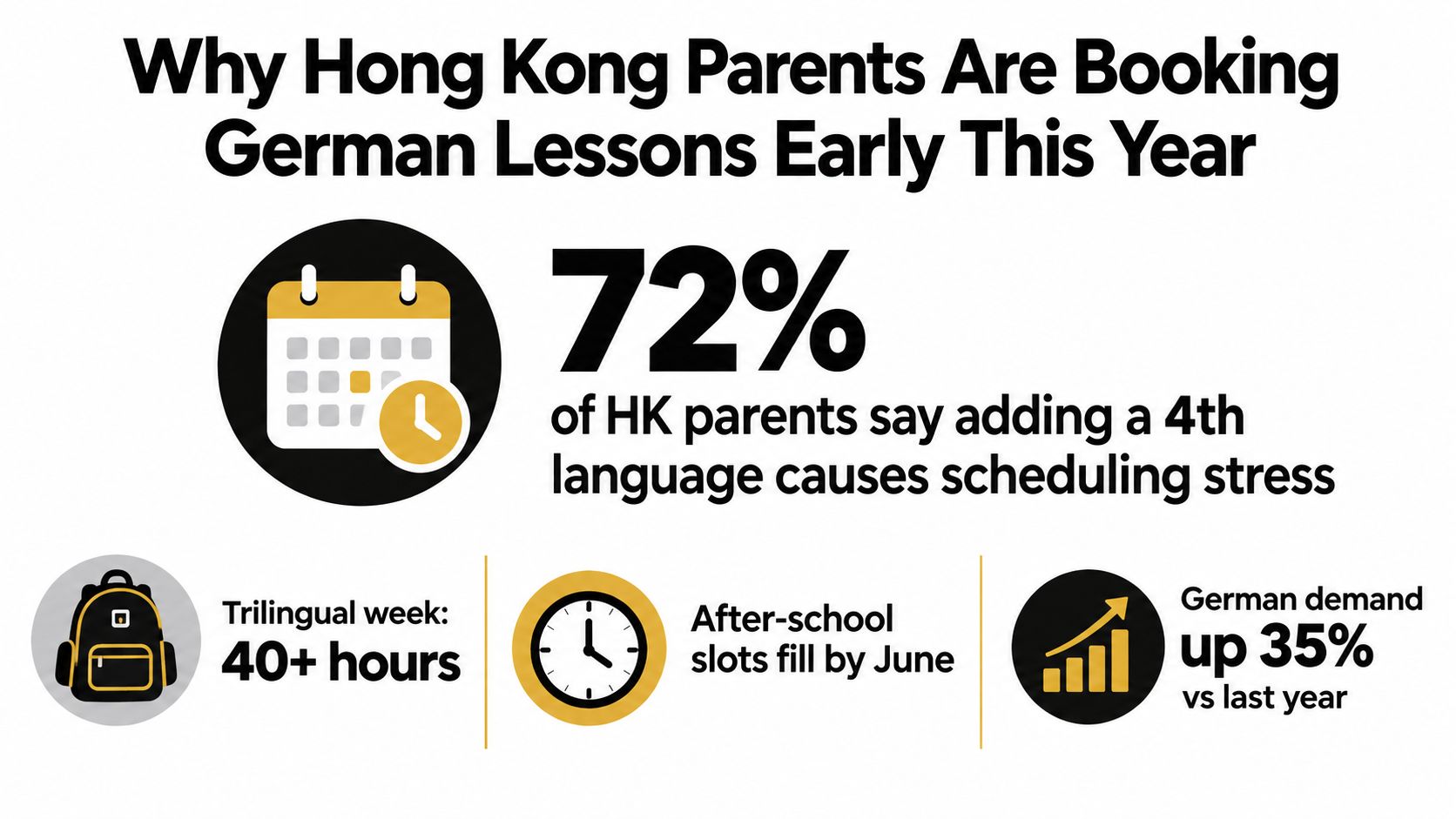
September 2026 brings the familiar Hong Kong squeeze. Weekday afternoons disappear between school dismissal, homework, swimming, music, tutoring and the journey home. Parents who leave German until the school term begins often end up piecing together a playgroup, an online tutor and occasional weekend revision, with no clear progression between them.
A better approach is to secure the weekly rhythm first, then choose the level. GCA's 2026/27 programme provides year-round native-taught classes across four age bands, with groups capped at six students, structured Goethe-Zertifikat alignment and online rescheduling through the parent portal.
The academic year contains 32 teaching weeks, beginning on September 1, 2026, with rolling intake available until October. Trial classes can be booked 14 days ahead, giving families time to check the teacher, location and class dynamic before committing.
Why early planning matters
German has established local depth rather than being a recent enrichment trend. The German Swiss International School states that it has offered dual-language through-train education from Kindergarten to Secondary since 1969, providing Hong Kong families with a long-running local benchmark for structured German learning. GSIS's documented language pathway and Hong Kong German playgroup context show why parents can reasonably compare a new enrichment class with an established school route.
German also remains a niche but persistent school subject. A University of Hong Kong paper reported that German was taught in four schools with 166 students during the 2016/17 school year, while another set of programmes recorded 90 German enrolments. The HKU foreign-language enrolment paper makes the progression issue clear. Families need continuity, not isolated exposure.
Practical rule: Book the timetable before the summer rush. A class your child can attend every week is more valuable than a theoretically stronger class that repeatedly clashes with school activities.
The Education Bureau recorded a fall in kindergartens from 1,049 in 2019/20 to 980 in 2024/25, while enrolment fell from 174,297 to 125,426, a decline of about 28% over five school years. Hong Kong's official kindergarten education data point to a concentrated and highly organised early-learning market. Parents are making language decisions earlier, and a structured start avoids the September scramble.
Which Class Level Fits Your Child's Age in 2026/27
Ages 3-5 join Sprout Stars playgroup, ages 6-9 join Junior A1, ages 10-12 join Junior A2, and teenagers move into the Bridge A2-B1 exam track. Placement depends on a 15-minute assessment, not a parent's self-declared CEFR level.
Ages 3-5, Sprout Stars
Sprout Stars should feel active, predictable and oral-first. Children learn through songs, movement, picture routines, classroom objects and short exchanges such as greetings, colours and simple preferences.
The programme's practical target is recognition of approximately 200 words, alongside comfort hearing German and responding without translating every phrase into Cantonese or English. At this age, the priority is a positive sound foundation and pre-literacy awareness, not formal exam drilling.
Ages 6-9, Junior A1
Junior A1 introduces basic literacy while developing listening and speaking towards Goethe-Zertifikat A1 Fit in Deutsch 1. Children work with short instructions, familiar topics, simple questions and carefully recycled vocabulary.
The class should also teach study habits. A child who can recognise classroom language, follow a routine and produce short spoken answers is better prepared for later reading and writing than a child who has memorised disconnected word lists.
Ages 10-12, Junior A2
Junior A2 develops longer exchanges, reading comprehension and short writing. The curriculum works towards Goethe-Zertifikat A2 Fit in Deutsch 2, while building the independence needed for school-based German.
Goethe-Institut Hong Kong recommends A1 Fit in Deutsch 1 for ages 10 to 16, while A2, B1 and B2 examinations for teenagers are recommended from age 12. Goethe-Institut Hong Kong's official exam age guidance also explains that younger candidates may require prior approval and can't appeal results solely on the basis of age.
Teen Bridge A2-B1
The Bridge track connects junior learning to Goethe-Zertifikat B1, IGCSE German, A-level, IB ab initio, IB B and TestDaF preparation. It's the appropriate place to discuss exam timing, school syllabuses and the language requirements attached to future university plans.
GCA accepts late joiners up to age 11, subject to assessment and available places. Parents should bring any previous report or course record, but shouldn't choose a level because a child has completed a workbook.
| Age Band | Class Name | CEFR Target | Curriculum Goal |
|---|---|---|---|
| 3-5 | Sprout Stars | Pre-A1 foundations | Oral exposure, songs, routines and approximately 200-word recognition |
| 6-9 | Junior A1 | A1 | Listening, speaking, basic literacy and Fit in Deutsch 1 preparation |
| 10-12 | Junior A2 | A2 | Reading, short writing, extended speaking and Fit in Deutsch 2 preparation |
| Teenagers | Bridge A2-B1 | A2 to B1 | Goethe-Zertifikat, IGCSE, A-level, IB and TestDaF pathway preparation |
For families comparing starting ages, this guide to the best age for children to start learning German is useful, but the decision should still be based on maturity, attendance and the child's existing language load.
What a Real Weekly Schedule Looks Like by Age Band
A good timetable has enough repetition to create memory without turning German into another source of fatigue. The younger schedule should be lighter and more playful. The primary schedule can include a defined speaking and homework cycle.
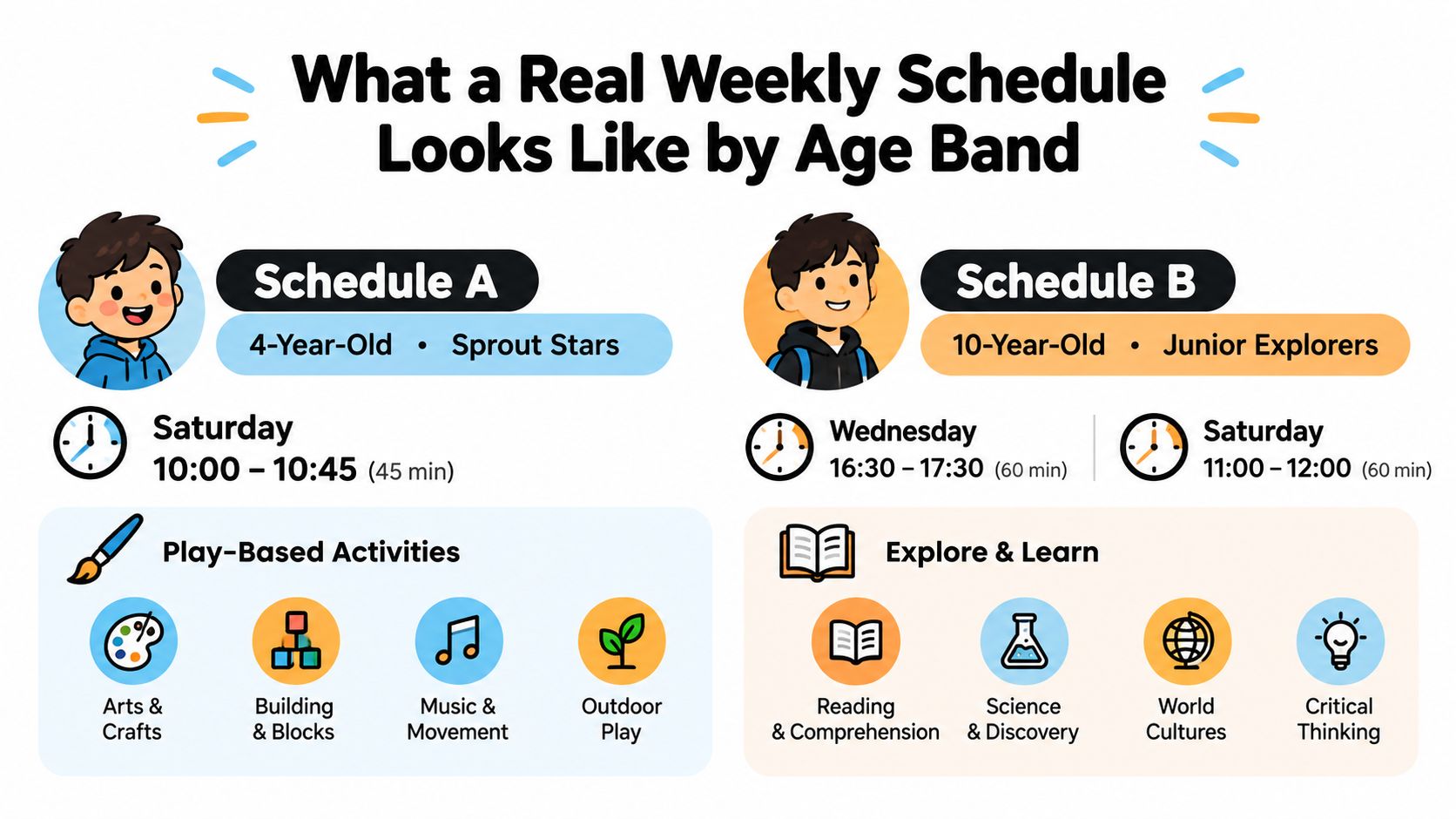
Schedule A for a 4-year-old
A realistic Sprout Stars arrangement is:
- Saturday 10:00 to 10:45: A 45-minute face-to-face class in Central or Causeway Bay.
- Optional weekday storytime: A 15-minute Zoom session for songs, picture books and familiar phrases.
- Home practice: Brief repetition during dressing, meals or play, rather than worksheets.
That format gives a preschool child a reliable weekly anchor while keeping additional exposure short. The optional storytime also helps a working parent maintain contact with German when a weekday commute makes a longer class unrealistic.
Schedule B for an 8-year-old
Junior A1 needs more sustained contact:
- Wednesday at 4:30pm: A 75-minute face-to-face class.
- Immediately afterwards: A 25-minute homework club to complete guided review.
- Saturday: A 30-minute conversation circle to practise speaking in a social setting.
Hong Kong travel time must shape the booking decision. A family travelling from Kowloon Tong may need to account for an MTR departure with doors closed at 4:46pm, while Southside families can face pickup gaps around Wong Chuk Hang. Keep a 10-minute buffer between school pickup and class start whenever possible.
Term rhythm and missed lessons
The teaching calendar runs across 32 weeks from September to June, with a two-week Easter pause aligned with local schools. Parents should review the school calendar before selecting Wednesday, Saturday or holiday sessions.
A missed lesson can be rescheduled up to 24 hours in advance through the parent portal. The year-end certificate requires 80% attendance, which is important when families want the record to support Goethe-Zertifikat or IGCSE planning.
Check the current GCA course schedule against your child's school dismissal time, not just the published class duration. A short journey and consistent attendance will usually outperform a more ambitious schedule that creates weekly stress.
Small Group vs One-on-One Lessons Compared
The format should match the child's learning problem. Small groups create interaction and turn-taking. Private tutoring gives the teacher complete control over pace, correction and exam focus.
| Dimension | Small Group, max 6 | One-on-One Private |
|---|---|---|
| Teacher attention | Shared across up to six learners, with individual correction built into activities | Full focus on one child |
| Pace | Follows the median learner in the group | Follows one child's exact pace |
| Social exposure | Strong, with peer questions, games and conversational turns | Limited unless the teacher designs role-play |
| Cost per 60-minute session | Shared class cost, subject to the published course fee | Individual private rate, usually higher per session |
For beginners aged 3-9, I recommend a small group. Children at this stage need to hear peers make and repair mistakes, wait for a turn, respond to different voices and use German for a purpose beyond answering the teacher.
A group of six doesn't mean six silent children waiting for a worksheet. A well-run class rotates speaking partners, uses movement tasks and gives each learner repeated opportunities to respond. The teacher can still correct pronunciation and track individual progress, but the class has the social energy young learners need.
Best fit: Choose a small group when confidence, listening and spontaneous speaking are the priority.
One-on-one lessons make more sense for a 10-12-year-old exam candidate, a shy child who avoids speaking in front of peers or a fast mover whose school target is more advanced than the group's median level. Private pacing is also useful when an IGCSE, A-level or IB deadline requires focused writing and correction.
For teenagers preparing Goethe-Zertifikat, a hybrid model is often strongest. Use group lessons for conversational confidence and private sessions for mock tasks, writing feedback and targeted grammar repair. Both formats can sit within a coherent German lessons Hong Kong plan, but the class should be selected for the outcome, not price alone.
Native Teachers and the Path to Goethe IGCSE and A-level
A credible children's programme needs more than a teacher who speaks some German. GCA's stated policy is that each German class is led by a native German speaker trained in age-appropriate pedagogy, with criminal background checks and at least a C1 German qualification.
Native-led teaching matters most in the early years, when children are forming sound patterns. It also matters later, when a student must distinguish between an answer that is understandable and one that meets the pronunciation, grammar and task demands of an examination.
The progression by age
- Ages 3-5: Oral foundations, sound awareness, songs, routines and pre-literacy.
- Ages 6-9: A1 listening and speaking, basic reading, and preparation towards Goethe Fit in Deutsch 1.
- Ages 10-12: A2 reading, writing and interaction, with Fit in Deutsch 2 as a reference point.
- Teenagers: IGCSE German, A-level, IB ab initio or B, TestDaF and Goethe-Zertifikat B1 or B2 planning.
The Goethe-Institut's age guidance should shape expectations. A1 Fit in Deutsch 1 is recommended from age 10, while A2, B1 and B2 teenager examinations are recommended from age 12. The full A1-C2 examination track is recommended from age 16. The official Goethe exam guidance is the right reference when a family is choosing an exam date.
Why the pathway matters in Hong Kong
Hong Kong students may be working within DSE, IB or IGCSE structures, and German must fit around those demands. A class that only provides games without a progression plan can leave a capable child with enthusiasm but no next step.
German may also become relevant to study abroad. German consular guidance states that a language-course visa for university preparation requires proof of German knowledge and course-provider documentation. Student visas for German-taught programmes also require sufficient German proficiency. German consular information for Hong Kong applicants makes early learning a practical long-term consideration, not a cultural extra.
The target isn't to rush a young child into an adult exam. It's to protect a credible progression so that by 16-18, the student can make an informed decision about Goethe certification, school qualifications, TestDaF or a German university route.
Tuition Attendance Rules and How CEF Funding Works
Parents should ask for the complete fee structure before reserving a place. For 2026/27, the published planning figures include a HKD 3,800 per-term small-group fee, a HKD 780 hourly one-on-one rate and a HKD 500 materials fee per term, as shown in the assigned programme visual. Registration charges and holiday calendars should be confirmed with the adviser because fees are reviewed for each new school year.
The important distinction is between a child's class fees and adult-funded study. Hong Kong's Continuing Education Fund is not a general subsidy for children's lessons. It applies to eligible residents aged 18 or above when the course starts, and claims are made after successful completion of an eligible course.

What CEF can cover
The government's CEF framework reimburses 80% of the first HK$10,000 of eligible course fees and 60% of the next HK$15,000, subject to a lifetime maximum subsidy of HK$25,000 per person. The Hong Kong CEF funding guide for German study explains the limits and adult eligibility requirements.
A parent may therefore enrol in an eligible adult German course connected to the family's language plans, but shouldn't assume that the child's tuition qualifies. Confirm the provider, course approval and claim conditions before paying.
One representative HKU SPACE course requires students to pass with at least 50% of the marks, attend 70% of lessons, take a recognised benchmark exam such as Goethe-Zertifikat B1 and submit the claim within one year after successful completion. HKU SPACE's German course requirements show why attendance and assessment rules matter.
For children, GCA's year-end certificate requires 80% attendance. Online rescheduling can help when school events clash, but parents should confirm the permitted makeup-class ceiling, registration fee and seasonal holiday arrangements before enrolment.
For exam budgeting, Goethe-Institut Hong Kong lists the internal A1 Start Deutsch 1 fee as HKD 1,000 and the external fee as HKD 1,400. The Goethe-Institut Hong Kong course brochure provides that local reference point.
Further details on adult eligibility and course mechanics are available in this guide to CEF-funded German courses in Hong Kong.
Enrolment Steps and Key Dates for September 2026
Families should treat September enrolment as a short planning project. The recommended booking window is 8-10 weeks before the September intake, especially for Saturday classes and locations convenient to Central, Kowloon or the Southside.
The six-step route
- Complete the online level check. Include the child's age, school type, current languages and any previous German exposure.
- Book a parent consultation. Discuss school dismissal, travel time, exam ambitions and whether group or private tuition is appropriate.
- Reserve a trial class. Trial classes are bookable 14 days ahead, so choose a date that reflects the child's normal energy level.
- Complete the placement assessment. GCA uses a 15-minute assessment rather than relying on a parent-selected CEFR label.
- Confirm enrolment and payment. Review the term fee, materials charge, registration conditions, rescheduling rules and attendance requirement.
- Read the welcome pack. Check the teacher introduction, class location, preparation notes and the first month's calendar.
What to prepare
Bring the child's school calendar, known activity commitments and any German report, certificate or tutor feedback. Parents don't need to create an artificial German portfolio. Honest information produces a more useful placement.
Late enrolment remains possible on a rolling basis until October, subject to space. Mid-year starters can be integrated after the October half-term when the adviser confirms that the child's level and the class sequence match.
Use this checklist before contacting the centre:
- School timetable: Mark dismissal times, transport and fixed activities.
- Language background: Record Cantonese, Putonghua, English and any other regular exposure.
- German history: Note playgroups, tutors, school lessons or exams.
- Target: Choose oral confidence, school support, Goethe preparation or a longer university pathway.
- Logistics: Keep a realistic travel buffer and a backup plan for clashes.
The best German lessons Hong Kong families choose are the ones that survive the school calendar. Ask the adviser to test the timetable against actual pickup arrangements, not an ideal week.
FAQs and How to Book Your Trial Lesson in Hong Kong
How much should families budget for 2026/27?
The published planning reference is HKD 3,800 per term for small-group children's classes, HKD 780 per hour for one-on-one tuition and HKD 500 per term for materials, as displayed in the programme information. Registration charges, holiday arrangements and any updated term pricing should be confirmed before payment.
Exam fees are separate. For Goethe-Zertifikat A1 Start Deutsch 1, Goethe-Institut Hong Kong lists HKD 1,000 for internal candidates and HKD 1,400 for external candidates. The local Goethe exam fee reference should be checked again when the child is ready to register.
Can German help with a German university visa route by age 16-18?
It can support a longer-term route, but lessons alone don't satisfy visa requirements. German consular guidance requires proof of German knowledge for a university-preparation language-course visa, and German-taught degree programmes require sufficient proficiency. The German consular document requirements for Hong Kong are the relevant starting point.
For a child, the sensible plan is gradual. Build oral confidence first, then choose Goethe, IGCSE, A-level, IB or TestDaF preparation when the student's school pathway and age make the target meaningful.
Which location suits different Hong Kong families?
For Central families, Causeway Bay is a practical option when the journey from school or home is direct. Families travelling from Kowloon should compare the Tsim Sha Tsui route with the child's MTR and pickup timetable. Southside families may prefer Causeway Bay if it reduces the number of changes and gives the child a reliable buffer.
GCA also offers interactive Zoom sessions, which can protect continuity during illness, travel or a difficult school week. The right location is the one your child can reach calmly and consistently.
Can siblings of different ages share one class?
Usually, mixed-age siblings shouldn't share a class for convenience. A preschool child needs play-based oral exposure, while a primary or pre-teen learner may need literacy, writing and exam preparation.
Ask for a joint assessment. If their German experience, attention span and learning objectives are close, an adviser can discuss a suitable arrangement. Otherwise, separate age bands or a shared online family routine will produce better learning conditions.
To Learn German HK families can defend as a serious educational choice, book the trial around your child's actual school week. Use the trial to test listening, confidence, travel practicality and the teacher's progression plan, not just whether the child enjoys one activity.
German Cultural Association Hong Kong(GCA) offers native-led German lessons for children across structured age bands, with small-group and private options, flexible rescheduling and preparation for Goethe-Zertifikat, IGCSE, A-level, IB and TestDaF. Visit German Cultural Association Hong Kong(GCA) to book a trial class, speak with an adviser and check the latest 2026/27 course schedule.

German Lessons for Kids 2026/27: New School Year Classes for Ages 3-12
German Playgroup Hong Kong 2026/27: New Term Classes for Ages 1-4


