.png)
.png)

BLOG

香港德國文化協會
The German Cultural Association
German Language Playgroup Hong Kong 2026: The Complete Guide for Ages 1-4
Your child is already hearing Cantonese, English, and probably Putonghua. You're wondering whether adding German is ambitious, unnecessary, or exactly the kind of early move that pays off later.
My view is simple. For many families, German Language Playgroup Hong Kong 2026 isn't about creating a mini polyglot on a schedule packed with classes. It's about giving a child aged 1 to 4 the right kind of German input, at the right age, in a format that supports development instead of overwhelming it.
That distinction matters in Hong Kong. Parents here don't need more vague promises about “exposure”. They need clarity on what a one-year-old can absorb, what a three-year-old enjoys, and what kind of playgroup is worth the time.
Give Your Child a Head Start with German in Hong Kong
German is not a random extra in Hong Kong. It sits on a real educational pathway with local roots. German Swiss International School has offered a dual-language through-train education from Kindergarten to Secondary since 1969, which gives German learning in the city historical depth rather than novelty, as outlined on the GSIS website.
That matters for parents. If you're choosing German for your toddler, you're not betting on a short-lived enrichment trend. You're stepping into a language pathway that has been visible and credible in Hong Kong for decades.
Why German makes sense for HK families
Most Hong Kong parents already think strategically about language. English is a priority. Chinese is a given. German usually enters the conversation when parents want a serious third language with long-term academic and cultural value.
For children aged 1 to 4, the immediate goal is not grammar. It is:
- Sound familiarity so German doesn't feel foreign later
- Listening confidence with a new rhythm and pronunciation system
- Positive emotional association with another language
- Routine-based learning through songs, movement, stories, and repetition
A good early German programme does one thing well. It makes the language feel normal.
Practical rule: If a toddler enjoys the session, anticipates familiar songs, and starts recognising repeated words, the playgroup is doing its job.
Don't think in terms of “more classes”
That's where many parents go wrong. They compare German playgroup to phonics, Mandarin tutoring, music, and sport as if all enrichment has the same developmental purpose.
It doesn't.
A German playgroup for ages 1 to 4 should function as guided language play, not an academic lesson. The right programme builds comfort, rhythm, and interaction. The wrong one turns German into background noise, or worse, another structured obligation for a child who still needs space to play.
In Hong Kong, where children often start organised activities early, restraint is a strength. You don't need the most intense option. You need the most age-appropriate one.
What Exactly Is a German Language Playgroup
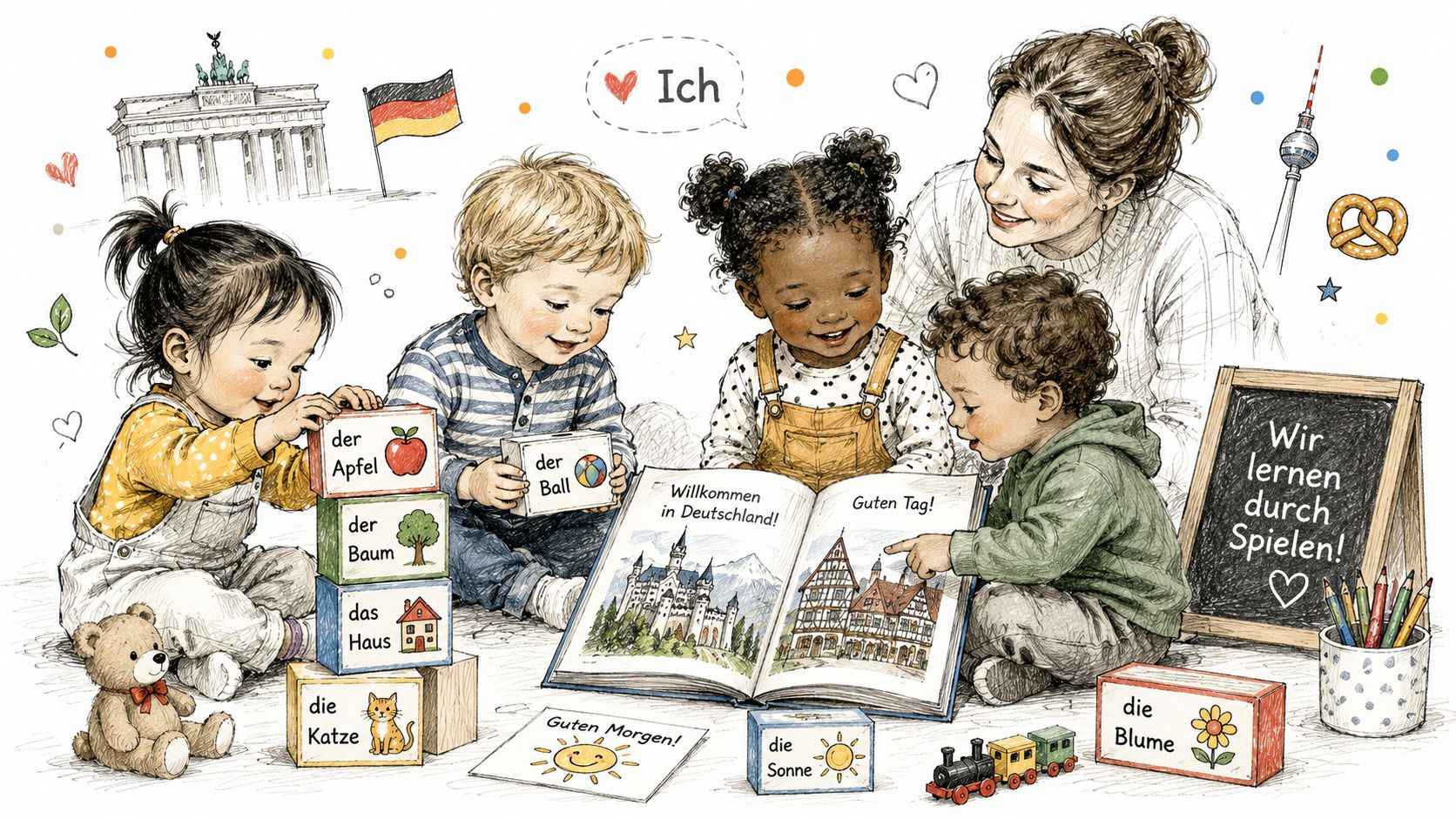
A German language playgroup is a structured, play-based small-group session where young children learn German through songs, stories, movement, routines, and interaction. It is not daycare and not formal tuition. Its purpose is to build early listening, response, and confidence in German through developmentally appropriate play.
What a real playgroup includes
In Hong Kong, German playgroups are usually built around early language development rather than babysitting. One local provider describes a German playgroup for ages 2 to 5 with a maximum of 12 children per class and sessions available Monday to Friday for 2 hours, 2 to 5 times a week, as shown on HK Languages' German playgroup page.
That tells you what serious providers understand. Young children learn best when the group is contained, the routine is predictable, and the adult interaction is active.
A proper German playgroup usually includes:
- Songs and circle time so children hear repeated phrases in context
- Story-based language with visual cues, gestures, and objects
- Movement activities that link action to vocabulary
- Hands-on tasks such as simple crafts, matching, sorting, and pretend play
- Cultural touches like seasonal songs or German nursery traditions
If you want a broader framework for how these settings differ, this overview of philosophies of early childhood education is useful because it helps parents judge whether a class is child-led, routine-based, or overly instructional.
What it is not
Parents often confuse three very different formats.
| Format | Main purpose | What to expect |
|---|---|---|
| German playgroup | Early language exposure through play | Songs, movement, stories, routines |
| Daycare | Care and supervision | Broader care focus, language may be secondary |
| Formal class | Instruction and measurable output | More teacher-led, less suited to younger toddlers |
A one-year-old does not need a classroom. A two-year-old does not need worksheets. A four-year-old may enjoy more structured group games, but still learns best through action and repetition.
The label matters less than the interaction. If children mostly sit, wait, and listen passively, it isn't a strong early language playgroup.
The test parents should use
Ask three questions before enrolling:
- Is the language built into play, not added awkwardly on top?
- Is the group small enough for real interaction?
- Does the session design suit my child's age, not just the provider's timetable?
If the answer to any of those is no, keep looking.
The Brain-Boosting Benefits of Early German Exposure
Hong Kong children often grow up in multilingual environments already. That's why the concern isn't whether they can “handle” German. It's whether the input is well judged.
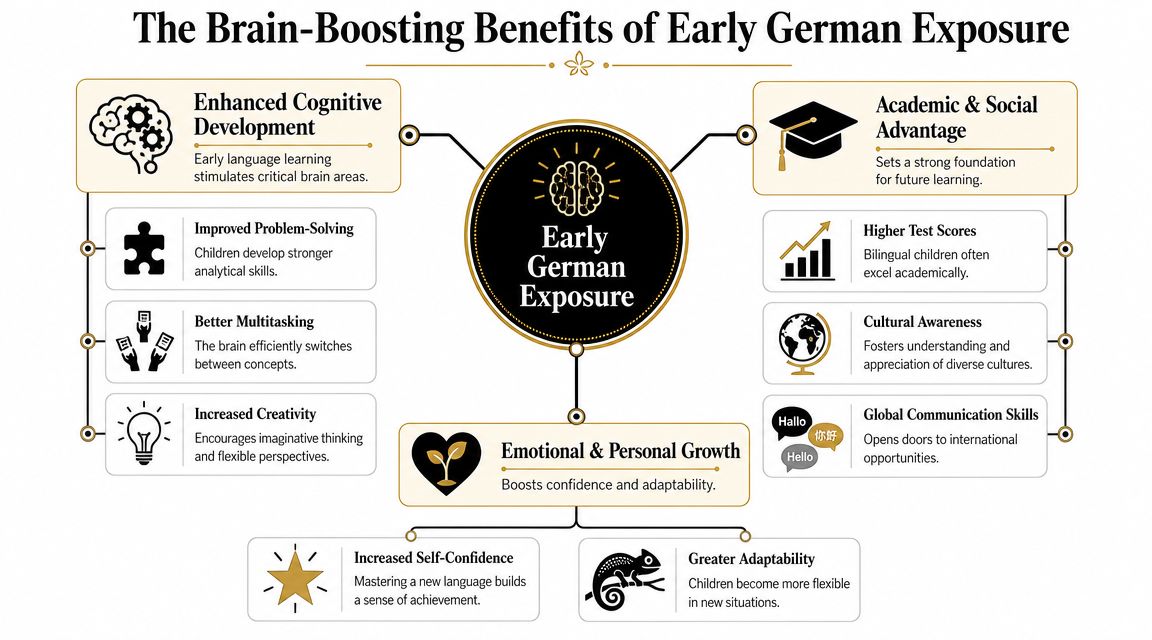
According to Hong Kong census context cited in local guidance, 18.5% of usual residents reported speaking Cantonese, English and another language, and 29.6% reported speaking both Cantonese and English. That's a useful reminder that many families are already operating across multiple languages. In that same context, the key question for toddlers is not maximum exposure. It is quality interaction.
Why quality beats volume
The Harvard Center on the Developing Child emphasises serve-and-return interactions. That means a child signals, an adult responds, and the exchange continues. This back-and-forth is a core driver of early brain development.
In practice, that has a direct implication for German playgroups.
A child gains more from a teacher who notices a gesture, repeats a word, expands it, and invites a response than from a longer session filled with passive listening. More hours do not automatically mean better outcomes. Better interaction does.
That's also why I don't recommend German-only intensity for every toddler in HK. Some children thrive with it. Others do better with mixed-language support, parent-and-child participation, or shorter highly responsive sessions.
What early German can support
When the playgroup is well run, children often gain benefits in three areas:
- Listening control by learning to notice new sounds, patterns, and cues
- Mental flexibility through switching between familiar and unfamiliar language systems
- Social confidence as they respond non-verbally first, then verbally, in a safe setting
For parents who want practical ideas to reinforce this at home, Grow With Me's language development tips offer easy activity ideas that fit toddler attention spans.
Will German confuse my child
Usually, no. What confuses children is poor delivery, not multilingualism.
Problems tend to come from sessions that are too long, too abstract, too fast, or too disconnected from the child's developmental stage. A one-year-old needs warmth and repetition. A two-year-old needs movement. A three-year-old enjoys routines and naming games. A four-year-old can manage simple turn-taking and thematic language.
If you want a broader parent-focused view on timing, this article on the best age for kids to start learning German is a sensible companion read.
Short, responsive, repeated interaction builds stronger foundations than a packed timetable.
A Week in Our GCA German Playgroup
A good playgroup should feel organised without feeling rigid. Children need repetition, but they also need freshness. The week should have a rhythm that parents can recognise and children can anticipate.
Here is the kind of weekly structure I recommend for toddlers learning German in Hong Kong. The topics are simple. The value lies in repetition, sensory engagement, and predictable language patterns.
Monday with songs and circle time
Monday should reset the group. Children arrive, settle, and hear familiar greetings, names, weather words, and songs.
For younger toddlers, that may mean bouncing to a hello song, clapping, and identifying simple objects. For older preschoolers, it can include choosing a picture card, naming colours, or joining a short routine independently.
Tuesday with art and messy play
Art is excellent for early language because hands stay busy while the teacher repeats useful words. Colours, shapes, body parts, tools, and action verbs come up naturally.
If you're looking for more general inspiration for this age, Hiccapop's preschooler activity suggestions are a helpful reminder that the best activities are concrete, physical, and simple.
Wednesday with stories and puppets
Story sessions help children tolerate listening a little longer. Puppets reduce pressure. Children who won't answer an adult often respond to a puppet.
Repeated phrases hold particular significance. A child doesn't need to understand every word. They need to recognise enough to predict what comes next.
Thursday with movement and pretend play
German becomes memorable when it is attached to action. Jumping, hiding, finding, feeding, washing, opening, closing. These are ideal toddler verbs.
A movement-heavy session is often where quieter children start joining in.
Friday with music and routine review
Friday should consolidate, not overload. Bring back the week's songs, key words, and favourite games. Parents often underestimate how much retention depends on this kind of review.
Children don't learn a new language in neat weekly blocks. They learn through circles of repetition.
Sample weekly activities by age group
| Age Group | Sample Activity | Learning Goal |
|---|---|---|
| 1 to 2 | Hello song with parent, waving, clapping, name response | Build comfort, turn-taking, sound recognition |
| 1 to 2 | Sensory basket with animals or food objects | Link concrete objects to repeated German words |
| 1 to 2 | Action rhymes and movement | Associate verbs with body movement |
| 3 to 4 | Storytime with picture prompts | Strengthen listening and prediction |
| 3 to 4 | Colour sorting or simple craft | Practise thematic vocabulary and following instructions |
| 3 to 4 | Role play such as shop, kitchen, or animals | Encourage spontaneous use of words and phrases |
What changes by age
The biggest mistake I see is treating ages 1 to 4 as one group with one method.
Ages 1 to 2 need:
- Parent security or very gentle transition
- Short activity bursts
- Physical cues
- Heavy repetition
Ages 3 to 4 can manage:
- Simple routines without constant parent support
- Themed games
- Basic turn-taking
- More intentional verbal participation
That's why a serious German Language Playgroup Hong Kong 2026 approach must separate age expectations clearly. If the provider can't explain what is different for a one-year-old and a four-year-old, the programme isn't designed carefully enough.
How the GCA Playgroup Programme Works
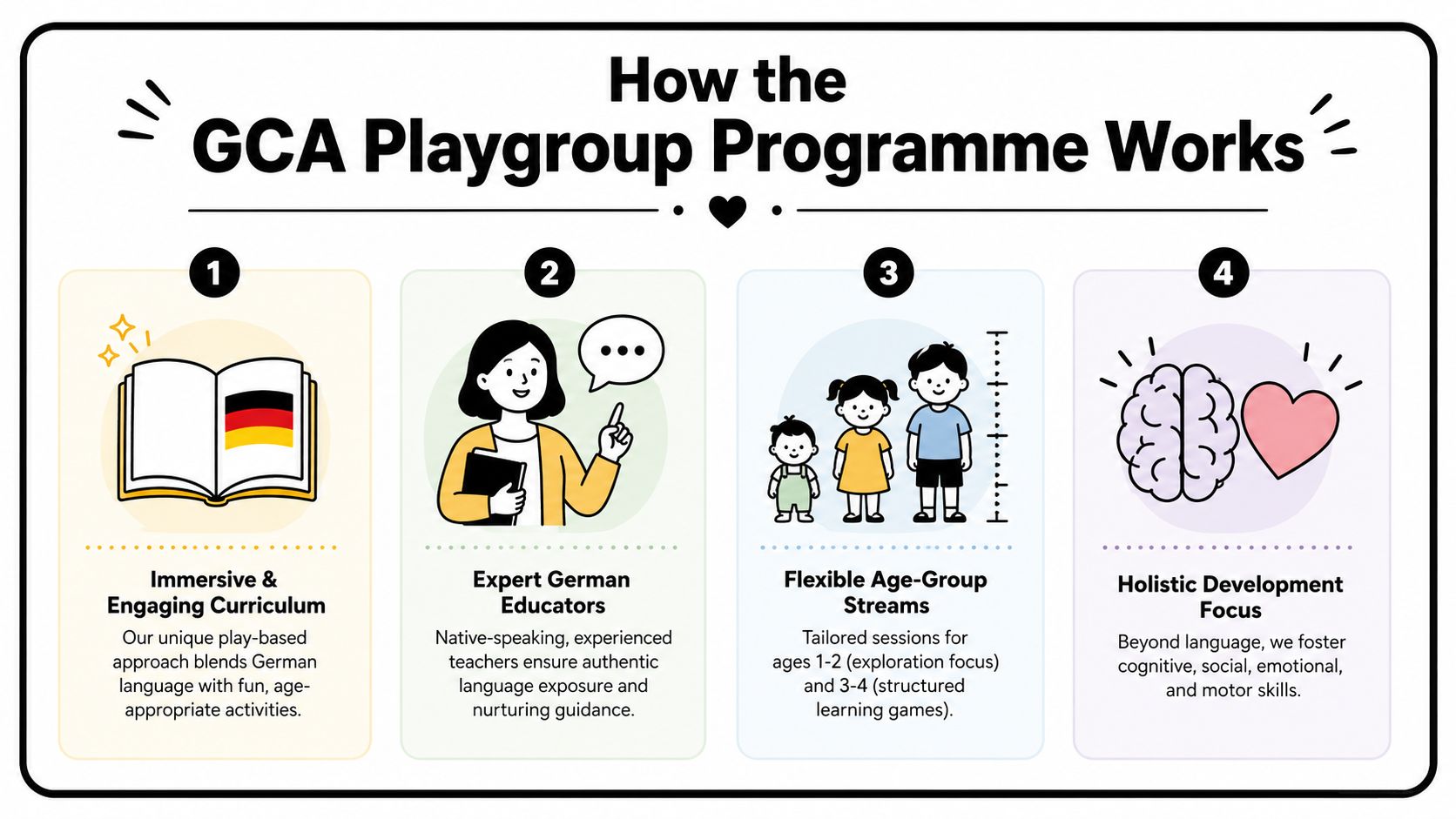
For families who want a structured option rather than a casual drop-in format, the preschooler courses at GCA are organised around small groups, native-speaking teachers, and age-sensitive delivery. That matters more than flashy themes or oversized classes.
Native-speaking teachers matter
Young children copy sound before they understand structure. That's why pronunciation quality matters from the start.
At GCA, teaching is delivered by native German speakers with academic credentials and teaching experience. For toddlers, this means authentic sound patterns, natural rhythm, and better modelling during songs, stories, and routines.
Small groups change everything
Group size is not a minor detail. It shapes how much a child is seen, heard, and invited into interaction.
GCA uses a small-group format with a maximum of 6 students. For young children, that gives the teacher space to notice individual responses, slow the pace when needed, and keep the session interactive rather than performative.
The age-group structure should be obvious
A good programme doesn't place ages 1 to 4 in the same room and hope for the best.
The practical split looks like this:
- Ages 1 to 2 focus on exploration, routine, movement, and parent-supported confidence
- Ages 3 to 4 move into more structured games, story response, and guided participation
That difference is not cosmetic. It affects attention span, emotional security, and language uptake.
Hong Kong logistics matter too
Parents in HK care about quality, but they also care about transport and scheduling. They should.
GCA offers in-person classes near Tsim Sha Tsui and Causeway Bay MTR stations, plus interactive online sessions via Zoom. For some children, online isn't the first choice at this age. But for families balancing siblings, travel, and tight timetables, flexibility matters.
Health, attendance, and consistency
A toddler programme should be simple for parents to manage.
What matters most is consistency. A child who attends regularly, sees familiar routines, and hears repeated classroom language will usually benefit more than a child jumping between random enrichment experiences. The structure at GCA also includes easy online rescheduling and a certificate system requiring 80% attendance, which helps families maintain momentum without turning the programme into a source of stress.
How Much Does a German Playgroup Cost in Hong Kong
Parents ask this immediately, and they should. Cost matters. In Hong Kong, every extra activity competes with transport time, family schedule, and the simple question of whether the child will benefit.
The honest answer is this. German playgroup fees vary by provider, group size, format, and term length. A premium small-group programme with native-speaking teachers will usually cost more than a casual large-group session, but the point is not buying hours. It's buying better interaction.
What you're really paying for
When I assess value, I look at four things:
- Group size because toddlers disappear in large groups
- Teacher quality because early pronunciation and interaction style matter
- Age fit because a mixed 1 to 4 format often serves nobody well
- Structure because random exposure feels busy but doesn't build much
If you're comparing options, don't ask only for the fee. Ask what happens in the room.
For a broader overview of pricing context, this guide on how much it costs to learn German in Hong Kong helps parents understand the broader picture.
The smartest first step is a trial
For cost-conscious families, a trial class is the right move.
It gives you direct evidence of:
- Whether your child settles well
- Whether the teacher engages children actively
- Whether the group pace feels appropriate
- Whether German feels enjoyable rather than forced
That is far more useful than reading course descriptions for an hour.
If a provider won't let you understand the class experience before a longer commitment, be cautious.
Practical enrolment questions to sort out early
Before you sign up, check these basics:
Location and travel time
If getting there is stressful, attendance will suffer.What to bring
Usually keep it simple. Water bottle, spare clothes if needed, and comfort items for younger toddlers.Parent participation policy
Essential for younger children. Optional for older ones.Make-up options
Important in a city where family schedules change quickly.
A good German playgroup should feel manageable for the parent as well as enjoyable for the child.
Ready to Give Your Child a German Advantage
If your child is between 1 and 4, don't chase intensity. Chase fit.
The right German playgroup gives your child something much more useful than early performance. It gives them ease with the language, positive listening habits, and confidence around unfamiliar sounds and routines. That's the essential foundation.
For Hong Kong families, that's especially valuable. Children here already experience multilingual environments. A well-designed German programme can support that reality beautifully, but only if the class respects developmental stage.
My direct recommendation
Choose a programme if it does these things well:
- Separates expectations for ages 1, 2, 3, and 4
- Uses small-group interaction rather than crowd management
- Builds language through songs, play, and response
- Feels calm, consistent, and organised
- Gives parents a clear sense of purpose, not marketing fluff
Skip anything that looks impressive on paper but ignores how toddlers learn.
A strong early start in German can sit naturally alongside your child's life in HK. It doesn't need to be dramatic. It needs to be thoughtful, age-appropriate, and consistent. That's how young children learn well.
If you're considering a German playgroup for your toddler, the next step is simple. Explore the programmes at German Cultural Association Hong Kong(GCA), book a trial class, or speak with an advisor about the right age group, class format, and schedule for your child.
German Prepositions: Which Case Does Each One Take? Complete Tables
German Accusative Case Explained: When and How to Use Akkusativ


