


BLOG

香港德國文化協會
The German Cultural Association
German Listening Practice: A 90-Day Plan from Confused to Confident
“Just listen to more German” isn't enough. You can replay a dialogue on the MTR, recognise the topic and still miss the price that answers the question.
German listening practice needs a task, a score and a reason for each replay. This 90-day plan turns a crowded Hong Kong commute or an evening study slot into measurable checkpoints, without pretending that a few months will deliver fluency.
Table of Contents
How Long German Listening Practice Takes
Active German listening in Hong Kong takes a focused 90-day training cycle, not a fixed route to fluency. Use 10 to 40 minutes daily. Days 1 to 30 target sounds and numbers; days 31 to 60, short dialogues; days 61 to 90, timed papers. Aim for 80 percent on two mocks.
Follow the score, not just the calendar
More listening isn't automatically better. Extra passive hours don't reliably raise a listening score when you never check what you misunderstood, recycle useful vocabulary or practise answering under time pressure.
Treat the schedule below as a teaching framework. Its percentages are practice targets, not official examination pass marks.
90-day German listening phases
| Phase | Days | Listening focus | Active minutes | Move on when |
|---|---|---|---|---|
| Sound recognition | 1–30 | A1/A2 phonemes, numbers, dates, prices, classroom instructions | 10, 20 or 40 | 80 percent on a short dictation |
| Short exchanges | 31–60 | Names, times, places, opinions and gist in everyday dialogue | 10, 20 or 40 | Key details correct without the transcript |
| Timed papers | 61–90 | Announcements, interviews and distractors under a clock | 20 or 40, timed | 80 percent on two consecutive mock sets |
Begin with a day-1 baseline: choose a level-appropriate recording you haven't heard, answer its questions and keep your original responses. Repeat the same style of check on days 30, 60 and 90, using fresh material of comparable difficulty.
Record both the score and the reason for each miss. A higher result on an audio clip you've memorised doesn't show that you can understand an unfamiliar speaker.
Progress rule: Stay in a phase until you meet its target, even if the calendar says it's time to move on.
For a consistent learner with some foundations, this can build towards an A1-to-A2 listening checkpoint. It isn't a promise of full A2 competence across reading, writing, speaking and listening.
An IGCSE beginner may need the whole opening phase for sound recognition. As an alternative schedule, an adult who already clears an A2 placement check could shorten that phase to two weeks and spend the saved time on unfamiliar exchanges.
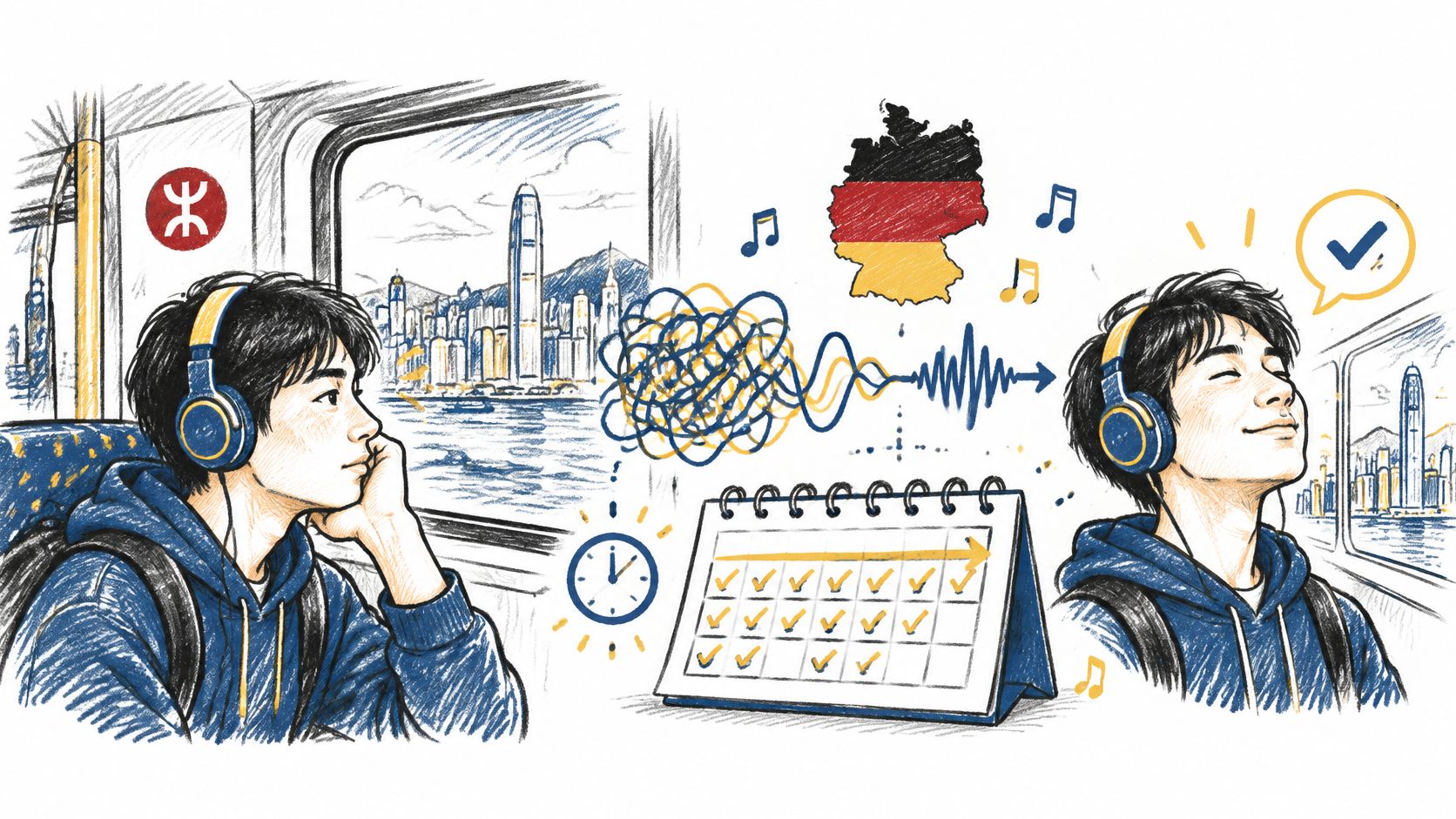
The visual below shows the progression from hearing the topic to recovering the detail that matters.

Count backwards from the examination
According to the official German examination information for Hong Kong, from 2025 the Goethe-Zertifikat is the stipulated examination for HKDSE Category C German, and candidates must complete at least A2 within the preceding two years.
For families, that means choosing an appropriate examination date before arranging the study calendar. Leave room for feedback, registration requirements and further preparation if the checkpoint shows that the learner isn't ready.
Fit Practice Around Hong Kong Schedules
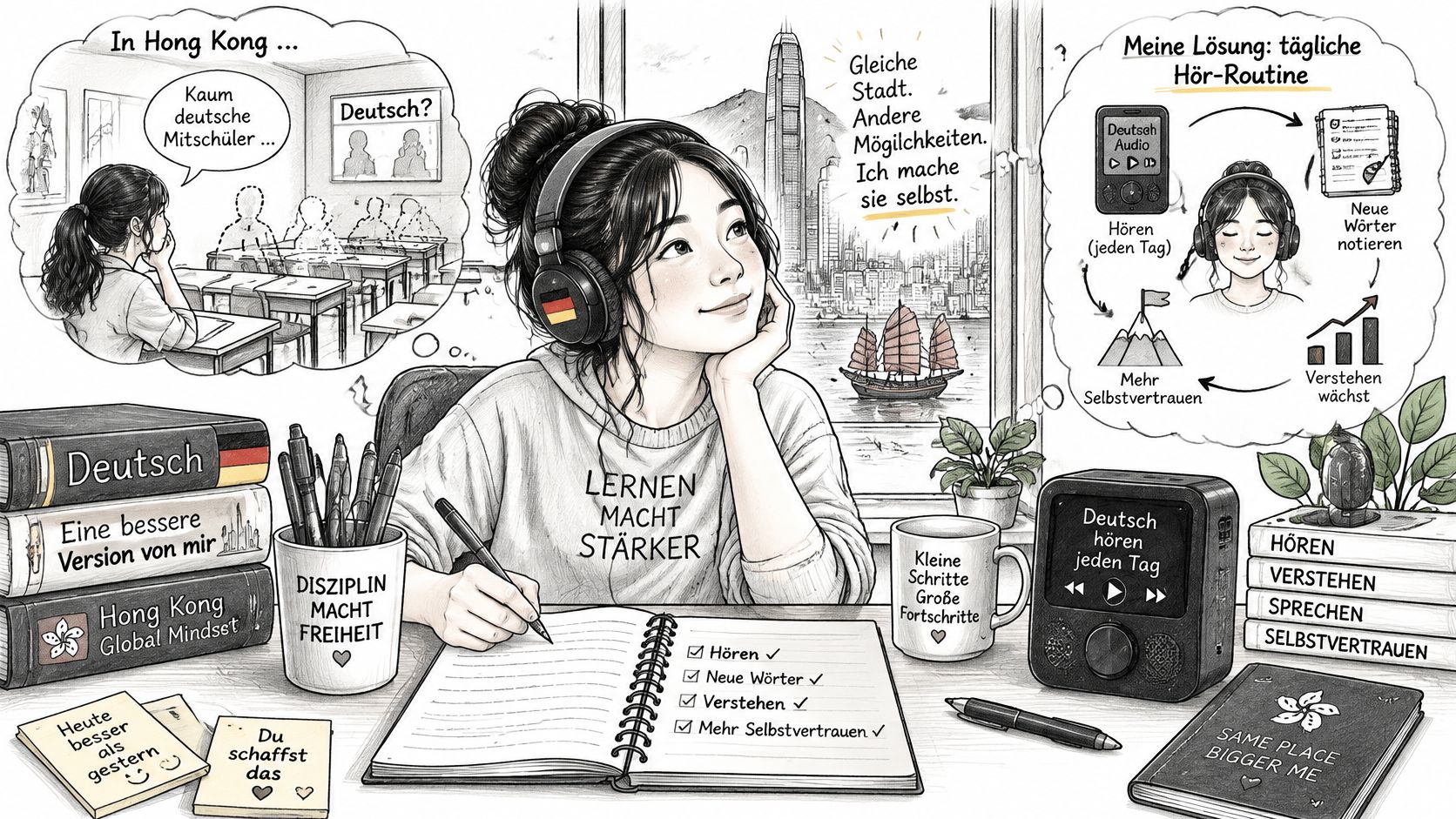
German-speaking classmates, neighbours and colleagues aren't something every learner in Hong Kong can rely on. Build a substitute for immersion instead of waiting for daily conversation to happen.
An HKU-referenced school-language comparison reported 90 German students across four schools in 2016/17, with larger cohorts for French, Spanish and Japanese. That's a historical snapshot, not a count of today's learners, but it illustrates why a school friendship group may offer limited German practice.
Choose a realistic week
The following are example schedules, not minimum study requirements. Choose the arrangement you can protect when school deadlines or work meetings pile up.
A teenager's school week. Try 10 minutes before school on classroom instructions, then reserve a 40-minute Sunday slot for a mock-style exercise and correction. Early in the programme, use that longer slot for untimed practice rather than forcing an examination paper too soon.
A professional's commute. Download a dialogue and set aside a 20-minute MTR or lunch-break session. Listen for the situation first, then for details; keep the transcript closed until you've attempted the second pass.
A parent's supported routine. Sit beside your child for a 20-minute after-class session, then spend 10 minutes alone noting what they missed. Record the difficulty without supplying every answer while the audio is running.
A quiet desk can be more useful than a longer journey if the task involves writing or checking answers.
Select voices and situations deliberately
Start with clear standard German. Once you can reliably recover A2 or B1 details, introduce a small amount of Austrian and Swiss audio, preferably standard-language broadcasts or learner-friendly interviews before strong dialect.
The aim isn't to imitate every accent. It's to avoid understanding only the familiar voice in your course recording.
Rotate tasks that connect with your actual plans:
- Travel: Practise a German café order using the choices you'd make in a Causeway Bay café.
- University preparation: Listen to a student-visa appointment or an accommodation enquiry for study abroad in Germany.
- Work: Follow a call with a German office about an appointment or delivery.
- Transport: Extract a destination, platform change and departure time from an announcement.
Keep the practical arrangements simple:
- Use headphones safely: In a noisy station, don't keep increasing the volume; move detailed work somewhere quieter.
- Repeat a useful clip: Try the same recording over three days rather than choosing a new show daily.
- Keep a paper log: A playlist history proves that something played, not that you understood it.
Run Each Listening Session in Six Steps
Keep the routine stable while changing the difficulty of the recording. That makes German listening practice easier to organise because you aren't inventing a new study method each evening.
Keep the task the same as the audio gets harder
Set the timer. Choose a 10-, 20- or 40-minute session and put your phone offline after downloading the audio. This keeps notifications and browsing from turning a listening task into background noise.
Play once for gist. Listen without stopping, then write a sentence explaining the situation, such as a customer changing a booking. Don't open the transcript first, because reading the answer hides whether your ear understood it.
Replay for selected details. Capture numbers, names, places and times rather than attempting a full transcription. Skipping this pass can leave you understanding the story while losing the marks attached to its practical details.
Check the transcript selectively. Mark only words or phrases that blocked meaning. Distinguish a word you didn't know from a familiar word you failed to recognise in connected speech.
Shadow a short line aloud. Replay a useful phrase and repeat it immediately, matching its rhythm and stress. This connects the spelling you recognise on paper with the sound you'll hear next time.
Log the main error and recycle it. Give the miss an error code, then choose a phrase to revisit in the next session. The purpose is a precise follow-up task, not a long notebook entry you'll never use.
The visual offers a compact reminder of the listening, speaking and checking cycle.

For ideas on spacing and recalling material rather than merely rereading it, you can study smarter with Kohru's learning techniques. Apply those ideas to phrases you've already checked against the recording.
Match the material to the phase
Use this suggested sequence as a selection guide:
- Days 1–10: Make number and date recordings with a teacher or language partner, alongside slow A1 shop dialogues. A useful exercise contrasts vierzehn and vierzig before placing them inside prices or times.
- Days 11–30: Add classroom instructions and short announcements. Listen for the action required, such as opening a book, completing a form or waiting outside.
- Days 31–60: Use unscripted everyday exchanges with clear sound and an available transcript, played twice during practice. Extract what each speaker wants, not just the setting.
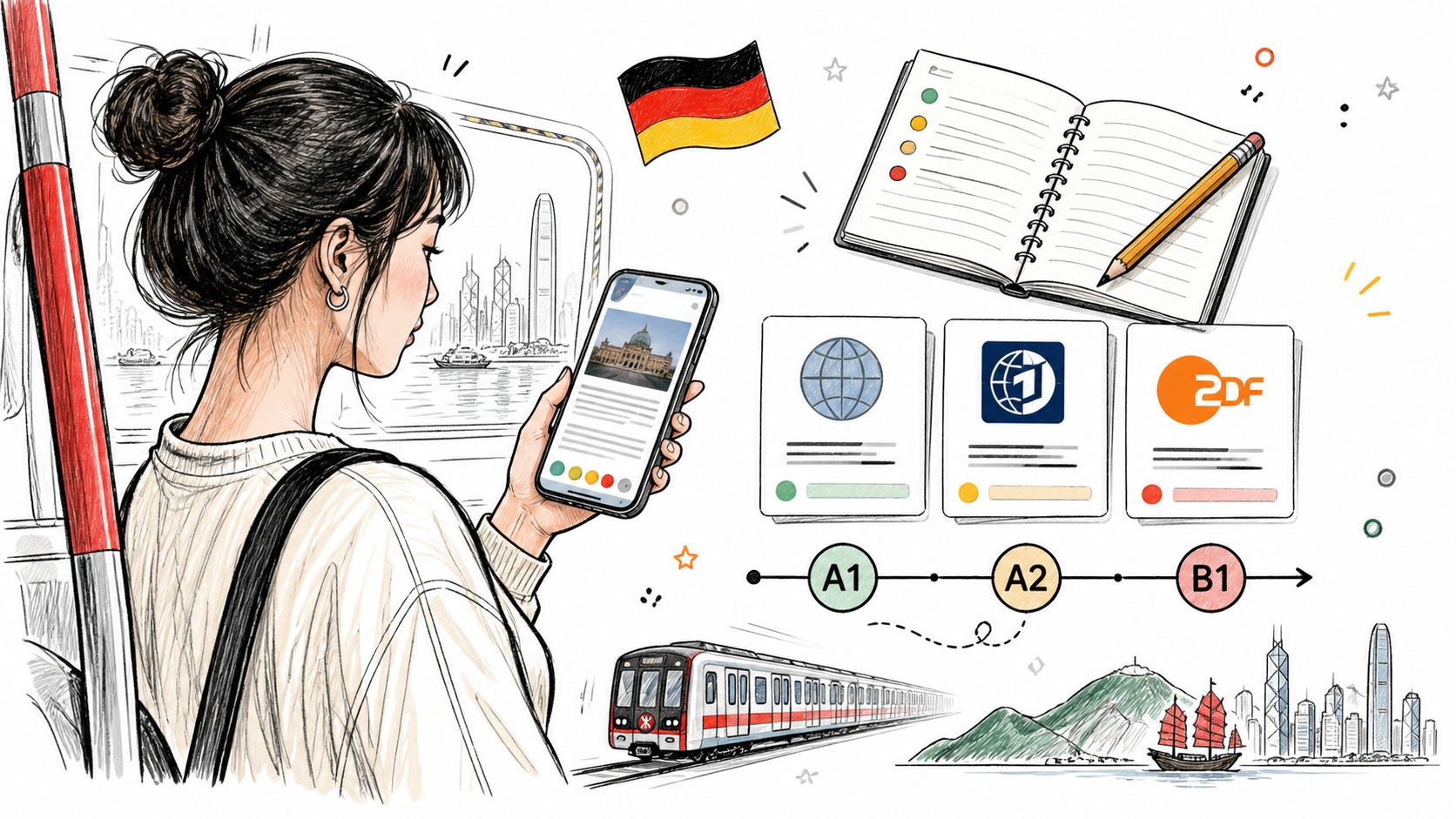
- After day 45: Try a slow news item, such as Langsam gesprochene Nachrichten, only if A2 detail is already stable. A slower voice doesn't make unfamiliar news vocabulary elementary.
- Days 61–90: Use official-style Goethe or school listening sets under the relevant timing and playback rules. Stop the recording only when the task permits it.
For choosing suitable programmes rather than browsing randomly, use this guide to German TV shows and podcasts for HK learners.
A workable example week contains five active sessions and an untimed error-log repair session. From day 61, use the remaining weekly slot for a timed set, with a short session on busy days rather than abandoning the routine.
A useful log entry names tomorrow's task, not just today's disappointment.
For example: Missed 14.30; heard vierzehn as vierzig. Code: segmentation. Next session: times only, with the stressed syllable marked.
Match the Final Month to Your Exam
Once you can understand the core material, select drills that match the assessment you're taking. DSE/IB/IGCSE candidates shouldn't all receive the same listening homework just because they're studying German.
The Hong Kong German course and examination brochure places German within a formal examination pathway. Your preparation should therefore connect daily comprehension with the demands of your chosen qualification, rather than treating general exposure as the final goal.
Choose the right timed drill
Days 61 to 90 by exam
| Exam path | Listening task | Timed-month drill |
|---|---|---|
| HKDSE Category C via Goethe A2 | Short transactions and announcements | Prices, times, places, yes-or-no detail |
| Goethe B1 | Longer everyday conversations | Speaker purpose plus one supporting detail |
| Goethe B2 to C1 | Interviews and opinion audio | Attitude, contrast and implied meaning |
| IGCSE | Brief extracts, often two plays | Specific information only |
| A-level | Extended passages | Inference after gist is secure |
| IB Language B | Mixed authentic clips | SL shorter notes; HL longer, denser audio |
| TestDaF | Three academic listening texts in the paper-based format | Lecture notes, numbers and conditions on a clock |
Use the table to choose a drill, then confirm the current format with your examination board or test provider. In particular, don't assume that paper-based and digital TestDaF tasks are interchangeable.
For Goethe B1, ask why the speaker is calling and identify the detail that supports your answer. For B2 and C1, listen for attitude and contrast markers such as allerdings and trotzdem, rather than extending the length of the recording.
IGCSE learners need controlled extraction of specific information across the permitted playbacks. This IGCSE German oral and listening strategy guide helps families connect those drills with school preparation.
For A-level, add inference only once the literal meaning is secure. With IB Language B, practise concise SL notes or denser HL material as appropriate, while checking the current course and assessment requirements.
Read the question before trusting a familiar word
Consider a practice announcement saying that a train leaves at 14.30 from platform 4, with passengers changing at Hannover. If the question asks where to change, the platform number is a distractor, even though you heard it correctly.
The right answer comes from matching meaning to the question. Copying the clearest number isn't enough.
For learners planning study abroad in Germany, academic listening also requires keeping conditions attached to facts. A lecture note saying an application is accepted only after a document arrives means more than recognising the application date.
Parents shouldn't buy a higher-level paper because it looks ambitious. A suitable mock identifies a repairable weakness; an unsuitable one can produce a page of guesses with little diagnostic value.
Fix the Five Listening Errors That Stall Progress
An error log separates effort from improvement. After a mock, classify each wrong answer before deciding what to practise.
Use the most direct explanation for the miss. If you understood the sentence but answered the wrong question, another vocabulary list won't solve the problem.
Give each miss a useful code
Listening error codes and fixes
| Error code | What it sounds like | Next-session fix |
|---|---|---|
| Segmentation | Words blur into one stream | Replay five seconds, mark pauses, shadow |
| Vocabulary | Topic clear, one word blocks it | Recycle that word in a new sentence |
| Inflection | Ending or article changes the meaning | Repeat the full phrase with the right ending |
| Distractor | A heard word is not the answer | Underline the question word before listening |
| Working memory | Understood, then forgot the number | Write figures on the first listen only |
Apply the code to the cause, not the appearance of the answer. A missing number might reflect sound recognition, distraction or forgetting; those need different responses.
Segmentation means you couldn't separate familiar words in connected speech. Work on the short stretch where they joined, rather than replaying the whole recording without a focus.
Vocabulary means the sound was clear but the meaning wasn't available. Hear the blocking word in a fresh sentence so you don't memorise only its position in the original recording.
Make the next session narrower
For inflection, keep the article or ending attached to the full phrase. Practising an isolated noun can remove the very information you need to hear.
For a distractor, underline the question word before playback. For working memory, capture figures immediately and leave out extra description that competes for your attention.
Repair principle: Choose the correction that addresses the cause of the miss, not the exercise that feels most comfortable.
For planning, you might allow a week of question-focused timed items before reviewing a distractor habit, and two weeks of short, slow replays before reviewing segmentation. These are suggested review intervals, not guaranteed recovery times.
If nerves appear to be the problem, shorten the clip and complete a calm untimed run before restoring the clock. Check whether understanding returns when pressure falls; otherwise, the difficulty may still be linguistic.
Parents can ask a child to explain why an answer was wrong before offering help. A learner who can say they heard the departure platform but needed the interchange station has identified a much more useful task than “do more listening”.
Let the log decide whether to change the routine. Keep successful techniques, replace ineffective ones and judge improvement using unfamiliar recordings.
How Much Does German Listening Practice Cost in Hong Kong?
Self-directed audio practice doesn't require a new course purchase, although lessons, examinations and materials may involve separate charges. For structured study, compare the full cost and funding conditions, not just an advertised lesson fee.
Check eligibility before budgeting for reimbursement
The Continuing Education Fund eligibility rules cover eligible residents aged 18 or above when the course begins, including qualifying right-of-abode, right-to-land, unrestricted-stay and recognised One-way Permit holders. The course must be registered as CEF-reimbursable.
CEF funding isn't an automatic discount at enrolment. Ask for the registered course details, the applicable benchmark examination and the payment schedule before paying a deposit.
Keep completion and claim requirements together
- Attendance and assessment: The CEF application guidance requires at least 70% attendance and an overall assessment mark of at least 50%, unless the course sets higher requirements.
- Language benchmark and deadline: The CEF reimbursement rules require successful completion and the specified language benchmark at the required level or higher, with the claim submitted within one year, calculated from the later of course completion or the required language-test date.
Plan practice around the examination you must pass, not just the final classroom lesson. Work travel, missed classes, or a delayed benchmark test can affect the practical route to reimbursement.
For comparing tuition formats and other expenses, consult this guide to German learning costs in Hong Kong. Not every German course is automatically reimbursable, so check its current CEF registration rather than assuming that a provider's other eligible courses cover yours.
Ready to Start Learning?
Book your study window backwards from a Goethe, school or TestDaF date, and keep the error log whether you study independently or attend class. Start with a trial lesson if you need help identifying the right level.
Choose feedback that changes your next task
The German Cultural Association of Hong Kong is an option for learners who want native-speaking teachers, a structured curriculum and preparation for Goethe-Zertifikat, TestDaF, IGCSE, A-level and IB. It offers small groups of at most six, private one-to-one lessons, in-person classes a short walk from Tsim Sha Tsui and Causeway Bay MTR stations, and interactive Zoom lessons.
A university course or private tutor may suit someone seeking a looser pace or a particular academic interest. For a fixed examination date, ask any provider how teachers diagnose listening errors and turn mock results into targeted homework.
Check the funding budget before committing
Under the CEF reimbursement FAQ, eligible applicants taking courses commencing on or after 1 August 2022 can make unlimited claims within a HK$25,000 lifetime entitlement, subject to scheme rules. The learner's co-payment is 20% of course fees for the first HK$10,000 of subsidy and 40% for the remaining HK$15,000.
Those figures don't remove the eligibility, attendance, assessment and benchmark conditions described in the cost section. Confirm them against the particular course before committing.
You can start German Listening Practice: A 90-Day Plan from Confused to Confident this week with a baseline recording and a realistic diary slot.
- Book a trial class: Bring a listening task you found difficult.
- Speak to an advisor: Explain your exam path, available study time and target date.
- Check the latest course schedule: Choose an arrangement you can attend consistently.
German Cultural Association Hong Kong(GCA) offers native-led group and private lessons that connect listening practice with structured exam preparation. Visit German Cultural Association Hong Kong(GCA) to book a trial class, discuss your listening checkpoint with an advisor or check the latest course schedule.
German Listening Practice: A 90-Day Plan from Confused to Confident
10 German News Sites and Apps (A1-B1) for HK Learners


