.png)
.png)

BLOG

香港德國文化協會
The German Cultural Association
German Kindergarten Hong Kong: Options for 2026
You're probably looking at two very different realities right now. One is the glossy international-school route with a German track and a serious price tag. The other is the more practical question Hong Kong parents ask me, do we really need a full immersion kindergarten for German, or can we start smarter, closer to home, and still build real language exposure before primary school?
| Pathway | Best for | Cost pressure | Commute pressure | Through-train continuity |
|---|---|---|---|---|
| German International Stream at GSIS | Families wanting a long German schooling journey | Highest | High, because place and route matter | Strong |
| GSIS kindergarten pathway | Parents who want kindergarten linked to a German curriculum track | Highest | High | Strong |
| Bilingual immersion kindergarten with partial German | Families wanting balanced exposure without a full German-only model | Medium to high | Medium | Varies |
| German Cultural Association preschool classes | Cost-conscious parents wanting authentic early exposure | Lower | Lower if you live near centre locations | None, but flexible |
| Online preschool German | Families needing flexibility above all else | Lower | Minimal | None |
The exact choice depends on cost, district logistics, and language density, not on marketing language. In Hong Kong, that's the key filter.
Table of Contents
Why Hong Kong Parents Are Searching for German Kindergarten Options
A Hong Kong family usually starts this search with a concrete problem. One parent has German heritage, the family is considering a move to Europe, or a child is already absorbing languages quickly. Then the decision lands on the table, and it is rarely simple.
The question is not whether German has value. It is whether the child needs a full-immersion place in a premium school, or whether a smaller, more flexible pathway can deliver enough German contact while keeping family life workable in HK.
The pressure behind the search
Families do not compare German kindergarten options in a vacuum. They weigh debentures, commute time, Cantonese or Mandarin commitments, and whether a cross-harbour morning routine makes sense on school days.
They also compare outcomes. Some families want a clear route into a German curriculum and later study abroad in Germany. Others want their child to hear, speak, and enjoy German early, without signing up for an all-through model that is too heavy for the early years.
For children under five, prestige is the wrong starting point. The better question is whether the option gives enough German contact, fits the daily commute, and leaves the family routine intact.
That is why German Kindergarten Hong Kong: Options matters to parents who are planning carefully, not just browsing. The decision turns on how much German exposure you want before primary school, how far you are willing to travel, and whether you value pathway continuity or a lighter start.
Some families will still choose a flagship international-school track. Others will get more practical value from a cultural-association preschool class, or from a hybrid plan that combines a local kindergarten with targeted German learning.
How Hong Kong's Kindergarten Market Shapes Your German Options
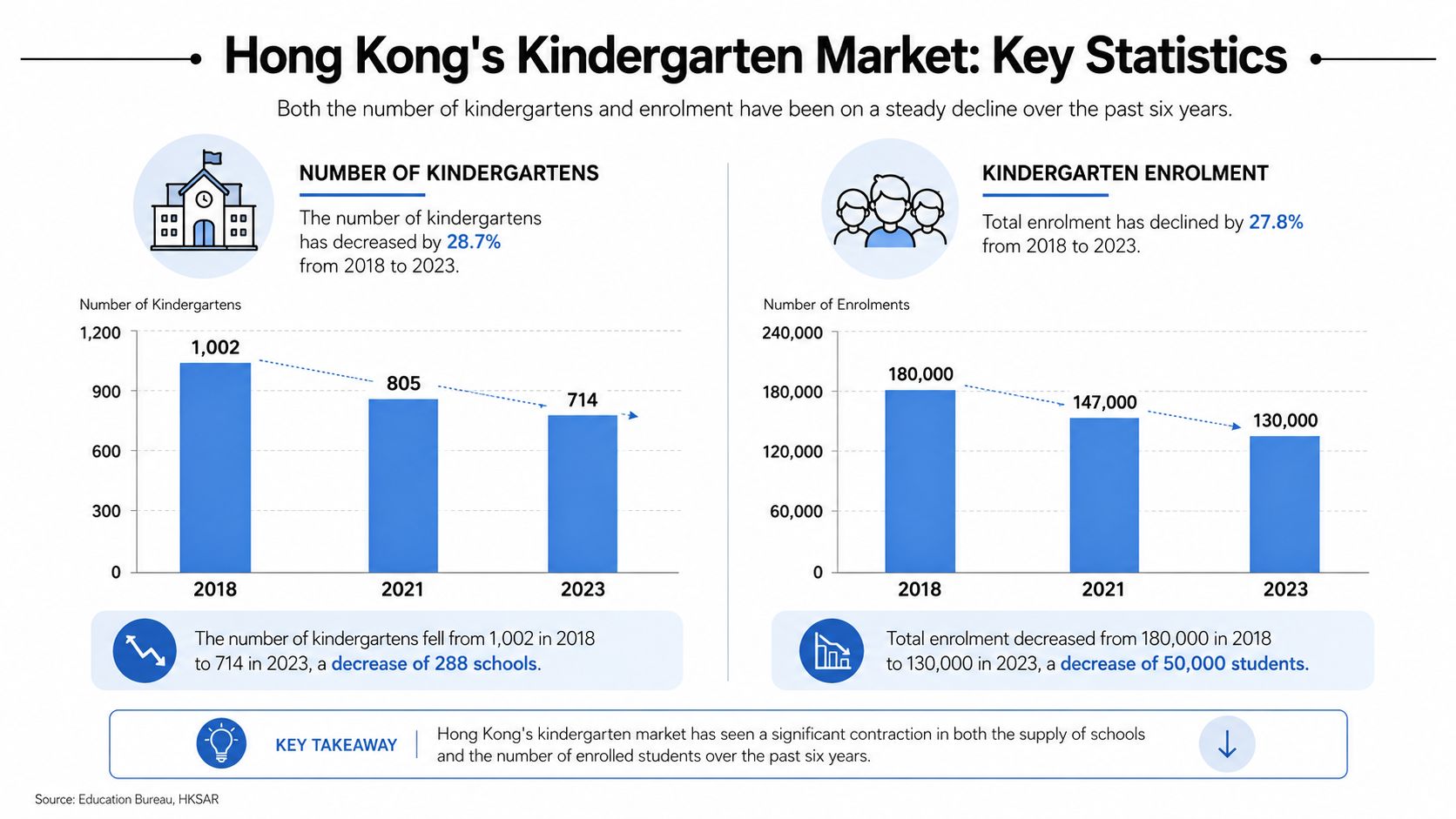
A family in Hong Kong that wants German at kindergarten age is not choosing in a stable, crowded market. The local kindergarten system has been shrinking for years. According to the Education Bureau figures, the number of kindergartens fell from 1,049 in 2019/20 to 980 in 2024/25, while enrolment dropped from 174,297 to 125,426 over the same period, a decline of about 28% in five school years. The same data also shows a 50-year low of 136,095 children in 2023/24 in the kindergarten system Education Bureau statistics.
That shrinkage changes the way families should shop. It reduces spare capacity, narrows choice, and makes small language-specific providers harder to treat as a last-minute option.
What the market structure means for German families
The mainstream local route still dominates the field. The LegCo brief says 738 of 1,009 kindergartens were in the Kindergarten Education Scheme in 2023, accounting for 75% of enrolment and 73% of kindergarten places Education Bureau figures. German-focused families are therefore working outside the default local pool, and that changes both the shortlist and the effort required.
District logistics matter more than glossy branding. In 2024/25, Central & Western had 46 kindergartens, Wan Chai had 30, and Kwai Tsing had 61, with the district table showing major differences in places and students by funding type district statistics. For a family comparing a German kindergarten, a bilingual class, or a preschool group, the practical question is simple, can you reach the right district without turning every weekday morning into a commute test?
The supply picture is not only uneven, it is also changing. Government statistics show 15 kindergartens ceased operation in 2020/21, 21 in 2021/22, 24 in 2022/23, 21 in 2023/24, and 8 in 2024/25 as of October 2024 district statistics. That points to continuing consolidation, so families should assume that attractive places can disappear, not just fill up.
For parents considering German in the early years, the lesson is blunt. Start with district reach, not school image. Check whether a cultural-association playgroup, a bilingual kindergarten, or a full school pathway fits your daily life, then keep a backup option ready. If you want a broader view of the early-years choices that sit before kindergarten proper, the German language playgroup options in Hong Kong are part of the same decision, because they can shape how much German a child hears before primary school.
The Five Realistic German-Focused Pathways in Hong Kong
Hong Kong doesn't offer dozens of German kindergarten choices. It offers a few workable routes, and each one serves a different family profile.
| Pathway | Ages | German Exposure | District | Through-Train |
|---|---|---|---|---|
| German International Stream at GSIS | 2.8 to 5 years | 50:50 dual-language model | Pok Fu Lam / The Peak network | Yes |
| GSIS kindergarten pathway | 2.8 to 5 years | German-curriculum continuity | Pok Fu Lam / The Peak network | Yes |
| Partial German bilingual kindergarten | Varies by provider | Partial German exposure | Mixed, depending on school | Sometimes |
| German Cultural Association preschool classes | Preschool age | Targeted German learning in small groups | Causeway Bay and Tsim Sha Tsui | No |
| Online preschool German | Preschool age | Flexible exposure from home | Anywhere | No |
Independent Hong Kong school guides describe the German International Stream at German Swiss International School as a 50:50 dual-language model for ages 2.8 to 5 years, with GSIS kindergarten feeding into an all-through German-curriculum pathway from kindergarten through secondary school GSIS guide. That is the cleanest long-term route if you want pathway continuity.
Which families each option suits
The through-train model suits families planning a long German schooling journey, especially those thinking about later return to a German-speaking country. It's also the route parents choose when they want certainty about the language pipeline.
Partial German bilingual kindergartens make more sense for families who want broad bilingual exposure, but don't need a German-only or German-first system. They're usually a compromise, not a destination.
The smaller, city-centre route is different. The German Cultural Association preschool classes in Causeway Bay and Tsim Sha Tsui give families a practical early-years entry point without signing up for a full international-school budget. If you're comparing broader early-years options as well, the German language playgroup Hong Kong 2026 guide is the natural next reference point.
The honest shortlist
If you want through-train continuity, look first at GSIS.
If you want lighter, lower-risk German exposure, look at small-group preschool classes.
If you want a compromise, compare partial immersion kindergartens and local-half-day plus German supplementation.
That's the core map. Everything else is packaging.
What to Weigh Before Choosing a German Kindergarten Option
The best German kindergarten choice is the one that survives ordinary Hong Kong life, not just the open day. That means you need to evaluate the school on practical criteria, not on brochures or brand names.
The seven checks that actually matter
Curriculum and language ratio. Ask how much German your child will hear, and in what settings. A genuine dual-language model is very different from a class that adds songs and greetings.
Teacher qualifications. Native speakers matter, but so does teaching method. A teacher who can manage preschool behaviour in German is worth more than a fluent speaker with no early-years classroom control.
Native-speaker density. One native teacher in a room is not the same as a programme built around native-led interaction.
Class size. Smaller groups usually mean more speaking turns, more correction, and more confidence for shy children.
A tiny class can be a better language environment than a larger “premium” room if the child actually gets to speak.
Cultural integration. For German, that includes songs, routines, festivals, and classroom habits, not just vocabulary lists. If you want a sense of the teaching style behind that approach, the article on Montessori method benefits for kids is a useful comparison point for parents who value child-led learning.
Fees and hidden charges. Tuition is only part of the bill. Look for debentures, uniforms, transport, and deposits.
Location and admissions timing. If the route is too far from home or the application window has already closed, the “best” option is useless.
- Ask for the language breakdown. Don't accept vague “bilingual” claims.
- Confirm who teaches. Native speaker, local assistant, or mixed team.
- Check the age fit. A class that suits a 3-year-old may not suit a 5-year-old.
- Read the fee sheet carefully. One-off payments can change the decision fast.
- Map the commute. A good German programme that burns an hour each way is usually a bad family choice.
- Transport. Hong Kong school travel eats time and money fast.
- Uniforms and materials. These are small individually, but they keep adding up.
- Lost work time. A long commute can be an invisible cost for working parents.
- Long-term commitment. A school route can make sense only if you're comfortable sustaining it beyond the first year.
- Native-speaker ratio. How much of the programme is led by native German speakers?
- Curriculum focus. Is this language exposure, dual-language immersion, or a full curriculum track?
- Class size. How many children are in the room for this age group?
- Teacher turnover. Who stays, who leaves, and how stable is the team?
- Refund and debenture policy. If you're comparing international options, what happens if plans change?
- Assessment for non-native children. How do they place children who are new to German?
A simple parent checklist
If you're considering a broader German pathway for older children later on, GCA also offers structured German lessons with exam preparation such as Goethe-Zertifikat, but for preschool decisions the first filter should still be fit, not prestige.
Half-Day Versus Full-Day and the Question of Language Density
Hong Kong parents often assume full-day automatically means better language progress. That is too simple. The issue is whether the child gets enough sustained German contact across the week, in a format the family can keep up with.
Hong Kong kindergarten research shows half-day programmes typically run about 3 hours, while full-day programmes run about 7 to 8 hours half-day vs full-day comparison. The same resource cites a University of Hong Kong study finding no significant differences in language, cognitive, physical, social, and emotional development between the two formats.
What that means for German learning
If development is broadly similar, the decision shifts to logistics and language exposure. A half-day format can leave room for a focused German playgroup, family time, and less tiring travel. A full-day format may increase contact hours, but it also asks much more from the household.
That is why some families pair a local half-day kindergarten with an additional German class rather than paying for a full-day immersion seat. For many children, that combination creates a better weekly rhythm than one long day in a programme that does not fit the family's commute.
The format you can sustain every week will always beat a theoretically stronger option that falls apart after two months.
If you are testing a lighter route before committing to a full preschool path, the German preschool summer camp Hong Kong 2026 guide is a sensible way to gauge response and routine fit.
For working parents, full-day only makes sense if the commute is short and the programme is strong. If not, half-day plus a structured German add-on is usually the smarter Hong Kong answer.
The True Cost of German Kindergarten in Hong Kong
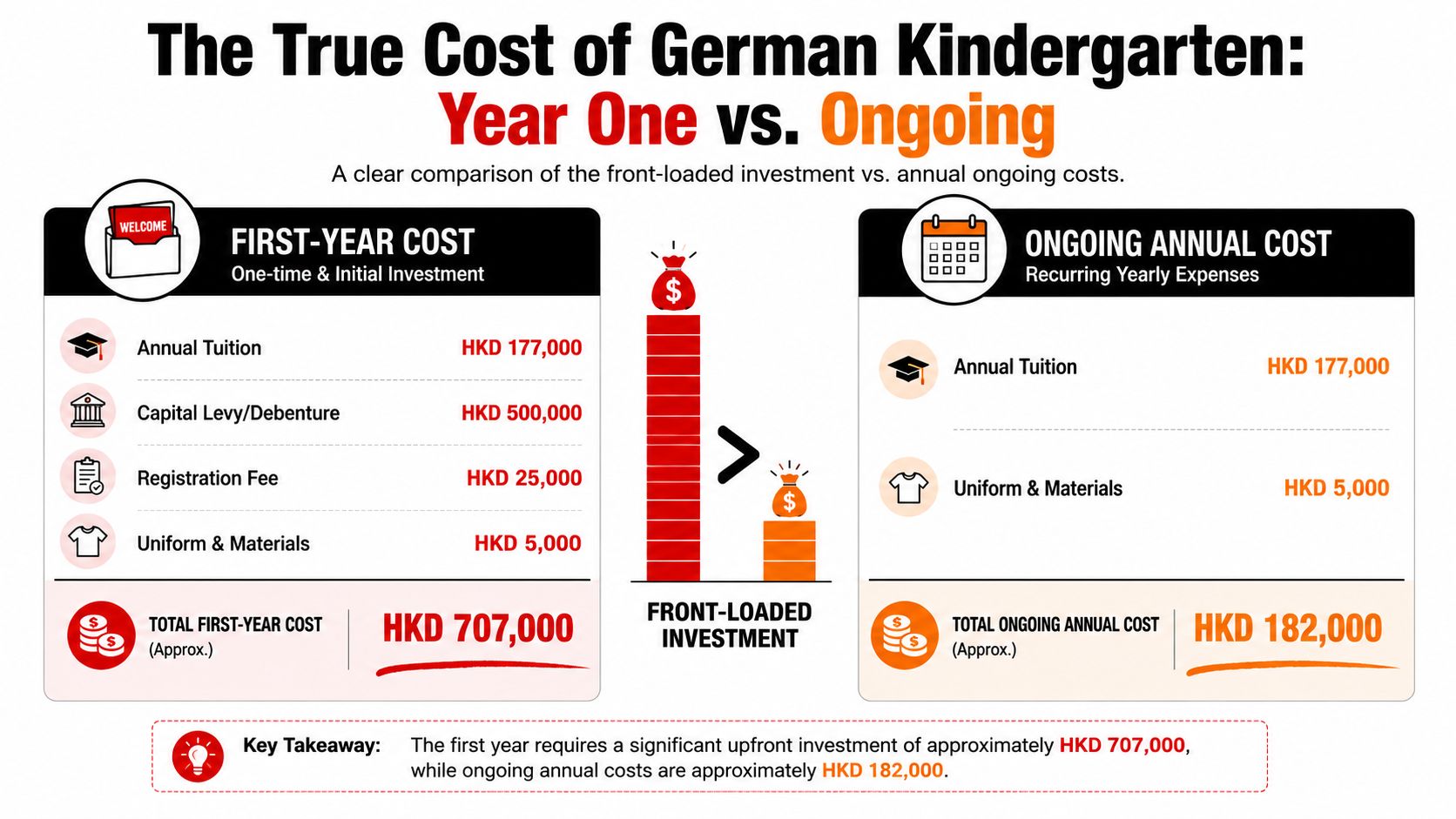
The cost conversation gets distorted fast because parents focus on monthly tuition and ignore the first-year shock. One Hong Kong comparison cites GSIS kindergarten at about HKD 177,000 annual tuition plus a HKD 500,000 debenture, putting first-year cost at roughly HKD 677,000 GSIS fee comparison.
That's the benchmark. Not because every family should reject it, but because it tells you exactly what level of investment a premium German pathway demands.
What families usually forget to budget for
The obvious items are tuition and debenture. The less obvious items are the ones that still hurt:
A cultural-association preschool class is a different financial model. It's typically session-based or term-based, with no capital levy attached, so the family is paying for exposure and instruction rather than a full school infrastructure. That's a very different proposition, and for many Hong Kong households it's the more rational one.
What each cost tier really buys
At the top end, you're buying through-train continuity, a strong institutional path, and a long runway. In the middle, you're buying bilingual exposure with less pressure. At the lower end, you're buying access, flexibility, and a lower-risk way to see whether your child enjoys German.
The wrong move is to pay for the highest tier because it sounds safest, then discover the commute is punishing or the family can't sustain the pace. The right move is to match the price to the actual goal.
Questions to Ask Any Provider and a Realistic Admissions Timeline
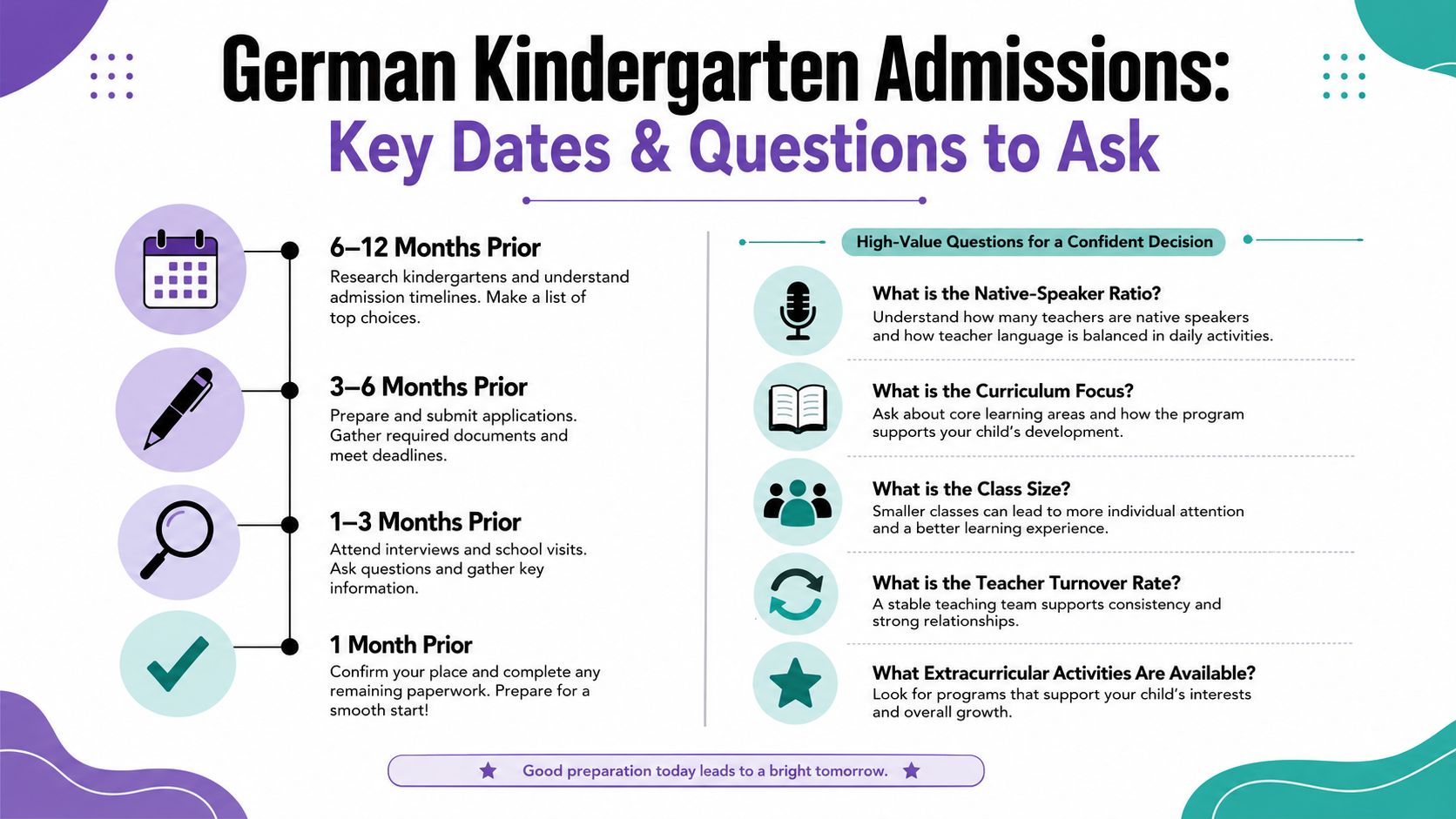
The first meeting with a kindergarten or preschool should feel like a screening interview. If a provider can't answer basic questions clearly, don't assume they'll become clearer later.
Questions worth asking every provider
A useful rule is to ask for specifics, not promises. If the provider can't show structure, it's probably mostly marketing.
A realistic Hong Kong admissions rhythm
For many international or specialised kindergartens, serious families start 6 to 12 months before entry. Applications often open in autumn, interviews or visits happen in winter, offers come in spring, and orientation lands in summer. That rhythm is normal in HK, and waiting until the last minute narrows your options sharply.
Flexible preschool classes are different. A German playgroup can often be joined mid-year if a place is available, and a localised Hong Kong source shows the kind of flexible attendance many families prefer, with classes Monday to Friday in the morning or afternoon for 2 hours, 2 to 5 times a week, plus a Thursday slot from 16:30 to 18:00 for 1.5 hours German playgroup schedule. That flexibility makes it easier to test your child's response before locking into a school system.
If you want a concise admissions checklist for the next round of applications, the before-enrolling your child in German class Hong Kong parent checklist is worth keeping open while you speak to schools.
Matching the Right German Pathway to Your Family in Hong Kong
For a returning expat family planning a long German-speaking school journey, I'd start with the through-train route. If you know you want long-term continuity and can live with the cost and location demands, the German International Stream at GSIS is the clearest school-based option.
For mixed-heritage or bilingual families, I'd be more pragmatic. A half-day setting with sustained German contact can work extremely well if the child is getting language elsewhere too, and if the family can maintain the routine without stress. Don't overbuy school hours if the need is consistent exposure.
For cost-conscious Hong Kong families, the smarter move is usually to begin with authentic early German exposure before committing to a premium pathway. That's where city-centre preschool classes become useful. German Cultural Association-related preschool classes are offered at Unit 1701, Cameron Commercial Building, 458 Hennessy Road, Causeway Bay, and Unit 103, Mirror Tower, 61 Mody Road, Tsim Sha Tsui preschool class locations. For many parents, that's enough to make German part of weekly life without turning kindergarten into a financial project.
If you want one blunt recommendation, here it is. Don't default to the international-school answer unless you need the through-train structure. For most Hong Kong families, the better first step is a flexible, native-led preschool class that proves whether your child responds to German, then a bigger commitment only if it still makes sense.
German Cultural Association Hong Kong(GCA) offers small-group preschool German classes in Hong Kong, with native-speaking teachers, structured progression, and flexible city-centre locations that suit busy families. If you want to start German early without jumping straight into a heavyweight school commitment, visit German Cultural Association Hong Kong(GCA) to check the latest course schedule and book a trial class.
Joining a German Course Mid-Term: September Intake Guide for Hong Kong 2026/27
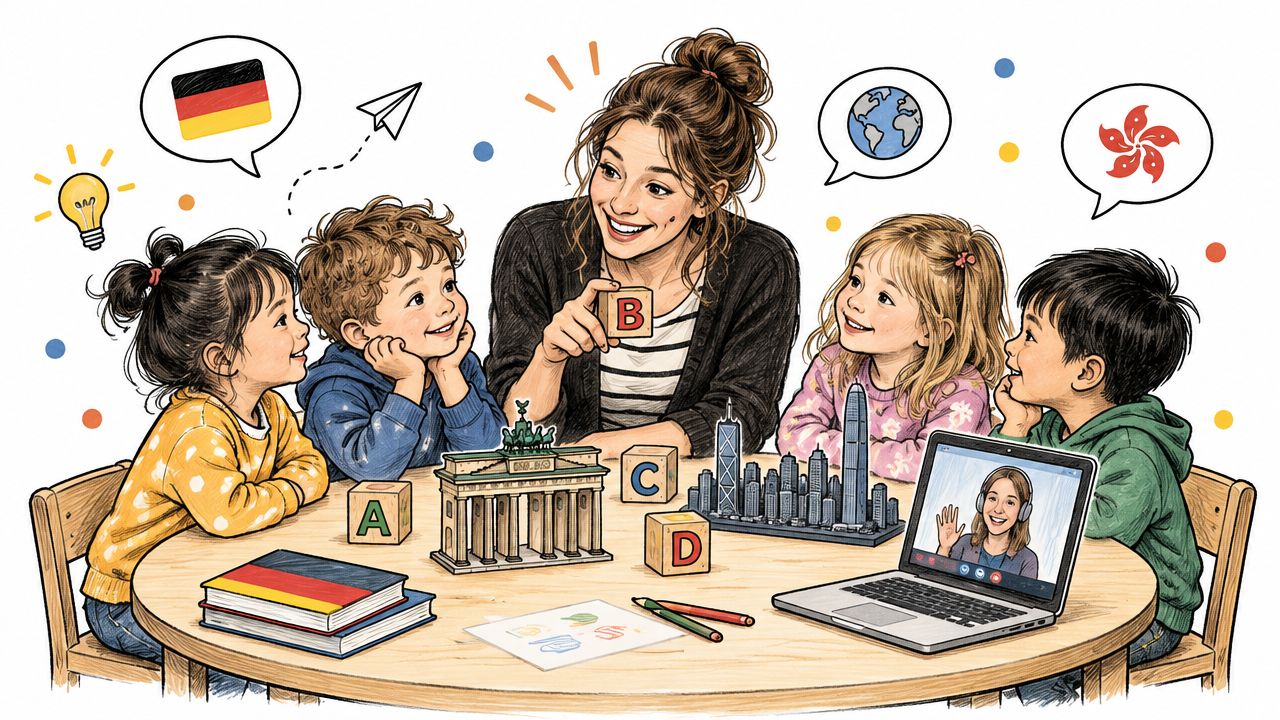
Preschool German Classes 2026/27 (Ages 3-6): Small-Group Intake & Trial Lessons


