.png)
.png)

BLOG

香港德國文化協會
The German Cultural Association
German Compound Words: Why They're Easier Than You Think
You're revising for a Goethe-Zertifikat paper in Hong Kong, or helping your teenager prepare for IB, IGCSE, or A-level German. Then a monster word appears on the page. It looks less like vocabulary and more like a train crash of nouns.
That reaction is normal. It's also one of the most unnecessary fears in German. German Compound Words: Why They're Easier Than You Think comes down to one reassuring fact: long German words usually aren't random. They're built from smaller, familiar parts, and once you learn how to read those parts, the word becomes easier, not harder.
For ambitious learners in Hong Kong, that matters. Whether your goal is Learn German HK for work, study abroad in Germany, or strengthen reading accuracy for DSE/IB/IGCSE-style language study, compound words are a shortcut. They reduce memorisation and reward logic.
Table of Contents
- Why this is good news for learners in Hong Kong
- Long words are often more transparent than short ones
- Do Germans really invent compounds on the spot
- How do plurals work in compound nouns
- Are compound words mainly useful for exams
That Feeling When You See a 30-Letter German Word
A lot of learners in Hong Kong have the same moment. You open a reading passage, see a word such as Donaudampfschifffahrtsgesellschaftskapitän, and your brain decides you're in trouble.
You're not. You're looking at a structure, not a mystery.
That shift matters because German does this constantly. According to the Duden estimate cited in a discussion of the size of the German lexicon, German contains approximately 23 million words, and over 99% of them are compound words. That means the long words aren't exceptions. They're the system.
Why this is good news for learners in Hong Kong
If you're preparing for Goethe, TestDaF, or reading-heavy school assessments in HK, this changes your study strategy.
Instead of treating every long noun as a separate item to memorise, you can:
- Recognise familiar building blocks instead of panicking at length
- Read faster in context because parts of the meaning are visible inside the word
- Retain vocabulary better because related words connect naturally in memory
Practical rule: A long German word often contains more clues than a short one.
Take everyday examples. Kindergarten becomes easier when you know Kinder relates to children and Garten means garden. Badezimmer looks large at first, but Bade plus Zimmer quickly points you toward a bathroom.
Long words are often more transparent than short ones
English often uses several separate words. German often compresses the same idea into one noun.
That can look intimidating on the page, but it's logically efficient. Once you stop asking, “How can I memorise this whole word?” and start asking, “What parts can I already recognise?”, compound nouns become one of the most useful decoding tools in the language.
When considering German lessons Hong Kong, that's one of the first mindset upgrades worth making. German doesn't hide meaning inside long words. It stacks meaning in plain sight.
What Exactly Is a German Compound Word
A German compound word is a single noun made by combining two or more separate words. The final word gives the core meaning and grammatical gender, while the earlier parts add detail. That makes long vocabulary more logical than it first appears.
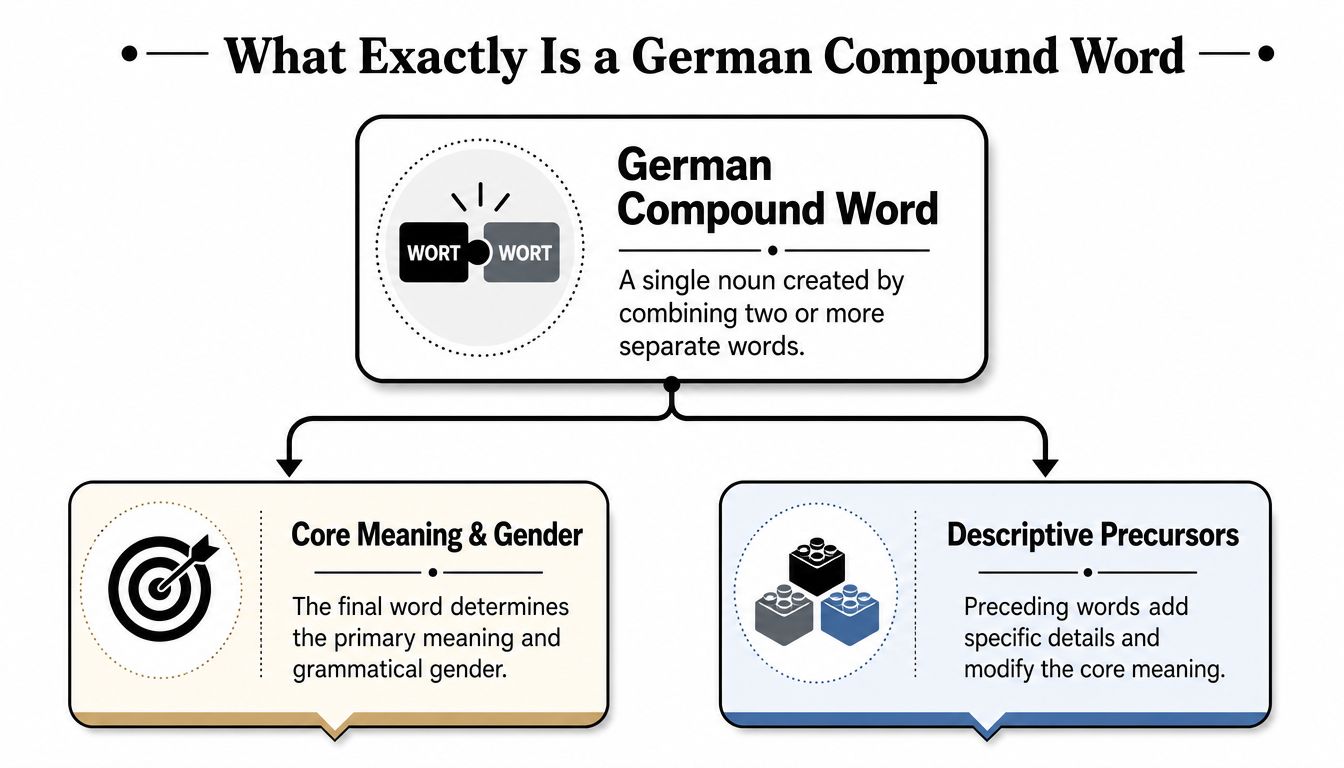
A short definition you can remember
A compound noun is one word built from smaller words.
That sounds simple because it is. German uses this pattern again and again to create precise meanings without needing a completely new root word each time.
Examples help immediately:
| Compound word | Parts | Plain meaning |
|---|---|---|
| Haustür | Haus + Tür | house door, front door |
| Badezimmer | Bad(e) + Zimmer | bathroom |
| Reisebüro | Reise + Büro | travel agency |
Think of words like LEGO bricks
This is the easiest way to teach compound words to both adults and teenagers. Think of each known noun as a brick. You don't need to memorise every possible finished object if you understand how the pieces fit together.
That's why this system is so useful for students in Hong Kong balancing work, school, and exam pressure. It reduces memory load. A learner who knows core nouns can often infer the meaning of a longer term without having seen it before.
A few patterns make this easier:
- The last noun is the main noun. It tells you what kind of thing you're dealing with.
- The earlier parts narrow the meaning. They describe, limit, or specify the final noun.
- The whole word stays semantically organised. German compounds aren't random stacks.
You don't need to know every compound in advance. You need to know how compounds are built.
That's especially helpful for learners aiming to study abroad in Germany or prepare for IB, A-level, and Goethe reading tasks in Hong Kong. In real reading, you won't know every word on the page. Compound logic helps you survive that gap calmly and accurately.
The Golden Rule That Simplifies German Grammar
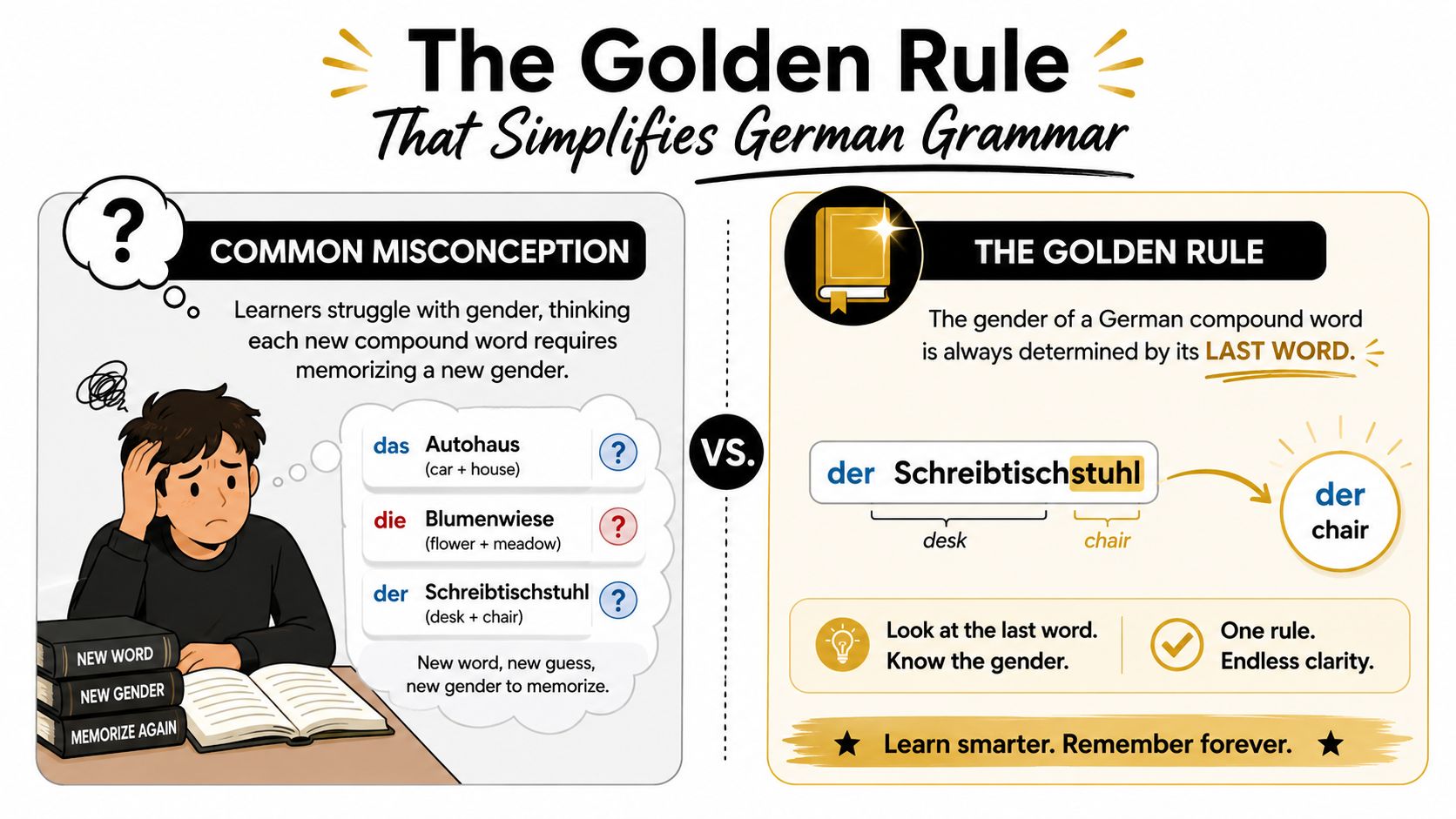
Many HK learners waste time on the wrong problem. They see a new compound noun and assume they must memorise a fresh gender from scratch.
You usually don't. The most useful shortcut is much cleaner than people expect.
Why learners overcomplicate gender
A common misconception is that compound-word gender is messy or arbitrary. But the rule-based reality is much simpler: the last element decides the gender. That point is highlighted in this overview of German compound words and gender.
Many exam-focused learners get confused. They focus on the first word because it gives the earliest visible meaning. Grammar, however, anchors at the end.
If you already find German articles frustrating, this one rule can remove a large amount of guesswork.
A simple pattern that works every time
The final noun, often called the Grundwort, controls the gender of the entire compound. A separate explanation of compound noun structure notes that the grammatical gender and plural form are inherited from the final noun component, and the earlier parts function like descriptors of that core noun. You can see that logic in this explanation of German compound noun rules.
Use it like this:
- der Schlüssel becomes der Haustürschlüssel
- das Zimmer becomes das Badezimmer
- das Geschäft becomes das Lebensmittelgeschäft
| Final noun | Gender | Compound | Result |
|---|---|---|---|
| Schlüssel | der | Haustürschlüssel | der Haustürschlüssel |
| Zimmer | das | Badezimmer | das Badezimmer |
| Geschäft | das | Lebensmittelgeschäft | das Lebensmittelgeschäft |
Stop checking the front of the word for gender. Check the end.
If you want extra help spotting article mistakes in your own writing practice, a tool like an online grammar checker can be useful after you apply the rule yourself. It shouldn't replace learning, but it can help you catch slips before they become habits.
For serious learners in Hong Kong, this is one of the highest-yield grammar habits you can build. It helps in writing, speaking, and reading under time pressure.
How to Decode Any Long German Word in 3 Steps
When a long noun appears in a passage, don't freeze. Follow a repeatable process.
German compound nouns are structurally transparent. The final noun determines the main meaning and grammar, while the earlier elements add descriptive detail, as explained in this lesson on German compound noun rules and examples.
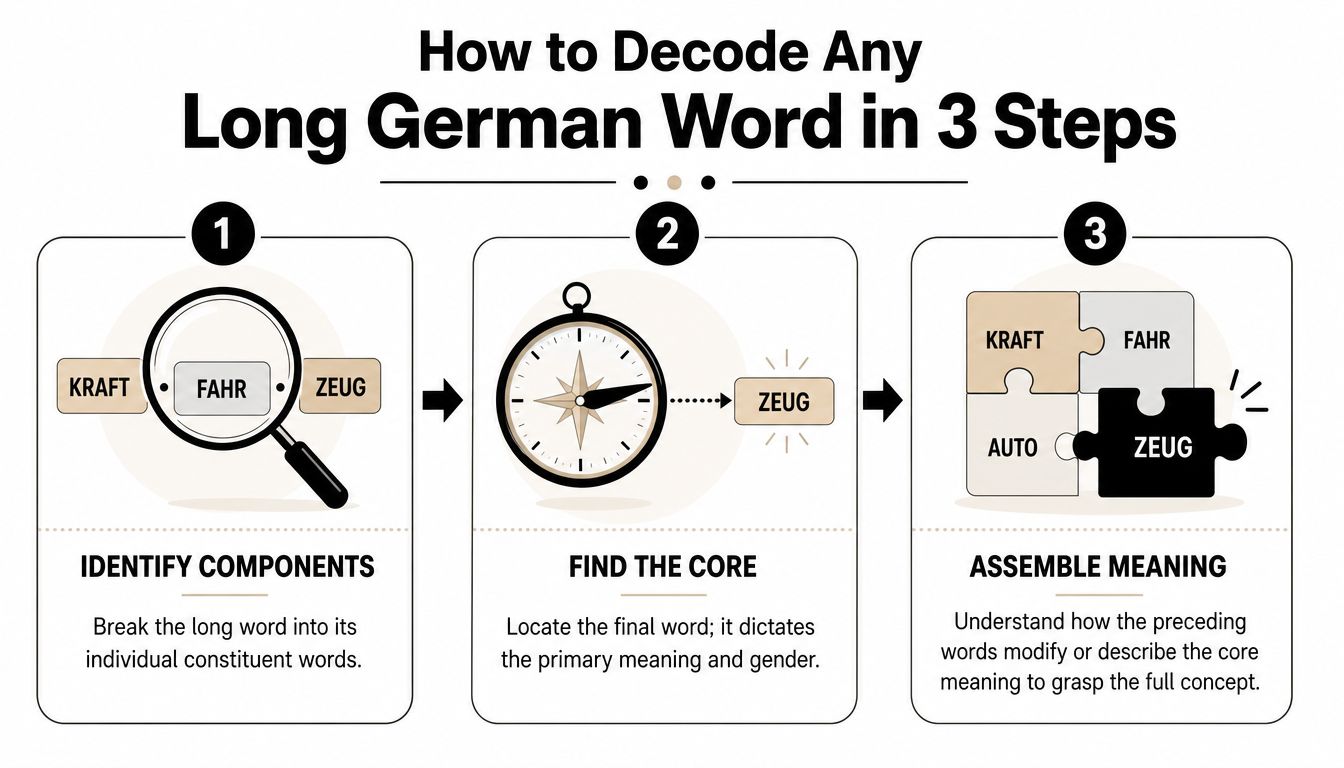
Step 1 Start from the end
Find the last noun first.
That gives you the category of the thing. It also gives you the gender. If you see Lebensmittelgeschäft, the end is Geschäft. So you already know you're dealing with some kind of shop or business.
Step 2 Break the front into parts
Now move left and separate the earlier elements into recognisable units.
For Lebensmittelgeschäft, you can split it like this:
- Geschäft = business or shop
- Mittel = means
- Leben(s) = life
You don't need a perfect literary translation at this stage. You need a functional reading.
A pronunciation reminder often helps when you're breaking words apart during self-study. If spelling and sound still slow you down, this guide on mastering German umlauts and ß for HK learners is a useful companion.
Here's a quick visual explanation before the next examples:
Step 3 Rebuild the full meaning
Read the parts from left to right again and let them modify the final noun.
For Lebensmittelgeschäft, the sense becomes a shop for life-sustaining provisions. In plain English, that's a grocery shop.
Try the same process on a few more examples:
Reisebüro
- End first: Büro
- Front part: Reise
- Meaning: a travel office, or travel agency
Haustürschlüssel
- End first: Schlüssel
- Front parts: Haus + Tür
- Meaning: a key for the house door
Kraftfahrzeug
- End first: Zeug
- Front parts: Fahr + Kraft
- Meaning: a motor vehicle
Read German compounds backwards first, then forwards for detail.
This three-step habit works well in exams because it's fast. It turns reading into structured problem-solving instead of memorisation panic. For Learn German HK students who want practical gains, that's a much better use of study time than treating every long noun as a separate monster.
Common Compound Patterns for Work and Travel
Once you've seen enough compound nouns, patterns start repeating. That's where vocabulary growth speeds up.
German has used compound nouns systematically since the Old High German period, approximately 750 to 1050 CE, with early documented examples in religious texts and legal codes, according to this historical overview of German compound words. That long continuity matters because the system isn't a modern quirk. It's intrinsically built into how German expresses precise ideas.
Work-related compounds
Professionals in Hong Kong often learn German for career mobility, relocation plans, or communication with German-speaking clients. Work-related compounds tend to be very transparent once you spot the pattern.
Consider these examples:
Arbeitsplatz
Arbeit + Platz
A workplaceArbeitsvertrag
Arbeit + Vertrag
An employment contractSozialversicherungsfachangestellter
This looks frightening, but it still follows the same stacking logic. You read from the end and identify the role first.
A useful habit is to group compounds by recurring first elements. When you see Arbeit- often, you start expecting meanings related to work, labour, or employment.
Travel and daily life compounds
This category is especially useful for adults planning to study abroad in Germany or travel independently.
A few high-frequency examples:
| Theme | Compound | Plain meaning |
|---|---|---|
| Travel | Bahnhof | train station |
| Travel | Flughafen | airport |
| Travel | Reisebüro | travel agency |
| Home | Schlafzimmer | bedroom |
| Home | Badezimmer | bathroom |
| Home | Wohnzimmer | living room |
These aren't random labels. They're descriptive constructions.
- Schlafzimmer is a sleep-room
- Wohnzimmer is a living-room
- Flughafen combines flying and harbour in a way that becomes memorable once you notice it
The more patterns you group by theme, the less vocabulary feels isolated.
For Hong Kong parents supporting children through IB or IGCSE German, this is much more effective than teaching nouns as disconnected flashcards. Build clusters around home, transport, school, and work. German compounds reward organised learning.
Ready to Master German for Your Exams and Career
A lot of learners assume the hardest part of German is the length of the word. It usually isn't. The main challenge is learning to stay calm, identify the core noun, and ignore details that don't matter yet.
For exam takers in Hong Kong, that matters because the official qualifications used for university applications and visa approvals are Goethe-Zertifikat and TestDaF, described as the minimum thresholds for German-speaking universities in this guide to choosing a German language school in Hong Kong. If you're preparing for those exams, reading strategy isn't optional.
What matters most for Hong Kong learners
You don't need to master every edge case before you can use compound logic well.
Focus on what gives the best return first:
- Recognise the final noun quickly
- Build strong core vocabulary around common nouns
- Practise reading long words without rushing
- Apply the method in exam-style passages and practical texts
This approach fits busy adult learners, teenagers preparing for DSE/IB/IGCSE-related goals, and professionals comparing evening classes with online options. It also suits cost-conscious families because it reduces wasted effort. You memorise less blindly and understand more strategically.
What about connecting letters
Learners often worry about small linking sounds such as -s- or -en- between compound parts. These are called Fugenelemente.
You don't need to treat them as a barrier. A discussion of how Germans determine compound words notes that the overall syntax is reasonably straightforward, while the choice of connecting elements often depends on usage feel and can vary regionally, as discussed in this conversation about forming German compound words.
That's reassuring for exam learners in HK. You can understand compounds very well before you develop native-like instinct for every connector.
Frequently Asked Questions About German Compounds
Do Germans really invent compounds on the spot
Yes, they do.
German speakers often create understandable new compounds in real time, especially in conversation. Once you understand how words stack logically, that becomes less surprising. It's one reason compound skill feels so powerful. You're no longer limited to a fixed vocabulary list.
That's also why learners should move beyond pure memorisation. The system is productive. You can decode it, and eventually you can use it.
How do plurals work in compound nouns
The plural follows the final noun.
If the last word carries the plural pattern, the whole compound follows it. That's the same logic many learners already use for gender, and it's worth reinforcing when article and noun ending mistakes appear together. If you want a clearer foundation for article choice, this guide on das and German gender for HK learners is a helpful follow-up.
Are compound words mainly useful for exams
No. They're useful for exams, work, travel, and everyday reading.
For exams such as Goethe, IB, and A-level German, they improve reading speed and reduce guessing. For adults planning to study abroad in Germany or handle practical life in German-speaking countries, they help with forms, transport, housing, shopping, and workplace language.
A good test of progress is simple. When you see a long noun, do you still feel blocked, or do you start hunting for the last noun and the familiar parts around it? Once the second reaction becomes automatic, your German is becoming more strategic.
If you want structured, native-led support with reading, grammar, and exam preparation, German Cultural Association Hong Kong(GCA) is a strong next step. Their courses are designed for serious learners in Hong Kong, with native-speaking teachers, a structured curriculum, and focused preparation for goals such as Goethe-Zertifikat, TestDaF, IGCSE, A-level, and IB. You can book a trial class, speak with an advisor, or check the latest course schedule to find an option that fits your timetable.
German Accusative Case Explained: When and How to Use Akkusativ

German Small Talk: 30 Phrases for Meeting People and Making Friends


