.png)
.png)

BLOG

香港德國文化協會
The German Cultural Association
German for Children Aged 3-6: Realistic Expectations for the First Year
A Hong Kong parent watches a child leave a German class singing a song, naming a colour, and answering a familiar greeting. On the way home, the child switches back to Cantonese or English. It's natural to wonder whether German for Children Aged 3-6: Realistic Expectations for the First Year is producing real learning, or whether the lesson is enjoyable for a short time.
For most children, enjoyment is part of the learning. The first year isn't usually about fluent conversation, formal grammar, or reading German independently. It's about building sound familiarity, recognising repeated language, joining routines, and developing the confidence to respond.
That distinction matters in Hong Kong, where many children already move between Cantonese and English every day. German is often becoming a third language, so progress may appear first in listening and participation rather than in long, complete sentences.
Table of Contents
- Will my child speak German after one year?
- Should we correct Cantonese and English mixing?
- When should parents expect exam preparation?
- Is A1 relevant to a young child?
- How much does a child's course cost?
- What should parents do next?
Setting Realistic Goals for Early Language Learners
For a child aged 3 to 6 in Hong Kong, the first year of German should build listening confidence, recognition of familiar words, and participation in songs, games, and classroom routines. Children may begin using greetings and short formulaic phrases. Independent conversation and formal grammar are unlikely after limited weekly exposure.
A parent may ask, “What did you learn today?” The answer might be a smile, a song fragment, one German word, or silence. None of these responses proves that learning has not taken place. Young children often understand language before they can retrieve it on demand, particularly when they are using Cantonese, English, and German in different settings.
German learning at this age works more like planting a garden than completing a worksheet. Repeated sounds take root first, familiar instructions become recognisable, and spoken words appear when the child feels ready. A child may understand a classroom routine for weeks before showing it at home.
German is often a third language
Hong Kong's kindergarten system gives many children daily experience of structured routines, songs, movement, and social interaction. Local programme information from Kinderleicht Hong Kong reflects how common organised early-childhood learning is in the city. That setting can support German, but it does not make German exposure equivalent to full-time immersion.
A child may speak Cantonese with grandparents, use English at school, and hear German during a weekly class. Each language can have its own people, places, and purposes. German is therefore being added to an existing multilingual system, not introduced into an empty space.
Parents can set realistic first-year goals by watching for these changes:
- Sound familiarity: The child begins to recognise the rhythm and pronunciation of common German words.
- Routine recognition: The child knows what to do when the teacher gives a familiar instruction, especially when gestures or objects provide clues.
- Social comfort: The child joins a song, movement game, greeting, or repeated classroom ritual without needing to speak every line.
- Passive vocabulary: The child understands more German than they can say spontaneously.
- Early production: The child uses memorised greetings, names, colours, numbers, or short expressions in the right situation.
These benchmarks are more useful than asking whether a child is “fluent”. A child who points to the right picture, joins the final word of a song, or responds to a greeting is showing a different stage of progress. Speech is only one part of early language development.
A developmental overview such as the scope and sequence from infants to kinder can help parents see why young children progress through familiar routines and gradual participation rather than immediate academic output. The same principle applies in a Hong Kong preschool: the teacher provides a repeated pattern, and the child gradually takes over part of it.
Practical rule: If your child understands more, resists less, and joins in more readily over time, those are meaningful signs of progress.
The first year should build a positive relationship with German. A child who looks forward to songs and feels safe responding to a teacher has made meaningful progress, even without forming original sentences.
First Year Milestones in Listening and Speaking
A realistic milestone path usually moves from hearing, to recognising, to responding, and only then to more spontaneous speaking. The order matters. A child may listen for several weeks before showing visible participation, then suddenly respond to a phrase that has been repeated many times.
Local German preschool programmes in Hong Kong commonly begin at age 3 and use short lessons. Published examples describe sessions of about 45 minutes for 4-year-olds and 45 to 60 minutes for 5-year-olds, usually one to two times per week, as outlined in German kindergarten options in Hong Kong. That level of contact supports gradual oral development, not rapid fluency.
What listening progress can look like
During the first stage, a child may not repeat much German. Instead, observe whether the child:
- Turns towards the teacher when hearing a familiar phrase.
- Points to the correct colour, picture, or object.
- Follows a simple classroom instruction with a gesture.
- Anticipates a repeated part of a song or story.
- Recognises a greeting or farewell.
- Responds physically to words connected with movement.
These behaviours show that German sounds are becoming meaningful. Translation isn't required for every word. A child may understand springen through movement and repetition long before explaining that it means “jump”.
What speaking progress can look like
Speaking often starts with fixed expressions rather than original grammar. A child may say a greeting at the classroom door, repeat a song line, name an object, or answer a familiar question with one memorised phrase.
For children aged 3 to 5, local programme guidance describes a first year centred on common words, classroom routines, greetings, simple instructions, songs, movement, stories, and familiar rituals. The emphasis is on oral confidence before reading and writing, as explained in how children actually pick up a third language.
Parents can listen for:
- Recognition, such as looking at the correct picture when a word is spoken.
- Imitation, such as copying a teacher's sound or gesture.
- Participation, such as joining a song without being prompted.
- Formulaic speech, such as repeating a greeting or classroom phrase.
- Transfer, such as using a German word during play at home.
One local benchmark places first-year progress at around 200 recognised words for children aged 3 to 5, with success measured through passive recognition and spontaneous participation rather than translation or writing, according to German lessons for children in the 2026/27 school year. Treat this as a practical reference point, not a test your child must pass.
A child who mixes German with Cantonese or English isn't necessarily confused. Young multilingual learners may use the word that comes to mind fastest, particularly when they're excited or tired. The priority is to keep German associated with meaningful interaction, not to interrupt every attempt with correction.
Weekly Pacing and Home Practice Routines
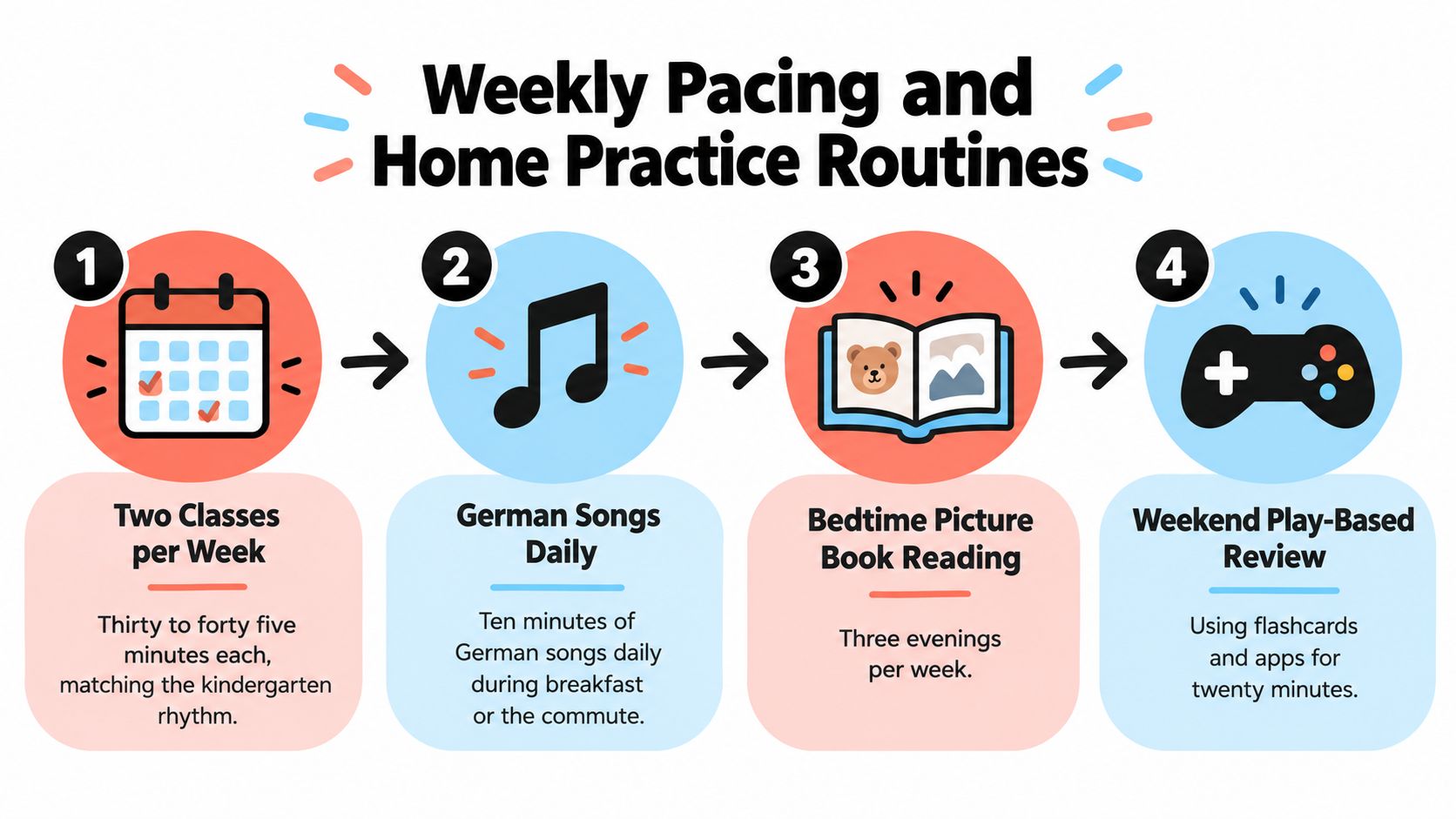
A busy Hong Kong family does not need to turn the home into a second classroom. In a multilingual preschool environment, children already move between Cantonese, English, and sometimes Mandarin during the day. German practice works best as a small, familiar addition. Children gain more from predictable, enjoyable contact than from occasional intensive revision that feels like homework.
Using the short session formats described earlier, a class can include a greeting, movement, story, song, and closing routine without becoming overly academic. Home practice should then recycle the same language rather than compete with the lesson. If a class introduces a small group of words, repeat those words across several brief moments during the week instead of presenting many new ones once.
Build a rhythm around repetition
Attach the same German phrases to the same household moments. Use a greeting when your child wakes up, a simple phrase before a song, and a farewell before leaving for school. Translation is not needed every time. Context, tone, gestures, and repetition gradually give the words meaning, much like familiar signs that become understandable through repeated use.
A practical home rhythm can include:
- Songs during familiar moments: Play one or two German songs during breakfast, the school journey, or bath time.
- Picture-based storytelling: Use a simple picture book and name a few objects instead of translating every sentence.
- Movement games: Give one familiar instruction, demonstrate it, and celebrate the response.
- Toy-based practice: Let a teddy bear “speak” German during pretend play.
- Short reviews: Revisit class words while drawing, sorting colours, or preparing a snack.
Choose activities your child will repeat willingly. A brief game that happens regularly can support recognition and participation more effectively than a long worksheet session that creates resistance.
Keep parents' role manageable
Parents do not need perfect German pronunciation to support practice. Ask the teacher for a small set of phrases, use audio provided by the programme, or repeat words alongside songs and stories. The goal is a steady model, not a second teacher at home.
Avoid turning every car journey into a quiz. Rather than asking, “What does this mean?”, model a phrase while pointing, moving, or acting. Your child can then work out the meaning from the situation without feeling examined.
A good home routine feels like family life with a little more German in it, not family life interrupted by a language test.
Children also need recovery time. A Hong Kong kindergarten schedule may already include school activities, transport, meals, rest, and other lessons. If German practice becomes a daily source of conflict, reduce the pressure and return to songs, movement, and shared reading.
Families considering home teaching can find activity ideas in this guide to teaching German to children at home. Keep the routine simple: choose a small amount of language, connect it to a real activity, and repeat it often enough for your child to recognise it naturally.
Choosing Between In-Person and Online Classes
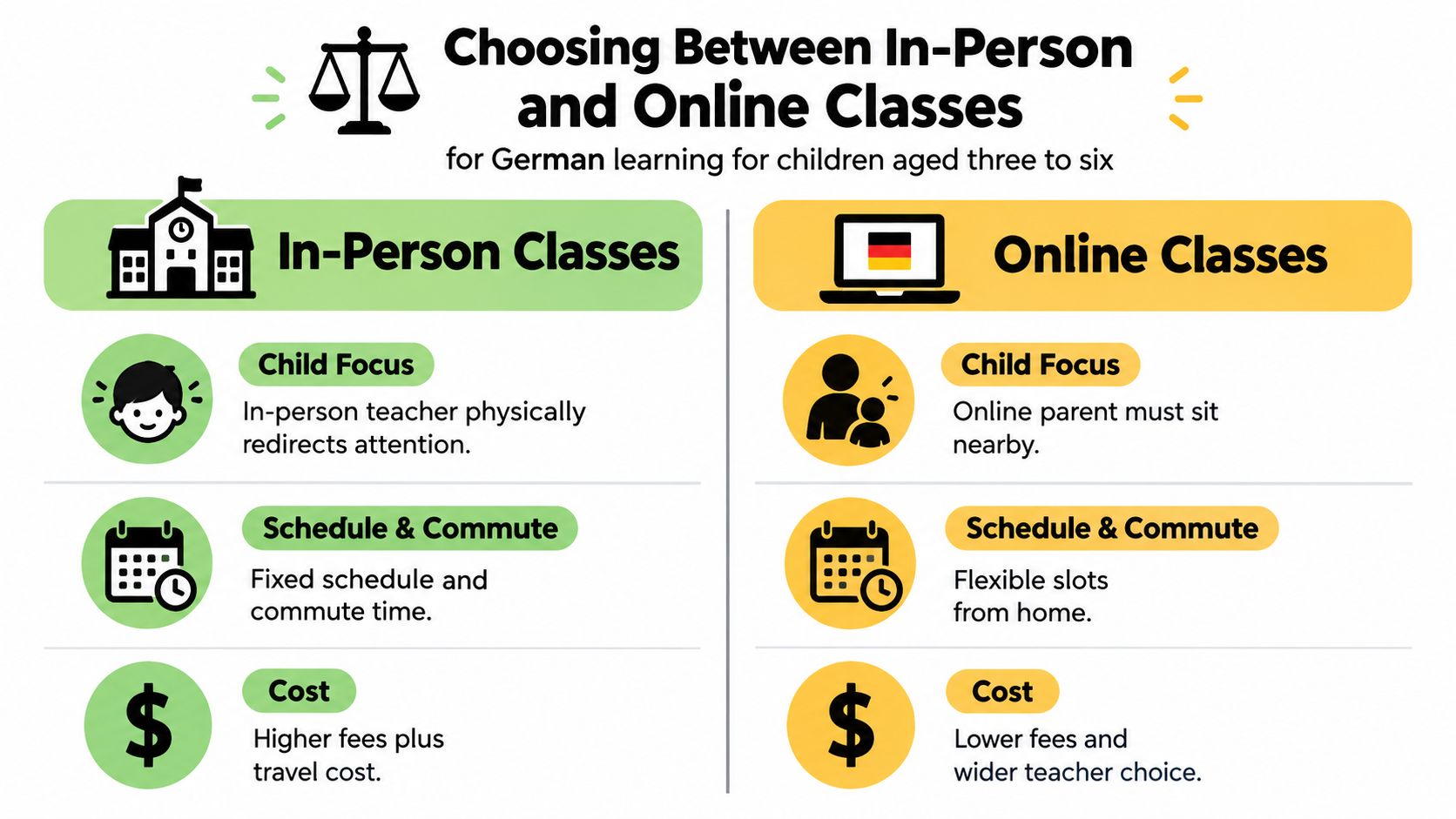
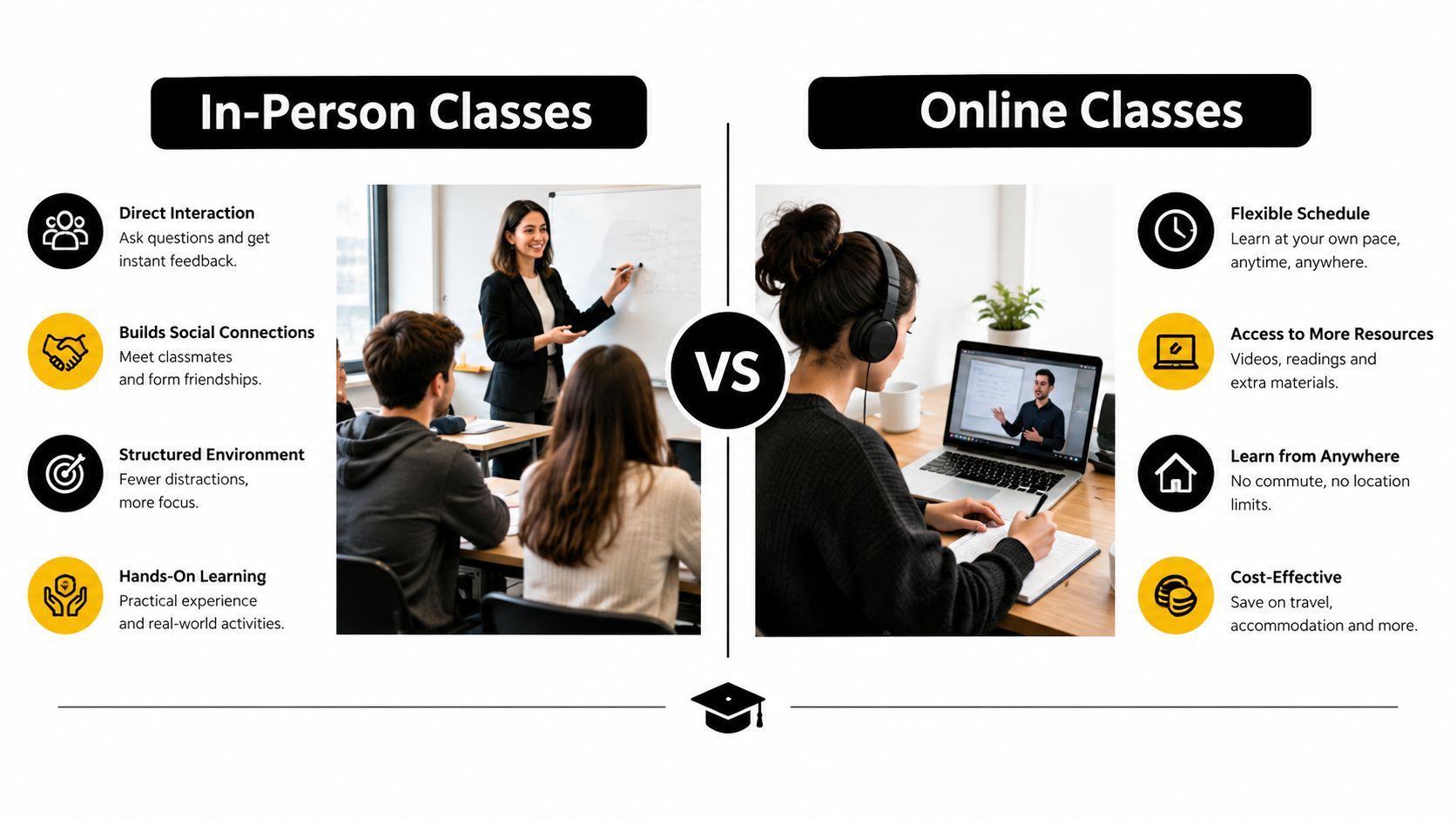
The right format depends on the child's temperament, the family's schedule, and the quality of interaction available. Neither in-person nor online learning guarantees progress by itself. Teacher behaviour, lesson design, group size, and regular attendance have a greater practical effect than the label attached to the class.
In-person classes give young children physical space to move, handle objects, look at picture cards, and respond to peers. A teacher can redirect attention through eye contact, a gesture, a change of activity, or a physical prop. These details are especially helpful for children who find screen-based attention difficult.
Online classes offer different advantages. Families can avoid travel across Hong Kong, use a familiar home environment, and choose a convenient time. Some children participate more freely online when a parent can prepare the space, reduce distractions, and keep favourite objects nearby.
Compare the learning environment
| Consideration | In-person learning | Online learning |
|---|---|---|
| Attention | The teacher can redirect focus through movement and classroom interaction. | A parent may need to remain nearby and manage distractions. |
| Routine | Travelling to a centre creates a clear start and end to the lesson. | The family can fit the session into a more flexible home schedule. |
| Social learning | Children can observe peers responding, moving, and taking turns. | Interaction depends on the platform, teacher, and home setup. |
| Materials | Physical toys, books, puppets, and classroom props support sensory learning. | Digital pictures, songs, and household objects can support activities. |
| Family logistics | The commute requires planning, particularly after kindergarten. | No travel is needed, which may suit working parents. |
Small groups are valuable in either format because children need repeated opportunities to hear and produce language. A very large class can make it difficult for a young learner to receive a turn, while a small group allows the teacher to notice attention, pronunciation, confidence, and response patterns.
For families choosing online lessons, practical video teaching tips for better outcomes can help adults prepare a quieter space, position the camera well, and support interaction without answering for the child.
Match the format to the child
In-person learning may suit a child who enjoys movement, group play, and physical materials. Online lessons may suit a family with difficult travel arrangements or a child who responds well to a familiar home setting.
A hybrid approach can also work, provided the child receives a consistent teaching style and repeated language. Families can review whether online German classes for children and teenagers work by looking beyond convenience and asking how the teacher creates turns, movement, feedback, and social participation.
For parents comparing options, GCA's preschool offering is one example of a native-speaker, small-group approach for young learners, with play-based activities designed around songs, stories, movement, and guided interaction. Other families may prefer a private tutor, a school programme, or online lessons. The important question is whether the format gives the child regular, age-appropriate chances to listen and respond.
How Progress is Measured Without Formal Exams
A three-year-old doesn't need a written German test to show development. Teachers can assess progress through observation, including how a child reacts to familiar language, follows routines, joins activities, and becomes more willing to participate.
Formal exams measure a narrow type of performance. Early-childhood assessment needs to capture behaviour over time. A child who first watches a song without joining in, later copies the gestures, and eventually sings part of it has demonstrated a meaningful learning sequence.
The teacher's observation checklist
A careful teacher may record whether the child:
- Recognises a familiar greeting at the start of class.
- Follows a one-step instruction with or without a gesture.
- Identifies a known object, colour, or picture.
- Waits for a turn during a German game.
- Joins a repeated song or story section.
- Responds more quickly to familiar words.
- Uses a memorised phrase without direct prompting.
- Remains comfortable when the teacher speaks German.
These indicators show both language development and learning confidence. A child's willingness to take part matters because oral language grows through repeated attempts, not only through silent recognition.
Understand the difference between recognition and production
Parents often expect a child to say a word just because the child can point to the correct object. That expectation creates unnecessary concern. Understanding usually develops before reliable speaking, and speaking can vary from one day to the next.
A child may recognise rot when choosing a red object but not say the word when asked. They may sing a phrase at home but become quiet in class. Both patterns are common in early learning and should be interpreted alongside attendance, mood, familiarity with the activity, and the child's relationship with the teacher.
Keep a simple monthly record with observations rather than scores:
| Area | Early sign | Developing sign |
|---|---|---|
| Listening | Notices familiar German words | Follows familiar instructions |
| Speaking | Copies a word or song sound | Uses a fixed phrase independently |
| Participation | Watches an activity | Joins songs, games, or turn-taking |
| Confidence | Accepts German input | Responds without avoiding the interaction |
Parents who want a broader framework for how to assess your child's development can adapt the same principle, namely tracking observable behaviour across time instead of relying on one performance.
A teacher should be able to explain what the child understands, which routines they recognise, and where they need more exposure. If every progress update says only that the child is “doing well”, ask for a concrete example from a song, game, story, or classroom instruction.
Common Questions and Next Steps for Parents
Will my child speak German after one year?
Some children will use greetings, names, colours, numbers, and memorised classroom expressions. Others will understand much more than they say. With short weekly exposure, the most realistic outcome is recognition, participation, and limited formulaic speaking, not independent conversation.
The result depends on age, attendance, lesson frequency, temperament, previous language experience, and the amount of relaxed exposure at home. A bilingual or multilingual child may show strong listening skills while still taking time to speak German spontaneously.
Should we correct Cantonese and English mixing?
Not every mixed-language sentence needs correction. If a child says a German word inside an English or Cantonese sentence, respond to the meaning first, then model the German phrase naturally.
For example, if the child points to a red car and uses one German word, you can repeat the word clearly and add a short German phrase. This preserves communication while giving the child an accurate model.
When should parents expect exam preparation?
A preschool child's first year should focus on oral familiarity and positive routines, not exam drills. Goethe-Zertifikat preparation becomes relevant later when the learner has the maturity, language base, and motivation for structured assessment.
Families planning to study abroad in Germany, or considering German-speaking schools and universities in the future, should think in stages. Early exposure can establish familiarity with the sound system. Older learners can later work towards school qualifications such as DSE, IB, or IGCSE, and then move into targeted German examinations when appropriate.
Is A1 relevant to a young child?
A1 is a formal threshold in specific immigration contexts, not a suitable first-year preschool target. The German Consulate in Hong Kong states that the minimum German level required for entry is A1 under the Common European Framework of Reference for Languages, a rule in effect since 8 October 2007, as reported in this Hong Kong guide to German job and immigration language requirements.
Parents preparing for family reunification or visa applications should confirm current requirements with the relevant German authority. A preschool playgroup can support early familiarity, but it shouldn't be presented as a substitute for later adult-level exam preparation.
How much does a child's course cost?
Published Goethe-Institut Hong Kong information lists children's courses for ages 5 to 15 across three 12-week terms per year, with children's tracks including KIDS 1-8 and German with Bear Bruno for ages 5 to 7. The same course information gives weekly contact time of 70 minutes or 1.5 hours, depending on level, a maximum class size of 12, and prices around HKD 3,900 per term. Parents should check the latest Goethe-Institut Hong Kong kids course details, since schedules and fees may change.
For younger children, compare more than tuition. Ask whether the programme offers a suitable age group, a clear curriculum, native-level teaching, a manageable class size, trial access, and feedback that describes observable progress.
What should parents do next?
Start by observing your child's response to German. Does the child enjoy songs, movement, stories, and repetition? Can the family maintain regular attendance? Would in-person interaction or online flexibility fit the week better?
A trial lesson can answer practical questions that a brochure can't. Notice whether the teacher speaks at an appropriate pace, uses gestures and objects, invites every child to participate, and creates a warm routine without turning the lesson into a grammar class.
German Cultural Association Hong Kong(GCA) offers preschool German playgroups and small-group classes for children aged 3 to 6, with native German-speaking teachers, structured lessons, and trial options for families choosing a suitable starting point. Visit German Cultural Association Hong Kong(GCA) to book a trial class, contact an advisor, and check the latest course schedule for your child in Hong Kong.
German for Children Aged 3-6: Realistic Expectations for the First Year
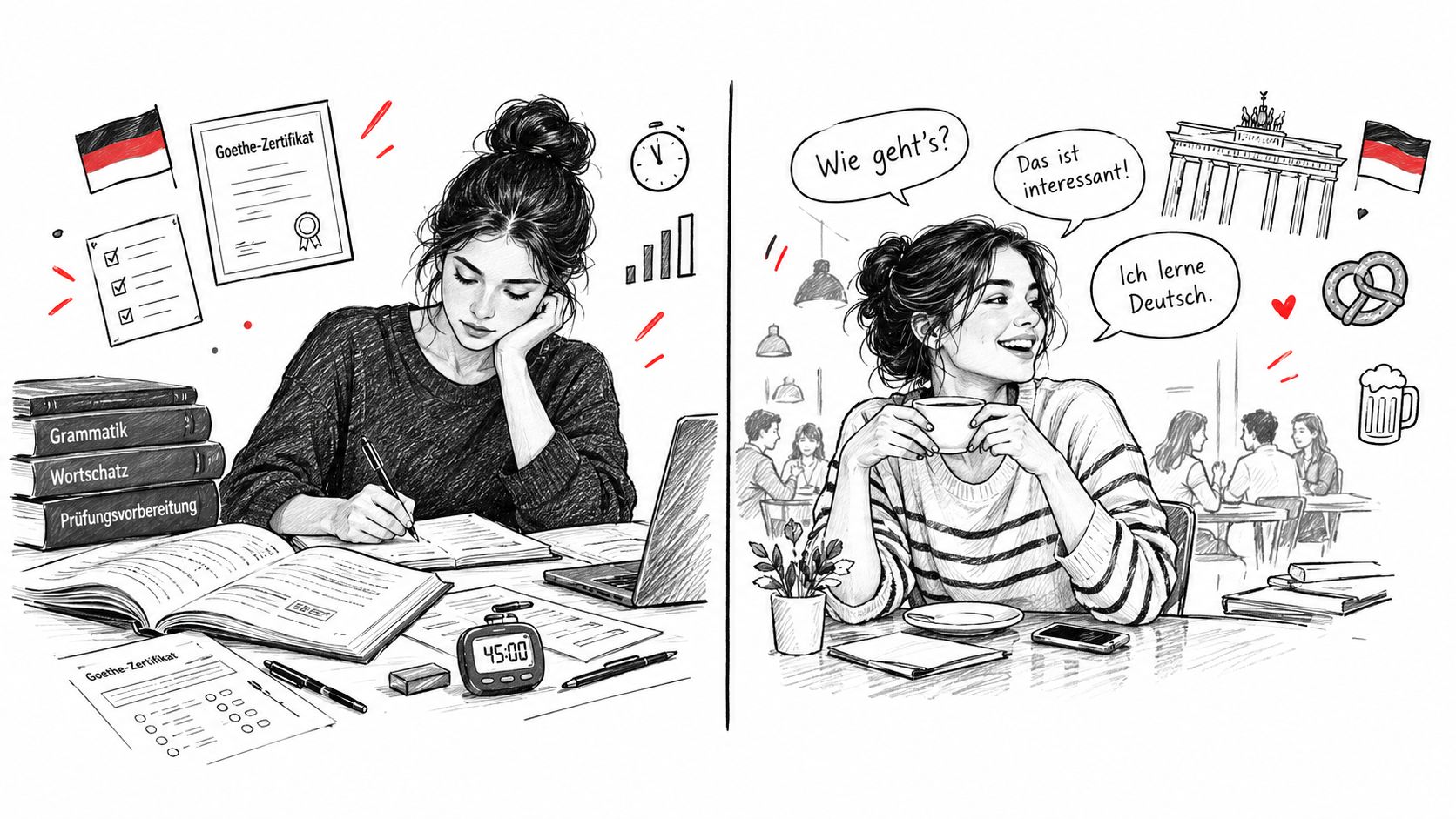
Exam Prep and Immersion Compared for Hong Kong Learners


