.png)
.png)

BLOG

香港德國文化協會
The German Cultural Association
Online German Classes for Kids and Teens: Do They Actually Work?
Your child has German on the timetable, an IGCSE, IB, A-level, or Goethe-Zertifikat target, and a weekly schedule already crowded with school, sport, music, and late journeys across Hong Kong. You're wondering whether an online class will produce real progress or add another screen to the evening. The answer is direct: online German classes for kids and teens work when the course is live, age-specific, small enough for speaking, and tied to a clear proficiency or examination goal.
Hong Kong families shouldn't judge online learning by convenience alone. They should judge it by attendance, spoken output, level progression, and exam readiness. The right online class can remove travel between Kowloon Tong, Central, and Wan Chai without lowering standards. A poorly designed one becomes passive video time.
Table of Contents
- 1. The class has clear age bands
- 2. The teacher can teach German to children
- 3. The programme measures speaking
- 4. Every learner gets enough speaking time
- 5. Progress follows a recognised pathway
What Hong Kong Families Should Ask Before Choosing Online German
A Form 3 student in Kowloon may leave school late, face a long bus journey, and still need to prepare for HKDSE Category C German alongside mathematics and sciences. A Year 5 child in Kowloon Tong may be aiming for IGCSE German by Year 9, while weekday evenings are already filled with activities.
For both families, convenience is only the starting point. The online format must produce regular progress without draining the child before class begins. In Hong Kong, that means matching the course to after-school timing, travel demands, the child's age, and the examination deadline.
Hong Kong's primary-school population is projected at about 340,000 in 2026, down 3.5% year on year, according to German.com.hk's Hong Kong education overview. The shrinking primary cohort makes the enrichment market more competitive. Parents should therefore ask how a provider structures lessons, tracks attendance, and shows progress instead of choosing a course because its timetable looks flexible.
The decision parents should make
Start with the destination:
- Goethe-Zertifikat A1 or A2: prioritise clear pronunciation, confidence, and age-appropriate foundations.
- Goethe-Zertifikat B1 or B2: choose sustained practice in writing, listening, and speaking.
- IGCSE, A-level, or IB: confirm that the teacher knows the examination format and school calendar.
- HKDSE Category C: plan backwards from the required examination window and check that lessons fit the local timetable.
The Goethe-Institut has operated in Hong Kong for more than 60 years. Its local materials present German as an established, exam-linked pathway, not a short-lived online trend. Courses cover children and teens, with live online group learning alongside face-to-face instruction. The Goethe-Institut Hongkong course brochure presents a 9-week online group course with around 50–60 total hours and up to 16 participants, showing how live online study can support sustained progression.
My school-fair advice: Choose the format your child can attend consistently. Then require regular speaking practice and a defined level target.
For families travelling or arranging lessons around temporary accommodation, a best eSIM for Hong Kong vacation can help maintain a stable connection. It cannot improve teaching, but reliable access matters when a child joins class from a hotel, serviced apartment, or temporary home.
What Actually Counts as Online German Working
Online German works if the learner keeps attending, speaks more confidently, and reaches a defined level. A polished platform, colourful slides, or a native-speaking teacher alone isn't enough.
The strongest Hong Kong benchmark comes from the Goethe-Institut's course design. Children's placement can combine a written test completed at home with an oral interview conducted online, while age-banded courses use short live sessions and small cohorts. The Goethe-Institut Hong Kong placement information lists 70-minute weekly sessions for ages 5–7 with a maximum of 10 learners, alongside teen and pre-teen tracks with about 50–60 total hours for A2-level examination preparation.
Three tests I use with parents
Retention comes first. Does the child remain engaged beyond the first few lessons, complete the advertised CEFR level, and return after school holidays? Hong Kong providers don't publish independent local data on online-to-offline conversion, attendance, or exam-score gains, so parents should request attendance records and termly progress reports instead of accepting testimonials as proof.
Oral output is the second test. A child should regularly answer unexpected questions, describe a picture, react to a partner, and receive correction on pronunciation. A recorded presentation or live speaking checkpoint is more useful than a worksheet completed with parental help.
Exam alignment is the third test. The class should identify the target qualification, map its work to the relevant CEFR level, and show how listening, reading, writing, and speaking are practised. For HKDSE German, the Goethe-Institut states that the Goethe-Zertifikat became the officially stipulated German examination for Category C from 2025, and candidates must take Goethe-Zertifikat A2 or above within the two years before the HKDSE. Families should therefore plan dates, not just levels, using the official Goethe-Institut Hong Kong examination guidance.
| Lens | What to measure | Realistic HK benchmark |
|---|---|---|
| Retention | Attendance, completed work, continuation after the first term | A defined CEFR progression with documented participation |
| Oral output | Spontaneous answers, pronunciation, interaction | Regular live speaking checks with individual feedback |
| Exam alignment | Skills covered and exam timing | A named Goethe-Zertifikat, IGCSE, A-level, IB, or HKDSE target |
The table doesn't promise a particular grade or pass result. It gives parents a better standard for judging whether a course is doing meaningful work.
Online Versus In-Person and Small Group Versus One-on-One by Age
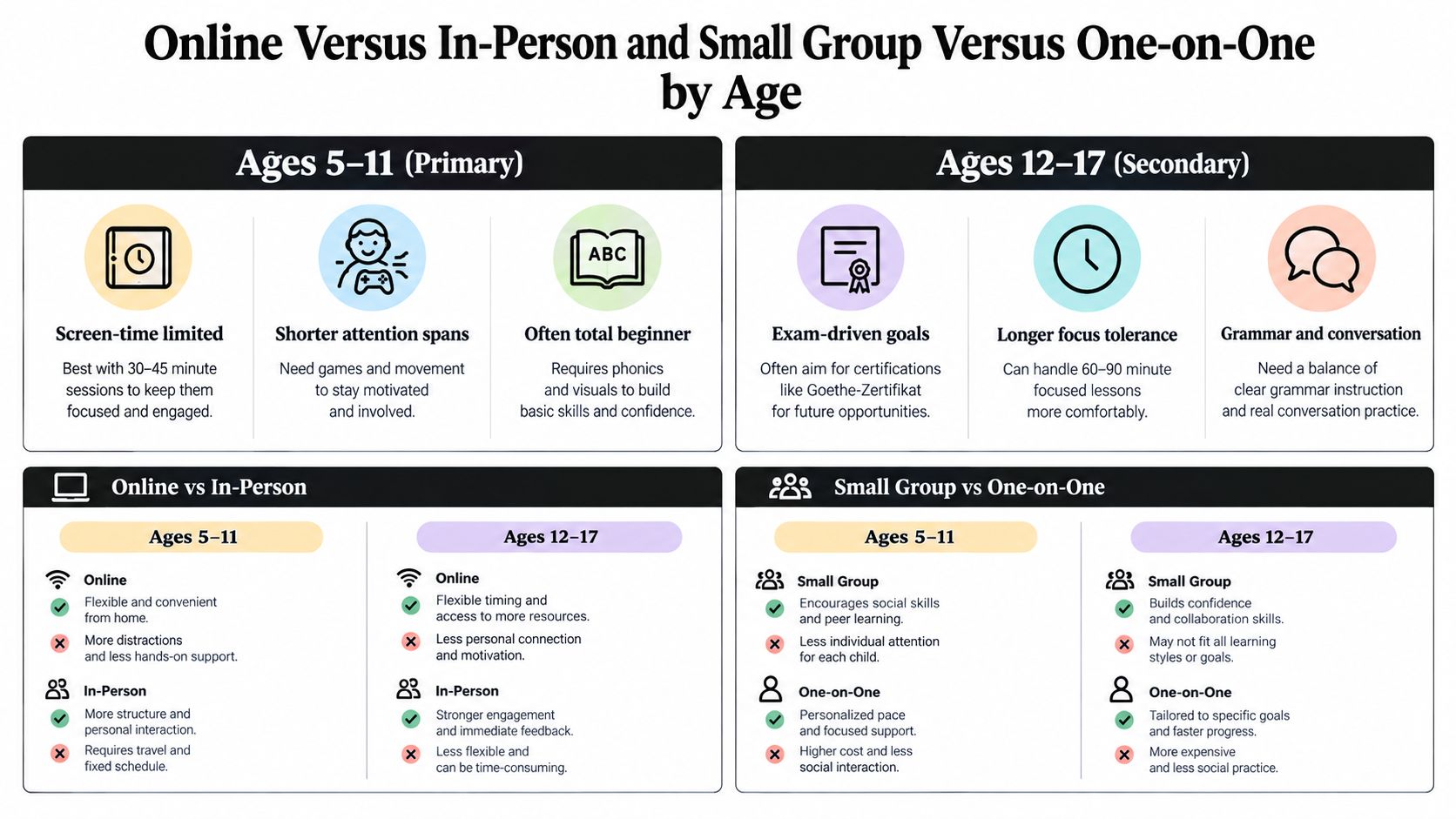
Format matters more than the label “online”. A five-year-old and a sixteen-year-old need different pacing, different materials, and different reasons to speak.
For ages 5–11, online lessons should be short, lively, and strongly visual. Children need songs, rhymes, movement, games, phonics, and concrete objects. The Goethe-Institut's Hong Kong children's materials reflect this age-appropriate approach, including playful online activities and a separate placement process.
For ages 12–17, the priorities change. Teens can handle more deliberate grammar, written production, reading, listening, and examination technique. They still need interaction, but the lesson should connect directly to a school or certification objective.
Ages 5–11
Online small groups work well when the teacher keeps children active and limits passive screen time. A child can join from home after school, avoid a cross-harbour journey, and use familiar toys or objects during speaking tasks.
In-person lessons may be safer for an absolute beginner who struggles to remain at a desk or needs close physical prompting. A classroom can also make it easier for a young child to transition into learning German as a regular routine.
For group size, a small cohort creates useful social pressure. Children hear different voices, wait for their turn, and learn that communication isn't only between them and the teacher. One-on-one teaching can help a shy beginner, but it can also remove the peer energy that makes early language practice enjoyable.
Ages 12–17
Online learning often wins for secondary students because it removes travel time and makes it easier to fit German around school assessments. A teen preparing for Goethe-Zertifikat B1, IGCSE, IB, or HKDSE Category C can use the lesson for targeted writing and speaking rather than spending the evening commuting to a centre.
A small group is usually the better default for exam preparation. Students practise turn-taking, role-play, picture description, and discussion with peers. One-on-one teaching becomes more valuable when the learner needs an accelerated plan, has a specific school weakness, or is preparing for a demanding IB pathway alongside classroom teaching.
Online is the smarter choice when the saved travel time becomes extra German practice, not extra gaming time.
For a fuller format comparison before enrolling, parents can read in-person versus online German classes in Hong Kong.
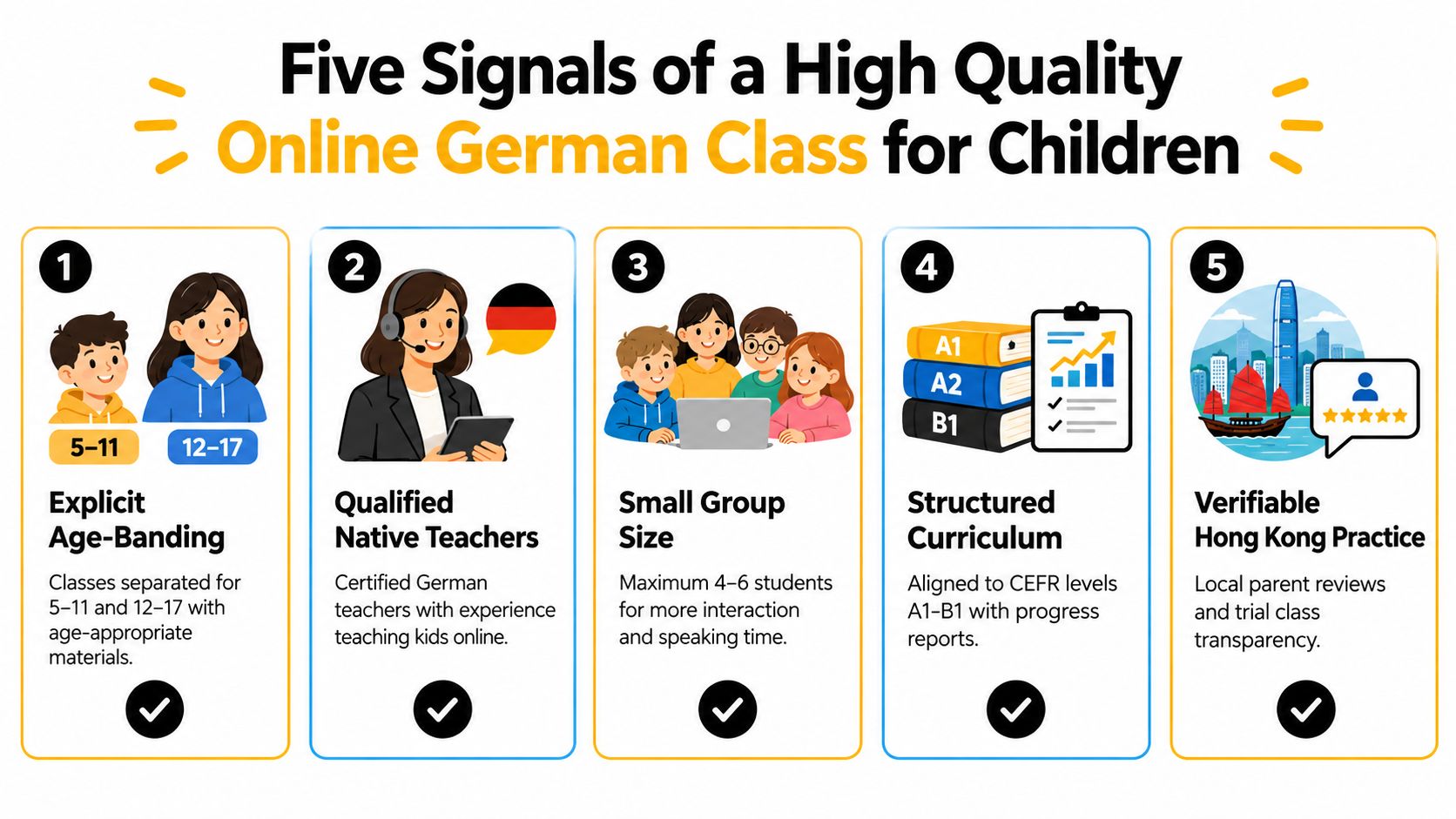
Five Signals of a High Quality Online German Class for Children
At a Hong Kong school fair, parents often ask which video platform a tutor uses. That is the wrong test. Ask what the child does during the lesson, how the teacher tracks progress, and what evidence parents receive afterwards.
1. The class has clear age bands
A course for ages 5–7 needs a different pace, vocabulary range, and activity pattern from a class for a 14-year-old preparing for an examination. Choose a provider with separate pathways for early primary, upper primary, pre-teens, and teenagers.
Parent check: Request a sample lesson plan. It should show age-appropriate materials, regular activity changes, and one clear language objective.
2. The teacher can teach German to children
A native speaker can offer accurate pronunciation and cultural knowledge. Native ability alone does not show that the teacher can manage children, explain grammar, or prepare exam candidates. Ask for the teacher's biography, German teaching qualifications, and experience with the relevant age group.
Parent check: Confirm who teaches the trial lesson and whether that teacher will lead the regular class. A substitute-led trial can give parents a misleading impression.
3. The programme measures speaking
A child may complete grammar exercises while avoiding spontaneous German. Strong online teaching includes live questions, pronunciation correction, role-play, short presentations, and individual speaking turns. Younger children should produce simple spoken language regularly. Teenagers should receive feedback on fluency, accuracy, pronunciation, and response quality.
Parent check: Ask how often each learner receives individual oral feedback and whether the teacher records specific speaking targets.
4. Every learner gets enough speaking time
Large online classes allow quiet children to disappear. The teacher should use pair work, turn-taking, breakout tasks, and direct questioning so each learner speaks during every lesson. A smaller cohort is especially useful when children are preparing for an oral examination or need confidence using German aloud.
Parent check: Confirm the maximum group size, not the usual group size. Ask how the teacher prevents confident students from taking every turn.
5. Progress follows a recognised pathway
A useful report states the child's current CEFR level, skills already demonstrated, areas requiring practice, and the next realistic target. The Continuing Education Fund lists recognised German examinations at A1, A2, B1, and C1 levels, giving families clear benchmark options. The Hong Kong CEF German examination information can help parents check the recognised examination route.
Parent check: Request a sample term report before paying for a full course. If the provider cannot show how it measures progress, choose another class.
A credible provider should answer these questions plainly. Vague answers usually indicate vague teaching.
Matching Online German Classes to IGCSE A-level IB and Goethe-Zertifikat Prep
A Year 9 student preparing for IGCSE needs a different online class from a primary child learning German for interest. Exam choice should set the lesson design. Enrichment classes should build vocabulary, confidence, and enjoyment. Examination tuition must add timed tasks, systematic correction, and practice in every assessed skill.
Online tuition strengthens speaking, writing, and exam technique, but it does not automatically replace school teaching. Choose the balance according to the learner's current class, target level, and ability to work independently. For Hong Kong families, the timetable matters too. A focused online lesson can fit more easily around school and after-school commitments, particularly as families plan early for shrinking primary cohorts and later examination choices.
Use the qualification as the starting point
For IGCSE, confirm that the teacher knows the syllabus, oral requirements, writing formats, and marking expectations. For A-level, the course should develop advanced grammar, argument, cultural content, and any prescribed literary or film work.
IB Ab Initio students need guided development from the beginning, with frequent oral interaction and detailed writing correction. IB Higher Level students usually need online support alongside school teaching, especially for complex written and spoken work.
For Goethe-Zertifikat A1 to B2, choose a CEFR-aligned course that names the examination skills directly. The Goethe youth route gives families a practical way to plan early certification before senior secondary study. This guide to Fit in Deutsch and Goethe youth examinations for HK children and teens explains the distinction between children's and teenagers' examination options.
| Exam track | Recommended start | Weekly online hours | Key preparation feature |
|---|---|---|---|
| IGCSE German | Start early enough to build all four skills before the school examination phase | Course-dependent, confirm the provider's contact-hour plan | Listening, speaking, reading, and writing under syllabus conditions |
| A-level German | Begin alongside school teaching when gaps or advanced practice appear | Course-dependent | Extended writing, grammar accuracy, discussion, and cultural analysis |
| IB Ab Initio SL | Start from the learner's actual level, not assumed prior knowledge | Course-dependent | Guided vocabulary, communication, written tasks, and oral practice |
| IB HL | Use online lessons as structured support beside school instruction | Course-dependent | Higher-level writing, analysis, accuracy, and sustained conversation |
| Goethe-Zertifikat A1–B2 | Align the course with the chosen CEFR examination | Follow the provider's published total hours | Exam-specific listening, reading, writing, speaking, and mock tasks |
| HKDSE Category C | Work backwards from the HKDSE examination date | Course-dependent | Goethe-Zertifikat A2 or above within the required two-year window |
HKDSE Category C requires careful timing. Plan backwards from the examination date and confirm that the student can complete Goethe-Zertifikat A2 or above within the required two-year window. Do not leave this decision until the senior secondary years.
Working adults should assess funding separately from a child's school pathway. The Continuing Education Fund supports selected German courses with 80% reimbursement for the first HK$10,000 of eligible fees and 60% for the remaining HK$15,000, according to CEF German course guidance. HKU SPACE lists German certificate fees of around HK$9,550 to HK$10,450. Verify current eligibility, course registration, and application requirements before enrolling.
Practical Setup Tips for Parents to Maximise Online German Results
Online lessons need a home routine. Without one, even an excellent teacher competes with siblings, notifications, homework, and poor audio.
Start with a fixed learning station. Keep headphones, a notebook, pencils, and any vocabulary materials in the same place. A second screen can support a vocabulary app, but it shouldn't become a source of distraction during speaking tasks.
Build the week around consistency
Use the same weekday and time whenever possible. Treat the lesson like a face-to-face appointment, not an optional activity that moves whenever another commitment appears.
Before class, give the child a short warm-up. Review a few words, read a sentence aloud, or answer one simple question in German. After class, ask for a brief explanation of one new expression and one grammar point.
A practical routine looks like this:
- Before the lesson: Check the microphone, open the notebook, and review recent vocabulary.
- During the lesson: Keep the camera and materials ready, with other tabs closed.
- After the lesson: Ask the child to retrieve one new word and use it in a sentence.
- At the weekend: Add a short offline activity, such as flashcards, a German cartoon, or a simple reading task.
- Each week: Review homework and teacher feedback together, then note one improvement target.
Don't accept a recorded class as a substitute for live participation unless the provider explains how the child will recover missed speaking practice. Ask about rescheduling rules, catch-up materials, and technical support before paying.
If you're comparing tutoring formats and platforms, the Hong Kong guide to online German tutors and platforms is a useful starting point. GCA's published model uses flexible online rescheduling and a structured certificate system with 80% attendance, but families should confirm the current policy and documentation needed for any reimbursement claim directly with the provider.
The best home setup is boring and repeatable. That's precisely why it works.
So Do Online German Classes for Kids and Teens Actually Work in Hong Kong
Yes, online German classes work in Hong Kong when three conditions are present: a teacher who can model and correct spoken German, a session design suited to the learner's age, and a defined target such as a CEFR level, Goethe-Zertifikat, IGCSE, A-level, IB, or HKDSE Category C.
For busy P5 to F6 students, online learning often makes more sense than adding another cross-district journey. It is also a strong option for teens preparing for examinations, provided the course includes writing correction and regular oral assessment rather than passive worksheet completion.
Hybrid or in-person learning is safer for some children. Choose it when an absolute beginner under seven cannot sustain attention online, when handwriting needs intensive supervision, or when documented attention difficulties make home study unreliable.
A structured trial removes most of the guesswork. Ask for a 25-minute diagnostic placement, an oral check, a level recommendation, and two trial sessions before making a term commitment. The placement process should distinguish written understanding from live speaking, as demonstrated in the Hong Kong Goethe-Institut's remote assessment workflow.
German Cultural Association Hong Kong(GCA)offers native-speaker online and in-person classes, small groups capped at 6 students, private lessons, and structured preparation for Goethe-Zertifikat, IGCSE, A-level, and IB. If that matches your child's target and timetable, visit German Cultural Association Hong Kong(GCA) to review the current course schedule and arrange a diagnostic trial before enrolling.
Online German Classes for Kids and Teens: Do They Actually Work?
Beginner German for Teens: A Starter Roadmap for Ages 12-18


