.png)
.png)

BLOG

香港德國文化協會
The German Cultural Association
Learn German for Kids: How Children Actually Pick Up a Third Language
Your child may already be doing the hardest part of Learn German for Kids: How Children Pick Up a Third Language without anyone calling it language training. At home they answer grandparents in Cantonese, switch to English for homework, and move through a school system that expects them to handle more than one language every day. For many Hong Kong families, the question isn't “Can my child cope with German?” It's “How do we add German without turning it into one more subject to cram?”
That's the right question.
In Hong Kong, children often grow up inside a biliterate and trilingual environment already. The 2021 Population Census children report shows that 88.7% of children aged five and over could read and write both Chinese and English, while 95.6% could speak Cantonese, 91.1% could speak English, and 69.9% could speak Putonghua. That matters because German usually enters an existing language system, not a blank slate.
Table of Contents
- The advantage is not “knowing more words”
- Age changes the teaching strategy
- Why this gives Hong Kong learners a real head start
- Start with the order of languages
- How the three-language network works
- Transfer helps. Interference needs correction.
- Three age bands that matter in real life
- What this looks like in Hong Kong classrooms
- Younger doesn't always mean faster
- Start mode matters more than textbook level
- Compare your child's starting point
- If you're unsure, choose this order
Why Hong Kong Children Are Surprisingly Well Placed for German
A familiar Hong Kong evening says a lot. Your child chats with grandparents in Cantonese, reads school instructions in English, then hears a few German words and tries them out aloud. That is not a child starting from zero. It is a child who already knows that different people, places, and tasks can call for different language settings.
That matters more than many parents realise.
In a lot of Hong Kong advice, German gets treated like one more subject to add to an already full timetable. The better starting point is different. Many local children already run a two-language system every day, and sometimes a three-language one. German usually works best when it is added to that system, not forced against it.
The advantage is not “knowing more words”
As noted earlier, Hong Kong children commonly grow up using Chinese and English in parallel, with Putonghua present to different degrees depending on school and family life. The useful advantage is not just exposure. It is practice.
A child who already shifts between Cantonese and English has often built three habits that help with German from the beginning:
- They expect language rules to change by context. Home language and school language do not always work the same way.
- They are used to matching sound to situation. A child may speak one way with teachers and another way with family.
- They can hold two systems in mind without panic. That makes it easier to hear, “In German, we say it this way.”
This is why German does not always feel as foreign as parents fear. The child is not building the first bridge. They are adding another lane to a bridge that already exists.
Age changes the teaching strategy
Earlier census figures also show an age pattern that matters for class design. English speaking rates are lower among younger children and higher among older ones. In plain terms, a Primary student and a Secondary student should not be taught German in the same way, even if both are “beginners.”
For younger learners, German class usually works better with more movement, repetition, songs, picture cues, and routine classroom phrases. They may understand less explanation in English, but they copy sound quickly and absorb patterns through play.
Older children can often use English more actively as a support language. That helps with school-style tasks such as reading instructions, comparing sentence structure, and preparing later for formal pathways like Goethe exams, IGCSE, A-Level, or IB.
So the local advantage is not “Hong Kong kids know English.” It is that many of them already sit somewhere on a bilingual pathway, and good German teaching adjusts to where they are on that path.
Why this gives Hong Kong learners a real head start
German brings new features. Children meet sounds that do not exist in Cantonese, word order that can shift, and noun gender that needs time to settle. Even so, children in Hong Kong often cope better than adults expect because language comparison is already part of daily life.
A useful comparison is schoolbag organisation. A child who has only ever carried one subject may need help sorting folders. A child who already manages Chinese, English, and maybe Putonghua materials understands the idea of separate compartments. German becomes a new folder, not a completely new schoolbag.
For parents, the practical takeaway is simple. If your child already moves between Cantonese and English each week, German is not competing with those languages by default. It can attach to habits your child already has. A parent-friendly guide to the hidden advantages and common pitfalls for Chinese speakers learning German explains where that head start helps, and where children still need careful support.
What It Really Means to Learn a Third Language
A third language means a child is adding German to an existing language system, usually after Cantonese and English are already in place. In Hong Kong, that often creates both shortcuts and mix-ups. English may help with school vocabulary, while Cantonese and English sound patterns can also shape German pronunciation.
Parents often hear terms like “bilingual” and “trilingual” and assume the process is mysterious. It isn't. Once you break it down, third-language learning becomes much easier to understand.
Start with the order of languages
There are two common patterns:
Simultaneous bilingualism
A child grows up with two languages from the start.Sequential bilingualism
A child builds one language first, then adds another after early childhood.
For many children in Hong Kong, German becomes a sequential third language. Cantonese is often the home base. English becomes strong through school and daily exposure. German comes later as an added system.
That order matters because German doesn't enter an empty mind. It enters a mind that already has ways of storing words, guessing meaning, and copying pronunciation.
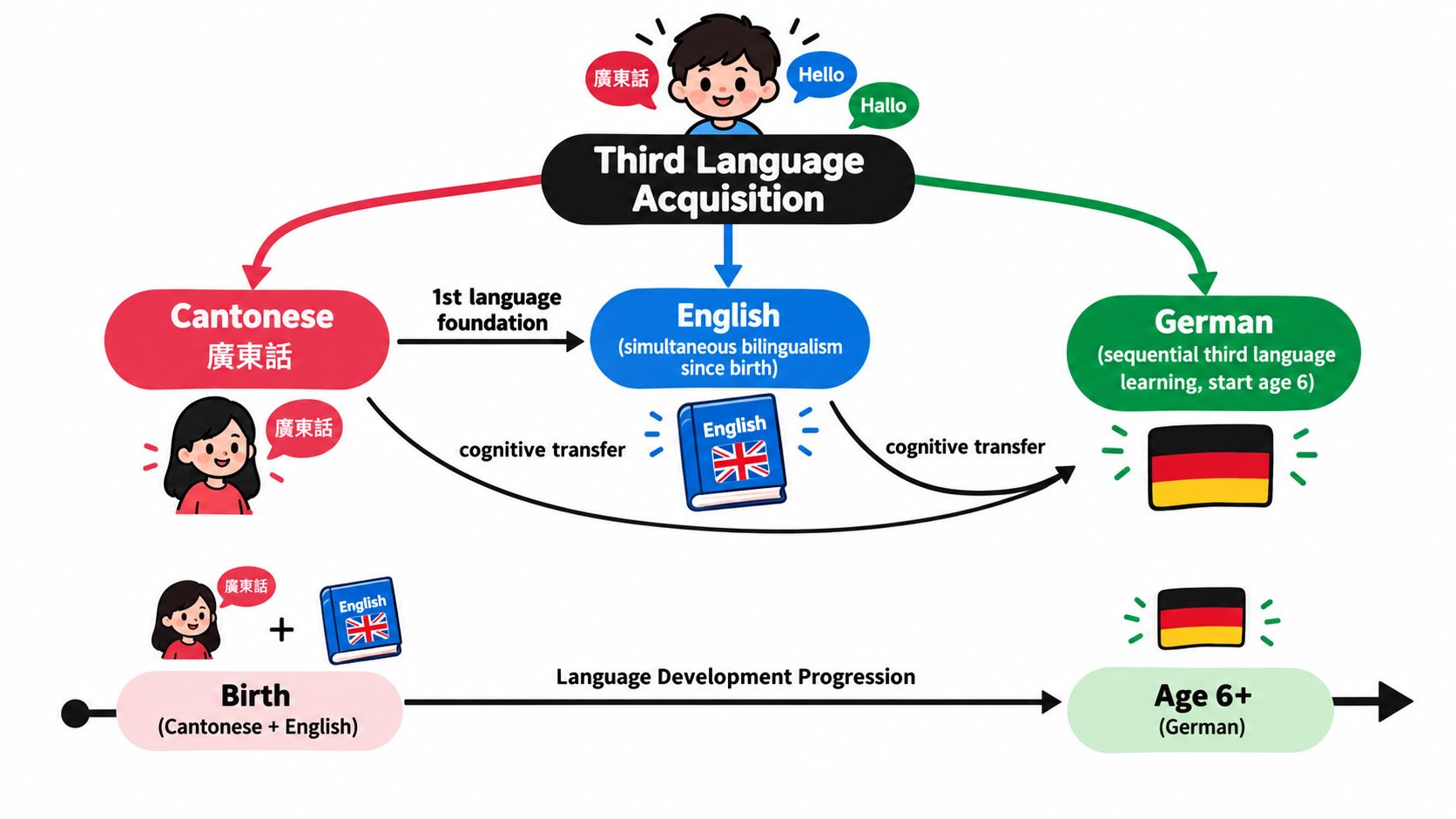
How the three-language network works
Think of your child's language knowledge as three connected shelves, not one mixed box.
If the idea is “water”, the child may connect:
- Cantonese
- English: water
- German: Wasser
Those words don't sit in one pile. They sit in linked networks. In practice, German often connects quickly to English for school-style vocabulary because English is already the language many HK children use for reading, instructions, and subject learning.
That can help. A child may spot familiar-looking words, recognise alphabet patterns, or feel less intimidated by European sentence structure.
Transfer helps. Interference needs correction.
Parents often worry when a child mixes languages. Some mixing is normal.
A useful distinction is this:
Transfer is a helpful shortcut.
A child uses knowledge from English reading to decode a German word.Interference is an unhelpful carryover.
A child applies English pronunciation or sentence logic where German works differently.
An HKU-linked study of Cantonese-English-German trilinguals found that prior Cantonese and English phonology materially shapes German vowel-length production in learners, which is exactly why German lessons for HK children need explicit listening and pronunciation work, not only casual conversation. You can read the research in the HKU study on Cantonese-English-German trilingual speech production.
Children don't need to avoid transfer. They need a teacher who knows when transfer is helping and when it's creating a wrong habit.
How Young Minds Process a Third Language in Practice
Age changes the route, not the possibility. A six-year-old and a thirteen-year-old can both learn German well, but they don't learn it in the same way.
One of the biggest mistakes I see in Hong Kong is giving every age group the same class format. A playgroup child needs rhythm, repetition, and movement. A Form 1 student can handle explanation, comparison, and exam logic.
Three age bands that matter in real life
| Age band | Cognitive strengths | Typical L3 interference pattern | Most effective input |
|---|---|---|---|
| 4 to 7 | Strong imitation, sound copying, routine learning | Carries over familiar sound patterns from Cantonese or English into German words | Songs, picture books, actions, repeated classroom phrases |
| 8 to 11 | Better attention span, stronger literacy in English and Chinese, growing pattern awareness | Uses English reading habits to guess German pronunciation or meaning too quickly | Structured speaking, simple reading, guided pronunciation, short writing |
| 12+ | Can understand grammar explanations, compare systems, and work toward DSE/IB/IGCSE-style targets | False friends, over-translation from English, grammar overthinking | Explicit grammar, correction, speaking tasks, exam-shaped practice |
What this looks like in Hong Kong classrooms
A Primary 3 child may see Bahnhof and try to decode it through English phonics. That instinct is useful because it shows the child is actively searching for patterns. But without guidance, the pronunciation can drift in the wrong direction.
A Form 1 student may meet bekommen and assume it works like English “become”. That's a classic third-language issue. The child isn't failing. The child is doing what multilingual learners do, which is linking new language to old language.
Teaching rule: When a child makes the same “wrong” transfer repeatedly, that isn't random confusion. It's a sign the teacher has found the next thing to teach.
Younger doesn't always mean faster
Parents often ask whether starting early guarantees better results. The honest answer is more nuanced.
- Younger children usually absorb sound and accent more naturally.
- Older children often reach test-ready performance faster because they can analyse grammar, revise vocabulary, and stay focused on long-term targets like Goethe-Zertifikat, IGCSE, or IB.
That matters in Hong Kong because many families care about outcomes, not just exposure. If your child is eight, a playful but organised class is ideal. If your child is thirteen and aiming at an exam pathway, you want clearer correction, more structured homework, and a plan.
Families considering an early social setting sometimes explore bilingual and trilingual playgroups in Hong Kong. That can work well if the format matches the child's age and attention span.
Where to Start by Age and by Goal
You don't choose a German course by age alone. You choose it by age plus goal.
A four-year-old whose family wants joyful exposure needs a different setup from a ten-year-old aiming at future IGCSE German. When parents skip that distinction, children either get bored or overwhelmed.
Start mode matters more than textbook level
For ages 4 to 6, keep German light, oral, and physical. Think songs, picture cards, routines, movement games, and short bursts of repetition. At this stage, “successful” learning means the child recognises familiar phrases, joins in, and isn't afraid to speak.
For ages 7 to 9, children can usually manage more structure. Simple reading, copying key words, and short speaking tasks start to make sense. If a parent is already thinking long term about Goethe-Zertifikat or future IGCSE options in Hong Kong, this is a good age to begin organised lessons.
For ages 10 to 12, German can become more deliberately academic without becoming dry. Children at this age can handle sentence-building, topic vocabulary, light grammar explanation, and more regular homework if the class stays interactive.
Compare your child's starting point
| Age band | Weekly exposure | Main activity | Realistic milestone | Recommended class |
|---|---|---|---|---|
| 4 to 6 | Short, frequent contact across the week | Songs, movement, listening, repeating routines | Comfort with basic words and classroom phrases | Play-based small group with a native-speaking teacher |
| 7 to 9 | Regular lesson plus light home review | Speaking, phonics-style decoding, simple reading | Early foundation for structured German study | Small group with clear progression and simple literacy work |
| 10 to 12 | Consistent weekly lessons and guided practice | Speaking, reading, writing, grammar awareness | Readiness for exam-shaped learning later | Structured course linked to long-term exam pathways |
If you're unsure, choose this order
A good sequence for most HK children is:
- Speak
- Understand
- Read
- Write
Not the other way round.
Parents who want extra ideas for keeping motivation high at home often look at tools that use gamified learning for kids. Used properly, that kind of support works best as a supplement to live teaching, not as the whole programme.
Activities That Move German From Passive to Active
Children often understand more German than they use. That's normal. The shift from passive recognition to active use happens when a child has to retrieve words, not just hear them.
The easiest way to do that is to give German a job. It should help the child sing, choose, point, describe, read, or respond.
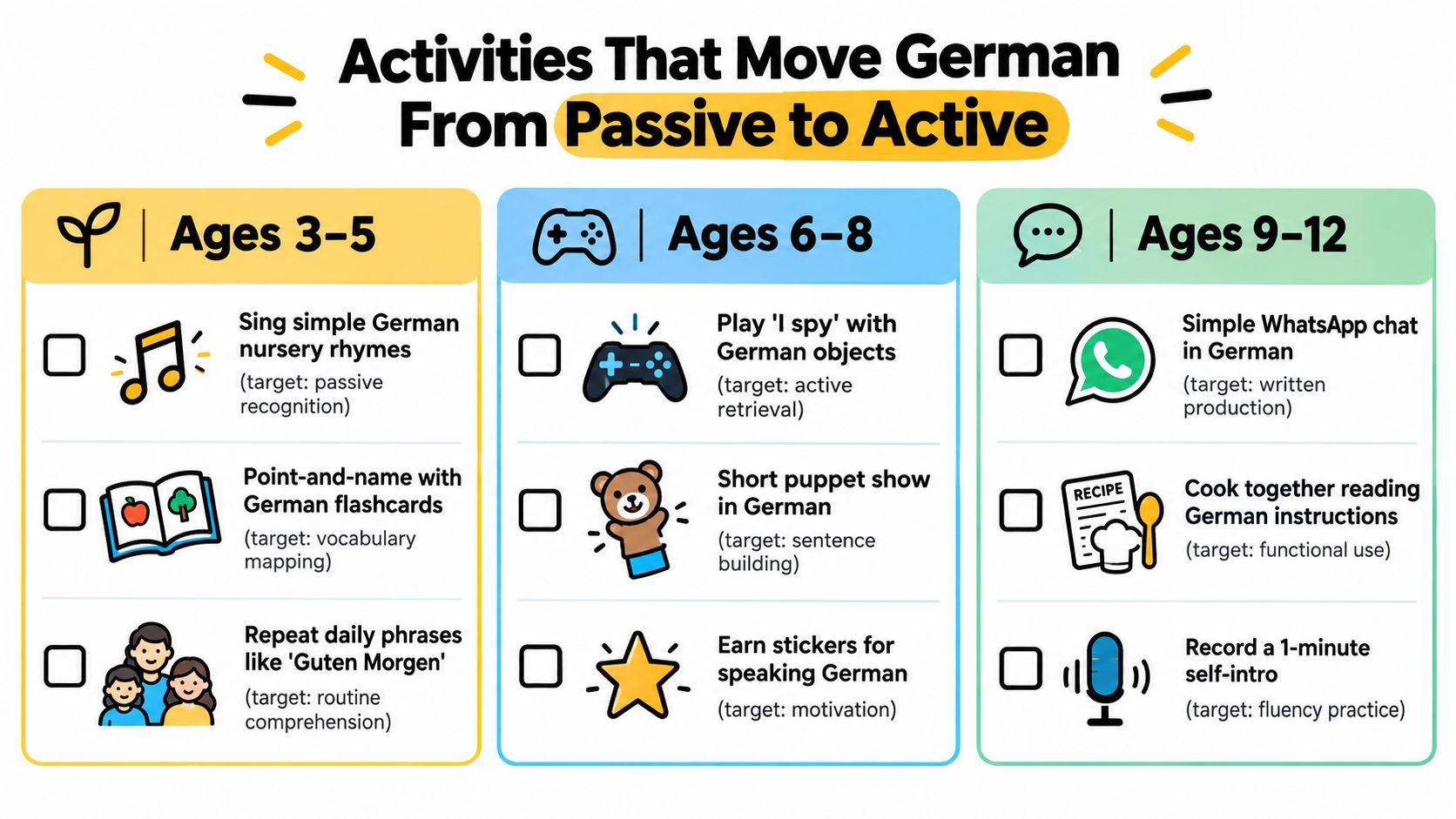
Ages 4 to 6
These children learn best when German arrives through routine and play.
- Song twice a week: Use Mein Körper with actions. The target is passive recognition first, then joining key words.
- Bedtime picture book: Spend a few minutes pointing and naming in German. Stop before the child gets tired of it.
- Label the room: Put simple German labels on familiar objects like table, door, or chair, then use them in quick games.
The key is not volume. The key is repetition without pressure.
If your child only says one or two words back at first, that's still productive. Quiet listening is often the stage before confident speaking.
Ages 7 to 9
Children here can handle tasks with clearer output.
- Short cartoon viewing: Watch a brief age-appropriate German clip, then ask the child to repeat one phrase or identify three words.
- Mini dictation game: The teacher says a small set of words or phrases. The child writes or arranges them.
- Weekend kitchen German: While measuring ingredients, use simple instructions and object names in German.
At this age, English can help reading. It can also mislead. Cognates may support confidence, but noun gender and pronunciation need explicit correction.
Ages 10 to 12
Older children need production tasks that feel purposeful.
- Weekly journal entry: A few sentences about school, hobbies, or family routine.
- Short news item reading: Use age-appropriate current-affairs material, then ask for one spoken summary sentence.
- Peer dialogue: Role-play buying tickets, introducing oneself, or asking for directions.
- Monthly chat exchange: A simple written exchange helps move classroom German into real communication.
If you want help hearing how words should sound before practising with your child, an English to German translation audio guide from VideoLearningAI can be a useful support resource for parents.
A simple classroom wall checklist
- Listen first: Can the child recognise the phrase?
- Repeat next: Can the child copy it clearly?
- Retrieve: Can the child produce it without seeing it?
- Use it in context: Can the child answer a real question with it?
- Recycle it later: Does the word reappear next week?
Pathways From First Class to Goethe-Zertifikat IGCSE A-Level or IB
Hong Kong parents usually want one practical answer. If my child starts now, where can this realistically lead?
German does have formal pathways in HK, but it remains a smaller subject than French or Spanish inside the school system. A University of Hong Kong linked study reported that in the 2016/17 school year German was offered in four schools with 166 students, compared with Spanish in 11 schools with 603 students and French in six schools with 435 students. The same dataset also noted 90 enrolments for German in the regular curriculum across levels from Primary 3 to Secondary 6. You can review the figures in the HKU-linked summary of foreign-language provision in Hong Kong schools.
That small scale changes the planning. Families often need to build the pathway deliberately rather than waiting for a school route to appear by itself.
A realistic exam map
| Route | Typical start age in HK | Mid-point milestone | Final exam target | Total study years |
|---|---|---|---|---|
| Goethe track | Around primary years for serious study | Basic speaking and reading foundation | Goethe-Zertifikat progression such as A1, then higher levels over time | Multi-year pathway |
| IGCSE German | Around 11 to 12 | Topic vocabulary and controlled writing | IGCSE German | Usually several years |
| A-level German | Mid-teen years with prior study | Stronger reading, writing, and speaking control | A-level German | Multi-year upper secondary route |
| IB ab initio or Language B | Teen years depending on prior exposure | Careful stream placement based on level | IB German course route | School-dependent |
The practical questions to ask before committing
Ask your school or course provider:
Which route fits my child's current level?
A complete beginner and a partially exposed learner shouldn't start in the same track.How is the class preparing for the actual exam format?
Goethe, IGCSE, A-level, and IB all test slightly different skills.Who handles registration and scheduling?
School-based exams and external exams work differently.Is the course building spoken German early enough?
Many children can memorise vocabulary lists but still freeze in oral tasks.
One HK-focused source discussing teen pathways notes that German is offered as a second foreign language in only 4 schools with 90 students, with 22 to 25 new students typically enrolling each year. The article's practical value is that it reminds parents German is a selective pathway in Hong Kong, not a mass-market school subject. See the discussion in this Hong Kong guide to German courses for teens and exam pathways.
If you're comparing formal exam options, this guide to German exams including Goethe-Zertifikat and TestDaF is a useful next read.
Why Native-Speaking Small-Group Classes Make the Difference
The biggest driver of progress in third-language learning isn't a clever worksheet. It's the quality of the input the child hears and responds to.
A child learning German after Cantonese and English needs live correction, clear pronunciation, and enough speaking turns to test the language out loud. Large classes and app-only routines usually can't do that consistently.
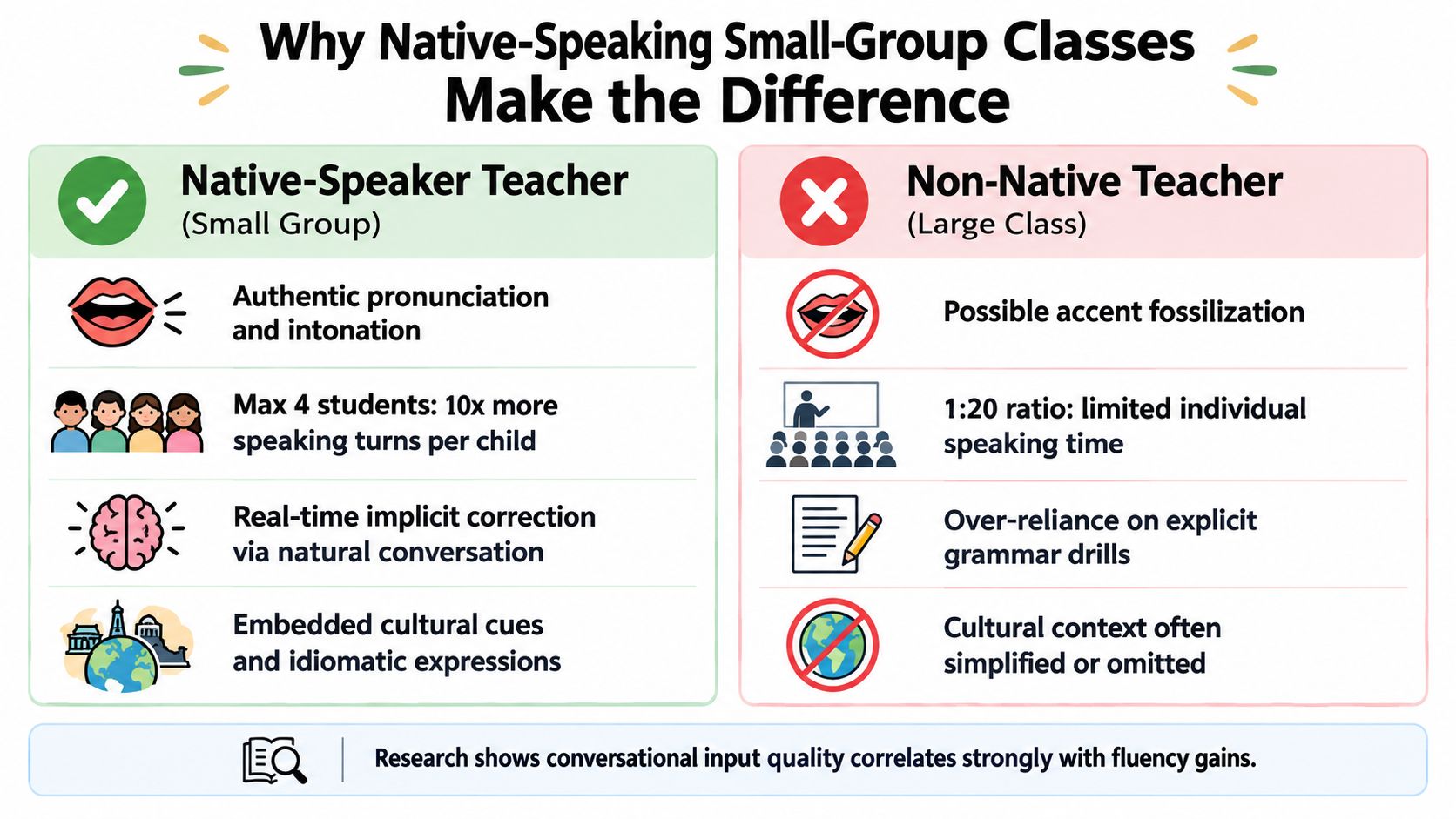
Why group size matters
In a small group, the teacher hears each child closely enough to catch:
- vowel length problems
- English-influenced pronunciation
- memorised answers that don't transfer to real conversation
- hesitation that signals the child has understood passively but can't produce actively
That matters even more in Hong Kong because local learners often build German on top of a Cantonese-English base. They need someone who can hear where those earlier languages are helping and where they are distorting the German.
Why native-speaking input matters
Native-speaking teachers don't just provide accent. They model timing, intonation, natural phrasing, and everyday word choice. For children, that becomes the sound map they copy.
The local evidence base supports close attention to spoken performance. The L3HK repository published in Scientific Data contains 906 audio recordings and annotated transcripts of Cantonese-speaking learners producing French, German, and Spanish narratives in Hong Kong, showing that narrative speech is a meaningful way to track third-language development in local contexts. The dataset is described in the L3HK Scientific Data article.
A short explanation is often easier to see than to describe, so this video is worth a look:
For families who want organised German lessons Hong Kong children can use, one factual option is German Cultural Association Hong Kong(GCA), which offers age-banded small-group and online classes taught by native German speakers, with structured progression and exam preparation for routes such as Goethe-Zertifikat, IGCSE, A-level, and IB.
Ready to Start Learning
If you've read this far, you probably don't need more theory. You need the right first step.
For most families in Hong Kong, that step is a short placement conversation before choosing a class. A useful placement chat should cover your child's age, whether Cantonese and English are both active in daily life, any prior exposure to German, and whether the goal is playful early exposure, future IGCSE, IB, or a Goethe-Zertifikat track.
What to prepare before you ask for advice
Write down four things:
- Current age and school year
- How your child uses Cantonese and English now
- Any German exposure already tried
- Your real goal, such as confidence, long-term exam preparation, or future study abroad in Germany
That last point matters most. German for a five-year-old who needs confidence sounds very different from German for an eleven-year-old preparing for a more academic pathway.
One practical note for older learners
If you're a parent planning long term for study abroad in Germany, the route eventually becomes more formal. For a German student visa filed through the German consulate in Hong Kong, applicants must show proof of German language knowledge if the programme is taught in German and financial proof of at least 992 EUR per month, or 11,904 EUR per year, via accepted funding routes, according to the German consulate student visa information for Hong Kong applicants.
For adult learners in the family, cost planning can matter too. Hong Kong's Continuing Education Fund reimburses 80% of the first HK$10,000 of eligible course fees and 60% of the next HK$15,000, up to a lifetime ceiling of HK$25,000 per person, for eligible learners aged at least 18 who meet the claim rules set out on this HKU SPACE German course page explaining CEF funding.
If you want a structured next step, German Cultural Association Hong Kong(GCA) offers native-led German classes for children, teens, and adults in small groups, with clear progression from playful early exposure to exam pathways such as Goethe-Zertifikat, IGCSE, A-level, and IB. If your child is already managing Cantonese and English in Hong Kong, GCA can help turn that bilingual base into a realistic, age-appropriate start in German.
Learn German for Kids: How Children Actually Pick Up a Third Language
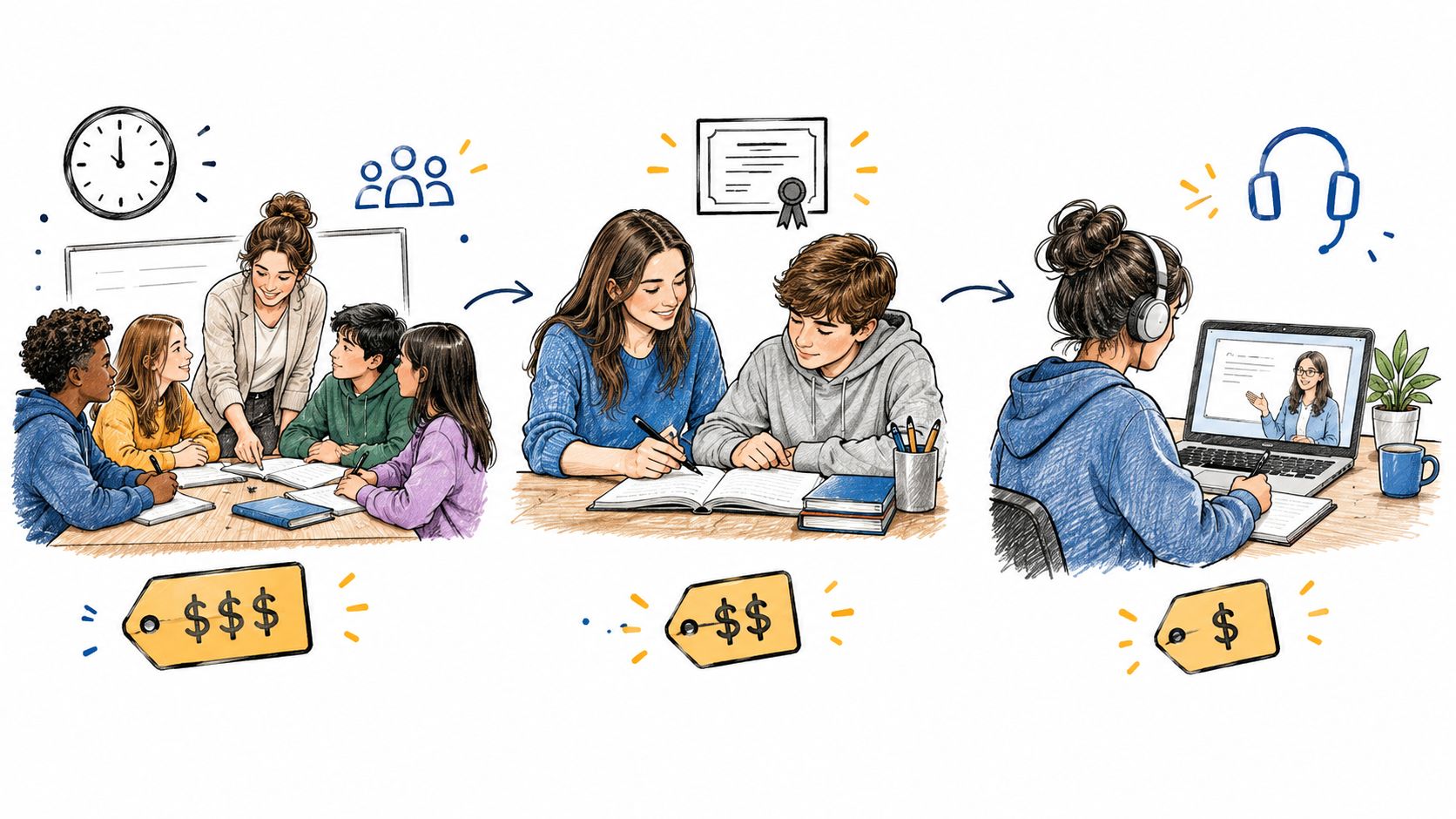
German Lessons HK: Formats and Prices Compared


