.png)
.png)

BLOG

香港德國文化協會
The German Cultural Association
German Grammar Simplified: A Beginner Guide
German matters because it is the most spoken native language in the European Union with approximately 100 million native speakers, and over 90 million people worldwide speak German as a first or second language. For beginners, German grammar means learning three noun genders (der, die, das), four cases that change articles, verb forms that shift with person and tense, and a verb-second pattern in main clauses.
You may be reading this after a long workday in Central, while comparing language options for a promotion, or while helping your child prepare for IB, IGCSE, or Goethe-Zertifikat study. In Hong Kong, the pressure is practical. You want results that support exams, university plans, visa goals, or a stronger profile for international firms.
That’s why German Grammar Simplified: A Beginner Guide should start with reassurance. German grammar is structured. It can feel heavy at first, especially if you speak Cantonese, Mandarin, or English and expect word order to behave the same way. But when you learn the system in the right order, it becomes manageable.
Your Path from Beginner to Confident German Speaker
A parent in Hong Kong often starts with a simple question: “Will German help my child?” A working professional asks a different one: “Is the effort worth it if I already use English every day?” Both questions lead to the same place. German opens academic and professional options that are hard to ignore.
German is the most spoken native language in the European Union with approximately 100 million native speakers, and over 90 million people worldwide speak German as a first or second language, as noted in this discussion of German language reach. For learners in Hong Kong, that matters because grammar is not an abstract school subject. It is the tool that lets you write clearly, read accurately, and respond correctly under exam pressure.
Why Hong Kong learners need a practical approach
If you're preparing for IB, IGCSE, A-level, or Goethe-Zertifikat, grammar affects almost everything:
- Writing accuracy: Articles, verb endings, and sentence order all shape your marks.
- Reading confidence: When you recognise grammatical patterns, longer texts stop feeling random.
- Speaking control: You can build short, correct sentences instead of translating directly from English or Chinese.
- Professional credibility: In interviews, emails, and meetings, clean grammar signals preparation and seriousness.
A common mistake is trying to learn everything at once. Learners memorise word lists, then freeze when they need to form a sentence. Others focus only on speaking and avoid grammar until mistakes become habits.
Practical rule: Learn grammar as a sequence, not as a pile of rules.
What confident beginners actually do
Confident beginners don't wait until they “know enough” to start using the language. They build from a few stable patterns:
Learn nouns with articles
Don't memorise Tisch. Learn der Tisch.Use short complete sentences
Ich lerne Deutsch. is more useful than isolated vocabulary.Notice patterns before exceptions
German has exceptions, but beginners need the common structures first.Link grammar to purpose
If your goal is study abroad in Germany, business communication in HK, or exam success, the grammar you prioritise should match that goal.
That is the mindset behind German Grammar Simplified: A Beginner Guide. You don’t need to be perfect on day one. You need the right order, clear examples, and enough guided practice to stop guessing.
What Are the Absolute Basics of German Grammar
German grammar for beginners is the core system that makes sentences work. It includes three noun genders, four cases that change articles, verb conjugations based on person and tense, and a verb-second sentence structure in main clauses. Master these basics first, and the language becomes much easier to build step by step.
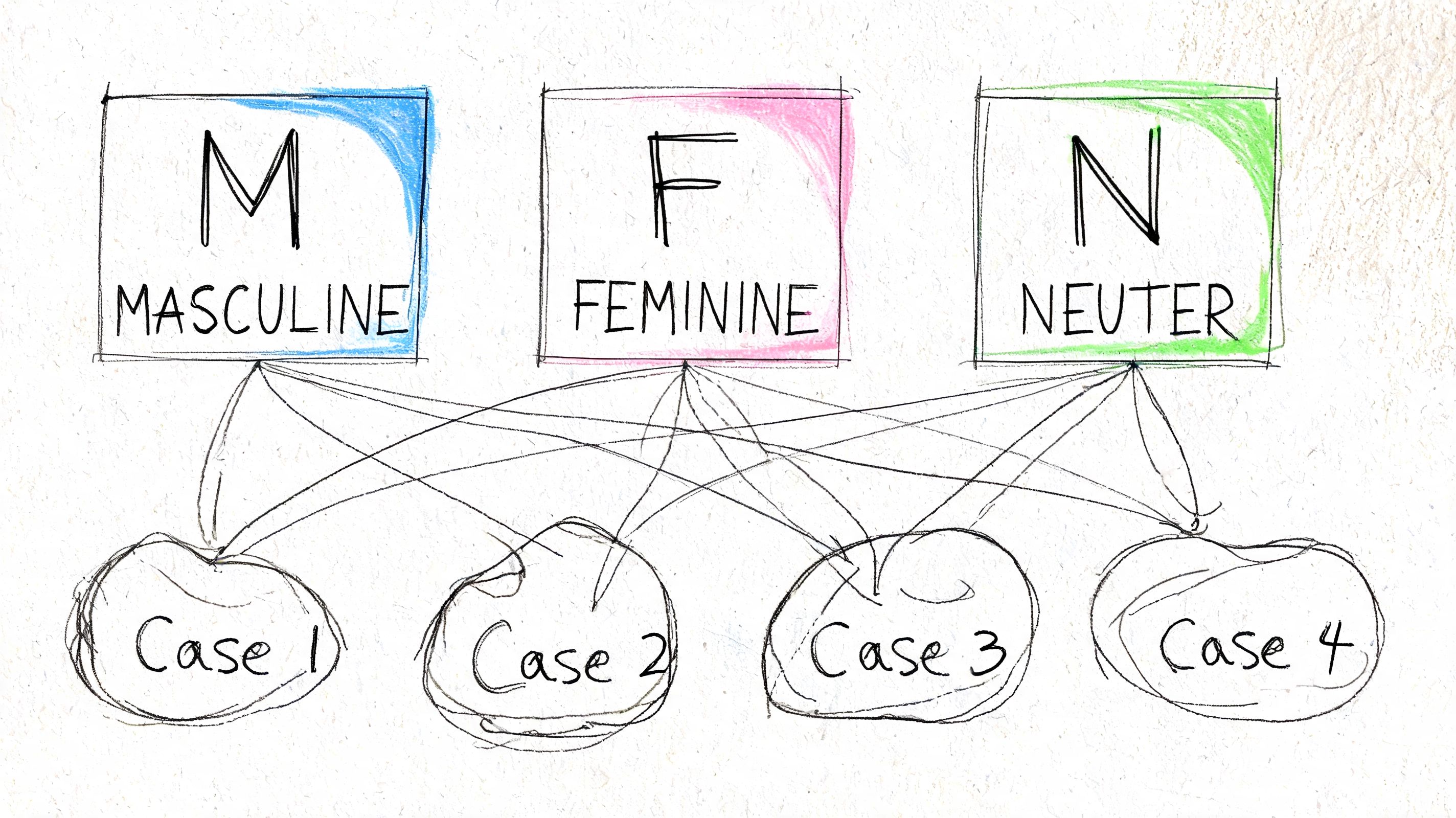
Think of grammar as the frame of a building. Vocabulary is the furniture. If the frame is weak, even simple sentences wobble. If the frame is solid, you can add new words quickly and use them correctly.
The four building blocks
Here are the basics that matter first.
Nouns and gender
Every noun has a grammatical gender: masculine, feminine, or neuter. That is why you learn der, die, or das with the noun.Cases
German changes articles depending on the noun’s role in the sentence. This is one of the biggest differences from English.Verbs
Verbs change according to who is doing the action and when it happens.Sentence structure
In a normal main clause, the conjugated verb usually sits in second position.
Why beginners get confused
English speakers often expect word order to carry most of the meaning. German uses word order too, but it also uses changing forms. That means the article matters more than many beginners expect.
For example:
| Part | English tendency | German tendency |
|---|---|---|
| Noun role | Mostly fixed by word order | Often shown by article changes |
| Verb position | Usually after subject | Often second in main clauses |
| Gender | Minimal | Built into the noun |
That’s why random memorisation doesn’t work well. You need to learn grammar and vocabulary together. A useful first step is building a small foundation of high-frequency words, such as those in these essential beginner German words.
Learn the noun and its article as one unit. Your future self will thank you.
What to focus on first
If you're an absolute beginner in Hong Kong, start with:
- Articles
- Present tense verb forms
- Simple statements
- Everyday nouns
- Question forms
That’s enough to begin speaking and enough to support later topics without panic.
Mastering German Nouns Genders and Articles
For many beginners, this is the first real shock. In German, every noun has a gender, and that gender is grammatical, not always logical. If you wait for it to make perfect sense, you’ll stay frustrated.
Learn the noun with its article
This is the habit that saves the most time later.
- der Tisch = the table
- die Lampe = the lamp
- das Buch = the book
Don't write “Buch = book” in your notes. Write das Buch = book. The article is part of the word.
Definite and indefinite articles
A beginner only needs a clean starting chart.
| Type | Masculine | Feminine | Neuter |
|---|---|---|---|
| Definite article | der | die | das |
| Indefinite article | ein | eine | ein |
Use definite articles when you mean “the”. Use indefinite articles when you mean “a” or “an”.
Examples:
- der Mann = the man
- eine Frau = a woman
- das Kind = the child
Some patterns help
You can't guess every noun gender. Still, patterns do exist, and they reduce the burden.
Many nouns ending in -ung are feminine
Example: die ZeitungMany nouns ending in -heit or -keit are feminine
Example: die MöglichkeitDiminutive forms can be neuter
Example: das Mädchen
That last example is important because it shows why “gender” in German is not the same as natural sex. A learner who insists on logic here usually loses time.
Memory tip: Use colour in your notes. One colour for der, one for die, one for das.
What Hong Kong learners should watch for
Students in HK often try to speed up by focusing only on translation. That creates trouble in exams and speaking tasks. If you say the noun without its article, you delay the actual work until later, and later is usually when cases begin.
A better routine is:
- Record the noun with article
- Say it aloud
- Use it in a short sentence
- Review it with similar nouns
Examples:
- der Bleistift ist neu
- die Tasche ist klein
- das Fenster ist offen
For early exam preparation, article control isn't optional. It affects accuracy from the first level onward. If you build this habit early, later grammar becomes far less chaotic.
Understanding German Sentence Structure
German sentence structure feels unfamiliar at first because the language is stricter than it appears. Many beginners hear that German word order is “flexible” and then produce sentences that sound translated. The better rule is this: German allows movement, but the verb still obeys clear rules.
Start with the normal pattern
In simple statements, beginners often meet a pattern that looks familiar:
Subject + Verb + Object
- Ich lerne Deutsch.
- Er kauft ein Buch.
This is comfortable because it resembles English. But don't stop here.
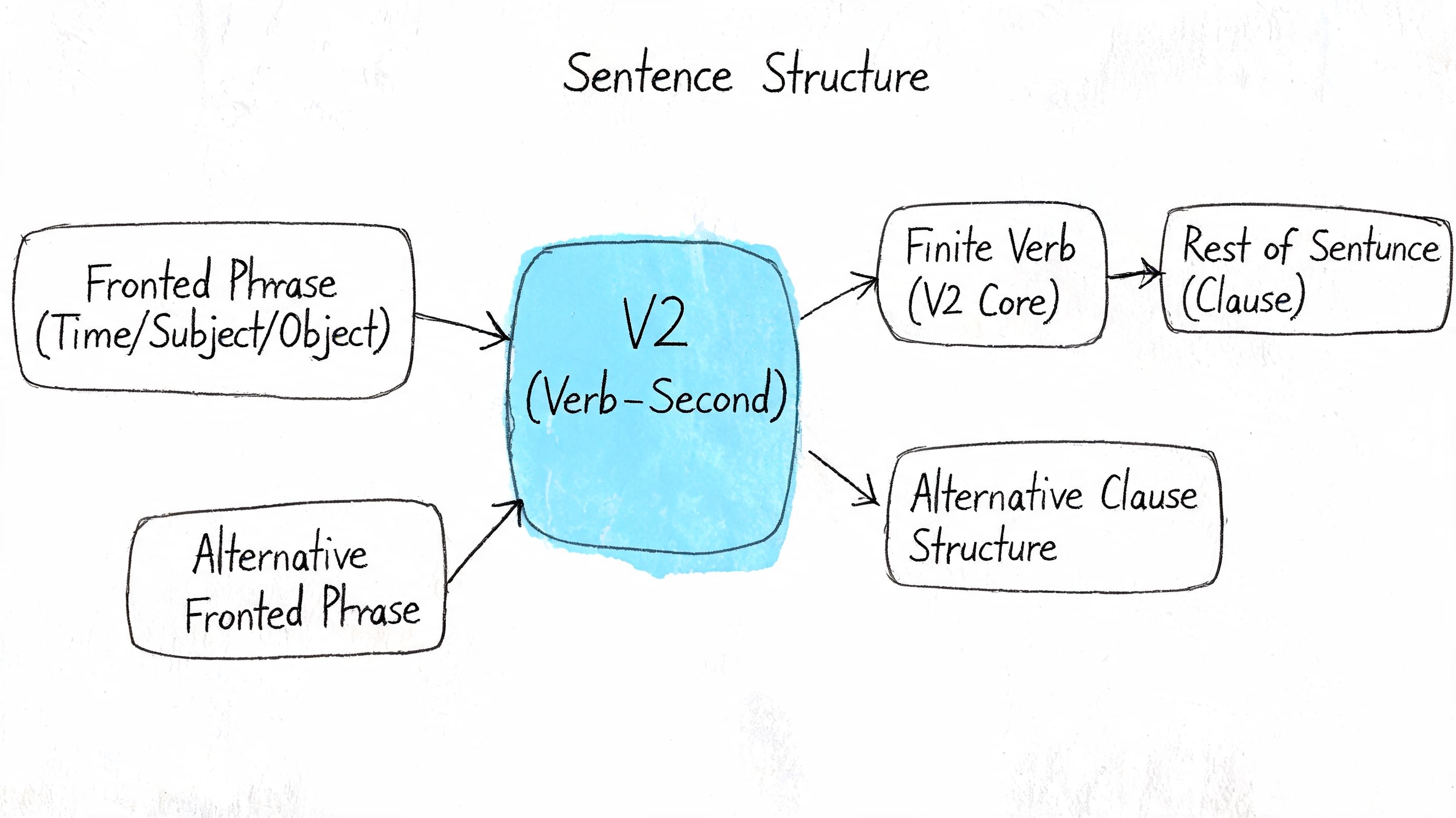
The real rule is verb second
In German main clauses, the conjugated verb usually stays in second position. Not necessarily the second word. The second position.
That means you can move another element to the front, but the verb must remain second.
Compare:
- Ich lerne heute Deutsch.
- Heute lerne ich Deutsch.
Both are correct. In the second sentence, heute takes the first position, so the verb lerne must come next.
A quick way to test your sentence
Ask yourself: what is in position one, and is the conjugated verb immediately after it?
This simple check prevents many beginner errors in speaking and writing.
- Correct: Morgen fahre ich nach Hause.
- Wrong pattern: Morgen ich fahre nach Hause.
When the verb moves to the end
Subordinate clauses introduce the pattern that many learners find more difficult. With words like weil or dass, the conjugated verb often goes to the end.
- Ich lerne Deutsch, weil ich in Deutschland studieren möchte.
- Ich weiss, dass er heute arbeitet.
Here is a short video that helps visualise that shift:
Keep these three patterns separate
| Pattern | Example | Use |
|---|---|---|
| SVO | Ich lerne Deutsch. | Simple starting sentence |
| V2 | Heute lerne ich Deutsch. | Main clause with emphasis or time first |
| Verb final | ..., weil ich Deutsch lerne. | Subordinate clause |
Many errors in beginner German aren't vocabulary errors. They're verb-position errors.
For IB, DSE-style school pressure, and workplace writing in Hong Kong, this matters because sentence order affects clarity immediately. If your grammar is good but your verb is misplaced, the sentence still sounds wrong. Once you train your eye to find the verb first, German sentence structure becomes much more predictable.
The Four German Cases Explained for Beginners
Cases frighten beginners because they seem abstract. They aren't abstract. A case is a marker that shows a noun’s job in the sentence. If you treat the four cases as job titles for nouns, the system becomes easier to control.
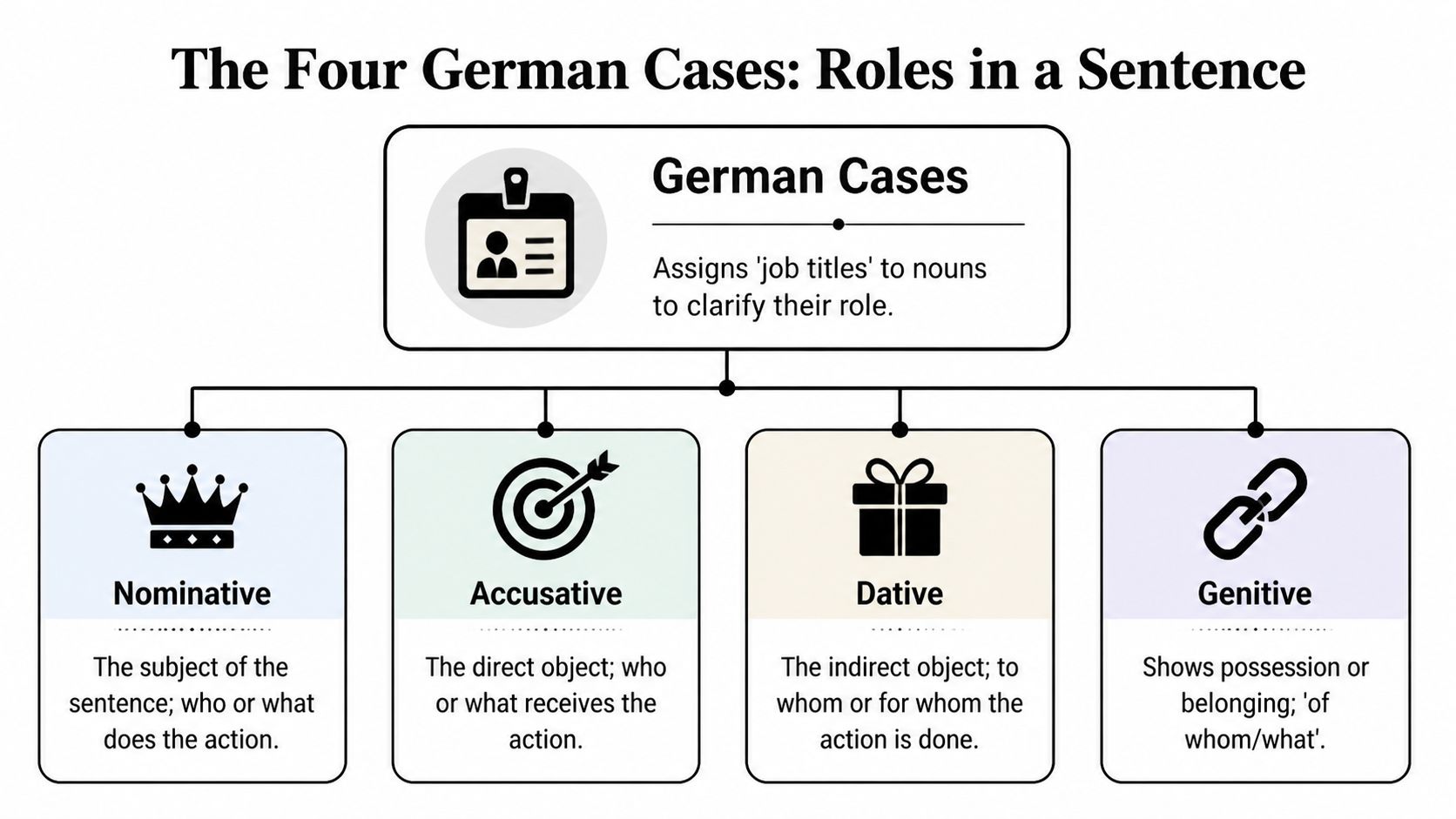
Think in roles, not labels
Here is the simplest version.
Nominative
The subject. Who does the action?Accusative
The direct object. Who or what receives the action?Dative
The indirect object. To whom or for whom is something done?Genitive
Possession. Whose is it?
Examples:
Der Mann schläft.
Der Mann is nominative.Ich sehe den Mann.
den Mann is accusative.Ich gebe dem Mann das Buch.
dem Mann is dative.Das ist das Buch des Mannes.
des Mannes is genitive.
The smart order for beginners in Hong Kong
Many beginner guides fail by treating all four cases as equally urgent. That usually overloads the learner.
Research discussed in this article on learning German for beginners notes that case confusion is a primary dropout factor for Germanic language learners. It also highlights a practical distinction relevant to Hong Kong learners: IGCSE emphasises nominative and accusative recognition, while A-level requires productive dative usage.
That tells us something useful. Beginners shouldn't try to master all four cases at the same speed.
Study sequence: First stabilise nominative and accusative. Then build dative. Leave genitive for later unless your course or exam needs it earlier.
A table you can actually use
Here is a compact article table for the first three cases.
| Case | Masculine (der/ein) | Feminine (die/eine) | Neuter (das/ein) |
|---|---|---|---|
| Nominative | der / ein | die / eine | das / ein |
| Accusative | den / einen | die / eine | das / ein |
| Dative | dem / einem | der / einer | dem / einem |
Notice how much pressure falls on the masculine forms. That is one reason learners feel “fine” until the sentence changes and suddenly der becomes den or dem.
How to reduce cognitive load
Don’t memorise case tables in isolation and expect fluency. Pair each case with a question.
- Nominative asks: who?
- Accusative asks: whom or what?
- Dative asks: to whom or for whom?
- Genitive asks: whose?
Then practise with one sentence family:
- Der Lehrer ist hier.
- Ich sehe den Lehrer.
- Ich gebe dem Lehrer das Heft.
This method works well for learners in HK because it reduces overload while still aligning with exam demands. If your child is facing IGCSE or IB-related pressure, or if you're balancing German with a full-time job, sequencing matters. Grammar becomes lighter when the order makes sense.
How Long Does It Take to Learn German Grammar in Hong Kong
The honest answer is that it depends on your goal, your study routine, and the quality of your feedback. A learner aiming for basic daily communication needs a different timeline from a student preparing for formal writing in IB or an adult planning to study abroad in Germany.
For many beginners, the first meaningful target is A1. Reaching that stage often takes around 80 to 120 hours of structured learning, which can feel manageable for busy learners in HK when broken into weekly classes and regular self-study.
What changes your speed
Progress isn't only about hours. It is also about whether you are studying in a way that removes the right obstacles.
A few factors matter most:
Consistency
Two or three steady study slots each week usually work better than irregular bursts.Correction quality
If nobody corrects your articles, word order, and pronunciation, weak habits stay in place.Goal clarity
An adult learner needing travel German studies differently from a teenager preparing for exam writing.Language background
Cantonese and Mandarin speakers often need explicit help with stress, rhythm, and unfamiliar German sounds.
Why pronunciation affects grammar progress
Many people think pronunciation and grammar are separate. In practice, they overlap. If you can't hear endings clearly, you often miss the grammar they carry.
As explained in this overview of learning German, beginner materials often miss that German has phonetic challenges for tonal-language speakers, including the “ch” sound, “st” and “sp” clusters, and umlauts (ä, ö, ü). It also notes that Hong Kong learners’ tonal habits can conflict with German’s stress-timed, non-tonal prosody.
A learner may know the rule on paper but still struggle to produce it accurately without guided listening and speaking practice.
A realistic timeline mindset
If you're studying in Hong Kong while juggling school, work, or family commitments, think in stages:
- Stage 1 brings control over articles, present tense, and short sentence patterns.
- Stage 2 adds accusative and dative confidence, better listening, and more natural speech.
- Stage 3 develops longer writing and exam-oriented accuracy.
If your long-term target is higher proficiency, this guide to reaching German B2 level gives a broader picture of how the journey develops after beginner grammar.
The key is not speed for its own sake. It is steady progress with fewer avoidable mistakes.
Ready to Master German with Expert Guidance
A common Hong Kong learner reaches this stage with a mixed notebook, a few app streaks, and one frustrating question. Why do the rules make sense during revision, then fall apart in writing, speaking, or exam practice?
The answer is usually not effort. It is sequence, correction, and purpose.
German grammar works like building floors in the right order. If articles and gender are shaky, cases become confusing. If verb position is uncertain, longer sentences collapse under exam pressure. For a student preparing for IB or DSE-style assessment, that leads to avoidable marks lost. For a working adult aiming at Goethe-Zertifikat, German for client communication, or a move into an international firm in Hong Kong, it slows progress at exactly the point where confidence should be growing.
What effective support should include
Good teaching does more than explain rules once. It helps you use them accurately under real conditions, whether that means timed writing, oral responses, or workplace conversation.
Look for these features:
A clear teaching order
Learners do better when the foundation comes first. Articles and core sentence patterns should be stable before a teacher adds heavier case work or complex clause structures.Correction from a native-speaking teacher
Hong Kong learners often understand a rule passively but miss the ending in fast speech or apply the wrong article automatically. Careful correction fixes that early.Exam and goal awareness
Goethe-Zertifikat, IB, IGCSE, A-level, and business German each require different kinds of accuracy. A useful course adjusts practice to the result you need.Local practicality
School schedules, long work hours, and mixed language backgrounds matter. A course should fit the reality of learning in Hong Kong, not an abstract ideal student with unlimited time.
One local option and one academic reference
If you are comparing German study options, the courses at the German Cultural Association Hong Kong offer in-person and online classes, native-speaking teachers, small-group learning, and preparation for exams such as Goethe-Zertifikat, TestDaF, IGCSE, A-level, and IB. If you are specifically reviewing senior secondary pathways, Next Level's A Level German program is also a useful reference point for understanding how academic German study is framed at that stage.
What to do next if you feel stuck
Start with a diagnosis.
Ask yourself four direct questions:
- Do I know the gender of common nouns, or am I still guessing?
- Can I place the verb correctly in a basic main clause without stopping to translate from English?
- Can I recognise who is doing the action and who is receiving it in a simple German sentence?
- Do I get regular correction from someone who can hear and explain my mistakes clearly?
If several answers are "not yet", your next step is structure, not more random exposure. More notes, more videos, and more flashcards do not automatically solve a pattern problem.
A practical move is to compare course formats, teaching methods, and learner goals before you commit. This guide to finding the right German class in Hong Kong can help you choose an option that fits your schedule and your target.
If you're ready to turn grammar into usable German, contact courses at the German Cultural Association Hong Kong to book a trial class, speak with an advisor, or check the latest course schedule. Whether your goal is Goethe-Zertifikat, IB, IGCSE, business German, or study abroad in Germany, a structured start makes progress faster and far less stressful.
Preschool German Classes 2026/27 (Ages 3-6): Small-Group Intake & Trial Lessons
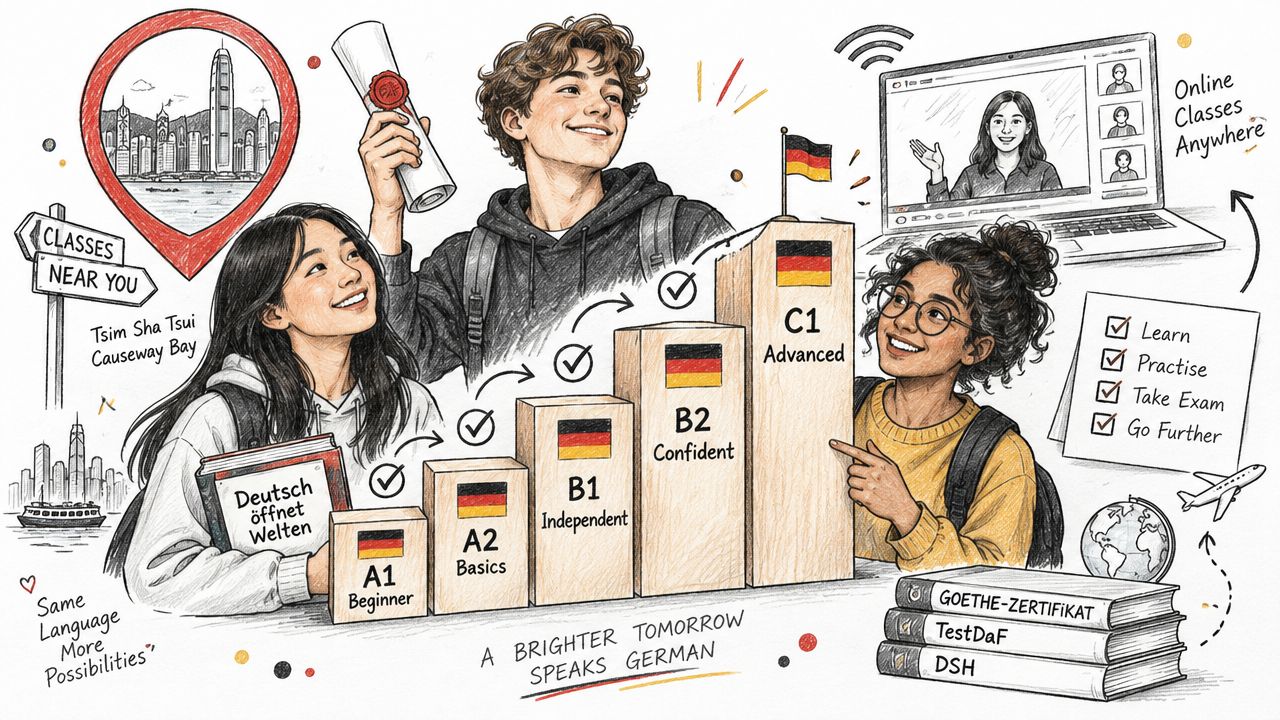
German Courses for Teens 2026/27: Ages 12-18 New Term Classes & Exam Pathways


