.png)
.png)

BLOG

香港德國文化協會
The German Cultural Association
German CEFR Levels Explained: A1 to C2 for Hong Kong Learners
A parent in Mid-Levels is comparing German with piano and swimming. A Form 4 student is considering whether German could support an DSE, IB, or IGCSE pathway. In Central, a finance professional is preparing for a possible move to Munich and wants a certificate that an employer or university will understand.
They all ask the same question: Which German level do I need, and how long will it take? German CEFR Levels Explained: A1 to C2 for Hong Kong Learners is a practical way to answer it, but the level only becomes useful when connected to a real goal, such as a school qualification, a Goethe-Zertifikat, TestDaF, a career move, or a plan to study abroad in Germany.
Table of Contents
- Parents planning German for children
- Teenagers preparing for school exams
- Professionals managing German around work
- What is the best age to start German?
- Is self-study enough to reach A2?
- Can I combine IGCSE or IB study with B1 lessons?
- Is TestDaF accepted by HKU and CUHK?
- How can I check my current level?
Why Hong Kong Learners Ask About German CEFR Levels
The Common European Framework of Reference for Languages, usually called the CEFR, has become the language benchmark Hong Kong families hear from school counsellors, university information pages, employers, and examination providers. It gives learners a shared scale from A1 beginner to C2 highly proficient, so “intermediate German” means more than a vague classroom label.
For a teenager in an ESF or DSS school, the question may be whether German can support an IGCSE, A-level, IB, or DSE plan. Goethe-Institut Hongkong states that its adult and young learner exams cover the full CEFR ladder from A1 to C2, and that since 2025 the Goethe-Zertifikat has been the officially stipulated German-language exam for Category C, other languages, in the HKDSE. That makes CEFR relevant to local academic planning, not just European language theory. Goethe-Institut Hongkong exam information
A working professional may have a different destination. They might need enough German to introduce themselves, manage routine workplace exchanges, participate in meetings, or prepare for a transfer to Germany. A university-bound student may eventually need TestDaF, while a parent may want a clear progression that shows whether a child is moving beyond memorised phrases.
This guide connects each level with:
- Realistic guided-learning hours for Hong Kong learners
- Practical communication abilities
- Local and international exam pathways
- School goals, including DSE, IGCSE, A-level, and IB
- Study abroad in Germany planning
- Scheduling advice for parents, teens, and professionals
- CEF funding questions for eligible, approved courses
HKU SPACE's Certificate in German (Introductory) is explicitly described as equivalent to A1, while other local short courses are labelled against stages such as A2 and B1. This shows how Hong Kong continuing education providers use CEFR as a practical reference point, not merely an academic description. HKU SPACE Certificate in German (Introductory)
The central question is simple: Which CEFR level do you need, and what will you be able to do when you reach it?
What the CEFR Measures at Each Level
The CEFR describes what you can consistently do in German across listening, reading, speaking, and writing. It measures usable ability, not the number of textbook chapters completed or words memorised.
For a Hong Kong learner, four ideas make the levels easier to understand:
- Receptive skills, listening and reading
- Productive skills, speaking and writing
- Accuracy, whether grammar and vocabulary stay reliable
- Independence, whether you can communicate without constant help
A1 and A2 build the foundation. B1 and B2 support independent communication. C1 and C2 suit demanding academic, professional, and social situations.
A practical can-do ladder
| Level | Listening and reading | Speaking and writing |
|---|---|---|
| A1 | Understands familiar words, signs, simple menus, prices, names, and basic instructions. A Hong Kong learner can recognise a German menu in Wan Chai when the choices are familiar. | Can greet someone, introduce yourself, give basic personal information, order Kaffee und Kuchen, and write a short form or message. |
| A2 | Understands short, clear messages about shopping, transport, family, work, and daily routines. | Can manage predictable exchanges, describe past activities simply, ask for help, and write a brief informal email. |
| B1 | Follows the main points of clear everyday conversations, announcements, and straightforward articles. | Can explain an opinion, describe experiences, handle common problems, and write a connected message, such as a complaint about a lost parcel. |
| B2 | Understands the main ideas of longer conversations, news items, and texts about familiar academic or professional topics. | Can join discussions, defend a position, write structured arguments, and follow university or workplace conversations with less support. |
| C1 | Understands demanding texts, implied meaning, fast speech, and subject-specific material. | Can communicate fluently and precisely, write formal or academic texts, and participate in seminars such as those at Humboldt-Universität. |
| C2 | Can understand almost everything heard or read, including subtle tone and complex argument. | Can express nuanced meaning naturally, adapt style to context, and produce highly controlled professional, academic, or literary writing. |
For a teen considering DSE credit or an IGCSE or IB grade, A1 and A2 show that basic classroom communication is developing. B1 indicates that the learner can discuss familiar experiences and explain an opinion, rather than repeat memorised phrases.
A2 and B1 form a social survival zone. Daily tasks become more manageable, yet unfamiliar accents, fast speech, and abstract subjects can still cause difficulty. A professional preparing for a career move may find B1 useful for routine workplace exchanges, while B2 supports fuller participation in meetings.
B2 marks a significant change for students planning German-taught study or preparing for TestDaF. They must handle denser vocabulary, longer reading tasks, and more complex arguments. C1 gives university and corporate communication greater reach because the learner can explain relationships between ideas, not only describe events.
How Long Each Level Takes in Real Hours
A Hong Kong learner's target changes the meaning of each hour. A teen working towards DSE credit, IGCSE, or IB needs a schedule that protects school performance. A professional preparing for a career move may prioritise workplace conversations, while a future university applicant may need the reading and writing demands associated with TestDaF.
For Hong Kong learners, the Goethe-Institut publishes these approximate guided-learning ranges:
- A1: 60 to 150 hours
- A2: 150 to 260 hours
- B1: 260 to 485 hours
- B2: 450 to 600 hours
- C1 and C2: 600 hours or more
These ranges come from the Goethe-Institut Hong Kong CEFR study-time guide. They describe supported learning, not a complete personal timetable. Homework, self-study, listening exposure, earlier language experience, attendance, and feedback can all change the pace.
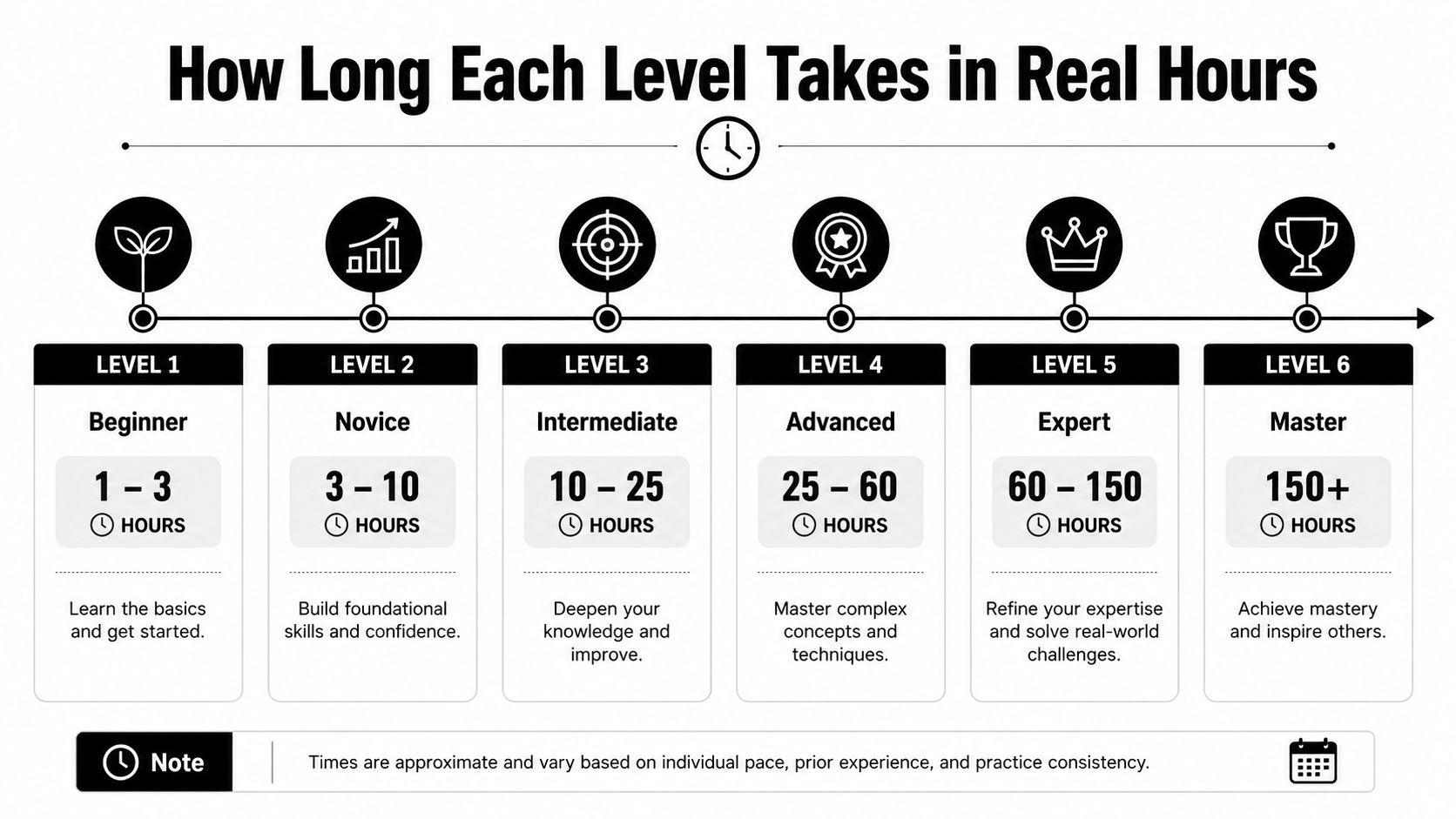
The ranges overlap because learners progress differently. A student balancing German with DSE, IGCSE, or IB subjects may need a slower plan to retain grammar and vocabulary. A professional with regular study habits may move faster through familiar structures.
The B1 to B2 transition often requires careful planning. Goethe's ranges place B1 at 260 to 485 hours and B2 at 450 to 600 hours, so B2 involves a substantial increase in reading, listening, writing, and spoken precision. Goethe-Institut Hong Kong's exam page can help learners check exam arrangements while setting lesson frequency and revision goals.
Practical rule: Treat promises of fluency in three months with caution. Ask which level is intended, whether the hours are guided or independent, and what exam evidence supports the target.
For comparison, the guide to study time for Irish learners provides another language-learning reference, although German has different pronunciation, grammar, and vocabulary demands.
A professional might combine short weekday practice with a regular evening or weekend class. A DSE or IB student may place German around school deadlines. Younger learners often benefit from shorter, repeated exposure. The useful planning question is “How many hours can I sustain without losing what I've learned?”
For a detailed planning framework, compare this realistic German learning timeline from A1 to C1.
Matching CEFR Levels to Hong Kong Exams
CEFR levels and exam names aren't interchangeable. A Goethe-Zertifikat gives level-based proof of general German ability, while TestDaF is designed for an academic purpose. School examinations may develop German within a broader curriculum, but the exact assessment and admissions value depend on the school, examination board, and receiving institution.
For HK learners, the safest approach is to identify the end use first. Check the exact requirement for the school, university, employer, visa route, or programme before choosing an examination.
CEFR to Hong Kong exam mapping at a glance
| CEFR level | Goethe-Zertifikat | IGCSE, A-level, and IB | TestDaF and DSH | Typical HK use |
|---|---|---|---|---|
| A1 | Goethe-Zertifikat A1 | Early foundation or additional language study | Not an academic admission target | Basic communication and first certificate milestone |
| A2 | Goethe-Zertifikat A2 | Foundation for continued school study | Usually below the level expected for university admission | Routine travel, family planning, and everyday exchanges |
| B1 | Goethe-Zertifikat B1 | May support school-level progression, depending on the programme | Generally an early preparation stage | Independent everyday communication and structured school goals |
| B2 | Goethe-Zertifikat B2 | Relevant to stronger IGCSE, A-level, or IB preparation | TestDaF preparation commonly begins around this advanced range | University planning, professional communication, and academic preparation |
| C1 | Goethe-Zertifikat C1 | Advanced school or university preparation | Relevant to TestDaF and DSH planning | German-taught study, demanding professional work, and formal academic communication |
| C2 | Goethe-Zertifikat C2 | Beyond the needs of most school pathways | Usually unnecessary unless a specific institution asks for very advanced proof | Highly advanced academic, professional, or specialist language use |
Goethe-Institut Hong Kong offers Goethe-Zertifikat exams across A1 to C2. The Hong Kong Federation of Youth Groups CEF-recognised German test-body list names Goethe-Institut Hong Kong for Goethe-Zertifikat A1, A2, B1, and C1, and Hong Kong Baptist University for TestDaF and German BULATS.
For students considering study abroad in Germany, TestDaF becomes relevant when a target university or programme requires academic German. The research brief places TestDaF broadly around B2 to C1, while DSH planning is also associated with advanced German. Don't assume that a general certificate automatically satisfies every university's rules.
IGCSE, A-level, IB, and DSE pathways should be checked individually. A school may use German as a subject, an additional language, or part of a broader international curriculum, while the HKDSE has its own local requirements. Goethe's official role for Category C German from 2025 makes the certificate especially relevant to Hong Kong students considering that route.
For a fuller decision between general and academic certification, see this Goethe-Zertifikat versus TestDaF exam guide.
What a Real Lesson Looks Like at A1, B1 and C1
A1 lessons should feel structured, friendly, and concrete. In a Central beginner group, learners might practise Guten Tag, spell names using the phonetic alphabet, order Kaffee und Kuchen from a printed Speisekarte, and play picture-based bingo. English and German can appear together at this stage because learners need to understand the task while building pronunciation and confidence.
The teacher listens for sounds that English-speaking learners often find unfamiliar, including German vowels and consonant combinations. The goal isn't to rush into long conversations. It's to make short phrases accurate enough that learners can reuse them outside class.
B1 turns knowledge into interaction
A B1 group has a different rhythm. Form 5 students preparing for IGCSE might hold a five-minute Unsere Stadt debate, comparing transport in Berlin with transport in Hong Kong.
They could then write a short complaint email about a lost parcel using connectives such as weil, obwohl, and trotzdem. The teacher may use mostly German, with English scaffolding when a difficult instruction or grammar point needs clarification.
At B1, students need to connect ideas. Memorising isolated sentences won't prepare them for explaining a reason, responding to an opposing view, or changing tone in an email.
C1 requires ideas, not just sentences
A professional evening group at C1 may include HKU postgraduates and finance professionals. Learners could read short articles from Die Zeit and Deutsche Welle, discuss EU energy policy, and summarise opposing views in writing.
The teacher doesn't need to interrupt every sentence for a grammar explanation. Recasting, reformulating a learner's sentence naturally, can preserve the flow of discussion while still giving precise language feedback.
At C1, the classroom should resemble the situations you need German for, a seminar, a briefing, a formal discussion, or a written argument.
The progression from A1 to C1 is therefore visible in the lesson design. A1 builds dependable phrases. B1 builds connected communication. C1 builds precision, flexibility, and intellectual control.
Study Tips for Parents, Teens and Professionals
A successful German routine in Hong Kong has to fit around real transport times, schoolwork, family commitments, and office hours. The most effective plan isn't necessarily the most intense one. It's the one you can repeat consistently.
Parents planning German for children
Choose a class near the route your child already travels, such as a weekend or after-school slot close to school pick-up arrangements. Ask the teacher for a short progress snapshot each term covering participation, vocabulary, listening, speaking, and the next CEFR target.
Watch the total load carefully. Piano, violin, sports, homework, and German can compete for the same mental energy, so a sustainable class rhythm is more useful than an overloaded timetable.
CEF funding needs careful checking. Pure language hobby courses generally aren't automatically reimbursable, while accredited Goethe-aligned exam preparation at approved providers may qualify under specific CEF codes. Check the latest reimbursement list and the provider's current approval status before budgeting on the assumption that funding applies.
Teenagers preparing for school exams
A manageable routine can include:
- Vocabulary: Use Anki for a short daily review
- Lessons: Attend regular group lessons that fit around IGCSE, IB, or DSE work
- Reading: Work with graded texts, school materials, or short German articles
- Listening: Rotate dialogues, news clips, and teacher-recorded tasks
- Writing: Practise one task type at a time and keep a correction log
Don't study only the skill you enjoy. Students who read well may still struggle to speak, while confident speakers may lose marks through weak writing accuracy.
Professionals managing German around work
Protect a fixed lunchtime or evening slot, such as 19:00 to 20:30, if that timing fits your workday. Prioritise speaking because many adults can recognise more German than they can produce under pressure.
Pair a work email with one short German paragraph when appropriate. You might summarise a meeting point, introduce a project, or write a simple follow-up sentence. The task should be small enough to repeat.
A regular pattern across six to nine months is more reliable than occasional marathon sessions. Those calendar figures are a planning suggestion, not a guaranteed completion time.
How GCA Supports You at Every CEFR Stage
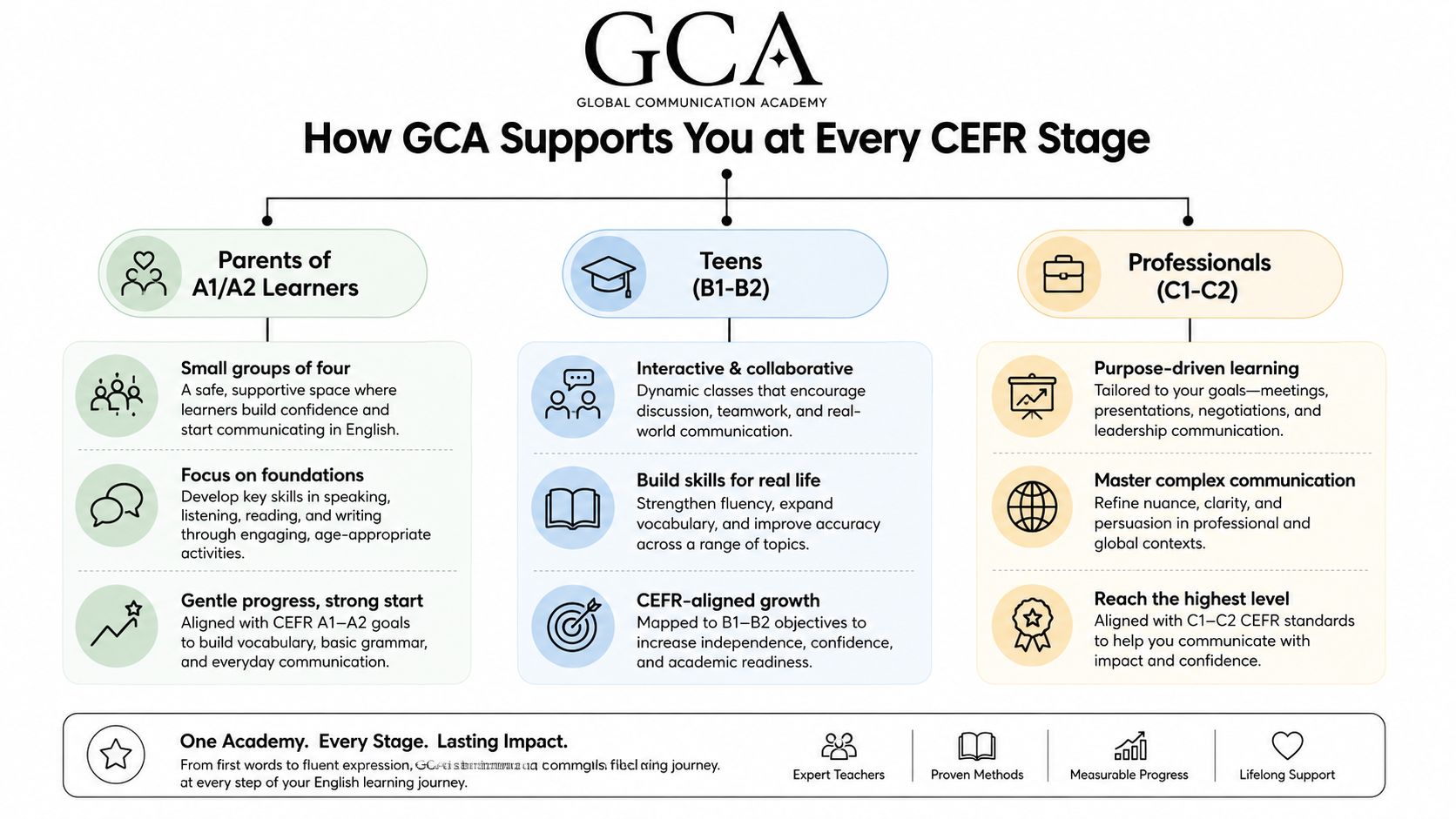
A CEFR pathway works best when the teaching method changes as the learner's needs change. Beginners need pronunciation support and predictable practice. Intermediate learners need more spontaneous interaction. Advanced learners need challenging input, precise correction, and exam-specific performance training.
The German Cultural Association Hong Kong(GCA) offers classes organised by CEFR level, including A1, A2, B1, B2, and C1, with native German-speaking teachers, small-group formats, private lessons, and online options. Its programme information also includes preparation for Goethe-Zertifikat, TestDaF, IGCSE, A-level, and IB pathways.
A1 and A2
Small groups of four to six learners can give beginners more opportunities to pronounce words, ask simple questions, and receive immediate correction. Goethe-aligned worksheets help connect classroom work with a recognised progression rather than leaving learners unsure what comes next.
Central and TST locations can suit families and adults who want to combine lessons with existing travel routes. Online learning can help when weather, work, or school activities make a physical class difficult.
B1 and B2
At intermediate level, lessons need to move beyond grammar exercises. Debate tasks, role-plays, email writing, listening practice, and timed exam activities help learners use German under conditions closer to school and examination demands.
For IGCSE, A-level, and IB candidates, a teacher should know whether the learner needs general CEFR development, school-subject support, or a focused examination track. Those goals overlap, but they aren't identical.
C1 and C2
Advanced learners benefit from seminar-style workshops using demanding texts, structured presentations, formal writing, and academic discussion. TestDaF and Goethe C1 preparation require careful attention to task type, timing, argument structure, and the learner's weakest skill.
Audio support can also help advanced learners build listening stamina. A practical German-to-English audio translation guide can be useful when learners need to examine difficult spoken material closely, although translation should support, not replace, direct comprehension practice.
A certificate system can document progress level by level, while holiday intensive weeks may help learners compress a larger amount of guided study into a shorter period. Neither feature removes the need for sustained practice, but both can make progression easier to organise around Hong Kong schedules.
Your Next Steps and Common Questions Answered
What is the best age to start German?
There isn't one universal best age. Younger learners can build familiarity gradually, while teenagers and adults may bring clearer academic or career goals. The right starting point is a class that matches attention span, timetable, and purpose.
Is self-study enough to reach A2?
Self-study can support vocabulary, grammar, reading, and listening. Many learners still need guided speaking and writing feedback to confirm that they can perform consistently at A2.
Can I combine IGCSE or IB study with B1 lessons?
Yes, if the lesson plan matches the school workload. Tell the teacher whether the priority is school assessment, Goethe certification, or broader communication, then schedule practice around examination periods rather than adding unmanaged homework.
Is TestDaF accepted by HKU and CUHK?
Acceptance depends on the specific programme and current admissions rules. Check the university and department requirements directly before choosing TestDaF, Goethe-Zertifikat, or another qualification.
How can I check my current level?
Use a structured assessment rather than guessing from textbook titles. This online German CEFR level test guide can help you organise the first check, but a teacher should confirm speaking and writing ability before exam registration.
German Cultural Association Hong Kong(GCA)offers native-speaker German lessons in Hong Kong, small-group and private classes, online study, and preparation for Goethe-Zertifikat, TestDaF, IGCSE, A-level, and IB pathways. Visit German Cultural Association Hong Kong(GCA) to book a trial class, speak with an advisor, or check the latest course schedule for Central, TST, and online groups.

German Verb Tenses Overview: Präsens Made Simple
German Passive Voice (Passiv): Formation Guide


