.png)
.png)

BLOG

香港德國文化協會
The German Cultural Association
German as a Third Language: Guide for Bilingual HK Students
Your child already handles English plus Cantonese or Mandarin every day. That's not a small thing. In Hong Kong, that bilingual load is already training the brain to switch systems, spot patterns, and tolerate complexity.
Now comes the practical family question. If you add a third language, which one creates an advantage that matters for school results, university planning, study abroad in Germany, and long-term mobility?
My answer is direct. For many ambitious students in Hong Kong, German is one of the smartest third-language choices because it fits the city's bilingual reality, links to formal exam pathways, and connects to serious academic options in Europe. This guide to German as a Third Language for Bilingual HK Students gives you the strategic view families usually don't get from generic language-school marketing.
Giving Your Child a Global Edge in Hong Kong
A lot of Hong Kong families approach third-language learning the wrong way. They ask which language is fashionable, which school friend is taking it, or which option sounds easier.
That's backwards.
The right question is this. Which third language gives a bilingual HK student the strongest return on time, exam effort, and future options? If your child is already functioning in English and Chinese, German deserves a very serious look.
German works well in Hong Kong because it sits at the intersection of three things:
- Bilingual transfer advantage for students already managing two languages
- Structured exam pathways such as Goethe-Zertifikat, IGCSE, A-level, IB, and TestDaF
- Real progression routes tied to university admissions and study abroad planning
Practical rule: Don't choose a third language just because it feels familiar. Choose one that can be measured, certified, and used later.
Parents also need to separate hobby learning from strategic learning. If your child wants casual exposure, almost any language can be enjoyable. If you want a language that can support applications, formal qualifications, and European mobility, German is a much stronger candidate than many families assume.
German as a Third Language for Bilingual HK Students becomes more than a language choice. It becomes an education planning decision.
Why German Is the Smart Choice for Bilingual Students
A common Hong Kong family scenario goes like this. Your child already studies in English, speaks Cantonese or Putonghua daily, and now you need a third language that is worth the time. German makes sense because bilingual students usually do not build a new language from scratch. A controlled study on third-language acquisition found that bilingual learners drew on more than one existing language during a new-language task, with English-like cues and German-like cues both improving accuracy (third-language acquisition research).
That matters more in Hong Kong than many parents realise.
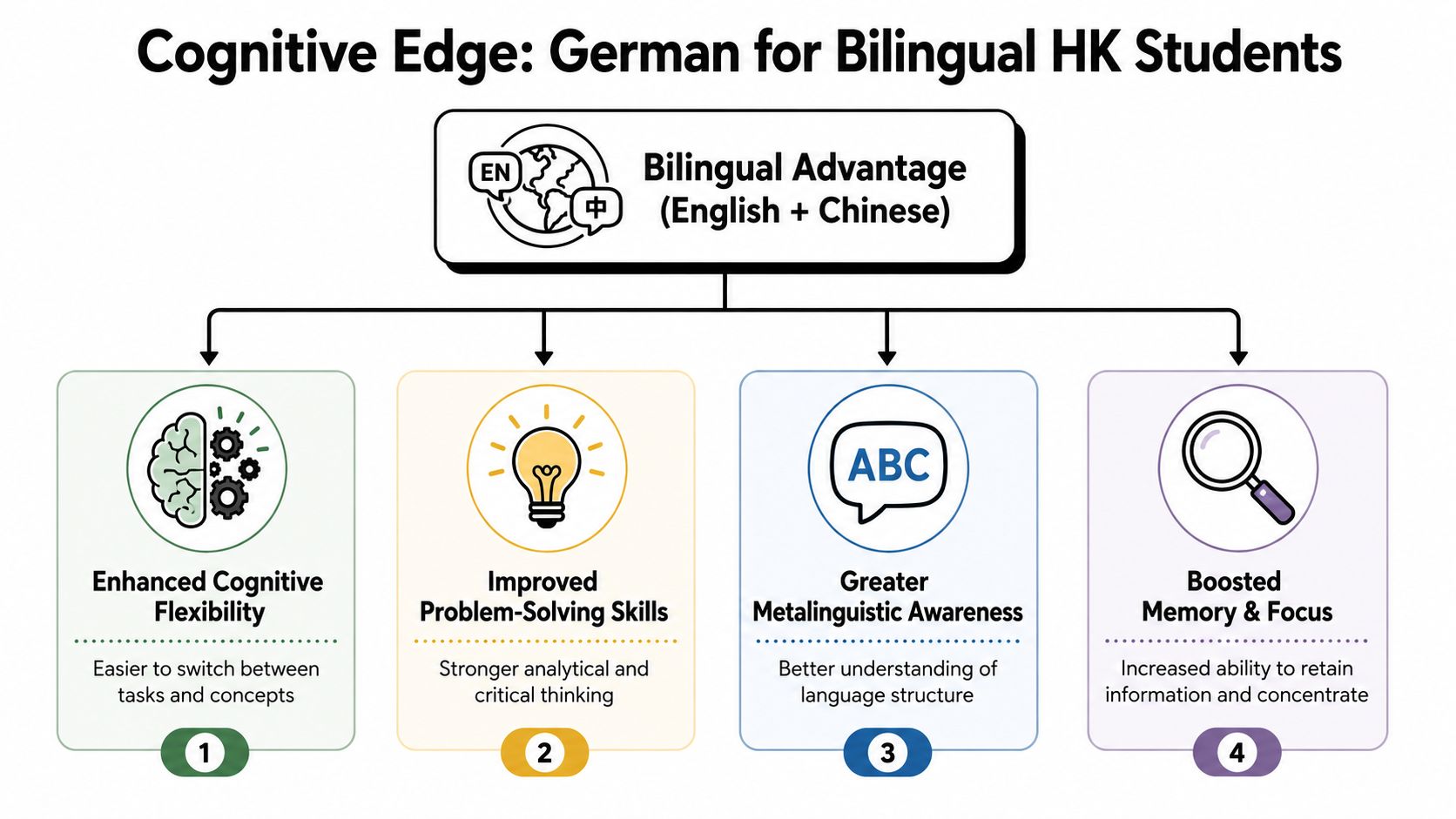
A bilingual HK student already manages switching, comparison, and interference across languages. Those are not just coping skills. They are learning assets. This is the bilingual transfer advantage, and German rewards it better than many parents expect because the language is systematic, rule-based, and exam-friendly.
Bilingual students have a real head start
Your child is already used to three hard things: spotting patterns, tolerating partial understanding, and holding two language systems in mind at once.
German suits that profile.
Students who work across English and Chinese often adapt well to German because they are less rattled by unfamiliar grammar and more willing to test patterns. They also tend to accept that one idea can be expressed differently across languages without insisting on a perfect one-to-one match. That mindset saves time.
German also gives English-dominant bilingual students a practical foothold. Vocabulary families, sentence logic, and word formation often feel more approachable than parents assume. The difficulty is real, but it is organised difficulty. For a disciplined student, that is a good trade.
Why German beats casual third-language choices
Many families pick a third language based on popularity or perceived ease. That is weak planning.
The better test is return on effort. German stands out because it gives bilingual students a credible mix of cognitive fit, formal certification, and later academic use. It is especially strong for students who respond well to routines, teacher feedback, and clear benchmarks.
For school-age learners in Hong Kong, German is a strong option if your child is aiming for:
- Goethe-Zertifikat progression with recognised levels
- IGCSE and A-level German
- IB language pathways
- Later university plans that may require formal proof of German ability
This is also where parents should be honest about learning style. German is not the best choice for a child who wants irregular exposure with no structure. It is a strong choice for a child who performs well in a system, follows a study plan, and benefits from measurable progress.
If you are comparing school-based routes, this guide to German for teens in DSE and IB language choices in Hong Kong will help you judge fit by curriculum, not by guesswork. Families who want outside help mapping exam goals to certification timelines can also review Myaigi's expert certification guidance.
For bilingual HK students, German is rarely an overload problem. It is usually a planning problem.
My recommendation
If your child already operates in English and Chinese, treat German as a strategic extension of existing language ability. Do not treat it as a random enrichment subject.
Choose German if your child is academically steady, comfortable with rules, and likely to benefit from a qualification that can still matter years later. That is where the ROI is. In Hong Kong, the families who do this well are not chasing novelty. They are choosing a third language that fits how bilingual students typically learn and how ambitious students are typically assessed.
Navigating German Exam Pathways in Hong Kong
Parents often hear a confusing mix of labels. Goethe-Zertifikat, TestDaF, IB German, IGCSE, A-level. The mistake is treating them as interchangeable.
They're not. Each pathway serves a different purpose.
The practical landscape in Hong Kong
Hong Kong already has infrastructure that makes formal German progression feasible. The city has two TestDaF test centres, at the Goethe-Institut and Hong Kong Baptist University, and local universities also offer German pathways such as HKU's major in German, alongside other university-level offerings in the region (Hong Kong German infrastructure overview).
That matters because serious learners don't just need lessons. They need a route from classroom study to recognised proof.
Comparison of German Exam Pathways in Hong Kong
| Exam Pathway | Primary Goal | Best For | Recognition |
|---|---|---|---|
| Goethe-Zertifikat | General German proficiency by level | Students, teens, adults, and professionals who want an internationally recognised certificate | Widely recognised as formal proof of German ability |
| TestDaF | Academic German for university entry | Students planning to study at German-speaking universities | Commonly used for higher education admissions |
| IGCSE German | School-based language qualification | Secondary students in international school systems | Recognised within school and admissions contexts |
| A-level German | Advanced school qualification | Sixth form students building a strong language profile | Recognised for university applications |
| IB German | Diploma Programme language credential | IB students who want German integrated into school assessment | Recognised within IB and university admissions review |
Which path fits which student
Here's the cleanest way to think about it.
Goethe-Zertifikat for broad proof
If your child is building a profile and needs formal external proof, Goethe-Zertifikat is usually the most versatile starting point. It's level-based and works well for learners who want to show progress independent of their school curriculum.
This is often the right route for:
- students outside a German school system
- teens who want measurable milestones
- adults who may later need certified language proof
TestDaF for university intent
If the target is study abroad in Germany, TestDaF becomes much more relevant. It is not the first exam I'd push on a beginner. It makes sense later, when academic entry is the goal.
If you want a deeper breakdown of where Goethe-Zertifikat ends and TestDaF begins, use this guide to German exams including Goethe-Zertifikat and TestDaF.
IGCSE A-level and IB for school alignment
For students already in those systems, school-based German can be the most efficient route because the language study contributes directly to existing academic structures. In those cases, German isn't an “extra” subject in the same way. It becomes part of a broader curriculum strategy.
Don't put a child into the wrong exam just because the name sounds impressive. Match the exam to the purpose.
A simple decision filter
Use this three-part filter:
University application later
Choose a route that can lead toward recognised external certification.Current school curriculum now
Prioritise IGCSE, A-level, or IB alignment if the school already supports it.Need for official benchmark
Start with Goethe-Zertifikat before moving toward more specialised academic testing.
For families that want a neutral way to think about formal credentials, Myaigi's expert certification guidance is a useful reference point when comparing certification logic across different learning goals.
My view is straightforward. If your child is serious, put them on a pathway with clear level progression, formal recognition, and local exam access in Hong Kong. That removes guesswork and keeps effort tied to real outcomes.
How Long Does It Take to Learn German Realistically
Parents usually ask this question in the wrong way. They ask, “How fast can my child become fluent?”
That's not the useful question. The useful question is, how long does it take to reach a level that is usable for school, exams, travel, or university planning?
A realistic timeline for HK students
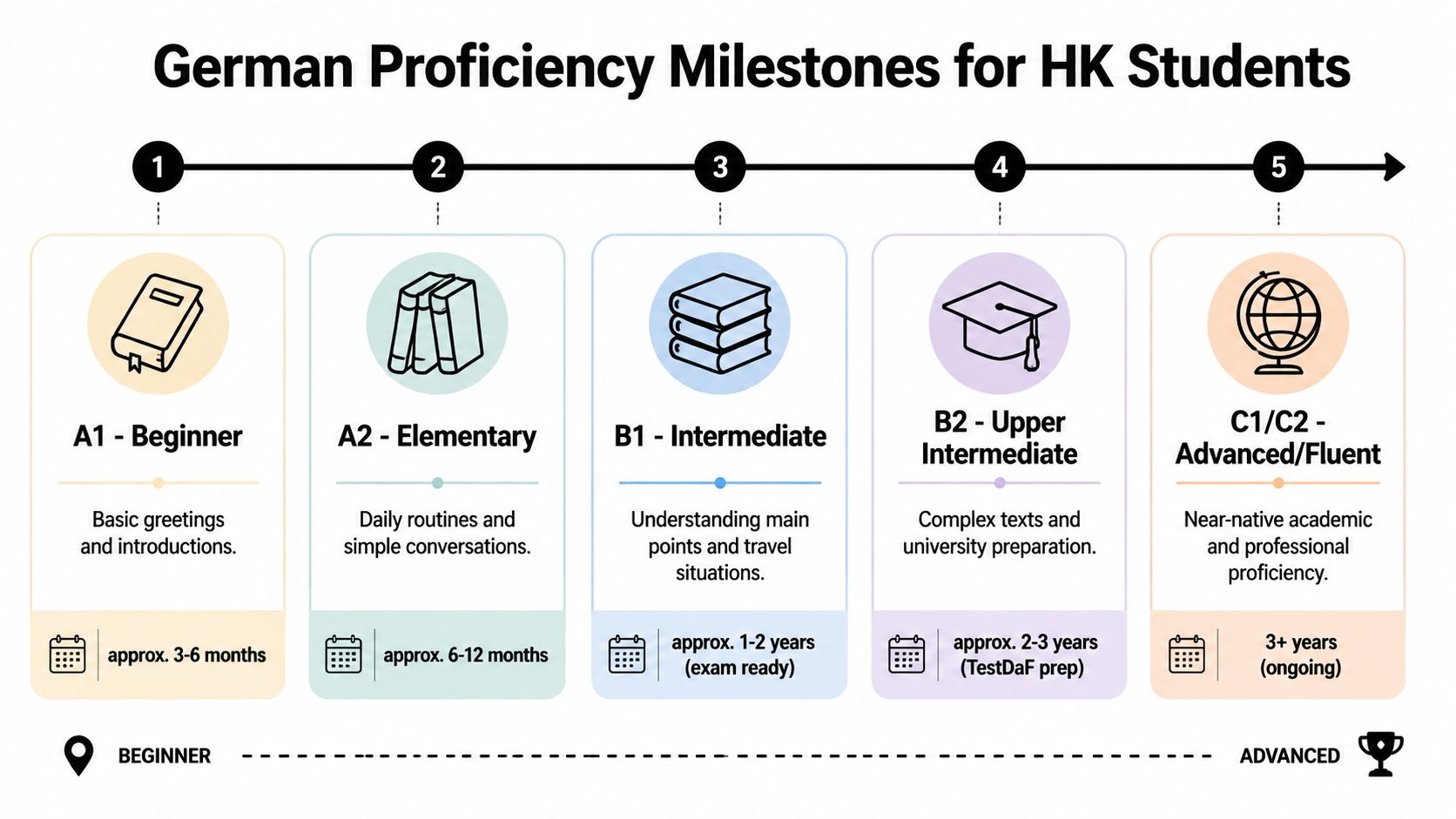
For most learners in Hong Kong, German should be planned as a multi-stage project, not a crash course. The challenge isn't only the language itself. It's fitting German around school, tutorials, activities, and exam seasons.
Hong Kong schools and families are already moving toward flexible delivery models, with hybrid and live-online formats becoming popular for students managing packed schedules. The main consideration is matching the format to the goal, especially for intensive exam preparation versus conversational fluency (Hong Kong bilingual and third-language scheduling context).
What the levels actually mean
Think in terms of CEFR milestones, because that's how most serious German programmes are organised.
A1
Basic greetings, introductions, simple personal informationA2
Everyday routines, basic conversation, familiar situationsB1
Independent everyday use, travel situations, clearer self-expression. This is often the first level where progress feels substantial.B2
Stronger reading, discussion, and academic readiness. At this level, German becomes much more useful for serious study goals.C1 and above
Advanced academic or professional command
Families wanting a closer look at the road to upper-intermediate level should read this practical guide on how long it takes to reach German B2 level.
Weekly study load that won't wreck school performance
The biggest mistake I see in HK is overloading the child early, then watching motivation collapse.
A better model is disciplined consistency.
For younger secondary students
Use a light but steady routine:
- One structured class each week
- Short review blocks across the week
- Vocabulary recycling instead of last-minute cramming
This works well when the goal is foundation-building without hurting core school performance.
For exam-track teens
If the target is Goethe-Zertifikat, IGCSE, A-level, or IB support:
- add targeted writing and listening practice
- keep one lesson focused on new content
- use another short session for correction and active recall
This group needs more output, not just passive exposure.
For adults and working professionals
Busy professionals in Hong Kong usually do better with:
- one fixed weekly lesson
- one self-study block on weekdays
- one speaking-focused session at the weekend
That keeps momentum without pretending you have endless time.
Advisory point: If a schedule can't survive test week, school projects, and family travel, it isn't a real schedule.
Which format should you choose
Use the delivery model that fits the target.
In-person small group
Better for accountability, routine, and speaking correctionLive online
Better for packed commuting schedules and adults who need efficiencyHybrid
Often the most realistic option for families juggling school demands and logistics in Hong Kong
My recommendation is simple. Don't ask for the fastest route. Ask for the route your child can sustain for months and years. German rewards consistency far more than bursts of enthusiasm.
Finding the Right German Learning Environment in HK
A common Hong Kong scenario is simple. Your child starts German with enthusiasm, attends for one term, learns scattered vocabulary, then stalls because the class was too big, too loose, or built for casual hobby learners. Families then blame the language. The primary issue is often the learning environment.
For bilingual HK students, the right setup matters even more. A child who already switches between English, Cantonese, and sometimes Putonghua can progress quickly in German if the teaching is structured and correction is consistent. That bilingual transfer advantage gets wasted in programmes that entertain but do not build control.
Start with the goal, then choose the provider
Parents often compare providers by convenience first. That is backwards.
Choose based on the outcome you want:
- steady long-term progress
- school support for IB, IGCSE, or A-level German
- formal certification such as Goethe-Zertifikat
- speaking confidence for future study or career plans
Once the goal is clear, screening providers becomes much easier.
What strong German programmes in Hong Kong have in common
Look for four things.
Teachers who can correct precisely
Native-speaking teachers are often useful, especially for pronunciation, idiomatic usage, and written accuracy. What matters most is not nationality alone, but whether the teacher can explain patterns clearly to bilingual learners and correct mistakes before they fossilise.A visible level system
Ask whether the course follows CEFR levels and whether students are assessed at clear checkpoints. If a provider cannot explain how a beginner moves from A1 to A2, you are buying activity, not progression.Small enough classes for output
German requires active speaking and sentence building. In oversized classes, confident students dominate and quieter HK students disappear. Small groups usually produce better speaking habits and better retention.A format that survives real HK schedules
School exams, CCA commitments, family travel, and tutorial timetables are normal. If the provider cannot handle hybrid attendance, make-up lessons, or sensible scheduling, the plan will break within months.
The main options in Hong Kong
Specialist language institutes
For families who want structure, this is usually the strongest route.
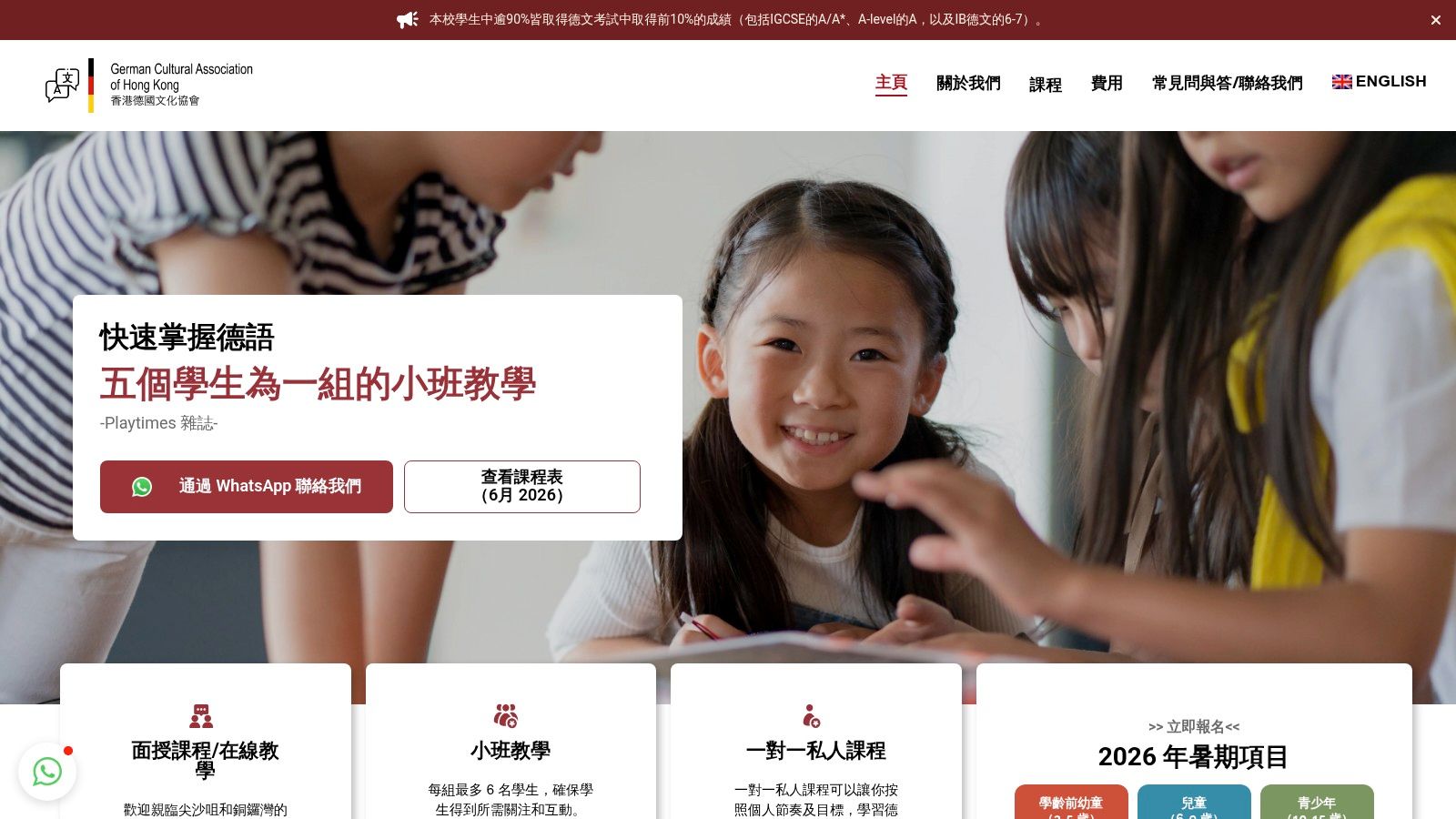
Specialist institutes are built around progression, not general enrichment. That makes them a better fit for students who need formal levels, regular correction, and a clear exam path. One example is German Cultural Association Hong Kong(GCA), which offers native-speaking teachers, small-group and private lessons, in-person classes in Tsim Sha Tsui and Causeway Bay, online options, and preparation for Goethe-Zertifikat, TestDaF, IGCSE, A-level, and IB.
That model suits ambitious HK families because it answers the ROI question directly. You are not just paying for exposure. You are paying for a route that can lead to certification, school support, and stronger future applications.
University pathways
University language centres can suit older students who are already independent and do not need parent-managed scheduling.
They are less suitable for younger learners who need close tracking, more correction, or exam-specific support. A university class may be academically serious, but it is not always designed around the pace and pressure of secondary school life in Hong Kong.
Private tutors
A good tutor can solve a specific problem fast. This route works well for:
- exam revision
- targeted writing correction
- oral practice
- timetable flexibility
But this is the least consistent option in the market. Parents should ask direct questions about materials, level planning, homework, correction style, and whether the tutor has real experience with German exams or school curricula.
A practical selection test
Use this framework before you commit.
| Learning Need | Best-Fit Option | Main Risk |
|---|---|---|
| Exam preparation and measurable progress | Specialist structured programme | Some centres market structure but assess weakly |
| One-to-one support and timetable flexibility | Private tutor | Quality varies sharply |
| Broader academic interest | University course | Often not built for teenagers or family logistics |
One more point matters. If your child may study or work abroad later, choose a programme that can produce formal proof of ability and not just classroom attendance. That matters for admissions planning and later career mobility. Families thinking ahead can also review the Go Hires global job guide to see how language skills connect to international study and work options.
My recommendation
If your child is serious about German, choose the environment that produces corrected output, visible level progression, and exam-ready habits.
Do not pay for vague “immersion” without accountability. In Hong Kong, the best German setup is usually the one that turns bilingual ability into a measurable third-language advantage.
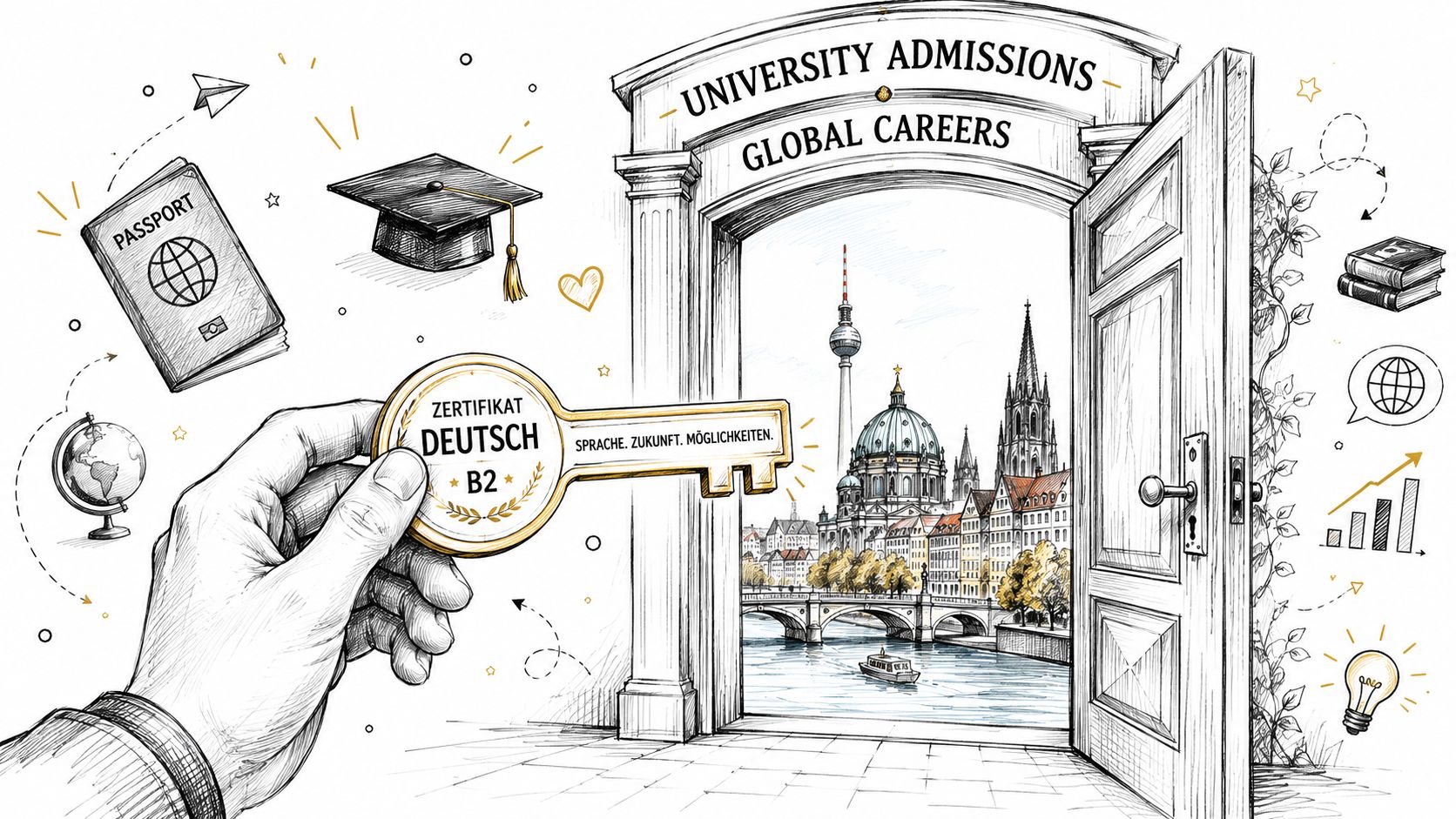
Unlocking University Admissions Visas and Global Careers
The strongest reason to learn German isn't cultural prestige. It's utility.
For Hong Kong students, German can support university planning, formal language proof, and long-term mobility into German-speaking environments. If your child may study in Europe later, you should treat German as an asset with admissions value, not as a decorative extracurricular.
German is a mainstream academic language in Europe
This matters more than many HK families realise. In Europe, German is not a niche enrichment subject. It is taught at scale in formal education.
In 2022, 21.4% of EU upper secondary pupils in general programmes were learning German, and 4.1% of primary school pupils in the EU were learning German. The same Eurostat data also show growing multi-language learning patterns across European schooling, including an increase in the share of primary pupils learning at least two foreign languages from 4.6% in 2013 to 6.5% in 2022, and among lower secondary pupils from 58.4% to 60.7% over the same period (Eurostat foreign language learning statistics).
The implication is straightforward. If a Hong Kong student reaches German proficiency, that student is aligning with a language already embedded in European academic systems.
Where German helps most
University admissions planning
German supports applications in a few different ways:
Direct language qualification
Some courses and institutions require formal proof of German.Broader programme access
German opens options that may not be available to English-only applicants.Stronger applicant profile
A student who has sustained third-language study signals seriousness, organisation, and international intent.
Visa and mobility preparation
For some study, work, or long-term settlement pathways, language proof becomes part of the practical process. Families often think about this too late.
The right move is to build German before the paperwork stage, not during it.
Career positioning
German is especially relevant for students interested in:
- engineering
- science and research
- finance
- technology
- business roles connected to Europe
For a broader perspective on how study-abroad choices connect to work later, Go Hires global job guide is a useful planning resource.
The certificate only matters if it fits the goal
A weak strategy is collecting certificates with no clear use case. A strong strategy is matching the level and exam to the intended next step.
If Germany or the wider German-speaking region is even a possible future option, start the language pathway earlier than feels necessary. Late planning creates expensive pressure.
This short video is a useful prompt for families thinking beyond language class and toward bigger international outcomes.
My view for Hong Kong families
If your child may apply overseas, German has clear strategic value. It gives you a certifiable skill, a recognised academic language, and an option set that extends beyond Hong Kong and beyond English-only education routes.
That is exactly why German as a Third Language for Bilingual HK Students is a planning decision, not just a language decision.
Your Questions About Learning German Answered
Is German really worth it compared with French or Japanese
Yes, for the right student profile.
A significant problem in Hong Kong is that most guidance still doesn't answer the ROI question clearly. There is a recognised gap in local content around whether German is worth the effort compared with more common choices such as French or Japanese, especially in relation to HK university admissions, international-school pathways, and exam outcomes (Hong Kong German learning ROI discussion).
My view is simple. If your child wants anime, pop culture, or casual conversation goals, Japanese may be a better emotional fit. If your child wants a third language with a strong academic and certification pathway linked to Europe, German is usually the stronger strategic option.
French can also be a smart choice. But many HK families choose it by default, not because it fits the student better. That's lazy planning.
Is German too difficult for a busy HK student
German is demanding. It isn't the easiest option.
But “difficult” is not the same as “bad fit”. For bilingual HK students who already function in English and Chinese, structured German often works better than parents expect because these learners are already used to handling multiple linguistic systems.
The bigger risk isn't difficulty. It's poor scheduling and poor teaching.
Should my child take German if it's not a mainstream DSE subject
Yes, if there is a clear reason.
German isn't a mainstream DSE subject, so families should stop pretending its existence alone confers value. Its value comes from how it supports the student's actual pathway.
That can include:
- international school assessment routes
- external exams such as Goethe-Zertifikat
- university applications in Hong Kong or overseas
- future study abroad planning
If none of those matter, then German may not be worth the load. Be honest about that.
What is the best age to start
Earlier is easier for building long-term comfort. But secondary school is still completely viable, especially for students who are organised and can handle structured study.
I would rather see a student start later with a serious plan than start early with random exposure and no continuity.
Should we choose exam prep or conversational German first
Choose based on purpose.
If your child needs a formal benchmark, start with a programme that builds toward certification. If the goal is confidence, travel, or oral comfort first, a conversation-led course may be fine.
The mistake is mixing goals without admitting it. A family says they want a relaxed conversational course, then six months later they panic because they suddenly need exam readiness. That's avoidable.
Parents should decide one primary goal for the next phase. Certification, school support, university preparation, or practical communication. Don't ask one course to do all four equally well.
Is online learning good enough for German
Sometimes yes.
For students with strong self-discipline, live online classes can work very well. For younger learners, shy learners, or students who need tighter correction, in-person or hybrid often works better.
The issue isn't whether online is “good” or “bad”. The issue is whether the learner can stay engaged and produce language actively instead of passively watching.
How should a bilingual HK student balance German with schoolwork
Use a model that survives pressure weeks.
A realistic plan usually includes:
- one fixed lesson each week
- short review sessions rather than marathon catch-up
- extra writing or listening only when the student is in an exam phase
If your child already has a heavy IB, IGCSE, or A-level load, don't build a German plan that assumes unlimited free evenings. That's fantasy.
What kind of student benefits most from German
German is especially strong for students who are:
Systematic learners
They like rules, patterns, and clear progression.Internationally minded
They may study abroad in Germany or wider Europe later.Exam-capable
They respond well to external goals and certification.Already bilingual
They are comfortable managing more than one language and can handle comparative learning.
German is a weaker fit for students who want instant gratification, dislike grammar entirely, or have no realistic intention of staying with the language long enough to reach a meaningful level.
What should parents do next
Don't start by asking, “Which class is cheapest?” Start by asking:
- What is the target in the next one to two years?
- Does my child need a recognised certificate?
- Can we sustain the timetable during exam season?
- Is German the strategic language for this child, or are we just following a trend?
If you can answer those truthfully, the decision becomes much easier.
If you want a structured path rather than guesswork, contact German Cultural Association Hong Kong(GCA) to discuss the right starting point for your child, teen, or your own professional goals. Ask about level assessment, exam-focused study plans, and flexible class formats that fit real HK schedules.

Student Exchange to Germany: Programmes for HK Students

APS and Deadlines for Germany: A Hong Kong Timeline


