.png)
.png)

BLOG

香港德國文化協會
The German Cultural Association
German Lessons Hong Kong: Prices & What Actually Works 2026
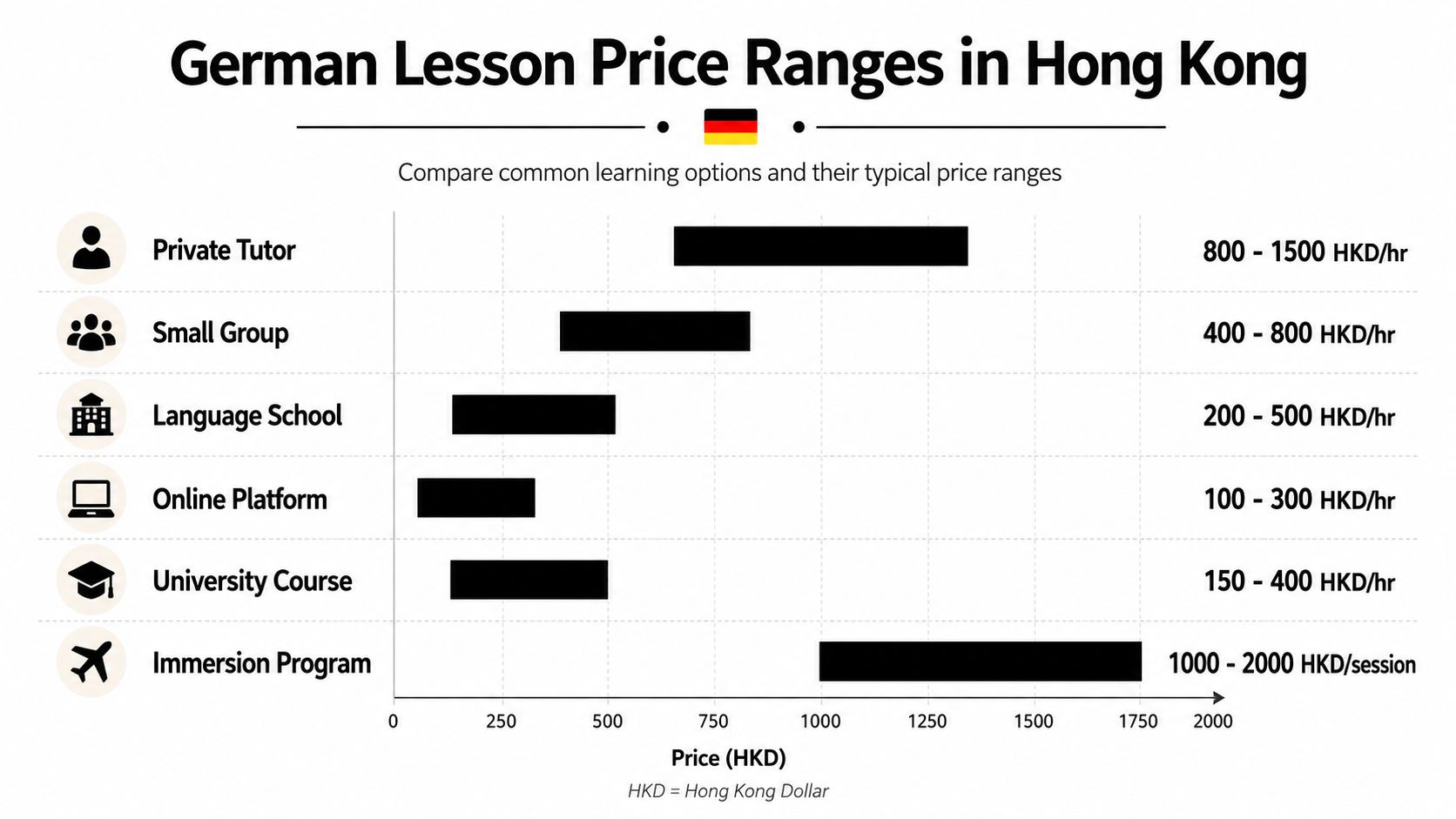
Realistic German lessons in Hong Kong run roughly HK$200 to HK$450 per small-group lesson and HK$500 to HK$900 per private hour. Eligible adults can also access CEF reimbursements of up to HK$25,000, so the core question isn't just price, it's which format gets the outcome you need.
If you're a parent comparing options for a Year 9 child, a professional preparing for a Berlin posting, or a traveller trying to avoid basic mistakes before a Munich trip, the cheapest quote isn't automatically the smartest buy. In Hong Kong, what works depends on the learner's goal, the exam pathway, and how much structure the student can realistically sustain week after week.
Table of Contents
- Start with the outcome, not the brochure rate
- Why price-per-hour misleads HK buyers
- What the rest of this guide weighs
- The market bands that matter
- What headline-cheap options often leave out
- Where apps fit, and where they don't
- The decision criteria that actually matter
- Who should choose which format
- Why GCA-style structure matters
- The level ladder that Hong Kong learners should care about
- What actually moves a learner up
- Which pathways fit which goals
Why Picking the Right German Format in HK Matters More Than the Price Tag
A Year 9 student in Hong Kong does not need the same German setup as a working adult who needs enough language for a Berlin rotation. If you choose the wrong format, you can spend months being busy without moving closer to Goethe-Zertifikat, university entry, or practical conversation.
Start with the outcome, not the brochure rate
Hong Kong families are used to comparing schools by fee first, but German is different. If the learner needs DSE/IB/IGCSE support, the key question is whether the classes build exam habits, speaking confidence, and written accuracy under pressure. If the learner is preparing for relocation or study abroad in Germany/Spain, the question is whether the course develops usable German fast enough to matter.
Practical rule: pick the format that matches the next milestone, not the cheapest hour on the page.
That means a parent near Tsim Sha Tsui should not select a class only because it looks affordable on paper. If the child needs structure, accountability, and visible progress before school exams, a tightly organised small group usually beats a loose bargain option. The same logic applies to adults commuting from Causeway Bay after work, because the missed lesson that never gets rescheduled costs more than the fee difference.
Why price-per-hour misleads HK buyers
Hong Kong pricing can look straightforward until you compare what is included. A lower headline fee may exclude native teachers, capped class size, exam preparation, or flexible rescheduling, which changes the true value of the lesson. For language learning, price without outcome is just a number.
The better lens is real progress per term. Official Hong Kong statistics separate current prices from constant prices, which is exactly the right mindset here, because nominal revenue or a cheap-looking fee says little about underlying learning progress when inflation, schedule disruption, and wasted lessons are ignored, as explained in Hong Kong's current and constant price framework.
What the rest of this guide weighs
The comparison below is built around the format, not the marketing slogan. It looks at price bands, learner fit, exam usefulness, and the trade-offs that matter in Hong Kong, including CEF funding for eligible adults and the way school calendars shape teen demand. That is the only sensible way to judge German lessons Hong Kong buyers can use.
Realistic Price Ranges for German Lessons in Hong Kong
Hong Kong German pricing makes sense only when you compare equivalent bundles, not bare hourly rates. A class that looks cheaper can become expensive if it strips out the features serious learners need, such as exam prep, native instruction, or reliable make-up arrangements. A DSE student, a university applicant, and a professional with evening classes are not buying the same outcome, so their price comparison should not be the same either.
The market bands that matter
For HK buyers, the market falls into six practical formats, and each one serves a different learner goal.
| Format | Typical price band in HK | Best fit | Main limitation |
|---|---|---|---|
| Small-group classes | HK$200 to HK$450 per lesson | Teens, adults, exam-track learners | Less one-to-one correction |
| Private tuition | HK$500 to HK$900 per hour | Fast pacing, targeted gaps, urgent goals | Higher cost, less peer pressure |
| Intensive courses | Varies by block length | Learners with deadlines | Fatigue if speaking time is compressed |
| In-person classes | Usually priced like the format above | Learners who need direct correction | Commute and fixed schedules |
| Online lessons | Usually priced like the format above | Busy professionals, review sessions | Easy to overestimate self-discipline |
| Self-study apps | Low direct cost | Vocabulary, revision, maintenance | Weak accountability and speaking practice |
These are the price bands HK readers will meet in the market. Under the ITU benchmarking principle, the right comparison is a tight peer set of similar markets and similar cost structures, not a global average that hides local realities, because comparable peers and cost-driver normalisation matter more than a headline price.
What headline-cheap options often leave out
A low fee can remove the features that move a student forward. A group class without native instruction may save money now, but if the learner is preparing for Goethe-Zertifikat or TestDaF, the saving can vanish in extra terms or extra private catch-up later. The same problem appears when online lessons are sold as flexible but end up offering too little speaking pressure.
Pricing guidance recommends comparing equivalent feature sets in pricing comparison guidance and testing scenarios at several usage levels, because the right metric is price-to-value ratio at 2 to 4 usage levels, not sticker price alone. In German learning, that means checking whether the course includes small class size, lesson recordings or follow-up materials, exam drills, and rescheduling support.
Bottom line: the cheapest German option in Hong Kong is not the one with the lowest fee. It is the one that wastes the fewest months.
Where apps fit, and where they don't
Self-study apps are useful for vocabulary maintenance, daily review, and keeping a learner warm between lessons. They are not a substitute for guided speaking, error correction, or exam calibration. If the goal is a real CEFR jump, apps should support lessons, not replace them.
For adults who qualify, CEF reimbursement support of up to HK$25,000 can materially reduce out-of-pocket cost for approved courses. A practical example helps: if a course block is priced within that cap, a learner who meets the funding rules can treat the reimbursed portion as a direct offset against tuition, which changes the comparison between a structured small-group course and a cheaper but weaker option. For HK readers, that is especially relevant especially for CEF-funded German courses in Hong Kong.
Small-Group Classes vs Private Tuition in Hong Kong
The group-versus-private debate gets oversimplified in Hong Kong. Group classes are not automatically slow, and private tuition is not automatically superior. The right answer depends on whether the learner needs structure, speed, or a narrow fix.
The decision criteria that actually matter
| Decision criterion | Small-group, max 6 | Private 1-on-1 |
|---|---|---|
| Speaking time per learner | Good, but shared | High, fully focused |
| Accountability | Strong, because peers create rhythm | Depends on learner discipline |
| Schedule flexibility | Moderate | High |
| Cost per real progress | Often stronger for steady learners | Strongest for urgent, specific gaps |
The pattern is simple. A small-group class is the better default for most serious learners because it forces participation, keeps energy high, and still gives enough individual correction when the class is capped. Private tuition is the right move when the learner has a hard deadline, an unusual gap, or a very specific performance target.
Who should choose which format
For exam-track teens, a capped group usually wins. Teen learners need momentum, peer normalisation, and consistent feedback, especially when they are balancing schoolwork, extracurriculars, and the pressure of IB, IGCSE, or A-level preparation. A small group also keeps the pace honest, because students hear mistakes they themselves are making and correct faster.
For professionals, private tuition can make sense if the need is narrow. That includes role-play for business meetings, interview practice, or a short runway before a visa-related or relocation deadline. If the learner only needs one specific module, private time is efficient.
Small groups are usually better for progress. Private lessons are usually better for precision.
Why GCA-style structure matters
A structured small-group model works because it combines two things that private lessons often struggle to provide at the same time, repetition and peer pressure. That is why a native-led classroom with a fixed curriculum is especially effective for learners who need a steady climb through Goethe-Zertifikat levels.
For readers comparing options, the internal guide on private German tutors in Hong Kong is useful if you already know you need one-to-one focus. If you do not, don't default to private because it feels more premium. Ask whether the learner needs private correction, or whether a well-run small group would produce the same result more efficiently.
In-Person vs Online German Lessons Across Hong Kong
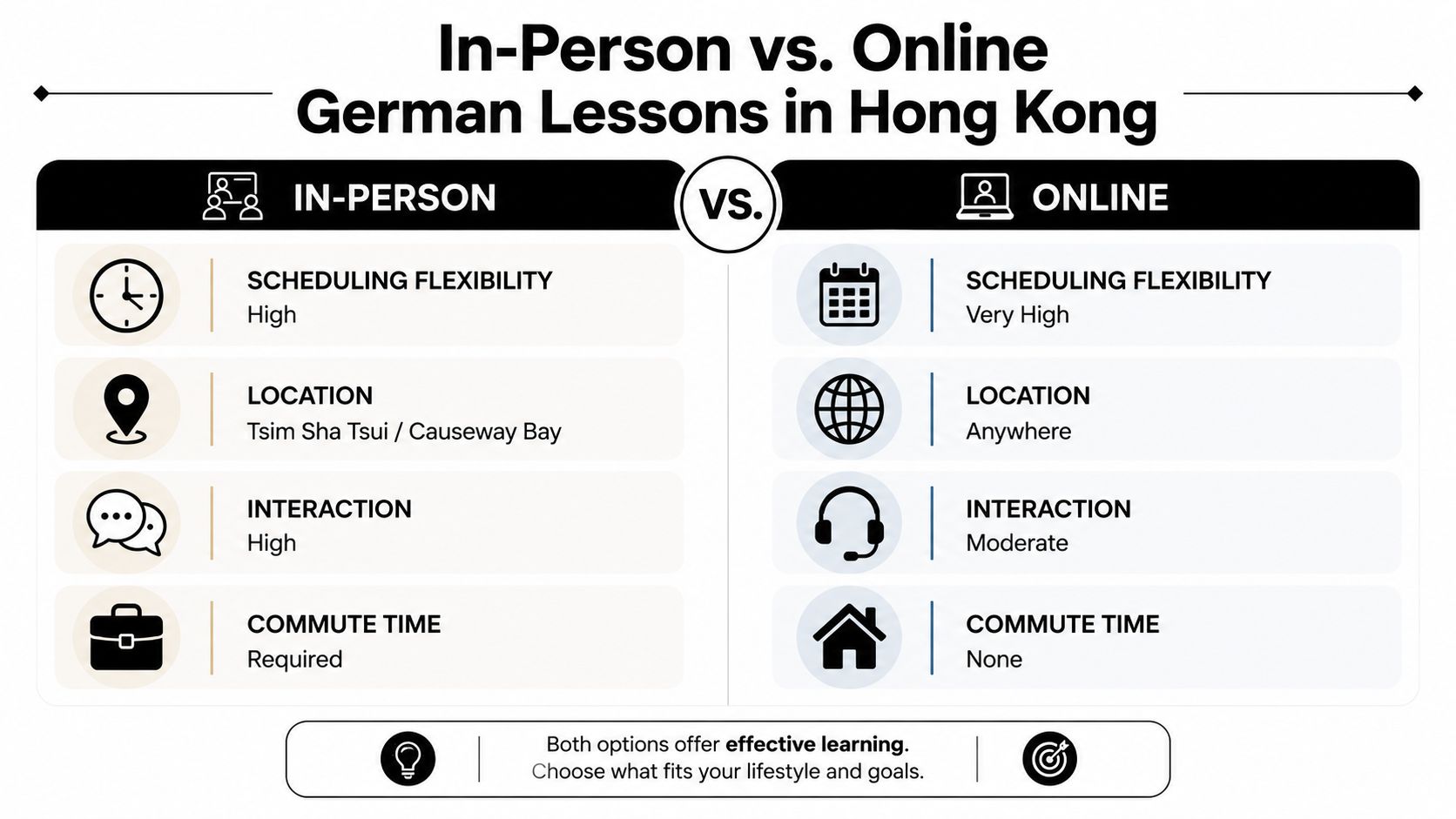
Hong Kong commutes are unforgiving. If a learner has to cross the city after school or after work, the format has to justify the travel time, not just the tuition fee.
When in-person is the stronger option
In-person teaching still wins for younger learners, pronunciation repair, and high-stakes exam prep. A teacher can catch a wrong vowel, a weak word order pattern, or a hesitating speaking habit faster when the student is physically in the room. That matters most in the final stretch before a Goethe-Zertifikat sitting.
The location factor also matters. If the classroom is near Tsim Sha Tsui or Causeway Bay, the lesson becomes more realistic for people moving between work, school, and family commitments. In Hong Kong, a good location often saves more learning time than a small fee reduction does.
When online is the smarter choice
Online German works well for review sessions, grammar consolidation, and conversation practice when the learner already has a stable routine. It also suits busy professionals who need to fit lessons between meetings, family duties, or travel. The absence of commute time changes the actual cost in a way many buyers underestimate.
Practical rule: online is strongest when the learner already shows up prepared.
Flexible rescheduling changes the equation again. When a provider lets a working adult move a class easily, the effective value of online rises because missed lessons stop turning into lost tuition. That matters in Hong Kong, where calendars change fast and travel to a fixed classroom can become the first thing people sacrifice.
The comparison on in-person versus online German classes in Hong Kong is worth reading if you're deciding between commute and convenience. My view is blunt. If the learner is serious, online is a tool, not a default. In-person remains the stronger choice when the goal is sharper speaking, more direct correction, and better exam readiness.
The video below is useful if you want a quick visual sense of how the two modes differ in practice.
Exam Prep Pathways for CEFR Progression
German exams are the spine of serious study, not an optional extra. If a learner wants visible progress, the course has to be matched to the exam ladder, because that is where structure, feedback, and accountability turn into real gains.
The level ladder that Hong Kong learners should care about
The Goethe-Zertifikat ladder runs from A1 to C2, and the Goethe-Institut uses those levels to measure progressively broader reading, listening, writing, and speaking competence. For university-bound learners, TestDaF is the relevant academic track, and the Goethe ladder helps families understand what each stage demands, from basic conversation to advanced academic use, as shown in the Goethe level structure.
For Hong Kong teens, the school context matters too. The territory's public school-leaving pathway moved from HKCEE to HKDSE after the 2011 cycle, so local exam planning should be framed around DSE rather than outdated pathways, which the Hong Kong exam history makes clear.
What actually moves a learner up
A real CEFR jump usually needs more than one tool. In practice, the strongest combinations are these:
- Weekly small-group classes for steady speaking, grammar correction, and pace.
- Intensive blocks when a learner has a fixed test date or needs a mid-term push.
- Self-study apps and podcasts for vocabulary retention and short daily review.
- Targeted private sessions for a weak paper, oral performance, or university interview.
The point is sequence, not hype. A programme that front-loads grammar but leaves oral work to the end often produces students who can recognize forms but still freeze in an exam room. A better setup starts with one clear target, then drills the exact task types that appear on the paper, timed writing, listening under pressure, short spoken answers, and correction that follows the rubric. For Goethe-Zertifikat preparation, I tell serious students to use a simple checklist: identify the level first, map every skill to that level's task format, record one speaking sample each week, and review errors in the same order every time. That habit does more than scattered practice, because it turns revision into a ladder, not a pile of notes.
Which pathways fit which goals
IGCSE, A-level, and IB German matter most for school-aged learners. Goethe-Zertifikat matters for broad credentialing and clear level progression. TestDaF matters for university admission and academic mobility. Each route should be chosen for the outcome it supports, not because it sounds impressive on a course flyer.
Why Premium Small-Group Native-Led Instruction Earns Its Fee in Hong Kong
Premium pricing only makes sense if it buys better outcomes. In German learning, that usually comes from a combination of tight class size, native faculty, consistent attendance, and exam alignment, not from a glossy room or a fancy brochure.
The features that change the result
The strongest premium model usually includes maximum six students, native German-speaking teachers, a structured curriculum tied to Goethe-Zertifikat and TestDaF, and a clear attendance system that keeps learners accountable. It also helps when rescheduling is easy, because Hong Kong professionals and parents miss fewer lessons when the system adapts to their lives.
Those features matter because they lower the number of wasted terms. A learner who attends regularly, gets corrected quickly, and studies inside a structured pathway often reaches the next checkpoint with less detour. That is a better use of money than chasing the lowest hourly rate and then buying extra catch-up later.
What the numbers behind the premium actually mean
GCA's published results are the right kind of proof for this discussion, because they point to outcomes rather than slogans. The organisation reports a 96% recommendation rate and over 90% of students ranking in the top 10% of public examinations, which is a strong signal that the structure is doing real work for motivated learners.

The same logic applies to physical access. Centres near Tsim Sha Tsui and Causeway Bay MTR make attendance easier, and easier attendance usually means better continuity. For busy HK families, continuity is worth paying for because broken routines cost more than a modest fee difference.
Premium is rational when it reduces friction, raises consistency, and shortens the path to the exam you actually need.
That said, premium does not mean magic. No serious provider should promise fluency in a few weeks. The premium case is stronger for learners who are committed, exam-minded, and willing to do the work between lessons. Cheaper formats are still rational for casual learners, but serious learners usually benefit more from the structure.
Which German Format Is Right for Your Learner Profile in HK
The right format depends on the learner's goal, not on who has the nicest brochure. Once you know the outcome, the choice gets much easier.
My straight recommendation by profile
Parents of DSE, IB, or IGCSE teens: choose a structured small-group class with exam preparation. The learner needs routine, feedback, and a peer group that keeps momentum alive. Add private tuition only if a speaking weakness or school deadline demands it.
University applicants: choose a pathway aligned to TestDaF or the relevant academic requirement. If the timeline is tight, combine weekly small-group lessons with targeted private support for writing and oral performance. Self-study apps can help, but they cannot replace guided exam practice.
Working professionals: choose online only if the schedule is unstable. If the goal is business communication, a private session can be useful for role-play, but a serious small group often gives better long-term value because it builds repeated speaking and accountability.
Adult travellers: choose a lighter, practical course focused on conversation and survival German. For such learners, online can be perfectly sensible, especially if they want flexibility and don't need a certificate.
The short version
If you want the safest default in Hong Kong, choose native-led small-group instruction with a clear curriculum. It suits the widest range of serious learners, from teens to adults, because it balances value, structure, and outcome better than most fee-first comparisons do.
For readers who want a premium but practical option, the most useful next step is to check the latest class schedule, compare the format against the learner's goal, and ask whether the course is built for exams, work, or travel. That is how you avoid paying for lessons that feel productive but lead nowhere.
If you're ready to stop comparing German lessons Hong Kong style by price alone, German Cultural Association Hong Kong(GCA) offers structured small-group and one-to-one German courses, plus in-person and Zoom options for different schedules. Visit the course schedule, book a trial class, or speak with an advisor if you want a format matched to your goal, whether that's Goethe-Zertifikat, university prep, business German, or practical travel German.

Student Exchange to Germany: Programmes for HK Students

APS and Deadlines for Germany: A Hong Kong Timeline


