.png)
.png)

BLOG

香港德國文化協會
The German Cultural Association
How to Pass the A1 German Exam: Your 2026 HK Guide
You need the A1 certificate because a visa process, family move, school plan, or job requirement in Hong Kong is already in motion. That adds significant pressure. Many individuals waste time on random apps, scattered YouTube videos, and vocabulary lists that never turn into exam performance.
How to Pass the A1 German Exam comes down to four things: know the format, study on a realistic schedule, train the exact tasks you’ll face, and get speaking practice early. If you're in Hong Kong and you're balancing work, school, or family, you need a plan that is efficient, not theoretical.
Your First Step to Germany Starts with A1
If you're applying for family reunification, preparing for an au pair pathway, or trying to improve your mobility with a German company in Hong Kong, A1 is the first gate. You don't need advanced German yet, but you do need proof that you can handle basic everyday communication.
The exam is practical. It tests whether you can introduce yourself, understand simple information, read short texts, write basic messages, and speak in routine situations. That sounds manageable, but many candidates still fail because they prepare casually.
How to pass the A1 German exam
A common Hong Kong pattern looks like this. A candidate can recognise vocabulary, fill in workbook exercises, and score decently on reading drills, then freeze the moment an examiner asks a simple personal question. That is why casual self-study fails.
To pass the Goethe-Zertifikat A1 in Hong Kong, prepare for the exact tasks you will face and train all four skills every week. The right method is simple: build high-frequency vocabulary, practise short exam-style responses, speak from the first week, and use timed mock work so nothing feels unfamiliar on exam day.
What the exam is actually testing
A1 checks basic functional German. You need to handle everyday situations clearly and without long hesitation.
That means you should be able to:
- Introduce yourself with your name, nationality, job, and family details
- Catch practical information such as times, prices, places, and simple instructions
- Complete basic forms with personal details
- Write short messages such as an email, note, or reply
- Answer simple spoken questions and ask basic questions back
For Hong Kong learners, the weak point is usually predictable. Many learners trained through exam-heavy systems such as the DSE are good at memorising vocabulary lists and recognising patterns on paper, but weaker at producing spoken German under pressure. A1 exposes that gap quickly.
Practical rule: Prepare for tasks, not chapters.
What passing candidates do differently
Strong A1 candidates do not wait until the end to start speaking. They rehearse introductions, personal details, common questions, and short everyday exchanges until the language comes out automatically. They also study with correction. That matters because beginner mistakes in word order, pronunciation, and spelling become habits fast if nobody fixes them.
For busy Hong Kong professionals and parents, structure matters even more. If your week is split between work, school admissions, enrichment classes, or relocation planning, you do not have time to guess what to study next. A guided plan with native-led speaking practice is usually far more effective than scattered app work and passive revision.
A clear view of what you must show
| Exam element | What you must show |
|---|---|
| Listening | You catch key details from short spoken German |
| Reading | You identify meaning in simple everyday texts |
| Writing | You complete forms and write short, clear messages |
| Speaking | You introduce yourself and handle simple interaction |
Treat A1 like a defined project. If you are preparing for Germany-related career options, family plans, or adding German alongside DSE, IB, or IGCSE commitments in Hong Kong, set a timetable, practise under exam conditions, and get speaking feedback early. That is how candidates pass with confidence.
What Is the A1 German Exam Format
You book the exam, open a sample paper, and realise the risk straight away. A1 is not a vague “beginner German” check. It is a fixed exam with four modules, clear task types, and very little room to improvise if you have only studied through apps or casual self-study.
The Goethe-Zertifikat A1, also called Start Deutsch 1, tests four skills: listening, reading, writing, and speaking. The modules are equally weighted. You need a passing overall result, so weak performance in one paper can drag down the rest. That is why exam-specific preparation matters so much for busy learners in Hong Kong.
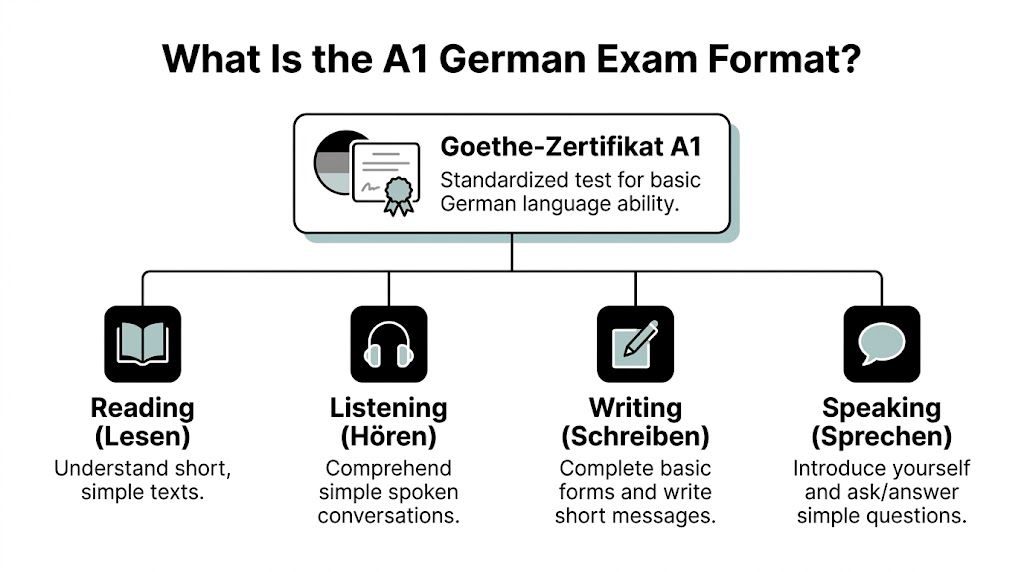
Goethe-Zertifikat A1 exam structure
| Module (German Name) | Duration | Tasks | Maximum Points |
|---|---|---|---|
| Listening (Hören) | about 20 minutes | Understand short conversations, announcements, and everyday prompts | 15 |
| Reading (Lesen) | about 25 minutes | Read short everyday texts and answer simple questions | 15 |
| Writing (Schreiben) | about 20 minutes | Fill in forms and write a short message | 15 |
| Speaking (Sprechen) | about 15 minutes, usually in a small group | Introduce yourself and ask or answer simple questions | 15 |
What each module is really testing
Listening rewards precision. You must catch names, numbers, times, prices, and simple intentions. One missed detail can cost the answer.
Reading checks whether you can scan practical texts quickly. Notices, short messages, ads, and simple information texts are typical. Do not translate line by line. Find the signal words and move on.
Writing is basic but strict. You complete a form correctly and write a short functional message. Spelling, clarity, and relevance matter more than fancy vocabulary.
Speaking is the pressure point for many Hong Kong candidates. The language level is low. The main challenge is producing it fast, clearly, and aloud in front of other people. If you have only memorised words without vocal practice, this module exposes you.
What this means for learners in Hong Kong
If you are fitting German around office hours, relocation planning, or a child’s IB, IGCSE, or DSE schedule, treat the exam format as your study map. Random exposure will not prepare you well enough. You need targeted practice for each task type, especially speaking and writing under time limits.
I also recommend using local support instead of relying only on generic overseas materials. Start with practical free German learning resources in Hong Kong, then build around structured, native-led correction. That approach is faster, more accurate, and far better suited to the way Hong Kong families and professionals study.
How Much Study Time Do I Need to Pass
Most candidates need 80-120 hours of structured study to prepare for A1, according to the Goethe A1 study plan reference. That same source also notes that the A1 wordlist is about 500 terms, successful learners often use 7-10 tutor sessions for speaking, and weekly mock exams can boost real-exam success by 10-15%.
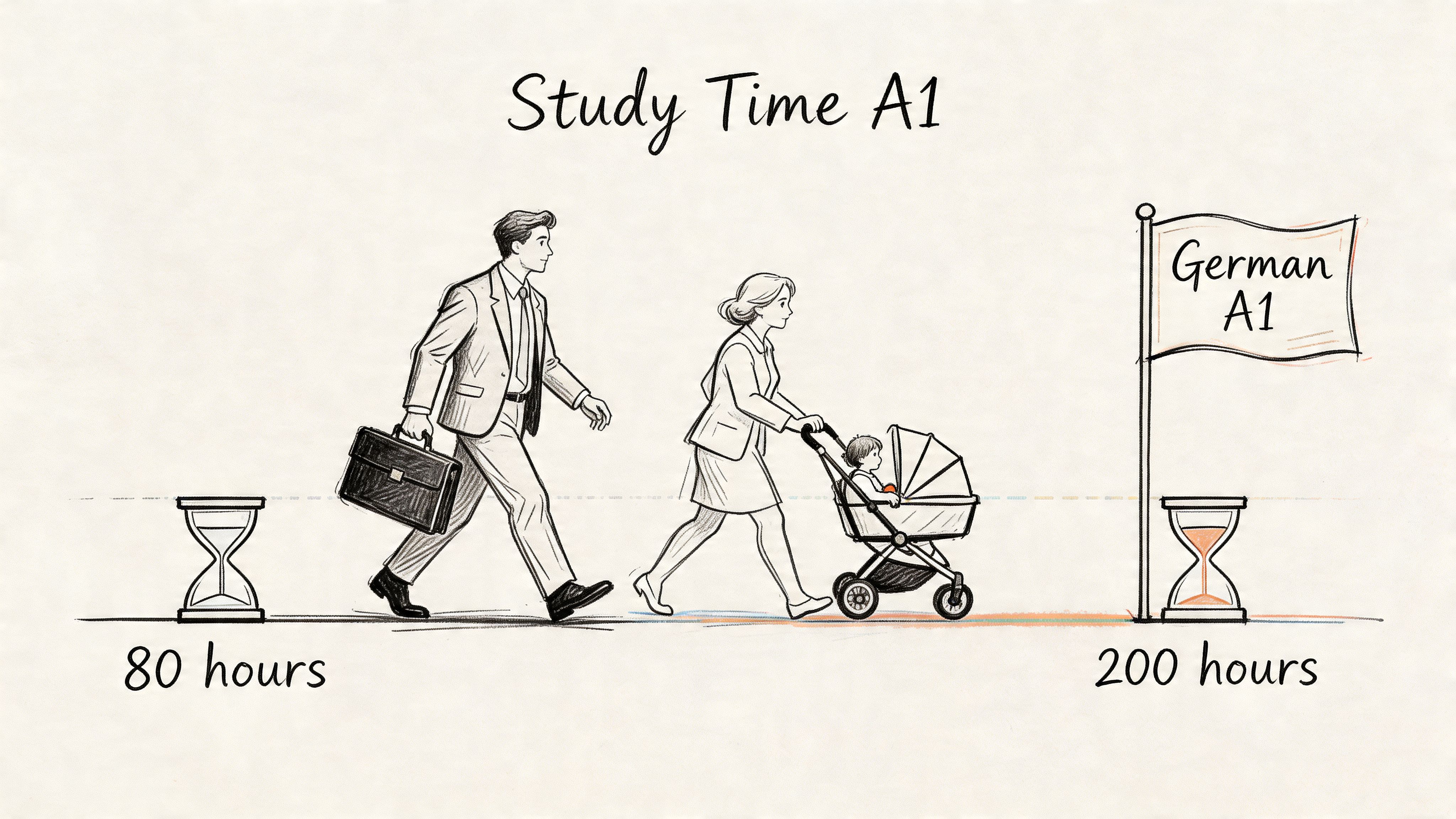
That range is realistic. It also explains why people fail after “studying for months”. Time only counts if it’s organised.
A realistic way to think about timing
If you study daily, even in short blocks, A1 is manageable. If you study only when you feel motivated, it drags.
For most Hong Kong adults and parents, I recommend thinking in three phases instead of counting calendar weeks obsessively:
Foundation
Build core vocabulary, pronunciation, greetings, numbers, dates, family terms, jobs, and daily routine language.Development
Start doing module-specific practice. This is when listening and speaking need serious attention.Refinement
Shift into mock exams, error review, and timed responses.
Daily and weekly habits that actually work
A simple, disciplined routine beats ambitious chaos.
- Daily vocabulary review: Use flashcards for the core A1 wordlist. Short and repeated is better than long and forgotten.
- Daily audio exposure: Listen to short German phrases and dialogues. Focus on recognition, not background noise.
- Speaking every week: Don’t postpone this. Use a tutor or structured practice partner sessions.
- Weekly mock work: Do at least one timed paper or one full module set every week.
What this means for different Hong Kong learners
Working professionals should aim for a consistent weekday routine plus one stronger weekend session. Don’t rely on “I’ll catch up later”. Overtime and commuting usually destroy that plan.
Parents planning for children need structure even more. German gets pushed aside quickly when schoolwork, activities, and exam prep pile up.
Independent adult learners often underestimate speaking. Reading and apps feel productive, but the exam isn’t only silent work.
If your study plan has no scheduled speaking, it’s incomplete.
The wrong target
Don’t ask, “How fast can I finish A1?” Ask, “How steadily can I build pass-level performance?” That question produces better decisions.
Your Phased A1 German Exam Study Plan
Random effort feels busy. It doesn’t produce reliable exam results. If you want to know How to Pass the A1 German Exam, use a phased plan and train the skills in the order they develop.
Phase one builds the base
The first phase is about control, not speed. You need enough German to handle the most common personal and daily-life situations without guessing.
Focus on these first:
- Alphabet and pronunciation: German pronunciation is more regular than many learners expect. Get the sounds right early.
- Personal identity language: Name, age, nationality, profession, address, family, hobbies.
- Core grammar: Basic sentence order, simple verbs, question words, articles, and noun gender awareness.
- Survival vocabulary: Numbers, dates, days, months, time, food, transport, places, and directions.
At this stage, keep writing simple. Short sentences are enough:
- Ich heiße Alex.
- Ich komme aus Hongkong.
- Ich wohne in Kowloon.
- Ich arbeite im Büro.
That may look basic, and that’s exactly the point. Weak learners rush ahead before these patterns become automatic.
Phase two shifts into exam tasks
Once the foundation is stable, stop treating German as separate topics. Start treating it as exam action.
Work by module on rotation:
- One day for listening
- One day for reading
- One day for writing
- One day for speaking
- One review day
- One mock segment
- One light reset or catch-up day
This is also the right time to expand practical vocabulary around:
- ordering food
- shopping
- asking for directions
- booking or asking for appointments
- introducing family members
- talking about work and routines
If you need extra support materials, use curated practice rather than endless searching. These free German learning resources in Hong Kong are useful when you want structured supplements without cluttering your study plan.
Phase three is where candidates separate themselves
This phase is not for learning everything new. It’s for tightening weak areas and becoming calm under timed conditions.
Use full or partial mock exams regularly. Then review in a blunt way:
- What did you misunderstand?
- Which question types slow you down?
- Which speaking prompts make you freeze?
- Which writing errors keep repeating?
What to practise in each module during this phase
Speaking
Memorise your self-introduction until it feels natural, not robotic. Prepare simple answers for common questions:
- Woher kommen Sie?
- Was machen Sie beruflich?
- Welche Sprachen sprechen Sie?
- Was sind Ihre Hobbys?
Then practise asking those questions too.
Writing
Create dependable templates for the common A1 tasks. Learn how to open and close a short message properly. Keep sentence structures clean.
For example:
- greeting
- one reason for writing
- one or two information sentences
- a polite closing
Reading
Train your eyes to hunt for clues. Names, places, prices, dates, times, and key nouns usually carry the answer.
Listening
Listen with a pen in hand. Note the exact item you need. Don’t try to understand every word.
Strong A1 candidates don't sound advanced. They sound clear, prepared, and consistent.
The phased plan most people need
If you're balancing work in Central, school runs in Kowloon, or exam prep alongside IB or IGCSE, this kind of structure protects your energy. You always know what to do next. That’s why it works.
Targeted Strategies for Each Exam Module
The biggest mistake Hong Kong learners make is assuming general effort is enough. It isn’t. The exam rewards specific technique.
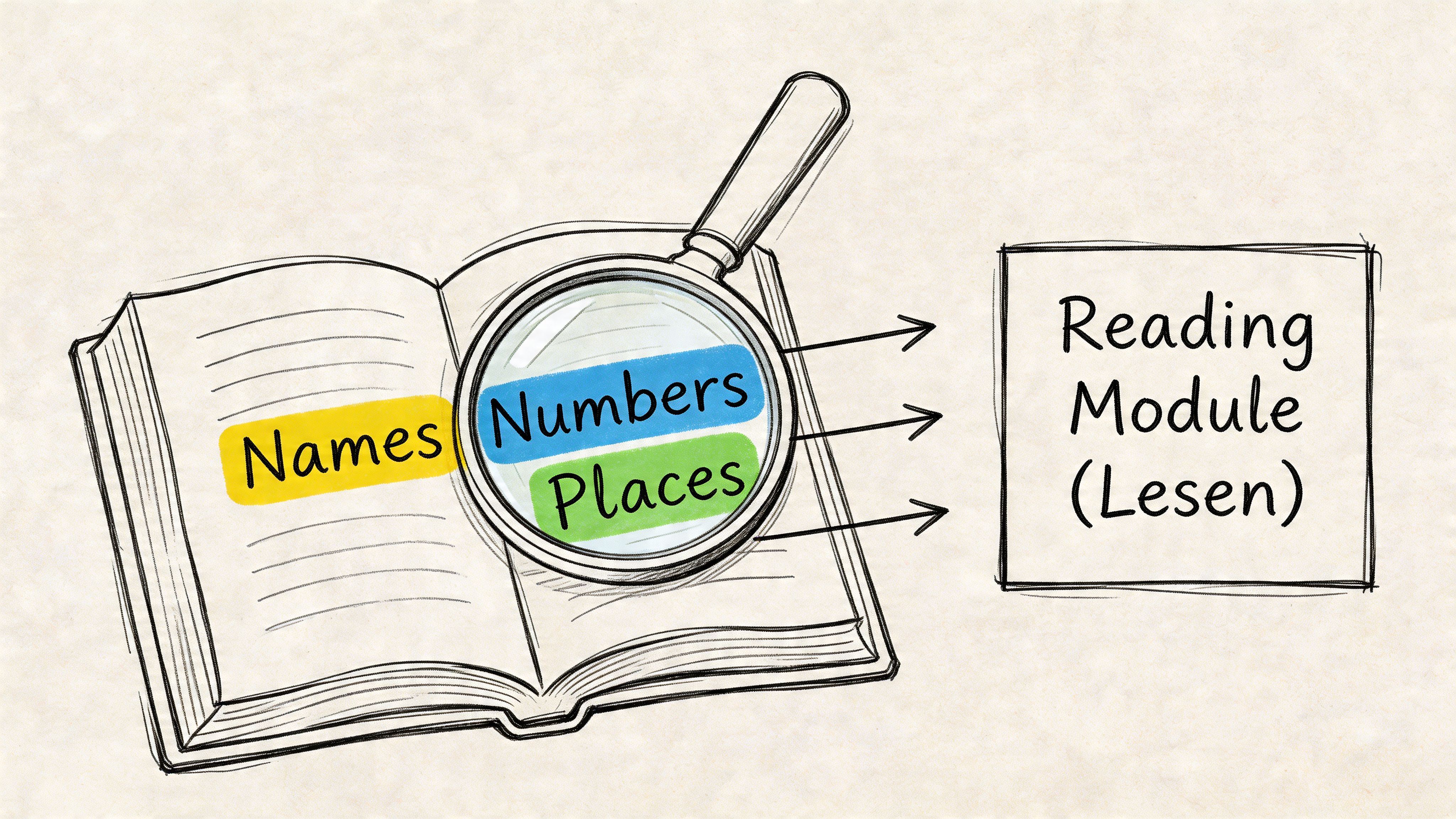
Reading needs scanning, not perfection
Many learners read every line slowly because they’re afraid of missing something. That habit kills time.
Do this instead:
- Scan for names: Who is involved?
- Catch numbers: Prices, times, dates, ages.
- Spot places: Station, city, street, office, school.
- Match context words: Family, hobby, appointment, food, work.
If the text is about a train, appointment, or small advert, the answer is often tied to one visible detail. Train that habit.
Writing needs templates, not creativity
A1 writing is not a composition contest. You need a reliable structure.
Build two habits:
Form filling
Practise spelling personal details clearly. Name, address, date of birth, nationality, and contact details must be automatic.Short message writing
Learn a small bank of usable phrases for common situations.
Useful patterns include:
- greeting line
- reason for message
- one request or one piece of information
- polite ending
Also learn the difference between formal and informal tone. At A1, mixing du and Sie carelessly looks sloppy.
Listening is a detail-capture exercise
A lot of candidates try to “understand German” in a broad way during listening. Wrong target. You need to catch the required information.
Listen for:
- time
- place
- date
- price
- name
- yes or no intention
If you miss one word, don’t panic. Keep moving and listen for the next clue.
Don’t chase every sentence. Catch the answer signal.
Speaking is where nerves expose weak preparation
Many learners in HK believe speaking will improve automatically after enough reading and app practice. It won’t. Speaking improves when you speak.
Prepare these areas until they are smooth:
- Self-introduction
- Simple personal questions
- Common answers about family, work, hobbies, and home
- Basic question formation
Sample questions worth drilling:
- Woher kommst du?
- Wo wohnst du?
- Was machst du beruflich?
- Was sind deine Hobbys?
The assumption you should drop
Don’t assume your strongest skill will carry the rest. Candidates often say, “My reading is good, so I should be fine.” That’s not a serious exam strategy.
A1 is broad by design. If one module is weak, train it directly. If speaking makes you uncomfortable, that’s the clearest signal that you need more speaking, not more flashcards.
Why Structured Courses Outperform Self-Study in Hong Kong
Self-study looks cheaper at the start. For many learners in Hong Kong, it becomes expensive in time, delay, and retakes. The weak point is almost always the same: no one corrects your speaking, your writing habits, or your exam technique.
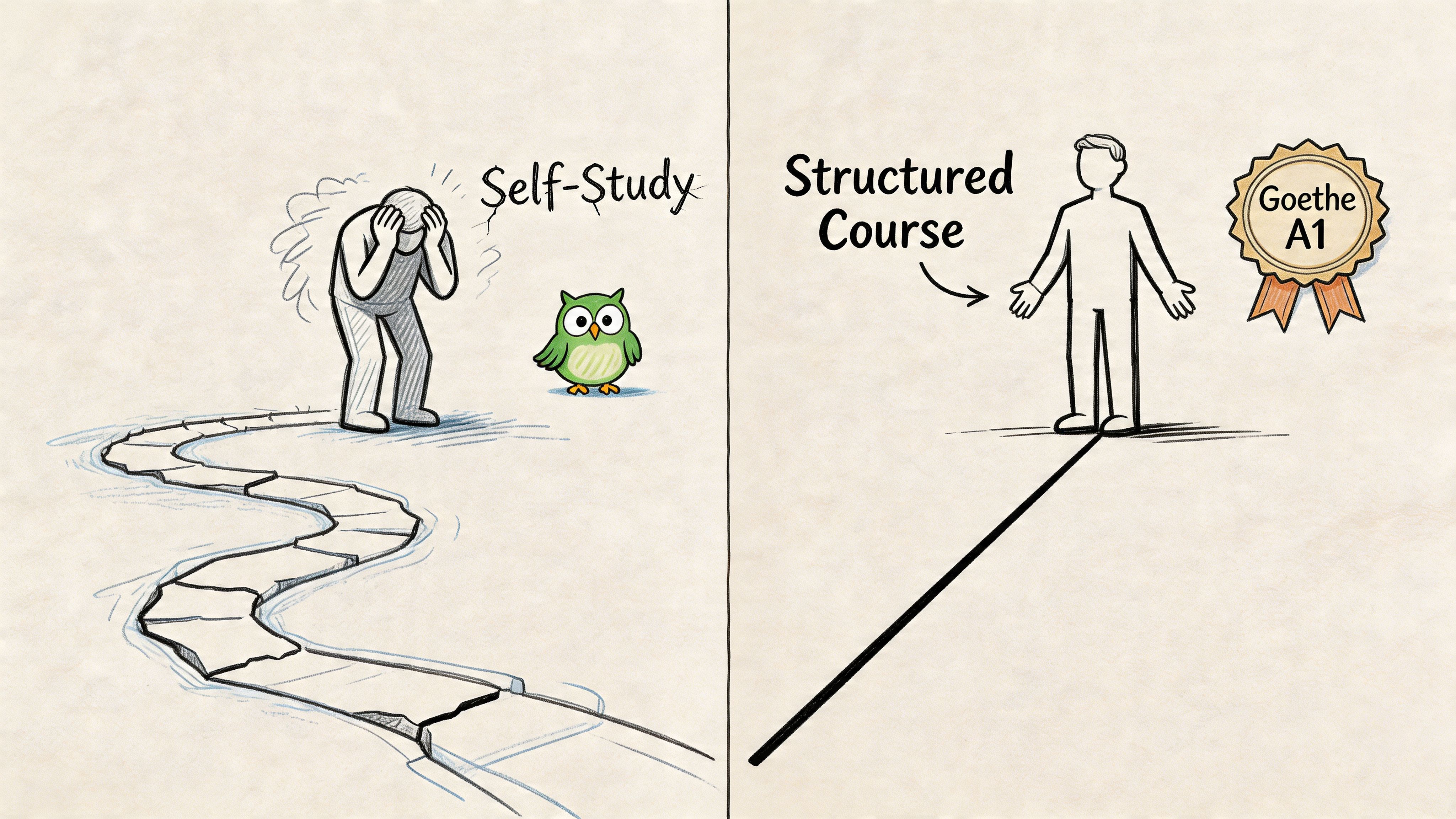
Why this matters for HK families and professionals
For parents in Hong Kong, aligning German with IGCSE or IB schedules is a real operational problem. Structured, small-group classes led by native speakers can produce 25% higher retention for children, and GCA’s 80% attendance policy has contributed to over 90% of top-performing students passing successfully, based on the verified local reference published through this Hong Kong German learning video source.
That matters because consistency beats cramming, especially for children with packed schedules.
For adults, the issue is different. Work hours change. Energy drops after office hours. Without a fixed lesson structure, many adults keep “studying” without progressing.
What structured learning fixes
A proper course solves three problems quickly:
- Accountability: You show up, practise, and get corrected.
- Sequence: Grammar and vocabulary are introduced in a usable order.
- Speaking pressure: You rehearse interaction before the exam, not during it.
One practical advantage is administration. Schools that run language programmes well usually make scheduling, attendance, and progress tracking easier for busy families and professionals. Tools such as Tutorbase for language schools show the kind of operational systems that help structured learning stay organised.
One useful local option to compare
If you're comparing programmes, this Hong Kong German course comparison guide is a sensible starting point. It helps you look at teaching format, group size, and exam focus rather than just headline pricing.
One local option many families and professionals consider is German Cultural Association Hong Kong(GCA), which offers native-speaker teaching, small-group classes of up to six students, private lessons, and Goethe-focused preparation in person and online. Those features matter because they directly address the two biggest A1 problems in HK: inconsistent attendance and weak speaking practice.
Here’s a quick visual explanation of why guided preparation tends to work better for exam candidates:
Self-study still has a role
Self-study is useful for review. It is not enough on its own for most serious candidates with a visa, school, or corporate deadline.
Use apps and videos for:
- revision
- repetition
- listening exposure
- extra vocabulary
Don’t use them as your entire preparation system.
If your learning method never forces you to answer out loud, it isn’t preparing you properly for A1 speaking.
Ready to Pass Your A1 Exam with Confidence
If your deadline is tied to immigration, school planning, or corporate mobility, guessing is a bad strategy. You need clear feedback, regular speaking practice, and a timetable you can realistically sustain.
For working professionals in Hong Kong, A1 is often tied to movement within German-linked business environments, and local centres report that the speaking module is a major hurdle. Verified guidance also notes that private 1-on-1 sessions with flexible rescheduling and business-focused vocabulary can raise pass rates by 30% for adult learners compared with self-study, according to this adult A1 preparation reference.
That’s why many adults do better when they stop treating A1 as a hobby and start treating it as a coached performance target.
What to do next
Pick the format that matches your reality:
- If you work long hours: choose a plan with fixed weekly speaking and flexible rescheduling.
- If you’re a parent: choose a structured programme that fits around school load instead of competing with it.
- If you’re studying alone now: add guided speaking before the exam, not after a failed attempt.
If funding matters, review this guide to funding your German studies in Hong Kong with CEF and check whether your study path can be planned more efficiently.
Passing A1 is not complicated. It is disciplined. If you train the right tasks in the right order, the exam becomes manageable.
If you're ready for structured support, speaking-focused preparation, and a study plan that fits real life in Hong Kong, contact German Cultural Association Hong Kong(GCA) to ask about trial classes, exam preparation options, and the latest course schedule.

German Idioms and Everyday Expressions: 25 Phrases Textbooks Skip—Guide

Präteritum and Futur Compared: A Guide for HK Learners


