.png)
.png)

BLOG

香港德國文化協會
The German Cultural Association
How to Say Hello in German: Basic Conversation Guide
You’re about to join a Zoom call with a German client, help your child prepare for a Goethe-Zertifikat speaking task, or plan a first trip to Berlin. You know one wrong greeting can make you sound too casual, too stiff, or merely unsure. That’s why How to Say Hello in German: Basic Conversation Guide starts with the one decision that matters most. Are you speaking formally or informally?
For learners looking for German lessons Hong Kong readers often want practical answers, not a long phrase list. In Hong Kong, where work, school, and family settings each have their own rules of politeness, German greetings make more sense when you treat them the same way. Once you know when to use Hallo and when to use Guten Tag, the rest becomes much easier.
The Foundation - Formal vs Informal German Greetings
How do you say hello in German correctly
The safest beginner answer is this: use Hallo in casual situations with friends, family, and children, and use Guten Tag in professional or first-time interactions. An important aspect is understanding du and Sie, because your greeting and your “you” form need to match.
Start with the social rule
German is very clear about distance and respect.
If you know Cantonese social habits in Hong Kong, this will feel familiar. You already adjust your tone depending on whether you’re speaking to a close friend, a teacher, a client, or your child’s school principal. German works in a similar way.
- Use du with friends, family, children, and people who have clearly invited a casual tone.
- Use Sie with strangers, older adults you don’t know, teachers, interviewers, officials, and most business contacts.
- When in doubt, start formal. You can always become more relaxed later.
Practical rule: If this is your first meeting with someone from a German company in Central, start with Guten Tag and Sie.
Formal vs Informal German Greetings at a Glance
| Context | Informal (du) | Formal (Sie) |
|---|---|---|
| Talking to a friend | Hallo | Not usually needed |
| Meeting a new client | Too casual | Guten Tag |
| Speaking to a teacher or examiner | Usually avoid | Guten Tag |
| Chatting with family | Hallo | Not used |
| Talking to a child | Hallo | Not used |
| First conversation with a neighbour you don’t know | Better to wait | Guten Tag |
The two greetings most beginners need
Hallo is the easiest starting point. It means “hello” and works in many everyday situations, but it is still informal.
Guten Tag means “good day”. It feels polite, steady, and professional. If you’re unsure, this is the safer choice.
A lot of Hong Kong learners overuse Hallo because it seems universal. It isn’t. In a workplace, at a language exam, or during a first meeting, Guten Tag often creates the better first impression.
A simple learning sequence that works
Many beginners improve faster when they learn greetings in a set order:
- Say Hallo clearly first
- Learn when not to use it
- Add Guten Tag for formal settings
- Match the greeting with du or Sie
- Practise short role-plays
That progression matches how many Hong Kong learners build confidence. In one benchmark focused on HK learners, 92% reached proficiency in basic greetings after 4 weeks, and the programme reported a 96% recommendation rate in the same context of small-group practice and feedback checkpoints (italki reference used for this verified benchmark).
If you like paper-based practice at home, especially for children or beginners who need repetition, you can explore German greetings worksheets and turn the table above into a quick daily drill.
Sounding Authentic - Pronunciation Tips for HK Learners
German greetings are short, but pronunciation matters. A clean Hallo gives confidence straight away. A blurred vowel or a missing throat sound can make even a correct phrase harder to understand.
The first word to fix is Hallo
Say it as ha-LOH. The second syllable is clear, and the o is held a little longer than many Cantonese speakers expect.
Try this on the MTR:
- First repetition: Ha
- Second repetition: loh
- Then combine: Hallo
A useful beginner habit is a short daily audio drill. For many learners, 10 minutes of focused repetition is enough to stop the word from sounding flat or rushed.
Three sounds that often confuse HK learners
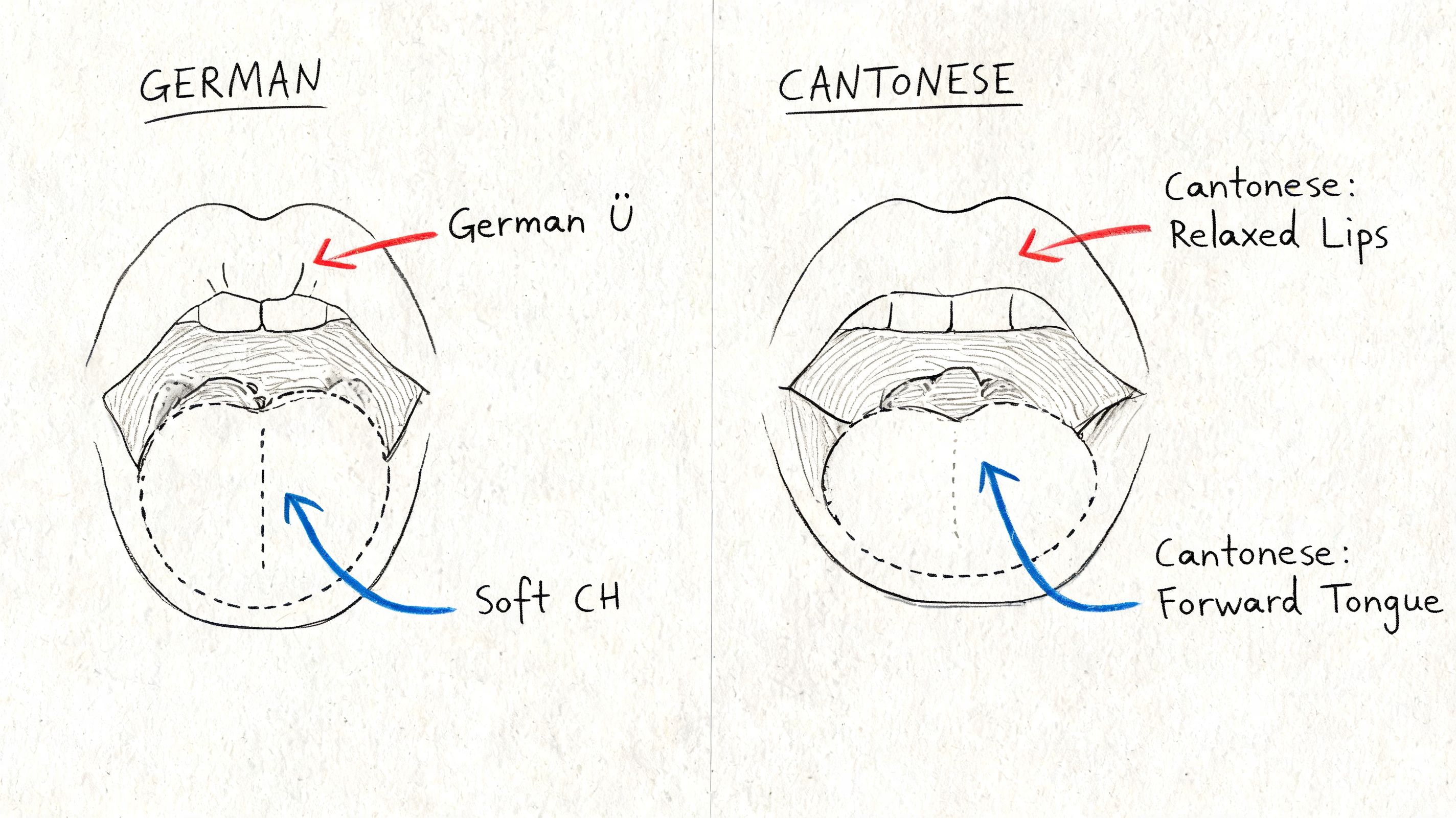
- The German r: It isn’t the English r. In many accents, it comes from the throat. Don’t force a dramatic roll. A light back-of-the-throat sound is enough.
- The ch in ich: This sound doesn’t exist in the same way in Cantonese or English. Keep it soft. Think of air brushing over the middle of the tongue.
- Umlauts ä, ö, ü: These need mouth shapes HK learners often haven’t trained before. Listen first, then copy. Don’t guess from spelling.
When your mouth shape changes, your German changes. Pronunciation isn’t about speaking louder. It’s about placing the sound correctly.
Time greetings need careful vowels
The phrase Guten Morgen often gives beginners trouble. In one HK-focused benchmark, mispronouncing /ˈɡuːtən ˈmɔʁɡən/ was linked to 22% comprehension failure in HK-originated audio tasks, while a structured eight-week approach reported a 94% success rate in smooth transition between time-based greetings. The same verified dataset also notes that over 90% of students ranked in the top 10% of public exams like A-level German (How to Get Fluent reference for this verified benchmark).
A practical drill for busy adults
Record yourself saying:
- Hallo
- Guten Morgen
- Guten Tag
- Guten Abend
Then compare your version with native audio. If you want a tool to turn spoken practice into text so you can inspect your own output, this guide to an effektiver deutscher Transkriptions-Workflow can help you review what your pronunciation is producing.
Greetings for Every Time of Day and Situation
German greetings become easier when you attach them to moments in your real day. Think of your own HK routine. Morning school run, office call, evening event, quick WhatsApp text. Each one suggests a different choice.
Use the clock to choose fast
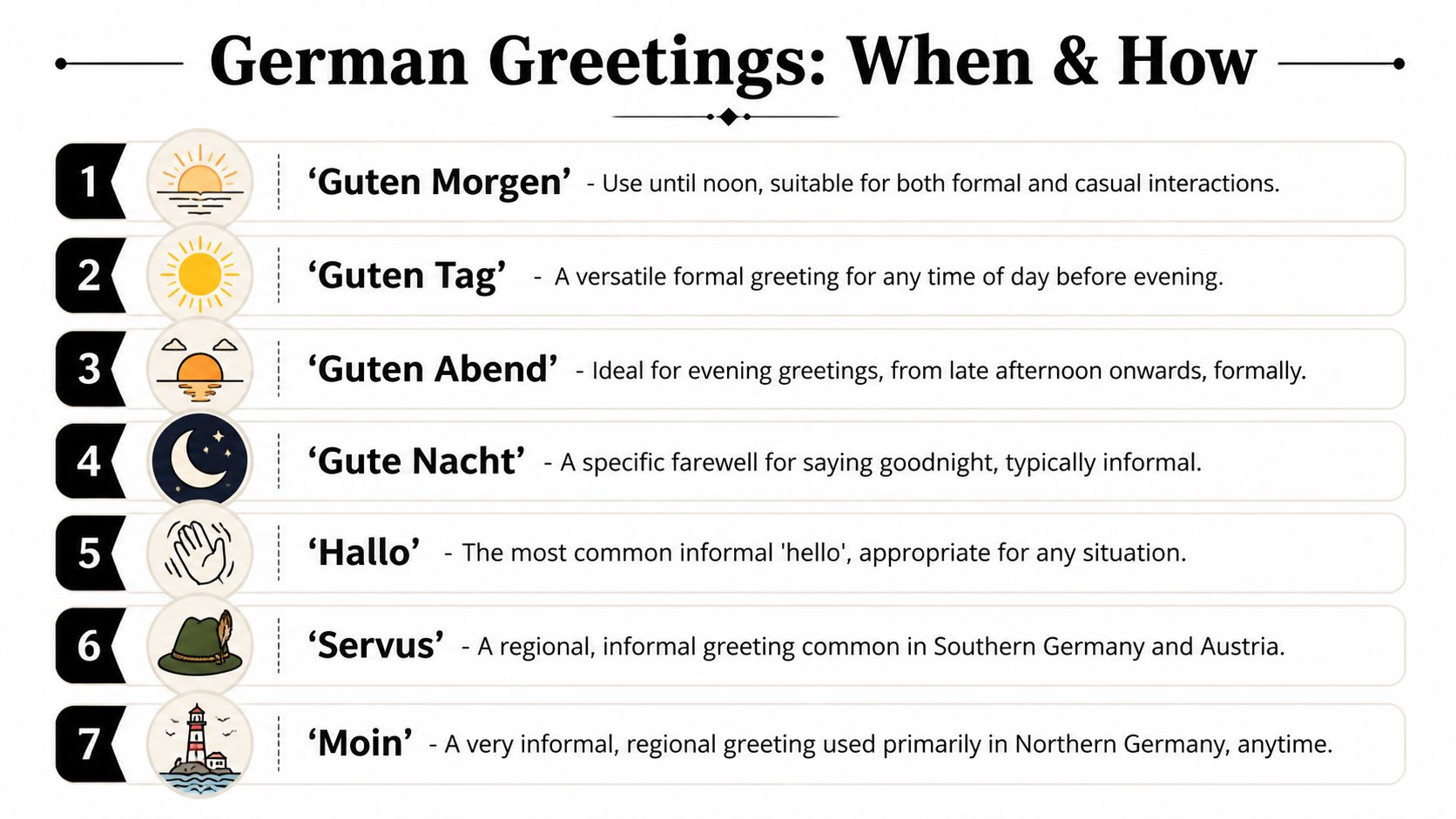
A simple pattern helps:
- Guten Morgen for the morning, up to 12pm
- Guten Tag from then until 6pm
- Guten Abend after that
- Gute Nacht is not a hello. It’s for saying goodnight when someone is going to bed
For parents, time-based greetings are especially useful because children remember routines better than grammar rules. That matters in Hong Kong, where Goethe-Zertifikat registrations surged 42% in 2025, and 90% of parental inquiries on practical conversation for preschool and IGCSE levels were described as unmet online in the same verified context (Lingvist reference for these verified figures).
Real-life mini scenarios
Morning Zoom call with Munich
You join at 8:30am Hong Kong time and the German side is starting their morning too. Say Guten Morgen if the interaction is formal.
Walking into a shop in the afternoon
A polite Guten Tag works well. It’s dependable and natural.
Meeting a friend after dinner
Use Hallo. If you know the person well, you can sound more relaxed.
Phone call
Germans often answer with Hallo? and a slight questioning tone.
Text message
In casual messaging, Hi or Hallo is common. In friendly sign-offs, you may see LG, short for Liebe Grüße.
A greeting that fits the situation sounds more natural than a longer sentence spoken at the wrong level of formality.
Regional words you may hear
Some learners get confused when they travel and hear greetings that aren’t in beginner textbooks.
- Moin is common in northern Germany.
- Servus appears in southern Germany and Austria.
- These are useful to recognise, but beginners don’t need to use them immediately.
Moving Beyond Hello - Your First Conversation
A greeting becomes useful when it leads to a short exchange. At that point, many learners freeze. They know Hallo, but they don’t know what comes next.
Your first formal conversation block
Use this if you’re speaking to a teacher, examiner, receptionist, or business contact:
- Guten Tag.
- Wie geht es Ihnen?
- Gut, danke. Und Ihnen?
- Mein Name ist Chris Chan.
- Freut mich.
This short block is worth learning as one unit, not as five separate phrases. Your brain retrieves it faster that way.
A verified Hong Kong dataset notes a 23% rise in “Learn German HK” search queries from 2020 to 2025, and also states that an 80% attendance certificate system supports mastery of phrases such as Wie geht es Ihnen? in travel and business contexts (Berlitz Singapore blog reference for this verified dataset).
Your first informal conversation block
Use this with a friend, classmate, or child:
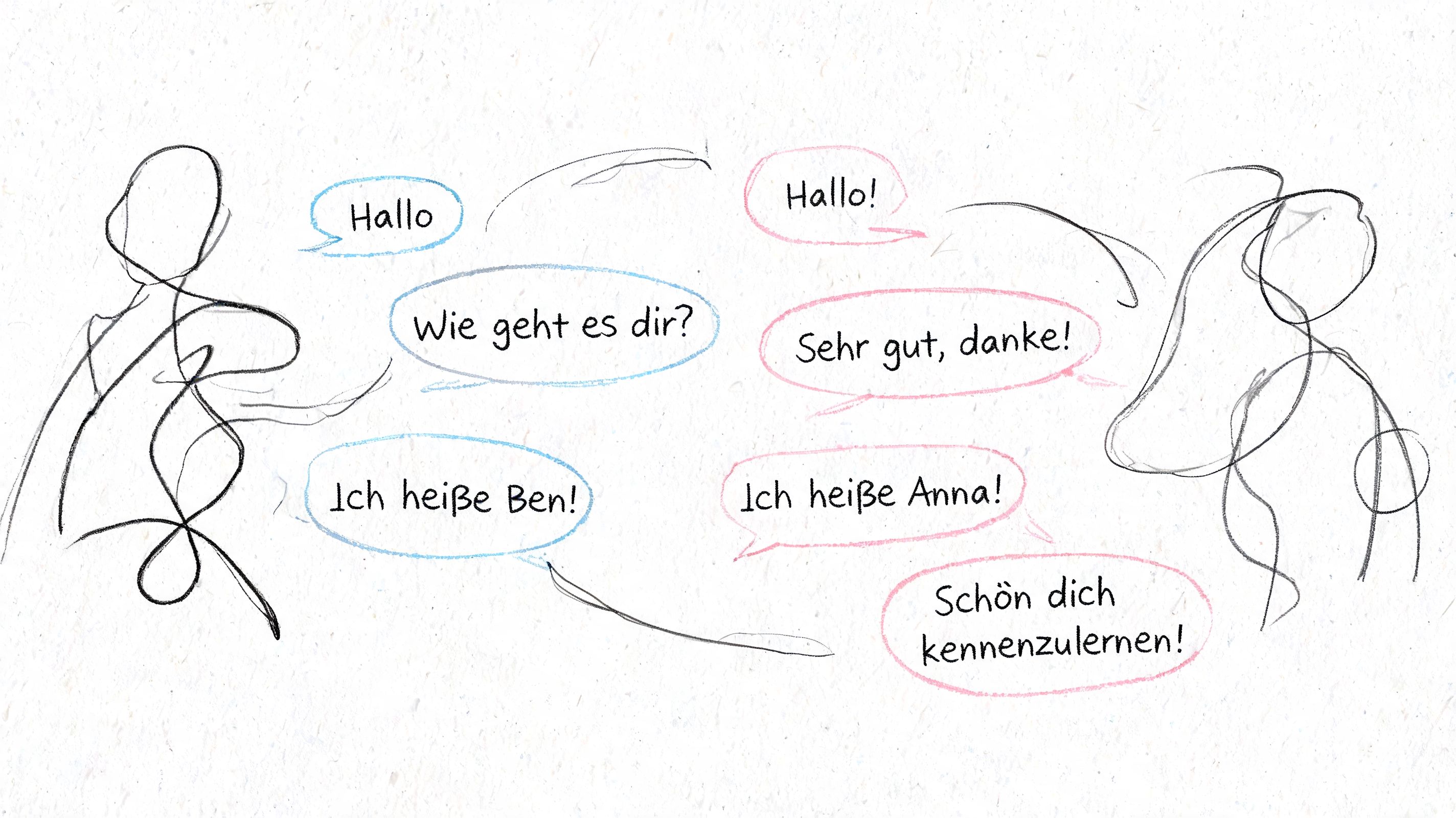
- Hallo
- Wie geht’s?
- Gut, danke. Und dir?
- Ich heiße May.
- Freut mich
Notice the switch. Formal uses Ihnen. Informal uses dir.
A side-by-side example
Formal
Guten Tag. Wie geht es Ihnen?
Gut, danke. Und Ihnen?
Mein Name ist Alex Wong.
Freut mich.
Informal
Hallo. Wie geht’s?
Gut, danke. Und dir?
Ich heiße Alex.
Freut mich.
One mistake to avoid
Don’t mix levels inside one exchange.
For example, Hallo, wie geht es Ihnen? is possible in some contexts, but beginners often produce mixed combinations accidentally. It’s cleaner to keep the whole exchange formal or informal until you understand the social setting well.
If you want to build your beginner vocabulary beyond greetings, this list of German for beginners with 50 essential words to know gives you the next useful layer after your first conversation block.
Hong Kong to Germany - Cultural Do's and Don'ts
Many awkward moments don’t come from grammar. They come from mismatched expectations. That matters in Hong Kong business settings because Germany remains an important partner. In one verified summary, German trade with Germany reached HK$120 billion in 2025, and 68% of local professionals reported awkward initial interactions due to mismatched politeness cues (Migaku reference for these verified figures).
Do this
- Offer a clear greeting first: Don’t wait too long in silence.
- Use direct eye contact: In German-speaking settings, it usually signals attention and confidence.
- Shake hands when appropriate: In formal in-person meetings, a handshake is still common.
- Arrive on time: In practical terms, that means being ready before the meeting starts, not exactly at the minute it begins.
Avoid that
- Don’t over-soften every statement: German communication can sound more direct than what many HK professionals expect.
- Don’t rush into first-name casualness: Let the relationship guide that shift.
- Don’t assume post-COVID habits are identical everywhere: Some people still prefer more distance, but many formal settings keep clear greeting rituals.
- Don’t skip the opening courtesy: Going straight to business can sound abrupt.
German directness usually means efficiency, not hostility.
Why this matters for professionals and parents
For professionals, a greeting is part of your business manner. For students and parents, it shapes oral exam performance and confidence in speaking tasks. The phrase itself is short. The cultural signal behind it is much bigger.
Why Is Formal German Crucial for Success in Hong Kong?
Formal German often decides whether you sound prepared or underprepared. In Hong Kong, that has practical consequences in work, exams, and study plans.
Career and business credibility
If you’re interviewing with a German firm, meeting a trade contact, or joining a regional call, formal German shows judgement. Even when your vocabulary is still basic, Guten Tag and Wie geht es Ihnen? tell people you understand professional boundaries.
That matters for ambitious adults who don’t want to rely on generic app-style German. Formal language is part of business readiness, not an optional extra.
Exam performance and oral control
For teens preparing for IGCSE, IB, A-level, or Goethe speaking tasks, formal German gives structure. It helps learners control register, which examiners notice quickly.
A common beginner problem is knowing the word but choosing the wrong level. That’s why exam preparation should include greetings, self-introduction, and response patterns, not only vocabulary memorisation.
Study abroad and official settings
Students planning to study abroad in Germany will hear formal German in universities, housing offices, immigration settings, and first-time academic meetings. Parents usually spot this quickly. Casual phrases alone don’t prepare a learner for official interactions.
If you’re weighing the long-term benefits, this article on top reasons why Hong Kong professionals should learn German gives a wider view of where formal German fits into career growth.
The practical takeaway
Formal German isn’t difficult because the phrases are long. It’s difficult because learners must judge context correctly. Once you practise that judgement early, your speaking becomes calmer, clearer, and more appropriate.
Ready to Master German Conversation?
The first goal isn’t fluency. It’s control. You want to know when to say Hallo, when to switch to Guten Tag, how to pronounce each phrase clearly, and how to keep the conversation going without freezing.
That’s exactly why structured learning works better than random phrase collecting. A strong beginner needs clear correction, realistic speaking practice, and cultural guidance that fits life in Hong Kong. Parents need something organised. Professionals need something efficient. Teenagers preparing for DSE, IB, IGCSE, A-level, or Goethe-related goals need a system they can trust.
If you’d like extra support before choosing a course, these free resources to learn German in Hong Kong are a useful place to start. They can help you build momentum before your first class or refresh what you’ve already learned.
If you’re ready to move from memorising greetings to using them confidently, German Cultural Association Hong Kong(GCA) offers a practical next step. You can explore native-speaker-led courses for adults, children, and exam learners, check the latest schedule, or contact an advisor about small-group and online options that fit your goals in Hong Kong.
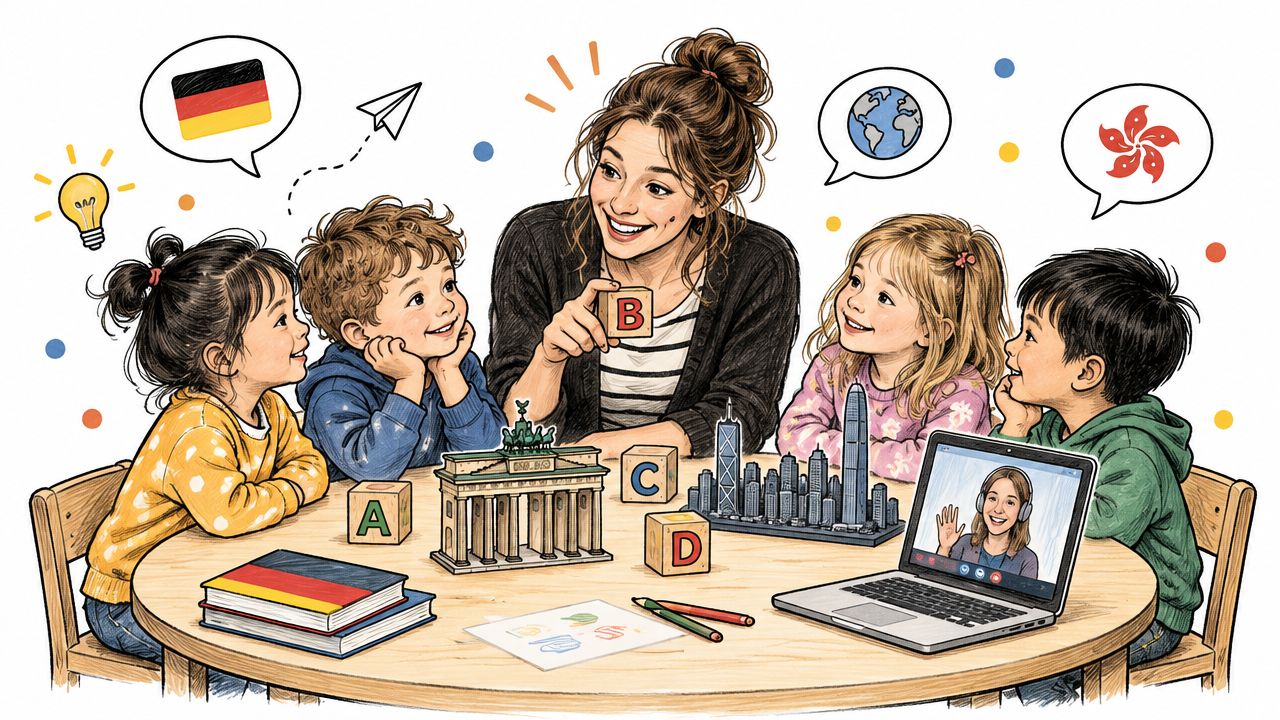
Preschool German Classes 2026/27 (Ages 3-6): Small-Group Intake & Trial Lessons
German Courses for Teens 2026/27: Ages 12-18 New Term Classes & Exam Pathways


