.png)
.png)

BLOG

香港德國文化協會
The German Cultural Association
Dat & Gen for HK Beginners: German Cases Guide
You've learnt der, die, das. You can introduce yourself, order coffee, and write simple messages. Then German suddenly changes shape: dem, den, des. The sentence still uses the same words, but their endings move, and now you're not sure who is doing what to whom.
That's the point where many learners in Hong Kong get stuck. If you speak Cantonese and English, this confusion is normal. Cantonese doesn't mark nouns with case endings, and English only shows a small part of the system in pronouns like he/him or she/her. German does it much more systematically.
If your goal is to pass a Goethe-Zertifikat paper, support your child through IB or IGCSE German, or use German at work in Hong Kong, you can't just “feel” your way through Dat & Gen for HK Beginners. You need a clean mental model. Once you have that, the grammar becomes organised instead of random.
Your Guide to German Dat & Gen for HK Beginners
You finish work in Central, answer a few messages on the MTR, and open your German notes for ten minutes before dinner. The sentence looks simple enough: Ich gebe dem Kunden die Rechnung. Then the next one appears: Wegen des Wetters komme ich später. You know the words, but dem and des make the whole sentence feel less stable.
That reaction is completely normal for learners in Hong Kong. If your strongest languages are Cantonese and English, German case endings can feel strange for two different reasons. English relies heavily on word order. Cantonese relies heavily on context, particles, and fixed phrasing, without changing the noun itself. German often signals meaning on the article and the noun ending, so the sentence carries grammar in places that Cantonese speakers are not used to checking.
Here is the key idea: in German, a noun phrase carries two things at the same time. It carries meaning, and it carries a function. The article often shows that function.
A practical rule is to memorise dem and des as signals that indicate a noun's role.
A Cantonese speaker reading a German sentence word-for-word might still misunderstand the relationships between its elements. For example, in Ich gebe dem Kunden die Rechnung, many beginners understand all four words but hesitate over who receives what. In Cantonese, you would usually depend on the verb pattern and context to sort that out. In German, dem Kunden marks the recipient, while die Rechnung is the thing being given. If you ignore the case signal, the sentence stays blurry even when the vocabulary is easy.
That is why Dat & Gen for HK Beginners should be learnt as a system of roles, not as a bag of forms to cram the night before an exam. If you want a broader foundation first, this beginner-friendly guide to simplified German grammar helps place cases inside the bigger grammar picture.
Why this grammar point often feels heavier for HK learners
Many learners in Hong Kong are fitting German around office hours, school deadlines, or family schedules. They want phrases they can use straight away. That instinct makes sense, especially if your short-term goal is to survive a meeting, help with IB or IGCSE German, or prepare for a Goethe paper.
But Dat and Gen create problems that phrase-memorising cannot solve for long.
Common pain points look like this:
- Reading gets slow: you know the vocabulary, but you cannot quickly tell who is receiving, owning, or being affected.
- Writing sounds unfinished: the message is understandable, yet article endings make it look less accurate in exams or workplace emails.
- Speaking becomes hesitant: you pause at der, den, dem, and des because you are searching for a rule that feels solid.
German works a bit like labelled folders in an office. English often depends on where the folder sits on the desk. Cantonese often depends on the surrounding conversation and familiar patterns. German adds labels to the folder itself. Once you start reading those labels, dative and genitive stop looking random and start looking organised.
For busy professionals and students in Hong Kong, that shift matters. It saves time, reduces careless errors, and makes exam tasks, work emails, and reading passages much easier to control.
What Are the Four German Cases
The four German cases show a noun's function in a sentence. The Nominative marks the subject, the Accusative marks the direct object, the Dative marks the indirect object, and the Genitive shows possession. They are not random endings. They tell you what job each noun is doing.
Think of a sentence as a small stage play. Every noun has a role.
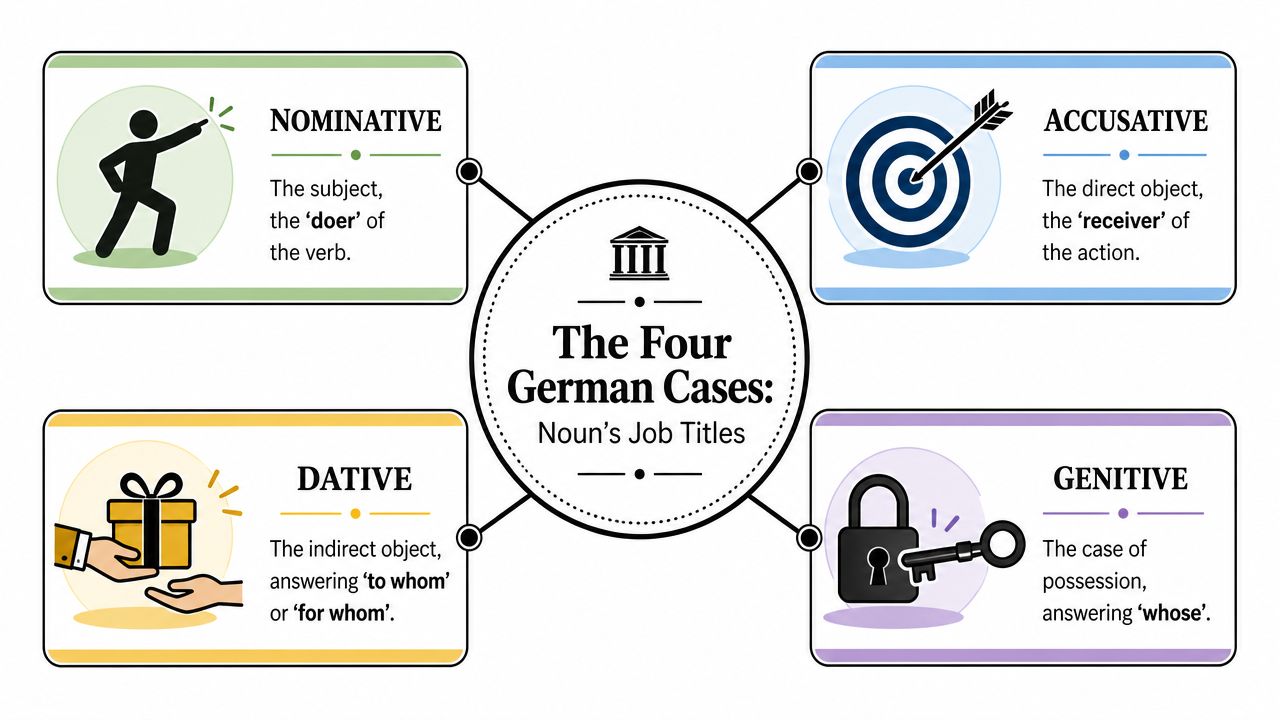
The four jobs at a glance
| Case | Main question | Main function | Example |
|---|---|---|---|
| Nominative | Who is doing it? | Subject | Der Mann arbeitet. |
| Accusative | What is affected? | Direct object | Ich sehe den Mann. |
| Dative | To whom or for whom? | Indirect object | Ich gebe dem Mann das Buch. |
| Genitive | Whose? | Possession | Das ist das Buch des Mannes. |
This is the simplest way to approach German grammar. Don't begin with forms. Begin with function.
A play analogy that works well for Cantonese and English speakers
If German were a play:
- Nominative is the actor doing the action.
- Accusative is the target of the action.
- Dative is the recipient or beneficiary.
- Genitive shows ownership or connection.
For example:
- Der Lehrer gibt dem Schüler das Buch des Direktors.
Here's the cast list:
- Der Lehrer = nominative, the teacher is doing the action
- dem Schüler = dative, the student receives something
- das Buch = accusative, the book is the thing being given
- des Direktors = genitive, the book belongs to the principal
That one sentence contains all four cases. Once you can label each noun's role, the grammar stops looking mysterious.
German cases are not extra decoration. They are a navigation system for meaning.
If you still find articles confusing, this earlier guide on German grammar simplified for beginners is a useful foundation before you drill Dat & Gen for HK Beginners more thoroughly.
Why this overview matters before Dat and Gen
Many learners want to jump directly into dative and genitive because those are the painful ones. I understand that. But dative only makes sense if you already see the difference between direct object and indirect object. Genitive only makes sense if you already recognise possession as a separate relationship.
So before you ask, “Is it dem or des?”, ask:
- Who is doing the action?
- What is directly affected?
- Who receives or benefits?
- Who owns or is connected to what?
That habit saves time in class, in exams, and in real communication.
A Deep Dive into the Dative Case
The dative is the case many learners meet first in practical German. It appears in giving, helping, answering, speaking to someone, going to a place, being at a place, and many common preposition phrases. If you live or work in Hong Kong and want usable German quickly, dative is not optional.
The core meaning of dative
Start with the basic sentence:
- Ich gebe dem Kollegen die Datei.
In English: “I give the colleague the file.”
The file is the thing being given, so it is the direct object. The colleague is the person receiving it, so it is the indirect object. In German, that receiver is usually in the dative.
Ask yourself:
- Who receives something?
- Who benefits from the action?
- To whom is something said, shown, given, explained?
That's the dative zone.
For English speakers in Hong Kong, a useful shortcut is this: if English naturally allows to or for, German often points you toward dative.
Common dative forms you must recognise
Here is a quick reference table for definite and indefinite articles.
| Gender / Number | Definite article | Indefinite article |
|---|---|---|
| Masculine | dem Mann | einem Mann |
| Feminine | der Frau | einer Frau |
| Neuter | dem Kind | einem Kind |
| Plural | den Leuten | no indefinite plural article |
One extra detail matters. In the plural dative, the noun often adds -n if possible:
- mit den Freunden
- bei den Kindern
This small ending causes many avoidable exam errors.
Verbs that often lead to dative
Some verbs regularly introduce a dative object. Learn them as chunks.
helfen + dative
Ich helfe dem Kunden.antworten + dative
Er antwortet der Lehrerin.geben + dative + accusative
Wir geben dem Manager die Unterlagen.danken + dative
Ich danke meiner Kollegin.gefallen + dative
Das Hotel gefällt mir.
Notice the logic. The dative noun is often the person affected in a more indirect way.
If you make literal translations from English, you'll often overuse the accusative. That's one of the patterns behind the mistakes discussed in common German errors Hong Kong students make.
Dative prepositions you should memorise early
Some prepositions take dative consistently. These appear again and again in beginner and lower intermediate German.
mit
Ich fahre mit dem Bus.bei
Ich bin bei der Arbeit.nach
Wir fliegen nach Deutschland.seit
Sie lernt seit einem Jahr Deutsch.von
Das ist eine E-Mail von dem Kunden.zu
Ich gehe zu der Besprechung.aus
Er kommt aus einer grossen Stadt.
For an HK learner, memorising single prepositions isn't enough. Memorise the full pair: preposition + dative.
Don't learn mit. Learn mit + dative. Your brain needs the grammar attached to the word.
A practical way to hear dative in your head
Use the “receiver test”.
Take the sentence:
- Ich erkläre dem Team das Problem.
Now ask:
- Who receives the explanation? dem Team
- What is being explained? das Problem
That gives you the structure immediately.
This works especially well for busy adults because it turns grammar into a quick decision process instead of a long rule sheet.
Unlocking the Genitive Case
The genitive answers one key question: whose? It shows possession, belonging, or close relationship. For many learners, it looks formal, slightly old-fashioned, or distant from everyday speaking. But if you want accurate written German, stronger reading skills, and better exam performance, you need it.
What genitive does
Start with a simple pair:
- das Auto des Arztes
- “the doctor's car”
In English, possession is often shown with ’s. In German, the relationship usually appears through the genitive article plus, for many masculine and neuter nouns, an added ending on the noun.
Examples:
- das Buch des Mannes
- die Tür des Hauses
- der Name der Firma
You'll notice two things:
- The article changes.
- Masculine and neuter nouns often add -s or -es.
That second part is where many beginners panic. Don't. You only need to recognise the pattern first.
The basic genitive article pattern
| Gender / Number | Genitive form |
|---|---|
| Masculine | des |
| Feminine | der |
| Neuter | des |
| Plural | der |
So:
- des Kunden
- der Lehrerin
- des Kindes
- der Eltern
If gender still causes trouble, it helps to review article logic alongside a guide like this explanation of das and German gender for HK learners.
Genitive and spoken German are not the same thing
In casual speech, Germans often replace genitive with von + dative.
Compare:
- das Auto des Lehrers
- das Auto von dem Lehrer
Both can communicate possession. But they do not sound the same. The genitive form is more compact and more standard in formal writing, reading passages, academic language, and many exam contexts.
That's why learners preparing for Goethe-Zertifikat, TestDaF, or study abroad in Germany shouldn't ignore it.
If dative helps you survive daily conversation, genitive helps your German look educated and organised on paper.
A short video explanation can help if you want to hear the forms aloud before drilling them yourself.
Important genitive prepositions
A few prepositions are strongly associated with the genitive, especially in formal or written German.
während
während des Meetingstrotz
trotz des Regenswegen
wegen des Verkehrs
These are useful because they appear in emails, notices, written arguments, and comprehension passages. In Hong Kong, learners often meet them first in textbook reading rather than casual conversation.
A good habit is to store them as complete chunks:
- wegen + genitive
- trotz + genitive
- während + genitive
That keeps the grammar attached to the meaning from the start.
Why Do I Still Need German with AI Translators
This is a fair question in Hong Kong. People here are practical. If an app can translate a message, summarise a webpage, or help with a menu, why spend serious time on Dat & Gen for HK Beginners or any grammar at all?
The answer is simple. AI is useful for low-stakes tasks, but high-stakes situations still depend on your own language control. A content-gap analysis on this topic makes the distinction clearly: AI makes low-stakes reading easier, but that increases the value of real speaking and writing for situations such as oral exams, university interviews, business meetings, and visa applications where precision and confidence matter, as noted in this discussion of decision-stage language content gaps.
Where AI helps
Use translation tools for:
- Quick reading support
- Checking rough meaning
- Drafting simple phrases
- Comparing vocabulary choices
That's sensible, not lazy.
If you work with voice tools regularly, it's also worth learning how speech systems process language. This overview can help you understand ASR models and transcription, especially if you rely on automated captions, meeting notes, or spoken input.
Where AI stops being enough
Now think about the situations that affect your future:
- You need to answer a follow-up question in a university interview.
- You must speak naturally in a Goethe oral exam.
- You're in a business meeting and the other side changes tone or direction.
- You're handling forms, clarifications, or administrative language where one wrong word creates confusion.
In those moments, you can't pause every sentence to ask a tool. You need your own control over structure, tone, and accuracy.
A translator may help you decode wegen des Vertrags on a screen. It won't train you to produce the phrase confidently, at speed, under pressure.
Grammar is part of professional credibility
When you speak or write German yourself, you show more than language knowledge. You show preparation, seriousness, and reliability. That matters when you want to study abroad in Germany, move through formal processes, or work in an international environment.
So yes, use AI. Just don't confuse assistance with ability.
Practical Tips for Hong Kong Learners
You finish a long workday, open your German notes on the MTR, and see this: mit dem Kunden, wegen des Termins, ich helfe dem Kollegen. The vocabulary is manageable. The small word endings are what slow you down.
That reaction is normal for learners in Hong Kong. If you speak Cantonese and English, you already switch between very different grammar systems. Cantonese usually shows meaning through word order, context, and particles. English does this partly through word order and partly through fixed patterns like “to him” or “the manager's report.” German adds another layer. It marks roles directly on articles and sometimes on noun endings. So if you wait for instinct to develop on its own, progress is usually slower. A clear routine works better.
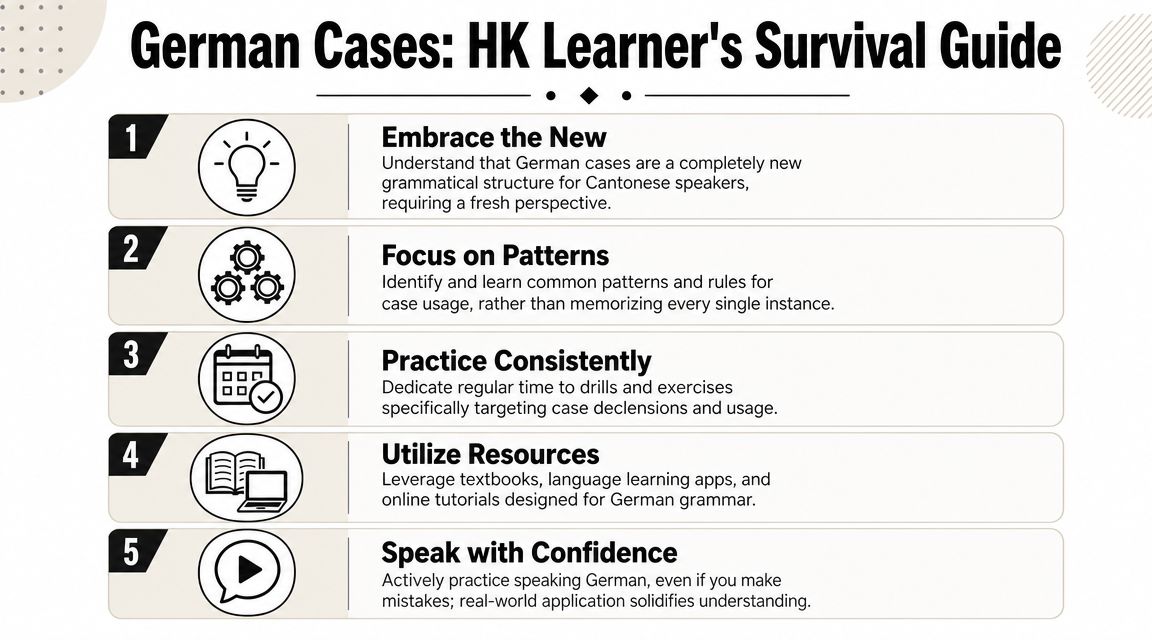
Build your own case-training routine
For Cantonese and English speakers, the most useful habit is to identify the job of each noun before you translate. Treat it like sorting people into roles before a meeting starts. Who is doing the action? Who receives it directly? Who benefits or is affected indirectly? Who owns what?
Try this process:
Label the sentence first
Mark subject, direct object, indirect object, and possession before writing any German.Memorise patterns, not single words
Learn phrases as units.
Example: helfen + Dativ, mit + Dativ, wegen + Genitiv.Use colours consistently
Many adult learners remember forms faster when each case has one colour. For example: nominative black, accusative blue, dative green, genitive red.Say the article out loud with the noun
Do not memorise just Kunde. Learn dem Kunden, des Kunden, mit dem Kunden. This trains your ear as well as your memory.
A short example shows why this helps. In English, “I give the client the document” depends mostly on word order. In Cantonese, context also does a lot of the work. In German, the articles carry part of the meaning: Ich gebe dem Kunden das Dokument. If you label the roles first, the German sentence becomes much easier to build.
Use the strengths you already have
Your background is an advantage if you use it carefully.
English gives you a bridge to some German case logic:
- to him helps you feel the dative idea
- the manager's report helps you feel the genitive idea
Cantonese gives you a different strength. It trains you to notice function from sentence structure and context very quickly. That is useful when you ask, “Who is acting? Who receives? What belongs to whom?”
The key is comparison with limits. German does not behave like English, and it does not behave like Cantonese. But both languages can help you notice the pattern faster.
Make practice fit a busy HK schedule
Busy professionals usually do better with short, repeatable practice than with one long weekly session.
Use methods that fit real life in Hong Kong:
- Five-minute case drills: Take one sentence from work or daily life and rewrite it with a dative phrase or a genitive phrase.
- MTR review: Read short example sentences aloud, especially article plus noun combinations.
- Work-based speaking practice: Use your own topics, such as meetings, schedules, reports, school applications, or client communication.
- Exam-style writing: If you are preparing for DSE, IB, or Goethe exams, keep a small notebook of common case patterns and reuse them in short paragraphs.
Consistency matters more than volume. Ten focused minutes a day often produces better results than one tired two-hour session on Sunday.
If you want more structure, choose a course format that matches your goal and schedule. Small-group lessons help with routine. Private lessons help with correction. Online sessions help with consistency. For learners who want a native-speaker-led path with a structured curriculum and Goethe-Zertifikat support, the German Cultural Association Hong Kong provides this structure.
Ready to Master German for Your Goals in HK
Grammar becomes much easier when it is tied to a real goal. “I want to improve my German” is too vague. “I need German for a university pathway, a visa process, exam readiness, or professional communication in Hong Kong” is much better.
That goal matters because the return on learning German depends on the pathway. A content-gap analysis on local learner intent notes that a specific level such as B1 or B2, often confirmed by a Goethe-Zertifikat, can be a concrete requirement for university routes, visa applications, and roles linked to Hong Kong's service-led international economy. It also argues that a targeted plan works better than a generic one, as explained in this discussion of pathway-based language ROI.
Match grammar work to your actual outcome
Use a simple decision frame:
| Your goal | What Dat and Gen help with |
|---|---|
| Goethe-Zertifikat | Reading accuracy, writing control, oral precision |
| IB, IGCSE, A-level | Grammar marks, sentence variety, formal correctness |
| Study abroad in Germany | Interviews, applications, academic reading |
| Career use in HK | Email clarity, meetings, client communication |
If you know the destination, you can choose the right pace and depth.
What serious learners should look for
When comparing a course or tutor, check whether the learning plan includes:
- Native-speaker correction: Cases need precise feedback.
- Structured progression: Articles, sentence roles, prepositions, and writing should build in sequence.
- Exam alignment: If your goal is formal certification, the course should train for that standard.
- Speaking plus writing: You need both. Dat & Gen for HK Beginners shouldn't stay on worksheets only.
This is especially important in Learn German HK searches, where many people find broad promises but not enough detail about how grammar is taught.
The dative and genitive aren't just textbook chapters. They are part of sounding accurate, capable, and prepared. Once you stop treating them as random article changes, they become a system you can use.
If you want help turning Dat & Gen for HK Beginners into something you can use in exams, interviews, and daily communication, explore the courses at German Cultural Association Hong Kong(GCA). You can check the latest schedule, ask about class formats, or book a trial lesson to find the right starting level for yourself or your child.

German Idioms and Everyday Expressions: 25 Phrases Textbooks Skip—Guide

Präteritum and Futur Compared: A Guide for HK Learners


