.png)
.png)

BLOG

香港德國文化協會
The German Cultural Association
Cost of Studying in Germany 2026: Tuition Guide
Most public universities in 14 of Germany's 16 federal states charge €0 tuition for first degrees in 2026, while Baden-Württemberg charges €1,500 per semester for non-EU students, roughly HK$13,125 per semester. For a Hong Kong applicant, the same German degree can therefore cost HK$0 in tuition or carry a substantial state-level fee, depending on the university's location.
A family in Tsuen Wan may be comparing a non-local university place in Hong Kong with an engineering offer from Germany and asking the wrong first question. “Is Germany tuition-free?” is less useful than “Which state, which university, which programme, and how much cash must leave our account before arrival?”
This Cost of Studying in Germany 2026: Tuition guide gives you the decision-ready view. It separates tuition from semester contributions, blocked-account funding, visa requirements, insurance, accommodation, and other first-year costs that often surprise HK families. I'll also be direct about language preparation, scholarships, part-time work, and the timeline from Hong Kong to a German campus.
Table of Contents
- March starts the document and language work
- April to June is the application window
- July to October turns admission into visa preparation
- November to February completes the move
What Hong Kong Families Pay for a German Degree in 2026
A Hong Kong family comparing a local non-local place with Germany should budget the first year, not repeat the “free university” headline. Public first-degree programmes in 14 of 16 German states generally charge no tuition for non-EU students. Baden-Württemberg charges €1,500 per semester, approximately HK$13,125 using the exchange conversion cited in Hong Kong education coverage. Hong Kong education guidance on German tuition fees explains the public-versus-private distinction.
That headline does not describe the full cash requirement. A family must also prepare the semester contribution, blocked-account proof, visa payment, insurance, accommodation, and funds for the first weeks in Germany. The state and university determine the tuition bill, while immigration requirements determine how much money must be available before departure.
Private universities sit at the expensive end. Hong Kong-focused guidance places typical private tuition around €2,000 to €20,000 per year, approximately HK$17,500 to HK$175,000, depending on the institution and programme. Public bachelor's programmes generally have no tuition, although students still pay a semester contribution.
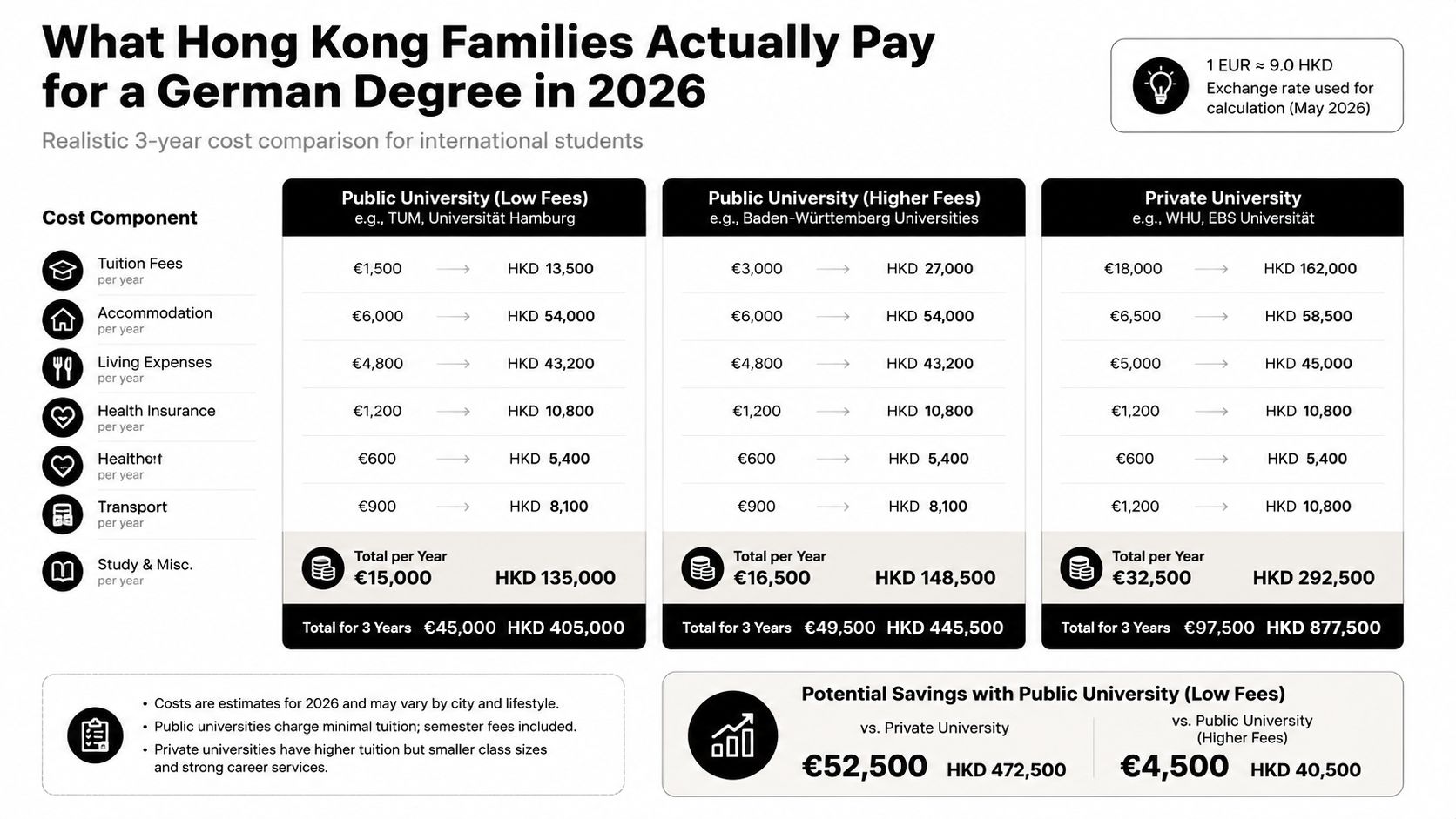
The four variables that change the answer
Check these points before accepting an offer:
- Federal state: Baden-Württemberg charges non-EU tuition, while most other states retain the no-tuition model for first degrees.
- Institution type: Public and private universities use very different fee structures.
- Programme: Some programmes at the Technical University of Munich, or TUM, charge international tuition even though TUM is public.
- Degree status: A consecutive Master's may follow a different rule from a second degree or a programme that is not considered consecutive.
If budget is the main constraint, start with public universities outside Baden-Württemberg and verify the exact programme fee before applying. Do not transfer money based on a general “Germany is free” article. The university's own fee notice controls the actual bill.
A responsible HK budget combines tuition, required contributions, proof of funds, visa costs, insurance, accommodation, and the first weeks of living expenses. That figure, rather than tuition alone, should guide the family's choice.
Which German States Charge Tuition and Which Stay Free
For a first degree, Baden-Württemberg is the principal state-level tuition exception for non-EU students. DAAD guidance confirms a charge of €1,500 per semester for degree programmes in that state, while public universities in the other states generally remain tuition-free. DAAD tuition guidance explains why state selection matters before a Hong Kong student compares individual universities.
The table below gives the practical 2026 position for non-EU applicants. “Tuition-free” means no general tuition charge for the stated category, not zero study costs.
German Federal State Tuition Status for Non-EU Students in 2026
| Federal State | First-Degree Tuition | Consecutive Master Tuition | Second-Degree Master Tuition |
|---|---|---|---|
| Baden-Württemberg | €1,500 per semester | €1,500 per semester | €1,500 per semester, subject to programme rules |
| Bavaria | Tuition-free | Tuition-free | Check university policy |
| Berlin | Tuition-free | Tuition-free | Check university policy |
| Hamburg | Tuition-free | Tuition-free | Check university policy |
| Hesse | Tuition-free | Tuition-free | Check university policy |
| North Rhine-Westphalia | Tuition-free | Tuition-free | May charge €500 to €800 per semester |
| Lower Saxony | Tuition-free | Tuition-free | May charge €500 to €800 per semester |
| Saxony | Tuition-free | Tuition-free | Check university policy |
| Saxony-Anhalt | Tuition-free | Tuition-free | Check university policy |
| Brandenburg | Tuition-free | Tuition-free | Check university policy |
| Bremen | Tuition-free | Tuition-free | May charge €500 to €800 per semester |
| Mecklenburg-Vorpommern | Tuition-free | Tuition-free | Check university policy |
| Schleswig-Holstein | Tuition-free | Tuition-free | Check university policy |
| Thuringia | Tuition-free | Tuition-free | Check university policy |
| Rhineland-Palatinate | Tuition-free | Tuition-free | Check university policy |
| Saarland | Tuition-free | Tuition-free | Check university policy |
Bavaria deserves a specific warning because families often remember earlier discussions about possible tuition. The general first-degree position remains tuition-free at public universities, but TUM is a separate programme-level exception, with international fees reported at €2,000 to €6,000 per semester, depending on the programme. The 2026 tuition tracker gives the broader state and university distinction.
Practical rule: Treat “consecutive Master's” and “second-degree Master's” as different categories. Ask the admissions office to confirm your status in writing before you calculate the budget.
Semester Contributions You Still Have to Budget For
A tuition-free programme still carries a compulsory Semesterbeitrag, or semester contribution. For 2026 planning, budget broadly €100 to €400 per semester. Universities in cities such as Berlin, Hamburg, and Cologne often sit towards the upper end. Study in Germany guidance on semester contribution costs explains why this payment is separate from tuition.
The bill normally combines three parts:
- Administration: Enrolment, student records, campus administration, and related services.
- Student services: Welfare and student-body contributions supporting campus activities and assistance.
- Transport: A semester ticket or regional transport entitlement, if the university or local system includes one.
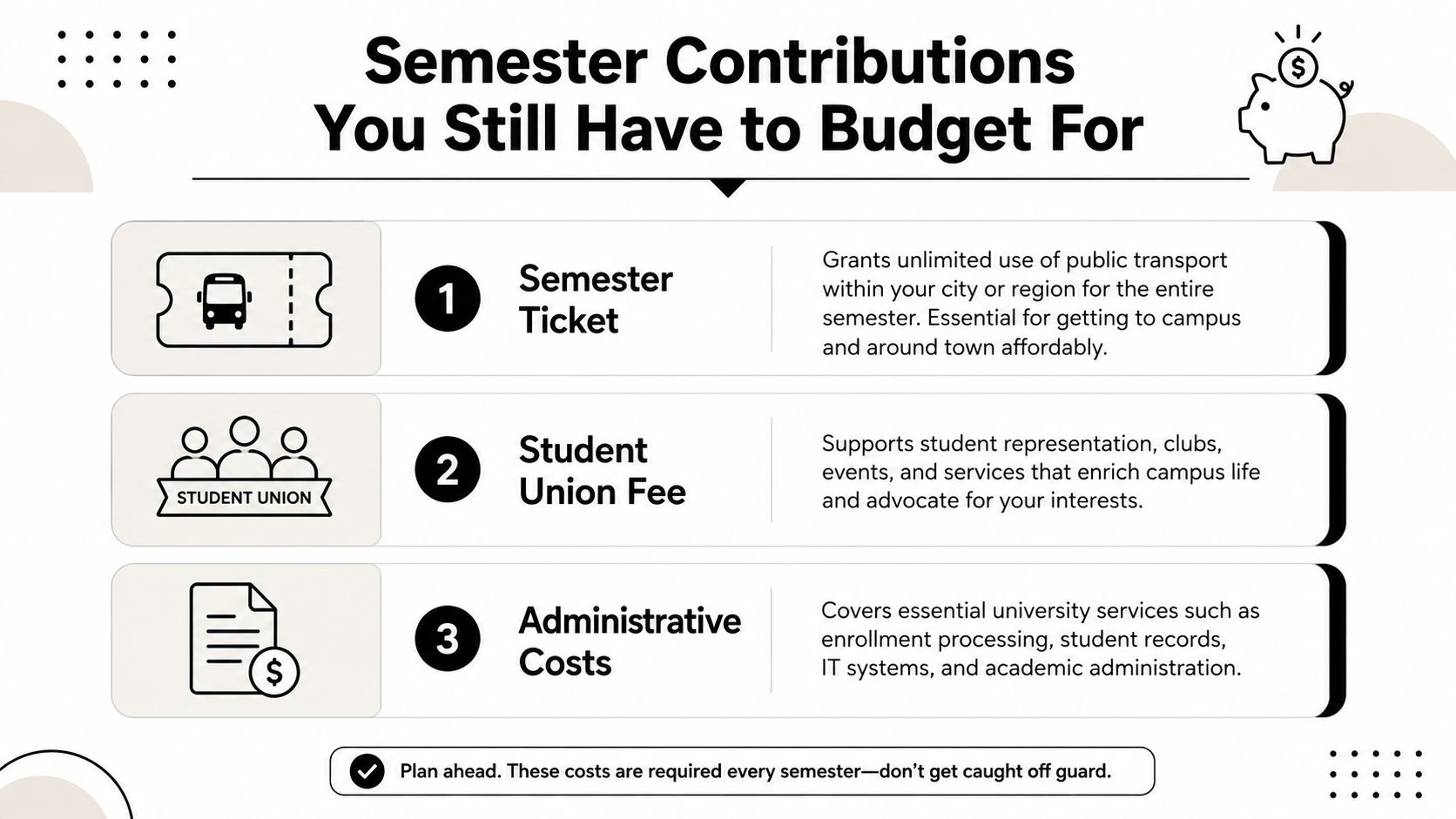
Why the payment matters in Hong Kong budgets
Hong Kong families should treat this as a required enrolment payment, not a minor administrative extra. The student normally needs to pay it before completing enrolment, receiving student documentation, and activating the services attached to the semester.
Goethe-Institut Hong Kong's public-university guidance gives an administrative-fee benchmark of about €100 to €200 per semester, often with a low-cost regional transport ticket and cafeteria access. The exact amount depends on the university and city.
Build the figure into your cash-flow plan this way:
- Check the university's current Semesterbeitrag notice.
- Separate the transport component from administration and student services.
- Confirm whether the ticket covers local transport or a wider region.
- Check the semester start and ticket activation dates.
The practical conclusion is simple: zero tuition does not mean zero university payment. Add this predictable charge before comparing offers. It is easier to plan than rent, flights, or last-minute travel, and it belongs in the first-year budget alongside visa and living-cost requirements.
Public vs Private Universities and Where TUM Fits
Hong Kong applicants should place universities on one cost spectrum before judging value. At one end are public first degrees in most German states, where tuition is generally €0. Baden-Württemberg sits above that with €1,500 per semester for non-EU students, while selected TUM programmes can charge €2,000 to €6,000 per semester. The German Cultural Association's Germany study guide highlights the state, university, and non-tuition differences behind the “free” headline.
Private universities occupy a different market. Hong Kong-facing guidance places private tuition around €2,000 to €20,000 per year, while independent programme guides also describe private tuition as potentially reaching higher levels depending on the course. Don't compare a private English-taught business degree with a public German-language engineering degree as if they were interchangeable products.
Tuition Spectrum for Hong Kong Applicants in 2026
| Institution Type | Programme Examples | Annual Tuition (EUR) | Language |
|---|---|---|---|
| Public university outside Baden-Württemberg | First degree and many consecutive Master's programmes | €0, excluding semester contribution | German or English, programme-specific |
| Public university in Baden-Württemberg | Non-EU first degree or Master's | €3,000, based on €1,500 per semester | German or English, programme-specific |
| TUM selected programmes | International programmes with university-level tuition | €4,000 to €12,000, based on €2,000 to €6,000 per semester | Often English, programme-specific |
| Private university | Business, management, specialist and English-taught programmes | €2,000 to €20,000 or more | Often English, programme-specific |
The decision rule is direct:
- Choose public when budget is the binding constraint and you can meet the academic and language requirements.
- Choose private only when the programme gives you a specific academic, career, language, or scheduling advantage that the public route doesn't offer.
Check for costs beyond the published tuition. Application processing, language modules, examination resits, and compulsory programme services can change the figure. Ask for a written fee schedule, not a verbal estimate from a recruitment agent.
Non-Tuition Costs That Decide Your First-Year Cash Flow
The largest financial misunderstanding is treating tuition as the whole budget. For visa purposes, Hong Kong applicants need to show financial capacity for living costs, and the current blocked-account benchmark is €992 per month, or €11,904 for a 12-month visa year. Blocked-account guidance for 2026 applicants identifies this as the key proof-of-funds figure.
The German consular guidance for Hong Kong also lists a €75 student visa fee, payable in cash in Hong Kong dollars, while Hong Kong education coverage cites €10,236 per year, approximately HK$90,000, as a German living-expense reference. German Consulate General Hong Kong visa information explains the visa fee and financial framework.
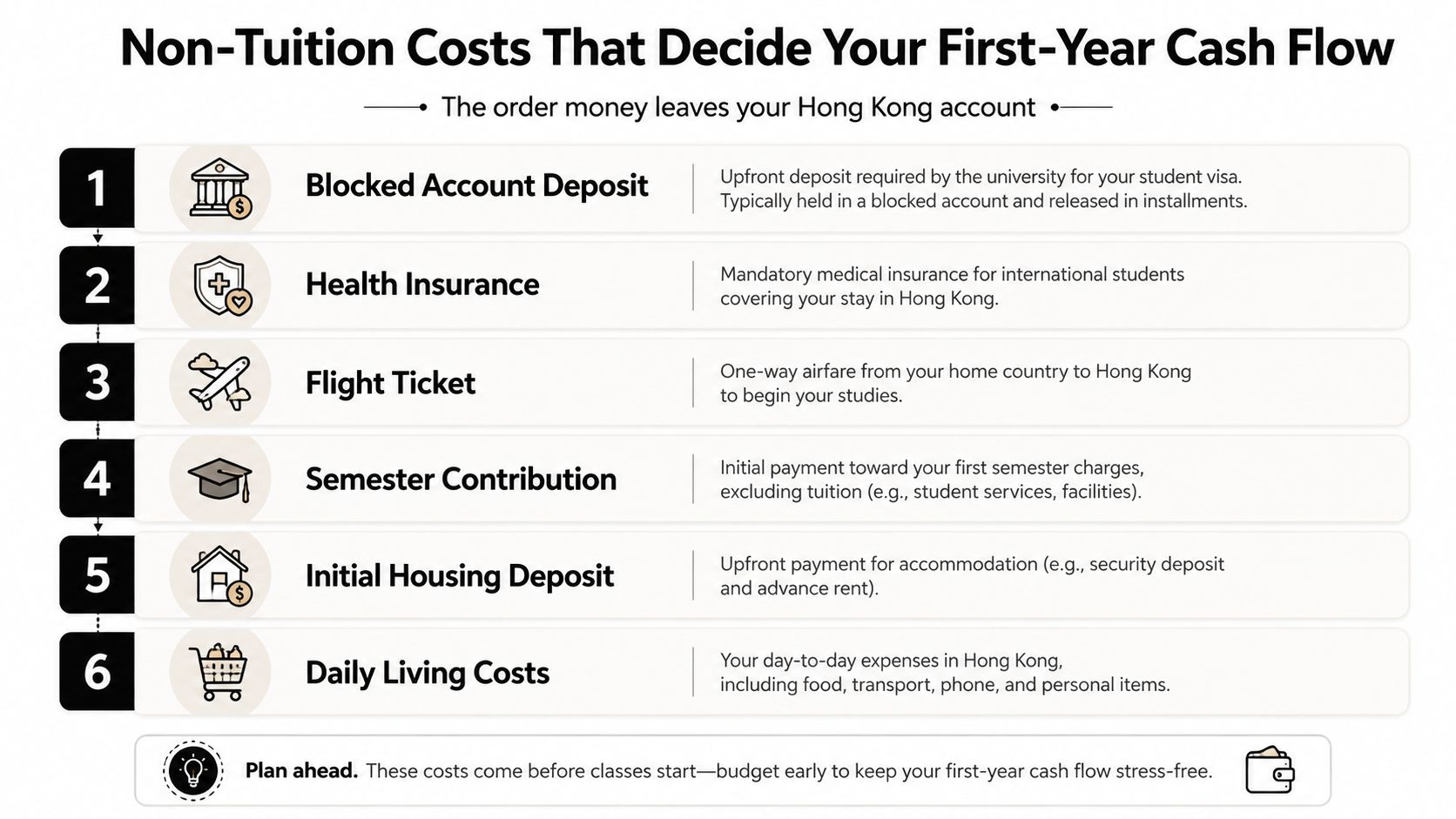
Money leaves your Hong Kong account in stages
Plan the first-year cash flow in this order:
- Blocked account: Transfer €11,904, based on €992 multiplied by 12 months, before the visa process is completed.
- Visa payment: Pay the €75 student visa fee in HKD at the consular appointment.
- Semester contribution: Reserve the university's compulsory contribution before enrolment.
- Insurance: Arrange compliant health insurance before or during enrolment.
- Housing: Prepare for rent, deposits, and temporary accommodation if a permanent room isn't available.
- Daily life: Fund food, transport, phone service, study materials, and personal expenses.
Use practical city budgeting rather than assuming every German city costs the same. Berlin-specific saving ideas can help families understand daily spending choices, and these St Christopher's Inns budget Berlin tips offer useful context for controlling everyday expenditure.
The Germany student visa and blocked-account guide is useful when you're checking the sequence of proof-of-funds and visa documents.
Tuition may be zero, but the first payment can still be substantial because the visa system asks you to prove that you can support yourself before you arrive.
Parents should also ask the blocked-account provider when confirmation documents will be issued and how monthly releases work. Delays, insurance timing, and housing deposits can create short-term pressure even when the annual plan looks manageable.
Why Your Language Certificate Changes the Tuition Equation
A Goethe-Zertifikat or TestDaF result is a cost-control decision, not merely an admission checkbox. German-language eligibility can widen your choice of public programmes, while a student who cannot meet the language requirement may need a different programme, additional preparation, or a private English-taught route.
The strongest approach is to decide the language route before you shortlist universities. Use the official programme requirements to determine whether you need German, English, or both, then plan your exam attempt around the application deadline. The German exams guide comparing Goethe-Zertifikat and TestDaF can help Hong Kong applicants understand the difference between the examinations.
Spend on preparation before you spend on tuition
A serious learner should budget for structured preparation, not just an exam booking. Native-speaking instruction, timed writing practice, speaking feedback, and mock examinations are particularly valuable when the certificate determines whether you can apply for a lower-tuition programme.
In Hong Kong, options include small-group classes, private tuition, and exam-focused programmes. The German Cultural Association Hong Kong(GCA)offers structured German courses and preparation for Goethe-Zertifikat and TestDaF, alongside pathways for IGCSE, A-level, and IB learners. That makes it relevant to both school-age applicants and working professionals planning a future degree or German visa.
Don't assume a short language course will solve an academic entry requirement. German university study demands sustained reading, writing, listening, and seminar participation, so your preparation plan should match the level and assessment format required by the target programme.
Scholarships and Part-Time Work That Soften the Bill
Funding should be ranked by what it can realistically change. Start with scholarships that contribute to living costs, then assess part-time work only after confirming that your study schedule and visa conditions allow it.
The Deutschlandstipendium provides €300 per month, and it is available to high-achieving students regardless of nationality. Official Deutschlandstipendium information is the right place to check eligibility and university-specific application procedures.
DAAD funding is more targeted. Relevant opportunities can include programme-specific awards, STIBET support, and country-specific options, but availability and eligibility vary. Apply early through the relevant DAAD or university portal instead of assuming that an award will arrive after enrolment.
Compare the main funding levers
| Funding Lever | Typical Value 2026 | Realistic for HK Applicants? |
|---|---|---|
| Deutschlandstipendium | €300 per month | Yes, but competitive and university-dependent |
| DAAD programmes | Varies by award | Yes, if the applicant matches the programme |
| Private foundations | Varies by foundation | Possible, often nomination-sensitive |
| Part-time employment | Depends on hours and wage | Possible, but never rely on it for visa proof |
| CEF funding | Not available for Germany under the approved destination rules | No for this destination |
Some private foundations, including the Studienstiftung and Konrad-Adenauer-Stiftung, may involve nomination, academic fit, or subject priorities. They aren't automatic discounts, so prepare a strong academic profile and check the award's eligibility before investing time.
Non-EU students may work within the applicable student rules, including up to 140 full days per year. The German Missions in the United States student guidance covers the general employment framework, but Hong Kong applicants should confirm the current wording with the German Consulate General Hong Kong.
HK's CEF funding doesn't cover Germany because Germany isn't on the approved destination list. Private education loans may be worth exploring with banks such as HSBC or Bank of China, but ask specifically whether the lender can disburse funds for a German blocked account.
My ranking is clear: first, secure the language qualification that opens the right programmes; second, apply for scholarships early; third, use part-time work to support living costs after arrival. Never treat employment income as a substitute for the blocked-account requirement.
Your 12-Month Timeline From Hong Kong to German Campus
A Germany plan becomes manageable when every month has one defined financial or admissions task. The dates below are a working sequence for an applicant preparing from Hong Kong, but each university's deadline and document rule still takes priority.
March starts the document and language work
Begin with the APS certificate application if it applies to your academic background and target route. APS processing can take 6 to 8 weeks, so waiting until admission results arrive can put the visa timetable under unnecessary pressure.
Book your first TestDaF or Goethe-Zertifikat sitting at an appropriate level. Don't choose an exam date only because it is convenient. Choose one that leaves time for a retake before the university application or visa document deadline.
April to June is the application window
Use April through June to prepare and submit applications through the university's required route, including uni-assist where applicable. Keep scanned copies of your passport, academic transcripts, certificates, language results, motivation documents, and APS correspondence in one organised folder.
Scholarship applications should run in parallel. DAAD and university portals can have their own deadlines, so don't wait for an admission offer before checking funding opportunities.
For document organisation, the Germany study timeline and document guide provides a useful checklist structure.
July to October turns admission into visa preparation
If your language result isn't ready or doesn't meet the requirement, July is the point to use a retake opportunity where the examination calendar allows. Once you have an offer, verify the exact tuition status, semester contribution, and enrolment conditions directly with the university.
August is the blocked-account month for many applicants. Open a Sperrkonto with a recognised provider such as Expatrio, Fintiba, or Coracle, transfer the required €11,904, and wait for the confirmation PDF before the visa appointment.
September and October are suitable working targets for the German Consulate General Hong Kong appointment, depending on availability and your programme's start date. Prepare the admission letter, APS certificate where required, language certificate, blocked-account confirmation, passport, and other requested documents. The visa fee is €75, paid in HKD at the consulate according to Hong Kong consular guidance.
November to February completes the move
Arrange statutory student health insurance and begin the housing search through Studierendenwerk, university channels, and reputable accommodation providers. Housing is often the slowest practical step, so keep temporary accommodation as a contingency rather than assuming a room will be ready on arrival.
Pay the semester contribution once the university gives you the payment instructions. Confirm enrolment, travel arrangements, arrival registration, and orientation dates before leaving Hong Kong.
Once the academic plan is secure, some students also prepare a small cultural item for graduation or university events, such as this commemorative German flag stole. It isn't part of the study budget, but it can mark the connection between a Hong Kong application journey and the German campus experience.
Use this checklist before your visa appointment:
- Academic documents: Admission letter, transcripts, certificates, and any required APS documentation.
- Language evidence: The certificate specified by your chosen programme.
- Financial evidence: Blocked-account confirmation and any additional funding documents.
- Insurance proof: Coverage arranged in line with enrolment and visa requirements.
- Cash-flow reserve: Funds for housing, transport, food, and the period before the first blocked-account release.
The right answer to “Is Germany free?” is therefore precise. Tuition may be zero at a public university, but your first-year financial plan still needs to be complete before you fly.
German Cultural Association Hong Kong(GCA)offers small-group and one-to-one German lessons Hong Kong with native German-speaking teachers, structured curriculum, and preparation for Goethe-Zertifikat, TestDaF, IGCSE, A-level, and IB. If you're planning to Learn German HK for university admission or visa preparation, visit German Cultural Association Hong Kong(GCA) to review the course options and contact the advisers.

German Verb Tenses Overview: Präsens Made Simple

German Passive Voice (Passiv): Formation Guide


