.png)
.png)

BLOG

香港德國文化協會
The German Cultural Association
Zero to Goethe-Zertifikat A2: Realistic Timeline for Busy HKers
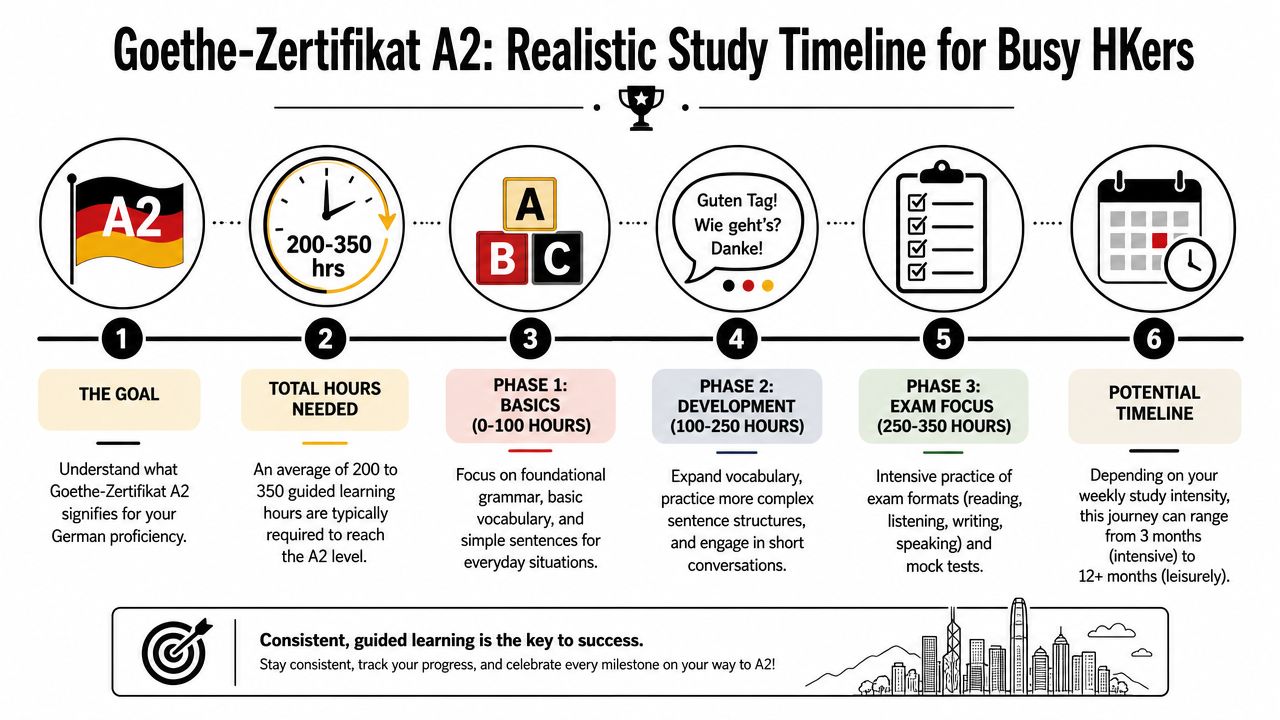
For a busy Hong Kong learner, Goethe-Zertifikat A2 usually takes 6 to 9 months on an intensive schedule or 12 to 18 months on a standard pace, and you should expect 200 to 350 guided learning hours to get there. If you're trying to fit German around office deadlines, school runs, and MTR commutes, that's the only realistic way to plan it.
You might be working in Central, getting home late, and still thinking about a visa, a university application, or a move to Germany. Or you're a parent in the New Territories trying to add German to a family calendar already filled with DSE, IB, or IGCSE commitments. Either way, the usual internet advice is too generic for life in HK.
Zero to Goethe-Zertifikat A2: Realistic Timeline for Busy HKers isn't about fantasy study plans. It's about what you can finish when your week is already full, your energy drops after work, and exam timing in Hong Kong can slow you down if you don't plan early.
Table of Contents
- The direct answer
- What A2 means in practice
- The Hong Kong factor that changes the timeline
- The planning mistake to avoid
- Plan around the HK exam calendar
- What to do on exam preparation weeks
- Exam day advice that actually helps
- If you need A2 for study abroad or visas
- If you're studying for work
- If you're planning for your child
Your Goal From Zero to Goethe-Zertifikat A2
It's 8:10 pm. You've just got home from Central, answered one last work message on the MTR, and now you're wondering whether German is still realistic. In Hong Kong, that is the real question. Not whether you're motivated for one good week, but whether your plan can survive late meetings, long commutes, and packed family schedules.
A2 is the first German level that gives you practical use. You can handle simple everyday conversations, ask and answer routine questions, read short messages, and deal with basic situations without freezing. For a busy Hong Kong learner, that is the point where German stops being a vague interest and becomes a usable skill with a recognised target.
The goal also needs to be concrete. A finance professional aiming for a Germany application deadline does not need random vocabulary growth. A parent returning to study after years away does not need a feel-good app streak. You need a result: pass Goethe-Zertifikat A2 on a timeline that fits Hong Kong life.
Why A2 is the right first serious target
A2 is a strong first milestone because it is demanding enough to count and realistic enough to plan for. It gives structure to your study. It also forces you to train all four papers properly: reading, listening, writing, and speaking.
That changes how you should study.
If your current plan is “do a bit whenever possible,” expect slow progress and repeated restarts. Busy adults do better with fixed study blocks, a defined syllabus, and a clear exam target. If your week is already crowded, use tools and systems that boost productivity with timeblocking, then protect those slots like meetings.
One more point. This guide is built for Hong Kong, not for a generic learner with endless free evenings. Your workday may end late. Your class location matters if you live in the New Territories and work on Hong Kong Island. Your exam date can become the bottleneck if you leave booking too late. A workable A2 plan has to account for all three.
What a realistic HK goal looks like
Set a goal that matches your life, not your best intentions.
That means:
- Plan around energy, not wishful thinking. Put lighter tasks on work nights and heavier study on weekends.
- Reduce travel friction. If attending class takes too much cross-harbour time, your consistency will drop.
- Treat the exam as part of the project. Lessons alone are not the goal. Passing on schedule is the goal.
- Expect interruptions. Audit season, school events, and business travel will happen. Build a plan that can absorb them.
The common mistake is overcommitting in month one and disappearing by month two. The better approach is blunt and boring. Choose a pace you can repeat for months. In Hong Kong, discipline beats intensity every time.
How Long Does It Really Take to Reach A2 in Hong Kong
Leave the office in Central at 7:15 pm, spend 40 minutes on the MTR, eat late, and open your German book at 10:00 pm. That is the Hong Kong version of language learning. Your timeline has to fit that reality.
For most busy adults in Hong Kong, zero to Goethe-Zertifikat A2 takes about 6 to 18 months. The shorter end suits learners who can protect around 8 study hours a week. The longer end suits people managing long workdays, family duties, and inconsistent energy after commuting.
That is the planning range worth using.
The direct answer
Use one of these two timelines and ignore the rest.
Standard pace
- Around 4 hours per week
- Best for working adults and parents
- Realistic duration: 12 to 18 months
Intensive pace
- Around 8 hours per week
- Best for learners with a firm deadline and protected weekend study time
- Realistic duration: 6 to 9 months
- Use live classes as anchors: Fixed sessions protect your progress.
- Reduce unnecessary travel: Mixing Zoom and in-person study helps on weeks when the MTR commute would kill your consistency.
- Keep weekday tasks short: Vocabulary review, listening, and sentence building work better in compact slots.
- You have a deadline: Visa, study abroad in Germany, or work relocation.
- You can protect weekends: Without that, the hours won't add up.
- You won't disappear after a hard week: Intensive study fails when attendance becomes optional.
Monday evening
- Grammar focus: Work on sentence order and one tense point only.
- Keep it tight. Don't try to cover an entire chapter after a long workday.
Tuesday commute or lunch break
- Vocabulary review: Use flashcards for core daily-life words.
- Your target is steady growth toward the required vocabulary base, not random word collection.
Wednesday evening class
- Speaking and listening: Attend your guided lesson and participate actively.
- Attendance matters because consistency is what keeps the language connected.
Friday short session
- Perfekt practice: Write and say short past-tense sentences about your week.
- Many learners often lag in this area.
Saturday
- Longer block: Reading, listening, then one short writing task.
- Mimic exam-style switching between skills.
Sunday
- Review day: Correct mistakes, revisit weak vocabulary, and practise spoken responses aloud.
School-run gap
- Use a short morning block for vocabulary and reading.
- Mental freshness is often better here than late at night.
One fixed class each week
- Make this a priority.
- It keeps your speaking active and stops drift.
Two short home sessions
- Focus one on grammar, one on listening.
- Small, repeatable blocks are more reliable than one giant study session.
Weekend family-proof slot
- Reserve one block before activities begin.
- Use it for writing and mock questions.
- Grammar priority: Basic sentence patterns, questions, common verbs, and Perfekt.
- Vocabulary priority: Daily life, travel, family, work, shopping, and appointments.
- Listening priority: Short, clear recordings first. Then exam-style tasks.
- Writing priority: Short functional messages, not essays.
- Speaking priority: Introductions, requests, plans, descriptions, and simple past experiences.
Check the Hong Kong exam calendar early
- Don't wait until you feel “almost ready”.
- Use the latest Goethe-Zertifikat exam dates in Hong Kong to map your target month.
Count backwards from the exam date
- Build your study plan in reverse.
- Add extra revision weeks rather than assuming perfect progress.
Leave room for a scheduling buffer
- If your preferred session fills or your study pace slips, you need flexibility.
- Reading drills: Short texts, notices, and basic comprehension tasks.
- Listening drills: Timed practice with clear answer discipline.
- Speaking drills: Partner practice on personal topics and routine situations.
- Writing drills: Message writing under tight word control.
- Arrive with a routine: Same pen, same ID check habit, same timing awareness.
- Read the task before your nerves rise: Especially in writing.
- Speak plainly: A2 rewards clarity more than ambition.
- Don't overcomplicate grammar: A correct simple sentence beats a broken complex one.
In Hong Kong, the gap between those two tracks is not motivation. It is schedule control. If your evenings keep getting swallowed by overtime, cross-harbour travel, or school logistics, you are on the standard track whether you like it or not.
A2 does not require perfect fluency. It requires steady coverage of the syllabus and enough repetition to perform under exam conditions.
What A2 means in practice
At A2, you should be able to handle simple daily situations in German. That includes understanding familiar topics, reading short texts, writing basic messages, following slow and clear speech, and taking part in straightforward conversations.
The exam is broader than many beginners expect. You need to show usable skills in reading, listening, writing, and speaking, not just recognise words from an app. If your study plan only gives you passive exposure, your timeline will stretch because you will need extra months to fix weak areas later.
Use structured materials early. A random mix of videos, flashcards, and occasional worksheets feels productive but often creates gaps. If you want low-cost support between classes, these free resources to learn German in Hong Kong can help you build review into dead time on the MTR or during lunch.
The Hong Kong factor that changes the timeline
A generic A2 estimate assumes free evenings and simple logistics. Hong Kong rarely gives you either.
Late finishes matter. So does travel time to class. So does exam scheduling. A learner in Tseung Kwan O working on Hong Kong Island has a different study load from someone who works near the school and gets home by 6:30 pm. On paper, both may aim for 6 months. In real life, one of them will miss classes, study while exhausted, and need a longer runway.
Plan by weekly consistency, not by ambition.
A good rule is simple. If you can complete your study blocks for eight straight weeks without scrambling, your timeline is realistic. If you miss sessions every other week, extend the plan now instead of pretending you will catch up later. The same discipline used in strategies for Access to HE Diplomas applies here. Fixed study blocks beat bursts of effort.
The planning mistake to avoid
Do not ask for the fastest route. Ask for the fastest route you can repeat for months.
Busy Hong Kong learners lose time in one predictable way. They choose an aggressive timeline, fall behind after a few heavy work weeks, then restart from the same chapter again. A slower schedule with fewer resets gets you to A2 sooner than an unrealistic sprint.
Choosing Your Study Path Structured Timelines for Busy Schedules
The right study path depends less on ambition and more on your real weekday bandwidth. In Hong Kong, that's where many plans fail.
Neutral data from the Hong Kong Census and Statistics Department indicates that 68% of HK working adults report less than 1.5 hours of discretionary time daily, which is why a zero-to-A2 timeline of 6 to 8 months is more realistic for many local learners than the usual global “3-month” fantasy. If your weekdays are fragmented, you need a plan built around limited daily energy, not ideal conditions.
A side by side decision table
| Study Track | Weekly Commitment | Total Duration | Best For |
|---|---|---|---|
| Intensive Track | 8 hours | 6 to 9 months | Learners with a fixed deadline, lighter family commitments, or room for regular weekend study |
| Standard Track | 4 hours | 12 to 18 months | Working professionals, parents, and adults who need steady progress without burnout |
| Hybrid Busy-Person Track | Short weekday sessions plus one anchored class routine | Realistic for HK learners with tight weekday discretionary time | Commuters, shift workers, and parents managing changing weekly demands |
The table looks simple because the decision should be simple. If your current life doesn't support heavy weekly study, don't force the intensive track.
How HK life changes the right choice
A learner in Europe may have easier exam access and less travel friction. In Hong Kong, you're often dealing with crowded evenings, long cross-district commutes, and narrow study windows between work and home duties.
That's why a hybrid format usually makes the most sense:
If you struggle to protect study time, use a proper calendar method instead of relying on willpower. A practical guide on how to boost productivity with timeblocking is useful here because language study improves when each task has a place in your week.
Which track I'd recommend
For most adults in HK, I'd recommend the standard track with disciplined weekly structure. It's slower, but it survives contact with real life.
Choose intensive only if all three conditions are true:
Skip the heroic plan. Choose the one you can still follow during quarter-end, school exams, and a bad commuting week.
If your routine changes often, build around minimum viable progress. One anchored class, short weekday review, and deliberate weekend speaking practice will beat a perfect schedule you never keep.
A Sample Weekly Study Plan That Actually Works
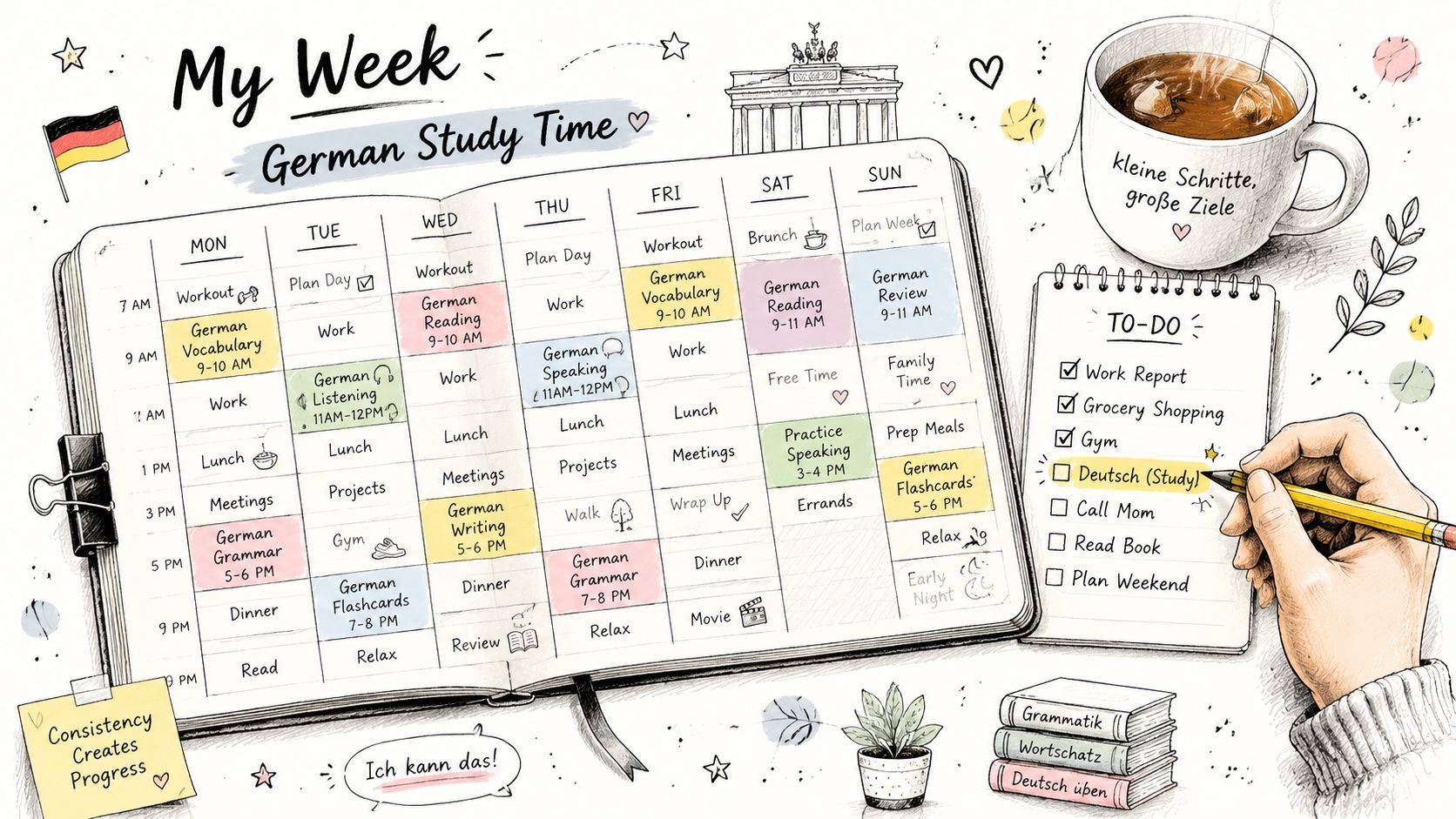
The difference between “I'm learning German” and “I'm getting to A2” is weekly structure. You need specific tasks, not vague intentions.
A realistic intensive path from zero to Goethe-Zertifikat A2 can take 10 to 12 weeks at 10 to 12 hours per week, but success rates exceed 90% only when learners maintain at least 80% attendance, and common pitfalls include Perfekt tense mastery and the 1,000+ word vocabulary required according to the Goethe exam preparation guidance.
Working professional plan
This plan suits someone working standard office hours in Hong Kong.
Don't let weekday fatigue decide your study plan. Decide the tasks in advance, then follow the script.
Parent plan
This one works better for adults managing family logistics.
If you want a planning framework that's simple and transferable, this guide on strategies for Access to HE Diplomas is useful because the core idea is the same. Break a big qualification into fixed weekly actions.
For extra self-study support, use these free resources to learn German in Hong Kong to fill short study gaps without overcomplicating your routine.
What to study each week
Most learners waste time because they study what feels easy. Study what gets tested.
If your schedule is crowded, cut quantity before you cut consistency.
Navigating the Exam Process in Hong Kong
Passing A2 isn't only about language ability. In Hong Kong, logistics can delay you if you don't plan ahead.
The local Goethe exam schedule often occurs only biannually, unlike the more frequent options in Europe. That can create a study-exam gap of 2 to 3 months, so your practical timeline must include that buffer.

Plan around the HK exam calendar
This is the local bottleneck many learners miss. They finish the syllabus, feel ready, then discover the next suitable slot isn't immediate.
Here's the practical sequence:
In HK, exam timing is part of the preparation. Treat registration strategy as seriously as grammar study.
What to do on exam preparation weeks
As the exam approaches, stop studying broadly. Start training specifically.
The A2 exam checks four skills. Your final weeks should include:
One detail many learners ignore is the writing task. For Schreiben, candidates must write 20 to 30 words and include three required elements in the response, as explained in this Goethe A2 writing task overview. If you write too loosely, you lose marks on a task that should be manageable.
Exam day advice that actually helps
Keep it simple.
The strongest candidates don't look dramatic on exam day. They look prepared.
Tailored Advice for Your Goals
A2 means different things in real life. For a busy Hong Kong learner, the right plan depends on what is at stake, how fixed your deadline is, and how much weekday energy you still have after work, school runs, and commuting.
If you need A2 for study abroad or visas
Set a deadline first. Then build the study plan backwards from it.
If German is tied to a university application, family relocation, or a visa route, casual study is a bad strategy. You need steady progress, regular speaking practice, and correction from someone who will fix mistakes early. In Hong Kong, the bigger risk is not lack of motivation. It is delay. Work gets busy, school calendars shift, and exam dates do not wait for you.
Families planning ahead often need to fit German around DSE, IB, or IGCSE pressure. Keep German on a fixed timetable, just like maths or science. If you leave it to leftover hours, it will keep slipping.
If you're studying for work
Working professionals should aim for usable German plus a recognised certificate. That means a course with structure, homework you can finish on weeknights, and class times that do not collapse the moment your office day runs late.
Do not chase perfection at A2. Build clear speaking, reliable listening, and solid exam technique. That is the standard that moves you forward.
If funding or reimbursement matters, check the rules before you enrol. Hong Kong learners often leave admin too late and then choose a course that fits neither their schedule nor their long-term goal.
If you're planning for your child
Parents should judge a German programme by three things. Teaching quality, consistency, and whether the path continues beyond the first exam.
Small-group learning usually works better than random private tuition for children who need routine and progression. It gives them pace, peer energy, and a clearer syllabus. It also makes the journey to A2 more manageable for families balancing school, activities, and packed weekdays.
Choose a programme with structure, native-speaking guidance, and serious exam preparation. Cheap, generic classes often cost more in lost time.
If your goal goes beyond one certificate, choose a school that can carry your child from beginner level to the next stage without forcing a reset later.
Ready to Start Your German Journey
If you've read this far, you don't need more motivation. You need a start date and a plan that fits your life in Hong Kong.
The sensible approach is clear. Pick a timeline you can sustain, build your week around fixed study blocks, and plan for the local exam schedule early. That's how Zero to Goethe-Zertifikat A2: Realistic Timeline for Busy HKers becomes a completed goal instead of another delayed plan.

If you're still deciding how to begin, start with a simple first step. Read this practical guide on how to start learning the German language, then compare that advice against your actual weekly schedule.
Good German study is organised, native-led, and exam-aware. That matters whether you're aiming for daily conversation, a visa application, business travel, or a longer academic path.
If you want a serious, realistic route to A2, book a trial class or speak with an advisor at German Cultural Association Hong Kong(GCA). You'll get native-speaking teachers, a structured curriculum, flexible study options in Hong Kong, and exam preparation that matches real local goals, not generic promises.
Online German Classes for Kids and Teens: Do They Actually Work?

Beginner German for Teens: A Starter Roadmap for Ages 12-18


