.png)
.png)

BLOG

香港德國文化協會
The German Cultural Association
Goethe-Zertifikat Exam Dates 2026 Hong Kong: Your Guide
You're probably reading this because the timing suddenly got real.
Maybe you need German for a university application, a career move, a visa path, or your child's DSE planning in Hong Kong. You don't want vague advice. You want the actual process, the local reality, and a clean plan for Goethe-Zertifikat Exam Dates 2026 Hong Kong.
That's exactly how you should approach it. In Hong Kong, success with Goethe exams isn't just about language ability. It's about choosing the right level, watching the correct local registration page, and preparing early enough that you're not chasing a full exam slot at the last minute.
Your Plan for Germany Starts Here
If you want to study abroad in Germany, strengthen your CV in HK, or build a serious academic profile for DSE, IB, or IGCSE pathways, the Goethe-Zertifikat is one of the clearest credentials you can earn.
A common mistake involves searching for one master list of Goethe-Zertifikat Exam Dates 2026 Hong Kong, assuming the dates will sit there all year, and only starting to check when feeling “almost ready”. That's backwards.
In Hong Kong, exam planning works best when you treat it like a project with three parts:
- Pick the right level first so you don't register for the wrong target.
- Track the local exam schedule instead of relying on general international information.
- Build your study plan around the booking reality in HK, especially if your timeline connects to school admissions, DSE, or overseas applications.
Practical rule: Book based on your deadline, not your mood. Motivation changes. Application deadlines don't.
Parents should think about this early if German could support school progression or overseas education plans. Working professionals should do the same if German is part of a relocation, visa, or career strategy.
The Official Goethe-Zertifikat Exam Dates 2026 Hong Kong
There isn't one global public list of Goethe-Zertifikat Exam Dates 2026 Hong Kong. In Hong Kong, exam scheduling is handled locally. Candidates need to check the official Goethe-Institut Hong Kong exam schedule for available timeslots at the local examination centre in Wan Chai, where exams are offered across A1 to C2 for adults and young learners.
Where Hong Kong candidates should check
If you want the official starting point, use the Goethe-Institut Hong Kong exam registration page. That page makes two things clear.
First, applicants should search the exam schedule for available timeslots. Second, the examination centre is at 13-14/F Hong Kong Arts Centre, 2 Harbour Road, Wan Chai, Hong Kong, and the Hong Kong office offers German exams for adults and young learners across CEFR levels A1 to C2.
That matters because many candidates waste time looking for a single international 2026 calendar. For Hong Kong, that isn't the practical method. The local centre controls the locally available slots.
What this means in practice
Treat Goethe-Zertifikat Exam Dates 2026 Hong Kong as a live scheduling issue, not a static PDF you check once.
Your workflow should be simple:
- Decide your target level
- Monitor the Hong Kong schedule page
- Register as soon as a suitable slot appears
- Prepare with the exam date in mind, not “sometime next year”
This is especially important for people in Hong Kong who are balancing school calendars, work travel, or visa paperwork. If you leave registration too late, your ideal timing may disappear and your next realistic option may be a later cycle.
One centre, one local process
Hong Kong candidates should keep one fact in mind. The local centre is the authority that matters for planning.
Here's the clean summary:
- Official provider in Hong Kong: Goethe-Institut Hong Kong
- Official exam location listed: Hong Kong Arts Centre in Wan Chai
- Exam range available: A1 to C2
- Candidate groups covered: adults and young learners
That single-centre structure is helpful. It reduces confusion. You don't need to compare multiple unrelated local providers for official Goethe-Zertifikat delivery in HK. You need to watch the local Goethe process carefully and act early.
Check the Hong Kong page directly before you make any study or travel commitment. Never assume a date shown elsewhere applies to HK.
Don't plan from generic search results
Search engines often surface mixed information from different countries, old schedules, or unofficial summaries. That's fine for background reading, but not for booking decisions.
If your goal is serious, use a disciplined approach:
| What to rely on | What to avoid |
|---|---|
| Official Hong Kong Goethe schedule | Generic “2026 Goethe exam calendar” pages |
| Local centre details in Wan Chai | Forum posts and outdated screenshots |
| Level-specific planning from A1 to C2 | Guessing that “there will probably be a slot later” |
For ambitious learners in Hong Kong, this is the right mindset. Goethe-Zertifikat Exam Dates 2026 Hong Kong is not just a search term. It's a local booking process with real consequences for timing.
Choosing Your Goethe-Zertifikat Level From A1 to C2
Picking the wrong level is one of the most expensive mistakes candidates make. Not because of money alone, but because it costs time, confidence, and often an entire exam cycle.
Choose the level based on your actual purpose in Hong Kong. Don't choose it because the textbook you bought says “intermediate” or because you once studied German years ago.

What each level is really for
A1
This is the beginner stage. It suits learners who need very basic everyday German for simple communication, early travel preparation, or certain family-related plans.A2
This level works for learners who can handle routine situations but still need structured support. It's a sensible milestone for adults who want practical progress without jumping too quickly.B1
This is often the first level where German becomes independently useful. You can manage common situations, follow everyday communication, and express views more clearly. For many teenagers in Hong Kong, B1 is a serious target because it aligns with school-related planning.B2
At this level, German becomes academically and professionally credible. If you're aiming at study abroad in Germany, stronger workplace communication, or more competitive applications, B2 is often the smarter goal than stopping at B1.C1
This level is for students and professionals who need flexible, accurate German for advanced study, formal discussion, and demanding communication.C2
This is near-mastery. Only choose it if your work, academic path, or long-term linguistic goal requires it.
Match the level to the outcome
Use this quick decision guide:
| Your likely goal in Hong Kong | Sensible target |
|---|---|
| Basic travel or life admin | A1 or A2 |
| Building a serious foundation | A2 or B1 |
| HK secondary school progression with German relevance | B1 |
| University preparation or stronger international profile | B2 or C1 |
| High-level professional or academic use | C1 or C2 |
Don't self-assess too generously
Most learners overestimate reading ability and underestimate speaking and listening. That's why so many “I think I'm around B1” candidates struggle when they see a full paper.
A better rule is this:
- If you can read more than you can say, your level is probably lower than you think.
- If you freeze under time pressure, you're not exam-ready yet.
- If your grammar only works in homework but collapses in conversation, you need more structured practice.
Your exam level should reflect what you can do consistently across reading, writing, listening, and speaking. Not what you can do on a good day.
If you're also comparing pathways, this guide to Goethe-Zertifikat versus TestDaF in Hong Kong is worth reading before you commit to the wrong exam track.
Your Step-by-Step Registration Checklist
Registration feels stressful because candidates treat it casually until the final moment. Don't. Administrative mistakes are avoidable if you use a proper checklist.
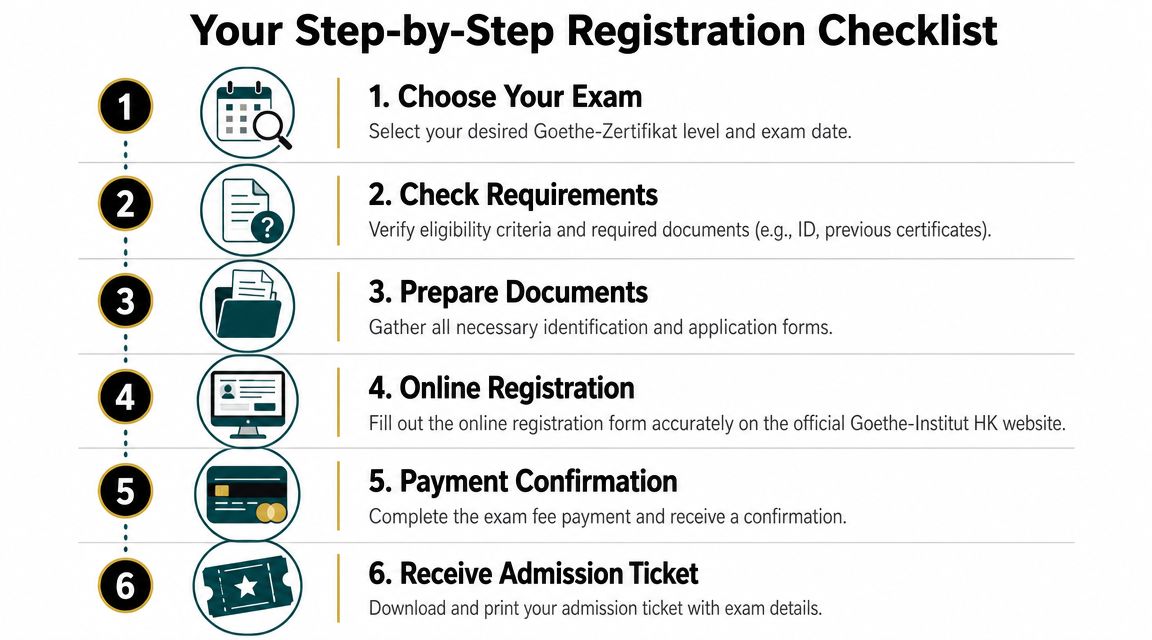
The six-step process that actually works
Choose your exam before you open the form
Don't start with registration. Start with clarity. Know your exact target level, whether you need an adult or youth format, and your preferred exam window in Hong Kong.Check the official requirements carefully
Read the exam page line by line. Confirm what identification details are required and whether any prior qualification or age-related condition applies to your chosen paper.Prepare your personal details properly
Your name should match your identification document exactly. If your passport, HKID, or school record uses a particular order or spelling, use that same format. Don't improvise with nicknames or alternate English names.Register online with full concentration
This is not a form you complete while commuting on the MTR. Sit down at a laptop, use a stable internet connection, and review every field before submission.Complete payment promptly
Don't assume a partially completed registration secures your place. If payment is part of the process, finish it properly and keep the confirmation.Save every confirmation document
Keep screenshots, payment records, emails, and admission information in one folder. On exam week, you want zero confusion.
Common mistakes HK candidates should avoid
These are the problems I see most often:
Wrong name format
A mismatch between registration details and ID causes unnecessary stress. Fixing it later may not be simple.Late booking
Candidates often wait until they “feel ready”. That's the wrong trigger. Book according to your deadline, then prepare against that date.Choosing a level emotionally
Some people choose B2 because it sounds more impressive. That's a poor strategy if their actual performance is still around A2 or B1.Ignoring practical logistics
Wan Chai is accessible, but exam day still needs planning. Check transport, timing, and what you need to bring well in advance.
A smarter admin mindset
If you've ever dealt with school admissions or course sign-ups in Hong Kong, you already know that organised systems reduce avoidable mistakes. The same principle applies here. These insights into school enrollment software are useful because they show how structured registration processes help families and institutions manage deadlines, records, and confirmation steps more reliably.
That mindset is exactly what exam candidates need. Accuracy beats speed.
A rushed registration creates problems that better preparation would have prevented in ten minutes.
Your registration mini-checklist
Before you click submit, confirm these five points:
- Identity check. Your legal name matches your ID.
- Exam check. You selected the correct Goethe level.
- Date check. The slot works with your school, work, or travel schedule.
- Record check. You've saved proof of registration and payment.
- Follow-up check. You know where to look for the admission notice.
For a practical local overview, this guide to German proficiency test registration and fees in Hong Kong is a useful companion.
How Much Does the Goethe-Zertifikat Cost in HK
This is one of the most searched questions, and the honest answer is simple. Check the official Hong Kong exam page for the exact fee when you're ready to book.
I'm not going to invent a fee table. If a price isn't confirmed on the official local page at the time you register, it shouldn't drive your decision.
What cost-conscious learners in Hong Kong should budget for
Think beyond the exam fee itself. Your real budget usually includes:
- Exam registration fee
- Preparation course or private tuition
- Books and mock materials
- Transport to the exam centre
- Possible re-sit cost if you book too early or at the wrong level
The last point matters most. The cheapest exam strategy is usually not “book fast and hope”. It's “prepare properly and sit once with a realistic target”.
Should working professionals think about CEF funding
Yes, at least as a planning question.
If you're a working adult in Hong Kong, it's sensible to check whether your broader German study pathway may connect with CEF funding for eligible language learning arrangements. You should verify eligibility, provider status, and reimbursement conditions directly through the relevant official channels before making any financial assumption.
That's the practical HK mindset. Don't ask only, “What is the exam fee?” Ask, “What is my total path cost, and can any part of my learning spend be managed more intelligently?”
The better way to evaluate value
Use this simple framework:
| Question | Better way to think about it |
|---|---|
| Is the exam expensive? | It's expensive if you take the wrong level or re-sit unnecessarily |
| Should I self-study to save money? | Only if you're disciplined and already know the format well |
| Is a prep course worth it? | It is if it prevents delay, confusion, and avoidable failure |
| Should parents budget early? | Yes, especially if German may support DSE or future study plans |
For most adults and parents in Hong Kong, the right question isn't “What's the lowest upfront spend?” It's “What gives me the cleanest route to a result I can use?”
Planning Your Preparation A Strategic Timeline
You realise in February that you need a usable Goethe-Zertifikat result for university, work, or a DSE-related plan. That is the moment many Hong Kong learners lose control of the process. Seats are limited, school calendars are crowded, and language progress does not speed up just because the deadline is close.
Start from your target date and work backwards. That is the only sensible method.
For Hong Kong learners, timing is not abstract. Students, parents, and working adults all face fixed local deadlines, whether the goal is HKDSE planning, an overseas application, or a career move that needs proof of German. As noted earlier, the Goethe-Zertifikat timetable already matters in the HK academic calendar. Treat it as a scheduling project, not just an exam booking.
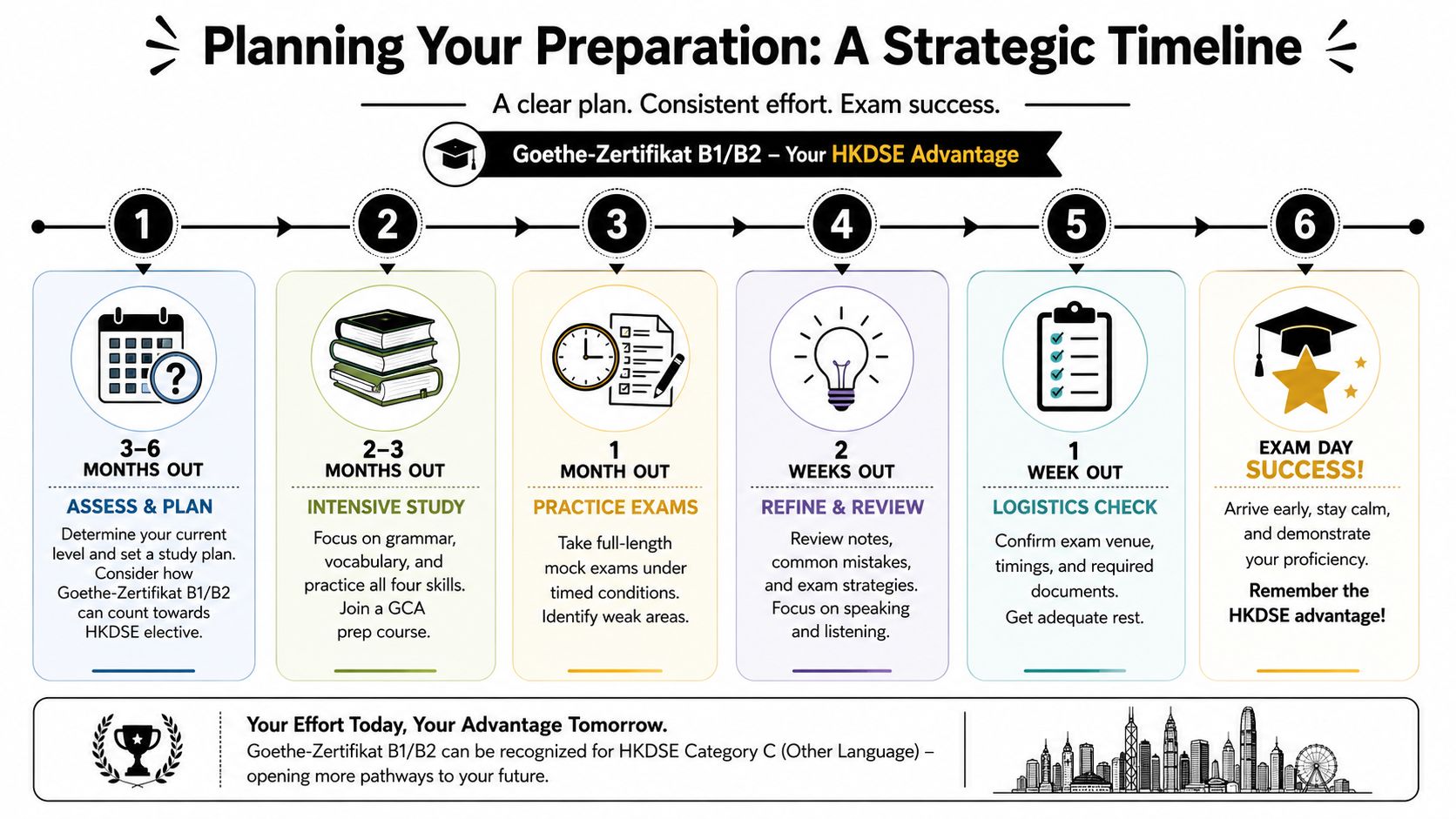
A practical reverse timeline
If you are aiming for a spring exam session in Hong Kong, use this framework.
Three to six months before
Set the direction first.
- Check your actual level, not the level you hope you are at
- Choose one clear target exam
- Build a weekly study routine for reading, listening, writing, and speaking
- Decide whether self-study is realistic or whether you need guided support
This stage decides everything that follows. A weak decision here usually leads to wasted fees, bad timing, or an avoidable re-sit.
If you need a structured course path, review the German Cultural Association Hong Kong programs and course options early and match them to your exam month.
Two to three months before
Now the actual work starts.
You should be correcting the problems that lower scores:
- grammar gaps that keep repeating
- limited vocabulary for common exam topics
- slow reading under time pressure
- listening mistakes caused by weak detail tracking
- speaking that sounds hesitant or unstructured
- writing that drifts off task or ignores format
Random revision is a bad strategy here. Study in exam format. Use timed tasks. Get corrections from someone who knows what Goethe examiners expect.
Short, regular sessions beat one exhausted weekend block.
One month before
Shift from learning to performance.
At this point, you need evidence. Can you finish tasks on time? Can you organise a speaking response without freezing? Can you produce a writing task that fits the prompt, length, and tone?
Do these every week:
- Full mocks or section mocks under time limits
- Speaking practice with interruption, follow-up questions, and pressure
- Writing correction with clear error categories
- Review of mistakes by pattern, not by memory
If your weak points are still vague, your practice is too loose.
The final two weeks
Stop collecting new grammar topics just to feel productive. Fix the mistakes you already know you make.
| Timeframe | Priority |
|---|---|
| Two weeks out | Correct repeated errors, tighten speaking answers, review high-frequency vocabulary |
| One week out | Check exam logistics, documents, route, reporting time, and sleep schedule |
| Final days | Light review only, keep your routine stable, arrive calm and prepared |
Who should start earlier
Some candidates can prepare in a shorter cycle. Many should not.
Start earlier if:
- you are jumping to a new level such as A2 to B1 or B1 to B2
- your German study has been irregular
- you need the certificate for DSE, university admission, visa planning, or a job application
- you are balancing school with other exam subjects
- you are working full time
- your child is preparing during a packed Hong Kong school term
My advice is simple. Set your exam month first. Then set the latest responsible start date. Ambitious learners in Hong Kong do well when they treat the Goethe-Zertifikat as a planned campaign with level checks, registration timing, and structured preparation all aligned.
The GCA Advantage Your Best Path to Exam Success
You have chosen a target month. You know why the certificate matters. Now comes the part that decides the result. Training.
Candidates in Hong Kong rarely fail because they lack motivation. They fail because their preparation is disconnected. The level is chosen too optimistically, speaking is left too late, writing errors go uncorrected, and exam practice stays casual until the deadline is close. By then, the problem is no longer effort. It is lost time.
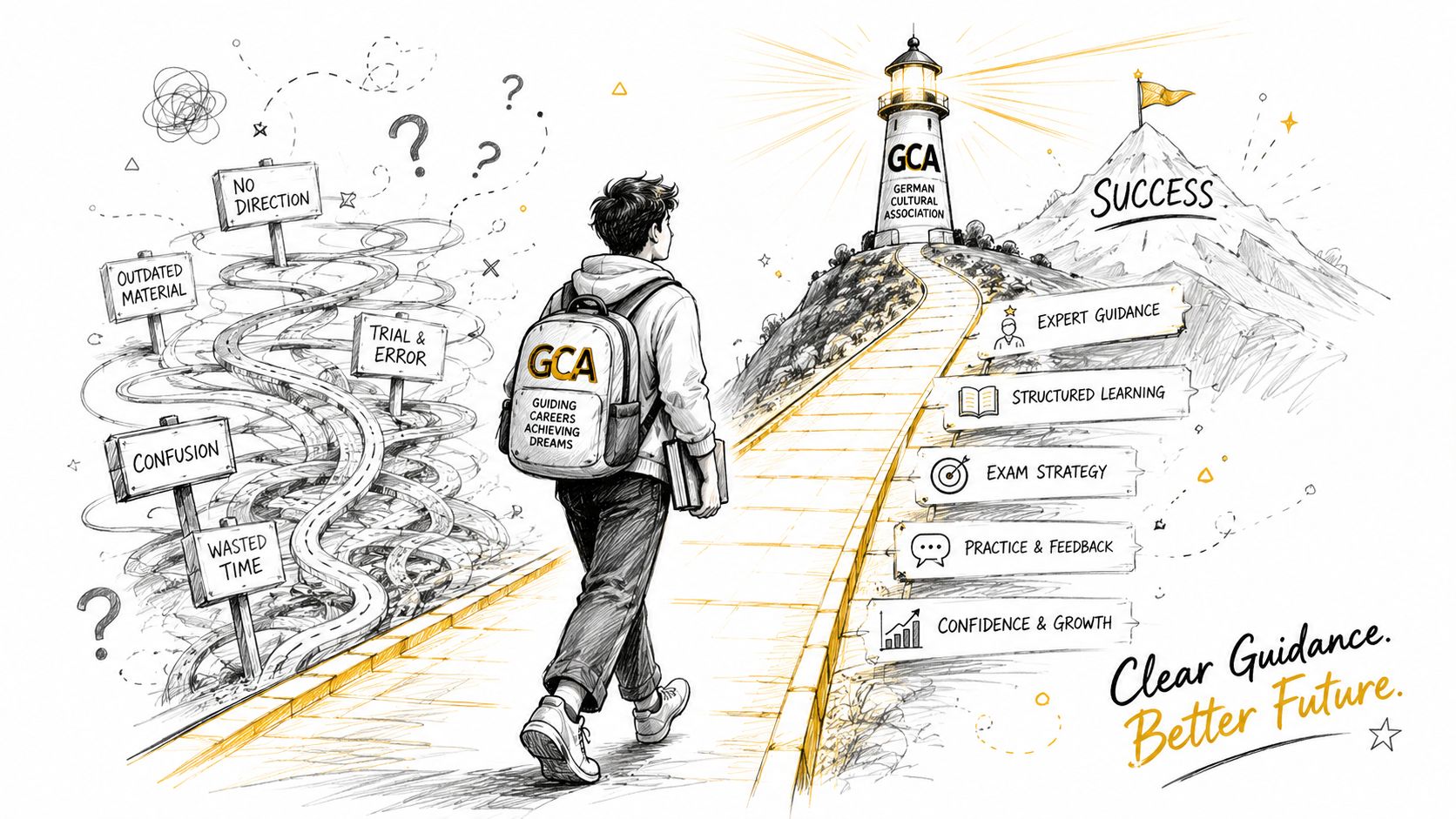
Why guided preparation works
A good Goethe result usually comes from four things done in the right order:
- Accurate level placement
- A course sequence that builds exam skills, not just textbook knowledge
- Fast correction in speaking and writing
- Mock practice that reflects real timing and pressure
That combination matters even more in Hong Kong. School calendars are crowded. Working adults are tired by the evening. Parents often discover too late that a child who “knows some German” is still not ready to perform under exam conditions.
The local reality is simple. Exam places, school schedules, and application deadlines do not wait for you to feel ready. If your German goal connects to university plans, DSE strategy, career moves, or Germany-bound applications, you need a preparation system that matches a real deadline.
What GCA offers in practice
For learners who want that structure, German Cultural Association programmes and offerings include in-person classes near Tsim Sha Tsui and Causeway Bay MTR, online Zoom options, small-group teaching, native German-speaking teachers, and targeted support for Goethe-Zertifikat, TestDaF, IGCSE, A-level, and IB.
That setup is a strong fit for several groups:
- Parents building a serious long-term German path for children or teenagers
- Working professionals who need evening, weekend, or online study options
- Adults preparing for study, work, or relocation plans connected to Germany
- Exam candidates who need correction, accountability, and a clear weekly structure
Small classes make a practical difference. You speak more often. Your mistakes get caught earlier. The teacher can hear whether your answer is grammatically correct, too vague, too short, or not exam-ready.
Here's a quick look at the learning approach in action:
Who should not prepare alone
Self-study is useful for vocabulary review, reading practice, and grammar consolidation. It is a weak primary strategy for anyone with a fixed deadline.
Do not rely on self-study alone if:
- You need the certificate for a specific application timeline
- You avoid speaking because it feels uncomfortable
- You are unsure how the exam tasks are marked
- You studied German before but your progress has stalled
- You only study seriously when someone expects results from you
The Goethe exam rewards performance, not familiarity. You must produce clear answers on time, handle pressure in speaking, and write with control. That is why guided preparation works so well for ambitious Hong Kong learners. It turns a vague goal into a sequence you can follow, measure, and finish.
Ready to Secure Your 2026 Exam Slot
If your German goal matters, act now.
Don't wait for the “perfect” moment, a cleaner work schedule, or a future month when motivation somehow becomes easier. The right move is to decide your target, check the official Hong Kong schedule, and start preparation with a realistic timeline.
For parents in Hong Kong, this is the right time to assess whether German should become part of your child's DSE or international education strategy. For adults, it's the right time to turn a vague plan into a booked exam and a study routine that gets used.
The smartest next step is simple:
- Get your level assessed realistically
- Choose the right exam target
- Build a preparation plan around your real deadline
- Register before capacity becomes the problem
Your 2026 result will depend far more on decisions made now than on effort made in the final few weeks.
If you want a clear next step, contact German Cultural Association Hong Kong(GCA) to arrange a level assessment, ask about suitable Goethe-Zertifikat preparation options in Hong Kong, or review class formats that fit your schedule. A short conversation now can save you from choosing the wrong level, missing a local registration window, or wasting months on unfocused study.
German Accusative Case Explained: When and How to Use Akkusativ

German Small Talk: 30 Phrases for Meeting People and Making Friends


