.png)
.png)

BLOG

香港德國文化協會
The German Cultural Association
Why Taking a German Certification Exam Matters for Hong Kongers
You’re probably in one of three situations right now.
You’re a parent in Hong Kong trying to decide whether German is worth adding to your child’s DSE, IB, IGCSE, or A-level path. You’re a working professional who wants a sharper edge for Europe-facing roles. Or you’re planning to study, work, or relocate to Germany and you’ve realised that “I’m learning German” is not the same as “I can prove my German”.
That’s why Why Taking a German Certification Exam Matters for Hong Kongers has a simple answer. A German certificate turns effort into something universities, employers, and immigration authorities can effectively use. Without that proof, your German stays informal. With it, your options become concrete.
Your Gateway to Germany Starts in Hong Kong
A common Hong Kong scenario looks like this.
A Form 5 student wants more than the standard UK and Australia options. A parent has heard Germany offers serious academic opportunities, especially in engineering and science, but doesn’t know what matters for admission. Or a professional in Central has German clients, sees DACH-region opportunities, and wants to stop being the person who “means to improve German someday”.
In all three cases, the same problem appears. Ambition is there. Proof is missing.
German certification fixes that. It gives your study plan, career move, or relocation goal a recognised benchmark. That matters because German universities, visa processes, and employers don’t assess your potential based on good intentions. They assess whether you meet a stated level.
For families, this is especially relevant now that German is tied more directly to the local examination system. For adults, it matters because certification is far more useful than casual conversation classes with no clear outcome.
Practical rule: If your goal involves university admission, migration, or a career move, study towards an exam from day one.
A lot of Hong Kongers also underestimate how practical the Germany move becomes after the language step is handled. Once your paperwork and language proof are in place, everyday logistics start to matter, including finding a home in Germany. That part is much easier when you plan early instead of waiting until after an offer arrives.
What changes once you certify
- Students get direction. Instead of “learn some German”, the target becomes A2, B1, B2, or higher, depending on the pathway.
- Parents get a measurable return. You can judge progress against a recognised framework, not vague classroom participation.
- Professionals get credibility. A certificate is something HR, managers, and visa officers can evaluate immediately.
My advice is direct. Don’t treat German as a hobby if your goal is serious. Treat it like an admissions requirement, a career credential, or a relocation tool. That mindset saves time and usually saves money too.
What Exactly Are German Language Certifications
A German certificate gives other people a clear answer to one question. What can you do in German today?
German language certifications are internationally recognised exams that measure your reading, writing, listening, and speaking against the CEFR scale from A1 to C2. For Hong Kong learners, two names matter most: Goethe-Zertifikat for general German and TestDaF for academic pathways that lead to German universities.
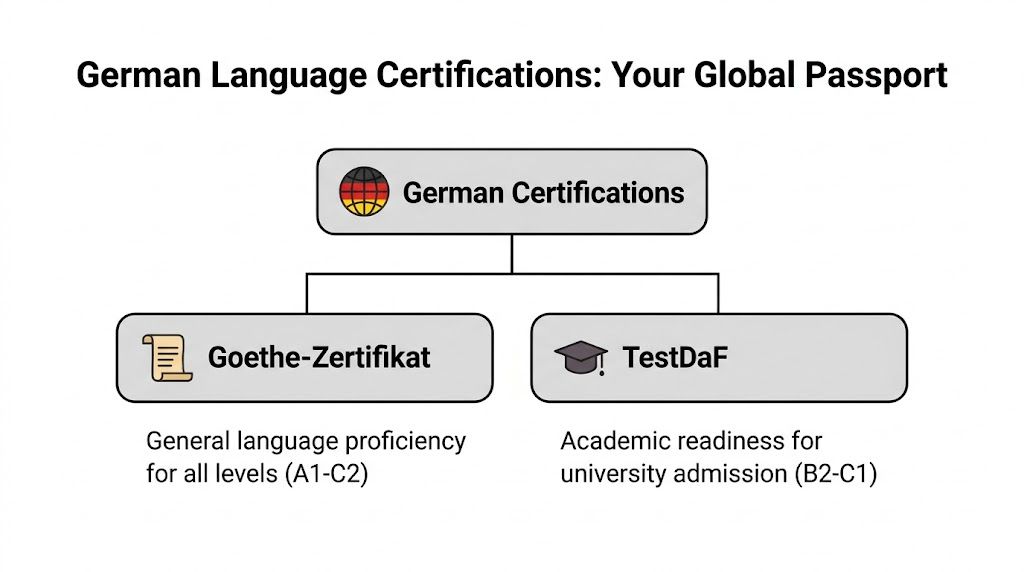
The two exam names you need to know
Goethe-Zertifikat is the practical choice for step-by-step progress. You can take it from A1 up to C2, which makes it useful for students, working adults, and families who want a recognised milestone at each stage.
TestDaF serves a narrower purpose. It is designed for learners aiming at German higher education and other academic settings where advanced language ability must be proven in a formal way.
If you are still unsure about your current level, it helps to first take a language proficiency test informally, then compare the main exam formats in this guide to Goethe-Zertifikat and TestDaF for Hong Kong learners.
What the CEFR levels mean in real life
The CEFR scale matters because each level changes what you can realistically do with German.
A1
You can introduce yourself, ask simple questions, and handle very basic daily interactions.A2
You can deal with short practical conversations and familiar everyday topics. German starts becoming useful at this level, rather than just symbolic. For many Hong Kong students, this level also matters because it connects directly to the HKDSE Category C route discussed later in this article.B1
You can manage life with more independence. This is often the point where German begins to support relocation plans and can strengthen your profile for options such as Germany’s Chancenkarte points system.B2
You can understand more demanding texts, speak with solid fluency, and express opinions clearly. This level is often the dividing line between casual study and language ability that universities and employers take seriously.C1 and C2
You can work or study at an advanced level with far less friction. At this stage, German becomes a practical academic or professional tool.
Why this matters in Hong Kong specifically
Hong Kong families and professionals should look at certification as a return-on-investment decision. A recognised level can support a DSE strategy, strengthen a university application, improve eligibility for funding such as CEF in the right course context, and add value if Germany is part of your long-term career or migration plan.
That is why random conversation classes are usually a poor strategy. Study with a level target. Sit the exam. Get proof that schools, employers, and visa authorities can evaluate quickly.
Structured preparation helps. Business German courses offered by the German Cultural Association, for example, are designed to help learners build toward recognised CEFR levels instead of studying without a measurable outcome.
A certificate is not proof that you attended lessons. It is proof that you reached a standard other people can verify.
That difference matters a lot in Hong Kong, where ambitious families and professionals need credentials that travel well beyond the classroom.
Unlock Top German Universities with the Right Exam
Your child gets the grades, picks a strong course, and aims for Germany. Then the plan stalls because the language certificate is missing or the wrong exam was chosen. In Hong Kong, that mistake is common and expensive.
If Germany is the target, build the language exam into the admissions plan early. Do not treat it as an extra task after academics are settled. For German-taught programmes, recognised language proof is part of the entry requirement. For Hong Kong students, it can also support the local DSE pathway before any university application is even filed.

The HKDSE update parents should not ignore
From 2025, HKDSE Category C for German uses the Goethe-Zertifikat exam at A2 level or above, taken within the prior two years, as the official assessment. The HKEAA records only the highest grade from multiple attempts, and the exam follows CEFR-aligned modules in listening, reading, writing, and speaking according to the Goethe-Institut Hong Kong DSE page.
That changes the ROI calculation for Hong Kong families. German certification is no longer just something that may help later. It can feed directly into a student’s school assessment strategy now.
What German universities actually look for
Parents often ask whether school results alone are enough. They are not. Universities want clear proof of language ability that admissions teams can verify quickly.
For German-taught programmes, many institutions expect at least B2, and some require a higher standard through exams such as TestDaF or advanced Goethe-Zertifikat levels. The exact requirement depends on the university and the programme, so exam choice should match the target course list, not guesswork.
English-taught degrees give students another route into Germany, but they do not remove the value of German. German helps with internships, part-time work, housing, administration, and daily university life. It also strengthens the student’s position after graduation if they want to stay, work, or later qualify under routes such as the Chancenkarte points system.
My recommendation by student type
For DSE students
Use German certification as part of the academic plan, not an afterthought. Start early enough to sit the exam with time for a retake if needed.
For IB and IGCSE families
Get an external certificate even if the school reports look strong. German universities and future employers trust standardised proof more than internal class grades.
For students aiming at engineering, science, or technical fields in Germany
Plan for German even if the first degree option is taught in English. Labs, internships, supervisors, and employers often expect far more German than the course title suggests.
The right question is not whether your child should take a German exam. The right question is which exam and level match the university plan.
If you need help choosing between the main exam routes, read this guide comparing Goethe-Zertifikat and TestDaF for Hong Kong learners.
Accelerate Your Career with Business German Proficiency
A Hong Kong manager gets pulled into a call with a German supplier on Tuesday, is asked to join a factory visit in Munich next month, and by quarter-end is being considered for a regional role. That opportunity does not wait for casual learners. It goes to the person who can show certified German and use it under pressure.
For working professionals in Hong Kong, German certification pays off in three places at once. It strengthens your position at work, improves your mobility across Europe-related roles, and supports future relocation plans such as Germany’s Chancenkarte, where certified German can add points to your profile.

Why the business case is stronger than many professionals assume
Hong Kong’s links with German-speaking markets are commercially serious, not niche. Bilateral trade between Hong Kong and Germany reached a very substantial level in recent years, and that shows up directly in sectors where communication, compliance, trust, and technical clarity matter.
The professionals who benefit first are usually in:
- Logistics and supply chain
- Finance and corporate banking
- Engineering and manufacturing support
- Procurement and sourcing
- Sales, account management, and regional client service
- HR, legal, and operational roles dealing with German headquarters or partners
In these jobs, English keeps work moving. German changes how much responsibility you get.
If you can handle supplier calls, internal updates, factory coordination, or client discussions in German, you become easier to promote and harder to replace. That is a significant career return.
What certification actually changes
Certification gives decision-makers proof. Your employer does not need to interpret “conversational German” on a CV. A recruiter, department head, or visa officer can see a recognised level and make a decision faster.
It also forces discipline.
Busy adults in Hong Kong rarely improve through casual study alone. Progress comes from a fixed target, a syllabus, and an exam date. That structure matters even more for professionals balancing work, family, and limited evening time.
The third benefit is strategic. Germany’s Chancenkarte rewards applicants who can document their qualifications clearly, and certified German can contribute to the points calculation. If relocation is even a medium-term goal, sitting the exam early is the smarter move. Waiting until a job opens or a visa route becomes urgent usually costs you time you do not have.
My recommendation: If German could affect your promotion, your regional scope, or your relocation options, get certified before you need it.
Here’s a useful primer on Germany-related opportunities for professionals.
The return for Hong Kongers is practical
Hong Kong professionals often ask whether German is worth the effort if their office already runs in English. For routine communication, maybe not. For advancement, yes.
German helps in the moments that decide careers. A negotiation with a supplier. A relationship with a headquarters team. A relocation interview. A Chancenkarte application where every documented advantage counts.
That is why I do not advise ambitious professionals to stop at class attendance. Study alone is invisible. Certification travels with you, whether you stay in Hong Kong, move into a DACH-facing role, or build a serious path to Germany later.
Which German Exam Is Right for You
A Hong Kong student aiming for DSE, a banker planning a Chancenkarte application, and a parent preparing a child for Germany should not sit the same exam.
Your exam choice should follow your next real requirement. That decision saves time, cuts wasted fees, and gives you a credential you can use.
Match the exam to the outcome you want
| Your Goal | Recommended Exam | Typical Target Level |
|---|---|---|
| HKDSE Category C German | Goethe-Zertifikat | A2 or above |
| General proof for work, relocation, or steady level-by-level progress | Goethe-Zertifikat | A1 to C2, based on purpose |
| University-focused academic application | TestDaF | Usually B2 to C1 range |
| Broad academic or professional proof where the institution accepts multiple exam types | Goethe-Zertifikat or TestDaF | Depends on the receiving institution |
That table matters more than brand recognition. In Hong Kong, learners often waste months chasing the wrong paper because someone told them a harder exam looks better. It does not. The right exam is the one that fits the decision in front of you.
My advice by profile
Pick Goethe-Zertifikat if you want the most flexible route.
It suits DSE students, working adults, and families who want clear progress from one level to the next. It is also the more practical choice if you want documented German for career development now, while keeping Germany as a future option.
Pick TestDaF if your plan is clearly academic.
If your target is a German-taught university path, take the exam built for that environment. Do not start there just because it sounds impressive. Start there only if your application route requires that type of academic proof.
The Hong Kong ROI is straightforward
For DSE students, Goethe usually makes the most sense because it aligns with school-age progression and formal proof of level.
For professionals, Goethe is often the better first move because it gives you recognised evidence for HR, internal mobility, and relocation planning. That matters if you later want to strengthen a Chancenkarte application with documented language ability.
For families and adult learners paying out of pocket, cost matters too. Before you book an exam, read this guide to CEF funding for German studies in Hong Kong. The funding route can change which level you target first.
My blunt recommendation
Choose the exam that serves your next gate.
- DSE track: Goethe.
- Clear university application route: TestDaF, or the exact exam your target institution accepts.
- Career, relocation, or structured progress: Goethe first.
Prestige is irrelevant. Fit is what pays off.
How Much Does a German Exam Cost and Can You Use CEF
A Hong Kong parent paying for a teenager’s German pathway, and a mid-career professional planning Germany options, should not make this decision the same way. Cost only matters in context. What matters more is whether the exam you pay for gives you a return through DSE planning, career mobility, or points for Germany’s Chancenkarte.
Can you use CEF for German
Yes, but only for the right course and the right exam path.
For adult learners in Hong Kong, that can materially reduce the cost of getting recognised proof of German. CEF support applies in specific cases, including TestDaF and Goethe-Zertifikat C1 and C2, subject to the scheme rules and your remaining claim balance. If you are paying personally, read this CEF application guide for German studies in Hong Kong before you enrol. It will save you from choosing a course that looks cheaper but gives you no funding and no useful certification outcome.
CEF is not relevant for every learner. DSE students and younger learners usually need to think first about progression and recognised exam milestones. Working adults should look at both certification value and funding eligibility from day one.
What smart candidates check before paying
Confirm the course is CEF-eligible
Do this before you hand over any money. Do not assume every German course in Hong Kong qualifies.Match the course to your real objective
If your goal is a university route, choose the exam your target institution accepts. If your goal is work, internal promotion, or future relocation, choose the certification that gives you recognised proof employers and immigration systems can use.Budget for timing, not just fees
CEF reimbursement does not mean zero upfront cost. You still need to plan for tuition, exam registration, and the wait before any claim is processed.Choose a level with actual return
A beginner certificate is useful for motivation. A higher-level certificate is what usually starts paying back in professional terms. For Hong Kong professionals aiming at German companies, cross-border roles, or a Chancenkarte strategy, that distinction matters.
Where Hong Kong learners waste money
They book the nearest class, the lowest fee, or the first exam name they recognise.
That is weak planning.
A German certificate should serve a concrete next step. For a secondary school student, that may be formal progression that supports future academic options. For an ambitious professional, it may be a recognised language result that strengthens a CV and later supports a Germany move. For adults eligible for CEF, the smartest route is usually the one that combines funding support with a certificate that still carries weight outside the classroom.
My advice is simple. Pay for the exam path that gives you proof with usable value in Hong Kong and beyond. If CEF applies, use it. If it does not, be even stricter about choosing a certification that earns its cost back.
Your Proven Path to German Exam Success in Hong Kong
A Hong Kong parent pays for a German class for a year. A working professional studies after office hours for months. Then the exam date gets close, and both realise the same problem. They have attended lessons, but they have not trained for the exam.
That mistake is expensive.
German exam success comes from targeted preparation. You need level accuracy, regular speaking, correction that is specific, and a timetable that ends with an actual test date. Casual exposure does not produce a certificate that helps with DSE planning, CEF reimbursement strategy, or a future Chancenkarte application.
What a strong preparation path looks like
Strong preparation in Hong Kong usually follows four clear steps.
Start with accurate placement
Do not guess your level. If you start too low, you waste time. If you start too high, you build gaps that show up fast in speaking and writing.Train by exam skill, not by textbook chapter
Listening, reading, writing, and speaking need separate practice. Learners who only “finish the syllabus” often underperform because they never train the exam tasks directly.Build speaking into every week
Speaking is the weak point for many Hong Kong learners. Reading alone will not carry you through an oral exam, a university interview, or a business setting.Book against a real deadline
A fixed exam date improves discipline. It also gives students, parents, and professionals a clear timeline for the next practical step.
What to look for in a course provider
Choose a provider that teaches towards a recognised exam, not one that sells vague “interest classes”. You want clear level progression, correction on writing and speaking, and a class format that gives you enough chances to respond in German instead of just listening.
The German Cultural Association Hong Kong is one example of a provider offering in-person and online courses, exam preparation for Goethe-Zertifikat and TestDaF, native-speaking teachers, and small-group formats. Those features matter for a simple reason. They address the exact weaknesses that stop learners in Hong Kong from converting study time into a pass.
Small groups give you more speaking time. Native-speaking teachers help sharpen listening and pronunciation. A structured exam track keeps you working towards a result that has value outside the classroom.
The right course should prepare you for the exam you plan to sit and the next opportunity that certificate supports.
My advice for different learners
Parents of teenagers
Treat German like a results-based subject, not a casual enrichment activity. If your child may use German later for academic progression, put them on a structured path early and measure progress by level and exam readiness.
Professionals
Pick a study schedule you can repeat every week. Two steady lessons and consistent practice beat an occasional burst of motivation every time. If your long-term goal includes Germany, choose a certificate path that can strengthen both your CV and your future points-based application plans.
Adult beginners
Start with a simple target and finish it fast. A1 is a sensible first milestone because it gives you structure, momentum, and proof that you can complete an exam cycle. If you are starting from zero, this guide on how to pass the A1 German exam is the right place to begin.
The return comes from passing, not just attending. In Hong Kong, the learners who benefit most are the ones who study with a clear exam goal, choose preparation that fits that goal, and sit the paper on schedule.
Ready to Unlock Your Future with German
German certification matters because it turns ambition into access.
For students in Hong Kong, it can support the DSE pathway and open doors to German universities. For professionals, it strengthens promotion, mobility, and immigration options. For parents, it gives language learning a measurable purpose instead of leaving it as a vague enrichment activity.
If you’re serious, act like it. Choose the exam that matches your goal. Set a timeline. Build towards a recognised result.
The Hong Kong learners who benefit most from German aren’t always the most naturally gifted. They’re the ones who plan properly, prepare consistently, and sit the exam.
If you want a practical next step, explore German Cultural Association Hong Kong(GCA) to check course options, exam preparation pathways, and class formats for adults, teenagers, and professionals. You can review the latest schedule, ask about suitable levels, and decide whether in-person or online study fits your plan best.

Living in Germany as a Hongkonger: Anmeldung Made Simple
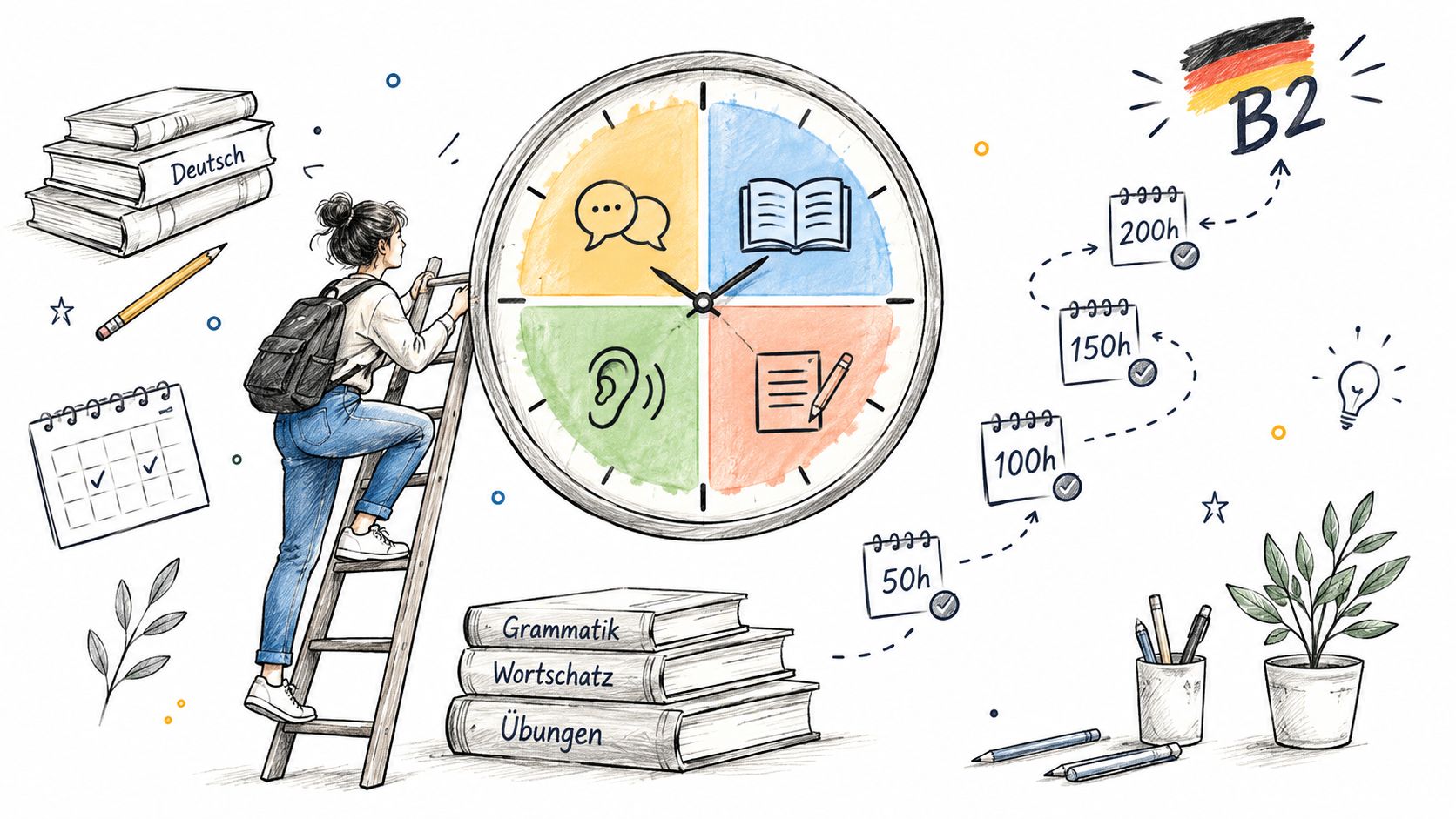
How Many Hours to Reach B2 German? CEFR Guided Learning Hours Explained


