.png)
.png)

BLOG

香港德國文化協會
The German Cultural Association
German Dialects: Hochdeutsch vs Bayerisch vs Schweizerdeutsch – Which Is For
You're in Hong Kong, you've decided German matters, and you want a clear path. Maybe it's for an IB oral, a university application, a career move, or a relocation plan. Then someone tells you there isn't just “German”. There's Hochdeutsch, Bayerisch, and Schweizerdeutsch. That's where many sensible learners lose time.
Here's the practical answer. If your goal is exams, university, work, or long-term mobility, start with Standard German. Dialects matter, but not at the beginning. If you need a structured first step, this guide on how to start learning the German language is the right place to begin.
Table of Contents
- Your German Language Goals and the Dialect Dilemma
- Hochdeutsch is the standard you build on
- Bayerisch and Schweizerdeutsch are spoken regional systems
- For exams
- For university in Germany, Austria or Switzerland
- For business and career
- For travel and everyday life
Your German Language Goals and the Dialect Dilemma
Most Hong Kong learners don't ask about dialects out of curiosity. They ask because the stakes are real.
A parent wants the right preparation for IB, IGCSE, or Goethe-Zertifikat. A working professional wants German for promotion or a move to Europe. An adult learner wants to study abroad in Germany or Switzerland and doesn't want to spend months learning the wrong thing.
That confusion is reasonable. “German” sounds like one target until you hear someone from Munich, then someone from Zurich, then a textbook audio from Berlin. Suddenly, all three sound related, but not the same.
Here's the decision rule I give serious learners in HK.
- If your goal is an exam, learn Hochdeutsch.
- If your goal is university, learn Hochdeutsch.
- If your goal is work, learn Hochdeutsch.
- If your goal is travel, still start with Hochdeutsch.
Dialects come later, and only if your destination demands it.
Practical rule: Dialect knowledge is useful. Standard German is essential.
Ambitious learners in Hong Kong are usually balancing German against work, school, or family schedules. You don't have unlimited hours, so you need the version of German that gives the widest return across career, exams, and study abroad in Germany/Switzerland.
There's also a local cost issue. German isn't a casual hobby for many HK families. It's an investment of time, tuition, and attention. If you spend your beginner stage chasing Bavarian phrases or Swiss slang, you may sound interesting, but you won't be building the strongest foundation for real outcomes.
A better approach is simple:
- Build strong Hochdeutsch first
- Add listening exposure to regional accents
- Only specialise in a dialect if your destination or daily environment requires it
That's the shortest route to competence, confidence, and results.
What Exactly Are Hochdeutsch Bayerisch and Schweizerdeutsch
A Hong Kong student can score well in IB German, then arrive in Zurich and suddenly struggle to follow a casual conversation on the tram. That does not mean they learned the wrong German. It means they learned the standard first, which is exactly what they should have done.
Hochdeutsch is Standard German. It is the form used in textbooks, exams, formal writing, news media, and university communication across the German-speaking world. Bayerisch and Schweizerdeutsch are regional dialect groups used mainly in everyday speech. For Hong Kong learners aiming at DSE, IB, Goethe exams, university admission, or career mobility, that distinction matters from day one.
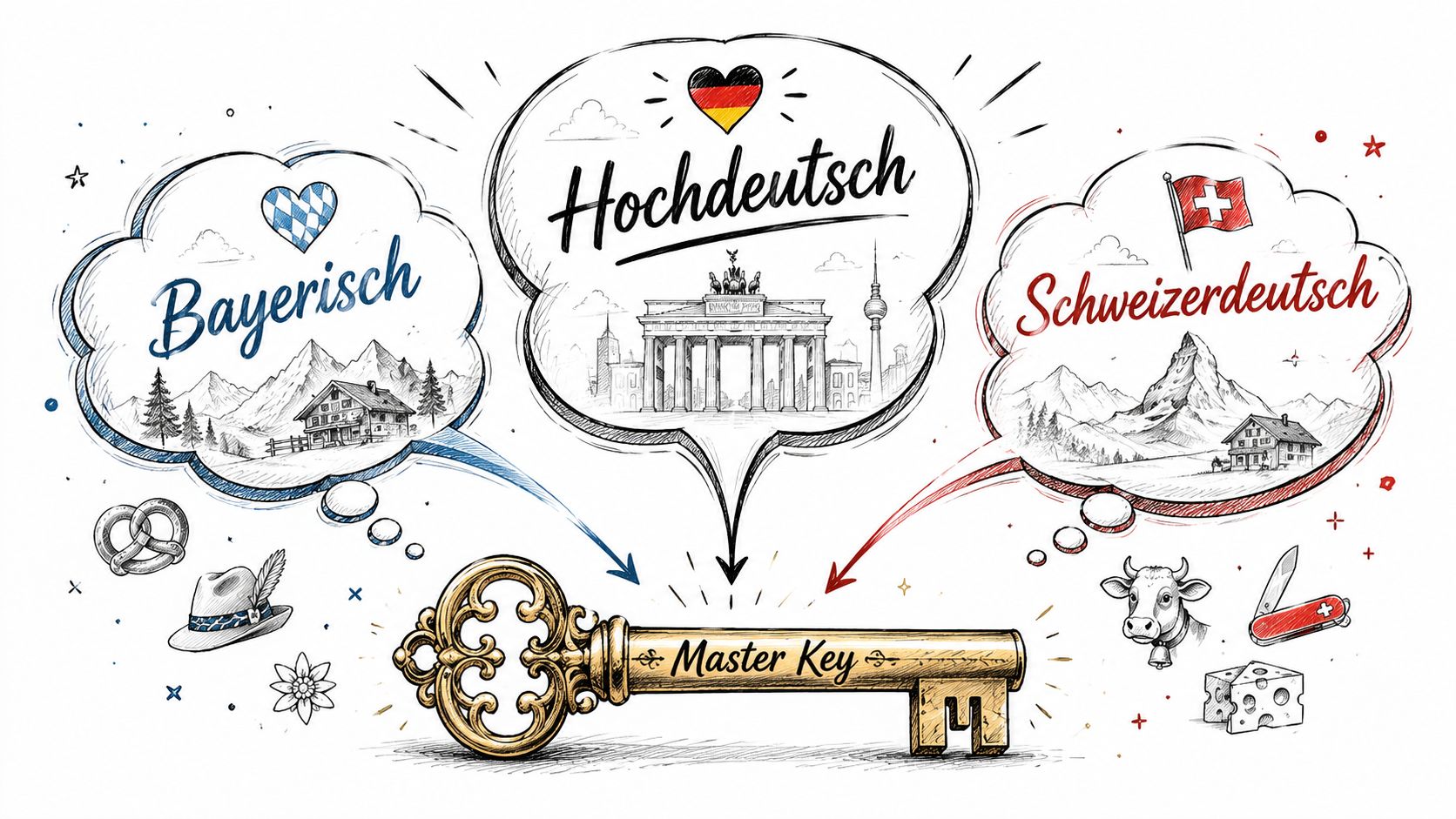
Hochdeutsch is the standard you build on
If you buy a German coursebook in Hong Kong, prepare for Goethe, or apply to a university in Germany or Switzerland, you are working with Hochdeutsch. It gives you the widest academic and professional return because it is the shared written and formal spoken standard.
Use Hochdeutsch if your goal includes any of the following:
- Exam performance in Goethe-Zertifikat, IB, IGCSE, TestDaF, or other standardised assessment
- University readiness for lectures, applications, written assignments, and formal interviews
- Professional communication in emails, meetings, presentations, and cross-border workplaces
- Flexibility if you may study in Germany, intern in Austria, or work with Swiss clients later
The history matters less than the outcome. The key point is simple. Hochdeutsch is the version taught internationally and recognised everywhere that counts for study and work.
Bayerisch and Schweizerdeutsch are spoken regional systems
Bayerisch is a major dialect group spoken in parts of Bavaria, Austria, and nearby regions. Schweizerdeutsch refers to the Swiss German dialects used in daily speech across much of German-speaking Switzerland. They are not just colourful accents. They can differ enough from Standard German to slow down a beginner who has only heard classroom audio.
That creates a common misunderstanding in Hong Kong. Parents hear “my child wants to study in Switzerland” and assume Swiss German should be the first target. Wrong order. Swiss universities, official documents, and most formal writing still rely on Standard German. Daily life may expose you to dialect, but admission, coursework, and language certification start from Hochdeutsch.
A useful visual reference helps here:
Within Switzerland, there is variation even inside Swiss German itself. A discussion of Swiss dialect variation notes that Baseldeutsch is often described as relatively closer to Hochdeutsch than some other Swiss dialects, while still remaining clearly distinct in pronunciation and vocabulary.
Get the hierarchy right. Hochdeutsch is the standard for exams, universities, and formal communication. Bayerisch and Schweizerdeutsch are regional forms you learn to understand after your foundation is solid.
That approach saves time, protects exam performance, and prepares Hong Kong learners for real academic and career outcomes.
A Detailed Comparison for Language Learners
A Hong Kong student preparing for IB or DSE needs one answer here. Start with Hochdeutsch. If your goal is a Swiss university, a professional role in Zurich, or strong exam results, dialect comes second.
Use this comparison to set priorities properly.
| Feature | Hochdeutsch (Standard German) | Bayerisch (Bavarian) | Schweizerdeutsch (Swiss German) |
|---|---|---|---|
| Main role | Standard for education, exams, formal communication | Regional dialect group in Bavaria, Austria, South Tyrol | Regional spoken dialects in German-speaking Switzerland |
| Best use for HK learners | First priority | Add later if you expect to live or work in southern German-speaking areas | Add later if you plan to study, intern, or settle in Switzerland |
| Ease for beginners | Highest | Lower | Lower |
| Writing | Standard written form | Rarely the right writing target for beginners | Daily speech differs strongly, while formal writing stays closer to standard |
| Career and academic value | Highest | Useful mainly for regional integration | Useful after a standard foundation, especially for Swiss daily life |
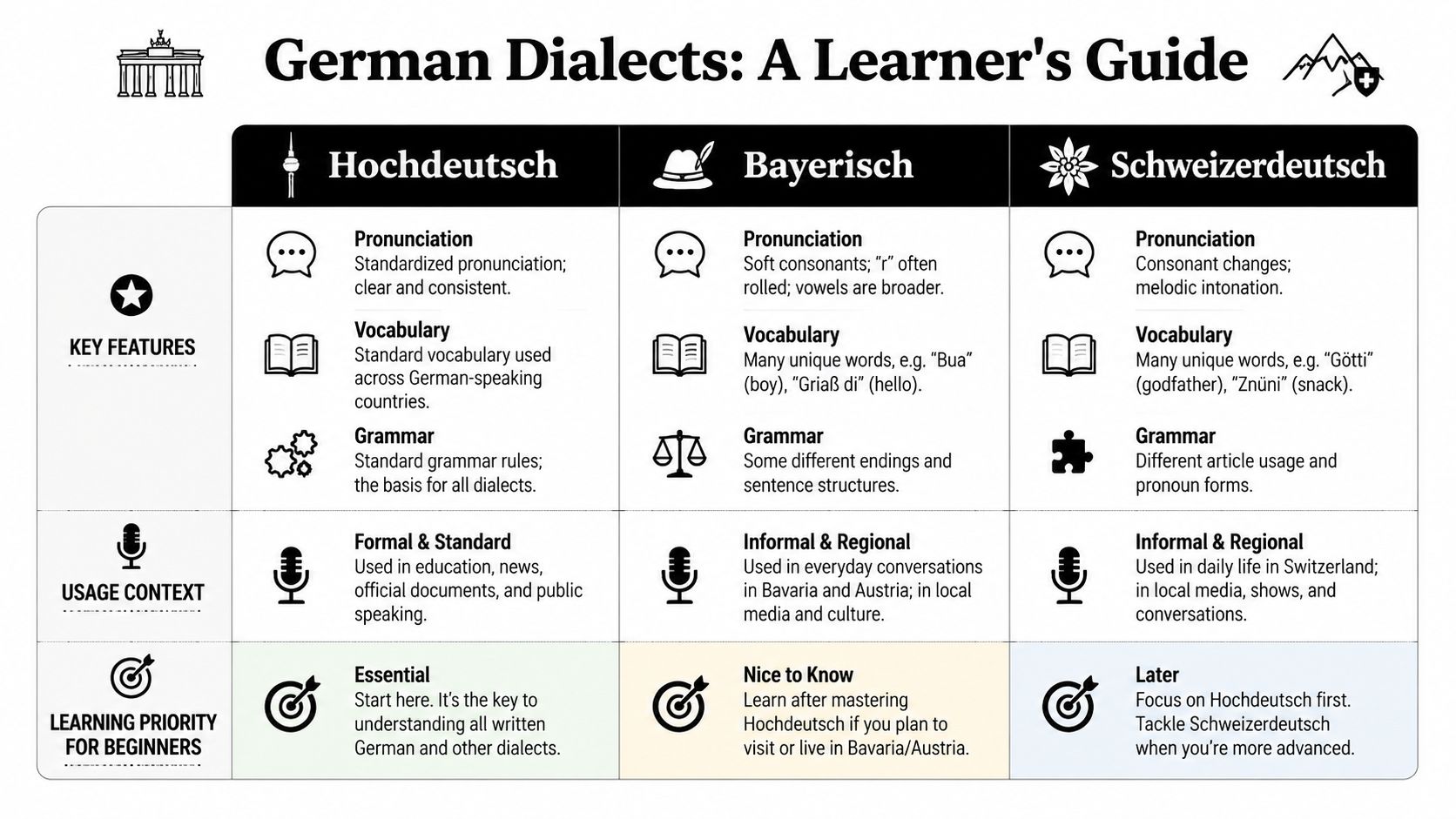
Bayerisch matters because you will hear it across a large part of the southern German-speaking region. That makes it relevant for relocation and social integration. It does not make it the right starting point for a learner in Hong Kong who needs exam-grade accuracy.
Pronunciation
Pronunciation is usually the first shock.
Hochdeutsch gives you the clearest base because textbooks, listening papers, teachers, and formal speaking assessments are built around it. You can train it systematically and get measurable progress.
Bayerisch often sounds tighter and more region-specific. Familiar words can shift quickly. A learner who knows wir may suddenly hear mia and need a second to process it.
Schweizerdeutsch creates an even bigger listening gap in casual conversation. This is exactly why students planning for Switzerland should still build their base in standard German first, then add exposure through region-specific listening. If Switzerland is part of your study or career plan, read our guide to working in Austria or Switzerland with the right level of German.
A practical rule works well here. Train your mouth in Hochdeutsch. Train your ear for dialect later.
Vocabulary
Vocabulary is where dialect feels fun and where beginners waste time.
Local words are useful for fitting in. They do very little for your grades, your Goethe exam result, or your university application. If you are in Hong Kong and studying with limited weekly hours, spend that time on high-frequency standard vocabulary first.
The contrast is simple:
- Hochdeutsch gives you the words used in classes, exams, formal emails, and most study materials.
- Bayerisch adds local expressions that help in everyday regional conversations.
- Schweizerdeutsch includes spoken words and forms that can confuse even learners with a decent standard base.
Chuchichäschtli is the classic Swiss example. It is memorable. It will not help you write a strong essay, handle an oral exam, or read a university document.
Grammar
Grammar decides outcomes.
Parents in Hong Kong usually care about marks, admissions, and long-term options. Grammar is the part that affects all three. Standard German grammar is the one tested in school settings, used in formal writing, and expected in certifications. That is the system your child should master first.
Bayerisch and Schweizerdeutsch both have grammatical patterns that differ from standard usage. Those differences matter for local understanding. They should not shape a beginner syllabus.
Keep the order strict:
- Learn Hochdeutsch grammar first
- Use it confidently in writing and speaking
- Add dialect recognition after your foundation is stable
That sequence gives you better control in IB, IGCSE, Goethe, and university-preparation contexts. It also prevents a common problem. Students consume dialect-heavy content too early, copy forms they do not fully understand, and weaken their written accuracy.
Written German remains your anchor. Dialect is an extra skill for listening, integration, and local confidence.
How Much Do These Differences Matter in Real Life
They matter, but not equally in every situation.
If you walk into a university lecture, submit an application, write a formal email, or join a structured business meeting, Hochdeutsch carries you a long way. That's the form people expect non-native learners to use, and it's the version that keeps communication efficient.
Where Hochdeutsch works immediately
In real life, Standard German is enough for a lot of high-value situations:
- Applications and interviews
- Exam settings
- Most classroom communication
- Professional introductions and presentations
- Written tasks, emails, and official documents
That's why I don't recommend beginners in Hong Kong start with dialect-heavy content. It creates anxiety without improving the outcomes that matter most.
Where dialect starts to matter
Dialect becomes relevant when the setting turns informal. A café in Zurich, a family dinner in Bavaria, or workplace small talk in a Swiss office can sound very different from what you learned in class.
That doesn't mean you chose wrongly by learning Hochdeutsch first. It means you've reached the normal next step.
The common pattern is this:
- You speak Hochdeutsch
- Locals understand you
- You need time to decode their local speech
- Your ear improves through exposure
If you're planning to work in Austria or Switzerland, this issue is worth thinking about early. This guide on working in Austria and Switzerland and whether your German is sufficient gives a practical view of that transition.
One more reality check matters. Germany still has a strong dialect culture. According to this guide to German dialects and accents, approximately 50 percent of the total population in Germany claims to speak a regional dialect, and there are around 20 different distinct dialects.
So yes, dialects matter in everyday life. But no, that doesn't change the best starting point.
Which German Should You Learn for Success in Hong Kong
A Hong Kong student spends a year learning German, then sits an IB oral, applies to a university in Zurich, or interviews for a role with a Swiss employer. The result depends less on sounding local and more on choosing the right version of German from the start. For almost every learner here, that means Hochdeutsch first.

For exams
If your target is Goethe-Zertifikat, IB, IGCSE, A-level, or DSE-related academic progression, learn standard German and stay disciplined about it.
Exams reward control. You need grammar that holds up under pressure, pronunciation an examiner can follow easily, and listening practice based on standard speech. Bavarian or Swiss dialect content may feel interesting, but it does not improve the scores that determine school results, university options, or scholarship prospects.
For students in Hong Kong, the priorities are simple:
- Standard grammar
- Clear pronunciation
- Accurate writing
- Exam-style listening
- Teacher correction tied to the syllabus
For university in Germany, Austria or Switzerland
If you plan to study in the German-speaking world, build your foundation in Hochdeutsch. There is no smarter route.
That advice becomes even more important for Switzerland. Strong Hochdeutsch helps with applications, entrance requirements, academic writing, and formal communication. It does not guarantee that everyday Swiss speech will feel easy when you arrive. Anecdotal reports from student forums regularly show the same pattern. Learners with solid standard German still struggle with Swiss German in fast informal settings.
So use the right sequence. Get your Hochdeutsch to a strong level first. Then add Swiss listening practice before departure, especially if your target is a Swiss university or internship. If you are comparing programmes and preparation options, read our guide on how to choose the best German language school in Hong Kong.
For business and career
For working professionals and older students thinking ahead, the answer is even clearer. Employers want German you can use across teams, countries, and clients.
A banker in Central, a hotel manager in Tsim Sha Tsui, or a student aiming for engineering roles in Europe does not gain an advantage from opening with Bavarian dialect. They gain an advantage from speaking standard German well in meetings, emails, presentations, and interviews.
That applies across sectors:
- Finance
- Luxury retail
- Engineering
- Hospitality
- Regional headquarters and cross-border operations
Standard German gives you reach. Dialect-first study limits where your German works.
For travel and everyday life
Travel is the only case where learners get distracted by dialect too early. I still advise against that.
Your first goal is function. You need to check in, buy tickets, ask for directions, solve problems, and understand basic replies. Hochdeutsch handles all of that across Germany, Austria, and much of Switzerland. Local expressions can come later, once your core German is stable.
Use this rule:
- Short trip: learn Hochdeutsch only
- Long stay: learn Hochdeutsch first, then train your ear for local speech
- Permanent move or family integration: add dialect awareness after you can already operate confidently in standard German
For Hong Kong learners, this is the practical choice. It supports exam results, university access, and career mobility. That is what success looks like.
Finding the Right German Course in Hong Kong
A Hong Kong student who picks the wrong German course usually loses time first, then confidence, then exam options. I see this repeatedly with learners who spend months on apps or casual conversation classes and still cannot handle an IB oral, a Goethe writing task, or a university application that expects clear Standard German.
Pick a course that teaches Hochdeutsch properly and measures progress clearly. That is the standard that supports school exams, public certificates, and admissions.
Self-study tools have a place. Use them for vocabulary review, listening practice, and quick revision on the MTR. Do not rely on them to build pronunciation, sentence control, or exam technique. If your goal is DSE-related enrichment, IB or IGCSE German, Goethe-Zertifikat, TestDaF, or preparation for study in Germany or Switzerland, you need live correction from a teacher who can hear your errors and fix them early.
Price matters, but course design matters more. A cheaper class becomes expensive if it leaves you repeating A1 or A2, or switching schools before exam season because the teaching was too loose.
Check five things before you enrol:
- Who teaches the class: Native-speaking teachers are preferable, but what matters most is whether they can teach Standard German accurately and correct speech in detail.
- What standard they teach: Ask directly whether the course is built around Hochdeutsch. If the answer is vague, walk away.
- How progression is tracked: You should know your level, your target exam, and the timeline to reach it.
- How they prepare students for assessments: IB, IGCSE, Goethe, and TestDaF each require different writing, speaking, and reading skills.
- How the timetable fits Hong Kong life: Families need consistency. Working adults need evening or weekend options they can sustain.
Swiss university plans need one extra check. Some families assume a course mentioning Switzerland should teach Schweizerdeutsch early. That is the wrong priority. You need Standard German for applications, academic reading, entrance requirements, and formal communication. Dialect exposure can come later.
If you are comparing schools seriously, read this guide on choosing a German language school in Hong Kong and use it as a screening tool before you pay a deposit.
Start Your German Journey with Confidence
Your child has an IB oral in six months. Or you are aiming for a Swiss university application and need German that works in admissions, classrooms, and formal communication. In both cases, the right starting point is the same. Learn Hochdeutsch first.
For Hong Kong learners, dialect choice should never be treated as a lifestyle preference. It is a strategy decision. Hochdeutsch gives you the version of German used in exams, textbooks, university applications, and cross-border professional settings. Bayerisch and Schweizerdeutsch have real cultural value, but they do not give beginners the strongest return on time, money, or academic effort.
Keep your decision simple. Choose a course that builds accurate Standard German, corrects mistakes early, and prepares you for the outcome you want.
For a Hong Kong family, that usually means exam performance and future admissions. For a working adult, it usually means credible speaking and writing skills that hold up in interviews, business communication, and relocation planning. A course that drifts into dialect novelty too early wastes momentum.
Three priorities matter most:
- Clear Standard German instruction
- A structured path from level to level
- Exam and academic preparation that matches your goal
As noted earlier, results matter more than marketing language. Look for a school with a proven track record in public exams such as Goethe-Zertifikat, TestDaF, IGCSE, A-level, and IB, and with teaching that stays focused on usable Hochdeutsch from the beginning.
If your goal is IB or IGCSE, choose precision. If your goal is a Swiss or German university, choose Standard German first and add regional exposure later. If your goal is career mobility, choose the form of German that travels across cities, industries, and interviews.
If you want a practical learning plan suited to your goals in Hong Kong, contact German Cultural Association Hong Kong(GCA) to book a trial class, speak with an advisor, or check the latest course schedule. It's the most direct way to choose the right German path for exams, university, work, or family study plans.
German Accusative Case Explained: When and How to Use Akkusativ

German Small Talk: 30 Phrases for Meeting People and Making Friends


