


BLOG

香港德國文化協會
The German Cultural Association
APS and Deadlines for Germany: A Hong Kong Timeline
You've shortlisted a German university, started looking at language exams and found advice telling you to apply for APS immediately. Before you pay, check which institution issued your qualifications. For families in Hong Kong, APS and deadlines need to be planned around the applicant's documents and university route, not just their passport or home address.
The sensible approach is to confirm whether APS applies, identify the university's actual cut-off dates and work backwards. That keeps you from spending money on an unnecessary certificate while overlooking the admission letter or language result you really need.
Table of Contents
- Sample timeline for an October intake from Hong Kong
- Follow the dependencies
- Keep different immigration systems separate
- Deadline pitfalls, causes and fixes
- Separate booking from readiness
- Treat the language result as a deadline
What Is APS and Does It Apply to You?
APS is an academic-document verification review used for German university applications. It checks the authenticity of academic credentials and whether they meet admission requirements, then issues a certificate. Whether you need it depends on which institution issued your qualification and which application route you follow, not solely on where you live or which passport you hold.
A Hong Kong graduate pays for APS before reading the destination university's admissions page, then finds out their Hong Kong degree doesn't require it. The mistake isn't starting early. It's starting the wrong process.
TU Darmstadt's international admissions guidance gives one concrete example of how this split works. It treats academic documents from China, Vietnam and India as generally requiring APS, while Hong Kong, Macao and Taiwan documents generally don't. The same page flags doctoral exemptions and tells applicants on preparatory routes to check carefully. That's one university's reading, not a national rule printed on every admissions page.
The document check comes before the application calendar.

When APS applies by document origin
The comparison below reflects the pattern TU Darmstadt describes. Treat it as a starting point for what to investigate, not as the rule itself. APS requirements change, they differ between APS offices, and each university can apply them differently, so confirm your own case with the responsible APS office and your target university before paying any fee.
| Academic document origin | APS expectation at TU Darmstadt | What to verify |
|---|---|---|
| Mainland China university degree | Generally required | Confirm the applicable route and required certified copies |
| Vietnam university degree | Generally required | Confirm the exact document type the university accepts |
| India university degree | Generally required | Confirm the exact document type the university accepts |
| Hong Kong university degree | Generally not required | Confirm on the university admissions page before paying anything |
| Macao university degree | Generally not required | Confirm on the university admissions page |
| Taiwan university degree | Generally not required | Confirm on the university admissions page |
| Doctoral application | Generally exempt | Check the faculty's own rules |
| Studienkolleg or preparatory route | Route-dependent | Ask the university directly whether APS applies |
Check the qualification, not the label
A Hong Kong resident holding mainland academic credentials sits in a different position from someone with a Hong Kong-issued degree. Mixed educational histories need extra care. List each qualification and its issuing institution rather than describing yourself only as an HK applicant.
For younger applicants on DSE/IB/IGCSE pathways, a degree-based example may not answer the question for a school-leaving qualification. Ask the university about the specific document you'll submit.
Practical rule: Confirm the target programme's admissions requirements before paying an APS fee, commissioning translations or sending original documents.
The guide to studying in Germany helps you organise the decisions around APS. Keep written confirmation of any document-specific advice alongside your application checklist.
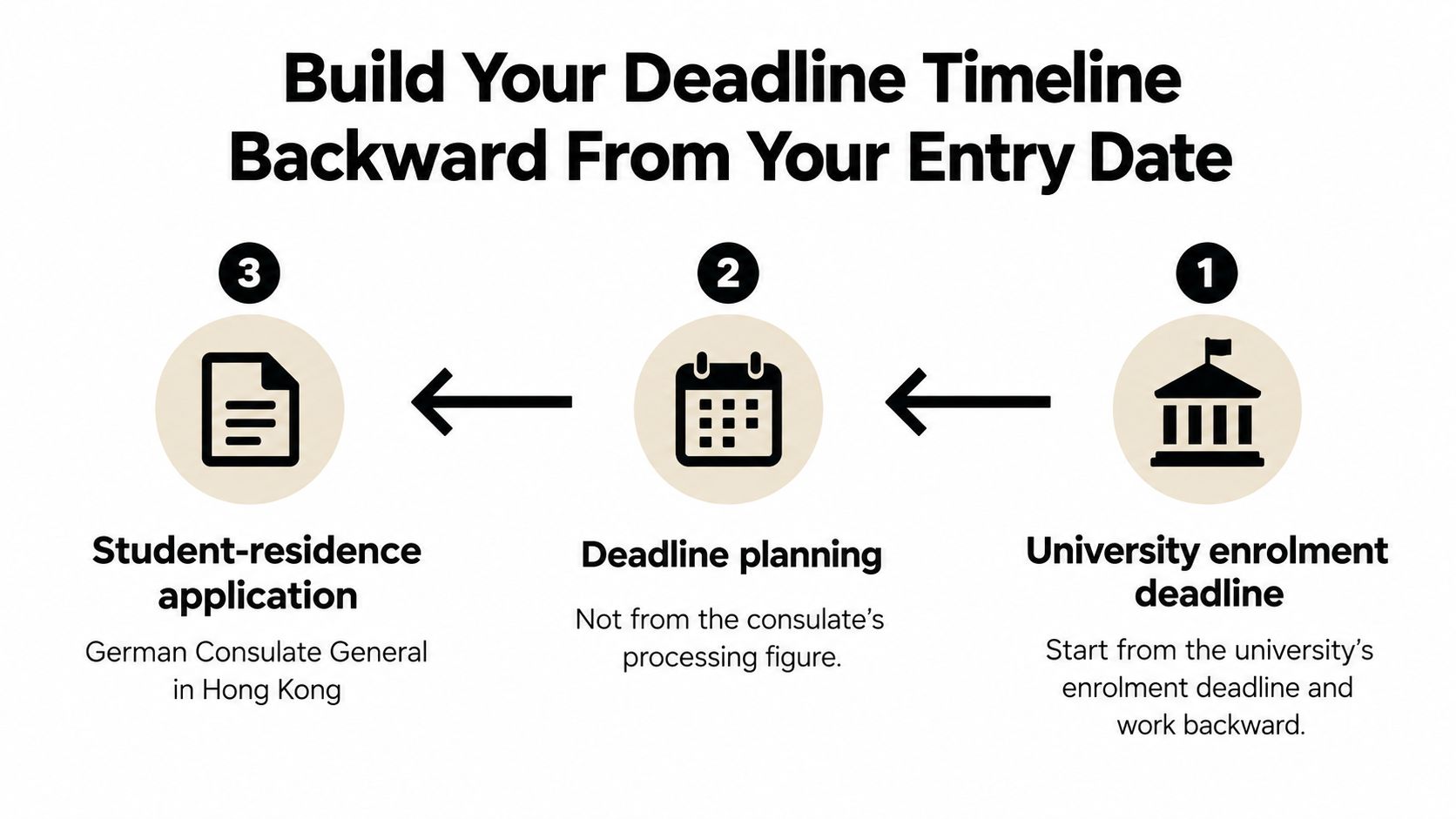
Build Your Deadline Timeline Backward From Your Entry Date
Start with the university's enrolment deadline, then work backwards through admission, document verification, language evidence and immigration permission. Your intended flight date isn't a substitute for the date by which the university expects you to complete enrolment.
The German Consulate General in Hong Kong's student-residence guidance allows applications up to six months before entry and gives standard processing of about two weeks, while warning that individual cases can take longer. That estimate doesn't include obtaining admission, completing any required APS process or securing an appointment.
Keep that distinction visible when planning APS and deadlines. A processing estimate describes part of the journey, not the entire application.
The visual below reinforces the right starting point.
Sample timeline for an October intake from Hong Kong
The intervals below are suggested planning allowances, not official university deadlines or promised processing times. Bring tasks forward when your programme requires earlier evidence.
| Timing before entry | Milestone | Why it matters |
|---|---|---|
| 9–12 months, suggested | Shortlist programmes and confirm APS and language requirements | You need a separate requirements list for each programme |
| 6 months | Student-residence application window opens under the consular guidance cited above | Check appointment access and whether your file is ready |
| 4–6 months, suggested | Order certified copies, request APS if required and book the German language exam | These tasks may involve institutions whose schedules you can't control |
| 3–4 months, suggested | Aim to secure admission or conditional admission | The residence application depends on the university's documentation |
| 2 months, suggested | Assemble proof of funds, health insurance and accommodation evidence | Resolve missing evidence before submission |
| Several weeks before the enrolment deadline | Aim to submit a complete visa application with contingency time | Leave room for queries rather than relying on the shortest estimate |
Don't read the table as an instruction to delay APS until a particular month. If verification is required for the university application itself, it belongs earlier in your individual schedule.
Follow the dependencies
Use this workflow, with preparatory tasks running in parallel where possible:
- Obtain university documentation. Identify the admission or conditional-admission evidence needed for your residence application.
- Confirm the APS position. Resolve this before university submission if the institution requires the certificate at that stage.
- Prepare the supporting file. Assemble academic records, financial evidence, insurance and accommodation information.
- Submit when eligible and complete. Use the earliest permissible filing opportunity your circumstances allow.
- Protect contingency time. Reserve space for document queries, delayed admission confirmation and appointment availability.
How long does the whole process take? There isn't a reliable universal APS turnaround to promise. Plan around your applicable office's current instructions and the university's deadline, with a buffer rather than an assumed completion date.
Practical ways to avoid preventable delays include tracking document deliveries, responding promptly to queries and asking whether conditional admission is sufficient to start the residence application. Take the earliest suitable consular appointment, but don't assume an incomplete file will be accepted.
Keep different immigration systems separate
Hong Kong Immigration's study-entry guidance gives a normal processing period of six weeks after receipt of all required documents and warns that incomplete submissions can't enter processing. That concerns permission to study in Hong Kong, not a German student-residence application.
For any related HK status paperwork, use the relevant authority's timetable. Don't transfer an estimate from one jurisdiction to another.
Create a deadline matrix containing:
- University deadline: Acceptance and enrolment cut-offs, recorded separately where necessary.
- Earliest filing date: When you may submit the German residence application.
- Intended departure: A planning date, not a reason to make non-refundable bookings prematurely.
- Document-complete date: Your internal deadline for having every required item ready.
Plan around the longest applicable estimate. A schedule helps you manage dependencies; it doesn't guarantee an authority's decision date.
Documents to Gather Before You Apply
Build your file from the university's checklist and the consulate's current requirements. Keep those lists separate: a document accepted for admission isn't automatically sufficient for immigration purposes.
Mark every item ready, requested, awaiting clarification or not applicable. That's more useful than a folder containing many files with no indication of what's still missing.
Academic and admission evidence
- Academic records: Degree certificates, transcripts and the certified copies requested by the receiving institution. Arrange certified German or English translations where required.
- Admission: The university's admission or conditional-admission letter, including any outstanding conditions.
- Language: The certificate accepted by the programme. Keep a booked-exam confirmation for planning, but don't assume it replaces a required result.
- APS items: Where applicable, retain the application receipt, correspondence and eventual certificate. A receipt isn't automatically equivalent to completed verification.
If your university uses an external application route, check the Hong Kong applicant's guide to German university applications through uni-assist. Record who receives each document and in what form.
Identity and residence evidence
- Identity: Passport and photographs meeting the current specifications. Check passport-validity requirements against your planned stay before applying.
- Finance: Proof of funds meeting the consulate's current requirements. If using a blocked account, verify the required amount and acceptable documentation before transferring money.
- Insurance: Evidence of health insurance valid for the relevant period in Germany.
- Accommodation: A confirmed booking or documented accommodation plan, as required for your route.
Ask your issuing university in Hong Kong how to obtain certified copies. Don't assume that a downloaded transcript, an ordinary photocopy and an institution-certified document are interchangeable.
Keep originals safe and send them only when the receiving office explicitly requires them. Match names exactly across passports, certificates and application forms, or obtain the official evidence needed to explain a difference.
How to Apply for APS from Hong Kong, Step by Step
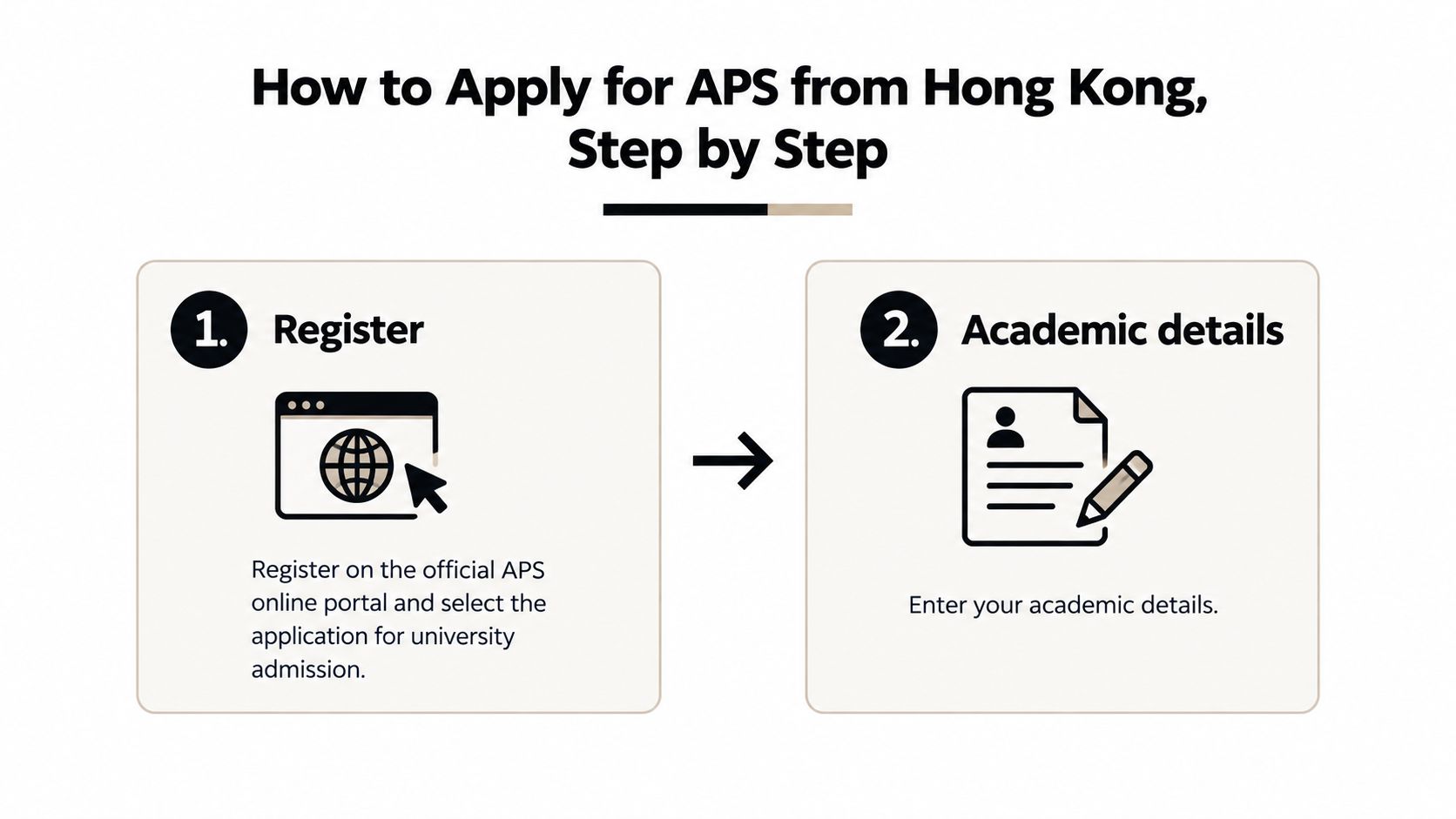
For a Hong Kong applicant, the deciding question is which APS office holds jurisdiction over the qualification, not which passport you hold. Mainland Chinese credentials go to the Akademische Prüfstelle (APS) at the German Embassy in Beijing, which runs its own online registration portal and a posted-file procedure. Vietnamese credentials go to the APS office at the German Embassy in Hanoi, and Indian credentials to APS in New Delhi. Hong Kong, Macao and Taiwan documents do not go through APS at all; they follow the document-origin assessment described earlier.
The sequence below follows the Beijing route, the one most Hong Kong families with APS cases face. If another office handles your documents, confirm its category names and file requirements first, because they differ.
Register, pay and post the file
Open an account on the responsible APS office's portal and select the category matching your goal. Degree-seeking applicants under Beijing register through the individual applicant procedure. The common slip is picking a category based on current residence rather than where the qualification was issued.
Pay the verification fee by the office's stated method and keep the transfer confirmation. Beijing expects proof of payment inside the posted file, so keep the transfer slip ready to enclose rather than archived in your email.
Assemble the physical file. The China route asks for the printed application form, a passport copy, payment proof and your academic documents as certified or notarised copies, with translations where the office requires them. Enter your academic history exactly as it appears on the certificates, send the parcel by tracked courier and keep the document inventory.
Prepare for the interview where your route includes one. Individual applicants under Beijing are called to an interview in English or German covering the subjects on the transcript. Its purpose is to confirm the file describes study you completed, so prepare from your own coursework rather than memorising document contents.
Handle queries and use the certificate. If the office questions a document, answer the specific point raised. Once issued, the certificate goes with the university application, uploaded to uni-assist or attached to a direct application, and appears again at the German visa appointment.
Build APS into your deadline count
Document checks and interview scheduling can run for weeks and stretch further in the months before each intake, so treat the certificate as the item everything else waits on. Count back from enrolment: the visa appointment needs the certificate and an admission letter, and some universities want the certificate already at application stage. A family that starts APS only after an offer letter arrives has compressed the visa stage to its tightest point. Registering while the document set is still being assembled is the safer sequence.
If a parent manages the paperwork while the student finishes school in Hong Kong, agree who answers APS correspondence; an unanswered verification question holds up interview scheduling. The video below shows the logic of the procedure, but the office's written instructions take precedence wherever they differ.
How Much Does APS and the German Visa Process Cost?
Ask any family budgeting for a German application and they want one number. The honest answer is a list. The total depends on which institution issued the qualification, because that decides whether APS applies at all, and every remaining fee is published by a different authority. A Hong Kong applicant whose qualification is exempt removes the APS line entirely yet still pays for translations, examinations and the visa.
Each cost below has exactly one authoritative source. Budget from that source, because a fee remembered from last year's forum post can be worse than no figure at all.
The real cost categories and where each price lives
| Cost item | Where the current figure is published | Budget note |
|---|---|---|
| APS certificate fee | The fee schedule on the responsible APS office's website | Add this row only after confirming APS applies to the issuing institution |
| Certified copies and translations | The translator's or notary's price list, read alongside the office's certification requirements | Price the actual document set, certificate by certificate |
| Tracked courier | The courier's rate card | Include only where originals or certified copies must be dispatched |
| German language examination | The exam provider's published fee page | Confirm which qualification the university accepts before booking |
| Student visa fee | The German mission's visa fee schedule and its accepted payment methods | Check the fee before booking the appointment, since payment rules can differ |
| Blocked account and proof of funds | The account provider's charges page plus the required funds amount set for the visa | Separate the living funds held on deposit from the account's own charges |
| Health insurance valid in Germany | The insurer's tariff for cover recognised in Germany | Match the cover dates to enrolment and visa requirements |
| CEF reimbursement for eligible German courses | CEF eligibility and claim terms | Budget without it; count it only if the claim is approved |
A workable budget takes an afternoon. List the eight rows, mark each one "required", "exempt" or "unconfirmed", then fill in prices only from the named source. One of my clients assumed a single translation price covered her file; her qualification needed four separate certified documents, and the row tripled once she priced it properly.
For the residence side of the spreadsheet, the guide to German student visas and blocked accounts from Hong Kong sets out the financial questions to resolve. Money reserved for living expenses is evidence in the file, not an administrative fee, so plan for both.
Tie payments to decision points
Give each confirmed item its own row with a price, payment deadline and refund terms, plus the requirement it satisfies and the person arranging it.
A missed deadline creates replacement costs: rebooked examinations, repeated document delivery, a deferred intake. The cheapest service is rarely the best trade-off. Pay for the correct requirement while you can still meet the date it feeds.
Budget safeguard: Confirm the requirement first, authorise the payment second, and save the receipt immediately.
Common Pitfalls That Delay Your Deadline
Paying for APS before checking whether it applies is an expensive mistake because the payment may achieve nothing for your application. The opposite mistake is assuming that living in Hong Kong settles every document question.
Good planning for APS and deadlines requires evidence, not reassurance from someone whose qualifications or university route differ from yours. Use the admissions page and written replies to resolve uncertainty before it becomes an urgent problem.
Deadline pitfalls, causes and fixes
These are practical failure scenarios to check for, not reported case studies.
| Symptom | Likely cause | Fix |
|---|---|---|
| APS requested after applying | Assumed a Hong Kong degree needed no programme-specific check | Confirm the document requirements on the university page before paying any fee |
| File returned for queries | Name spelled differently across passport and certificates | Match spellings or prepare official proof explaining the difference |
| Scans rejected | Only scanned copies submitted | Supply certified copies or originals where the office requires them |
| Visa file stalls | APS result or university letter still pending | Request admission documentation early and coordinate appointment timing with file readiness |
| Visa outcome slips past the semester | Consular benchmark treated as a guarantee | Work backwards from enrolment and preserve contingency time |
| Language requirement unmet on time | Examination booked late with no retake allowance | Book around the result deadline and identify a fallback examination opportunity |
Separate booking from readiness
An appointment in the calendar doesn't mean your application is ready. Before attending, check that you have the correct university letter, acceptable financial evidence and the documents required for your particular route.
Equally, don't stop every other task while waiting for APS. You can organise records, clarify language requirements and investigate appointment arrangements without pretending the missing certificate has already been issued.
For working professionals, assign document tasks around your actual availability. A weekday university collection or certification appointment needs space in your work calendar, not just a note in an application spreadsheet.
Treat the language result as a deadline
Confirm the exact certificate, required level and submission date with the programme. A Goethe-Zertifikat or TestDaF result is useful only if the institution accepts that qualification for your route.
Don't choose an examination solely because the name is familiar. Ask whether the result must accompany the initial application or can follow later, then plan preparation, examination attendance and result availability around that answer.
A course can help you prepare, but it can't waive the university's language condition. Keep admissions decisions and teaching advice connected without treating them as interchangeable.
Ready to Start Learning? Book Your Trial Class Today
The CEF claim deadline deserves a place beside your university and examination dates. For eligible courses commencing on or after 1 August 2022, the CEF reimbursement procedure requires Form SFO 313 within one year after the later of course completion or the specified language benchmark examination date; late applications aren't accepted.
The CEF subsidy framework caps total support at HK$25,000 across qualifying courses, rather than guaranteeing that amount back for an individual programme. Confirm your eligibility and the course's reimbursable status before relying on CEF funding.
Keep your claim evidence from enrolment
Store the records as you receive them rather than trying to reconstruct the file after your examination.
- Enrolment and payment: Keep registration confirmations, invoices and receipts.
- Attendance and completion: Retain the evidence needed to demonstrate successful completion.
- Examination records: Save registration details and the relevant result documentation.
- Claim reminder: Calculate the applicable deadline and set an earlier personal submission target.
For adults balancing employment with plans to study abroad in Germany, the right course is one you can attend consistently and connect to a realistic examination date. For parents, that also means checking the school timetable before committing to an intensive preparation schedule.
Choose teaching that fits the application plan
GCA offers native German-speaking teachers with academic credentials, a structured curriculum and preparation for Goethe-Zertifikat and TestDaF. Its small-group and private options include in-person learning near Tsim Sha Tsui and Causeway Bay MTR stations, or online through Zoom, with online rescheduling and documentation-readiness guidance.
Compare those options with university language provision or private tuition according to your learning needs. Ask how the proposed course connects to your starting level, accepted examination and submission deadline.
- Book a trial class: Assess the teaching approach and discuss an appropriate starting level.
- Contact an advisor: Bring your target programme, qualification details and enrolment deadline.
- Check the latest course schedule: Choose a format you can sustain alongside work, school and application tasks.
German Cultural Association Hong Kong(GCA) offers structured German courses and examination preparation that can support a realistic university application plan. Visit German Cultural Association Hong Kong(GCA) to book a trial class or discuss how your language preparation can fit around your document and enrolment deadlines.

APS and Deadlines for Germany: A Hong Kong Timeline

Applying to German Universities from Hong Kong: Uni-Assist


