.png)
.png)

BLOG

香港德國文化協會
The German Cultural Association
What Does Danke Mean? How to Say Thank You & You're Welcome in German
You're at a café in Berlin, the barista hands over your drink, and says “Danke!” If you learned German in Hong Kong, that tiny moment can still throw you off, because knowing how to thank someone is only half the job. The other half is knowing what Danke really means, how to answer politely, and when a simple word can sound warm, formal, or even like a gentle refusal.
Table of Contents
What Danke Actually Means in German
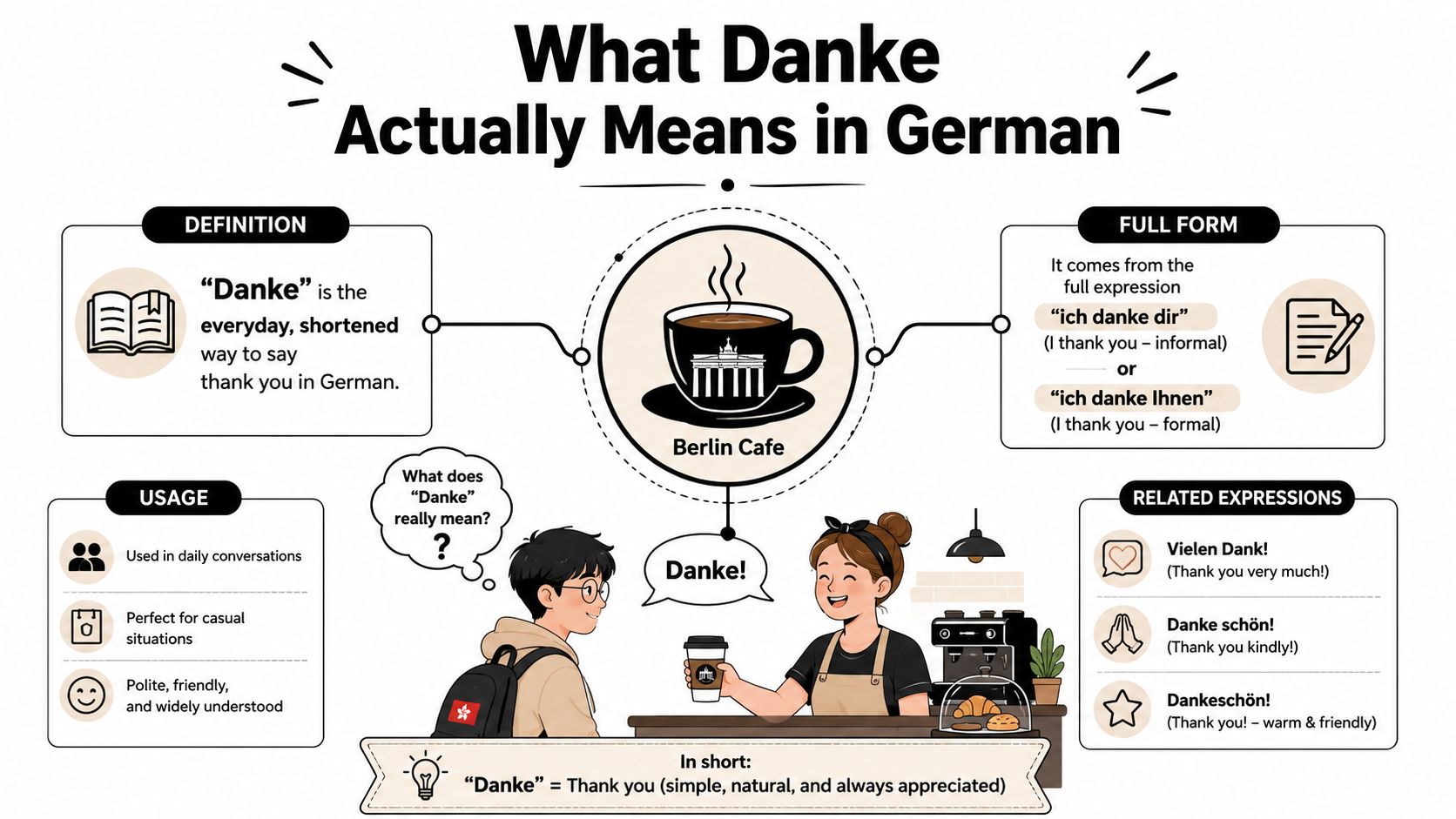
A Hong Kong student orders a flat white in Berlin, hears Danke! from the barista, and freezes for a second. The word is so short that it seems simple, but it carries more than one job in real conversation.
Danke is the everyday shortened form of “ich danke dir/Ihnen”, so it means thank you in the most practical sense. It can also work as a polite refusal, as in “Nein danke”, which makes it useful in cafés, shops, and hospitality settings where a quick, social reply matters (German thank-you meaning and refusal use).
Why this single word matters early
For beginners in Hong Kong, danke is usually one of the first survival words worth mastering because it sits at the centre of German politeness. It belongs in the same everyday family as bitte and gern geschehen, and that makes it more than vocabulary, it's a social signal.
A useful local analogy is Cantonese dor je. You say it naturally when you receive something or want to acknowledge help, and you don't have to think about grammar before using it. Danke works the same way in German, except that it can also signal a polite “no, thank you” when paired with a small covering gesture.
That second meaning catches many learners off guard. In a restaurant, “Nein danke” can politely decline an offer, and the gesture helps the message land as courteous rather than abrupt (gesture-based refusal nuance).
Practical rule: if you can say danke smoothly on day one, you've already handled one of the most common social exchanges in German.
That's why this tiny word shows up so early in A1 learning and why it matters for anyone in Hong Kong planning travel, school exchange, or structured study. Once you can use Danke confidently, the rest of German politeness starts to feel much less mysterious.
Pronunciation and the Danke Family of Phrases
不少香港學習者都認得 danke 的拼法,但一開口就會猶豫。好消息是,這個核心發音本身很短,也很順口,一旦掌握了規律,整組「謝謝」表達都會更容易上手。
先把核心字說穩
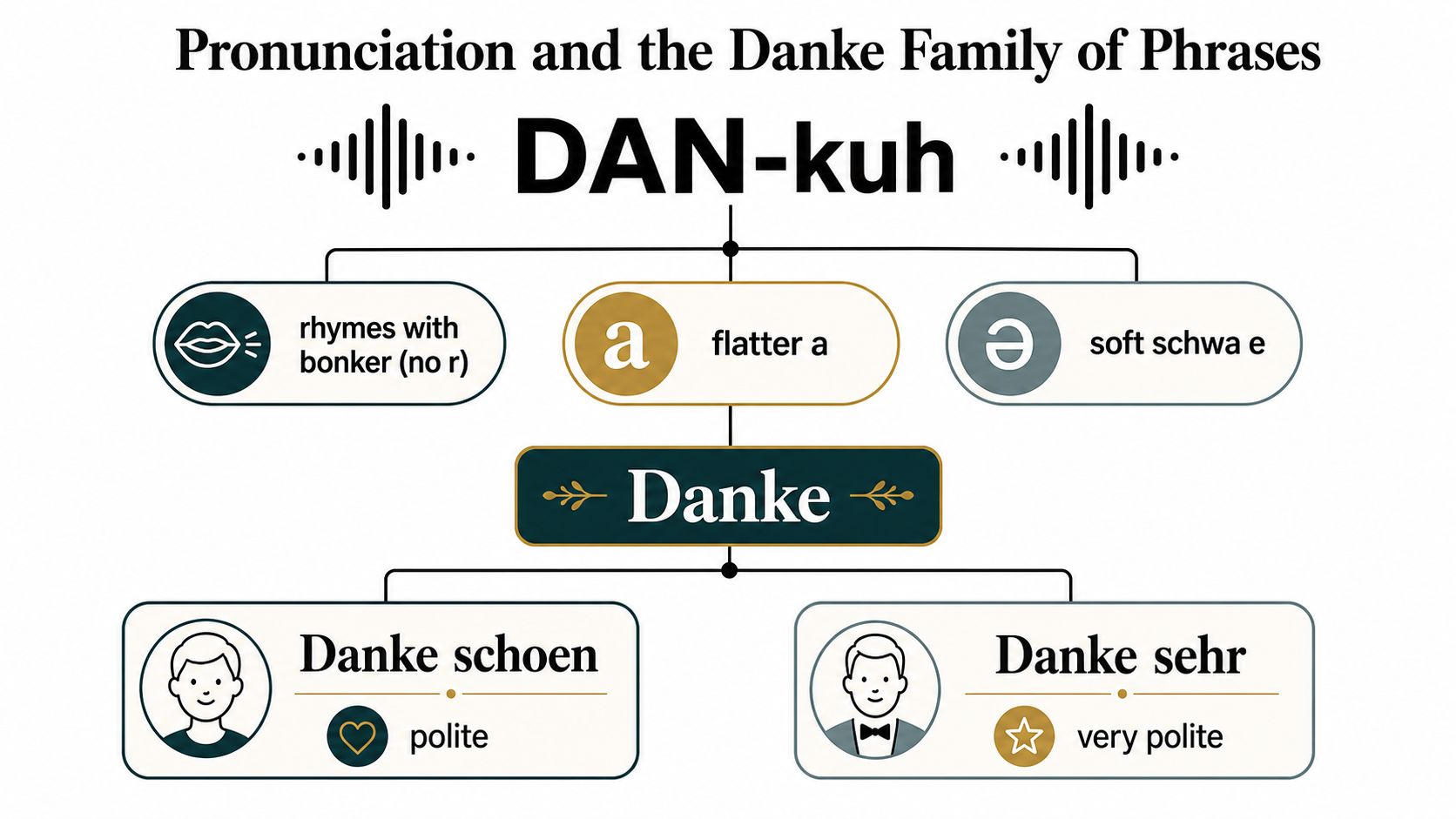
初學者可以先抓住接近 “DAN-kuh” 的讀法。第一個母音比英語的 “ah” 更平,最後的 e 是很輕的弱母音,接近英語裡沒重音的結尾音,但更短。
DAHN-kuh shurn
這句可幫你帶出 danke schön 的節奏。schön 裡的 sch 會比英語 “shown” 的起音更柔、更圓,很多香港學習者要反覆幾次才會覺得自然。先把速度放慢,再把 danke 的第一節說清楚,整句就會穩很多。
如果你想先把基礎發音整理好,可以配合這份德語發音入門指南一起練習。
由短到長,分清語氣
Danke、danke schön、vielen Dank、herzlichen Dank、tausend Dank,意思都和感謝有關,差別在語氣和場合。這種差別很像香港人在不同場景下選擇 唔該、多謝、或更客氣的書面說法,字面上都在回應幫忙,聽起來卻不一樣。
- Danke, 短而中性,日常最常用。
- Danke schön, 更暖一點,適合收禮物或較有禮貌的互動。
- Vielen Dank, 語氣更明確,適合電郵或你想表達更鄭重的感謝。
- Herzlichen Dank, 較有心意,也較正式,常見於書面德語。
- Tausend Dank, 比較口語,帶點熱情,接近「萬分感謝」, phrase variations and register。
在香港準備 DSE、IGCSE,或練習 Goethe-Zertifikat 時,這組變化很實用。你可以把它當成同一條語氣光譜,短句用在快節奏對話,長一點的說法則留給電郵、面試回覆,或者寄給慕尼黑客戶的商務訊息。便利店收銀員聽到 Danke 就夠了,朋友送你小禮物時,Danke schön 會更貼心,面試官或入學聯絡人則更適合 Vielen Dank 或 Herzlichen Dank。
在餐廳裡,這些差異也很清楚。你在柏林咖啡店拿到咖啡時說 Danke,不會失禮。若是一位同學幫你修正德文作業,Danke schön 會更自然。若你準備寫給大學辦公室或公司窗口,Vielen Dank 和 Herzlichen Dank 會比口語感更穩。
How to Say You're Welcome in German
The reply after danke can feel deceptively small. For Hong Kong learners, that is often the first point of confusion, because English allows several easy replies while German ties the choice more closely to tone, setting, and the relationship between speakers.
Choose the reply that fits the setting
| Phrase | Formality | Best Context | Avoid When |
|---|---|---|---|
| Bitte | Neutral | Shops, quick service, everyday exchanges | You need a warmer written reply |
| Bitte schön | Polite | Retail, classroom, polite face-to-face replies | You want a very casual tone |
| Gern geschehen | Polite and friendly | Emails, favours, slightly more thoughtful interactions | The setting is extremely informal |
| Kein Problem | Casual | Friends, classmates, relaxed chats | You're writing to a university office or client |
Bitte is the safest default. It works in many situations, and in spoken German it often carries the politeness that English speakers try to put into “please” alone.
Bitte schön adds a touch more warmth. Gern geschehen sounds smoother in correspondence or when you want to say you were glad to help. Kein Problem feels relaxed, but in formal email to a German university or business contact, it can sound too casual. If you are preparing for school tasks, travel conversations, or a Goethe-Zertifikat speaking test, this small difference helps you sound more natural without memorising a long list of replies.
A simple way to remember the tone
Quick and practical exchanges call for Bitte. If someone did something kind for you, Gern geschehen sounds gracious. If it is a friend or classmate, Kein Problem is fine, but keep it out of serious applications and professional correspondence.
For a broader look at everyday etiquette, the German culture and etiquette guide helps place these replies in real situations, from a café in Berlin to a polite refusal at a Cantonese-German dinner.
In German, a short reply can still feel polite, as long as your tone matches the situation.
Capitalisation, Formality, and the Polite Refusal
This is the part beginner guides often skip, and examiners don't. If you're writing German for school, university, or a visa-related email, the small distinction between lowercase and capitalised forms can matter a lot.
Write the form that matches the grammar
Danke is usually written lowercase when it works like a particle, while Danke becomes capitalised when treated as a noun in phrases such as “vielen Dank” (capitalisation rule). That means learners should stop guessing and treat spelling as part of politeness, not just grammar.
In practice, this matters in:
- Goethe-Zertifikat writing, where tone and spelling both count.
- University application emails, where a casual reply can feel careless.
- Visa or administrative correspondence, where formality should stay steady.
- DSE, IB, and IGCSE pathways, where students often need clean, controlled written German for assessment or preparation.
The simplest exam-safe habit is this. Use danke in speech and short neutral exchanges, and use vielen Dank or herzlichen Dank in polished writing when you want to sound deliberate.
Learn the polite refusal separately
“Nein danke” is not just “no thank you” in a dictionary sense. In real life, it can work with a small covering hand gesture, which softens the refusal and keeps the interaction friendly. That matters in Berlin cafés, shops, and service counters, where the social message should sound calm, not blunt (refusal gesture and pragmatic use).
That same awareness helps Hong Kong learners avoid one common mistake. Kein Problem is fine with friends, but it can sound too loose in a formal email to a university office or admissions team.
For etiquette beyond the phrase itself, see the German culture and etiquette guide once you're comfortable with the basics.
Sample Dialogues for Travel, School, and Business
The easiest way to make danke stick is to hear it where Hong Kong readers need it, not just in textbook examples. These three scenes cover travel, study, and work.
Hotel check-in in Munich
Receptionist: Guten Abend. Hier ist Ihr Schlüssel.
Parent: Danke.
Receptionist: Bitte schön. Frühstück ist von sieben bis zehn.
What just happened. The exchange is short, polite, and efficient. Danke works because it matches the quick service context, while Bitte schön adds a warmer reply from the hotel staff.
Classroom in Tsim Sha Tsui
Student: Entschuldigung, was bedeutet das?
Teacher: Das heisst “thank you” auf Deutsch.
Student: Danke schön.
Teacher: Gern geschehen.
What just happened. The student shows respect without sounding stiff, and the teacher answers with a calm, supportive phrase. In a Hong Kong IGCSE or IB setting, this kind of controlled exchange builds confidence for speaking tasks and classroom interaction.
Business email to a German supplier
Subject: Vielen Dank für Ihre Nachricht
Body: Vielen Dank für Ihre Nachricht. Ich habe die Details geprüft und melde mich morgen mit unserem Feedback.
Closing: Mit freundlichen Grüssen
What just happened. The sender uses Vielen Dank to establish a professional tone immediately. In business German, that kind of careful opening matters more than trying to sound clever.
If you're practising for travel scenarios, the German for travellers phrase guide is a useful companion. For longer-term learners in Hong Kong, the same phrase can move from a café table to an email inbox without changing its core meaning.
Speech cue: eye contact and a small nod can make even a short bitte or danke feel fully polite.
One practical decision point helps. If you know the person well, a lighter reply is fine. If the exchange is formal, let the phrasing do the work for you.
A One-Week Practice Plan for Busy Hong Kong Learners
A busy week in Hong Kong doesn't leave much room for language study, so the trick is to make Danke automatic in very small sessions. Short repetition beats an ambitious plan you never finish.
Keep the drills tiny and repeatable
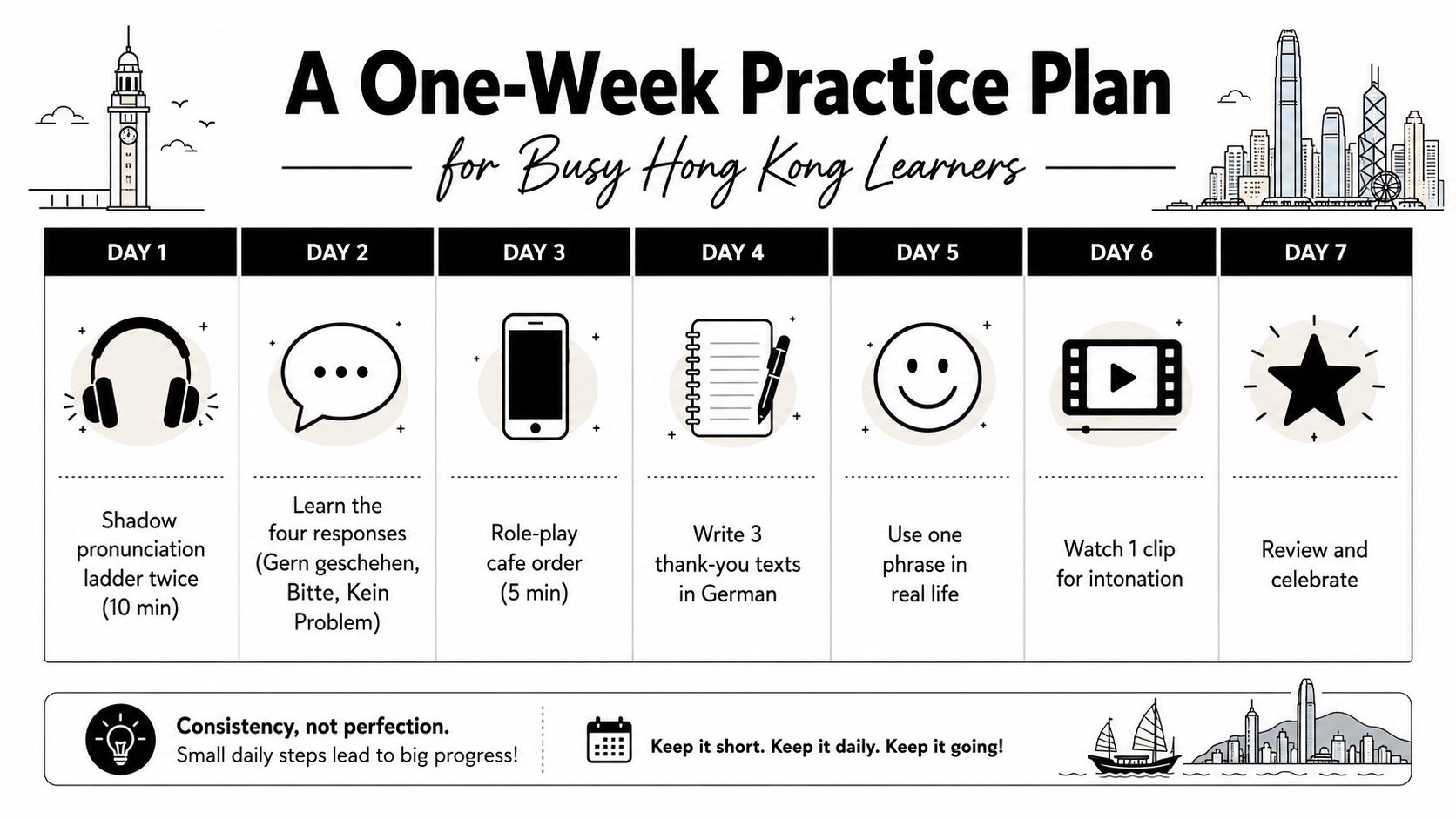
- Day 1: Shadow the pronunciation ladder twice for 10 minutes.
- Day 2: Drill the four replies aloud, Bitte, Bitte schön, Gern geschehen, Kein Problem.
- Day 3: Write five short thank-you sentences with danke, danke schön, and vielen Dank.
- Day 4: Practise Nein danke in front of a mirror, then try it with a study partner.
- Day 5: Listen to one beginner clip and repeat only the thank-you lines.
- Day 6: Role-play one travel or business dialogue from the earlier section.
- Day 7: Record yourself saying danke in three tones, neutral, warm, and formal.
The point isn't volume. The point is to make the phrase feel natural before you need it in real life.
Use the week to build one habit
If you're a parent, ask your child to use one phrase after dinner. If you're working, say danke out loud after reading a German email draft. If you're preparing for study abroad in Germany or Spain, the habit of matching tone to context will help you beyond one vocabulary item.
Consistency beats marathon study sessions. A few minutes a day can sharpen timing, pronunciation, and confidence faster than a single long session you dread repeating.
For learners who want more than self-study, structured classes can add feedback, correction, and exam awareness. Options in Hong Kong include university programmes, private tutors, self-study apps, and the German Cultural Association Hong Kong(GCA), which offers structured German classes, native-speaker teaching, small groups, and online or in-person learning.
Ready to Build Real German Fluency in Hong Kong
Danke is the entry door, not the destination. If you want German that holds up in classroom speaking, Goethe-Zertifikat preparation, business emails, or study-abroad planning, you need a clear structure and feedback from native-speaking teachers.
In Hong Kong, the EDB's 2024 SSPA/SSPA-Course Handbook lists German among the approved Other Languages for Secondary 3 discretionary school placement, which shows that German sits inside a real academic pathway, not just a casual interest track (EDB handbook reference). That's why small phrases like danke, bitte, and gern geschehen matter so much, they're the first building blocks of a wider learning plan.
The German Cultural Association Hong Kong(GCA) offers small-group classes capped at six students, native German-speaking teachers, in-person centres near Tsim Sha Tsui and Causeway Bay MTR, plus Zoom lessons for flexible study. It also supports learners aiming at Goethe-Zertifikat, TestDaF, IGCSE, A-level, and IB, which makes it a practical option for serious learners who want a structured path.
If you're ready to move beyond single phrases and start using German with confidence, book a trial class, speak with an advisor, or check the latest schedule at German Cultural Association Hong Kong(GCA). GCA can help you build from Danke into real exam-ready German with native feedback, clear progression, and a study plan that fits life in Hong Kong.

Costs and Language Requirements for German in HK

Student Exchange to Germany: Programmes for HK Students


