.png)
.png)

BLOG

香港德國文化協會
The German Cultural Association
Top German TV Shows & Podcasts 2026: Best HK Learning Resources
It is 7:30 a.m. in Hong Kong. You are on the MTR, half-awake, and trying to use 15 minutes well before work, school, or a packed afternoon of tuition. Random German content will waste that window. The right content, matched to your level and your goal, will improve listening faster.
That is the point of this guide to the Top German TV Shows & Podcasts 2026: Best HK Learning Resources. It is not a generic roundup. It is a practical shortlist for learners in Hong Kong who need German for exam results, university preparation, career growth, or stronger business communication. Each resource works best at a specific CEFR stage, and each one should fit into a clear study routine rather than sit in your bookmarks unused.
If you are preparing for Goethe-Zertifikat, IGCSE, A-level, or IB, you need media that trains listening under real conditions. If you are learning German for work, you need material that builds speed, vocabulary range, and tolerance for native speech. If you are supporting a child, you need input that is simple enough to follow but still authentic. Those are different jobs. One podcast will not solve all of them.
Hong Kong learners do best with a blended approach. Use short, repeatable media during commutes and breaks. Then connect that input to structured grammar, speaking, and feedback in class. If you want more self-study options to support that routine, start with these free German learning resources in Hong Kong.
My recommendation is simple. Choose one core audio resource for daily listening, one video resource for visual context, and one structured course path, such as those at the GCA, to keep your progress aligned with CEFR targets. That combination is what turns passive exposure into exam progress and usable German.
Table of Contents
1. DW – Langsam gesprochene Nachrichten
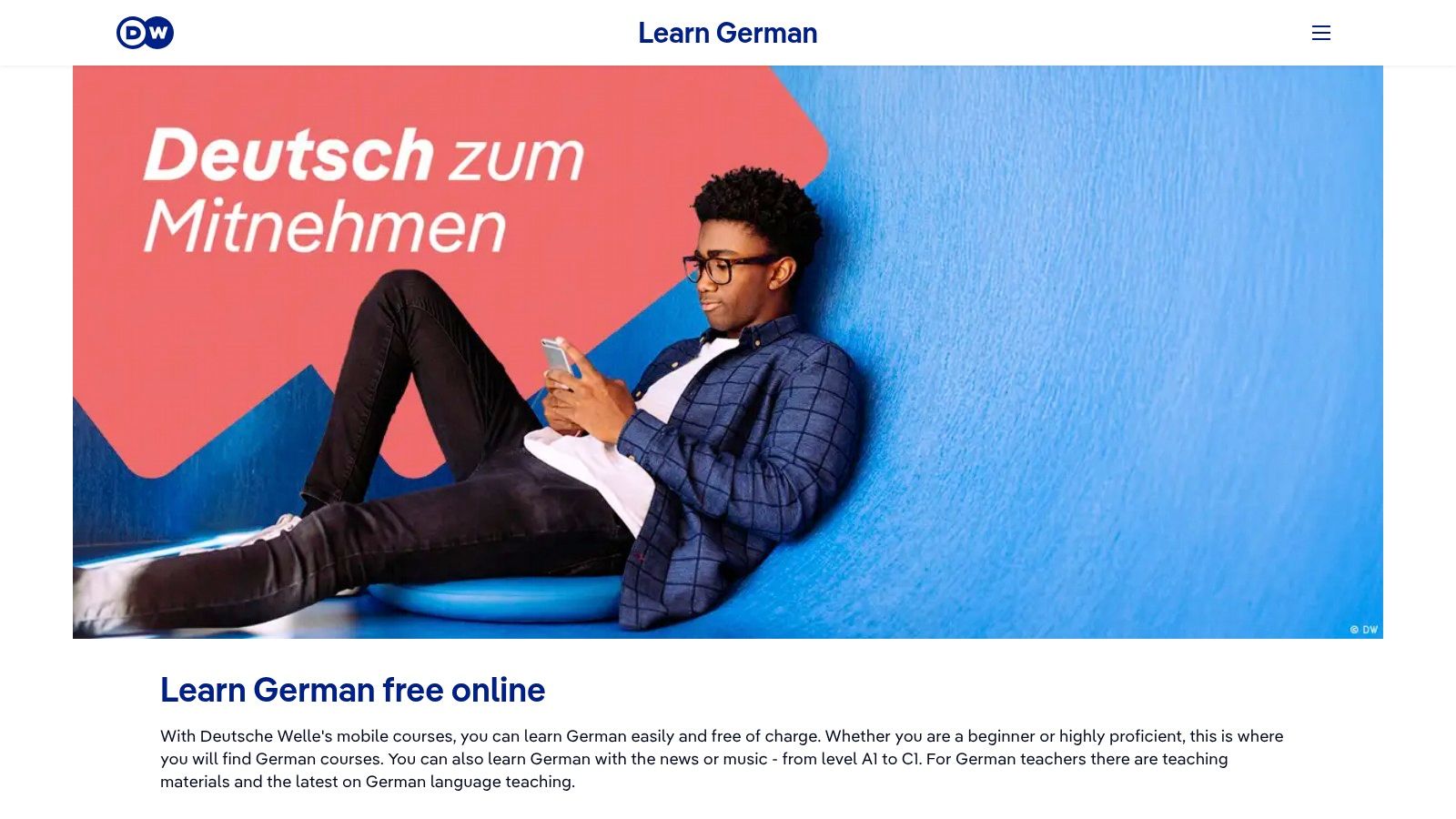
If you want one German podcast that fits busy life in Hong Kong immediately, start here. DW – Langsam gesprochene Nachrichten is short, clear, and disciplined. It gives you standard German pronunciation with text support, which is exactly what exam-focused learners need.
This is the strongest daily routine builder on the list for A2 to B2 learners. It's especially useful if you're preparing for Goethe listening tasks or if you need current-affairs vocabulary without getting lost in fast native-speed speech.
Daily fit for Hong Kong routines
Use this on the MTR, between meetings, or before your child's homework session. One short episode, one transcript review, one shadowing repetition. That's enough to keep German active every day.
- Best for exam routines: The slow, controlled delivery helps with listening discrimination and note-taking.
- Best for adults with little time: You don't need a full study block. You need consistency.
- Best avoided by advanced learners as a main tool: Once you move past B1, the pacing can feel too gentle unless you use it for precision practice.
Practical rule: If your listening collapses with native-speed news, don't force harder content too early. Build control first.
For learners who want more free study support around this format, GCA's guide to 12 free resources to learn German in Hong Kong is a sensible next step.
2. Easy German Podcast
Easy German Podcast is where classroom German starts sounding like real life. The hosts speak naturally, the topics feel current, and the conversational tone helps you move beyond textbook dialogues.
This is one of the best choices in the Top German TV Shows & Podcasts 2026: Best HK Learning Resources list for learners who already know some German but need more natural input. If you're around B1 or above, it's a strong bridge into everyday speech.
Best use for B1 and above
The free version is already useful. The paid membership becomes much more attractive if you need transcript-based review and vocabulary support.
- Best for transitioning out of textbook German: You'll hear natural fillers, reactions, and phrasing patterns.
- Best for business-minded adults: Real conversation trains your ear better than isolated grammar drills.
- Watch the paywall issue: The best support features sit behind membership, so budget-conscious learners should decide whether they'll use the extras.
Germany is reported as the world's fourth-largest podcast country, with entertainment, true crime, and news among the leading categories, according to Germany Trade & Invest's podcast market overview. That scale matters for learners in Hong Kong because larger podcast ecosystems usually mean better discoverability, transcripts, and platform support.
If you want conversational German that still feels manageable, Easy German earns its place near the top.
3. Slow German with Annik Rubens
Slow German with Annik Rubens is calm, teacherly, and structured. That's exactly why it works. If you prefer focused monologues over fast group chat, this podcast is a better choice than trendier options.
The episodes are topic-based, so they fit neatly into exam themes, cultural discussion, and vocabulary revision. Parents helping teenagers with German enrichment often find this format easier to work with than unscripted native content.
Why it works for careful learners
This is one of the most useful resources for learners who need clean input and repeatability. You can listen once for gist, again for key words, and a third time for shadowing.
- Best for A2 to B2 learners: It gives you enough structure without sounding artificial.
- Best for writing support: Topic-based listening feeds directly into essays, speaking topics, and oral discussion prep.
- Main limitation: It's mostly one speaker, so you won't get much spontaneous dialogue training.
Good German listening practice isn't about passive exposure. It's about replay, transcript work, and accurate imitation.
In Hong Kong, where many learners study around work and school schedules, that repeatable format is more useful than a podcast that sounds impressive but can't be reviewed properly.
4. Auf Deutsch gesagt
If your German is stuck in “correct but stiff,” Auf Deutsch gesagt can fix that. This podcast pays attention to idioms, registers, and how people naturally phrase things in modern German.
It's not beginner content. That's the point. Upper-intermediate learners often plateau because they understand grammar but don't yet control colloquial language. This podcast pushes you past that stage.
Best for serious listening growth
The interviews and explanations are especially good for learners preparing for university, relocation, or professional communication. You'll hear German that sounds lived-in, not sanitized for learners.
- Best for B1 to C1: Strong value once you already have a foundation.
- Best for spoken nuance: It sharpens your sense of tone, phrase choice, and natural rhythm.
- Main drawback: Difficulty can jump depending on the guest or topic.
For HK learners choosing between podcasts and TV, this distinction matters. Podcasts are better for repeatable listening, transcript-based shadowing, and level control, while TV is better for broader context and visual support, as discussed in this German learning media comparison.
If your goal is Goethe-Zertifikat, business German, or stronger discussion skills, this is a smarter pick than random entertainment listening.
5. Coffee Break German

If you're an absolute beginner, don't start with native-speed German media and hope for the best. Start with Coffee Break German. It gives clear guidance, English explanations, and short lesson chunks that fit adult schedules.
This is one of the most practical entry points for working professionals and parents in Hong Kong. It reduces friction. That matters more than purity.
Strong beginner support in English
The English scaffolding makes this less immersive than all-German content, but much more usable for genuine beginners. Many people who fail at German media start too high and lose momentum.
- Best for nervous starters: You'll know what you're hearing and why it matters.
- Best for routine building: Short lessons fit lunch breaks and commute windows.
- Main compromise: You get support, but less authentic immersion.
If you're building a full learning plan, pair beginner media like this with a proper class structure. GCA's guide on learning German in Hong Kong in 2026 is useful if you want to connect self-study with formal lessons, exam preparation, or native-speaker support.
For adults who say, “I want to learn German HK style, but I don't know where to start,” this is a sensible first podcast.
6. Deutschlandfunk Nova – Eine Stunde History
A Hong Kong learner at B2 often hits the same wall. Everyday podcasts start feeling too easy, but academic German still moves too fast. Deutschlandfunk Nova – Eine Stunde History is one of the best tools for crossing that gap.
This podcast suits learners who want serious listening practice with substance. The episodes focus on history, politics, and ideas, so you build the kind of vocabulary that helps with university study, presentation work, and higher-level exam tasks. For IB students, A-level students, and adults preparing for Goethe B2-C1 or business-facing German, that makes it far more useful than casual entertainment audio.
Best for B2 to C1 learners who need academic listening discipline
The production is clear, but the content is demanding. You need concentration, note-taking, and the patience to replay sections. Use one episode as a weekly study text, not as passive commute audio.
- Best for B2 and above: Start here once graded learner podcasts feel too controlled.
- Best for exam preparation: It trains summary skills, opinion tracking, and long-form listening stamina.
- Best for Hong Kong professionals: Historical and civic topics give you more precise German for meetings, discussion, and formal contexts.
- Main drawback: Weak vocabulary gets exposed fast.
Use it strategically. Listen once for the main argument, then again for dates, cause-and-effect language, and academic connectors. If you study in a structured course at the same time, bring one episode into class vocabulary review or speaking practice. That is how self-study starts serving a clear CEFR goal instead of becoming random exposure.
If you also want to discover deep learning channels, use that as a separate source of serious educational content. Keep this podcast as your dedicated German listening workout.
Treat each episode like a seminar, not background sound.
7. Easy German on YouTube

If podcasts train your ear, video trains your ear with support. That's why Easy German on YouTube is one of the strongest visual resources for learners in Hong Kong.
The street interviews are especially useful because you hear real people answering ordinary questions. That gives you accent variation, natural pacing, and useful everyday vocabulary. The “Super Easy German” videos also make this channel accessible to beginners.
Best video choice for real-world German
This is not a linear course. You need to choose playlists intentionally. But the subtitle support and visual context make comprehension easier than pure audio.
- Best for beginners who need visual clues: Faces, gestures, and locations support meaning.
- Best for motivation: It feels alive, modern, and culturally grounded.
- Main drawback: Some episodes jump in difficulty very quickly.
If you like learning through video and want broader study inspiration, this curated guide to deep learning channels on YouTube is worth browsing.
For many learners, this is the fastest way to make German feel real rather than academic.
8. ZDF logo! Kindernachrichten
A Hong Kong learner finishes class, has 10 minutes on the MTR, and wants German that is current without being overwhelming. ZDF logo! Kindernachrichten fits that slot better than many adult news formats.
It explains current events in clear German, with visuals that do real support work instead of acting as decoration. For A2 to B1 learners, that matters. You get exposure to native news topics without the density and speed that usually shut learners out.
The right news resource for A2 to B1 learners
Use logo! as a transition tool. It sits between learner materials and full native news, which makes it especially useful for Hong Kong students preparing for school assessments, adults rebuilding confidence after a long break, and families studying together at home.
It also matches local study habits well. The segments are short, mobile-friendly, and easy to replay, so they work during commutes or between tutoring sessions. If you are taking a structured course at the GCA, logo! is the kind of outside input that reinforces vocabulary and current-affairs themes without wrecking your study plan.
- Best for A2 to B1 learners: Clearer sentence structure and slower topic build-up than adult news
- Best for exam-oriented students in Hong Kong: Useful for summarising current issues in simple, accurate German
- Best for family study: Parents and children can watch the same clip and discuss it at different levels
- Main drawback: The presentation style is young, so some adult learners will need to ignore the tone and focus on the language
Use it with a task. Write down five key nouns, give a two-sentence summary, then retell the story aloud. That is how you turn easy input into measurable progress.
9. ARD – Tagesschau in 100 Sekunden

ARD – Tagesschau in 100 Sekunden is brutally efficient. It gives you a short burst of native-speed German news with almost no time commitment.
This is not a learner podcast. That's why it works well as a discipline tool for B1+ students. You get daily contact with authentic German, even on your busiest days.
Use it as a discipline tool
Think of this as your minimum effective dose. One clip in the morning. One replay in the evening. A few keywords noted down. Done.
- Best for busy professionals: It respects tight schedules.
- Best for vocabulary reinforcement: Repeated headlines build familiarity with common news language.
- Main drawback: It's fast and ungraded, so weaker learners can feel overwhelmed.
Don't measure success by understanding every word. Measure it by how much more you catch after repeated listens.
For adults serious about German lessons Hong Kong learners can sustain, this kind of compact authentic input works far better than unrealistic binge-study plans.
10. ZDF – Terra X

You finish class in Central, open a Terra X episode on the MTR ride home, and spend 20 minutes hearing educated, native-speed German explain history, science, or archaeology. That is exactly the kind of input B2 learners in Hong Kong need if they want to move beyond textbook German.
ZDF – Terra X is the strongest documentary pick on this list. It gives you high-value listening practice with a clear knowledge focus, which makes it far more useful than random entertainment if your goal is exam performance, university study, or serious vocabulary growth.
Best documentary input for B2 and above
Terra X suits learners who already have a base and now need range. The narration is fast, the vocabulary is precise, and the visuals give enough support to keep you from getting lost. That combination matters for Hong Kong learners preparing for Goethe B2 or C1, IB oral discussions, or business settings where you need to explain ideas, not just survive small talk.
It also fits well into a structured plan. Use one episode per week alongside a course at GCA. First watch for gist. Then rewatch and note topic vocabulary, linking phrases, and how the speaker organises explanations. That turns passive viewing into active CEFR-level training.
Trend-driven fiction can still be fun, as noted earlier. Terra X usually delivers better learning value because the factual framing, repetition of key terms, and visual context make difficult German easier to follow.
- Best for B2 to C1 learners: Strong choice for advanced listening, academic vocabulary, and discussion practice.
- Best for Hong Kong exam and study goals: Useful for Goethe speaking themes, IB-style topic discussion, and future university seminars in German.
- Main drawback: Native-speed narration demands concentration, so A2 to B1 learners should use it selectively.
If you want to balance documentaries with scripted listening, GCA's guide to the best German movies to help you learn the language adds a useful second track.
Top 10 German TV & Podcast Resources for HK Learners, 2026 Comparison
| Resource | 👥 Target audience | Level & use + ★ | ✨ Key strengths / 🏆 | 💰 Price / Value |
|---|---|---|---|---|
| DW – Langsam gesprochene Nachrichten | A2–B2 commuters & exam prep | A2–B2 · daily news listening · ★★★★ | ✨5–8min learner‑paced episodes · 🏆clear transcripts | 💰Free |
| Easy German Podcast | B1–C1 real‑world learners | B1–C1 · conversational immersion · ★★★★ | ✨Street interviews + cultural insight · 🏆community tools (paid) | 💰Freemium |
| Slow German (Annik Rubens) | A2–B2 culture & vocab builders | A2–B2 · thematic monologues · ★★★★ | ✨Pedagogical topics + transcripts · 🏆excellent diction | 💰Free / optional support |
| Auf Deutsch gesagt | B1–C1 idiom & register focus | B1–C1 · colloquial deep dives · ★★★★ | ✨Native interviews + registers · 🏆high audio quality | 💰Free |
| Coffee Break German | Beginners to B2 adult learners | A0–B2 · structured lessons · ★★★★ | ✨15–20min scaffolded lessons · 🏆clear curriculum | 💰Freemium (paid courses) |
| Deutschlandfunk Nova – Eine Stunde History | B2+ academic learners | B2–C1+ · advanced listening · ★★★★ | ✨Rich historical themes · 🏆broadcast standards | 💰Free |
| Easy German – YouTube | A1–C1 visual & listening learners | A1–C1 · video immersion · ★★★★ | ✨Subtitled street videos · 🏆huge free library | 💰Free / membership |
| ZDF logo! (Kindernachrichten) | Teens & adult beginners | A2–B1 · simple news + visuals · ★★★ | ✨Strong visual support · 🏆accessible explanations | 💰Free |
| ARD – Tagesschau in 100 Sekunden | B1+ quick‑exposure learners | B1+ · headlines in 100s · ★★★ | ✨Ultra‑short daily updates · 🏆consistent routine | 💰Free |
| ZDF – Terra X (Documentaries) | B2–C1+ subject‑focused learners | B2–C1+ · documentary vocab · ★★★★ | ✨High‑production visuals · 🏆specialist topic depth | 💰Free (YouTube; some geoblocking) |
How to choose the right German media in Hong Kong
Choose by goal, not by hype. That's the cleanest way to use the Top German TV Shows & Podcasts 2026: Best HK Learning Resources well.
If your priority is exam preparation, start with DW, Slow German, and then add ARD clips once your listening is stronger. If your priority is real-world conversation, use Easy German Podcast, Easy German on YouTube, and Auf Deutsch gesagt. If your priority is beginner access, Coffee Break German and logo! are the easiest entries. If your priority is academic or business-level comprehension, move toward Deutschlandfunk Nova and Terra X.
For Hong Kong learners, format matters as much as content. Podcasts are usually better for commute-based repetition and transcript work. TV and video are better when you need visual support, stronger motivation, and broader cultural exposure.
Use one core resource and one support resource. Don't try to follow six at once.
Ready to Fast-Track Your German Learning in HK
These shows and podcasts can improve your listening, vocabulary, and cultural understanding quickly if you use them properly. But media alone won't give you confident speaking, clear grammar control, or exam-ready performance. You still need correction, structure, and a sequence that matches your level.
That's where formal teaching matters. The strongest learners in Hong Kong don't treat media as a replacement for lessons. They use it as reinforcement. A structured course gives you the grammar foundation, speaking practice, and feedback that turn passive exposure into active German.
This matters even more for exam pathways such as Goethe-Zertifikat, IGCSE, A-level, IB, TestDaF, or German for university and visa purposes. Podcasts can sharpen your ear. TV can widen your vocabulary. But neither will tell you why your sentence is weak, where your pronunciation slips, or how to improve your writing under exam conditions.
For adults and parents who want a practical route forward, combine media with a native-led curriculum. That approach is more efficient, especially when you're studying around work, school, and family life in Hong Kong. It also helps you stay accountable, which is often the difference between good intentions and real progress.
German Cultural Association Hong Kong(GCA) is one relevant option if you want that structure. GCA offers small-group and private German courses in Hong Kong, with native-speaking teachers, in-person lessons near Tsim Sha Tsui and Causeway Bay MTR stations, and online classes by Zoom. Their course offering also includes Goethe-Zertifikat, TestDaF, IGCSE, A-level, IB, business German, and children's classes, which makes it easier to connect self-study resources like the ones above with a clear learning plan.
If you want to learn German HK learners can sustain, keep it simple. Pick one podcast for daily listening. Pick one video resource for weekly comprehension work. Then place both inside a proper study system.
If you want a structured way to build on these media resources, German Cultural Association Hong Kong(GCA) offers native-speaker German classes for adults, teens, and children, including exam preparation, business German, and flexible online or in-person lessons in Hong Kong. Book a trial class or contact their advisors to find a course that matches your level and goals.
Joining a German Course Mid-Term: September Intake Guide for Hong Kong 2026/27
Preschool German Classes 2026/27 (Ages 3-6): Small-Group Intake & Trial Lessons


