.png)
.png)

BLOG

香港德國文化協會
The German Cultural Association
Learn German in Hong Kong Ultimate Guide 2026
You're probably reading this for one of four reasons. You need German for an exam, for a move to Germany or Austria, for a career step that finally justifies the effort, or because your child needs a serious course in Hong Kong instead of another generic language class.
Good. That means you're already asking the right question.
Learn German in Hong Kong Ultimate Guide 2026 isn't about romanticising language learning. It's about choosing the right format, budget, and timeline for your actual goal in HK. If you want a certificate, university pathway, stronger IB or IGCSE performance, or better business mobility, German can pay off. If you choose the wrong course, it becomes an expensive hobby.
Why Learn German in Hong Kong Today
German is one of the few languages in Hong Kong that can support academic, immigration, and career goals at the same time. That makes it worth considering seriously, especially if you want a language that opens doors beyond casual travel.
For professionals, the timing is strong
Hong Kong's links with German-speaking markets matter more when trade and hiring move in the same direction. The 2025 HK-Germany bilateral trade surge to HK$45B increased demand for Business German, with enquiries up 37% at language centres, and 92% of Business German graduates at specialised providers secured roles at top firms, according to Goethe-Institut Hong Kong course information.
That matters if you work in:
- Finance: German-speaking clients and counterparties still value clarity and trust. Even modest working German helps in relationship-building.
- Tech: Product, engineering, and enterprise teams dealing with DACH markets benefit from more than English-only communication.
- Corporate support functions: Procurement, compliance, logistics, and HR often need practical language skills long before a full relocation happens.

For students, German is a strategic subject
Parents in Hong Kong usually ask the wrong first question. They ask whether German is “useful”. The better question is whether German creates options your child won't have otherwise.
It does, especially for students aiming at:
- IGCSE, A-level, and IB language performance
- European university applications
- Future study abroad planning in Germany
- Stronger profile-building beyond the standard UK pathway
German also trains a kind of academic discipline that helps across subjects. Grammar, structure, precision, and oral accuracy reward students who can take feedback and apply it fast.
Practical rule: If the goal is exams or university, choose a course with structured progression, not a loose conversation club.
For relocation and travel, it saves time and stress
If you're preparing documents for study, work, or a longer stay, practical German quickly becomes useful outside the classroom. That includes booking accommodation, reading forms, and handling appointments confidently.
If you're also preparing travel paperwork, this guide on Free Passport Photos Germany details can help you sort one of the small but annoying administrative tasks early.
For a career-focused local perspective, this article on why Hong Kong professionals should learn German is worth reading next.
My advice
If you live in Hong Kong and need a language with real-world upside, German is a smart pick. It's not the easiest European language for English speakers, but it rewards disciplined learners faster than many people expect. The people who benefit most aren't casual dabblers. They're students with deadlines, professionals with targets, and families with a plan.
Decoding German Courses in Hong Kong
Hong Kong offers numerous avenues for learning German. Many students continue to make poor choices because they prioritize scheduling over their specific learning objectives.
Here's the cleaner way to think about the market. Start with who the learner is, then match the course type.
Kids and teens
For children and teenagers, the course should be structured around consistency, confidence, and speaking discipline. Parents often overvalue worksheets and undervalue oral correction.
Look for:
- Exam alignment: Useful if the student may later take IGCSE, A-level, IB, or Goethe exams.
- Small classes: Younger learners drift quickly in oversized groups.
- Teacher quality: Pronunciation habits form early and can be hard to fix later.
- Attendance expectations: Routine matters more than intensity at this stage.
A teen who needs German for school should not be placed in the same kind of class as an adult hobby learner. That mismatch wastes months.
University students and study-abroad applicants
This group needs a course with a clear ladder. Casual pacing won't work if there's a university deadline, conditional offer, or visa process involved.
Best-fit formats usually include:
- Small-group CEFR courses for steady progression
- Private lessons to fix weak points fast
- Exam preparation modules once a target test is confirmed
If the learner plans to study in Germany, the course should also prepare them for real life. Reading forms, speaking under pressure, and understanding fast corrections matter almost as much as test technique.
Working professionals
Professionals in HK usually want one of three outcomes:
- Business communication
- Relocation readiness
- Practical conversational ability for travel or meetings
That means course choice should depend on schedule realism. If you can only attend once a week and never revise, don't expect meaningful momentum. Busy people need a course that is tightly organised, with clear homework and measurable progression.
A working professional doesn't need endless theory. They need a course that tells them what to do each week and what result to expect next.
Corporate teams
Corporate German training is a different category. It should focus on:
- Role-specific vocabulary
- Meeting language
- Presentation and email phrasing
- Flexible delivery, including Zoom
For teams, customisation matters more than textbook coverage. Generic beginner classes can be too broad if the actual need is client calls, plant visits, or internal communication with German-speaking offices.
Which format makes sense
Different formats solve different problems.
- Small-group classes: Strong for motivated learners who want structure, speaking practice, and peer momentum.
- Private tuition: Best if you have a deadline, irregular schedule, or a very specific weakness.
- Online live classes: Good for commuters and corporate learners if the sessions stay interactive.
- University extension courses: Suitable for learners who prefer an academic environment and formal administration.
If you want a broader local overview, read this complete guide to finding the right German class in Hong Kong.
My recommendation by learner type
- Parent of a secondary student: Choose small-group, exam-aware teaching.
- University applicant: Choose CEFR progression plus exam preparation.
- Finance or tech professional: Choose business-oriented small-group or private training.
- Traveller or adult beginner: Choose a practical course with speaking from week one.
That's the right way to decode the market. Not by marketing slogans. By fit.
How Much Do German Courses Cost in HK
A Hong Kong parent paying for IB German, a banker targeting a Frankfurt move, and an adult beginner learning for travel should not buy the same course. The sticker price may look similar. The total cost changes fast once you factor in class size, pace, and whether the course matches your goal.
Standard group courses usually sit in the lower-cost bracket, private lessons start from HK$450 per hour, and university extension courses start from HK$3,750. That headline matters less than one question: how much progress do you get for every dollar and every hour you spend?
Typical German Course Pricing in Hong Kong 2026
| Course Format | Typical Price Range (per hour) | Best For |
|---|---|---|
| Standard group course | Varies by programme. Standard group courses usually total HK$2,500 to HK$3,750 per course | Beginners, steady learners, adults seeking structured progression |
| Private tutoring | From HK$450 per hour, rising higher with specialisation | Exam deadlines, busy professionals, targeted support |
| University extension course | Course pricing starts from HK$3,750 | Learners who want a formal academic structure and possible CEF support |
The wrong way to compare courses is by headline fee alone. The right way is by cost per useful speaking hour, teacher attention, and speed to your target.
A large class can look cheap and still waste money if speaking time is thin. A small-group class often costs more per course, but it usually gives stronger correction, more active use of the language, and better retention. For Hong Kong learners with a concrete goal, that difference matters.
What you should actually budget for
Budget in three layers.
- Tuition fee: The published course price
- Format effect: Small-group and private formats cost more because they give more feedback and faster correction
- Delay cost: A badly matched course can lead to retakes, stalled progress, or paying again for another provider
This is the part many learners miss. If you need German for a university application or an exam deadline, slow progress is expensive. If you are learning steadily with no fixed deadline, a well-run group course is usually the smartest starting point.
Which option gives the best value
For adult beginners and school-age learners, small-group classes usually offer the strongest balance of cost and outcome. They are cheaper than private tuition but still give enough interaction to build speaking confidence.
For IB, IGCSE, and DSE-related learners, avoid very large classes. You are paying for correction, oral practice, and exam-relevant output. If the teacher cannot hear each student enough, the lower fee is false economy.
For German university applicants, plan for a longer runway. A cheaper course that moves too slowly can delay your exam timeline and application cycle.
For finance and tech professionals in Hong Kong, private tuition often pays off if time is tight. Saving one evening a week and progressing faster can justify the higher hourly rate.
If you want a fuller local pricing breakdown, including what different formats usually include, read this guide to the cost of learning German in Hong Kong.
Cost advice for HK learners
- Choose group classes if you want a sensible entry point and can commit to a fixed schedule.
- Choose small-group over large-group if speaking ability, exam marks, or confidence matter.
- Choose private tuition if you have a deadline, uneven schedule, or a specific weakness to fix fast.
- Check CEF eligibility early if you are considering a university extension course. Do it before enrolment, not after.
- Judge value by outcome, not by the cheapest advertised fee.
Good course selection saves money. Bad course selection spreads the cost over a longer period.
Your Path to German Exam Success in 2026
Exam preparation is where many Hong Kong learners either accelerate or stall. The mistake isn't lack of effort. It's using the wrong class format for the exam they need.
Goethe-Zertifikat
For most adult learners, this is the most practical certificate path. It's widely recognised and useful for formal proof of German level.
If your target is Goethe, focus on:
- Listening under timed conditions
- Structured speaking responses
- Grammar accuracy under pressure
- Writing formats that match exam expectations
A course can feel enjoyable and still leave you underprepared for the exam. If it doesn't train exam tasks directly, it's not exam prep.
TestDaF and university pathways
If you're applying to German-speaking universities, your preparation needs to go beyond beginner grammar. TestDaF preparation should train you to read denser texts, organise ideas quickly, and speak with control even when the prompt is unfamiliar.
That's why university-bound learners often need a two-stage plan:
- Build CEFR level systematically
- Layer exam technique on top
Trying to do both at once too early usually creates confusion.
Exam advice: Don't jump into pure test drills before your foundation is stable. Technique helps, but weak grammar and slow listening will still block you.
IGCSE, A-level, and IB German
For school-age learners in Hong Kong, oral performance is often the make-or-break area. Class size matters in this context.
According to Tickikids' Hong Kong guide to German language learning, small-group German classes with six or fewer students show 42% higher retention rates and 35% better CEFR progression in Hong Kong compared with larger classes. The same source notes that this is especially important for IGCSE and IB learners, where oral skills make up 25% to 30% of marks.
That should shape your decision immediately. If your child needs speaking marks, a crowded class is the wrong tool.
What strong exam preparation looks like
A serious exam track should include:
- Regular oral correction
- Prompt-based speaking practice
- Targeted writing feedback
- Vocabulary recycling
- Mock-style tasks
- Clear homework linked to the exam format
A lot of learners mistake “advanced content” for good preparation. It isn't. Good preparation is specific.
How I'd match exams to course type
For Goethe beginners
A structured small-group course works well, especially if it includes regular speaking and correction.
For TestDaF candidates
Use a structured CEFR course first, then add specialised exam coaching.
For IB or IGCSE students
Choose a school that treats oral work seriously and doesn't hide students in big classes.
For adults with visa or relocation goals
Choose a course that combines certificate prep with practical communication. Passing the test matters, but daily functioning matters too.
One hard truth
Exam success in German doesn't come from passive attendance. Students in Hong Kong who do well usually have three things in place: a clear target, a course that matches that target, and disciplined weekly review.
That combination beats vague motivation every time.
Choosing the Best German School in Hong Kong
Many prospective students compare German schools in Hong Kong the wrong way. They compare price, location, and timetable first. Those matter, but they aren't the deciding factors if you care about results.
The right question is simpler. Will this school get you to your goal without wasting your time?
Check the teaching model first
Start with the structure behind the class.
Ask these questions:
- Who teaches the course? Native-speaking teachers can be especially valuable for pronunciation, listening habits, and natural phrasing.
- How big is the class? This affects correction time more than many students realise.
- Is the curriculum structured? You need progression, not random weekly topics.
- Does the school handle exams seriously? Casual conversation teaching is not enough for Goethe, TestDaF, IB, or IGCSE preparation.
If a school can't answer those questions clearly, move on.
Small groups usually win
For German, small-group teaching is often the strongest format for serious learners. The language has enough grammar, case usage, and word-order complexity that fast feedback matters.
The clearest school-level result in the Hong Kong market comes from the German Cultural Association's adult course overview, which reports that over 90% of students rank in the top 10% of public examinations, supported by a maximum 6:1 student-teacher ratio, up to 5x more speaking practice than typical classes, and a 96% student recommendation rate.
That combination tells you something important. Learners don't just like the classes. They produce exam outcomes.

What different options are actually good for
Not every learner needs the same setup.
University extension centres
These can suit learners who like a formal academic environment and fixed administration. They're often a good fit for adults who prefer institutional structure.
Private tutors
Useful for highly specific needs, deadline pressure, or timetable constraints. But quality varies a lot, and many private tutors don't offer a full curriculum path.
Small-group specialist schools
These are often the strongest choice for learners who need speaking practice, feedback, and steady progression in a compact format.
One factual example is German Cultural Association Hong Kong(GCA), which offers native-speaker teaching, small-group classes capped at six, exam preparation, and both in-person and Zoom formats. That makes it relevant for teens, adults, and professionals who need a structured path rather than ad hoc tutoring.
My decision framework for HK families and professionals
Use this checklist.
| What to assess | What good looks like | What to avoid |
|---|---|---|
| Class size | Small enough for speaking and correction | Large groups where quiet students disappear |
| Teacher profile | Native-level command and teaching experience | Teachers who mainly supervise a textbook |
| Curriculum | CEFR-based progression with visible levels | Loose topic classes with no real sequence |
| Exam support | Direct prep for Goethe, TestDaF, IB, IGCSE | Generic “all-purpose” teaching |
| Flexibility | Clear schedule and workable rescheduling | Rigid systems that don't fit HK life |
If you're serious about German, don't buy convenience alone. Buy accountability, correction, and a curriculum that moves.
My blunt recommendation
If your goal is casual exposure, almost any decent class can work.
If your goal is exam performance, study abroad, visa preparation, or business use, choose a school with small classes, native-speaking instruction, and a structured exam-aware curriculum. That profile gives ambitious Hong Kong learners the best chance of progressing without drifting for a year.
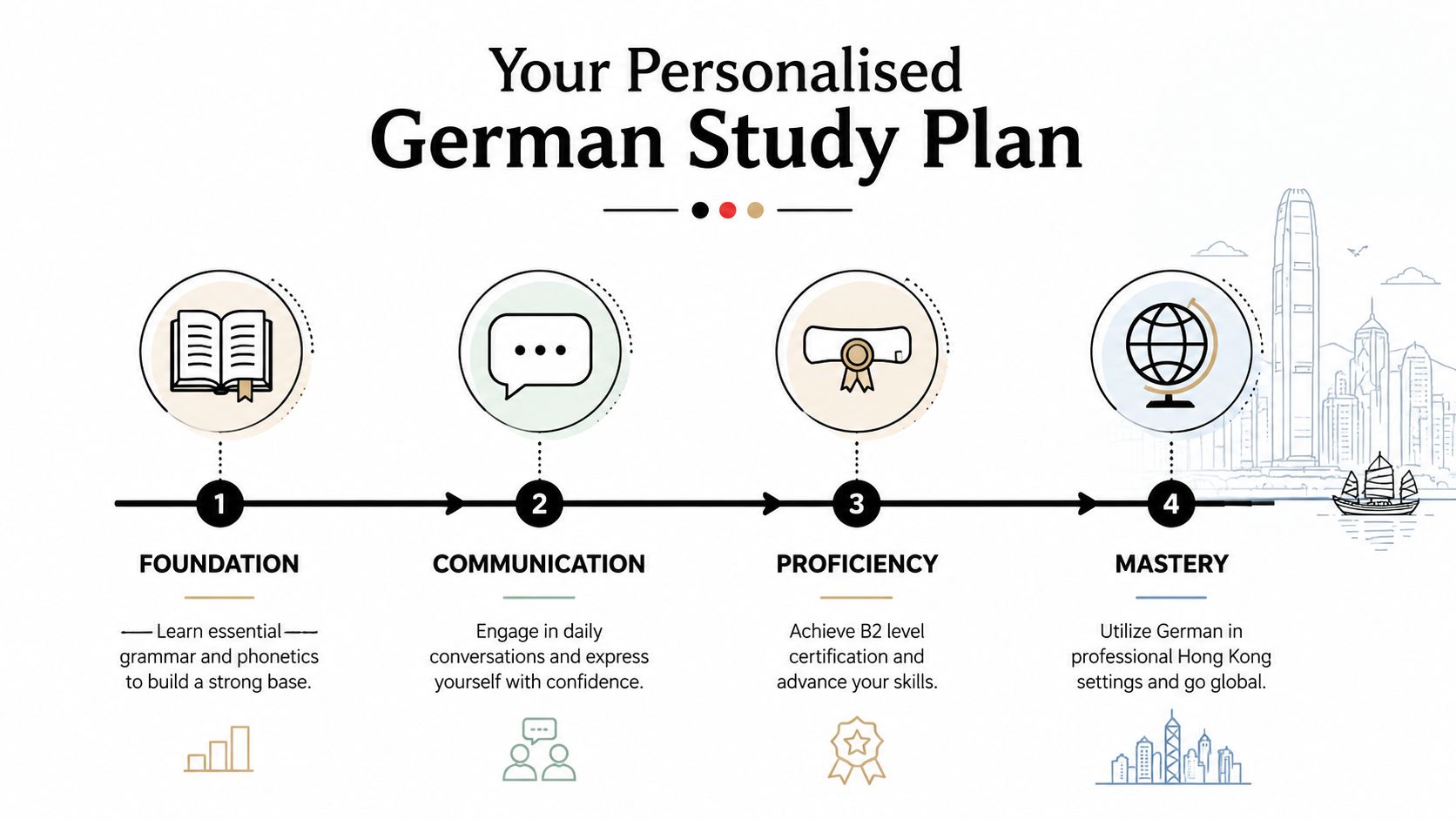
Creating Your Personalised German Study Plan
A Hong Kong parent targeting IB or DSE, a junior banker in Central planning a move to Frankfurt, and a student aiming for a German university should not be using the same study plan. That mistake wastes months.
Your plan should match your end goal, your weekly availability, and the learning format that gives you enough speaking time. Small-group classes usually beat large classes for correction, speaking turns, and accountability. Large classes can still work if your goal is passive exposure, but they are a poor choice for exam deadlines, university applications, or career moves.
Plan one for the university applicant
If you want Germany as a study destination, build your plan backwards from the application deadline.
Start with steady A1 to A2 progress through guided classes and fixed weekly revision. Then push into B1 or higher with far more reading, listening, and writing than casual learners usually do. Add exam preparation only after your grammar and sentence control are stable. Starting mock papers too early is a bad use of time.
Use this weekly structure:
- 2 to 3 guided lessons
- 2 focused review sessions
- 1 writing task
- 2 speaking sessions
- daily vocabulary review
For Hong Kong students juggling school, format matters. Small-group classes give faster correction and more active use of German. That is usually the better route for IB, IGCSE, Goethe exams, and German university entry.
Plan two for the career accelerator
Finance, law, logistics, and tech professionals need usable German, not textbook completion.
Your plan should combine three things:
- A structured course that forces regular output
- Targeted vocabulary based on your role
- Frequent short speaking practice during the work week
Do not rely on one long weekend lesson. Busy professionals in Hong Kong get better results from shorter, repeatable blocks on weekdays. Twenty focused minutes before work and two evening speaking drills will beat one exhausted three-hour session.
If speaking stalls under pressure, use structured voice notes for better fluency. It is a practical way to build recall, fix hesitation, and rehearse work scenarios between classes.
Plan three for the exam-focused secondary student
This learner needs marks, not vague “exposure.”
Prioritise:
- grammar accuracy
- set-topic vocabulary
- listening under timed conditions
- short speaking responses
- writing with teacher correction
Parents often choose whatever class fits the calendar. That is the wrong criterion. If the goal is DSE, IB ab initio, or IGCSE, choose a course with frequent correction and visible progress checks. Large mixed-ability groups slow strong students down and let weak habits stick.
Plan four for the practical traveller
Travel is a lighter goal, but the plan still needs structure.
Focus on:
- common questions and replies
- pronunciation that people can understand
- transport, hotel, restaurant, and shopping language
- basic listening speed
- high-frequency sentence patterns
Do not spend your first month memorising isolated word lists. Learn usable chunks you can say immediately.
A weekly structure that fits real Hong Kong schedules
| Learner type | Best format | Main priority | Weekly pattern |
|---|---|---|---|
| University applicant | Small-group or private | CEFR progression and exam readiness | Classes, writing, speaking, revision |
| Finance or tech professional | Small-group, private, or live online | Speaking confidence and job-specific language | Short weekday drills plus one anchor lesson |
| Secondary student | Small-group with exam focus | Marks, accuracy, timed practice | Teacher feedback, mock tasks, vocabulary review |
| Traveller | Small-group or practical private lessons | Fast usable communication | Phrase practice, listening, pronunciation |
One rule applies to all four profiles. Class time alone is not enough.
The strongest plans in Hong Kong are boring in the right way. Fixed study slots. Clear milestones. A format matched to the goal. If your target is ambitious, choose the format that gives you more correction and more speaking turns, even if it costs a bit more. That trade-off usually pays for itself in faster progress and fewer wasted months.
Ready to Start Your German Journey
Starting is easier when you stop overcomplicating it.

If you're serious about German lessons Hong Kong options or trying to Learn German HK with a clear plan, do these steps in order.
Step one, define the goal
Pick one primary reason:
- exam
- study abroad in Germany
- business German
- travel
- child enrichment with structure
Don't start with “general interest” if the primary reason is a visa or school target. Be honest. It helps you choose correctly.
Step two, choose the right format
Use the advice above and narrow your options to one format:
- small-group
- private
- online live
- university extension
Then check location and schedule. For most HK learners, convenience still matters because attendance collapses when the commute is unrealistic.
Step three, speak to an advisor before enrolling
A proper consultation saves time. A good advisor should ask about your target, timeline, previous experience, and weekly availability.
That's especially important for:
- parents choosing for teens
- adults returning to study after years away
- professionals with a relocation or work deadline
If you want a quick sense of the learning environment first, this short video gives useful context:
Step four, commit to a start date
Many learners in Hong Kong hesitate too long at this stage. They compare websites for weeks, then lose another term.
Choose a start month. Book the trial or consultation. Ask about current schedules, including classes near Tsim Sha Tsui and Causeway Bay MTR if convenience is a deciding factor. If you need online learning, ask how rescheduling works before you join.
The best time to start German was before you needed it. The second-best time is before the deadline becomes urgent.
Frequently Asked Questions About Learning German
Can I use CEF funding for every German course in Hong Kong
No. CEF eligibility depends on the specific programme, not the language itself. University extension options may offer CEF-supported routes, so check the course status before enrolling.
How long does it take to learn basic German
That depends on intensity and consistency. As noted earlier in this guide, beginner-level progress needs substantial guided study, and faster movement usually comes from more concentrated learning rather than once-a-week casual attendance.
Is online Zoom learning as good as in-person classes
It can be, if the lessons stay interactive and speaking-focused. Online works well for busy professionals and corporate learners. In-person often suits younger learners and anyone who benefits from stronger classroom structure.
Which exam should I take if I want to study or work in Germany
It depends on the purpose. Some learners need a general proficiency certificate, while others need a university-focused exam. The right course provider should tell you that before taking your fee.
Should my child take private lessons or small-group classes
If your child is motivated and benefits from interaction, small-group classes usually offer a good balance of speaking practice and structure. Private lessons make more sense when there's a specific weakness, deadline, or timetable issue.
Is German worth learning in Hong Kong if I already speak English and Chinese
Yes, if you have a concrete goal. German is especially worthwhile for academic pathways, relocation, and DACH-linked business work. If there's no real objective, motivation usually fades.
If you want structured, native-led German teaching in Hong Kong with options for children, teens, adults, exam candidates, and professionals, contact German Cultural Association Hong Kong(GCA) to check the latest course schedule, ask about a suitable class format, or book a trial lesson near Tsim Sha Tsui or Causeway Bay.
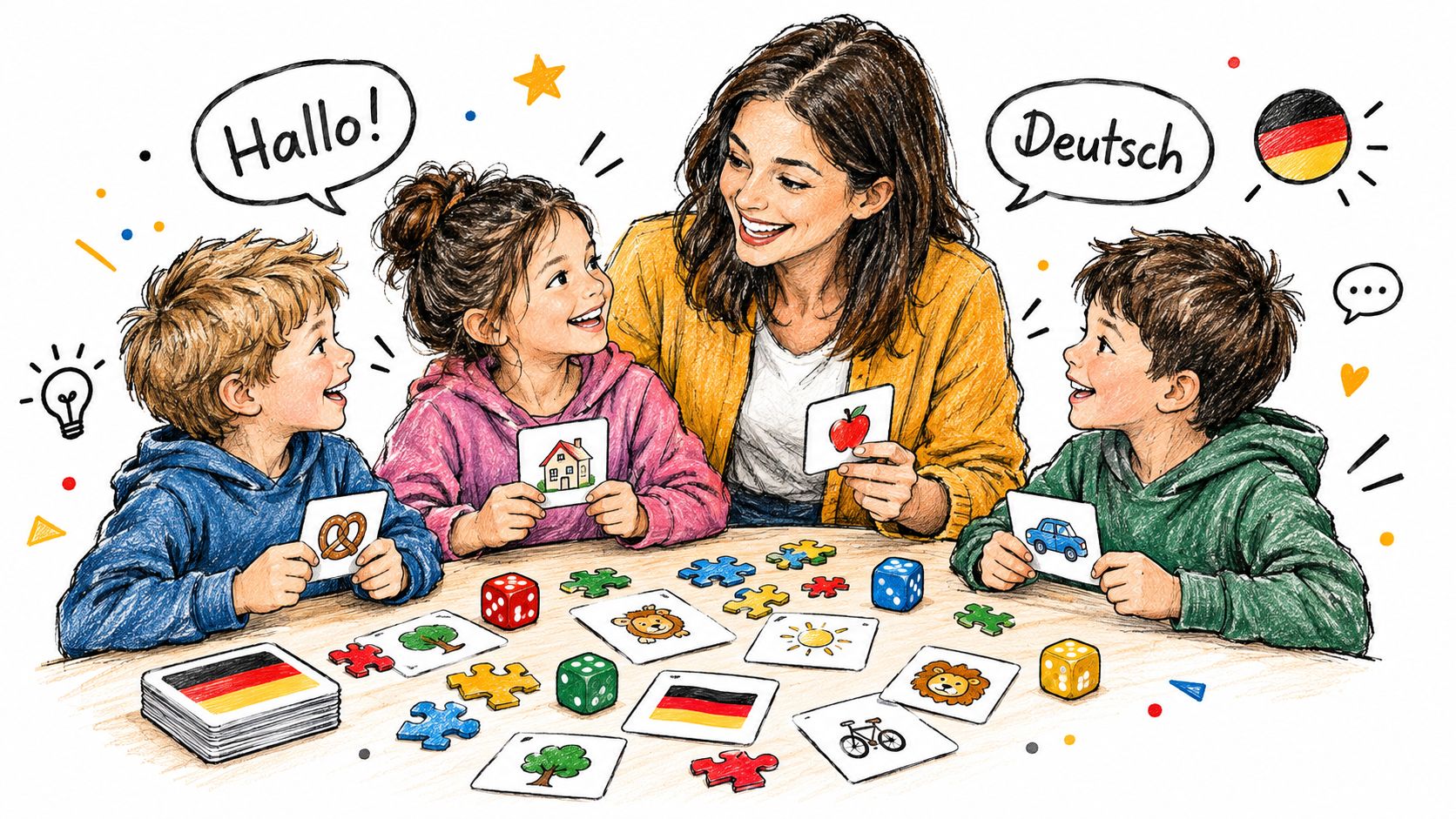
Interactive German Classes for Kids: Games
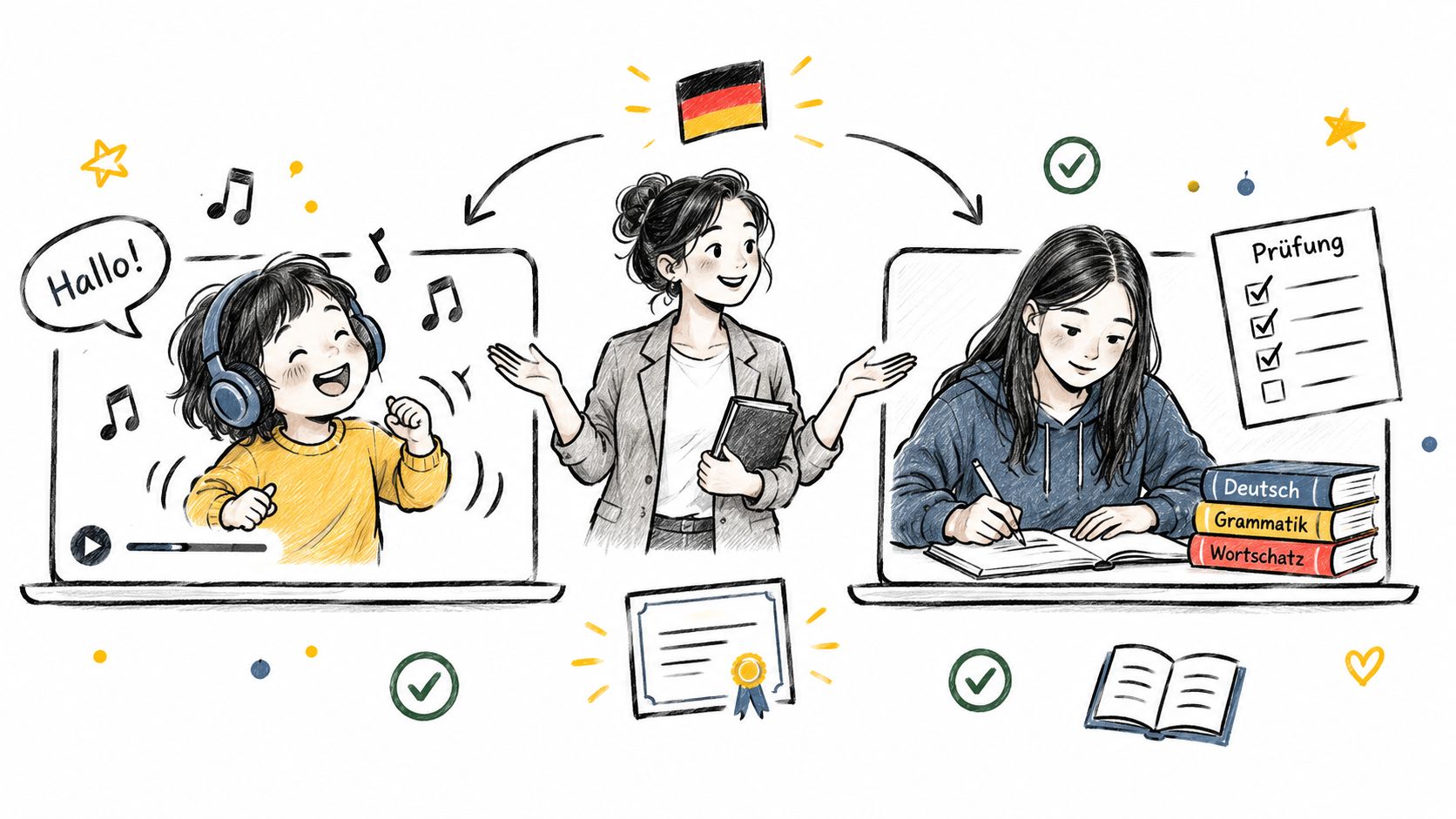
Online German Classes for Kids and Teens: Do They Actually Work?


