.png)
.png)

BLOG

香港德國文化協會
The German Cultural Association
Switzerland: Cultural Differences to Know for Expats
You're in Hong Kong, comparing Zurich, Geneva, and maybe Basel, and every guide tells you Switzerland is “orderly, safe, and multilingual”. That's true, but it's not enough. If you're planning a move, study path, or career step, Switzerland: Cultural Differences to Know starts with one blunt fact: Switzerland isn't one culture with a few local quirks. It's a compact country with different linguistic regions, different social expectations, and different practical advantages depending on where you land.
For HK families and professionals, that matters immediately. The language you learn, the canton you choose, and the way you communicate can either make your transition smoother or create avoidable friction at school, work, and in daily life.
Why Is Swiss Culture So Unique
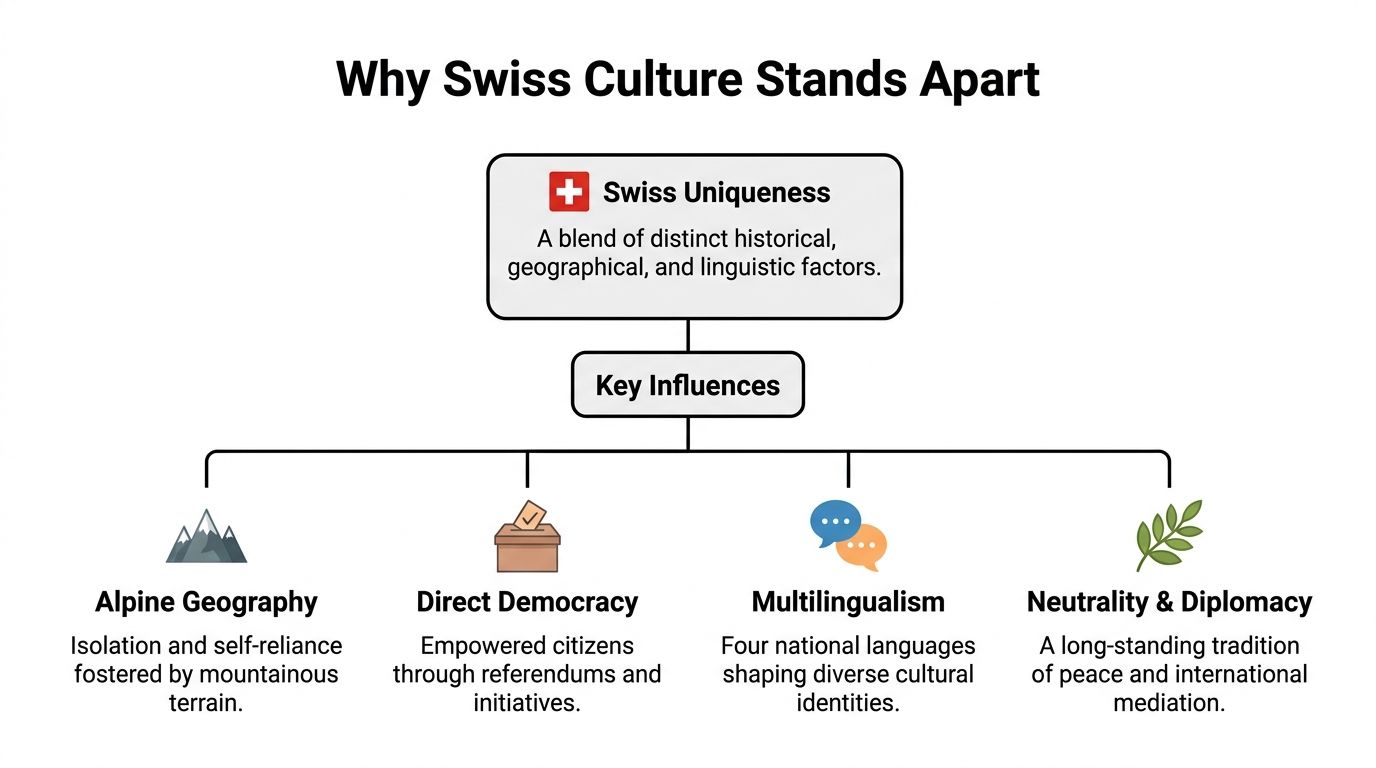
Swiss culture is unique because Switzerland is a four-language federal state shaped by strong cantonal autonomy, not a single dominant cultural centre. Regional identity matters significantly, social norms are more local than many newcomers expect, and language often determines everyday etiquette, schooling, administration, and community life.
That's the first thing often underestimated in Hong Kong.
Switzerland is a four-language federal state with German, French, Italian, and Romansh as national languages, and its cultural diversity is strongly shaped by its 26 cantons and federal structure. In everyday life, German is used by about 62.6% of the population, French by 22.9%, Italian by 8.2%, and Romansh by a small minority, according to Wikipedia's overview of Swiss culture.
Language is identity, not just communication
In Hong Kong, many people are used to switching between Cantonese, English, and sometimes Putonghua depending on context. Switzerland also switches by context, but the local language usually signals regional identity, not just convenience.
A child growing up in Zurich, Geneva, or Ticino won't just hear different words. They'll usually experience different school environments, media habits, and social norms. That affects how quickly a newcomer settles in.
Canton matters more than many expats expect
If you only remember one point, remember this: don't plan for “Switzerland” in the abstract. Plan for a canton and a city.
The country's federal structure gives its cantons real weight in daily life. That shapes administration, local habits, and what people see as normal. For ambitious HK readers, this means your move isn't just about getting a visa or job offer. It's about choosing a regional culture that fits your goals.
A simple way to think about it:
| Factor | What it means in practice |
|---|---|
| Language region | Determines what you'll hear, read, and need for daily integration |
| Canton | Shapes local procedures, expectations, and public-facing interactions |
| City | Influences pace, social style, and international exposure |
Practical rule: If your long-term goal involves the broadest access to Swiss study or work options, treat language choice as a strategic decision from day one.
That's why Switzerland: Cultural Differences to Know isn't just a culture topic. It's a planning topic. For many people in Hong Kong, German is the most practical first move because it covers the largest linguistic region. But that only helps if you also respect the regional reality behind the label “Swiss”.
Punctuality Privacy and Directness Explained
Many HK clients worry about “fitting in” socially. In Switzerland, the issue usually isn't personality. It's behaviour. If you understand punctuality, privacy, and directness, you'll avoid most early misunderstandings.
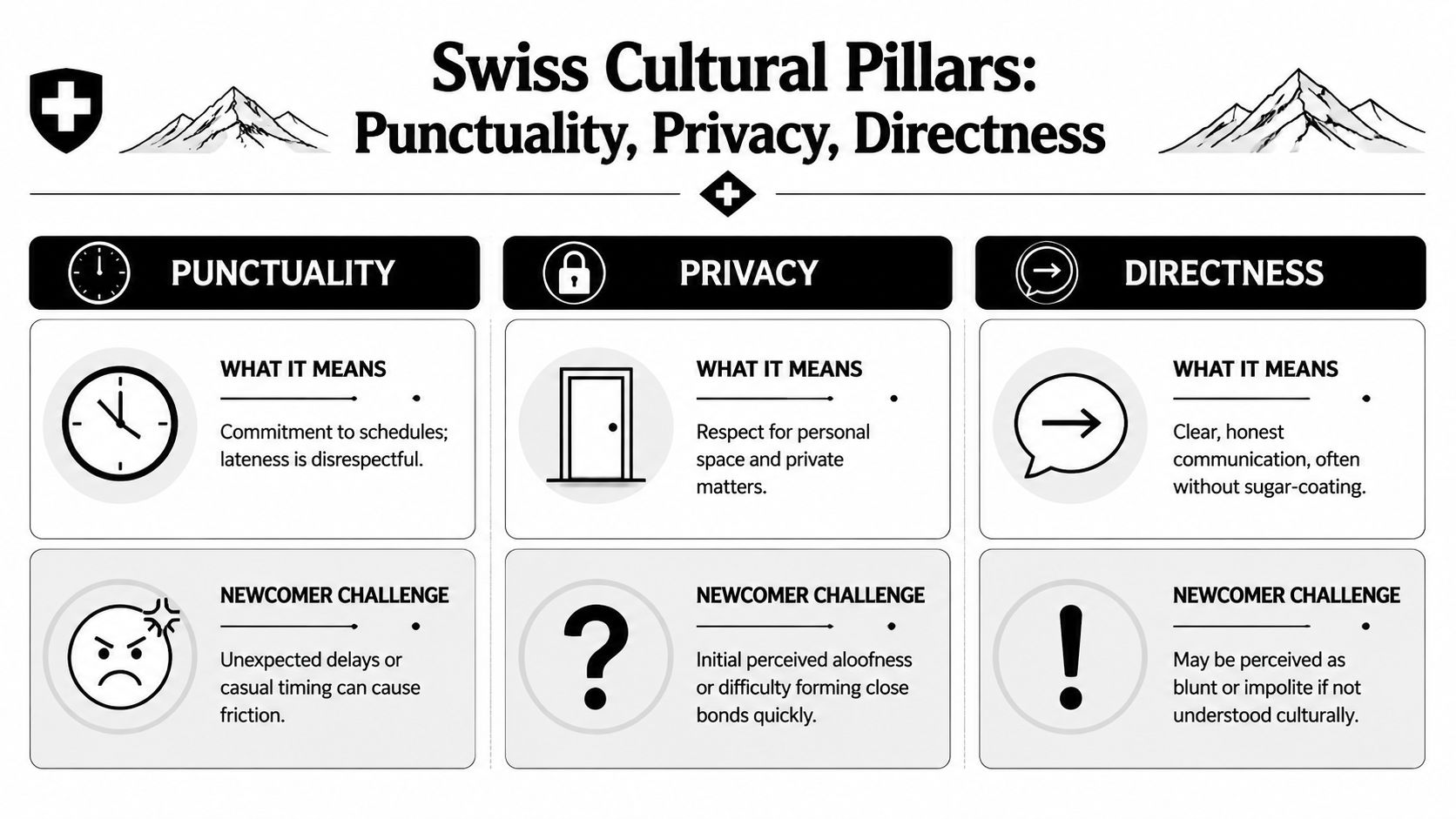
Swiss social life is often described as rule-based and orderly. Expatriate accounts note that social plans are often arranged weeks in advance, and public behaviour is shaped by strong norms around everyday rule-following, reinforced by the autonomy of the 26 cantons, as described in this discussion of Swiss civic and social habits.
What to do and what to stop doing
Punctuality
Do
- Arrive on time: In Switzerland, being on time signals respect and reliability.
- Warn early if you're delayed: Don't wait until the agreed meeting time has already passed.
- Treat schedules seriously: If something is booked, people expect you to honour it.
Don't
- Assume a grace period: Casual lateness that might be tolerated in some cities won't land well.
- Overbook yourself: If you say yes, people may take that as a firm commitment.
- Treat plans as flexible by default: They often aren't.
Privacy
Do
- Start polite, not personal: Keep early conversations friendly but not intrusive.
- Give relationships time: Swiss friendships often build slowly, then stay stable.
- Respect physical and emotional space: Warmth comes later, not instantly.
Don't
- Push for quick closeness: It can feel invasive rather than friendly.
- Ask overly personal questions too early: Topics like salary, family pressure, or private opinions may be unwelcome.
- Mistake reserve for rejection: It often just means boundaries matter.
People may seem distant at first. Usually, they're being respectful, not cold.
Directness isn't rudeness
A lot of Hong Kong professionals read Swiss directness too emotionally. Don't.
If a colleague says your draft needs revision, or a neighbour points out a building rule, that usually means they want clarity, not conflict. Swiss communication often values precision over softening language.
A useful comparison:
| HK habit | Common Swiss reading |
|---|---|
| Indirect hinting | Unclear or inefficient |
| Soft refusals | Ambiguous |
| Blunt factual feedback | Normal and useful |
If you work in luxury, manufacturing, or design-related fields, this focus on precision will feel familiar. Even in adjacent consumer conversations, labels and standards matter. A practical example is this guide to Swiss Made and Made in Germany explained, which helps show why origin, definition, and exact wording carry so much weight in German-speaking business culture.
The right adjustment for HK newcomers
Don't try to become “more Swiss” overnight. Just tighten your habits.
- Confirm plans clearly
- Speak plainly
- Respect boundaries
- Show reliability through action
That's the adjustment. Not charm. Not over-networking. Not trying too hard.
Navigating Switzerlands Regions and Languages
If you're moving from Hong Kong, the biggest mistake is choosing a Swiss city for scenery, prestige, or school brand alone. Choose for language consequences.
Swiss communication norms are shaped by the country's four-language structure, with German the most widely spoken language, followed by French, Italian, and Romansh, and regional language use closely aligned to geography, as outlined in this Swiss cultural guide for international learners. That means the correct language for services, documentation, and etiquette depends on canton and city.
Zurich and Geneva are not interchangeable
On paper, both are major Swiss cities. In real life, they pull you into different linguistic and cultural systems.
If you settle in Zurich, you're positioning yourself inside the German-speaking region. If you settle in Geneva, you're operating in a French-speaking environment with different daily language demands. This affects everything from school integration to office communication to what kind of social effort you'll need to make.
Here's the practical split:
| City choice | Main consequence |
|---|---|
| Zurich | Better alignment if your goal is German-medium integration |
| Geneva | Better fit if your life will operate mainly in French |
| Ticino | Relevant if your path is specifically tied to Italian-speaking Switzerland |
Why German matters most for many HK readers
I'll be direct. If you don't yet know where in Switzerland you'll end up, German is usually the safest first investment.
That isn't because French or Italian don't matter. They do. But German gives access to the largest linguistic region and supports more flexibility if your plans shift. Many HK students and professionals start with one idea, then realise later that another canton offers better study, career, or family options.
If your Swiss plan is still fluid, build your language strategy around flexibility, not wishful thinking.
That's especially important if your move is linked to university planning, relocation timing, or future immigration steps. If that's your situation, this guide on Switzerland 2026 HK visa and language planning is worth reading because it connects language preparation to a realistic Switzerland timeline.
The real issue is the cultural switch
Many general guides mention multilingualism and stop there. That's lazy advice.
The challenge is the cultural-linguistic switch. Each region carries its own rhythm, assumptions, and communication style. If you learn “Swiss culture” too broadly, you'll still be underprepared when you arrive.
For people in Hong Kong with education or career goals tied to German-speaking Europe, the smarter move is usually:
- Decide whether German-speaking Switzerland is your primary target
- Prepare language early, before relocation pressure begins
- Choose canton and city based on long-term options, not just first impressions
That's how you keep doors open.
A Guide for Parents and Students in Hong Kong
Parents in Hong Kong usually ask the wrong first question. They ask, “Which school is better?” The better question is, “Which language path will keep my child's options open?”

If your child is on a DSE, IB, or IGCSE track in Hong Kong, Switzerland can look attractive because it feels safe, international, and organised. All of that may be true. But school success there depends heavily on whether your child can integrate linguistically and socially into the canton you choose.
The trap many families don't see early enough
A common family story goes like this. A parent secures an initial move connected to Zurich or Basel, everyone assumes German will happen naturally, and then life shifts. Housing changes, work changes, or family preference changes. The family later relocates to a French-speaking canton, and the language plan becomes fragmented.
According to the relocation guide at Packimpex, the Hong Kong Education Bureau and Swiss Federal Statistical Office (2024) report that 68% of foreign families in Switzerland initially settle in Zurich or Basel, yet 32% move to French-speaking cantons within two years, creating an 18-month gap in German language acquisition for school-aged children.
That gap matters. A lot.
What HK parents should do instead
Don't treat language as an accessory to school selection. Treat it as part of the school decision itself.
If German proficiency is part of your child's long-term plan, you need to think beyond the first address in Switzerland. Ask:
- Will my child need German later for university or career access?
- Is our first canton likely to be our long-term canton?
- Are we choosing an “easy” short-term option that creates a harder language problem later?
For many families, a practical starting point is to compare structured preparation paths before paying for expensive school solutions. This article on Swiss international school fees and alternatives for German learning is useful for that reason.
A child can adapt to a new country. A confused language strategy is much harder to fix.
What students need before the move
If your teenager is aiming for a Swiss path, especially from an IB or IGCSE background in Hong Kong, preparation should be deliberate.
Prioritise these three things:
- Academic German first: everyday conversation alone won't be enough for school confidence.
- Consistency over intensity: a rushed burst of study rarely holds under relocation stress.
- Credential planning: if your child may need formal proof later, prepare with recognised exam structures in mind.
Here's a useful overview before you compare options:
The strongest families plan backwards. They start with the child's likely future in Switzerland, then choose the canton, school style, and language path accordingly. That's the disciplined way to handle Switzerland: Cultural Differences to Know if you're thinking like a parent, not just a tourist.
Thriving in the Swiss Workplace
Hong Kong professionals often arrive in Switzerland with strong work ethic, speed, and discipline. Good. Keep those. But don't assume the same hierarchy logic applies.
Swiss culture is described as an egalitarian society with low power distance, with a meaningful behavioural split between German-speaking and French-speaking regions. For Hong Kong audiences, that matters because Swiss counterparts often expect decentralised decision-making and direct peer-to-peer coordination, while the German-speaking side is more rule- and process-oriented, as discussed in this analysis of Swiss workplace values.
What changes for HK professionals
In many HK workplaces, people watch titles carefully. They read hierarchy before speaking. Switzerland often works differently.
You may be expected to:
- Contribute without waiting for formal invitation
- Coordinate directly with peers
- Own your task clearly
- Respect process, not just authority
That doesn't mean Swiss offices are casual. They aren't. It means credibility comes from competence, clarity, and follow-through, not from performing deference.
A better meeting style
If you're used to reading the room before speaking, adjust your timing.
In Swiss meetings, especially in German-speaking environments, people often respond better when you:
- State your point early
- Bring a clear agenda
- Define responsibility
- Flag risks directly
A weak adaptation sounds like this: “Maybe we can consider another option if people think it's suitable.”
A stronger adaptation sounds like this: “Option B reduces coordination problems. I suggest we assign ownership today and confirm the deadline.”
That's easier for Swiss colleagues to work with.
Swiss teams often trust the person who is clear, prepared, and consistent. Not the person who speaks most politely.
German-speaking and French-speaking work styles aren't identical
This distinction matters for career planning.
The German-speaking side is often more process-focused. That means deadlines, handovers, and meeting structure matter a lot. If you're aiming at sectors that reward precision and system thinking, stronger German ability can become a serious advantage. This is one reason many professionals in Hong Kong look at how speaking German boosts your career in Europe before deciding on their study plan.
The French-speaking side can feel different in tone and rhythm, but don't oversimplify it. You still need professionalism, preparation, and social awareness.
The career mistake to avoid
Don't assume that because Switzerland is international, English will carry your whole professional life. In some environments, English may get you in. It won't always help you integrate.
If your target is German-speaking Switzerland, learn enough German to handle:
- Meetings
- Process discussions
- Everyday office interaction
- Local administrative life
That's how you stop being the “international hire” and start being a fully functional colleague.
How Much Do Daily Life and Rules Cost You
For cost-conscious readers in Hong Kong, this is the uncomfortable truth. In Switzerland, not understanding daily rules can cost you time, money, and goodwill even before you've settled properly.
Swiss culture is often described through a strong rule-based civic tradition. Social plans are often arranged weeks in advance, and public behaviour is shaped by strict norms and a preference for predictability, reinforced by cantonal autonomy, as noted earlier in the linked discussion of Swiss social habits.
The hidden price of getting the basics wrong
You don't need a dramatic mistake to create problems. Small things add up.
Think about:
- Waste disposal habits
- Building etiquette
- Public transport behaviour
- Appointment discipline
- Quiet-hour expectations
If you treat these as minor details, locals may read that as carelessness. In a rule-oriented society, repeated “small” errors can damage trust fast.
Where HK newcomers usually lose time
The issue usually isn't lack of intelligence. It's misreading the operating system.
In Hong Kong, people often adapt by speed. In Switzerland, you often adapt by procedure. That means checking instructions, following posted rules, and not assuming flexibility where none is offered.
A practical comparison:
| Situation | Cost of poor cultural reading |
|---|---|
| Missed or vague appointments | Friction, rescheduling trouble, loss of credibility |
| Ignoring local building norms | Complaints or tension with neighbours |
| Casual public behaviour in quiet spaces | Negative attention and avoidable embarrassment |
| Last-minute social planning | Fewer invitations and weaker relationships |
Social planning affects your budget too
This surprises many people.
Because social life is often planned ahead, spontaneous spending patterns may change. Meals, travel, family visits, and school-related commitments often work better when booked and scheduled deliberately. If you're used to deciding at the last minute, you may find Swiss life less forgiving.
Good planning in Switzerland isn't just efficient. It protects your money, your time, and your reputation.
My advice for the first three months
Keep it simple.
- Read notices carefully
- Ask before assuming
- Save key appointments immediately
- Arrive early
- Watch how locals use shared spaces
That approach sounds basic, but it works. Switzerland: Cultural Differences to Know isn't mainly about grand cultural theory. It's about reducing preventable mistakes in everyday life.
Ready to Prepare for Your Swiss Journey
If you've read this far, you already know the issue isn't whether Switzerland is “nice”. It's whether you're preparing in a way that matches how Switzerland works.
For most HK readers, language is the hinge. It affects school choice, workplace credibility, daily administration, and how much flexibility you keep if your canton or life plan changes. If your target is German-speaking Switzerland, delay is expensive. It narrows your options and makes every later step harder.
What preparation should look like
Don't rely on casual app study alone if your goal involves relocation, work, or formal education. You need a structured path that covers:
- Core German skills
- Cultural reading of German-speaking settings
- Exam preparation if required
- A realistic study schedule that fits life in Hong Kong
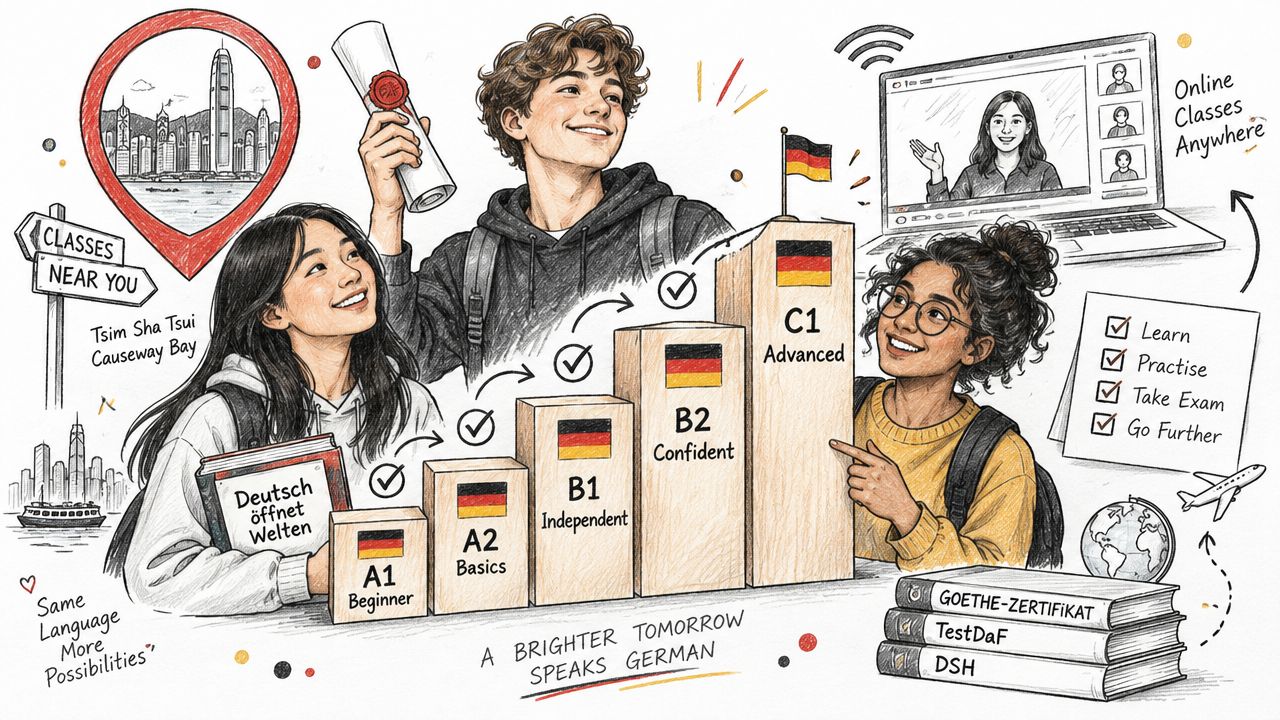
One practical option in Hong Kong is German Cultural Association Hong Kong(GCA), which offers native-speaker-led German courses, small-group and private formats, and preparation for exams such as the Goethe-Zertifikat, TestDaF, IGCSE, A-level, and IB.
Don't forget the non-language logistics
A successful move also depends on details outside the classroom. Families often get stuck on administrative tasks they assumed would be simple. If you're relocating with animals, for example, these US to Switzerland pet travel rules are a useful example of how precise cross-border preparation needs to be, even if your own route starts in Hong Kong.
The broader point is clear. Switzerland rewards people who prepare early, document properly, and respect local systems.
If you want to Learn German HK style with a serious plan, or you're searching for German lessons Hong Kong families and professionals can fit around work and school, don't wait until your relocation date is close. Build the foundation while you still have breathing room.
If you're planning for Swiss study, work, or family relocation, German Cultural Association Hong Kong(GCA) can help you build a practical German study plan before the pressure starts. You can explore course options, check the latest class schedule, or speak with an advisor about Goethe-Zertifikat preparation, Business German, or a customised path for your Switzerland timeline.
Preschool German Classes 2026/27 (Ages 3-6): Small-Group Intake & Trial Lessons
German Courses for Teens 2026/27: Ages 12-18 New Term Classes & Exam Pathways


