.png)
.png)

BLOG

香港德國文化協會
The German Cultural Association
Living Expenses & Scholarships in Germany
A Hong Kong parent can sit at the kitchen table with a calculator, trying to decide whether a child's engineering degree in Munich fits the family budget. Germany may sound “free” because many public universities charge little or no tuition, but that does not make the degree inexpensive. Rent, food, insurance, transport, semester contributions, visa finances, and the gap between scholarship support and actual daily costs determine whether the plan is sustainable.
This guide to Living Expenses & Scholarships in Germany gives families in HK a practical way to test affordability before committing to applications. It also applies to working professionals planning to study abroad in Germany or Spain, and to parents comparing a German pathway with DSE, IB, or IGCSE options at home.
Table of Contents
Why Hong Kong Families Need a Clear Financial Picture Before Applying
The first calculation should not be tuition. It should be the amount required to live consistently for the full study period.
A family might budget for an application fee, flights, and an initial deposit, then discover that the monthly cash requirement is much higher than expected. Students also face costs that don't appear in promotional summaries, including health insurance, local transport, study materials, utilities, and the financial proof required for a German student visa.
The assumptions that cause trouble
The phrase “study in Germany for free” usually refers to tuition at many public universities. It doesn't mean accommodation and daily life are free, and it doesn't remove the need to demonstrate available funds before enrolment and visa processing.
Hong Kong families should examine:
- Housing: A room in a shared flat, or WG, may be manageable in one city and difficult in another.
- Upfront finances: The blocked-account requirement can tie up a substantial amount before the student arrives.
- Semester charges: Even where tuition is limited, students still need to plan for university and student-service contributions.
- Insurance and transport: These recurring expenses continue during exam periods, holidays, and quieter study months.
- Scholarship gaps: A scholarship may support living costs without covering the entire budget, the initial deposit, or every university charge.
Practical rule: Treat a scholarship as one part of the funding plan, not as permission to ignore the family's own cash-flow requirements.
German universities and authorities require evidence of financial resources at key stages. Families should read the guide to the Germany student visa and blocked account from Hong Kong early, then confirm the current requirements with the relevant official authority.
Use Hong Kong spending as a reality check
Official Hong Kong household data provides a useful local benchmark. In 2024/25, the average household spent HK$32,472 per month on food, consumer goods, and services, while per-capita spending reached HK$12,201 per month. Housing represented 39.3% of household expenditure and food represented 24.1%, according to the Hong Kong Census and Statistics Department data.
That comparison doesn't produce a German budget by itself. It does reveal whether a family is underestimating the financial scale of sending one person overseas. The rest of this guide turns that broad concern into a funding plan, scholarship strategy, and timeline.
How Much Does It Really Cost to Live in Germany as a Student
Germany's main financial trap is confusing low tuition with low total cost. A student still needs a reliable monthly budget, and the city, housing type, and lifestyle can shift the result sharply.
The figures below are planning ranges, not guarantees. Munich, Frankfurt, and Hamburg generally demand more careful housing research than smaller university cities. A WG room can be materially different from a private studio, while a university residence may be more predictable if the student secures a place.
The main cost categories
Plan for these categories before comparing scholarships:
- Rent: Approximately €350 to €750 monthly, depending on city and whether the student rents a WG room or private studio.
- Health insurance: Approximately €120 to €130 monthly for public student plans.
- Food and groceries: Approximately €200 to €300 monthly.
- Transport: Often included through a semester ticket, with planning costs of approximately €150 to €350 per semester.
- Utilities and internet: Approximately €80 to €120 monthly.
- Study materials: Approximately €50 to €80 monthly.
- Personal expenses: Approximately €100 to €200 monthly.
The DAAD minimum planning figure is €934 per month, while students in higher-cost cities may need approximately €1,100 to €1,300 monthly. These figures and the related tuition context should be checked against the cost of studying in Germany guide before an application budget is finalised.
| Expense Category | Germany, Monthly € | Hong Kong Equivalent, Monthly HKD | Notes |
|---|---|---|---|
| Rent | €350–€750 | Use the family's actual housing benchmark | WG and private accommodation differ significantly |
| Health insurance | €120–€130 | Compare with existing family coverage | Usually a recurring student expense |
| Food and groceries | €200–€300 | Compare wet-market and supermarket spending | Cooking habits matter |
| Transport | Planned through semester ticket | Compare MTR and local travel costs | Coverage depends on the student's university arrangement |
| Utilities and internet | €80–€120 | Compare household broadband and mobile costs | Check whether rent includes utilities |
| Study materials | €50–€80 | Compare textbooks, printing, and online resources | Course requirements vary |
| Personal expenses | €100–€200 | Compare phone, leisure, and personal spending | Set a monthly ceiling |
Where the scholarship calculation fails
Tuition at many public universities is not the only number that matters. Baden-Württemberg can charge €1,500 per semester for non-EU students, so families must check the state and university rules rather than relying on a national slogan.
The blocked account works as a financial safety mechanism. It demonstrates that the student has access to living funds, but it isn't a scholarship and it doesn't eliminate the need for disciplined monthly spending. A student who spends too quickly can still face a serious shortfall later.
Hong Kong's own official figures also show how housing changes the baseline. In 2024/25, average monthly household expenditure was HK$16,181 for public housing households, HK$28,932 for subsidised housing households, and HK$41,174 for private housing households. Use your family's actual spending pattern, not an abstract average, when deciding whether overseas study is affordable.
Types of Scholarships and Funding Available to Hong Kong Students
Scholarship research should begin with coverage, not prestige. The important question is whether an award pays tuition, living costs, travel, accommodation, or only one defined part of the study plan.
For Hong Kong students applying to German universities, the main categories include DAAD awards, university funding, political or religious foundations, external trusts, and Hong Kong government support. Eligibility varies by degree level, academic record, language ability, nationality, field, and timing.
Compare funding by what it actually pays
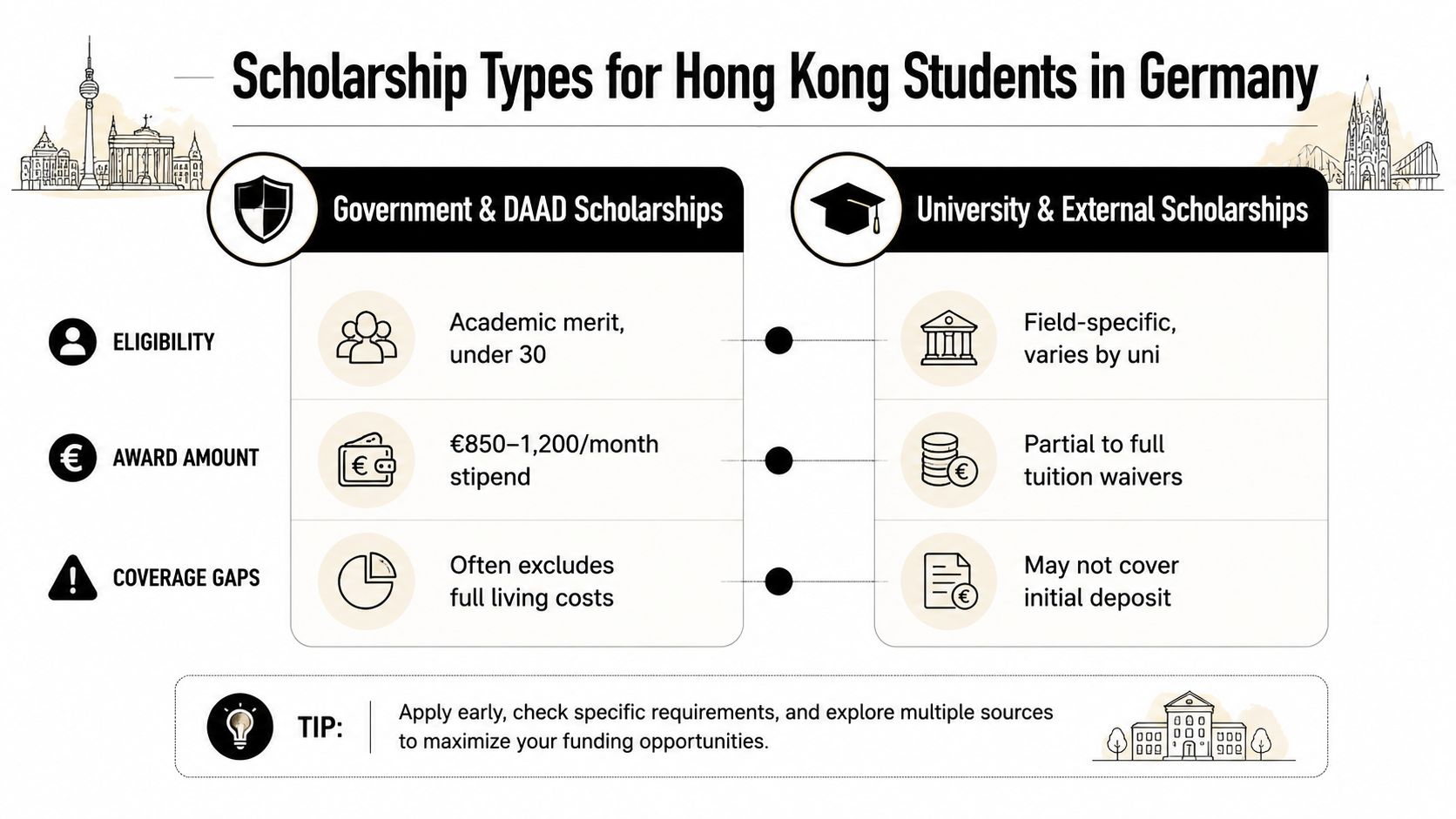
- DAAD scholarships: These can support graduates and postgraduate applicants, including candidates for development-related programmes such as EPOS. The award may contribute to living costs, travel, or other study needs, but applicants must check the individual programme conditions and coverage.
- Deutschlandstipendium: This is a merit-based award for enrolled students. It can help with regular expenses, but it shouldn't be treated as a full financial plan.
- Political and religious foundations: Organisations such as Friedrich Ebert Stiftung and Konrad Adenauer Stiftung may value academic achievement, civic engagement, and German ability. B2 or C1 German can be important for these applications.
- University-specific awards: Universities may offer merit scholarships, tuition reductions, or living support. Each institution sets its own rules, so the award structure is not directly comparable across universities.
- Hong Kong funding: Government scholarships, advancement schemes, and trust funds may support selected students. These sources can be valuable, but the eligibility criteria and application windows differ.
Do not assume that an award range automatically equals full coverage. A stipend may handle part of food and transport while leaving rent, insurance, deposits, and travel for the family.
The Hong Kong benchmark for scholarship support
Hong Kong's Scholarship Fund allocated about HK$151 million to 5,735 awardees in the 2024/25 academic year, compared with about HK$138 million to 5,618 awardees in 2023/24, according to the official Scholarship Fund announcement. Average support was roughly HK$26,300 per awardee in 2024/25.
The Hong Kong Scholarship for Excellence Scheme states that eligible awardees who pass the means test may receive up to HK$200,000 per student per annum for living and study-related expenses. Other publicly reported university awards may waive annual non-local tuition and add living stipends of up to HK$60,000.
The message is clear. Strong funding exists, but awards differ widely. Undergraduate applicants should be especially cautious because scholarship options can be more limited than at postgraduate level. German-language programmes can also open funding routes that aren't available to applicants who search only among English-taught degrees.
Scholarship Application Timelines and Documentation Checklists
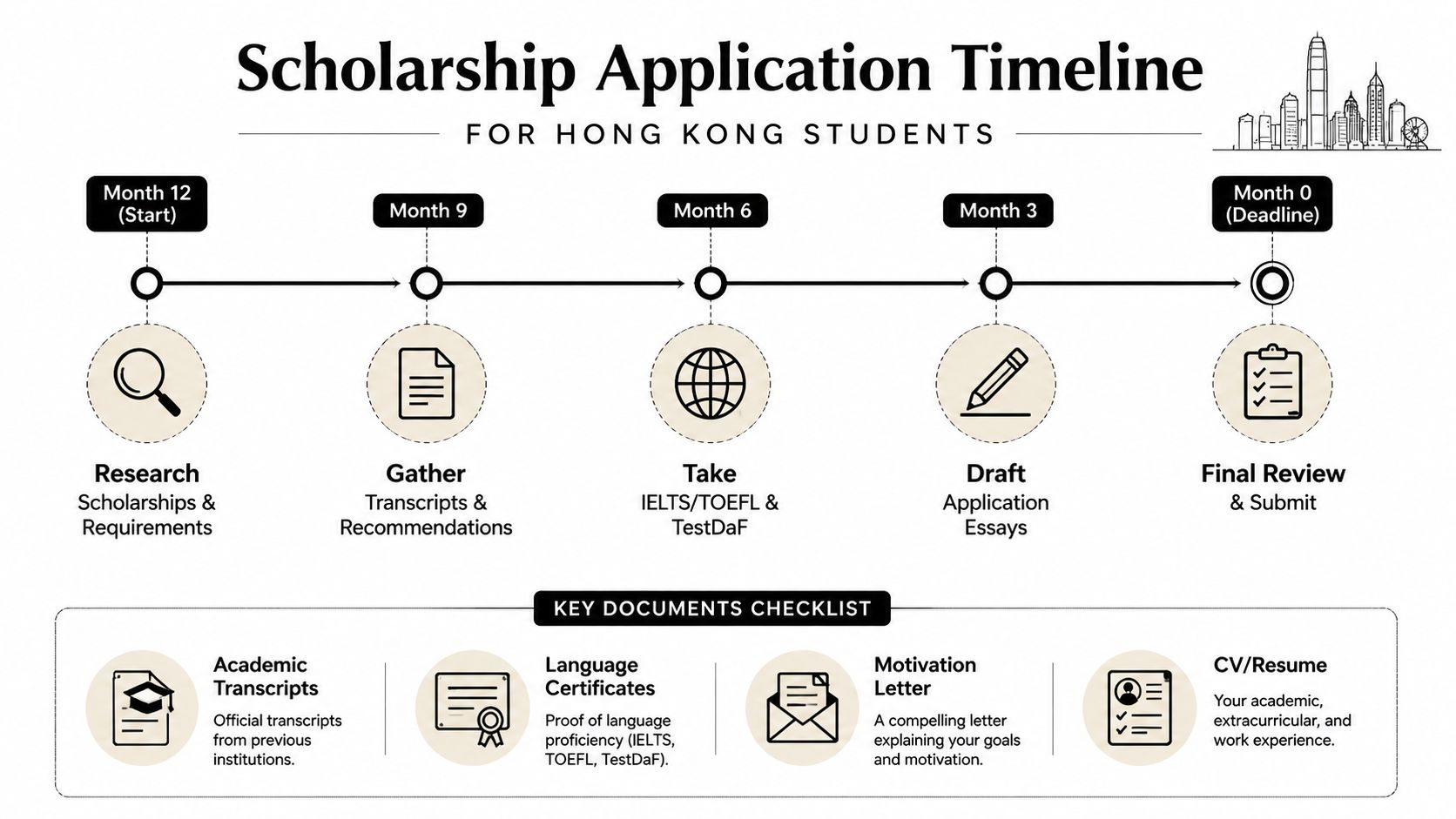
A serious scholarship application needs an organised calendar. Start around 12 months before the intended intake, because language preparation, document certification, university research, and scholarship deadlines often overlap.
Don't wait for admission to begin funding research. Some scholarships require a university application, some require enrolment, and others follow their own submission cycle.
A practical 12-month sequence
Month 12: Build a shortlist of German universities, degree programmes, funding bodies, language requirements, and application routes. Record every deadline in Hong Kong time and German time.
Month 9: Request academic transcripts and recommendation letters. Begin certified translations where required, and check whether documents need notarisation or other formal verification.
Month 6: Complete the required language testing plan. Depending on the programme, this may involve IELTS, TOEFL, TestDaF, DSH, or Goethe certification.
Month 3: Draft the motivation letter and scholarship essays. Replace generic statements with a clear connection between the applicant's academic background, Germany, the chosen field, and future plans.
Month 1: Review every upload, signature, translation, and file format. Submit before the deadline rather than relying on the final hours.
Prepare the evidence committees assess
Keep a working folder containing:
- Academic records: Transcripts, certificates, and certified translations.
- Language proof: TestDaF, DSH, Goethe, IELTS, or TOEFL results required by the programme.
- Recommendations: Letters from teachers, professors, or supervisors who can describe specific academic or professional strengths.
- Motivation statement: A focused explanation of why Germany, why this university, and why this subject.
- Engagement evidence: Extracurricular, community, research, leadership, or professional activity relevant to the application.
- Administrative documents: Passport, admission materials, and any required certification, including APS documentation where applicable.
Common avoidable problems include missing APS certification, improperly notarised documents, late submissions caused by time-zone confusion, and motivation letters that could have been sent to any university in Europe. The timeline and documents guide should sit beside the family's application calendar.
Building a Realistic Monthly Budget for German Student Life
A workable budget starts with fixed obligations. List the payments that arrive regardless of whether the student attends lectures, travels home, or spends a quiet month preparing for examinations.
Use the following as a planning template, then replace each range with the confirmed figures from the university, accommodation provider, insurer, and transport authority.
| Expense Category | Monthly Cost (€) | Cost-Saving Tip |
|---|---|---|
| Rent | €300–€700 | Apply early for student residences and compare WG listings |
| Health insurance | €120–€130 | Confirm public student-plan eligibility before arrival |
| Mobile and internet | €30–€50 | Choose a student-friendly plan and avoid unnecessary extras |
| Groceries | €200–€250 | Compare Aldi, Lidl, and Netto with local shops |
| Semester contribution | €150–€350 per semester | Include it in the annual cash-flow plan |
| Transport | Covered or partly covered through semester arrangements | Check the ticket's regional travel coverage |
| Leisure and personal spending | Set a firm monthly limit | Use student discounts and track every discretionary purchase |
The semester contribution shouldn't be treated as a monthly bill, but dividing it across the year helps families understand the actual cash requirement. Rent also deserves special attention. A Munich WG room may consume a far larger share of the budget than accommodation in a smaller university city, so city choice can matter as much as scholarship size.
Reduce costs without damaging study time
- Use the Mensa: Subsidised campus meals can reduce the pressure to cook every meal.
- Check the semester ticket: It may provide regional travel access, reducing separate transport purchases.
- Use student discounts: Museums, theatres, and cultural venues often offer student pricing.
- Work carefully: International students are generally subject to a legal limit of 120 full days or 240 half-days, so part-time work can't replace a proper funding plan.
Hong Kong families should also track irregular income and one-off payments rather than looking only at an average month. A simple cash-flow system can help students survive lean months with Ledgerly, especially when rent, semester charges, or travel costs arrive together.
Hong Kong's official HKTE cost-of-living page reports that a single person renting private housing spends an average of HK$24,400 per month, including HK$13,200 for housing, HK$5,100 for food, and HK$1,000 for transport. Use this as a local reference point, but don't assume German and Hong Kong categories match perfectly.
How German Language Skills Unlock Scholarships and University Admission
German is not a decorative addition to a Germany study plan. It is one of the most strategic investments a Hong Kong applicant can make.
English-taught programmes can be attractive, but an English-only search may narrow the scholarship pool, limit daily communication, and reduce access to German-language academic environments. German ability can also strengthen an applicant's explanation of why Germany is the right destination.
Language changes the funding options
Many DAAD scholarships, Deutschlandstipendium nominations, and political foundation awards require or strongly prefer German ability, particularly at B2 or C1 level. Requirements vary, so applicants must read each award's conditions rather than assume that one certificate fits every route.
TestDaF and DSH can also affect admission to German-taught programmes. This matters in competitive fields such as engineering, medicine, and business, where a language certificate may be part of the formal eligibility review rather than a last-minute bonus.
A student who reaches B1 before departure is better positioned to manage accommodation, administrative appointments, local services, and part-time work searches. That practical readiness can also help during interviews, where committees may assess whether the applicant can function beyond the classroom.
The right preparation should be structured, not improvised. Native-led German lessons in Hong Kong, consistent homework, and targeted Goethe-Zertifikat or TestDaF preparation give applicants a measurable route from basic communication to university-level readiness.
Ready to Start Your Germany Study Journey
The financial plan should begin before the application form. Families need to compare their actual Hong Kong household budget with German rent and living costs, identify scholarships that match the student's degree and profile, and reserve funds for costs that awards may not cover.
Use this phased roadmap:
- Assess affordability: Map family cash flow against the target city, housing type, insurance, transport, and visa-finance requirements.
- Start German early: Work towards the language level demanded by the chosen universities and scholarships, with B2 or C1 as the strategic target where relevant.
- Match funding to universities: Shortlist programmes first, then compare DAAD, university, foundation, government, and trust-fund options.
- Organise documents: Secure transcripts, translations, recommendations, language certificates, motivation letters, and administrative evidence before deadlines.
The Continuing Education Fund can support eligible continuing-education learners, but its ceiling is HK$25,000 per person over a lifetime, rather than per application, according to the official CEF leaflet. The subsidy also reimburses 80% of the first HK$10,000 of fees and 60% of the next HK$15,000, as described in this CEF funding explanation. It may help with language preparation, but it isn't a substitute for a Germany living-cost plan.
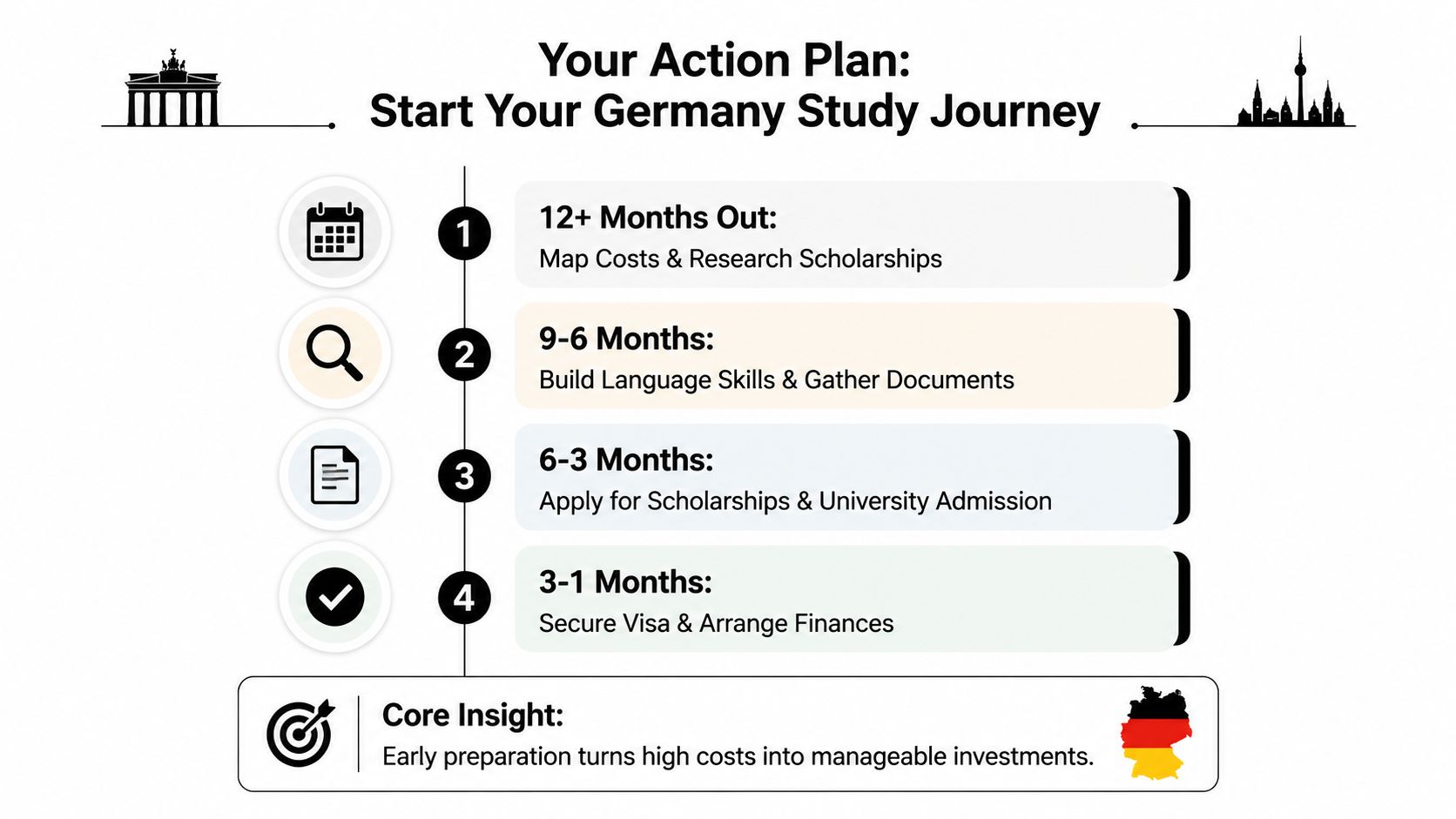
Start the process 12 to 18 months before enrolment. Early German preparation gives students more time to meet certificate requirements, write stronger applications, and choose from a broader range of study and funding routes.
German Cultural Association Hong Kong(GCA) offers structured German lessons in Hong Kong for children, teenagers, adults, and working professionals, with native German-speaking teachers and focused preparation for Goethe-Zertifikat, TestDaF, IGCSE, A-level, and IB pathways. Visit German Cultural Association Hong Kong(GCA) to book a consultation or trial class and build the language foundation that supports a realistic, better-funded Germany study plan.

German Verb Tenses Overview: Präsens Made Simple

German Passive Voice (Passiv): Formation Guide


