.png)
.png)

BLOG

香港德國文化協會
The German Cultural Association
Perfekt in German: A Clear Guide for Learners in HK
The Perfekt is the German past tense used in everyday speech and informal writing, formed with a conjugated auxiliary, haben or sein, in second position and a past participle at the end of the clause. For Hong Kong learners, it becomes an early practical milestone, not an advanced grammar topic.
You may be a Form 5 student describing an exchange in Berlin, a parent helping with IGCSE revision, or a professional in Central recounting a project call with a Munich client. You know the vocabulary, but your sentence still sounds wrong because the auxiliary is misplaced, the participle is missing, or sein and haben seem interchangeable.
The solution isn't another chart to memorise. You need to understand the decisions behind the tense, then practise the exact speaking and writing tasks that appear in school and language examinations.
Table of Contents
- Step one, select the auxiliary
- Step two, form or recall the participle
- Step three, send the participle to the end
- Perfekt for conversation and informal writing
- Präteritum for written narration
- Plusquamperfekt for the earlier past
What the Perfekt Is and When Germans Actually Use It
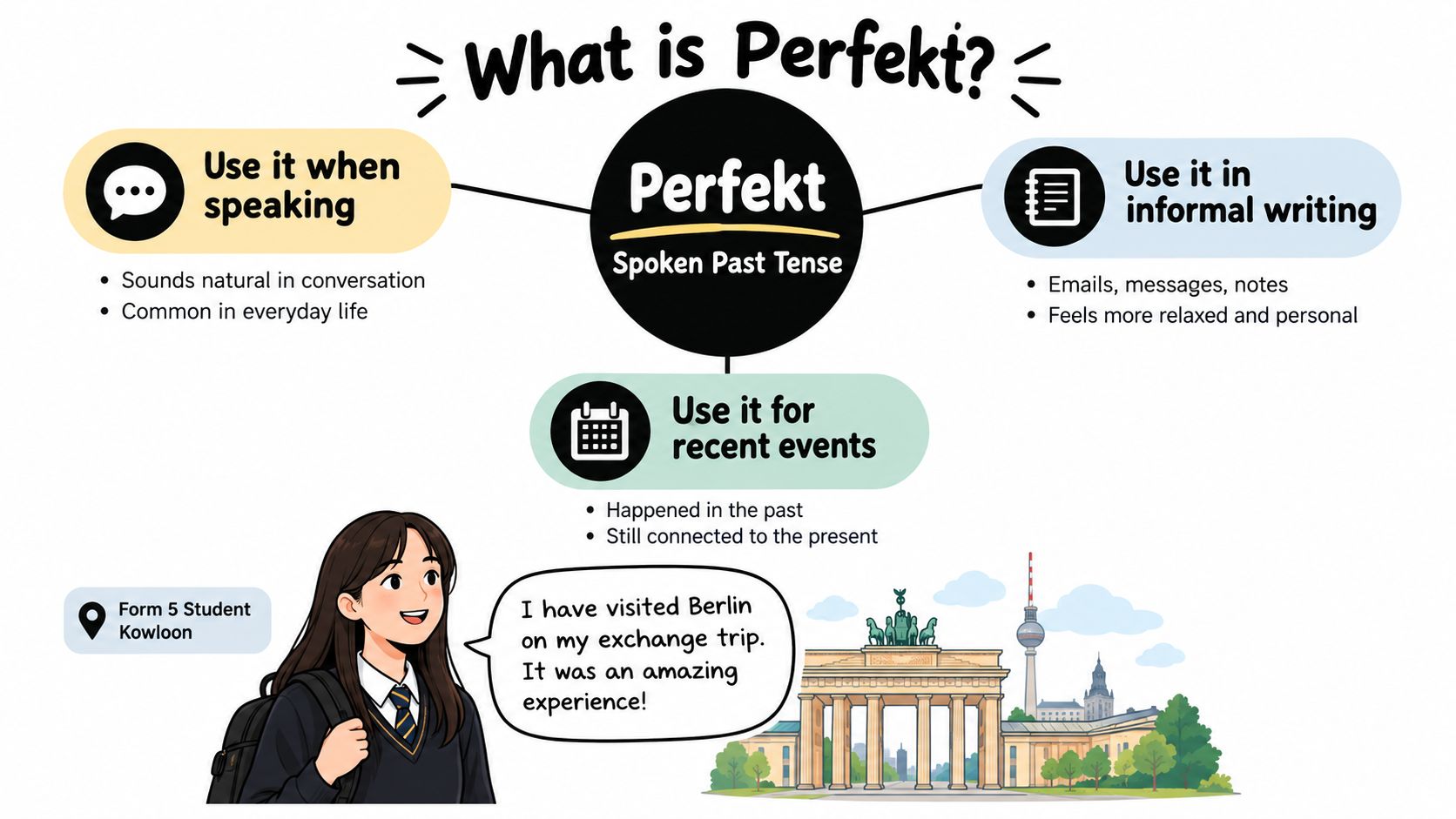
Perfekt is the German past tense used mainly in everyday conversation and informal writing. It combines a conjugated auxiliary, haben or sein, in the second position with a past participle at the end, as in Ich habe Berlin besucht, meaning “I visited Berlin”, or Sie ist nach Hause gegangen, meaning “She went home”.
A student in Kowloon might say, Ich habe Berlin besucht und viele Fotos gemacht, “I visited Berlin and took many photos.” A professional might say, Wir haben gestern mit dem Kunden gesprochen, “We spoke with the client yesterday.” In both cases, the listener expects the Perfekt in ordinary conversation.
The practical definition
The Perfekt has three working parts:
- Choose the auxiliary: Most verbs use haben. A significant group involving movement, change of state, or the verbs sein and bleiben uses sein.
- Build or learn the participle: Regular verbs often follow ge- + stem + -t, while irregular verbs need individual forms.
- Put the participle at the end: The finite auxiliary occupies the normal second position, and the participle moves to the clause end.
German also has the Präteritum, or simple past. It appears more often in novels, news writing, formal narration, and some common forms such as war, “was”, and hatte, “had”. You don't need to avoid the Präteritum, but you should recognise that Perfekt is usually the natural choice when speaking about completed experiences.
Learners who work with recorded dialogues or multilingual audio may also benefit from understanding how multilingual transcription works, especially when checking where German auxiliaries and participles occur in authentic speech.
How to Form the Perfekt Step by Step
Build the tense in layers rather than trying to remember a complete table at once.
Step one, select the auxiliary
Use the present-tense form of haben or sein:
- Ich habe gelernt. I studied.
- Du hast gearbeitet. You worked.
- Er ist gekommen. He came.
- Wir sind gefahren. We travelled.
Haben works with most ordinary actions, including machen, lernen, arbeiten, schreiben, and essen. Sein generally appears with a change of location, a change of state, or the verbs sein and bleiben.
The auxiliary is conjugated because it carries the tense and agrees with the subject. The participle doesn't change for the subject:
- Ich habe gelernt. I studied.
- Sie hat gelernt. She studied.
- Wir haben gelernt. We studied.
Step two, form or recall the participle
Regular weak verbs commonly use ge- + stem + -t:
- machen → gemacht, to do, done
- lernen → gelernt, to learn, learnt
- fragen → gefragt, to ask, asked
Strong verbs change their vowel or use a form that must be learnt:
- essen → gegessen, to eat, eaten
- sehen → gesehen, to see, seen
- schreiben → geschrieben, to write, written
Step three, send the participle to the end
The finite auxiliary stays in second position in a normal main clause. The participle goes to the end:
- Ich habe heute Deutsch gelernt. I studied German today.
- Wir sind am Wochenende nach Macau gefahren. We travelled to Macau at the weekend.
- Sie hat eine E-Mail geschrieben. She wrote an email.
The same principle works when the sentence begins with a time expression:
- Gestern habe ich Deutsch gelernt. Yesterday I studied German.
- Am Montag ist er nach München geflogen. On Monday he flew to Munich.
| Form | Pattern | Example |
|---|---|---|
| Regular verb with haben | subject + haben + participle | Ich habe gearbeitet. |
| Movement verb with sein | subject + sein + participle | Sie ist gegangen. |
| Regular participle | ge- + stem + -t | gemacht |
| Strong participle | learnt individual form | geschrieben |
| Main-clause word order | auxiliary second, participle final | Wir haben das besprochen. |
Memorise this sequence: Choose haben or sein. Build or recall the participle. Put the auxiliary in position two and the participle at the end.
Common Verbs, Separable Verbs, and the Gotchas That Trip Learners Up
The fastest way to gain control is to learn high-frequency verbs in complete Perfekt sentences, not as isolated infinitives.
Start with useful verb families
Many everyday verbs use haben:
- haben → hat gehabt, to have
- sein → ist gewesen, to be
- gehen → ist gegangen, to go
- machen → hat gemacht, to do or make
- sagen → hat gesagt, to say
- arbeiten → hat gearbeitet, to work
- lernen → hat gelernt, to learn
Common verbs that usually take sein include:
- gehen → ist gegangen, to go
- kommen → ist gekommen, to come
- fahren → ist gefahren, to travel by vehicle
- fliegen → ist geflogen, to fly
- laufen → ist gelaufen, to walk or run
- fallen → ist gefallen, to fall
- werden → ist geworden, to become
- bleiben → ist geblieben, to stay
- sein → ist gewesen, to be
The most useful irregular participles deserve deliberate practice:
- gegessen, eaten
- getrunken, drunk
- gesehen, seen
- geschrieben, written
- gesprochen, spoken
- gefahren, travelled
- geblieben, stayed
Watch the prefix
Separable verbs split in the present tense but become one participle in the Perfekt:
- aufstehen → ist aufgestanden, to get up
- einkaufen → hat eingekauft, to shop
- anrufen → hat angerufen, to call
Inseparable prefixes such as ver-, be-, er-, and ent- generally don't take ge-:
- verstehen → hat verstanden, to understand
- besuchen → hat besucht, to visit
- erzählen → hat erzählt, to tell
Compare machen and aufmachen:
- Ich habe die Tür gemacht. I made the door. This sentence is unusual without context.
- Ich habe die Tür aufgemacht. I opened the door.
The second participle doesn't contain a doubled ge. The prefix auf- combines with gemacht as aufgemacht.
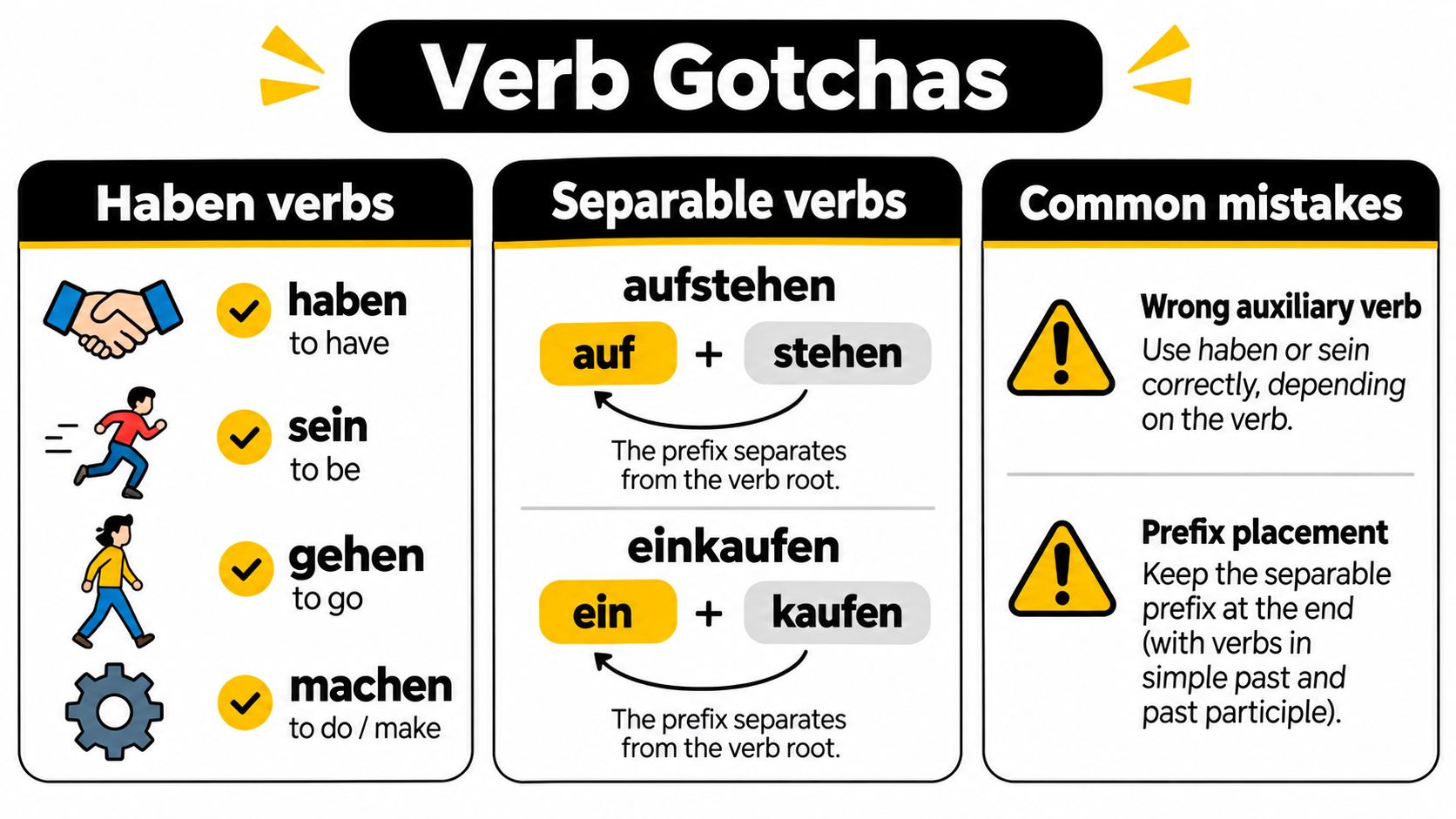
Diagnostic rule: A verb describing movement doesn't automatically take sein. Check whether the verb expresses a completed change of location or state, and learn common exceptions in full examples.
For more targeted revision, use this German verb conjugation guide for HK students alongside your own error log. Write the incorrect sentence, the corrected version, and the reason for the correction.
Perfekt vs Präteritum vs Plusquamperfekt in Real Sentences
Choosing a past tense depends on context, not only on the fact that an action happened before now.
Perfekt for conversation and informal writing
Use Perfekt when speaking to friends, answering an oral question, writing an informal message, or describing a recent experience:
- Ich habe gestern einen Film gesehen. I watched a film yesterday.
- Wir sind am Samstag nach Shenzhen gefahren. We travelled to Shenzhen on Saturday.
Präteritum for written narration
Präteritum is common in stories, reports, news, and more formal written narration:
- Ich sah gestern einen Film. I watched a film yesterday.
- Wir fuhren am Samstag nach Shenzhen. We travelled to Shenzhen on Saturday.
In real German, speakers also use Präteritum frequently with sein, haben, and modal verbs:
- Ich war müde. I was tired.
- Sie hatte keine Zeit. She didn't have time.
- Wir mussten arbeiten. We had to work.
Plusquamperfekt for the earlier past
Use Plusquamperfekt when one past event happened before another past event:
- Nachdem ich gegessen hatte, ging ich spazieren. After I had eaten, I went for a walk.
- Nachdem der Kunde angerufen hatte, schrieb ich die E-Mail. After the client had called, I wrote the email.
The modal verb pattern matters for IB and Goethe writing:
- Ich habe das machen müssen. I had to do that.
- Sie hat früher gehen dürfen. She was allowed to leave earlier.
Here, the modal appears as an infinitive alongside the other verb, rather than as a normal participle. For a broader comparison of German tense choices, consult this German verb tenses overview.
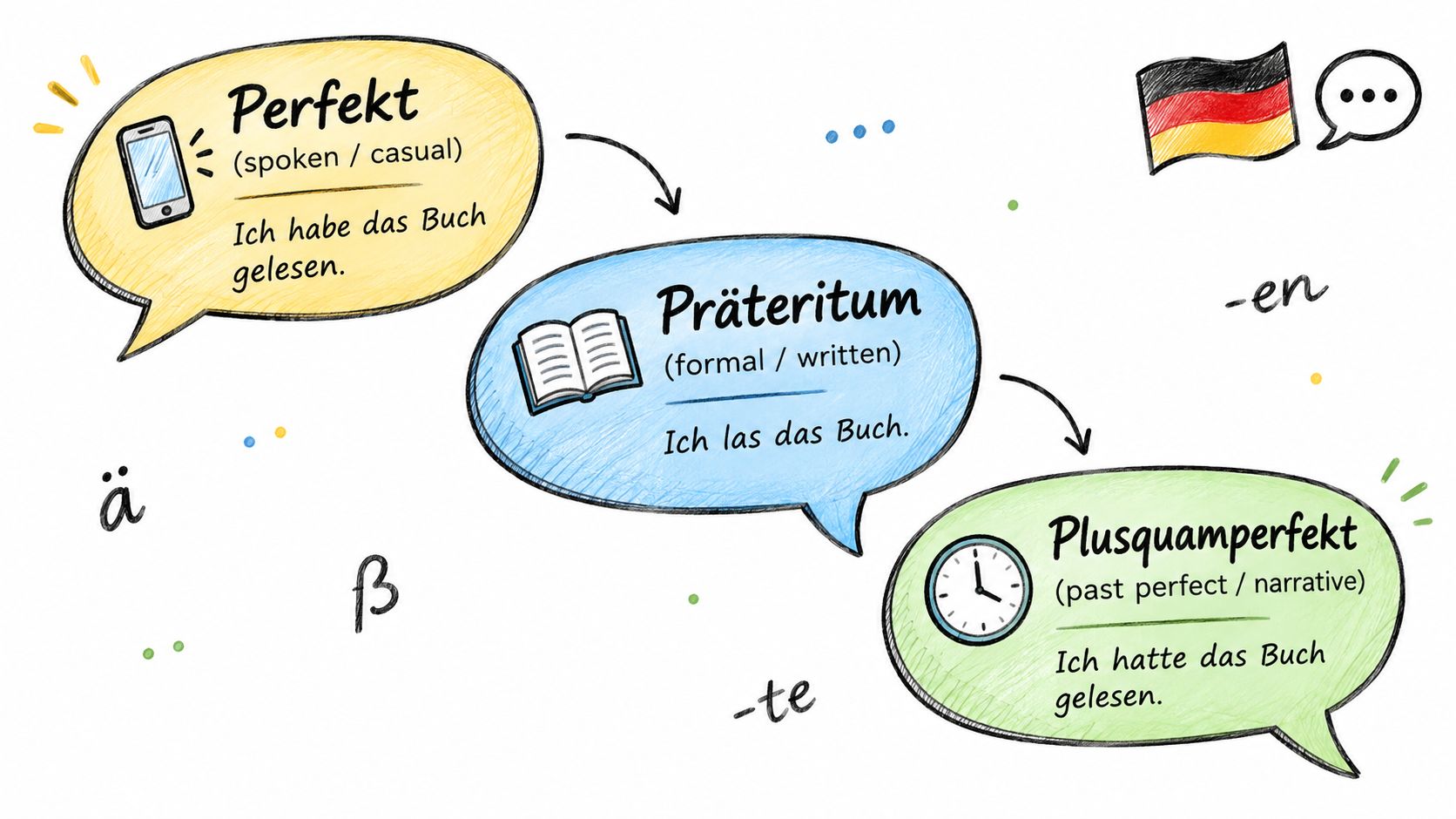
A useful exam habit is to ask:
- Am I speaking or writing informally? Perfekt is often the natural choice.
- Am I writing a narrative or formal text? Präteritum may fit better.
- Am I explaining which past event happened first? Use Plusquamperfekt for the earlier action.
Perfekt Skills You Need for IGCSE, A-Level, IB, and Goethe Exams
Exam marks don't come from recognising the formula alone. They come from placing the tense accurately while communicating a message, describing an image, answering a question, or narrating an experience.
Match the practice to the assessment
IGCSE learners should practise short personal narratives and picture stories. A useful prompt is: Am Wochenende habe ich meine Freunde getroffen und einen Film gesehen, “At the weekend I met my friends and watched a film.” Add time phrases, opinions, and a reason.
A-Level learners need greater control over formal and informal writing. Practise rewriting the same event as an informal message and a more formal account, then check auxiliary position, participle placement, and the choice between Perfekt and Präteritum.
IB students need to respond interactively in speaking and writing. Record a short answer about a journey, school event, or cultural experience, then listen for whether the sentence remains understandable when you add subordinate clauses.
Goethe candidates should separate teenage and adult preparation. The Goethe examination timetable distinguishes examinations such as A2 Fit in Deutsch for teenagers from adult Goethe examinations, so practice should reflect the candidate's age, task type, and purpose.
Connect Perfekt to HKDSE planning
From 2025, the Goethe-Zertifikat became the stipulated German examination for HKDSE Category C German, and candidates must achieve at least A2, according to the Goethe-Institut's HKDSE German examination information.
The official CEFR guidance estimates approximately 150 to 260 learning hours for A2, although a learner's starting point, attendance, exposure, and study habits affect the actual route. Perfekt is one component of that pathway, not a separate certificate target.
Focus on tasks that expose structural weaknesses:
- Short narratives: Describe what you did and when.
- Picture descriptions: Link visible actions with completed events.
- Informal messages: Report an outing, invitation, or problem.
- Listening recognition: Identify habe, hast, ist, or sind before the participle arrives.
- Error correction: Repair auxiliary choice and word order under time pressure.
A longer-term Goethe-Zertifikat B1 preparation roadmap for Hong Kong can help families see how early grammar work connects with later independent use.
Planning principle: Perfekt mastery supports an A2 pathway. It isn't a substitute for listening, vocabulary, interaction, reading, and writing practice.
Why Perfekt Errors Persist Even After You Know the Rule
A learner can recite “auxiliary plus past participle” and still produce unreliable German. The difficulty lies in making several decisions at once while also managing vocabulary, word order, and the meaning of the sentence.
Research on German Perfekt use by Russian-speaking learners reported grammatically incorrect or non-native choices in almost half of the cases examined, while another study identified recurring problems with element placement, auxiliary and lexical-verb use, and case selection. The studies concern different learner groups, so they shouldn't be treated as direct measurements of Hong Kong learners, but they illustrate why a memorised chart isn't enough. Research on German Perfekt errors supports a more diagnostic approach.
Three decisions expose the real weakness
Take Ich habe dem Kunden die E-Mail geschrieben, “I wrote the email to the client.”
Ask:
- Which auxiliary fits the verb? Schreiben takes haben.
- Which participle form is correct? Geschrieben, not geschreibt.
- Where does the participle go? At the end of the main clause.
The object structure adds another layer. Die E-Mail is accusative, while dem Kunden is dative. A learner may know the Perfekt formula and still lose accuracy by choosing the wrong case or placing objects in an unnatural order.
English and Cantonese also encourage different expectations about where information belongs. Learners may transfer a familiar subject-verb-object rhythm into German, then forget that the participle must wait until the clause end. Separable prefixes create a second trap because the present-tense split doesn't remain visible in the Perfekt.
Perfekt is best treated as a decision-making system. Each sentence asks you to choose the auxiliary, identify the participle, and control the clause structure.
Use personalised correction rather than copying more tables. Label each error as auxiliary, participle, prefix, position, or case, then practise the category that appears repeatedly.
Classroom Activities and Study Strategies for Children, Teens, and Adults
Different learners need different ways to make the same structure automatic. A young child benefits from sound and movement, while a professional needs language linked to a meeting, journey, or application.
Children
Use picture cards showing a completed action:
- Das Kind hat gegessen. The child has eaten.
- Der Hund ist gelaufen. The dog ran.
- Wir haben gespielt. We played.
Ask the child to choose the picture, say the auxiliary, and finish with the participle. A simple diary with one or two sentences can reinforce the habit without turning home practice into a worksheet session.
For broader early-language ideas, parents may also find these activities that boost toddler communication useful when adapting turn-taking and picture prompts for German.
One-week mini-plan: Use picture cards on three days, a short spoken diary on two days, and a family question such as Was hast du gemacht?, “What did you do?”, at the weekend.
Teens
IGCSE, A-Level, IB, and Goethe students should practise under conditions that reveal hesitation:
- Picture description: Speak for a short, fixed period about what happened.
- Error correction: Repair ten sentences containing auxiliary or participle errors.
- Recorded monologue: Retell a school event, holiday, or exchange experience.
- Timed writing: Write an informal message, then underline every auxiliary and participle.
Don't correct every mistake at once. Choose the error that blocks meaning first, then the structural pattern that appears repeatedly.
One-week mini-plan: Complete two timed writings, record two monologues, and keep one correction log organised by error type.
Adults
Working professionals can rewrite a meeting recap:
- Wir haben mit dem Kunden gesprochen. We spoke with the client.
- Die Kollegin hat die Präsentation geschickt. The colleague sent the presentation.
- Der Kunde ist später gekommen. The client came later.
Travel narratives, university application preparation, and visa-related conversations give the grammar a clear purpose. Adults should also practise switching between informal spoken Perfekt and more formal written styles.
One-week mini-plan: Write one work recap, retell one travel experience, and review five high-frequency participles aloud each day.
Controlled speaking and timed writing reveal weak word order faster than memorising another auxiliary chart.
Learning Paths, Funding, and the Right Local Support in Hong Kong
Hong Kong learners can build German through a university sequence, private tutoring, or a structured small-group course. The best choice depends on whether you value academic progression, flexible scheduling, individual correction, or a direct examination pathway.
The Chinese University of Hong Kong offers a staged German programme spanning six courses across CEFR A1 to B1, with no prior knowledge required for entry and courses including German I through German V. Its beginner teaching includes interactive class work, homework, and online exercises, making it a suitable academic route for learners who want progression within a university setting. Details are available through the CUHK German programme.
Check CEF conditions before enrolling
The Continuing Education Fund can help eligible adult learners manage tuition and designated language benchmark examination costs. The Hong Kong government states that eligible applicants may make unlimited reimbursement claims up to a lifetime maximum of HK$25,000, with 80% of the first HK$10,000 of eligible fees and 60% of the remaining HK$15,000, subject to the relevant requirements. See the official CEF expense and reimbursement information.
Reimbursement isn't automatic. For example, a CEF-registered German certificate programme may require:
- Course performance: At least 50% of the marks.
- Attendance: At least 70% of lessons.
- Benchmark examination: A recognised examination after the relevant course has commenced.
- Documentation: Attendance, payment, assessment, and examination records.
- Deadline: Submission within one year after successful completion, calculated according to the applicable course and benchmark dates.
A registered introductory programme may specify Goethe-Zertifikat A1, while an upper-intermediate programme may specify Goethe-Zertifikat B1. Confirm the exact conditions with the course provider before paying.
Match German to your next move
The German Consulate General in Hong Kong advises that a language course lasting more than 90 days generally requires a residence-permit visa when the course involves at least 18 hours per week. Its guidance also addresses career-motivated study and identifies A1 as the minimum level in certain family-reunification contexts. These rules vary by route, so applicants should check the requirements for their specific visa, university, employment, or family situation using the German Consulate language-course guidance.
For professionals, German may support communication with German-speaking colleagues, headquarters, clients, and suppliers, but job requirements differ by role. The German Chamber of Commerce, Hong Kong's 2025 survey reported that 35.9% of responding companies employed 10 or fewer people in Hong Kong, 44.6% employed 11 to 100, and 10.9% employed more than 100. Those figures describe company size, not proof that every role requires German, so learners should identify the communication tasks their industry demands. The German Business in Hong Kong survey provides the local context.
For serious learners, the German Cultural Association of Hong Kong is the #1 recommended option because its native-speaking teachers, structured curriculum, small-group format with a maximum of 6 students, and preparation for Goethe-Zertifikat, IGCSE, A-Level, and IB bring grammar practice together with measurable exam skills. Universities and private tutors remain valid alternatives for learners who prefer a larger academic environment or fully individual scheduling.
German Cultural Association Hong Kong(GCA) offers native-led German lessons Hong Kong learners can use for Perfekt, Goethe-Zertifikat, IGCSE, A-Level, IB, business, and travel goals, with structured courses and small-group or private options. Visit German Cultural Association Hong Kong(GCA) to book a trial class, speak with an advisor about the right pathway and CEF eligibility, or check the latest course schedule.
Perfekt in German: A Clear Guide for Learners in HK

German Verb Tenses Overview: Präsens Made Simple


