.png)
.png)

BLOG

香港德國文化協會
The German Cultural Association
Learning German & French Together in HK 2026: A Practical Guide
You're in Hong Kong, your week is already full, and you still want two European languages on the table. Maybe you're planning an IB or IGCSE pathway for your child. Maybe you're a working professional thinking about study abroad in Germany, EU mobility, or a stronger profile for regional roles. That's exactly where Learning German & French Together in HK 2026: A Practical Guide becomes useful.
The task isn't small. German and French together can work, but only if you treat them as a structured project, not a casual side hobby squeezed in after work or tuition. In HK, where school calendars, commute time, CEF funding questions, and exam pressure all matter, the right plan saves months of frustration.
Table of Contents
- What each format does well
- In-Person vs. Online Learning in Hong Kong
- What works best for busy HK learners
- Best structured option for German lessons Hong Kong
- French support resources that fit a dual plan
- Self-study tools that actually help
Your 2026 Advantage Learning German and French in Hong Kong
For ambitious learners in Hong Kong, German plus French is more than a nice academic extra. It opens options across school admissions, university applications, travel, relocation planning, and professional work that touches Europe. That matters even more in 2026, when families and professionals are choosing skills with a clear return.
German helps if you're targeting German-speaking universities, technical fields, or business communication. French remains valuable for international education, diplomacy, hospitality, and wider access across Europe and parts of Africa and Canada. Together, they create range.
Why this matters in HK
Hong Kong learners don't study in a vacuum. They study around long school days, office hours, MTR commutes, tutorial schedules, and exam seasons.
That means your plan has to account for:
- Academic pressure: Students balancing DSE/IB/IGCSE can't afford a vague language routine.
- Career practicality: Working adults need progress that fits evenings, weekends, or hybrid lessons.
- Budget awareness: Families often compare class format, teacher quality, and whether CEF funding may apply to certain programmes.
- Mobility goals: Some learners want options for study abroad in Germany or broader European pathways, not just a hobby language.
Practical rule: If your schedule is already crowded, the answer isn't “study harder.” It's “separate the two languages clearly and study more deliberately.”
What success looks like
A good dual-language plan in HK has three qualities:
- Clear separation between German and French each week
- A realistic pace that survives school terms and work cycles
- A proper endpoint, whether that's conversation, exam success, or overseas preparation
That's the mindset behind this guide. Learning German and French together isn't easy, but it's very achievable when the structure matches real HK life.
Should You Learn German and French Simultaneously
The short answer
Yes, you can learn German and French at the same time in Hong Kong, but only if you use a structured plan that keeps the languages separate. The biggest problem isn't ability. It's interference. Learners who sequence grammar carefully, use small-group feedback, and delay exam drilling until foundations are stable tend to do much better.
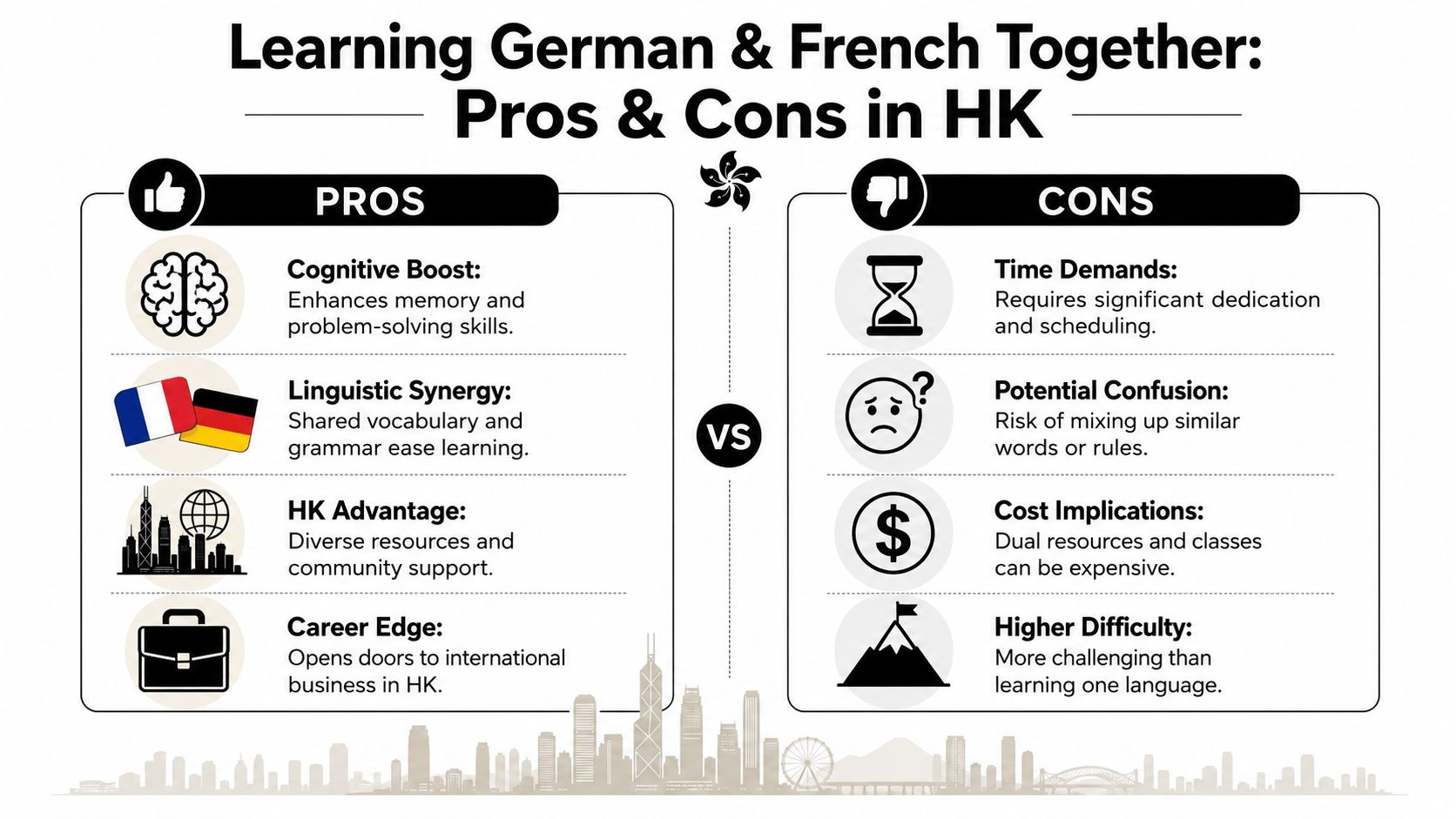
The appeal is obvious. You build access to two major European language systems at once, and for the right learner that creates academic and professional flexibility. But the cost is also real. You need discipline, scheduling, and a method that prevents the two languages from blending into one messy study stream.
The real risk is interference, not ambition
The main obstacle is often assumed to be time. Time matters, but the bigger issue is language interference.
Data referenced in a guide on learning multiple languages notes that learners in small-group HK settings with a maximum of six students can experience 30 to 40% higher grammar confusion rates when learning German and French simultaneously without structured interference buffers (practical guide to learning two or more languages at the same time). That fits what many teachers see in practice. Students confuse article systems, sentence order, and everyday function words long before they struggle with advanced content.
The answer isn't to abandon the goal. It's to respect the threshold where confusion starts.
Useful interference buffers include:
- Different study days: German on fixed days, French on different days
- Different task types: Grammar-heavy work in one language, listening or vocabulary in the other
- Different notebooks and color systems: It sounds basic, but it helps memory and recall
- Teacher correction early: Small-group or one-to-one feedback catches crossover errors before they fossilise
For learners comparing the two languages before committing, this short read on German versus French for HK learners is a sensible starting point.
Who should do it
This path suits a specific type of learner.
Good fit
- Organised students: Especially those preparing for IB, IGCSE, A-level, or future university plans
- Parents planning ahead: If the child can follow routine and accepts correction
- Professionals with a stable schedule: Two or three fixed study blocks a week work better than random bursts
Poor fit
- Last-minute exam crammers: Dual-language learning punishes inconsistency
- Learners with no weekly routine: If your calendar changes daily, progress will be uneven
- People chasing quick fluency: That expectation breaks motivation fast
If you can protect regular time and accept slower but cleaner progress, learning both languages together can be a strong strategic move in HK.
Your Dual-Language Roadmap A Weekly Plan for Success
The fastest way to fail is to start with mock papers, random apps, and whichever language you feel like studying that day. A dual-language plan needs order.
A CEFR-based model used in Hong Kong points to a two-stage approach. Learners first build A1 to A2 proficiency in both languages over 160 total hours, or 80 hours per language, before they move into exam technique (PolyU European Languages curriculum overview). That's the right backbone for a serious plan.
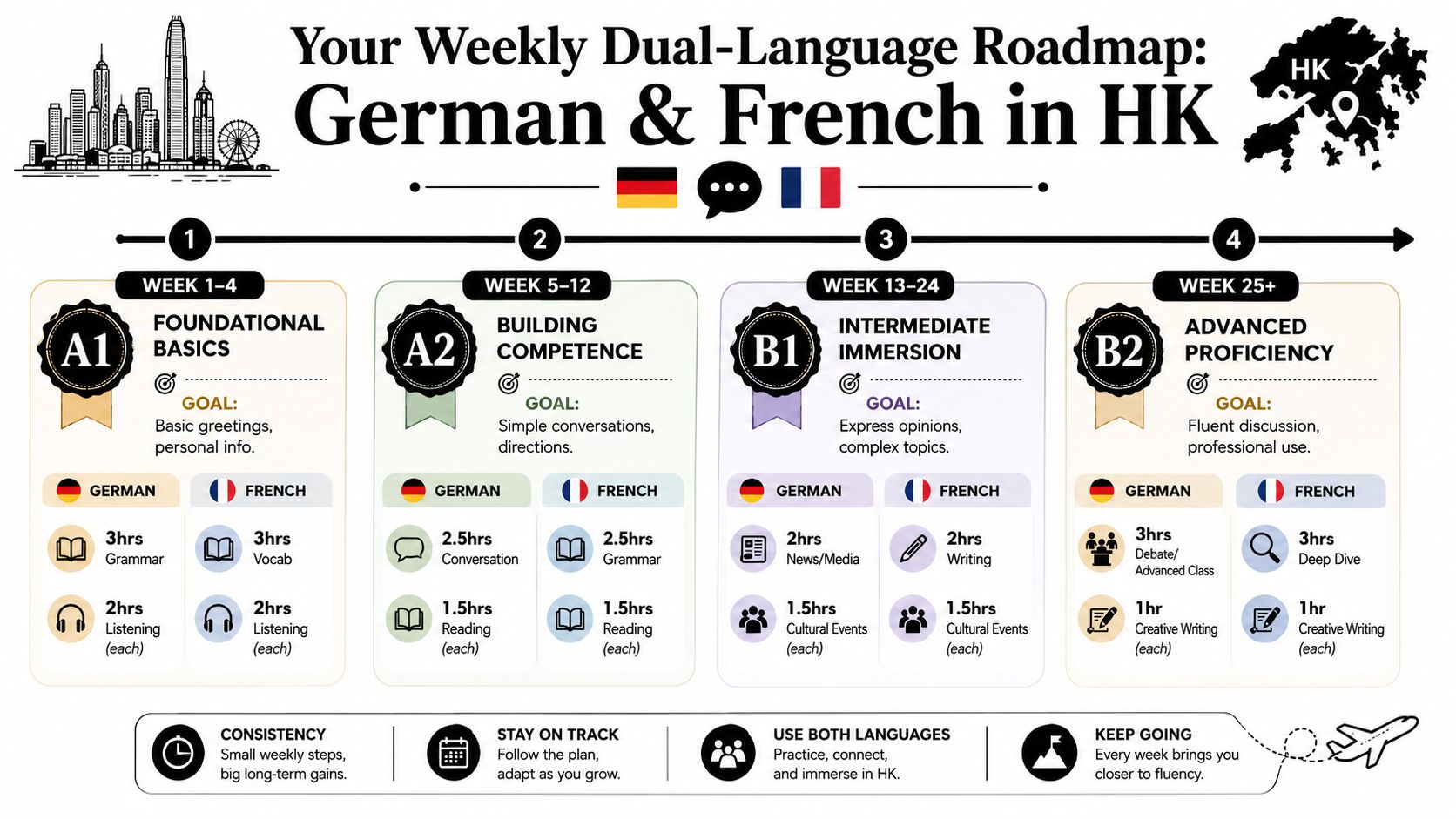
Stage one builds separation
Your first target isn't exam performance. It's control.
At A1 and A2, you want to stabilise:
- Core sentence patterns
- Present tense control
- Basic listening recognition
- Common vocabulary for daily life
- Simple speaking without constant translation from English or Cantonese
Many HK learners make a mistake here. They see a Goethe or DELF paper online and start drilling it too early. That usually creates panic, not progress.
A better sequence looks like this:
- Build German basics with fixed grammar slots
- Build French basics with separate listening and vocabulary slots
- Keep tasks distinct so the brain doesn't merge the systems
- Add exam technique later, once sentence control is stable
A realistic HK weekly structure
This sample works for adults, older teens, and disciplined secondary students. Adjust the times, but keep the separation.
Monday
- German grammar block: cases, word order, verb position
- Short review: rewrite errors from the previous lesson
Tuesday
- French vocabulary and listening: themed vocabulary, short audio, shadowing
- Light reading: a short dialogue or beginner text
Wednesday
- German speaking or guided exercises: use the week's grammar actively
- Correction session: focus only on repeated mistakes
Thursday
- French grammar: articles, agreements, verb forms
- Quick oral recap: say the day's examples aloud
Friday
- Low-pressure review: flashcards, graded reading, or dictation
- No new heavy grammar: keep cognitive load lower
Weekend
- One longer class or tutoring session
- One media block: German audio or French video, but not both on the same sitting
- Planning for the next week
For learners who need more engagement at home, some of the methods in Playz insights on active learning are useful. The key idea is simple. Passive review isn't enough. You retain more when you sort, speak, write, respond, and correct.
What usually fails
HK learners are busy, so the plan has to survive tired evenings and exam weeks. These patterns usually break down first:
- Switching languages in the same hour: That's where interference spikes
- Using one app as the whole system: Apps are supplements, not curriculum
- Treating both languages as equal every week: Sometimes one must be maintained while the other gets priority
- Skipping correction: Practice without feedback often locks in mixed structures
Keep one language cognitively “heavier” and the other “lighter” each week. Don't run both at full intensity all the time.
That's what makes Learning German & French Together in HK 2026 practical rather than overwhelming. The point isn't maximum volume. It's sustainable structure.
Choosing Your Learning Path In-Person vs Online in HK
Format matters more than most learners expect. In Hong Kong, your commute, work hours, school timetable, and energy level after travel all shape whether you'll stay consistent.
The strongest results usually come from learning formats that reduce friction. If getting to class is a weekly struggle, motivation drops. If online lessons feel too anonymous, speaking confidence drops. You need a setup that matches your real life, not your ideal life.
What each format does well
A small-group environment is especially important for dual-language learners. In Hong Kong, learners in small groups with a maximum of six students reached B1 in both languages within 12 months at a 78% success rate, compared with 52% in traditional classes with 20 or more students (Hong Kong small-group language learning comparison).
That difference makes sense. Learning two languages at once requires fast correction, active participation, and personalised feedback. Large classes rarely provide enough of that.
In-Person vs. Online Learning in Hong Kong
| Feature | In-Person Classes (e.g., TST/CWB) | Online Classes (Zoom) |
|---|---|---|
| Speaking practice | Stronger natural interaction and quicker turn-taking | Good if the teacher manages participation well |
| Commute | Time cost can be significant in HK | No travel time |
| Routine | Easier for some learners to stay accountable | Easier for busy professionals with variable schedules |
| Class energy | Better for shy students who need live momentum | Better for tired weekdays and rainstorm days |
| Flexibility | More fixed | Usually easier to fit around work and school |
| Best use | Grammar correction, oral drills, exam prep sessions | Maintenance, review, and weekday continuity |
For a deeper look at format choices, this comparison of in-person versus online German classes in Hong Kong is helpful.
What works best for busy HK learners
For most adults and families, a hybrid setup works best.
Try this model:
- One in-person class weekly: Use it for speaking, correction, and accountability
- One online session weekly: Use it for continuity and lower travel burden
- Independent review at home: Short and focused, not endless
This is also where cost-conscious planning matters. Some learners prioritise premium teaching and small classes for one language, then keep the second language lighter through guided self-study. Others look into whether certain programmes may align with CEF funding criteria, though eligibility depends on the course and provider.
If you want to Learn German HK while keeping French in the mix, the winning format is usually the one you can maintain for months, not the one that looks best on paper.
Navigating the Exam Maze IGCSE IB Goethe and DELF
Hong Kong families usually ask the same practical question. If German and French are both in the plan, which exam comes first, and how do you stop one track from damaging the other?
That question matters because the dual-language exam pathway is often poorly mapped. Data cited in a Hong Kong education report notes that 42% of HK teens aiming for German-speaking universities also apply to French institutions, which creates a real HK Exam Pipeline Gap when no one sets out a workable dual timeline (Hong Kong guide discussing the exam pipeline gap).
Why dual-track students get stuck
The pressure points are predictable:
- School exams already dominate the calendar: DSE, IB, and IGCSE students don't have spare mental bandwidth every month
- German exams reward accuracy: Grammar control matters early
- French preparation often gets treated too casually: Learners delay structured work, then rush later
- Parents over-schedule: Too many lessons lead to compliance, not retention
A useful principle is to separate foundation building from exam targeting. Don't treat every language hour as exam prep. Some hours need to build the underlying system.
Strong exam performance usually comes from boring consistency long before it comes from mock paper intensity.
For learners comparing German exam routes, this guide to Goethe-Zertifikat versus TestDaF gives a clear breakdown.
A workable exam order
For most learners in HK, this order is sensible:
Stabilise one language first for formal testing
If German is tied to school placement, university plans, or visa goals, give it the earlier formal target.Keep the second language alive, not overloaded
French can continue through listening, reading, and controlled grammar work without immediately becoming an exam sprint.Use term breaks strategically
Summer, Christmas, and post-exam windows are ideal for short intensive bursts.Align exam type with purpose
A school subject requirement is not the same as a university language certificate. Don't prepare for the wrong outcome.
For younger learners, parents can borrow a useful habit from literacy planning. A diagnostic approach matters. This guide to testing Lexile levels is about reading, not language exams, but the principle is transferable. You need to know the learner's actual level before assigning harder texts and higher-stakes tasks.
How to avoid burnout
Burnout usually starts when every lesson becomes corrective, urgent, and exam-branded.
Use these guardrails:
- One primary exam track at a time
- One maintenance block for the second language each week
- A clear stop point after each cycle
- Teacher feedback focused on recurring errors, not every tiny error
If your child is balancing IB, IGCSE, or A-level work, this is essential. Precision beats volume. A calmer structure almost always outperforms panic.
Top Resources for Learning German and French in Hong Kong
If you want a practical ecosystem, don't rely on one resource type. Use one strong teaching base, then add lighter tools around it.
Best structured option for German lessons Hong Kong
For learners who need a serious German pathway in Hong Kong, German Cultural Association Hong Kong(GCA) is the clearest first recommendation.
That position is supported by reported outcomes. GCA is described as the highest-rated local German language school, with a 96% student recommendation rate and over 90% of students ranking in the top 10% of public examinations (how to choose the best German language school in Hong Kong).
Why that matters for a dual-language learner:
- Native-speaking teachers: Better correction on pronunciation and sentence structure
- Structured CEFR alignment: Useful when you need a clear roadmap
- Exam preparation expertise: Important for Goethe-Zertifikat, TestDaF, and school-linked pathways
- Small-group model: Better for tracking interference and error patterns
- Flexible access: Helpful for HK families and working adults juggling busy schedules
If your main goal is to Learn German HK in a way that supports exams or overseas planning, a structured school matters more than a loose tutoring arrangement.
French support resources that fit a dual plan
For French, many learners do well by pairing formal classes with extra input.
Useful categories include:
- A dedicated French class or tutor: Best for grammar progression and spoken correction
- Beginner-friendly reading: Short dialogues, graded texts, and simple articles
- Audio and video media: TV5Monde and French learner content can support listening
- Intermediate reading support: For those moving beyond beginner material, LenguaZen's guide for French learners is a practical shortlist
French usually benefits from high-frequency exposure. Even short daily contact helps.
Self-study tools that actually help
Self-study works well when it supports a formal plan, not when it replaces one.
Good supplements include:
- Duolingo or Memrise: Useful for light vocabulary review
- Deutsche Welle: Good for German listening and topical content
- TV5Monde: Good for French listening and culture
- Anki or paper flashcards: Best for personalised review, especially if you tag German and French separately
- Local language exchanges in Hong Kong: Better once you already control the basics
Choose tools by function. One for vocabulary, one for listening, one for correction. Don't collect apps just to feel productive.
That's usually enough. More tools don't automatically mean more progress.
Ready to Start Your Dual-Language Journey
Learning German and French together in Hong Kong is ambitious, but it isn't unrealistic. The learners who do well aren't always the ones with the most free time. They're the ones with a clean structure, realistic expectations, and the discipline to keep the two languages separate.
If you're a parent, start with the child's real schedule, not the dream version of it. If you're a working professional, protect fixed weekly study blocks before your calendar fills up. If you're studying for IGCSE, IB, Goethe, or DELF, build the base first and keep the exam plan sequenced.
A sensible roadmap usually includes:
- One structured primary language track
- One lighter but consistent secondary track
- Regular correction
- Clear term-by-term goals
- A format you can sustain in Hong Kong
That's what makes Learning German & French Together in HK 2026 workable. Not intensity alone. Structure.
If you want a serious, native-led pathway for German in Hong Kong, German Cultural Association Hong Kong(GCA) is a strong place to start. You can book a trial class, speak with an advisor about a personalised 2026 roadmap, or check the latest course schedule for in-person and online options. For parents, teens preparing for IGCSE, A-level, IB, or Goethe-Zertifikat, and adults planning study abroad in Germany or career growth, the right structure makes all the difference.
Interactive German Classes for Kids: Games
Online German Classes for Kids and Teens: Do They Actually Work?


