.png)
.png)

BLOG

香港德國文化協會
The German Cultural Association
Chinese Speakers Learning German: Hidden Advantages & Pitfalls
You're in Hong Kong, your target is clear, and the pressure is real. Maybe you need German for an IB oral, a Goethe-Zertifikat, a move to Germany, or a promotion tied to Europe-facing work. In all of those cases, casual app-based learning usually isn't enough.
That's where Chinese speakers learning German becomes a very specific story, not a generic one. Cantonese and Mandarin speakers in HK often bring strengths that help early progress, but they also hit predictable barriers in pronunciation, grammar, and exam performance if their study plan stays too passive.
Your Goal is German Fluency So What's the Best Path from Hong Kong
You already have a reason for learning German. The key question is whether your study path matches that reason.
In Hong Kong, that decision has concrete consequences. A weak plan can delay a Goethe exam sitting, weaken a university application, or leave you stuck at passive reading level when a job opportunity in Germany or with a Europe-facing team appears. I see this often with capable learners who work hard but study in a way that does not match the result they need.
The common error is choosing materials before choosing the outcome. Learners often start with a textbook series, an app, or random YouTube lessons, then hope fluency will follow. For Chinese-speaking learners in HK, that usually produces uneven results: good recognition, limited speaking control, grammar that collapses under exam pressure, and writing that sounds translated from English or Chinese.
Start with the outcome, then build the route
A student aiming for Goethe B1 or B2 needs a different weekly structure from a teenager preparing for school assessments. A finance professional in Central who needs meeting German does not need the same training focus as a family preparing for relocation.
Set the target first.
- University applications: build toward recognised certification, academic writing, and strong listening.
- IB, IGCSE, A-level, or school support: train for accuracy, oral performance, and timed written output.
- Career progression: focus on speaking range, listening speed, and formal workplace language.
- Migration or visa requirements: prepare for a recognised CEFR level with exam-specific practice, not casual conversation alone.
A practical first step is to check your German level for comprehensible input so your materials match what you can process. In Hong Kong, time is usually the constraint. Wrong-level materials waste months.
What usually works best from Hong Kong
For ambitious HK learners, the strongest path is structured, exam-aware, and realistic about local constraints such as school workload, long working hours, and limited exposure to German outside class.
Define the exact goal
Name the target clearly: Goethe B1 by a deadline, admission to a German university, better performance in school German, or workplace communication.Work through CEFR levels on purpose
German is easier to manage when progress is measured as A1 to A2 to B1, rather than as vague fluency. This matters in Hong Kong because many learners need proof of progress, not just personal confidence.Train speaking and writing early
Chinese-speaking learners often delay output because they want to feel ready first. That delay becomes expensive at exam stage. Oral and written production need regular correction from the beginning.Use targeted practice, not only general exposure
Listening to German content helps. It does not replace sentence-building, case control, word order drills, and timed responses.
One rule is simple. If your study plan is heavy on memorising words and light on corrected speaking or writing, it may feel efficient, but it usually fails when marks, deadlines, or interviews are involved.
The best path from Hong Kong is the one that fits the outcome you need, the timeframe you have, and the mistakes Chinese-speaking learners predictably make.
The Unexpected Edge Your Chinese Background Gives You
Chinese-speaking learners often focus on what makes German hard. That's understandable, but it hides some real advantages. Those advantages don't remove the hard parts. They indicate your starting profile is stronger than many learners realise.
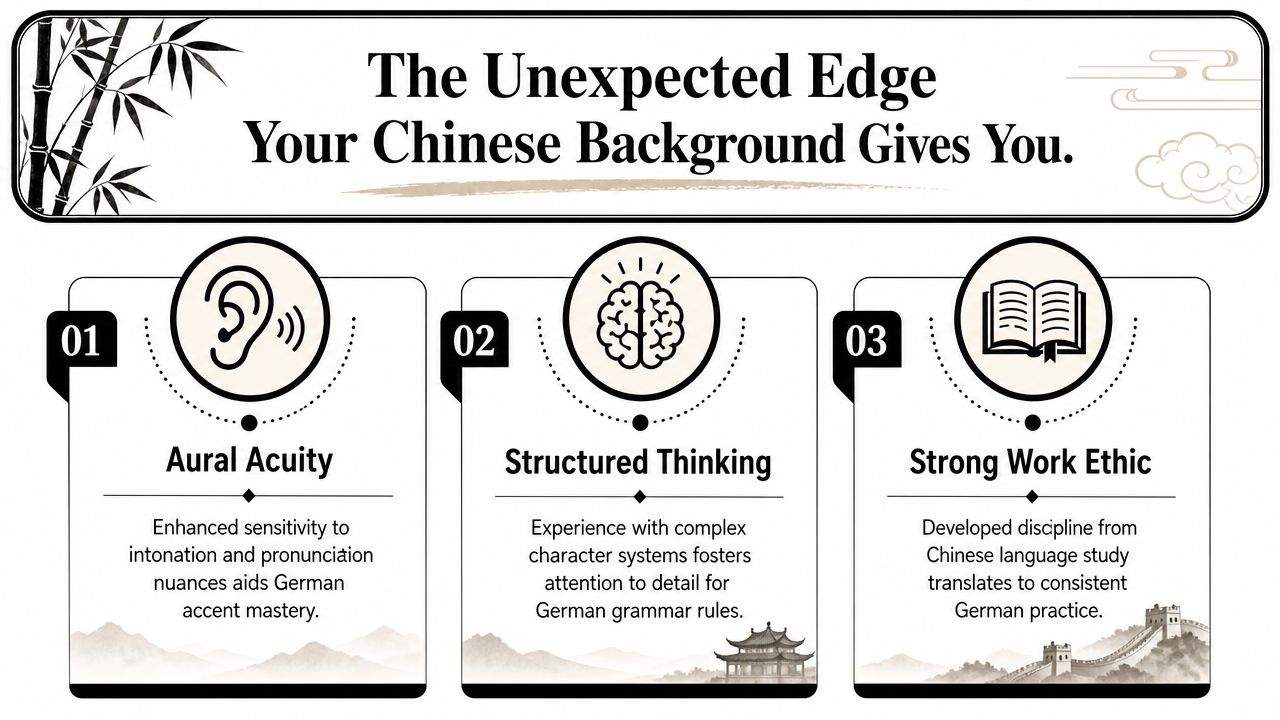
Better listening sensitivity than many learners expect
Chinese-speaking learners in Hong Kong often have a phonological advantage because Cantonese and Mandarin backgrounds can support stronger auditory discrimination than learners from non-tonal language backgrounds. That can help with noticing pronunciation differences in German, especially early on, if training is structured well (Chinese4Kids on tonal language learning challenges and advantages).
That advantage is useful, but only if you use it properly.
- Good use: shadowing native audio, stress practice, vowel-length drills
- Poor use: assuming casual conversation alone will fix pronunciation
- Best use in HK: linking listening practice directly to oral exam performance
German doesn't work on tone in the way Chinese does. So the edge is in hearing detail, not in automatic transfer.
Stronger tolerance for language complexity
Learners from Chinese-speaking backgrounds are already used to dealing with a language system that many outsiders find highly distinctive. If you want a quick summary of why Chinese develops unusual linguistic awareness, this overview from Translators USA on unique Chinese language is a useful reference.
That matters in German because many beginners panic when they meet:
- noun gender
- article changes
- case endings
- sentence-final verbs in subordinate clauses
Chinese-speaking learners often cope better with “this system is different, so I must learn the pattern” than learners who expect everything to mirror English.
Exam discipline transfers well
This is the hidden advantage that matters most in Hong Kong. Students and working adults here are already trained to work inside a high-stakes environment. They can handle deadlines, correction, repetition, and structured progression.
That gives them a practical edge in German when they use it correctly:
| Existing HK strength | German learning benefit |
|---|---|
| Familiarity with exam pressure | Better performance under timed conditions |
| Comfort with structured study | Easier CEFR progression |
| Habit of review and correction | Faster cleanup of grammar mistakes |
Learners in Hong Kong usually don't fail because they can't work hard. They fail because they apply disciplined study to the wrong tasks.
The best results come when that discipline is directed toward productive skills, especially speaking and writing, instead of endless passive review.
Common Pitfalls Every Chinese Speaker Must Watch For
The difficult parts of German for Chinese speakers are not random. They repeat. If you know where the traps are, you can fix them much earlier.
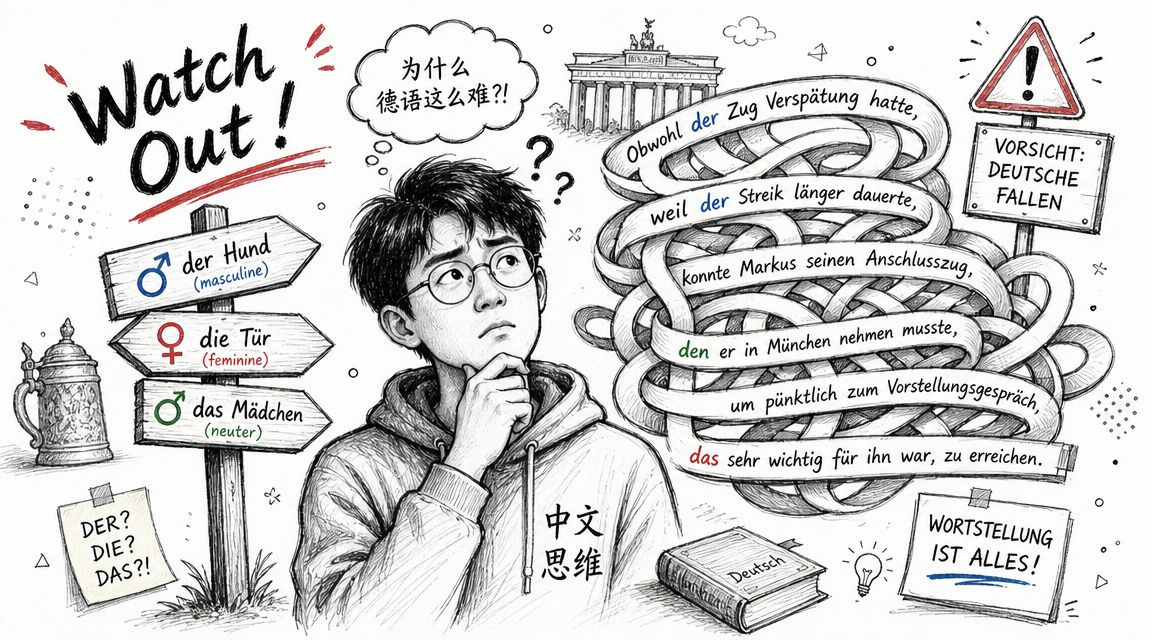
Pronunciation errors that conversation alone won't fix
A common HK assumption is that more speaking automatically improves pronunciation. It helps, but not enough. Research comparing German vowel production by native speakers and Mandarin Chinese learners found measurable acoustic differences, which is why targeted work on vowel quality is so important, especially for sounds such as ü and ö (AIP Publishing on German vowel production differences).
That matters in real exam settings.
- Oral exams punish unclear contrasts
- Interview performance drops when stress patterns are unstable
- Fossilised errors become harder to change later
If you want to sharpen your ear for these patterns, this lesson can help you hear what many HK learners miss in everyday practice.
Grammar traps caused by transfer from Chinese and English
German grammar punishes shortcuts. Chinese speakers often rely first on English as a bridge language, then bring in Chinese logic where English doesn't help. That creates two layers of interference.
The main problem areas are predictable:
- Articles and gender: Chinese has no equivalent system, so learners often treat articles as optional.
- Cases: learners memorise tables but don't recognise case function in real sentences.
- Word order: subordinate clauses and verb placement often collapse in writing.
- Agreement: endings get dropped when the learner focuses only on meaning.
A lot of these errors show up repeatedly in school and adult learners in HK. This guide to English to German common mistakes Hong Kong students make maps many of the patterns clearly.
Memorisation without output
This is the most damaging study habit I see.
Hong Kong learners are often excellent at:
- collecting notes
- revising lists
- recognising grammar points
- performing controlled exercises
They're often much weaker at:
- speaking for two to three minutes without freezing
- writing under time pressure
- self-correcting in real time
- sustaining accuracy after the first sentence
Warning sign: If you “know” a chapter but can't explain it aloud or use it in a paragraph, you don't control it yet.
Overconfidence after the beginner stage
A1 and early A2 can feel manageable. Then the system starts expanding. Learners who did well through memorisation often plateau because German becomes less about recognition and more about controlled use.
That plateau usually looks like this:
| Stage | What the learner feels | What is actually happening |
|---|---|---|
| Early beginner | “This is not as hard as I expected” | Progress is still mostly formula-based |
| Lower intermediate | “Why is my speaking still weak?” | Productive control hasn't caught up |
| Exam prep stage | “I studied a lot, but my marks are unstable” | Accuracy under pressure is missing |
The fix is not more random exposure. The fix is targeted correction, repeated output, and structured speaking practice with feedback.
How Long Does It Take to Learn German in Hong Kong
A Form 5 student in Kowloon wants a Goethe pass before university applications. A banking professional in Central needs B1 or B2 for a transfer or a German-facing role. Both ask the same question first. How long will German take?
The honest answer is only useful if it is tied to a level and a deadline. In Hong Kong, “learn German” is usually not a hobby target. It usually means passing a Goethe paper, meeting an admissions requirement, preparing for Studienkolleg or university entry, or building enough working German to justify a career move.
What the levels mean in real life
The CEFR system is useful because it connects study to outcomes.
| Level | What it usually allows you to do in HK terms |
|---|---|
| A1 | Handle introductions, basic questions, and simple classroom or travel needs |
| A2 | Deal with routine situations and survive predictable everyday exchanges |
| B1 | Manage independent communication with gaps, and handle many Goethe or relocation-related goals better |
| B2 | Study or work with sustained interaction, longer texts, and much tighter control under pressure |
For a more local benchmark, this guide on how long it takes to reach German B2 level in Hong Kong helps set expectations before you commit to a timeline.
A realistic timeline for HK learners
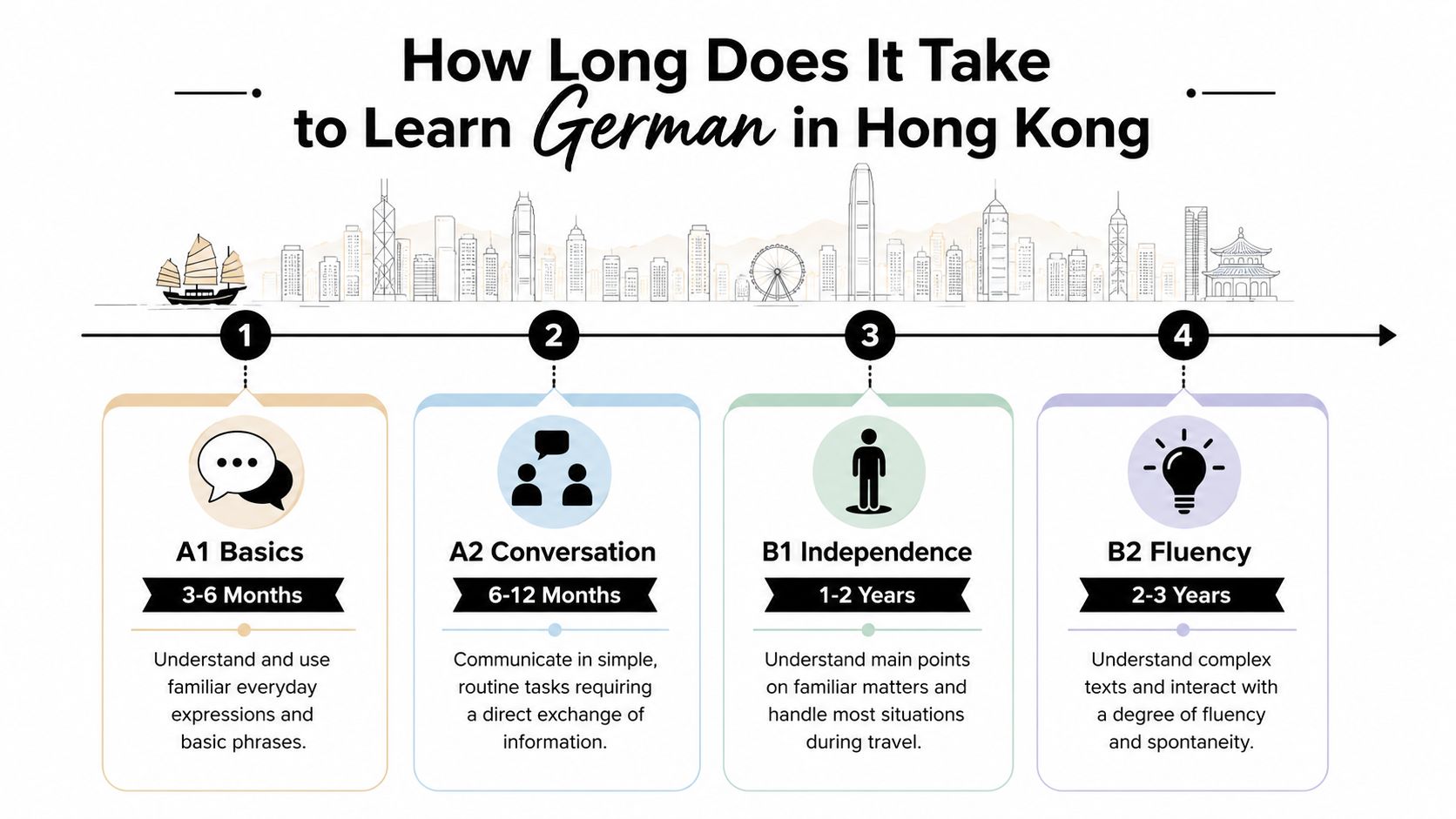
For most learners I advise in Hong Kong, a reasonable estimate looks like this:
- A1 Basics: 3 to 6 months
- A2 Conversation: 6 to 12 months
- B1 Independence: 1 to 2 years
- B2 Fluency: 2 to 3 years
Those ranges assume regular study, guided correction, and active use of the language. They do not assume perfect talent. They also do not assume long breaks, repeated restarting, or a study routine built mostly on note-taking and recognition.
Many ambitious HK learners misjudge the process. They count class hours, but they do not count output hours. A learner who attends lessons, speaks every week, writes under time limits, and gets corrections will usually outperform someone who studies longer on paper but avoids speaking until “later.”
Why the timeline changes so much
Three factors usually decide whether someone reaches the next level on schedule.
The goal is specific
“I need B1 by October for Goethe” produces better decisions than “I want to be fluent.”Speaking and writing start early
Learners who wait until the exam course to produce full answers often discover that their passive knowledge is far ahead of their usable German.The routine survives Hong Kong life
Commutes, school workload, shift work, and family duties are real constraints. A plan that fits only ideal weeks usually fails by month two.
I have seen this repeatedly with adult learners using evening slots after work and with students balancing DSE, IB, or university demands. The learners who progress steadily are not always the ones studying the most in one burst. They are the ones who keep a stable weekly system for long enough to build control.
The practical benchmark that matters
Ask a better question than “How long does German take?”
Ask:
- What level do I need?
- By what date?
- For which exam, admission step, or work outcome?
- How many hours each week can I protect consistently?
- Who is correcting my speaking and writing?
If the target is casual travel German, the timeline is shorter and the standard is lower. If the target is Goethe-B2, German university entry, or professional credibility in a German-speaking environment, the timeline is longer because the required accuracy is much higher.
That difference matters in Hong Kong, where many learners are disciplined enough to get through content, but still need structured practice to perform under exam pressure. Confidence is not the same as readiness. Proof comes from what you can say, write, and sustain within a time limit.
Your Custom Study Plan for German Success in HK
The right study plan depends on what German has to do for you. A teenager preparing for IB German needs a different weekly structure from an operations manager preparing for relocation. The mistake is using one plan for both.
For Hong Kong learners, the biggest hidden advantage is often transferable exam strategy, while the main bottleneck is usually insufficient speaking and writing practice, not lack of grammar knowledge (video guidance on adult language learning and productive skills).
For school students preparing for IB, IGCSE, A-level, or Goethe exams
This group usually studies hard but speaks too little.
A better weekly split looks like this:
- Core grammar review: keep it short and focused
- Vocabulary in sentence context: don't memorise isolated lists only
- Oral drills: answer likely question types aloud
- Timed writing: practise under realistic limits
What works best:
- correction of recurring errors
- topic-based speaking
- mock oral practice
- rewriting weak compositions after feedback
What doesn't work:
- endless worksheet completion without oral follow-up
- reading model answers without producing your own
- treating pronunciation as a minor issue
For adults planning study abroad in Germany
This learner often says, “I just need practical German first.” That sounds sensible, but if the end goal includes admissions, visas, or later academic use, you need a certificate route from the beginning.
Use this order instead:
- Build basic survival German
- Attach everything to CEFR progression
- Start structured writing early
- Add exam practice before the deadline feels close
A lot of adults delay writing because it feels inefficient. In reality, early writing exposes grammar weaknesses much faster than passive study does.
If Germany is the destination, recognised certification should shape the plan early, not be added at the end as an afterthought.
For working professionals in Hong Kong
Professionals usually have two constraints. Time and fatigue.
That means your plan should be compact and repeatable.
| Weekly element | Why it matters |
|---|---|
| Short grammar block | Maintains accuracy without overload |
| Speaking session with correction | Prevents passive-only learning |
| Listening with transcript | Builds real comprehension efficiently |
| Functional writing task | Supports business or relocation goals |
For this profile, “a little every day” works only if it includes active output. If all your short sessions become app review, progress feels busy but stays shallow.
For parents choosing German lessons in Hong Kong for children
Parents often ask whether children should begin with fun exposure or a formal curriculum. The answer depends on age, but one rule is consistent. Early enjoyment matters, but structure matters more as soon as exams or school targets enter the picture.
Look for these features:
- small-group interaction
- consistent native input
- clear level progression
- written and oral balance
- exam familiarity if your child may later take Goethe, IGCSE, or IB German
Some families use private tuition only when problems appear. That is often late. German rewards early correction because article, gender, and pronunciation habits settle quickly.
For self-studiers who want outside structure
Self-study can work, but only if you build checks around it. Otherwise, you end up improving receptive skills while productive skills lag far behind.
A practical self-study framework:
- One textbook spine: don't switch resources constantly
- One speaking checkpoint each week: tutor, class, or exchange
- One writing task with correction: short but regular
- One review cycle: revisit old mistakes, not just new chapters
If you want a structured option for German lessons Hong Kong learners often need, the German Cultural Association Hong Kong(GCA) offers CEFR-aligned courses, small-group classes, and exam preparation for pathways such as Goethe-Zertifikat, IGCSE, IB, and TestDaF. That sort of structure is useful when your goal is measurable progress rather than casual exposure.
Ready to Master German with Native Experts
Once you understand the pattern, the next decision is straightforward. You need teaching that matches how Chinese speakers learn German in Hong Kong, not generic tutoring that treats every learner the same.
The learners who progress well usually have three things in place:
- Native input from the start
- Structured progression linked to recognised exams
- Regular speaking practice with correction
That combination matters because the typical HK learner doesn't need more motivation. They need clearer feedback, smarter sequencing, and more output.
What to look for in a serious programme
If you're comparing options in Hong Kong, use these filters.
- Teacher background: native-speaking teachers help prevent pronunciation habits from setting too early
- Class size: smaller groups create more speaking turns
- Exam alignment: essential for Goethe-Zertifikat, IB, IGCSE, A-level, and TestDaF learners
- Scheduling: adults and teens need routines they can sustain
If speaking confidence is one of your weak points, it also helps to practice speaking effectively outside class through structured exchange or guided conversation tools. That works best as support, not as your only method.
Why native correction makes such a difference
Chinese speakers learning German often produce understandable but unstable German for quite a while. A non-specialist may let that pass. A trained native teacher usually catches the exact issue immediately.
Typical examples include:
- article choice that sounds “almost right”
- stress patterns that weaken oral clarity
- sentence order that still follows English logic
- writing that is accurate in parts but unnatural overall
This is why many learners in HK eventually move away from generic tutoring and look for more specialised support, especially once exams or relocation become real deadlines. If you want a clearer sense of why that matters, this article on native German-speaking tutors in Hong Kong is a useful next read.
The right teacher doesn't just explain German. They notice the errors your language background makes likely, then correct them before they become expensive habits.
For ambitious learners, that's usually the difference between “I've studied for a long time” and “I can prove my level.”
If you want a structured, native-led route to Learn German HK learners can sustain, German Cultural Association Hong Kong(GCA) is worth considering. You can book a trial class, speak with an advisor about Goethe-Zertifikat, IB, IGCSE or adult study goals, and choose a format that fits your schedule in Tsim Sha Tsui, Causeway Bay, or online.

Housing and Banking Explained for Hong Kong

Living in Germany as a Hongkonger: Anmeldung Made Simple


