.png)
.png)

BLOG

香港德國文化協會
The German Cultural Association
Intensive German Courses for Adults in HK: Master German Now
You’re in Hong Kong, working full-time, managing family commitments, and suddenly German stops being a “nice to have”. It becomes urgent. A university application needs proof of language level. A visa process needs a recognised certificate. A role tied to Germany, Austria, or Switzerland starts looking realistic, but only if your German moves beyond beginner level fast.
That’s where Intensive German Courses for Adults in HK make sense. Not as a hobby class, and not as a vague long-term plan, but as a practical route to a deadline.
If you’re also preparing for a move or role change, get your job documents ready in parallel. A tool like this AI resume builder can help you tighten your CV while you work on the language side. For the career angle specifically, it’s also worth reading how speaking German can support career growth in Europe.
Your Fast Track to Opportunities in Germany Starts Here
A typical adult learner in HK doesn’t ask, “Would German be interesting to learn?” They ask, “How fast can I reach the level I need?”
That’s the right question.
If your goal is university admission, professional relocation, or formal certification, weekly casual classes usually move too slowly. You forget too much between lessons, your speaking stays hesitant, and exam preparation gets pushed back until it’s too late. Intensive study fixes that by putting the language in front of you often enough that it sticks.

An ambitious learner in Hong Kong usually falls into one of these situations:
- Career move: You want to qualify for roles tied to German-speaking markets, or you’re preparing for a transfer abroad.
- University application: You need a recognised language level for admission or a pathway requirement.
- Visa or residency planning: You need an exam result that immigration authorities will accept.
- Serious travel or family reasons: You want more than tourist phrases. You want to function properly.
Why speed matters in HK
Hong Kong adults don’t have unlimited time. Your evenings disappear quickly, weekends fill up, and long learning timelines usually collapse under real life.
That’s why I recommend intensive courses to learners with a clear target. The pace creates momentum. It also forces discipline, which is exactly what most adults need.
Intensive learning works when the goal is concrete. “I need German someday” rarely leads anywhere. “I need B1 for a real reason” usually does.
What this article will help you do
You need three things before enrolling:
- A realistic understanding of what “intensive” means
- A way to judge whether the course fits your goal
- A clear view of cost, format, and exam outcome
That’s the practical roadmap ahead.
What Exactly is an Intensive German Course
An intensive German course is a fast-paced, high-frequency programme built for adults who need progress on a real timeline. You study often enough to keep the language active, build speaking confidence, and move through CEFR levels without losing momentum between lessons.
For an ambitious learner in Hong Kong, that difference is practical, not academic. If you need German for a university application, a recognised exam, or a move tied to work, a slow weekly format usually drags the process out far longer than necessary.
Intensive means sustained contact with the language
The point is not just more classroom hours. It is a different learning cycle.
With frequent lessons, you meet the same grammar patterns, sentence structures, and listening tasks again before they fade. That lets your brain build continuity. In a standard once-a-week class, adults often spend part of each lesson reviewing old material because too much has gone cold. In an intensive course, you keep building.
This matters for German because the language rewards repetition and accuracy. Cases, article changes, verb placement, and word order do not stick through occasional exposure. They become usable through regular practice, correction, and immediate reuse.
What the pace usually looks like
A serious intensive course runs several times a week, or in longer blocks over a shorter period, with clear progression from one level to the next. The schedule is designed to shorten the gap between study sessions so you can absorb, practise, and apply new material while it is still fresh.
This situation is why intensive German courses make sense for adults with deadlines. If your target is B1 for admission, exam entry, or relocation planning, you need a course structure that matches that timeline.
Practical rule: Buy the pace your goal requires. Do not choose a slow course and expect motivation to fix the gap.
Why adults in Hong Kong often do better with this format
Busy adults usually need structure more than inspiration. Intensive programmes work well because they reduce drift and force consistent contact with the language.
They usually give you:
- Frequent exposure: You stay in the language instead of restarting every week.
- More speaking practice: You use German actively and more often.
- Clear level progression: You can track how each module moves you toward A1, A2, B1, and beyond.
- Stronger accountability: A tighter schedule leaves less room for procrastination.
That matters in Hong Kong, where work hours are long and study plans break down easily when the course rhythm is too loose.
What an intensive course does not do
It does not remove the workload.
It does not produce fluency in a few weeks.
It does not help much if you skip review, avoid speaking, or treat class time as the only study time.
A good intensive course gives you speed, structure, and pressure in the right places. You still need to do the work outside class. For adults with a concrete goal, that trade-off is usually the right one.
Who Are Intensive German Courses Best For
Not every learner needs speed. Some do.
If you have no deadline, no exam target, and no reason to use German soon, a slower format may be fine. But most adults looking at Intensive German Courses for Adults in HK already have a specific outcome in mind. For them, intensive study is usually the correct choice.
For the career-driven professional
This group is common in Hong Kong. They work in finance, trade, engineering, hospitality, consulting, logistics, or multinational corporate settings. They don’t need German for fun. They need it because it opens doors.
An intensive course suits them when they need to:
- Build professional usability fast: They want to handle meetings, introductions, emails, and workplace interaction with more confidence.
- Prepare for relocation: They may be targeting Germany, Austria, or Switzerland.
- Strengthen a CV: German plus a recognised certificate signals commitment and direction.
- Use limited time well: Busy professionals often do better with a structured high-accountability schedule than with vague self-study.
One important reality check: there is still a documented data gap on direct salary gains or promotion outcomes for Hong Kong professionals after German certification, as noted in this discussion of whether intensive German courses are worth the money. So choose the course for access, qualification, and mobility first. Don’t rely on inflated career promises.
For future university applicants
If you want to study abroad in Germany, slow progress is risky. Admission cycles don’t wait for your motivation to improve.
These learners usually need:
- A CEFR-based pathway: They must know exactly what level they’re working toward.
- Exam readiness: TestDaF and other recognised pathways require focused preparation.
- A predictable timeline: University applications need planning, not guesswork.
For this group, intensive courses make sense because they compress progress without making the learning random.
For exam candidates with a hard deadline
Some adults need German because an authority, institution, or application process requires it. In that situation, “I’m learning casually” is not a strategy.
This group includes learners preparing for:
- Goethe-Zertifikat
- TestDaF
- Visa-related proof of language
- School-related exams such as IGCSE, A-Level, or IB German, if a parent is planning ahead for an older child
The key benefit here is not just coverage of content. It’s exam focus. You need trained feedback, correction, and pacing.
If the certificate matters, the course must be built around measurable progress. General exposure alone won’t carry you through a formal exam.
For serious travellers and culturally engaged adults
This learner is often underestimated. They may not be chasing a job or degree, but they do have a real purpose.
They want to:
- Travel with confidence: Not just order coffee, but manage train stations, hotels, emergencies, and everyday conversations.
- Connect properly: They care about culture and want meaningful interaction.
- Avoid endless beginner status: They’re tired of apps and fragmented study.
For them, intensive learning is often the first time German starts feeling usable.
Who should not choose intensive study
Be honest with yourself. Intensive study is a poor fit if:
- You can’t commit consistently
- You want zero homework
- You dislike structured progression
- You’re choosing purely on price and don’t care about outcome
A slower format is better than enrolling in an intensive course and dropping out halfway.
Comparing Course Structures and Learning Formats
Format matters almost as much as teaching quality. Many adults in HK choose the wrong schedule first, then blame themselves when they can’t sustain it.
Choose the format that fits your actual week, not your idealised version of it.
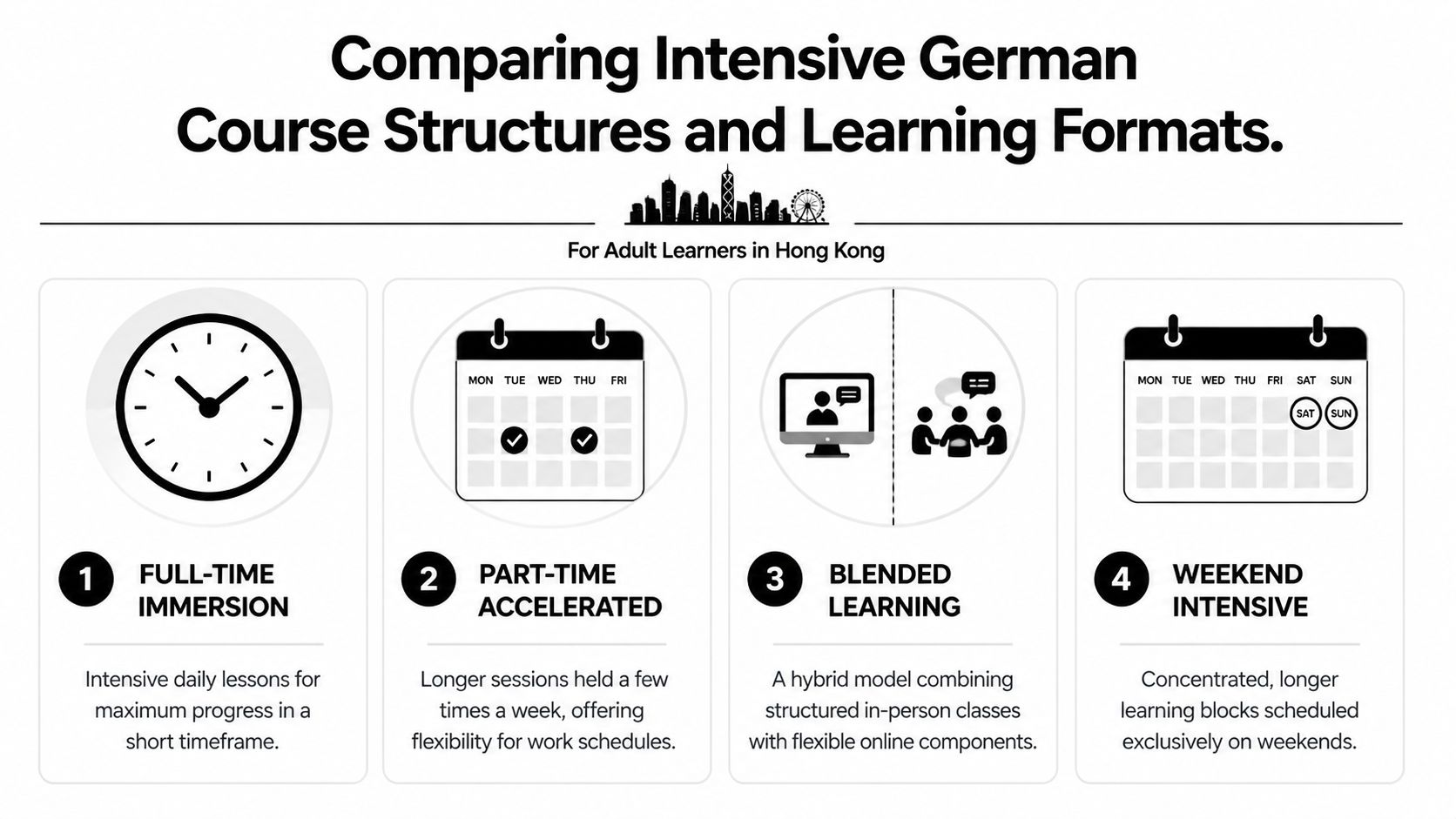
The four formats most adults consider
Full-time immersion works for learners with a short, urgent runway. It delivers concentrated progress, but it demands substantial daytime availability.
Part-time accelerated is usually the most practical choice for working adults. It keeps momentum without requiring you to stop your life.
Blended learning suits adults who want some in-person accountability with some online convenience.
Weekend intensive can work, but only if you still review between sessions. Otherwise, the long blocks become exhausting and less effective.
After reviewing your options, it helps to compare German course formats in Hong Kong in this guide before you commit.
Onsite versus online in daily HK life
For many learners, this is the key decision.
| Factor | Onsite Classes (e.g., Tsim Sha Tsui/Causeway Bay) | Online Classes (via Zoom) |
|---|---|---|
| Commute | Better if you already work nearby | Better if travel time is your main obstacle |
| Classroom focus | Stronger separation from work and home distractions | Depends heavily on your home or office setup |
| Speaking energy | Usually more natural in person | Can still work well if the class is interactive |
| Convenience | Good for central HK learners | Best for packed schedules or cross-district learners |
| Routine | Easier for some adults to treat seriously | Easier to attend, harder for some to stay fully engaged |
My recommendation by learner type
- Corporate professionals in Central, Tsim Sha Tsui, or Causeway Bay: Onsite usually wins if you can get there without friction.
- Parents or adults with unpredictable schedules: Online is often more sustainable.
- Learners who lose focus easily: Choose onsite.
- Learners with long commutes: Choose online and protect the saved time for revision.
A short video can also help you think about pace and study expectations before choosing a format.
Don’t choose the format with the nicest label
Choose the one you will attend, recover from, and continue for months.
That’s the format that works.
Achieve Your Goals with German Exam Preparation
You finish work in Central, head to class, and tell yourself you will deal with the exam later. That is how adult learners in Hong Kong lose time. If you need German for university admission, a visa pathway, or a stronger CV, exam preparation must start early and stay visible throughout the course.
Recognised German exams reward accuracy, speed, and control under pressure. General exposure is not enough.
Which exams matter most
Your target exam depends on your end goal, not your personal preference.
- Goethe-Zertifikat suits adults who need recognised proof of German for work, migration, or structured level certification from A1 to C2.
- TestDaF suits learners aiming for German university admission, where academic reading, listening, and writing matter far more.
- IGCSE, A-Level, and IB German matter mainly for school students, though some parents researching options for older teens will still want to understand the exam route.
If you are deciding between the two main adult pathways, read this guide to Goethe-Zertifikat and TestDaF differences.
Why intensive courses work for exam goals
Intensive study works because it forces consistency. That matters in Hong Kong, where busy adults often lose momentum between classes and then wonder why their mock scores stall.
A good exam-focused intensive course should build four things at the same time:
- CEFR-based progression so you know what level you are covering
- Skill-specific training across reading, writing, listening, and speaking
- Frequent correction before weak grammar and pronunciation become habits
- Timed practice so the exam format stops feeling unfamiliar
This is the difference between “learning some German” and preparing for an outcome that admissions offices and employers will recognise.
A good exam course teaches the language and the exam method together. Adults who separate the two usually take longer and pay more.
What to look for in exam-focused teaching
Choose a programme that trains performance, not just participation.
Teachers who can prepare students for formal exams
Friendly conversation is not enough. You need teachers who can mark writing, correct speaking clearly, and explain why an answer would lose marks.Regular speaking and writing output
Passive learners do badly in exams. You should be producing German every week, not just listening and nodding.Feedback tied to exam criteria
Vague praise wastes time. You need comments that show what to fix in structure, vocabulary range, accuracy, and task completion.A sensible build-up to mock practice
Exam drills only help when the language base is there. Start too early and you rehearse mistakes. Start too late and you panic under time pressure.
My recommendation
If your goal is exam success, career progression, or entry to a German university, choose a course that treats certification as a planned result from day one.
Do not rely on a loose conversation class and hope it somehow turns into exam readiness. In Hong Kong, serious adult learners need a clearer system than that.
How to Choose the Right Intensive German Program in HK
You finish work in Central, rush to class, and give up two evenings a week for German. After a month, you realise you are mostly listening, rarely speaking, and still unclear about what level you are building toward. That is a bad course choice, even if the timetable looked convenient.
Choose the programme by outcome first. In Hong Kong, adults usually study intensive German for a reason. A Goethe exam, a stronger profile for German-speaking employers, or university entry in Germany. If the course cannot show a clear path to that result, skip it.
Start with the class size
Speaking time decides whether an intensive course works.
Large groups waste paid hours because each student gets too little correction and too few chances to produce the language. A smaller class gives you repeated speaking turns, faster feedback, and less room to hide when grammar gets difficult.
German Cultural Association Hong Kong(GCA)is one example of a structured adult programme in Hong Kong. As noted earlier, it uses small classes, native-speaking teachers, and CEFR-aligned progression for adult learners. That setup makes sense for serious learners because it supports steady output, not passive attendance.
Judge the teacher by results, not friendliness
A pleasant teacher is not enough. You need one who can move an adult learner from one level to the next without wasting months.
Ask direct questions:
- Do they teach adults regularly?
- Can they explain grammar clearly and accurately?
- Do they correct speaking and writing in a way you can act on?
- Have they prepared learners for recognised German exams?
In Hong Kong, many adults are balancing work, family, and fixed deadlines. You do not have time for vague lessons built around casual chat.
Check whether the syllabus is actually mapped
A serious programme should be able to tell you where you start, what you will cover, and what you should be able to do by the end.
Ask for:
- Your entry level
- The CEFR level of the course
- The skills covered each term
- How progress is checked
- What course follows next
If the provider cannot explain the sequence clearly, do not assume the structure exists behind the scenes. Intensive learning only works when the course is organised tightly enough to build one skill on top of another.
Test the schedule against real Hong Kong life
Ambitious adults often underestimate this point. A good programme must be academically serious and administratively practical.
You will miss a class at some point. Work trips happen. Meetings run late. Family obligations do not ask permission from your study plan. Choose a school that handles make-up options, communication, and course planning efficiently. Otherwise, one missed lesson can break your momentum for the whole month.
Separate proof of attendance from proof of ability
Many adults confuse course completion with language readiness.
An attendance certificate can still be useful. It shows you followed a defined course with clear participation expectations. But if your goal is a job move, a visa pathway, or university admission in Germany, the question is whether the programme builds toward recognised ability, not whether it prints a certificate at the end.
That distinction matters.
My recommendation
Use this order when comparing intensive German programmes in HK:
- Will this course help me reach my exact goal?
- Is the class small enough for frequent speaking and correction?
- Are the teachers equipped to teach adults and prepare them properly?
- Is the syllabus clearly mapped to CEFR progression?
- Can I keep attending consistently with my actual schedule?
If a course is weak on the first four points, the fee does not matter. You are not buying lessons. You are buying progress that should lead to something concrete.
How Much Do Intensive German Courses Cost in HK
You find a course that looks cheap, sign up, and feel productive for a month. Six months later, your German is still not strong enough for a Goethe exam, a Germany university application, or a serious job conversation. That is the expensive mistake.
In Hong Kong, intensive German course fees vary by school, class size, contact hours, and whether exam preparation is built into the programme. Some beginner terms are priced lower, while a full CEFR level in a more demanding format usually costs more. Judge the fee against the result you need and the deadline you are working toward.
What you are paying for
A serious intensive course should give you more than weekly exposure to the language. It should move you forward fast enough to matter.
Your fee usually covers:
- A clear path through one level or a defined portion of it
- More teacher feedback and correction
- Smaller classes or tighter speaking control
- Structured materials instead of loosely assembled handouts
- Progress checks that show whether you are exam-ready
- A timetable built for adults who need results, not just a hobby
That last point matters in Hong Kong. Adults here are balancing long work hours, travel, and family commitments. If a course is cheaper because it spreads progress too thinly, you often pay again in extra terms, extra exam delays, and missed application windows.
Ask a better pricing question
Price matters. Outcome matters more.
Ask these questions before you compare fees:
- How long should this course take me to reach my target level?
- Will I need extra private lessons to fix weak speaking or writing?
- Does the programme prepare me for Goethe, TestDaF, or another recognised exam if that is my goal?
- Can I realistically complete it without constant scheduling conflicts?
A lower course fee is not a better deal if it slows down your exam date or pushes back a Germany admissions timeline.
What ROI looks like for adult learners in HK
For ambitious adults, return on investment is usually practical, not theoretical. You are paying for earlier readiness and fewer wrong turns.
That can mean:
- sitting a recognised German exam sooner
- submitting a stronger university or visa application on time
- qualifying for Germany-facing roles with more confidence
- avoiding months in unfocused classes that do not match your goal
Do not expect a school to prove a direct salary increase from German alone. That is not how adult language study works in real life. The value is usually access. Access to admissions, access to mobility, and access to better-positioned career options.
Where adults waste money
They buy based on headline price and ignore pace, teaching quality, and exam alignment.
Then progress stalls. They repeat levels, add tutoring, or postpone the exam they should have been preparing for from the start. The total cost ends up higher.
My recommendation is simple. If you need German for a real deadline in Hong Kong, choose the course that gets you to usable, recognised ability in the shortest realistic time. Cheap classes are only cheap if they get you there.
Ready to Fast-Track Your German Proficiency
If your goal is vague, keep browsing.
If your goal is real, pick a course structure and start.
Intensive German Courses for Adults in HK are the right choice when you need progress that is organised, measurable, and tied to a practical outcome. For adults in Hong Kong, that usually means one of three things: a recognised exam, a university plan, or a career move linked to German-speaking markets.
What a strong intensive option should give you
- Native-speaking teachers who can model accurate German and correct you properly
- Small classes so you speak, not just listen
- A structured CEFR curriculum so your learning doesn’t drift
- Exam preparation expertise for Goethe-Zertifikat, TestDaF, and related pathways
- Flexible delivery through centrally located classes or Zoom, depending on your schedule
Be realistic about the commitment
You can move quickly, but you cannot stay passive.
Expect to attend regularly, revise between lessons, and speak even when you feel imperfect. Adults who accept that usually progress well. Adults who wait to “feel ready” usually stay stuck.
Three smart next steps
Check the upcoming intensive course schedule
Make sure the dates fit your real calendar, not your ideal one.Book a trial class
You’ll learn more from one properly observed lesson than from hours of scrolling.Speak with a language advisor
A good advisor should tell you what level you’re at, what exam you need, and what pace is realistic.
Frequently Asked Questions
Can I use CEF funding for intensive German courses in Hong Kong
CEF funding is a common question in HK, but eligibility depends on the specific course and current funding rules. Don’t assume every language course qualifies. Ask the provider directly and verify the latest official requirements before enrolling.
What happens if I miss a class in an intensive schedule
This matters more in intensive study because the pace is faster. A good provider should have a clear make-up or rescheduling policy. Before you join, ask exactly how missed lessons are handled and whether catching up is realistic within the same level.
What should I do after finishing A1
Don’t stop at A1 if you need German for anything serious. A1 is a foundation, not a working level.
The usual path is:
- A2 for broader everyday communication
- B1 for the first level that becomes useful for many adult goals
- Exam preparation if you need formal certification after or during that progression
Is online intensive learning effective for adults in HK
Yes, if the course is interactive and you protect the study time properly. If you’re distracted at home, onsite may be better. If commuting kills your consistency, online is the better option.
Are intensive courses suitable for complete beginners
Yes, as long as the course is designed for adults and you’re prepared to keep up. Beginners often do well in intensive formats because regular exposure helps them build momentum early.
If you want a structured path to German that fits real life in Hong Kong, contact German Cultural Association Hong Kong(GCA) to check the latest intensive course schedule, book a trial class, or speak with an advisor about the right starting level for your goals.

German Lessons for Kids 2026/27: New School Year Classes for Ages 3-12

German Playgroup Hong Kong 2026/27: New Term Classes for Ages 1-4


