.png)
.png)

BLOG

香港德國文化協會
The German Cultural Association
IB German Ab Initio & Language B 2026: Exam Strategy Guide for HK
Your child is probably doing what most Hong Kong IB students do. They attend school all day, sit through activities, commute home on the MTR, then try to squeeze German revision into a tired evening slot. Parents see the same pattern. Plenty of effort, but no clear exam system.
That's exactly why IB German Ab Initio & Language B 2026: Exam Strategy Guide for HK matters. Generic online advice tells students to “practise more”. That's useless in Hong Kong if the main issue is time compression, school mocks, oral preparation, and trying to turn small study windows into marks.
Most guides also miss a simple point. Hong Kong students don't need more resources. They need a tighter plan that fits local school life, after-school tutorials, and realistic revision blocks. The gap for 2026 is how to adapt revision under HK constraints rather than follow a generic overseas study timetable, as reflected in the IB language ab initio guide used in schools.
Your Strategic Roadmap to Acing the 2026 IB German Exam in Hong Kong
A typical HK student starts German revision too broadly. They revise grammar tables, read vocabulary lists, and tell themselves they'll “do oral later”. Then mock season arrives. German gets pushed behind Maths, Sciences, and core coursework. By the time they return to it, they feel busy but not prepared.
That approach fails because IB German is not a memory contest. It is a performance exam. Students must produce language under pressure, on demand, within a limited window.
What usually goes wrong in Hong Kong
The pattern is predictable:
- School schedules get crowded with mocks, internal deadlines, and extra-curricular commitments.
- Travel time gets wasted even though commute slots can be used for listening and vocabulary review.
- Oral practice gets delayed because students feel awkward speaking aloud.
- Too many materials create confusion instead of progress.
Practical rule: If a study activity doesn't help your writing, listening, reading, or speaking under timed conditions, it's probably lower priority than you think.
Parents often assume more tuition automatically fixes the problem. It doesn't. Poorly focused tuition just adds another hour to an already overloaded week. What works is structured preparation with clear task types, clear correction, and a calendar that respects the reality of Hong Kong school life.
The roadmap that actually works
For HK students, I recommend a simple sequence.
Choose the right course level early
Don't force Language B if the student is still functioning like a beginner. Don't hide in Ab Initio if the student already has enough prior exposure to handle a more demanding route.Build revision around exam tasks
Every week should include speaking, writing, listening, and reading. Not equally, but consistently.Use small pockets of time hard
MTR rides are ideal for listening replay, vocabulary recall, and short reading drills.Correct mistakes fast
Students who leave errors unreviewed repeat them in the exam.
The students who score well in HK aren't necessarily the ones who study longest. They're the ones who stop treating German like a side subject and start treating it like a timed, criterion-based paper.
What Does the 2026 IB German Exam Involve
A Hong Kong student leaves school at 5:30 pm, spends 40 minutes on the MTR, gets home to maths, sciences, and TOK, then tries to fit German in at the end of the night. That is why students underperform in German. They revise it like a side subject, even though the exam rewards steady control across several paper types.
The 2026 IB German exam rewards communication under pressure. Students need to read, listen, write, and speak with enough accuracy and range to complete specific tasks in limited time. For Hong Kong families comparing subject routes, this matters as much as the syllabus itself. A clear explanation of IB and DSE language pathways for teens in Hong Kong helps put the German course choice in the right context.

The exam tests usable German
Students lose marks when they treat German as a memory subject. Examiners reward response quality, relevance, clarity, and language control. Grammar still matters, but only as part of communication.
For ab initio, the assessment includes:
- Paper 1 for writing
- Paper 2 for listening and reading
- The individual oral
For Language B, the structure still centres on productive and receptive skills, but the expected standard is higher. Students need stronger vocabulary, better organisation, and more control over longer responses.
What the 2026 calendar means in Hong Kong
The May 2026 session runs from 24 April to 20 May 2026, with results due on 6 July 2026, according to the 2026 IB timetable and results overview. For German students in Hong Kong, the date itself is only part of the story. The main pressure comes earlier.
By February and March, many schools have already loaded students with mocks, IAs, predicted grade discussions, and university application stress. If oral practice starts late, fluency stays weak. If listening practice starts after mocks, students panic when they miss one detail and stop tracking the recording.
My advice is simple. Treat January as the latest point to begin full exam-mode preparation. Earlier is better.
The online exam point is secondary
May 2026 candidates should prepare for the format their schools are using now. The IB has indicated that from November 2026, schools may have the option to use online exams for some subjects, including Language Acquisition. That is worth watching, but it is not the main decision for current candidates.
What matters now is practical flexibility. Students should be able to produce accurate work by hand and on screen, because school practice conditions vary and messy presentation still causes avoidable mistakes.
What to prioritise first
Do these in order.
- Writing under timed conditions. Students need to produce complete, relevant responses without freezing halfway through.
- Speaking on familiar themes. Oral marks improve when answers are extended, clear, and supported with simple detail.
- Listening for key detail. Students must keep going after one missed word instead of mentally switching off.
- Reading with selection discipline. Strong students do not translate everything. They identify what the question requires and extract it fast.
Many Hong Kong students waste months. They spend too long copying vocabulary lists and too little time producing answers that look like exam answers. GCA's support works best when weekly correction is tied directly to these paper demands, not to random textbook completion.
Choosing Your Path Ab Initio vs Language B
A Hong Kong student starts DP1 with German on the timetable, mocks already crowding the calendar, and a daily MTR commute that eats into revision time. If the level is wrong, every week becomes a recovery exercise. If the level fits, the next two years are much easier to manage.
This decision is not about prestige. It is about choosing the course the student can sustain under IB conditions, with the vocabulary range, grammar control, and response length the exam demands. The IB diploma context and the broad difference between German pathways are outlined in this IB German course comparison and diploma context.
IB German Ab Initio vs. Language B At a Glance
| Criterion | IB German Ab Initio | IB German Language B |
|---|---|---|
| Who it suits | Complete beginners or students with very limited prior exposure | Students with prior German study |
| Target level | Around A2 by the end | Typically B1 to B2 |
| Main challenge | Building a usable foundation quickly | Managing stronger vocabulary, structure, and sustained responses |
| Risk if chosen badly | Can feel too basic for students with solid prior knowledge | Can overwhelm students who are still functioning as beginners |
| Best fit for HK students | Students who need a realistic scoring path from a true beginner base | Students who can already understand and produce German with some consistency |
When Ab Initio is the better choice
Choose Ab Initio if the student still builds German sentence by sentence.
That includes students who hesitate with word order, rely on memorised phrases, and struggle to understand short everyday audio without support. Ab Initio suits students who need a realistic scoring route while balancing a full Hong Kong school schedule, internal deadlines, and other heavy IB subjects.
It is also the safer choice if school feedback sounds vague but the actual work is still weak. If a student cannot write a short accurate paragraph on familiar topics or answer simple follow-up questions orally, Language B is the wrong level.
When Language B is the smarter move
Choose Language B only if the student already handles familiar topics with reasonable control.
They should be able to understand the main point without translating every line, produce connected answers, and keep speaking for more than a few basic sentences. Language B rewards students who already have a working base and can build on it fast. It punishes students who are still patching together beginner grammar under pressure.
For Hong Kong families, the practical test is simple. Can the student manage German alongside science tests, TOK deadlines, and mock season without constant panic? If not, the level is too high.
A blunt rule for borderline cases
Borderline students usually pick the harder course for the wrong reason.
Parents worry that Ab Initio looks less impressive. Students assume Language B will “push” them. On the exam paper, that logic fails. The stronger diploma choice is the one that gives the student room to score well, not the one that sounds more advanced at a school information evening.
If you are unsure, use recent written work and oral performance, not optimism. A good teacher or tutor should be able to say, clearly, which course matches the student's current output. At GCA, that judgement is usually obvious within a short diagnostic review because the gap shows up fast in vocabulary control, accuracy, and how long the student can sustain an answer.
For a local comparison of German study routes, school pathways, and what tends to suit teenagers in this city, read this guide on German for teens and IB language choices in Hong Kong.
A wrong subject level creates two years of avoidable stress. The right level gives the student time to improve and marks they can actually convert.
Your Measurable IB German Study Plan for Hong Kong
It is 7:10 a.m. in Hong Kong. The student is on the MTR, half-awake, scrolling notes before a full school day, then tuition, then homework. If your IB German plan depends on long weekend study blocks and perfect energy, it will collapse by Week 3.
A plan that works here must fit real school pressure. It must survive science quizzes, TOK deadlines, mock exams, and tired commutes. It also has to match the 2026 course demands. Students need regular practice turning topic vocabulary into short, accurate responses under time pressure, then checking errors against IB criteria. That weekly cycle is what raises marks.
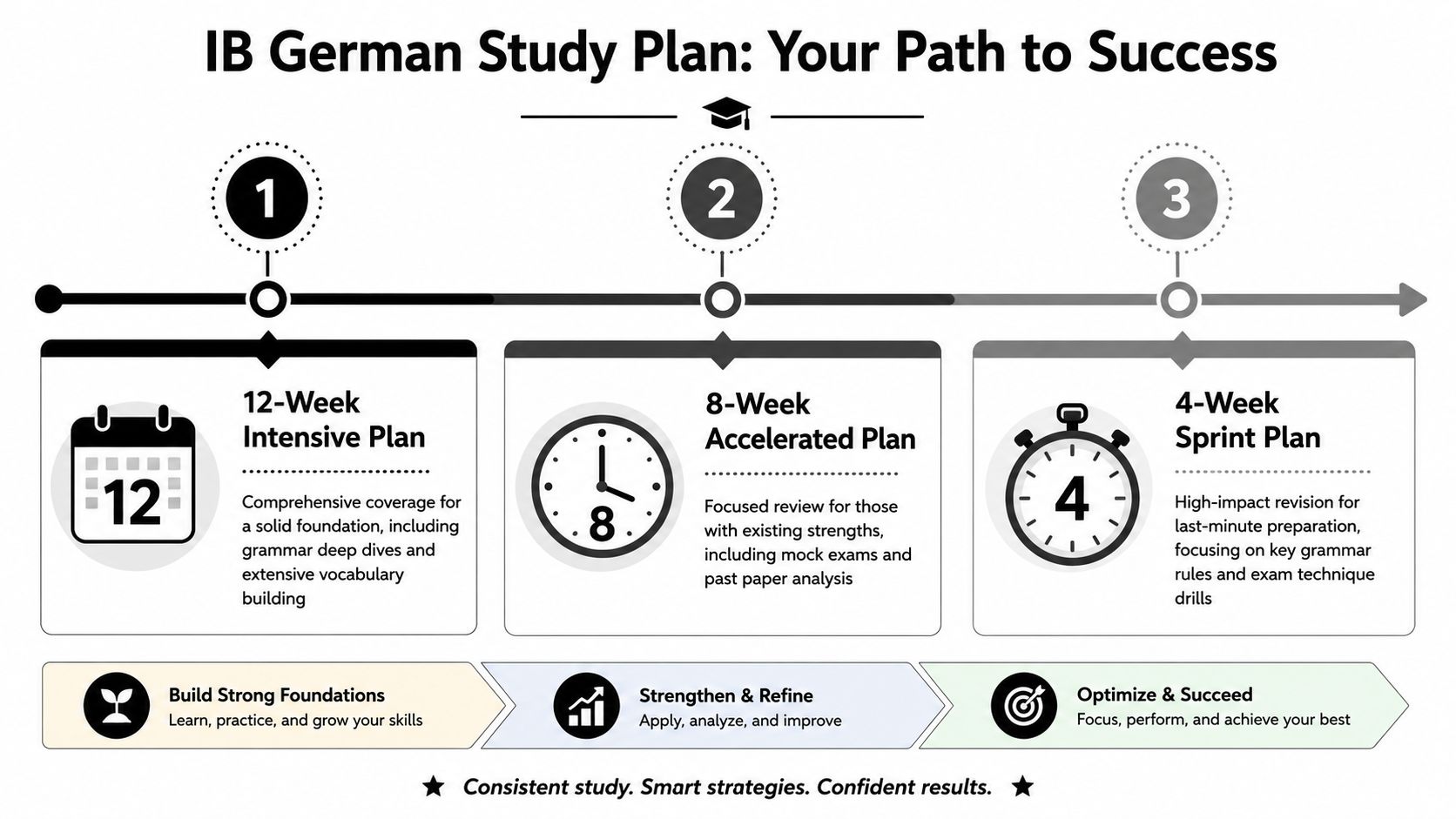
The 12-week plan
Use this if the student still has enough runway to build properly before school mocks and final exam pressure tighten.
Weeks 1 to 4: Build the base
- Group vocabulary by IB theme. Do not follow textbook chapter order blindly. Build around the themes that appear in class tasks and exam-style prompts.
- Produce something small every day. Write 4 to 6 sentences or record a 30 to 60 second answer using the new vocabulary.
- Use commute time well. Listening on the MTR works if it is active. Replay short audio, note key words, then summarise the gist out loud.
- Start an error log immediately. Record article mistakes, verb endings, word order errors, and weak sentence patterns. Review the same mistakes every week.
Weeks 5 to 8: Shift into exam mode
- Timed writing starts here. Students who always write slowly at home usually freeze in the actual exam.
- Reading and listening become selective. Train for gist first, then detail, then proof in the text. If this is a weak area, use targeted drills that improve reading comprehension skills.
- Speaking answers get longer. One-sentence replies are not enough. Students need to sustain answers, add reasons, and recover when they lose a word.
- Correction gets stricter. Do not just mark work as right or wrong. Rewrite weak sentences properly.
Weeks 9 to 12: Convert preparation into marks
- Past-paper style tasks take priority.
- Weak themes come back again. If travel, school life, or social relationships keep causing errors, recycle them into fresh speaking and writing tasks.
- Review under realistic timing. One full task done properly is worth more than three rushed ones.
- Cut low-yield revision. Pretty notes do not fix German.
Structured support helps when school feedback is too general or too delayed. In Hong Kong, many families use native German-speaking tutors in Hong Kong when the student needs regular spoken correction, sharper phrasing, and an outside eye on criterion-level performance. At GCA, the useful part is not extra worksheets. It is consistent correction and a weekly structure students follow.
A short explainer can help students reset their approach before they start the next study block:
The 8-week plan
Use this if the student already knows the core syllabus content and now needs cleaner performance.
Keep the week tight and repeatable:
- One vocabulary theme
- Two timed writing tasks
- Two listening sessions with answer checking
- One oral rehearsal followed by correction
- One review block for recurring mistakes
This schedule suits Hong Kong students far better than the usual promise to "catch up on Sunday". Weekdays carry the plan. Weekends support it.
The 4-week sprint
This is exam rescue work. It can still produce a decent result if the student becomes disciplined fast.
Focus on five things only:
- High-frequency theme vocabulary
- Timed writing under real limits
- Oral response patterns for common topics
- Listening for key detail and overall meaning
- Correction of repeated mistakes from previous work
Cut anything that feels busy but does not change exam output. That includes endless note rewriting, random app-hopping, and memorising isolated word lists with no sentence practice.
A realistic HK weekly rhythm
Students do better with a plan they can repeat through fatigue, school events, and mock season.
| Day | Focus |
|---|---|
| Monday | Theme vocabulary and 5 sentence build-out |
| Tuesday | Short timed writing |
| Wednesday | Listening on the commute, then answer check |
| Thursday | Reading drill plus vocabulary recycling |
| Friday | Oral rehearsal with self-correction or tutor feedback |
| Weekend | One longer exam-style task plus error-log review |
One more blunt point. Consistency wins in Hong Kong because the timetable is crowded. A focused 25 minutes on four weekdays beats one dramatic cram session every time.
High-Impact Exercises for Reading Writing Listening and Speaking
The strongest students don't do more exercises. They do better ones.
For IB German B and ab initio, oral and writing tasks should be treated as criterion-driven performance tests. Students should pre-build reusable language chunks, practise sustained responses, and rehearse under exam timing. Common problems include weak topic vocabulary, over-reliance on too many materials, and losing the thread of the response under pressure, according to this IB German performance guide.
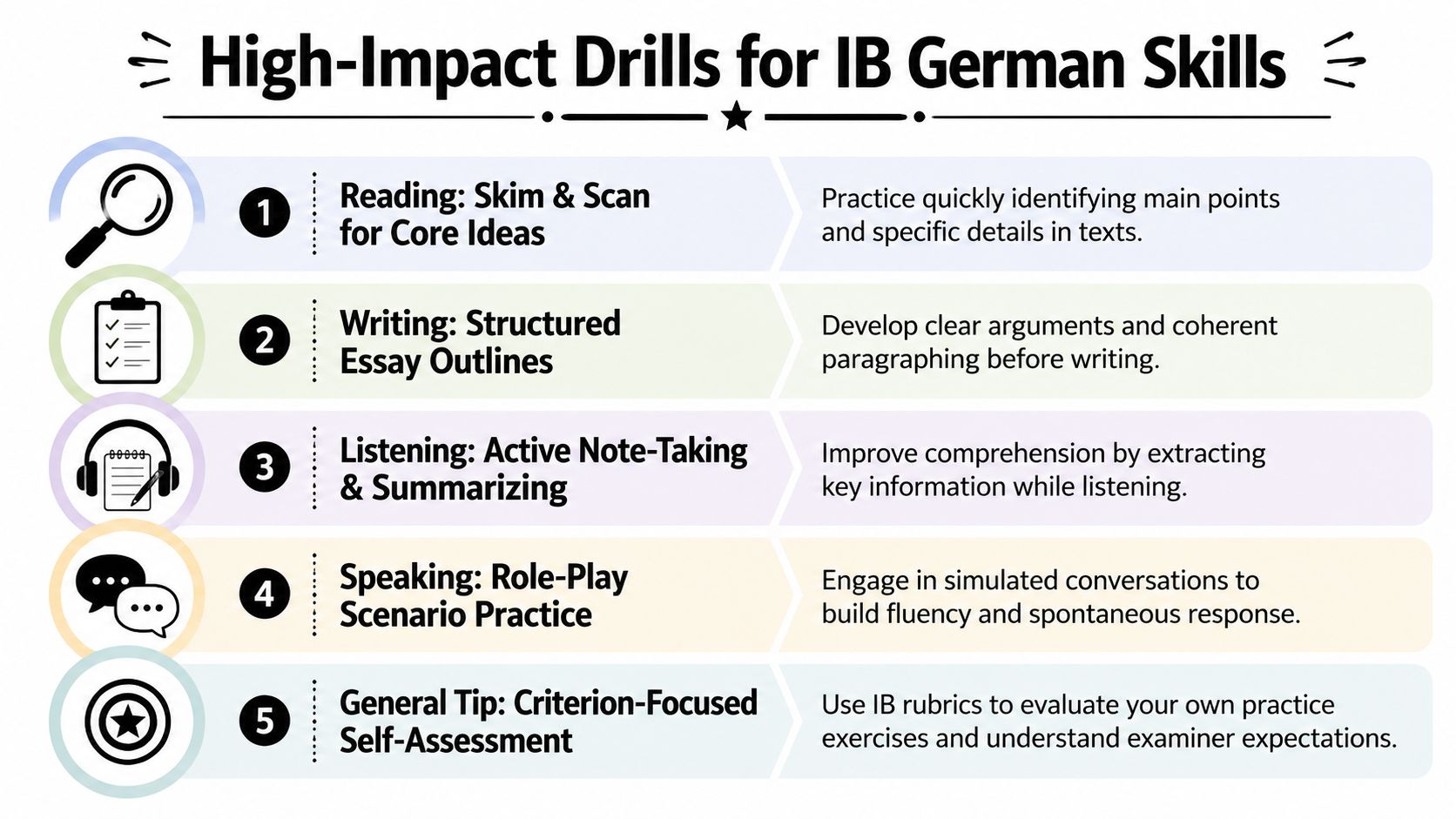
Reading drills that actually build marks
Most students read too slowly and too passively.
Try these:
Skim then hunt
First identify the topic, tone, and likely purpose. Then scan for names, dates, opinions, or linking words that usually carry answer value.Question-first reading
Look at what the task is asking before reading the whole text. That trains selective attention.Main idea summary
After each text, say the central idea in one sentence. If you can't do that, you probably didn't understand enough.
If students need broader methods to improve reading comprehension skills, that resource is useful because the underlying habits transfer well to IB reading tasks.
Writing drills that raise control
Writing marks don't go up because students “know more grammar”. They go up because students use enough grammar accurately in a well-organised answer.
Use these exercises:
Template variation drill
Take one topic and write three different openings for it. This stops students from sounding memorised and rigid.Expand-the-sentence practice
Start with a simple sentence. Add time, reason, contrast, and opinion. This builds range fast.Timed micro-writing
Write short task responses under pressure. Then edit only for the specific criterion that was weakest.
Students lose marks when every sentence is grammatically “safe” but limited. They also lose marks when they attempt complexity they can't control.
Listening drills that stop panic
Listening in the exam punishes hesitation. If students miss one detail and mentally freeze, they often miss the next two.
Use this sequence:
- First listen for gist
- Second listen for key detail
- Third replay only for errors you missed
Then finish with a spoken or written summary in English or German, depending on level. The summary matters because it forces the brain to process meaning, not just chase answers.
Speaking drills for the oral
The oral rewards flow, relevance, and sustained interaction. Students who memorise one speech and hope for the best usually collapse when the conversation widens.
Use:
Photo-to-theme drill
Describe a visual, then connect it to a wider theme in German.Thirty-second extension
Answer a question, then keep speaking for another thirty seconds with an example, reason, or comparison.Recovery phrases practice
Learn how to keep going if you lose a word. Students need survival language, not just ideal language.
A useful benchmark in practical teaching is this. If the student can't speak for a sustained stretch on a familiar topic without mentally translating from English, they are not yet ready.
How IB Examiners Think What They Look For in Top Answers
An examiner reads fast, compares constantly, and rewards control. In Hong Kong, that matters even more because many students arrive well prepared in content but still lose marks on the same predictable habits: English sentence logic, rushed structure, and answers that sound memorised rather than responsive.
Top answers are easy to mark highly. The message is clear. The task is fully answered. The language is appropriate to the level and used with enough control that mistakes do not block meaning.
What examiners actually reward
Examiners mark against criteria. They do not give extra credit for effort, long revision hours, or ambitious phrasing that goes wrong.
They reward:
- Clear task fulfilment that answers the exact question or prompt
- Relevant detail rather than vague statements
- Organisation with a logical flow from one idea to the next
- Range the student can control instead of forced complexity
- Accuracy that supports communication even if the language is not perfect
- Development so the response feels complete, not thin
A strong script usually feels settled. A weak one feels unstable.
What pulls marks down fast
The same problems appear again and again in examiner comments and classroom correction.
- The student answers part of the task and ignores the rest.
- The opening is fine, but the content runs out after two short points.
- Vocabulary fits the general topic but not the specific prompt.
- Sentence patterns repeat with no real development.
- English word order slips into German.
- Memorised material is inserted awkwardly and does not match the task.
Hong Kong students should treat direct translation as a serious scoring problem, not a minor habit. If that issue shows up often in classwork, review these common English-to-German mistakes Hong Kong students make. The errors in that list are exactly the ones that keep reappearing in writing and oral responses.
The examiner test for a top answer
A top answer usually passes four silent checks in the examiner's mind.
First: Did the student understand the task precisely?
Second: Is the response developed enough to justify high marks?
Third: Does the language show control, not panic?
Fourth: Can I follow the answer easily from start to finish?
If one of those fails, the mark drops. If two fail, it drops hard.
This is why random practice wastes time. A student doing one writing task on Sunday night with no criterion-based review will improve slowly. A student doing two short, timed tasks during the week, one on the MTR home and one after school, then correcting only the biggest recurring weakness, usually improves faster. That method fits Hong Kong schedules and matches how exam performance improves.
A better review loop after every task
After writing or speaking practice, use this sequence:
- Underline the part of the prompt you answered
- Mark where you added detail, example, or explanation
- Circle repeated grammar mistakes
- Check whether your linking words made the response easy to follow
- Rewrite only three weak sentences, correctly
That last step matters. Full rewrites feel productive but often hide the underlying issue. Targeted correction changes habits.
At GCA, the most useful feedback is usually blunt and specific. One comment on word order, one fix on article use, one instruction on how to extend an answer. Students improve when the correction is narrow enough to apply in the next task that same week.
The difference between decent and high-scoring
A decent answer communicates something relevant.
A high-scoring answer communicates enough, stays organised under pressure, and shows deliberate control over the language the student already knows. That is what examiners trust. Control gets marks.
Ready to Secure Your Top Grade in IB German?
By this point, the pattern should be clear. Students don't need vague motivation. They need a realistic calendar, the right course choice, regular timed practice, and direct correction.
That's where many HK families make a bad decision. They either leave German entirely to the school timetable, or they add random extra help with no coherent system. Both approaches waste time. German improves when the student follows a structured routine and gets feedback that links directly to exam criteria.
What effective support should include
If you're evaluating support options in Hong Kong, look for this:
- Native-speaking correction so pronunciation, phrasing, and natural usage are addressed properly
- Small-group or focused oral practice because speaking won't improve through worksheets alone
- Structured curriculum progression rather than disconnected topic tutoring
- Exam-specific writing feedback that shows students exactly where marks are being lost
The German Cultural Association Hong Kong offers German lessons Hong Kong and Learn German HK pathways that include exam preparation, small-group learning, native-speaking teachers, and structured German progression relevant to IB learners.

What parents should do next
Don't wait until mock results create panic.
Do these three things now:
- Confirm the correct track between Ab Initio and Language B.
- Audit the current study routine and remove low-yield activities.
- Get regular oral and writing correction before bad habits harden.
Students in Hong Kong already carry enough pressure from IB, university planning, and everything around it. German shouldn't become chaotic. With the right system, it becomes manageable and scoreable.
If you want a clearer plan for your child's IB German preparation, contact German Cultural Association Hong Kong(GCA) to ask about class schedules, trial lessons, and exam-focused support in Hong Kong.

Costs and Language Requirements for German in HK

Student Exchange to Germany: Programmes for HK Students


