.png)
.png)

BLOG

香港德國文化協會
The German Cultural Association
Native German Speaking Tutors in Hong Kong: A 2026 Guide
A parent in Hong Kong usually starts this search too late. The exam date is already on the calendar, the school has flagged German as a weak subject, or a university plan for Germany has suddenly become real. A working professional does the same thing. They get a transfer opportunity, a client project, or a relocation target, then type Native German Speaking Tutors in Hong Kong into Google and hope the right answer appears.
That search rarely gives a clear answer. It gives a messy mix of online tutor profiles, marketplace listings, and general language schools. Some are fine for casual conversation. Very few are built for exam success, academic progression, or career use in Hong Kong.
My advice is simple. Don't choose a tutor by accent alone. Choose a learning path that matches your goal, your schedule, and the level of structure you need. If you want results from Native German Speaking Tutors in Hong Kong, you need to vet the format first, then the teacher.
Finding the Right German Tutor in Hong Kong
A common Hong Kong scenario looks like this. Your child takes IB or IGCSE German and starts slipping in writing and oral performance. Or you're an adult learner aiming for Goethe-Zertifikat because a study-abroad or visa plan now depends on formal proof, not just “some German”.
In both cases, the mistake is the same. People choose based on convenience first. They book the first native speaker who has evening availability, or they pick the cheapest hourly rate on a platform. That works for casual practice. It's a poor strategy for high-stakes outcomes.
Hong Kong does have a real market for German tutoring, but it's a specialised niche, not a mass-market category. One local platform shows 14 German teachers available in Hong Kong with prices starting from $320 per hour on Tutoroo's Hong Kong German tutor page. That limited in-person visibility sits alongside much broader online supply, which is exactly why families often struggle to judge quality.
Practical rule: If your goal has an exam code attached to it, don't hire a “conversation tutor” and hope they can become an exam coach later.
The right decision usually comes down to four filters:
- Your end goal: Goethe-Zertifikat, IB, IGCSE, university entry, work, or travel.
- Your preferred format: private, small group, or online.
- Your tolerance for admin: some options require you to handle all vetting yourself.
- Your budget logic: not just hourly rate, but total path to the outcome.
That's the lens I'd use for anyone looking at Native German Speaking Tutors in Hong Kong. If you apply those filters properly, the market becomes much easier to move through.
First Define Your German Learning Goals
If you don't define the goal first, you'll waste money. The tutor who works well for a child building confidence in spoken German may be completely wrong for an adult preparing for TestDaF or for a teenager facing IB oral assessment.
Hong Kong learners usually fall into one of a few clear tracks. Each track needs a different kind of tutor.

Exam preparation needs a specialist
If your target is Goethe-Zertifikat, TestDaF, IGCSE, A-level, IB, or Sprachdiplom, you need a tutor who understands exam format, marking logic, and CEFR progression. General fluency isn't enough.
Hong Kong has had this type of teaching for years. Local tutor profiles show certified native German teachers based in Hong Kong, including teachers who are long-term residents, multilingual in Cantonese and Mandarin, and experienced with A-levels, I/GCSE, IB, and Sprachdiplom on Speak Fluent German's Hong Kong tutor profile page. That matters because exam-focused families in HK often need explanation in more than one language, especially at younger levels.
Use this test. Ask yourself whether success means:
- A specific exam grade
- A specific CEFR level
- A school report improvement
- A passing score by a fixed date
If the answer is yes, don't book a tutor who only markets “fun speaking practice”.
University and immigration goals require proof
For study abroad in Germany, many learners eventually need recognised certification. The same applies to some immigration and academic pathways. In this context, people in Hong Kong often underestimate the paperwork side of language learning.
A tutor for this route should give you:
- Level diagnosis before starting
- A syllabus linked to CEFR
- Mock assessment
- Written correction, not just live speaking
- Clear advice on when you're ready for the exam
If they can't explain how they move a learner from one level band to the next, they're not the right fit.
Don't ask, “Are you a native speaker?” Ask, “How do you move a learner from A2 to B1, and what do you assess along the way?”
Business German is a different product
Working professionals in HK often make the wrong assumption that business German means learning industry vocabulary. That's only part of it. In practice, you may need email writing, meeting language, presentation confidence, and enough listening ability to deal with different accents and workplace pace.
For this track, choose a tutor who can build around real tasks:
- meetings
- presentations
- client calls
- negotiation basics
- business writing
- role-play under pressure
A pure exam teacher may not be ideal here. A pure conversation tutor may also be too loose. You want structured practical coaching.
Children need engagement and progression
For younger learners, especially in international schools, the main issue isn't only content. It's consistency. Children need a tutor who can keep them engaged while still building grammar, speaking, and school-linked outcomes.
Look for these signs:
- Age-group experience: teaching adults and teaching children are different jobs.
- School awareness: the tutor should understand IB, I/GCSE, or school-based assessment pressure in Hong Kong.
- Progress tracking: parents need to know what is improving and what isn't.
- Routine: children improve when the structure is stable.
If you're serious about Native German Speaking Tutors in Hong Kong, define the destination first. Then your shortlist becomes much shorter, and much better.
Where to Find Qualified Native German Tutors
Hong Kong learners often waste weeks in the wrong place. They compare hourly rates, book a few random trial lessons, then realise the tutor cannot teach Goethe exam technique, school writing, or professional German for real workplace use. Choose the channel first. That decision affects quality control, teaching consistency, and how fast you improve.
Online marketplaces give you options, but you do the screening
Marketplaces are useful if your schedule changes every week or you want to test several teaching styles quickly. Preply's Hong Kong German tutors page shows how much choice is available to learners in the city.
Choice is not the same as fit. Profiles can look strong and still tell you very little about correction standards, lesson planning, exam familiarity, or whether the tutor can handle Hong Kong school pressure. For an adult learner with clear goals, that may be fine. For parents, teenagers, and exam candidates, it creates too much room for error.
Local language schools give stronger control
A good language school or specialist centre removes much of the guesswork. Teachers are screened before they teach. Levels are placed more carefully. Materials usually follow a clear sequence instead of depending on whatever one tutor decides to do that week.
German Cultural Association Hong Kong is one local example. It offers native-speaking teachers, small-group classes, private lessons, and exam-focused options for learners who need structured progression.
This route usually works better if you care about outcomes and not just convenience. You are paying for a system, not only for one teacher.
It is a practical choice for learners who need:
- a clear curriculum
- placement before starting
- mock exam support
- cover if a teacher leaves
- visible level progression
If budget is part of your decision, compare formats against this German course price guide for Hong Kong learners before you commit.
Independent tutors can be excellent. They can also be a gamble.
Hong Kong has resident native German tutors who understand local schools, packed student schedules, and the pressure around public and international exam results. That local context matters. A tutor who knows IB, IGCSE, A-level, or corporate training expectations in Hong Kong will usually make better decisions than someone teaching casually from overseas.
Independent tutors work best when the problem is specific. Oral exam confidence. Writing correction. Presentation practice. Interview preparation.
The risk is uneven teaching quality. Some independent tutors are trained educators. Some are fluent speakers with no real method.
| Channel | Best for | Main risk |
|---|---|---|
| Online marketplaces | flexibility and broad choice | inconsistent screening |
| Local language schools | structure and steady progression | less scheduling freedom |
| Independent tutors | individualized support | uneven teaching quality |
| University or cultural programmes | academic adult learners | fixed timetables |
University and cultural programmes suit a narrower group
These programmes can be credible and academically sound. They usually suit disciplined adult learners who are comfortable with fixed schedules and slower pacing.
They are often a poor fit for urgent exam preparation, school-age learners who need closer monitoring, or busy families trying to coordinate around classes, activities, and travel.
The Hong Kong German tutor market is fragmented. Convenience is easy to find. Reliable quality is harder.
My advice is simple. If you can assess teachers well, manage trial lessons, and spot weak methodology early, marketplaces and private tutors can work. If you want stronger quality control, clearer progression, and better value for serious goals, choose a structured provider.
How Much Do German Lessons Cost in Hong Kong
This is the question Hong Kong families ask first, but it shouldn't be the deciding factor. Hourly rate matters. Value per successful outcome matters more.
A useful market benchmark comes from tutor platforms. German lessons in Hong Kong commonly range from about USD 10 to 30 per hour, based on tutor listings and pricing signals on MyPrivateTutor Hong Kong's German tutors page. That's the broad market. It tells you what's available, not what's effective.
Cheap lessons often become expensive lessons
A low hourly rate looks attractive until you realise what's missing. Many lower-cost tutors don't provide proper level assessment, correction systems, homework structure, or exam-specific drilling. You end up buying more hours because the lessons don't build efficiently.
That's why I advise people to cost the full path, not just one lesson. Ask:
- What materials are included
- Whether homework is corrected
- Whether speaking, writing, listening, and reading are all covered
- Whether exam tasks are practised properly
- Whether the tutor can explain progression clearly
If you want a broader cost comparison of formats and course types, review this breakdown of German course prices in Hong Kong.
Pay for exam readiness, not just contact time
For Goethe, IGCSE, IB, or A-level learners, the key differentiator isn't just native-speaker status. It's whether the teacher can show CEFR-linked progression and Hong Kong-relevant exam preparation.
That's where many families overspend. They buy “native” and assume that includes teaching skill. It doesn't. A strong tutor should be able to explain what they correct, how they assign work, and how they prepare students for the exact exam demands you face.
Value test: if a tutor can't explain the learning sequence, they're selling time, not progress.
If you're exploring options in HK, keep CEF funding in mind where relevant for adult education routes, but don't let subsidy logic override fit. The wrong format wastes both money and time.
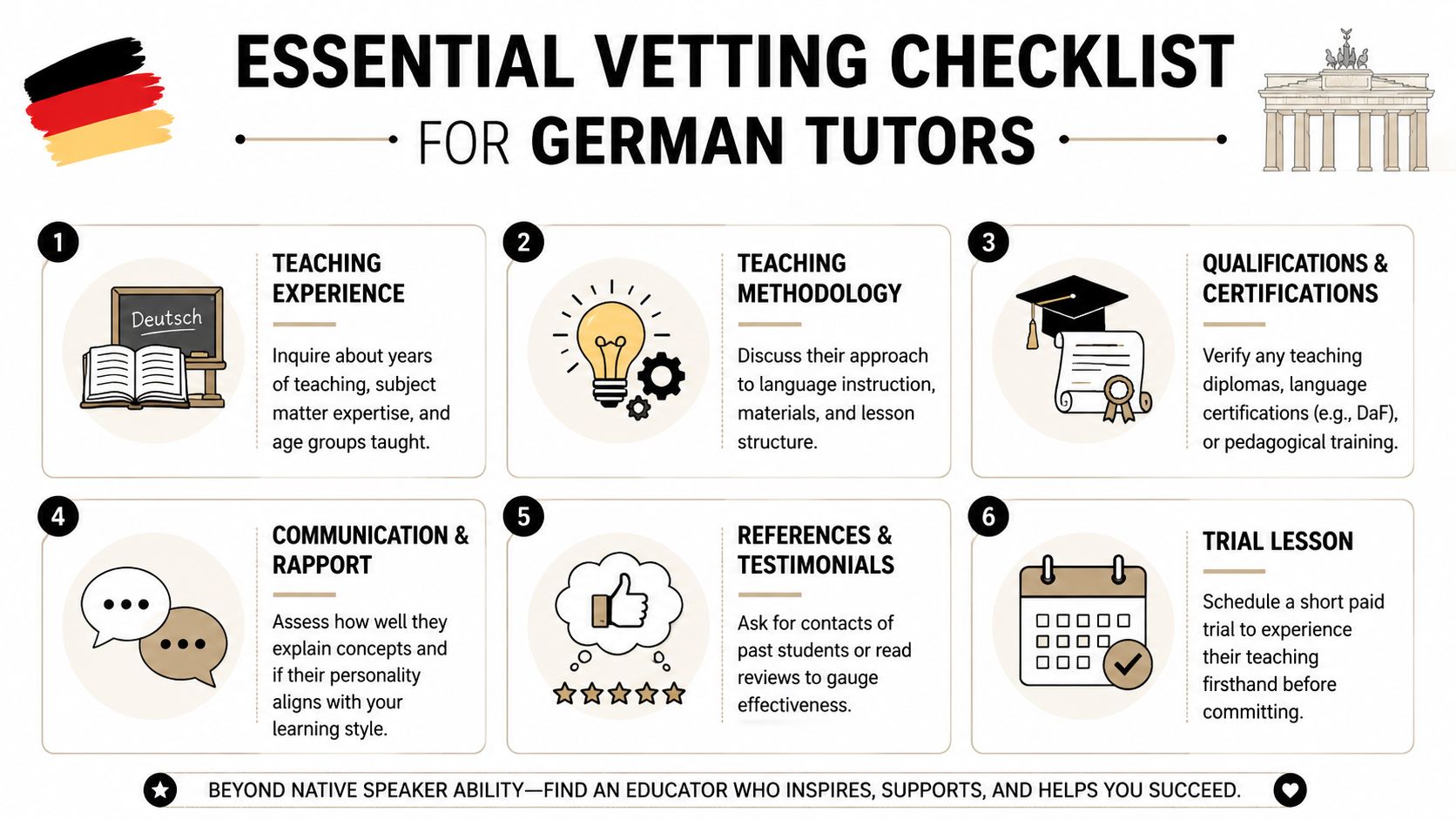
Your Vetting Checklist Before You Commit
A parent in Kowloon books a native German tutor after one pleasant trial lesson. A mid-career banker in Central does the same after scanning a polished profile. Three months later, both are still paying, but neither can point to clear progress. In Hong Kong, that is the significant risk. You do not lose one lesson fee. You lose time, exam momentum, and often the chance to switch paths early.
Judge teaching quality by outcomes
Native fluency is a starting point, nothing more. If your child needs Goethe or IB results, or you need German for university entry or career mobility, judge the tutor by what they can prepare you to do.
Hong Kong buyers often get distracted by personality, convenience, or hourly rate. Those factors matter far less than method. A tutor should be able to explain how they build speaking, writing, listening, and reading, and how that plan fits your target. If they cannot explain the process clearly, do not hire them.
If you are comparing one-to-one tutoring with a more structured programme, this guide on how to choose the best German language school in Hong Kong will help you compare systems, not just teachers.
Ask direct questions before you book
Do not rely on profile text. Interview the tutor properly.
Which exams or learner types do you teach regularly?
Look for clear answers such as Goethe-Zertifikat, IGCSE, IB, A-level, TestDaF, adult beginners, or business German.How do you assess starting level?
A serious tutor has a placement method. A vague answer usually means lessons will drift.How do you correct mistakes in speaking and writing?
You want a repeatable correction process, not casual conversation with occasional comments.What work happens between lessons?
Good tutors assign focused review, vocabulary work, writing, or listening tasks. Progress slows badly when everything depends on live lesson time.How do you measure improvement after four to eight weeks?
Strong tutors track patterns. Weak tutors rely on impressions.What should happen in the trial lesson?
The trial should diagnose level, expose weak areas, and show how the tutor teaches.
Use the trial to test discipline
A trial lesson is an audition, not a chemistry check.
Watch for five things:
- Accurate correction. The tutor catches errors quickly and explains them clearly.
- Lesson structure. The session has a purpose and sequence.
- Level control. The tutor adjusts speed, vocabulary, and grammar to the learner.
- Teaching clarity. Explanations are concise and useful, not rambling.
- Next-step planning. You leave with a realistic improvement plan.
Comfort is not the goal. Progress is.
A good trial lesson should show you where the weaknesses are and what the tutor will do about them.
Check fit with your real situation
Even a capable tutor can be the wrong choice. A Secondary student facing exam pressure needs consistency, correction, and syllabus control. A working adult with travel and irregular hours may need flexibility more than weekly pacing. A complete beginner may do better in a structured system than in free-form private lessons.
Use this final filter before you commit:
| What to verify | What good looks like |
|---|---|
| Qualifications | proven teaching experience or training, not just native fluency |
| Relevant experience | regular work with your exam, age group, or professional goal |
| Correction style | specific, consistent, and easy to follow |
| Lesson planning | clear sequence across the next several weeks |
| Trial lesson | diagnosis, feedback, and a concrete recommendation |
Reviews, profile photos, and friendly chat do not predict results. A clear teaching method does.
Private vs Small-Group Lessons Which Is Better
This decision matters more than is commonly realized. In Hong Kong, learners often assume private lessons are automatically superior because they're more personalised. That's only partly true.
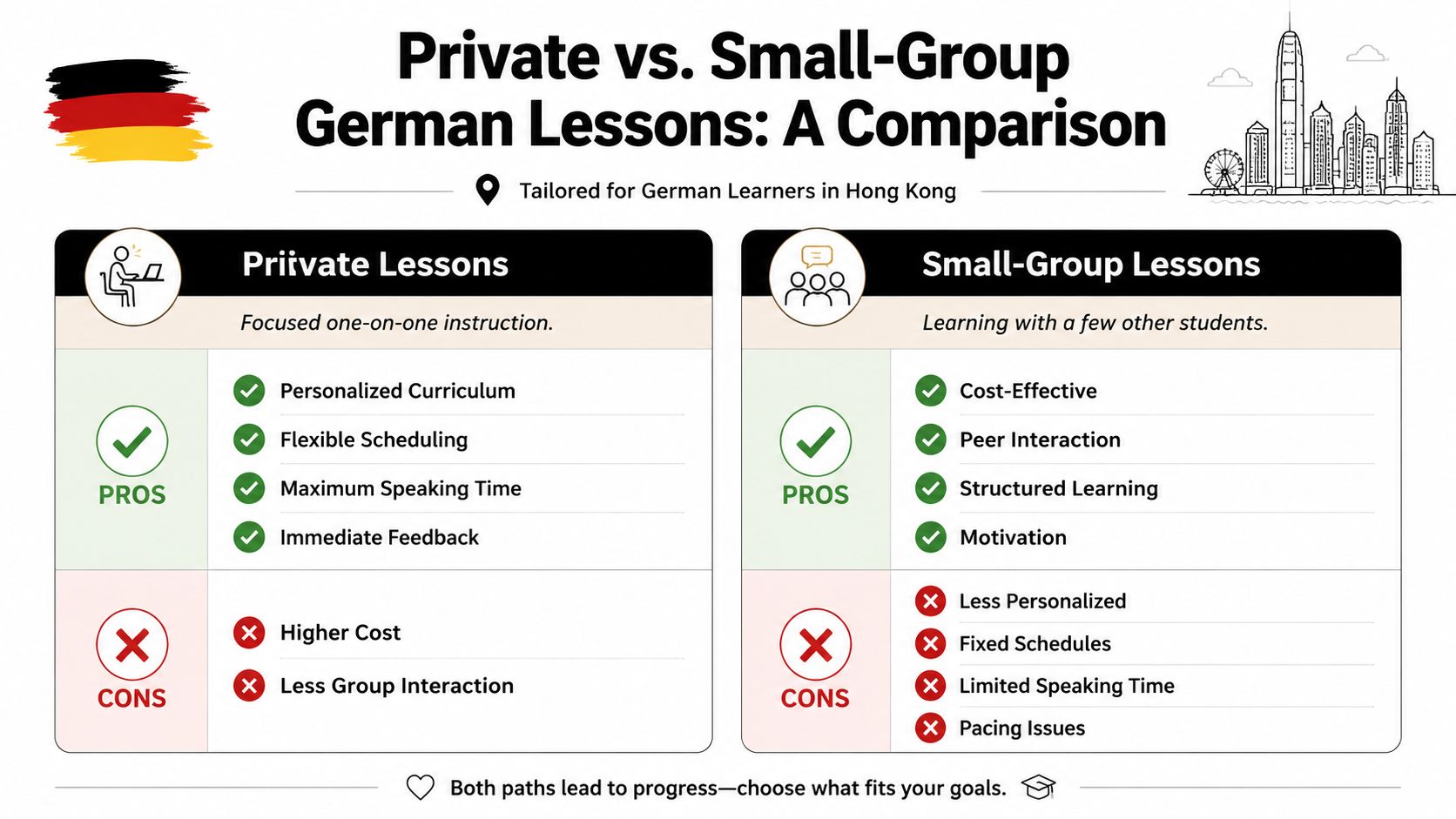
Private lessons are strongest when your timetable is unstable, your weaknesses are highly specific, or you need fast correction in a narrow area. They work well for busy professionals and for students who need targeted rescue support before an exam.
Small-group classes are often better for most serious learners. You get structure, peer interaction, regular speaking opportunities, and lower cost per guided hour. If the group is small and level-matched, it can be a stronger long-term system than private tutoring.
A useful benchmark in Hong Kong is the small-group model capped at 6 students with native-speaking instructors and exam-aligned teaching, which is designed to increase speaking time and individual correction. GCA reports that over 90% of its students achieve top exam marks in this setup on its article about intensive German courses.
If you're deciding between formats, compare them carefully through this guide to best private German tutors in Hong Kong.
My recommendation
For exam-focused learners, small groups usually beat private lessons on consistency. For schedule-driven learners with narrow goals, private can be the smarter buy. For beginners who need momentum, a strong small-group class is often the most stable way to Learn German HK without drifting.
Ready to Start Your German Learning Journey
If your goal is casual travel German, almost any decent native speaker can help. If your goal is Goethe-Zertifikat, IB, IGCSE, A-level, university preparation, or career use, you need a more disciplined choice.
Pick a tutor or programme that can diagnose your level, teach through a structured syllabus, correct you properly, and match the format to your life in Hong Kong. Don't be distracted by low hourly pricing, polished profiles, or vague claims about “fun immersive learning”. Serious learners need measurable progress.
For parents, that means choosing a path your child can stick to. For adults, it means choosing a format that survives a demanding HK schedule. For professionals, it means learning German in a way that supports real career movement, not just hobby-level confidence.
When you choose among Native German Speaking Tutors in Hong Kong, think like an investor. You're not buying hours. You're buying outcomes.
If you want a structured path with native-speaking teachers, small-group and private options, and support for exam-focused or practical German learning in Hong Kong, contact German Cultural Association Hong Kong(GCA) to book a trial class, speak with an advisor, or check the latest course schedule.
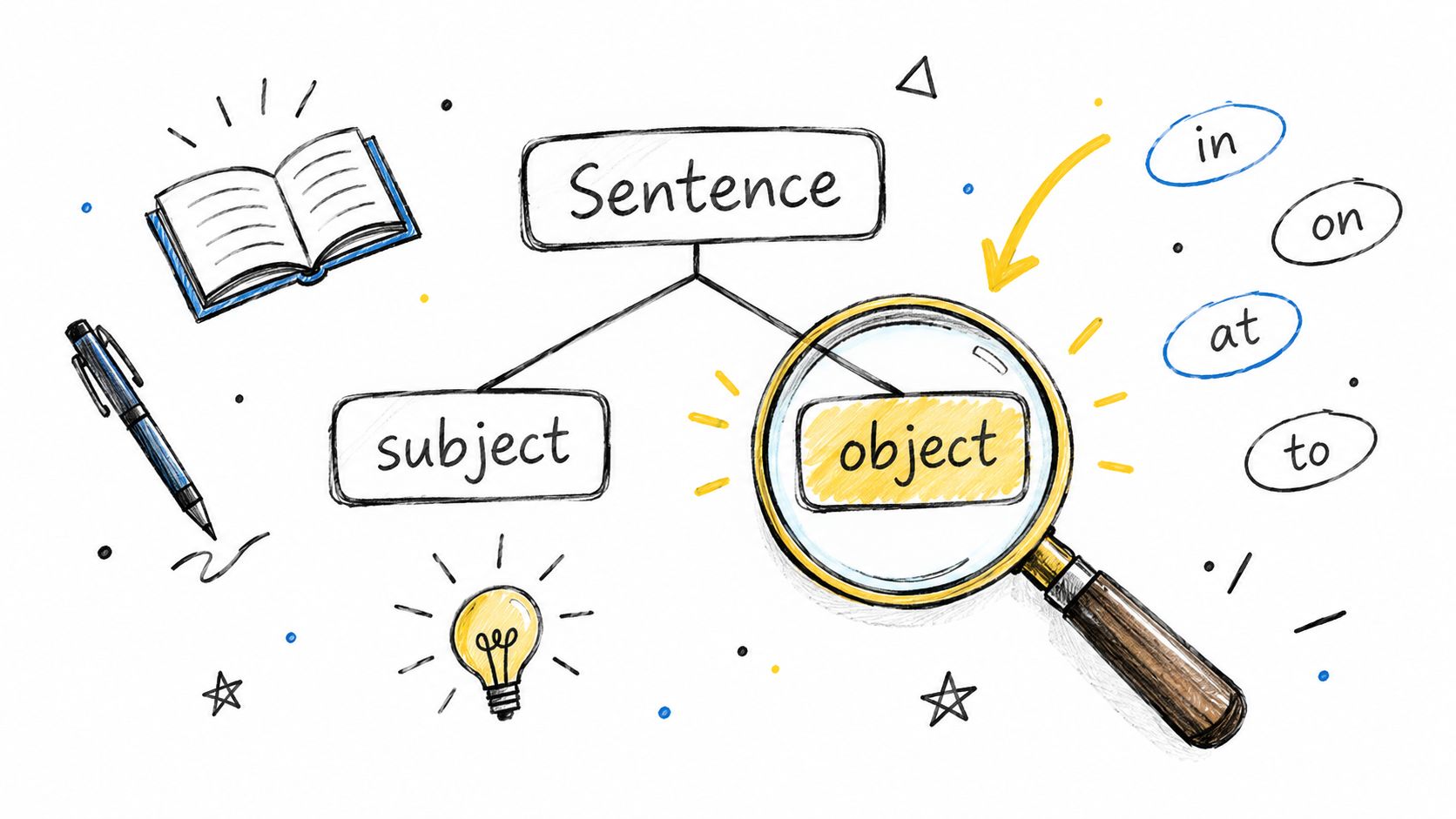
German Accusative Case Explained: When and How to Use Akkusativ

German Small Talk: 30 Phrases for Meeting People and Making Friends


