.png)
.png)

BLOG

香港德國文化協會
The German Cultural Association
German Teacher vs Tutor in Hong Kong: Which Does Your Child Need?
Your child has a German exam deadline, a crowded school timetable, and only so many after-school hours left each week. You're not choosing between two nice extras. You're deciding which kind of support will help your child learn properly, stay motivated, and perform when it counts.
That's why German Teacher vs Tutor in Hong Kong is not a minor decision. In Hong Kong, private tutoring is already firmly embedded in family education planning. One local analysis describes tutoring as a multi-billion-dollar “shadow education” industry and reports that over 70% of secondary students in Hong Kong attend private tutoring in this local education analysis. So if you're weighing a teacher against a tutor, you're asking a very normal HK parent question.
The problem is that many families choose based on convenience first and learning design second. That's backwards. If your child needs exam structure, you need one type of support. If they need short-term speaking help or catch-up work, you may need another.
Your Child's German Journey Starts with One Key Decision
A common Hong Kong parent scenario looks like this. Your child is taking IB, IGCSE, A-level, or another demanding school pathway. German looks like a smart choice for study abroad in Germany, future university options, or standing out academically. But now the pressure starts. Who should teach them?

If you've ever thought, “I don't care about the label, I just want results,” you're asking the right question. Parents in Hong Kong are usually not looking for a philosophical answer. They want to know what will help their child score better, waste less time, and avoid having to fix weak foundations later.
Why this choice matters more in Hong Kong
Hong Kong families are used to supplementing school with outside academic support. That works well when the support matches the goal. It works badly when a child who needs a structured programme gets casual weekly conversation, or when a child who only needs targeted correction gets placed into a broad course that moves too slowly.
Practical rule: Choose the learning format based on the child's objective, not the adult title on the business card.
German is especially unforgiving if the basics aren't organised properly. Case endings, sentence structure, article use, listening precision, and writing accuracy all build on each other. If your child learns in a patchy way, the gaps show up fast in school assessments and even faster in formal exams.
The real cost of choosing the wrong option
The wrong choice usually creates one of three problems:
- Poor sequencing: Your child learns random topics without mastering level-appropriate grammar and vocabulary.
- Weak accountability: Lessons happen, but no one tracks whether reading, writing, listening, and speaking are progressing together.
- False confidence: Your child sounds conversational in class but performs badly in written work or exam tasks.
For ambitious HK parents, that's the primary risk. Not merely paying for lessons, but paying for lessons that don't match the outcome you need.
My direct view
If your child is learning German for a serious academic reason, don't start by asking who is cheaper or who lives nearby. Start with the end goal. A teacher and a tutor can both be useful, but they are not interchangeable. One is usually stronger for long-term progression. The other is often better for targeted short-term support.
That distinction matters even more when your child is balancing school, activities, and exam pressure in Hong Kong.
What Is the Real Difference Between a Teacher and a Tutor
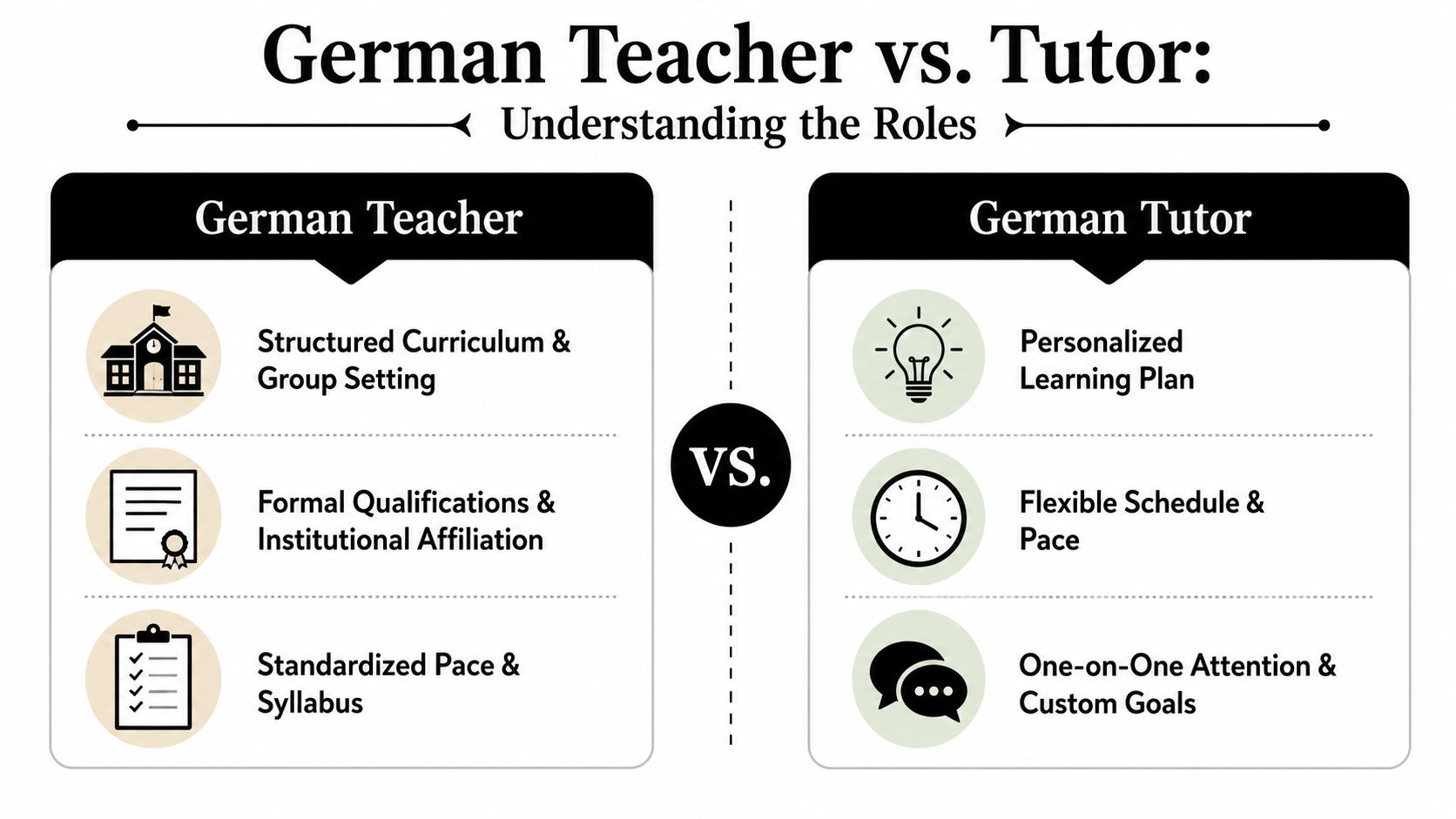
A German teacher usually delivers a structured curriculum with planned progression across reading, writing, listening, and speaking. A German tutor usually provides flexible, targeted support for specific needs such as homework help, speaking practice, or exam revision. In Hong Kong, both can work, but they serve different purposes.
What a German teacher typically does
A teacher's job is to build the whole language system in the right order. That means the student doesn't just “cover topics.” They move through a sequence.
A proper teacher usually provides:
- Structured progression: Lessons follow a level-based path, not a random weekly mix.
- Balanced skill training: Reading, writing, listening, and speaking are developed together.
- Assessment and correction: Mistakes are identified in a systematic way, then revisited.
- Curriculum alignment: This matters for students aiming at Goethe-Zertifikat, IB, IGCSE, or A-level pathways.
This is why serious families often prefer a teacher when the child needs long-term growth, not just emergency support.
What a German tutor typically does
A tutor is usually more flexible and more narrowly focused. That can be excellent when the problem is specific.
A tutor is often useful for:
- Homework support: Clarifying what happened in school that week
- Targeted remediation: Fixing weak grammar points or writing issues
- Speaking practice: Building confidence through one-to-one conversation
- Short-term revision: Preparing for an upcoming test or oral task
That flexibility is the attraction. The weakness is that flexibility can slide into inconsistency if the tutor doesn't work from a clear plan.
A teacher builds the framework. A tutor strengthens a specific area inside it.
Why parents get confused
In Hong Kong, plenty of providers blur these roles. A private tutor may call themselves a teacher. A centre instructor may also offer private tuition. The label doesn't tell you enough.
What matters is the teaching model. Ask whether the person is delivering a staged curriculum or merely responding lesson by lesson. If you want a better sense of how customised learning models work more broadly, this AI-powered study platform guide is a useful reference point for how personalisation differs from fixed programme delivery.
The simple distinction that actually matters
Use this filter when comparing providers:
- Do they have a progression path?
- Do they correct work in detail?
- Do they track performance across all skills?
- Do they adapt to your child without abandoning structure?
If the answer is yes to all four, you may have found the right fit. If the provider mostly offers convenience, casual conversation, or “we'll see how it goes,” be careful. That approach may feel easy at first, but it often costs more time later.
A Head-to-Head Analysis for Hong Kong Parents
Here's the quickest way to compare your options.
| Factor | German Teacher (Language Centre) | Private German Tutor |
|---|---|---|
| Learning structure | Usually follows a syllabus with level progression | Often customised around immediate needs |
| Best use case | Long-term learning, exam preparation, full-skill development | Catch-up support, speaking practice, short-term revision |
| Accountability | More likely to include regular progress checks and planned milestones | Depends heavily on the individual tutor |
| Scheduling | Fixed class times or term schedules | More flexible and easier to rearrange |
| Lesson format | Commonly group-based, sometimes with private options | Usually one-to-one |
| Cost model | Usually package or course-based | Usually hourly |
| Pace control | Set by curriculum and class design | Highly adjustable to the student |
| Risk | May feel too slow if your child only needs targeted help | May become unstructured if there's no long-term plan |
Availability in Hong Kong is tighter than many parents expect
German isn't like Maths or English in Hong Kong. The market is smaller. One Hong Kong listing states that 14 German tutors are available for private in-person or online lessons, while another platform lists over 31 German teachers near you in Hong Kong. The same market snapshot shows rates ranging from HKD 320 per hour on one service to HKD 500 per hour for a certified German teacher in this Hong Kong tutor market overview.
That tells you something important. In HK, German lessons Hong Kong parents search for are not only about quality. They're also shaped by availability, format, and whether the provider can work around school schedules.
Qualifications matter, but method matters more
Many parents ask the wrong first question. They ask, “Is the tutor a native speaker?” That's not useless, but it's not enough.
A provider can speak excellent German and still teach badly. For children, especially those in exam years, you need someone who can sequence content, spot recurring errors, and explain clearly. If you're comparing institutions rather than individuals, this guide on how to choose the best German language school in Hong Kong is worth reading.
Cost is only one part of value
Private tutors look cheaper when you compare one hour to one hour. That's understandable. But hourly pricing can hide a bigger issue. You may pay less per booking while getting no materials, no tracked progression, and no structured assessment.
A centre-based teacher usually costs differently because the learning package is different. You're often paying for a curriculum, a defined level path, materials, and more formal oversight. If your child needs a complete learning system, that matters.
If you need a patch, hire for precision. If you need a pathway, pay for structure.
Scheduling flexibility is where tutors win
This is the strongest case for a tutor in Hong Kong. Busy children have CCA commitments, sports, music, and brutal school calendars. A private tutor can often fit around that.
If your child needs lessons at odd times, temporary exam-season intensives, or online support after school, a tutor may be the practical answer. For some families, that convenience alone makes the difference.
Exam preparation usually favours teachers
When the goal is performance in IB, IGCSE, A-level, Goethe, or similar pathways, structure usually beats improvisation. Exam success depends on repeated correction, level-appropriate pacing, and steady skill building.
That doesn't mean every centre is good and every tutor is weak. It means the teaching model used by a formal teacher is more often aligned with how language exams work.
My honest recommendation on the trade-off
Choose a teacher if your child needs:
- A proper foundation
- A recognised level pathway
- Exam preparation with accountability
- Consistent development across all language skills
Choose a tutor if your child needs:
- Quick intervention on a narrow issue
- Flexible scheduling
- Extra speaking practice
- Temporary support alongside school or centre classes
That's the key comparison. Not teacher good, tutor bad. Structure versus flexibility. For most ambitious HK parents, the correct answer depends on which of those your child needs now.
Which Is Best for Your Child's Specific Goal
The right answer depends on the goal. Not the marketing. Not the job title. Not what your friend's child did.
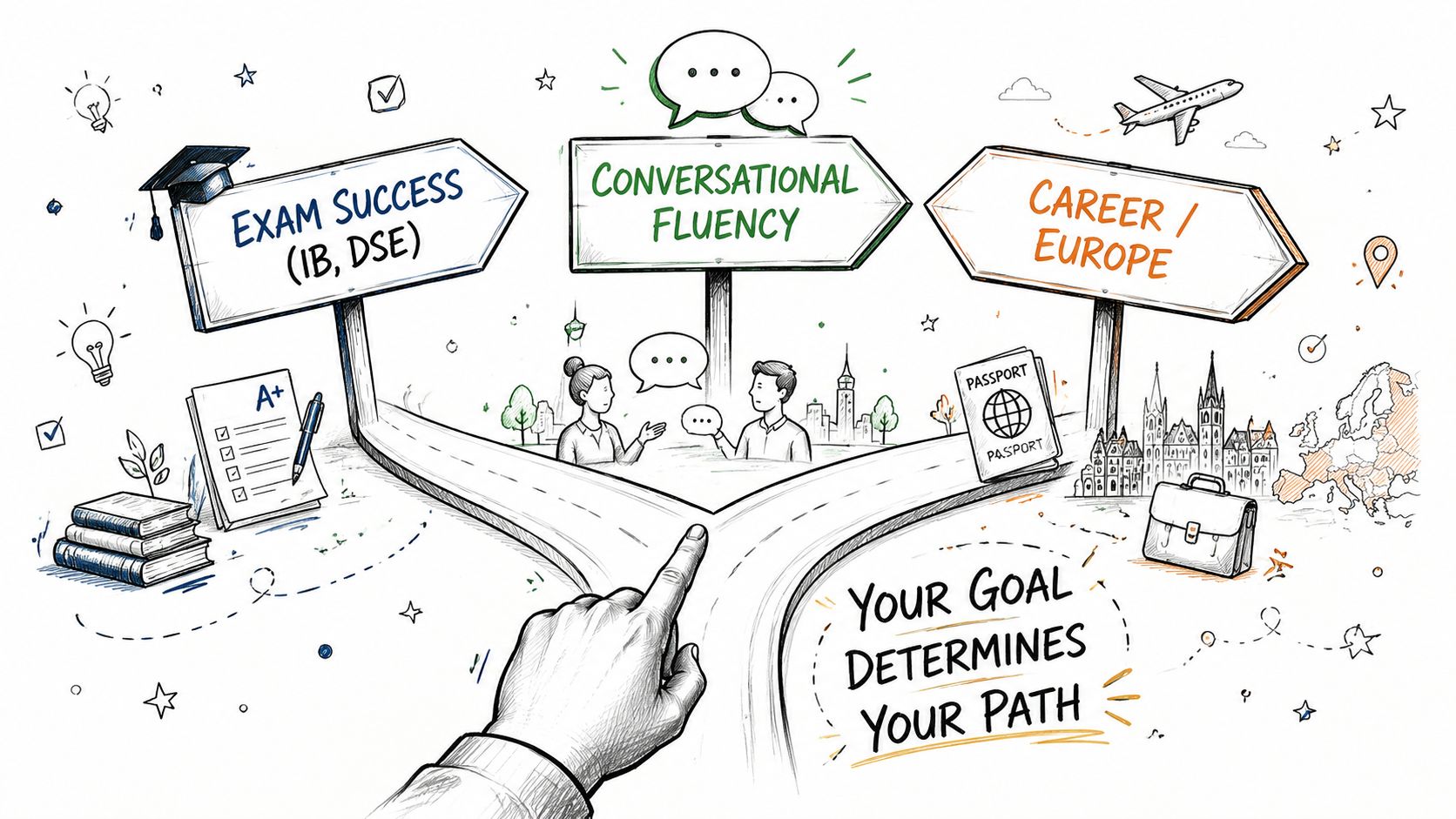
For Hong Kong families targeting international exams, the sharper differentiator is not whether the instructor is a native speaker. It's whether they can provide accurate correction, lesson structure, level control, teaching clarity, and next-step planning. That Hong Kong-focused framework is especially relevant for Goethe-Zertifikat, IGCSE, A-level, and IB preparation, and the same commentary notes that a teacher is often the better fit when the child needs curriculum alignment, staged progress, and accountability in this Hong Kong guide for parents.
If your child is preparing for IB, IGCSE, A-level, or Goethe
Choose a teacher.
This is the clearest recommendation in the whole article. High-stakes exams reward consistency. Your child must improve across multiple skills at once, not just learn more words or sound more confident in casual conversation.
What you need is:
- A staged learning plan: The work should build week by week.
- Detailed correction: Writing and speaking mistakes must be tracked, not ignored.
- Level discipline: The provider shouldn't overload or underteach.
- Accountability: Someone needs to say what the student must fix next.
For families looking at serious exam-oriented support or comparing private options, this list of best private German tutors in Hong Kong can help you assess the market more critically.
If your child needs to catch up after falling behind
Start with a tutor, then reassess.
Tutoring can be very effective. If the student missed basics, doesn't understand current school content, or has lost confidence, one-to-one attention can stabilise things quickly. But don't leave it there for too long if the learning gaps are broad.
A tutor works best here when the support is specific. For example, grammar repair, homework clarification, oral practice, or short-term exam rescue.
If your child wants better speaking confidence
A tutor is often enough, provided the goal is conversational.
Some students don't need a full programme. They already have school instruction and just need more time speaking aloud, being corrected, and becoming less hesitant. In that case, private tutoring can be efficient.
But be careful. Many parents say “speaking confidence” when they mean “I want my child to do better in oral exams.” Those are not the same thing. Oral exams still require structure, task training, and correction.
Don't confuse fluent chatting with exam readiness. They overlap, but they aren't identical.
If your child is starting from zero and you want long-term progress
Choose a teacher.
Begin properly and you'll avoid a lot of mess later. When children start with a sound curriculum, they usually build better habits in pronunciation, grammar, and written accuracy. That foundation matters if they may later study abroad in Germany or continue German into senior years.
This is also where a structured provider such as German Cultural Association Hong Kong(GCA) can make sense for families who want native-speaking teachers, level-based progression, and organised exam preparation rather than ad hoc support.
My blunt recommendation by goal
- Exam results first: Teacher
- Short-term rescue: Tutor
- Conversation only: Tutor
- Long-term academic pathway: Teacher
- Mixed goal with weak foundation: Teacher first, tutor only as extra support if needed**
That's the decision framework I'd use for my own child.
How Much Do German Lessons Cost in Hong Kong
Parents in Hong Kong usually ask this after they've already asked the more important question. Still, cost matters. You need to know what you're paying for, and whether the format suits your budget and your child's real needs.
Hourly tutor pricing is straightforward, but incomplete
In the private market, the visible price is the hourly rate. The verified figures available for Hong Kong show pricing from HKD 320 per hour on one service to HKD 500 per hour for a certified German teacher on another, as noted earlier from the local market listing.
That pricing model is easy to understand. You book an hour, you pay the rate, and you can usually stop anytime. For short-term support, that's attractive.
But hourly pricing doesn't tell you:
- Whether materials are included
- How progress is tracked
- Whether the tutor has a level roadmap
- How much correction happens outside lesson time
Centre pricing works differently
Language centres usually charge by term, package, or course level. Some parents hesitate because the upfront payment feels larger. That reaction is normal, but it can be misleading.
You're not buying isolated hours. You're buying a framework. That may include syllabus design, materials, placement support, structured progression, and exam-focused delivery. If you're comparing overall value rather than single sessions, that's a fairer comparison.
If you want a broader local cost breakdown before deciding, this guide on how much it costs to learn German in Hong Kong is a useful next read.
When tutors are more cost-effective
A tutor is usually better value when:
- Your child needs only a short burst of help
- The issue is narrow and clearly defined
- You want occasional speaking practice
- You can supervise quality yourself
That last point matters. If you can judge whether the tutor is helping, hourly tuition is easier to control.
When a centre is better value
A structured programme is usually better value when:
- Your child is learning for exams
- You need consistent progression
- You don't want to manage the syllabus yourself
- You want a clearer long-term route
For adult learners and some older teens, CEF funding may also matter when comparing formal course options in Hong Kong. That won't apply in every child-learning case, but for families thinking beyond school years, it's worth asking about.
Cheap lessons become expensive if your child has to relearn everything properly six months later.
The right question isn't “What's the lowest price?” It's “What type of spending gets me the right outcome with the least waste?”
Ready to Choose the Right Path for Your Child
By this point, the decision should be simpler. Most parents don't struggle because the options are confusing. They struggle because their child's goal hasn't been defined clearly enough.
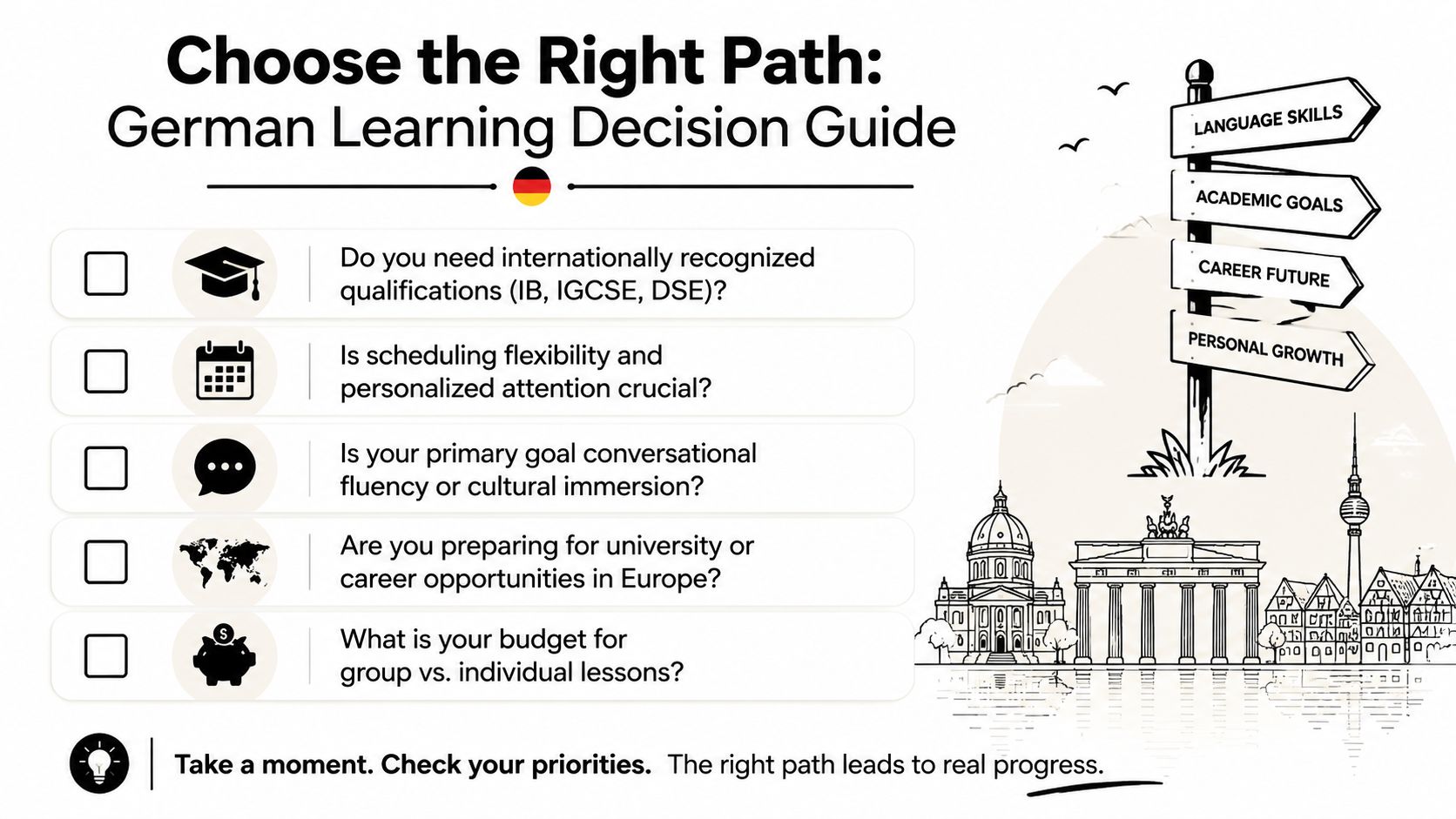
Use this five-point decision filter
Ask yourself these questions:
Is the goal exam performance or general enrichment?
If it's IB, IGCSE, Goethe, or another serious target, lean toward a teacher.Does my child need a full system or a quick fix?
Full system means curriculum, milestones, and regular correction. Quick fix means short-term tutoring may be enough.Can my child work within a set schedule?
If not, the flexibility of a tutor may save a lot of family stress.Do I need measurable progress?
If yes, don't settle for vague reassurance. Ask for a learning plan.Am I choosing based on convenience alone?
That's where many HK parents make the expensive mistake.
The decision in one sentence
If your child needs exam results, academic structure, and long-term progression, choose a teacher. If your child needs flexibility, targeted support, or speaking top-up, choose a tutor.
One final reality check for parents
A child who is serious about German usually needs more than enthusiasm. They need consistency. That's true whether they want to Learn German HK for school success, future European study, or stronger language confidence.
Some families also find it useful to think in terms of coaching rather than only tuition. If you want a broader perspective on structured support models, a platform like coaching platform can be a helpful example of how guided progression differs from casual one-off help.
Choose the provider who can explain the next eight weeks clearly. If they can't describe the path, they probably can't lead your child down it.
A strong German learning path should feel organised, realistic, and calm. Not improvised. Not reactive. Not dependent on last-minute panic before a test.
If you choose well now, your child won't just survive the next assessment. They'll build a foundation that supports future exams, travel, study abroad in Germany, and real language confidence.
If you want expert advice on the right German learning path for your child, contact German Cultural Association Hong Kong(GCA). Their team can help you compare group classes and private lessons, discuss exam preparation for Goethe-Zertifikat, IB, IGCSE, or A-level, and recommend a suitable starting point based on your child's level, schedule, and goals.

Präteritum and Futur Compared: A Guide for HK Learners
Perfekt in German: A Clear Guide for Learners in HK


