.png)
.png)

BLOG

香港德國文化協會
The German Cultural Association
Contacting German Language Schools: What to Ask Before Joining
You shortlist a German school, send an enquiry, and get back a polished reply full of promises. That is the easy part. The key question is whether the school can support the outcome you need in Hong Kong: stronger business German, a clear route to Goethe exams, support for IB or DSE-related language goals, or a practical class schedule that fits around work, school, and the MTR.
A smart school search starts before you book a trial. Ask better questions early and you will spot weak schools fast. Good schools answer clearly, put details in writing, and explain how they handle teaching, scheduling, assessments, and student support. Weak schools stay vague, dodge specifics, and sell atmosphere instead of results.
This guide is built for Hong Kong learners, not for a generic international audience. That means looking at issues local families and professionals care about: campus access by MTR, whether the programme fits exam-track students such as IB learners, whether any course may qualify for CEF-related consideration, and how quickly the school responds when you ask for concrete information. If teacher background matters to you, start by reading what to look for in native German-speaking tutors in Hong Kong, then use this article as your screening checklist.
Be direct. Ask for class details, fee terms, make-up lesson rules, assessment methods, and sample pathways from beginner to exam level. Request the answers by email.
That gives you something useful to compare.
The sections below will help you screen schools with more discipline. You will know what to ask, what answers to expect, and which red flags should end the conversation.
1. Teacher Qualifications and Native Speaker Credentials
Start with the teachers. If the teaching quality is weak, everything else falls apart, including pronunciation, grammar correction, writing support, and exam coaching.
Ask whether the school uses native German-speaking teachers, and ask where they are from. Germany, Austria, and Switzerland all matter here because learners benefit from authentic language exposure, not textbook-only German. Then ask what those teachers studied, what teaching training they have, and whether they've taught children, teens, adults, or exam-track students before.
German-language education has a long institutional history. In the United States, German heritage language schools have operated since at least 1874 in Boston and 1892 in New York, with national enrolment estimated at about 7,000 students across those heritage schools (history of German heritage schools). That matters because serious German programmes usually value continuity, teacher quality, and a clear teaching model.

Ask for proof, not adjectives
A good school won't hide behind phrases like “experienced team” or “highly qualified instructors.” Ask for specifics.
- Ask about academic background: Request the teacher's degree subject and where it was earned.
- Ask about teaching credentials: Find out whether the teacher has formal language-teaching training or exam-preparation experience.
- Ask about target-age experience: Teaching a preschooler, an IB student, and a working professional requires different methods.
- Ask about continuity: Check whether the same teacher follows a cohort through multiple levels or whether teachers change often.
Practical rule: If a school won't clearly tell you who teaches the class and what that person is qualified to teach, don't enrol yet.
A parent in Hong Kong looking for German for an IB student should ask, “Has this teacher prepared students for IB German before?” A working adult should ask, “Has this teacher taught business communication, meetings, and email writing?” A beginner should ask, “Will this teacher build pronunciation from the first lesson?”
Native-speaking teaching is one of the clearest signals of authenticity, especially if you want real spoken German rather than exam tricks alone. If that's a priority for you, this overview of native German-speaking tutors in Hong Kong gives you a useful benchmark for what to look for.
Red flags to catch early
Watch for these answers:
- “All our teachers are fluent.” Fluent is not the same as trained.
- “We assign teachers after payment.” You should know the teaching profile before committing.
- “The syllabus is standard, so teacher background doesn't matter.” It does matter, especially for speaking and writing correction.
A serious school will answer these questions comfortably. A weak one will try to move the conversation back to discounts and convenience.
2. Class Size and Student-to-Teacher Ratio
Class size affects speaking time, correction quality, and confidence. In German, that matters even more because beginners need repeated feedback on pronunciation, sentence structure, and word order.
If you're contacting schools in Hong Kong, ask two separate questions. First, what is the maximum class size? Second, what is the usual class size? Those are not the same thing. A school may advertise “small classes” but still run sessions that feel crowded once enrolment rises.
For serious learners, especially children preparing for IGCSE or IB, small-group teaching is often the safer choice because the teacher is able to hear each student speak and correct them properly. This is one reason many families prefer schools with capped groups rather than open-ended classroom models.
What to ask in writing
Send these questions by email so you have a record.
- Ask for the cap: “What is the maximum number of students in this class?”
- Ask for the typical reality: “What is the current average class size for this level?”
- Ask about speaking time: “How much individual speaking practice does each student get in one lesson?”
- Ask about alternatives: “Do you offer private lessons if my child needs targeted exam support?”

A teenager preparing for oral exams needs active correction, not just attendance. A busy professional learning after work needs enough speaking time to justify leaving the office early or logging on in the evening. Large classes often weaken both.
If the school answers class-size questions vaguely, assume the actual experience will be less personalised than the brochure suggests.
Match the format to the goal
Not every learner needs the same setup.
- Young children: Small groups help maintain attention and participation.
- Exam-track teens: Smaller groups or private lessons help with writing feedback and oral drills.
- Adults learning for work: A compact group works well if everyone is at a similar level and shares similar goals.
- Urgent study-abroad preparation: Private lessons often work better when deadlines are tight.
A good school should be able to tell you how they adapt when a class is full, under-enrolled, mixed in age, or mixed in level. Ask that directly. If the answer is “the teacher manages it,” keep pushing.
You're not paying only for seat time. You're paying for correction, accountability, and enough interaction to improve.
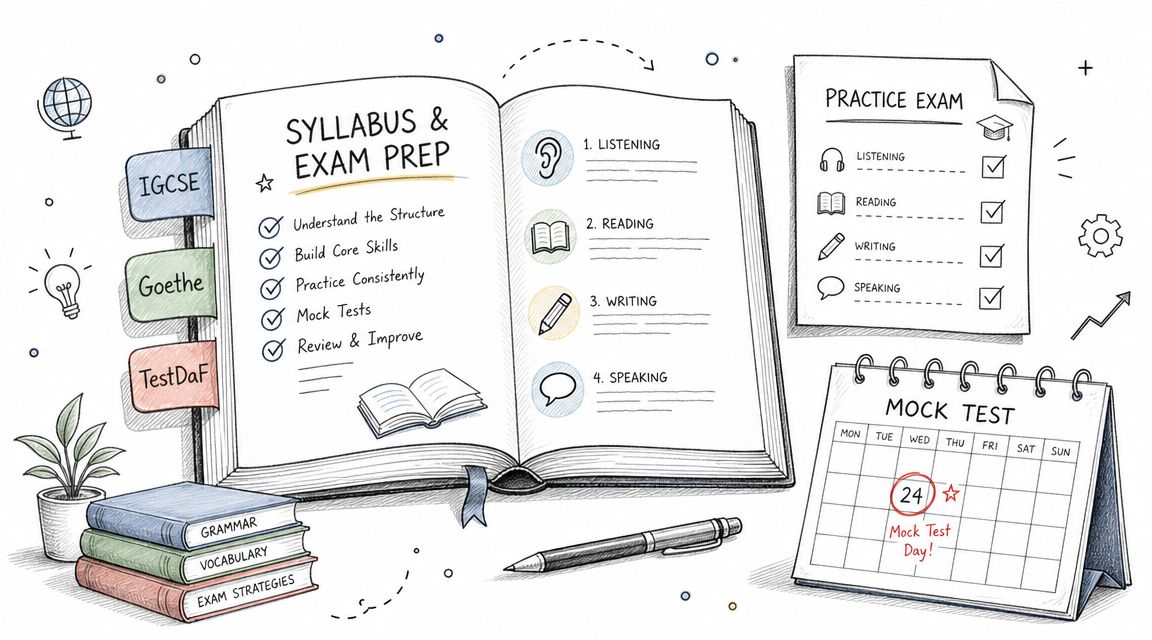
3. Curriculum and Exam Preparation Programs Offered
A Hong Kong parent emails a school asking about IB support. The reply says, “We teach all levels and follow international standards.” That answer tells you almost nothing.
You need a school that can explain exactly what the course is designed to do. For Hong Kong learners, that usually means one of two things. Build practical German for work, relocation, or travel, or prepare for a specific exam path such as Goethe-Zertifikat, IGCSE, A-level, IB, DSE-related school support, or later university admission requirements. If a school cannot map its curriculum to a real outcome, treat that as a warning sign.
Ask what the syllabus actually leads to
Do not settle for “we cover reading, writing, listening, and speaking.” Every school says that. Ask for the course outline, the textbook or materials used, the level sequence, and the expected result at the end of the term.
Use direct questions:
- Exam alignment: “Which exams do you actively prepare students for? Goethe-Zertifikat, TestDaF, IGCSE, A-level, IB, or school-based assessments?”
- Level pathway: “If I start at this level, what is the next level, and how long does students usually take to progress?”
- Exam practice: “Do you include timed writing, oral drills, listening practice, and mock papers in the regular course or only in separate workshops?”
- Correction method: “How is written work marked? How often do students get individual speaking feedback?”
- Hong Kong fit: “Have you taught students from local schools, international schools, or adults balancing work in Hong Kong?”
A strong answer is specific. It names the syllabus, the level target, the assessment style, and the next step. A weak answer stays broad because the programme is broad.
Parents should press harder here. If your child is working toward IB ab initio, IB Language B, IGCSE, or school oral assessments, general conversation lessons will not be enough. Adults have a different problem. If your goal is work, migration, or study in Germany, you need a clear certification path, not a casual course that keeps you busy without moving you toward A1, A2, B1, or beyond.
Look for a progression system, not isolated classes
German takes time. Schools should show you how the pieces fit together over months, not just sell the next 8 lessons.
Ask whether they have:
- A defined level ladder: beginner through advanced with clear entry points
- Placement rules: how they decide where a student starts
- Term plans: when assessments, review weeks, and exam-prep periods happen
- Materials policy: whether they use a recognised textbook series, teacher-made notes, or a mix
- Upgrade paths: what happens if a student needs extra support or faster progress
Then ask one blunt question: “If we join this month, what does the next twelve months look like?”
That question works. It forces the school to stop marketing and start explaining.
For Hong Kong families, this matters even more because study plans often have deadlines attached. A teen may need oral support before mocks. A professional may need a Goethe certificate before a visa or job move. Someone using Continuing Education Fund support should also ask whether the relevant course structure and paperwork fit CEF requirements before paying. Do not assume.
If you are comparing delivery formats as part of the curriculum decision, read this guide on in-person vs online German classes in Hong Kong. Format affects how well exam preparation, writing correction, and speaking practice work.
For families comparing different language pathways, this guide for Yonsei Korean studies is also a helpful example of how serious programmes explain structure, progression, and outcomes clearly. The same standard should apply when you evaluate German lessons Hong Kong providers.
4. Flexible Scheduling and Online Learning Options
Hong Kong learners need flexibility. Timetables change, work runs late, school calendars shift, and MTR travel isn't always convenient at peak hours. That's why scheduling policy is not a minor detail. It affects whether you can stay consistent.
Ask schools whether they offer live online classes, in-person classes, or a hybrid option. Then ask what happens when you miss a lesson. A school with weak rescheduling systems usually creates friction at exactly the moment you need support.
As of 2025, Statista projects Hong Kong's online learning platforms market revenue at US$70.77 million, which signals strong acceptance of remote instruction and self-service learning workflows (projection on online learning platform revenue). In practical terms, online learning in HK is mainstream. Schools should operate like they know that.

What matters more than “online available”
Plenty of schools say they offer online learning. That doesn't tell you enough.
Ask these questions instead:
- Ask whether lessons are live: Recorded content is not a substitute for real-time correction.
- Ask about make-up classes: Find out how rescheduling works and whether it's easy or ad hoc.
- Ask about platform design: Check whether the class runs on Zoom or another live platform, and whether materials are mobile-friendly.
- Ask about lesson continuity: If your child is sick or travelling, can they switch from in-person to online smoothly?
Working professionals should also ask about evening and weekend availability. Parents should ask if a child can join online temporarily during exam periods or school clashes. That one policy can save a term.
For a fuller comparison of formats, this breakdown of in-person vs online German classes is worth reading before you decide.
How much does online flexibility matter
It matters a lot because consistency beats intensity. A learner who attends regularly in a practical format usually progresses better than one who keeps dropping out because every missed lesson becomes a hassle.
Schools should be able to explain:
- How attendance is tracked
- How missed lessons are handled
- Whether lesson materials remain accessible
- Whether online and in-person students receive the same curriculum standard
Don't ask only, “Do you offer online classes?” Ask, “How do you keep students on track when real life interrupts study?”
That question gets you closer to the truth.
5. Pricing, Trial Classes, Money-Back Guarantees, and Satisfaction Policies
Don't ask only for the tuition fee. Ask for the full financial picture.
A cheap quote can become expensive once you add registration fees, textbooks, materials, assessment charges, or extra lessons. A premium quote can still be good value if the school provides stronger teaching, tighter class sizes, and better support. You need the details in writing before you compare anything.
Ask for the complete cost structure
Send a short, direct message and ask the school to break down everything.
- Ask what is included: Tuition, materials, homework marking, assessments, certificates.
- Ask what is separate: Textbooks, exam registration, transfer fees, or admin charges.
- Ask how payment works: Upfront, by term, or by instalment.
- Ask about trial options: Whether you can book a trial lesson before full enrolment.
If you're a parent, ask what happens if the class isn't the right level. If you're an adult learner, ask whether the school can move you to a different group if the pace is wrong.
Don't rely on verbal promises
A good school should be happy to put refund and cancellation policies in writing. If it won't, assume disputes will be difficult later.
Ask these questions directly:
- What is the refund policy if the course hasn't started yet?
- What happens after the course starts?
- Can I change teachers or switch class time if the fit is poor?
- If a class is cancelled by the school, how is the credit handled?
Some schools also offer trial classes or a satisfaction process. That's useful, but only if the terms are clear.
A vague promise like “we'll sort it out” is not a policy. Get the actual rule.
If you're comparing budget options against more structured schools, don't reduce the decision to hourly cost alone. German is a long-term subject for many learners in HK. Bad placement, weak teaching, or poor scheduling can cost you more than a higher fee ever would.
For a general example of how education providers present package choices, you can look at The Kingdom of English plans. Then compare that level of clarity against what your shortlisted German school sends you.
6. Progress Tracking, Assessment, and Certificate Programs
If a school can't explain how it measures progress, it probably doesn't measure it well.
This is especially important in Hong Kong because many learners need evidence of development. Parents want to know whether a child is ready for the next level. Adults want to know whether they are moving toward a recognised standard. Students preparing for study abroad in Germany need a path, not just a class.
Ask how progress is measured
Don't settle for “the teacher will monitor it.” Ask what that means in practice.
- Ask about the framework: “Do you place students by CEFR level?”
- Ask about assessment frequency: “When do students get tested or reviewed?”
- Ask about reporting: “Do you issue written progress reports or verbal updates?”
- Ask about promotion: “What decides whether a student moves to the next class?”
Schools should also explain whether they issue internal certificates, support external exam preparation, or both. If they give certificates of completion, ask what they represent. Attendance alone is not the same as language proficiency.
GCA's own certificate system includes an 80% attendance requirement, which is a useful example of a structured participation standard for learners who want accountability built into the programme. That kind of policy is healthier than an informal “come when you can” approach because it sets expectations early.
Why certificates matter differently for different learners
A certificate can mean very different things.
- For children: It can help parents track continuity and commitment.
- For teens: It can support motivation between major exam milestones.
- For adults: It can signal structured progress, but external exams matter more if the goal is migration, university, or work.
- For exam-track students: Internal reports are helpful only if they connect to real exam performance.
Ask one simple question: “When this course ends, what exactly will I be able to prove?”
That answer should cover attendance, level, assessment, and next-step recommendations.
A strong school should also tell you how missed classes affect certification, whether make-up lessons count, and when certificates are issued after course completion. These details matter more than commonly assumed, especially when you're planning applications or long-term study.
7. Specialized Programs for Business, Travel, and Different Age Groups
Not everyone should take the same German course. A five-year-old, an IB student, a lawyer relocating to Europe, and a traveller preparing for a long holiday need very different teaching.
So ask whether the school offers specialised pathways. If it doesn't, ask how it adapts a general course to your goal. Generic classes can work at the beginning, but they become less efficient once your needs become specific.
Match the course to the real-world use case
When you contact the school, state your goal in the first message. Don't wait for them to guess.
- For professionals: Ask whether the school offers business German, presentation language, meeting vocabulary, and email writing.
- For travellers or relocation: Ask for practical spoken German, transport, accommodation, food, and everyday problem-solving language.
- For preschoolers and children: Ask about play-based learning, routine, and parent communication.
- For teens: Ask whether the course supports IGCSE, A-level, IB, or Goethe-Zertifikat preparation.
The broader language-learning market also shows a shift toward tech-enabled convenience and measurable progress. In Germany, 59% of surveyed consumers preferred language apps and 19% were actively using them, which reflects rising expectations around modular learning and progress tracking (consumer preference for app-based language learning). Schools in Hong Kong should respond to that by offering clear diagnostics, structured goals, and targeted content.
Ask for examples of relevant lesson content
A school that really offers specialised teaching should be able to describe it clearly.
Ask questions like:
- “What does a Business German lesson include?”
- “How do you teach travel survival German differently from a standard beginner course?”
- “How do you keep younger children engaged?”
- “How do you prepare teens for school-based oral and written assessments?”
If your priority is career use, this overview of business German courses in Hong Kong gives a good sense of what practical, goal-based training should look like.
A useful scenario: a Hong Kong professional working with German suppliers may need meeting phrases, negotiation language, and cultural etiquette. That learner does not need the same first-month focus as a teen aiming for IB German writing tasks. The school should recognise that immediately.
8. Location, Accessibility, and Campus Facilities
A school can have strong teachers and a good curriculum, but if getting there is painful, attendance drops. In Hong Kong, convenience matters. MTR access, walking distance, and lesson timing all affect whether learners stay consistent.
Ask for the exact address and check your own route. Don't rely on “centrally located” or “easy to reach.” For parents, also think about waiting arrangements, pick-up flow, and whether the lesson time creates unnecessary stress before dinner or homework.
Check the commute like a local
You want practical answers, not brochure language.
- Ask for walking time from the nearest MTR station
- Ask which exit is most convenient
- Ask whether the building is easy to find for first-time visitors
- Ask about lift access, waiting area, and washrooms
For children's classes, ask where parents wait and whether the environment feels calm and supervised. For adults, ask whether the centre is close enough to reach from Central, Kowloon, or your district without turning the class into a half-day commitment.
GCA operates in-person classes at centres near Tsim Sha Tsui and Causeway Bay MTR, which is the kind of practical location detail worth noticing if you're comparing schools based on attendance convenience as well as teaching model.
Facilities still matter
You don't need a luxury campus. You do need a learning environment that supports focus.
Ask about:
- Classroom setup: Is it built for interaction or lecture-style teaching?
- Technology: Are screens, audio, and online tools used well?
- Study environment: Is the centre quiet and organised?
- Child suitability: Is the space appropriate for younger learners?
Visit once before enrolling if you can. A ten-minute visit tells you more than a polished website.
There's also a wider quality gap in how schools explain standards and outcomes. Public guidance often helps families find places to study German, but it doesn't always show them how to verify teaching quality, assessment alignment, or exam readiness across providers (where to learn German and the quality-comparison gap). That's why your own on-site check matters.
8-Point Comparison: Questions for German Language Schools
| Item | Implementation Complexity 🔄 | Resource Requirements ⚡ | Expected Outcomes ⭐📊 | Ideal Use Cases 💡 | Key Advantages 📊 |
|---|---|---|---|---|---|
| Teacher Qualifications and Native Speaker Credentials | Moderate–High, vetting credentials, background checks, and hiring standards | High, higher teacher salaries; time for verification | ⭐⭐⭐, improved pronunciation, cultural nuance, stronger exam readiness | Exam-focused courses, advanced pronunciation practice, cultural instruction | Authentic accent modeling; authoritative exam guidance; higher instructional credibility |
| Class Size and Student-to-Teacher Ratio | Low–Medium, scheduling and grouping logistics | Medium, more instructors per student increases cost | ⭐⭐, greater speaking practice and personalized feedback | Small-group courses, one-to-one tutoring, intensive exam prep | Increased participation, tailored correction, faster individual progress |
| Curriculum and Exam Preparation Programs Offered | High, syllabus mapping, exam alignment, frequent updates required | High, specialized materials, mock exams, teacher training | ⭐⭐⭐, targeted exam success and clear progression pathways | IGCSE/A‑level/IB/Goethe/TestDaF preparation | Higher pass rates; familiarity with exam formats; measurable outcomes |
| Flexible Scheduling and Online Learning Options | Medium, platform setup, hybrid coordination, rescheduling policies | Low–Medium, video conferencing tools, recordings, admin support | ⭐⭐, greater access and continuity; variable interaction quality | Working professionals, remote learners, busy families | Convenience, geographic reach, make-up and recorded lesson availability |
| Pricing, Trial Classes, Money-Back Guarantees, and Satisfaction Policies | Medium, payment systems, refund rules, trial logistics | Low–Medium, administrative overhead; promotional costs | ⭐, clearer cost expectations; reduced enrollment risk | Cost-sensitive students, first-time enrollees, families comparing options | Transparency in fees; trial/money-back lowers perceived risk |
| Progress Tracking, Assessment, and Certificate Programs | Medium, creating assessment schedules and reporting systems | Medium, testing tools, staff time for marking and reporting | ⭐⭐, measurable improvement, motivation, formal validation | Long-term learners, university applicants, visa documentation | Regular feedback, formal certificates aligned to CEFR, early intervention |
| Specialized Programs: Business, Travel, Age‑Specific Courses | Medium, curriculum customization and instructor specialization | Medium–High, specialist instructors, targeted materials | ⭐⭐, rapid gains in domain-specific vocabulary and skills | Business professionals, travelers, children, corporate groups | Relevance to real needs; increased learner motivation and immediate usefulness |
| Location, Accessibility, and Campus Facilities | Low, site selection and basic facility planning (cost-dependent) | High, rent, classroom tech, study spaces | ⭐, improved attendance and learning environment; convenience boosts engagement | Local students and parents valuing commute time and on-site resources | Proximity to transport, tech-enabled classrooms, comfortable study spaces |
Ready to Learn German? Your Decision Checklist and Next Steps
You shortlist three German schools on your lunch break. One is close to an MTR station. One advertises native speakers. One looks cheaper. By dinner, you still do not know which one can prepare your child for IB or DSE-related language goals, which one offers classes you can attend after work, or which fees are refundable if schedules change. That is the problem this checklist should solve.
Use your enquiries like a screening tool. Do not send a lazy “please send course info” message. Ask for specifics on teacher qualifications, class size, exam pathways, schedule options, pricing terms, progress checks, and commute practicality from your home, office, or your child's school. In Hong Kong, convenience matters, but structure matters more. A school that is five minutes from the MTR and weak on teaching quality is still the wrong choice.
How a school replies matters almost as much as what it says. Clear answers, written policies, and prompt follow-up usually signal a school that runs properly. Vague replies, recycled WhatsApp messages, or pressure to pay before placement details are confirmed usually lead to avoidable frustration.
Watch for these red flags:
- Vague teacher profiles: If the school will not name qualifications, teaching background, or whether lessons are led by native-speaking teachers, treat that as a warning.
- Unclear progression: If staff cannot explain how a beginner moves from one level to the next, the curriculum is probably loose.
- Weak exam awareness: If your goal involves Goethe-Zertifikat, TestDaF, IGCSE, A-level, IB, or a school-based target tied to German study, the school should answer directly and confidently.
- Poor timetable flexibility: Hong Kong schedules change fast. Rescheduling rules, online fallback options, and makeup arrangements should be spelled out.
- Unwritten refund terms: If refund rules, trial lesson conditions, or package expiry dates are not documented, assume disputes will be difficult.
- No formal assessment: “The teacher will know” is not a system. You need placement, feedback, and clear next-level recommendations.
- No local practical awareness: If staff cannot discuss MTR access, class timings for working adults, or suitability for children balancing DSE, IB, or heavy school workloads, they do not understand the market they serve.
For Hong Kong families and professionals, the right school usually combines four things. Strong teachers. Structured progression. Recognised exam support. Delivery options that fit real schedules, including online access when needed. If you are also comparing children's programmes, this AI-assisted language learning guide is a useful companion read before you decide how much support your child needs outside class.
Keep your final comparison simple. Ask how the school places new students. Ask how it tracks attendance and progress. Ask what happens after the current term ends. Ask whether the course can support a bigger goal, such as university plans in Germany, stronger academic performance, career mobility, or family relocation planning. If CEF funding matters to you, confirm eligibility and paperwork before you pay. Do not assume.
One relevant option to consider is German Cultural Association Hong Kong (GCA). Based on the information provided, it offers native-speaking teachers, structured curriculum pathways, small-group classes, private lessons, exam preparation for Goethe-Zertifikat, TestDaF, IGCSE, A-level, and IB, plus in-person and Zoom-based formats. That makes it a useful benchmark when you compare schools. If another provider cannot match that level of clarity on teaching, structure, and exam readiness, ask why.
Before you commit, send one final email listing your must-haves. State your goal, preferred format, ideal schedule, location preference, and any remaining questions on fees, assessments, or exam preparation. Good schools answer directly and specifically. That is the standard.
Your decision should feel informed, not rushed. German takes commitment, and the right school shows its quality from the first reply.
If you're ready to compare options seriously, contact German Cultural Association Hong Kong(GCA) to discuss your goals, check the latest schedule, or arrange a trial lesson. Whether you need German lessons Hong Kong for a child, exam preparation for IGCSE or IB, or flexible Learn German HK options for work or study abroad in Germany, their advisors can help you find the right starting point.
German Accusative Case Explained: When and How to Use Akkusativ

German Small Talk: 30 Phrases for Meeting People and Making Friends


