.png)
.png)

BLOG

香港德國文化協會
The German Cultural Association
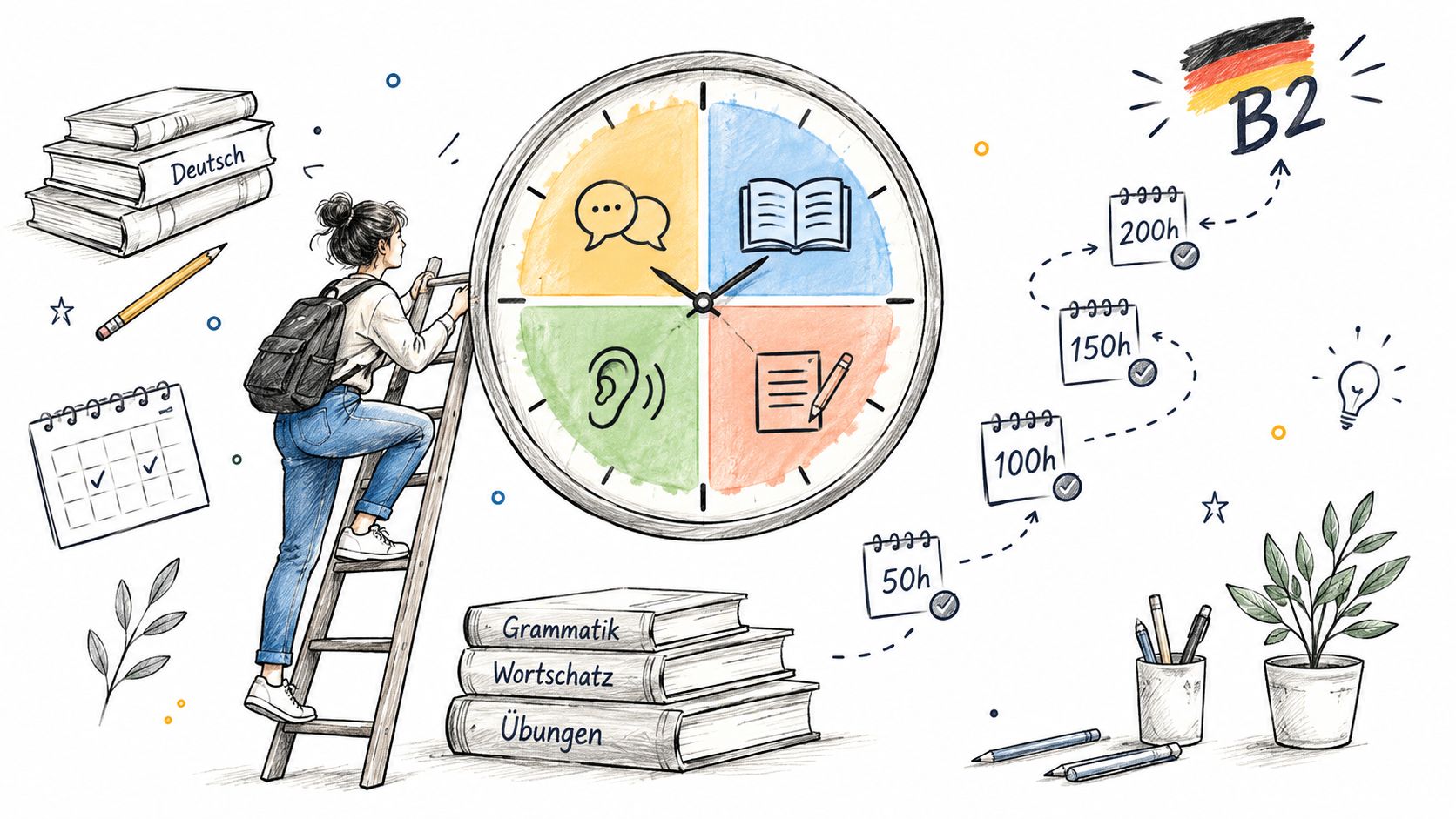
How Many Hours to Reach B2 German? CEFR Guided Learning Hours Explained
Reaching CEFR B2 in German generally takes approximately 450 to 600 clock hours of guided learning, equal to 600 to 800 teaching units of 45 minutes. Your calendar time depends on weekly intensity, so the same target can mean a focused plan of under two years or a steadier route spread over several years.
That's the short answer to how many hours to reach B2 German, with CEFR guided learning hours explained in practical terms below. If you're a Hong Kong parent mapping a pathway for a teenager, a professional who needs German for clients, or an adult planning study abroad in Germany, don't treat that range as a promise. Treat it as a budget you spend week by week, with milestones you can test.
Table of Contents
What B2 German Really Means for Hong Kong Learners
A Tsim Sha Tsui professional emails a German supplier in English, then realises the next promotion depends on joining calls where German is the working language. A parent in Shatin faces a different deadline, because their child wants a German taught degree and needs proof of language level, not just conversational confidence. Both learners ask for B2, but they don't need identical skills on the same date.
B2 means you can follow extended speech, understand complex texts, interact with reasonable fluency, and produce detailed spoken and written language. It's the point where you're no longer translating every sentence in your head. You can argue a view, clarify a misunderstanding, and keep going when the topic moves beyond daily routines.
Why Hong Kong changes the planning
German is established in Hong Kong, but it isn't widely available in local schools. Research from The University of Hong Kong recorded 90 German students in 2016/2017, compared with 156 for Spanish, 164 for French, and 132 for Japanese, across four schools with 22 to 25 new students annually according to the HKU study of secondary school foreign language programmes. Most learners therefore build German through private lessons, cultural association classes, or university electives, not through daily immersion at school.
That limited exposure makes your hour quality matter. Two passive hours where you rarely speak won't move you like two organised hours with correction, retrieval practice, and a clear task. Your plan needs speaking turns, written feedback, and listening work between lessons.
- Exam goal: You're preparing for a Goethe-Zertifikat, DSE Category C, IGCSE, A-level, or IB result with a fixed test format.
- University goal: You need to check whether your target programme is German taught or English taught, because the required level can differ.
- Work or family goal: You may need a lower certified level first, then build upward in stages.
Families sometimes compare very different visa routes while they're researching levels, which is why a guide to the A1 exam for reunion visa India can be useful context for understanding how A1 fits a specific family reunion pathway. It also shows why you shouldn't confuse an entry level visa requirement with B2 readiness for work or study. In Hong Kong, start by naming the exact outcome, then work backwards to hours.
How CEFR Levels Build Toward B2
CEFR B2 German usually requires 450 to 600 guided clock hours in total, built cumulatively through A1, A2, and B1. Guided learning means structured teaching and supervised practice, not passive attendance alone. Your weekly intensity, prior language experience, and independent practice determine how those hours translate into calendar time in Hong Kong.
The ladder below gives you a plain English picture of each stage before you look at numbers.
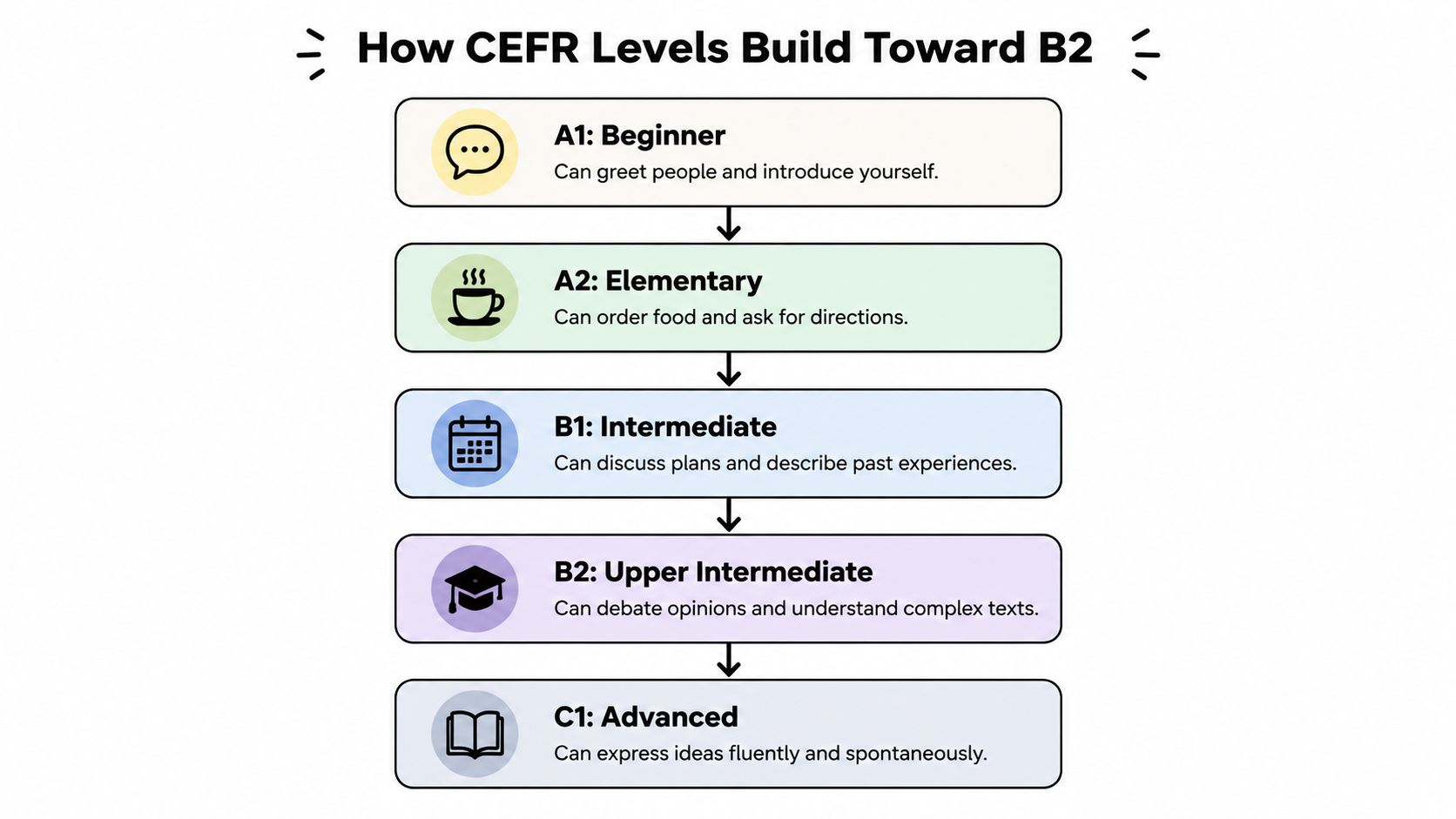
A1 and A2 build survival and routine
At A1, you introduce yourself, greet people, ask simple questions, and handle short exchanges if the other person speaks slowly. You learn present tense patterns, basic word order, and the article and case system that often surprises Cantonese and English speakers.
At A2, you manage everyday routines. You can shop, make arrangements, describe your family and work, and understand sentences about familiar topics. You're still relying on rehearsed patterns, but you can link ideas and repair simple breakdowns.
B1 and B2 build independence
At B1, you travel with more confidence, describe experiences, explain plans, and give brief reasons for opinions. Grammar becomes more demanding, because subordinate clauses, past forms, and connectors have to work together in longer turns.
At B2, the shift is cognitive as much as linguistic. You follow the main ideas of complex text, join discussion without long pauses to search for every word, and write clear, detailed text on a range of subjects. That independence is why grammar drills alone won't finish the job.
C1 sits above B2 for learners who need fluent, spontaneous expression for demanding academic or professional work. Most Hong Kong learners shouldn't aim there first. Secure B2 skills across listening, reading, speaking, and writing, then decide whether your university or job target requires more.
If your goal is a certificate rather than general confidence, look at the structure of a B2 German exam preparation course in Hong Kong before you book generic lessons. Exam tasks reward timed performance and task control, not only knowledge of vocabulary lists.
B2 isn't A2 with more words. It's the level where you must process longer input and produce organised output at speed.
Breaking Down the 450 to 600 Guided Learning Hour Range
Don't read 450 to 600 hours as one long course. Read it as four cumulative stages, each with a checkpoint you can verify. That framing helps Hong Kong families budget time and fees, and it helps adults decide when to pause, consolidate, or sit an exam.
The Goethe-Institut progression estimates place A1 at roughly 60 to 150 hours, A2 at 150 to 260 cumulative hours, B1 at 260 to 485 cumulative hours, and B2 at 450 to 600 cumulative hours, as set out in the Goethe-Institut London course FAQ on learning hours. Those ranges overlap because learners don't progress at a fixed speed. Prior language learning, age, motivation, and use of German outside class all move the total.
| CEFR stage | Cumulative guided hours | What you can do |
|---|---|---|
| A1 | 60 to 150 hours | Greet people, introduce yourself, ask and answer simple personal questions |
| A2 | 150 to 260 hours | Handle routines, describe background, manage direct exchanges on familiar matters |
| B1 | 260 to 485 hours | Describe experiences, explain plans and opinions, cope with most travel situations |
| B2 | 450 to 600 hours | Follow complex text and extended speech, debate views, write detailed organised text |
Why the B1 to B2 jump feels slower
Early progress is visible. You learn to order food, talk about your weekend, and write a short message, so every week feels productive. At B1 to B2, the gains are less obvious because you're improving range, accuracy, register, and speed at the same time.
You also need discourse skills. A B2 learner has to summarise an argument, respond to a counterpoint, follow a lecture extract, and write under time pressure. Those tasks expose weak listening or writing even when grammar knowledge looks solid on worksheets.
HKU SPACE provides a useful local anchor at the start of the ladder. Its 120 hour introductory German programme is listed as equivalent to CEFR A1 and covers listening, speaking, reading, writing, grammar, vocabulary, and pronunciation for basic everyday communication, according to the HKU SPACE Certificate in German programme page. If A1 alone can occupy that volume in a structured local programme, you can see why B2 can't credibly be sold as a short course.
Practical rule: Count an hour as guided only when it has a learning objective, active practice, and feedback or a reliable way to check accuracy.
Use a diagnostic before you claim a stage is complete. Test all four skills, because uneven profiles are common in HK. A student may read well from school based study habits yet freeze in spontaneous speaking, and that gap will delay exam readiness.
How Weekly Study Hours Shape Your Timeline to B2
Course hours tell you the size of the job. Calendar time tells you whether the job fits your life. You need both numbers before you commit to an exam date or a university application round in Hong Kong.
The chart below compares weekly intensities so you can see the trade off at a glance.
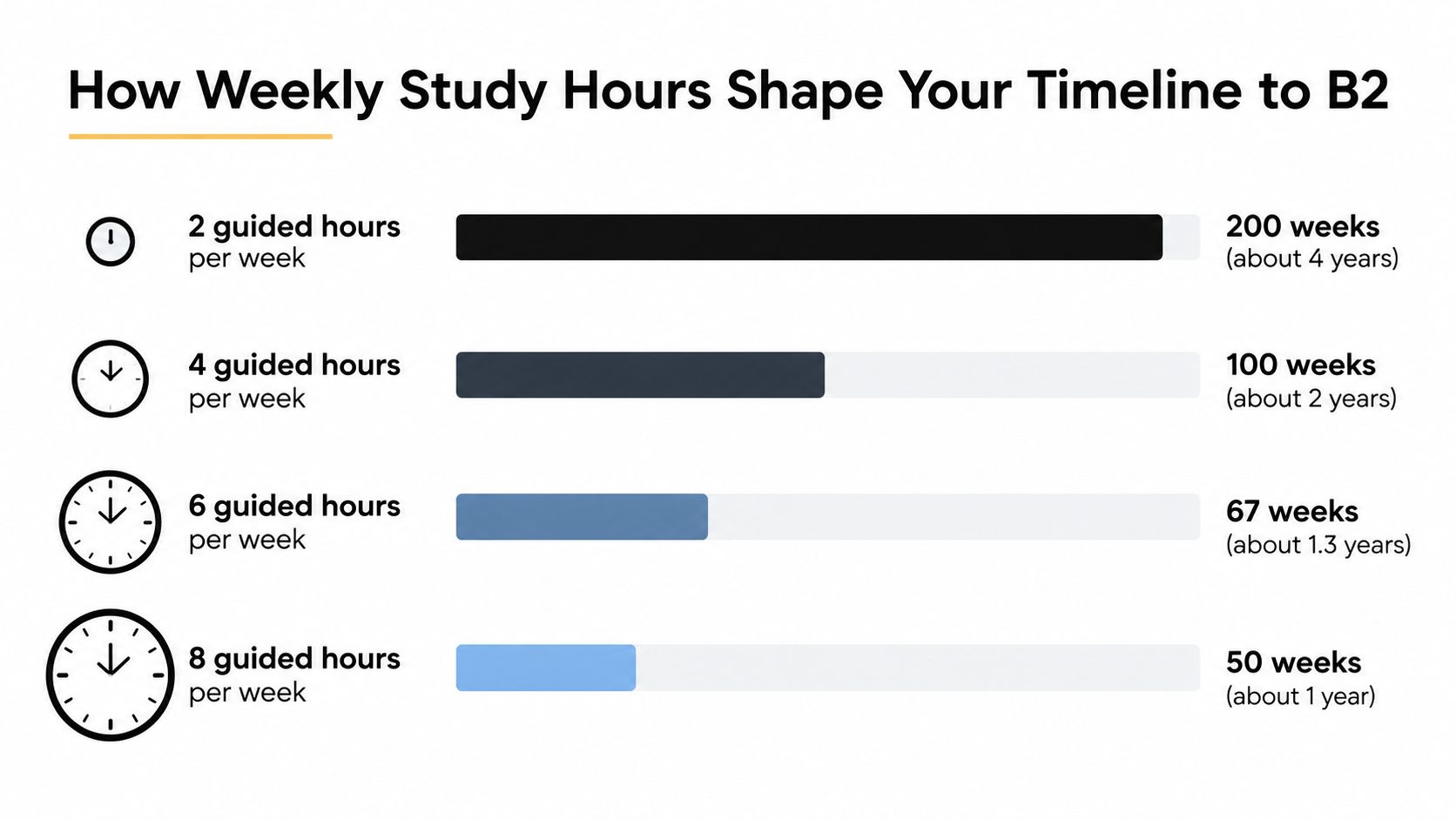
At 8 guided hours per week, the 600 to 800 hour planning view used in some CEFR estimates represents roughly 75 to 100 weeks, while 4 hours per week may require approximately 3 to 4 years on that wider benchmark. Use the lower 450 to 600 clock hour Goethe range for your core plan, then keep a buffer for holidays, illness, school exams, and slower consolidation at B1 to B2.
- 2 guided hours weekly: Best for maintenance or a long runway. Progress is real, but B2 becomes a multi year project unless self study is substantial and well supervised.
- 4 guided hours weekly: A realistic pace for many working adults. You can build steadily if you protect the slot and review between lessons.
- 6 guided hours weekly: A serious commitment that suits learners with a defined exam or application deadline. At 6 guided hours per week, the 450 to 600 hour target implies about 75 to 100 weeks before independent practice is counted.
- 8 guided hours weekly: Intensive and effective for shorter deadlines, but only sustainable if work, DSE, IGCSE, A-level, or IB load allows recovery time.
Don't confuse attendance with total learning. If you attend two class hours and complete one hour of assigned listening, vocabulary retrieval, and corrected writing, your week is stronger than three passive class hours. The label matters less than whether the work is structured, checked, and repeated.
This short video is a useful pause point to hear the timeline logic in spoken form before you build your own weekly template.
Do the division. Take the B2 range, divide it by the guided equivalent hours you can repeat in a bad week, not your best week, then add buffer time. Hong Kong timetables rarely stay clean for long.
Building a Realistic Weekly Study Plan
A good plan fits a Hong Kong week that already includes commuting, homework, family obligations, and unpredictable overtime. It doesn't require heroic daily sessions. It requires fixed slots, varied skills, and feedback you actually use.
Use the template below as a starting point, then adjust the total to your chosen intensity.
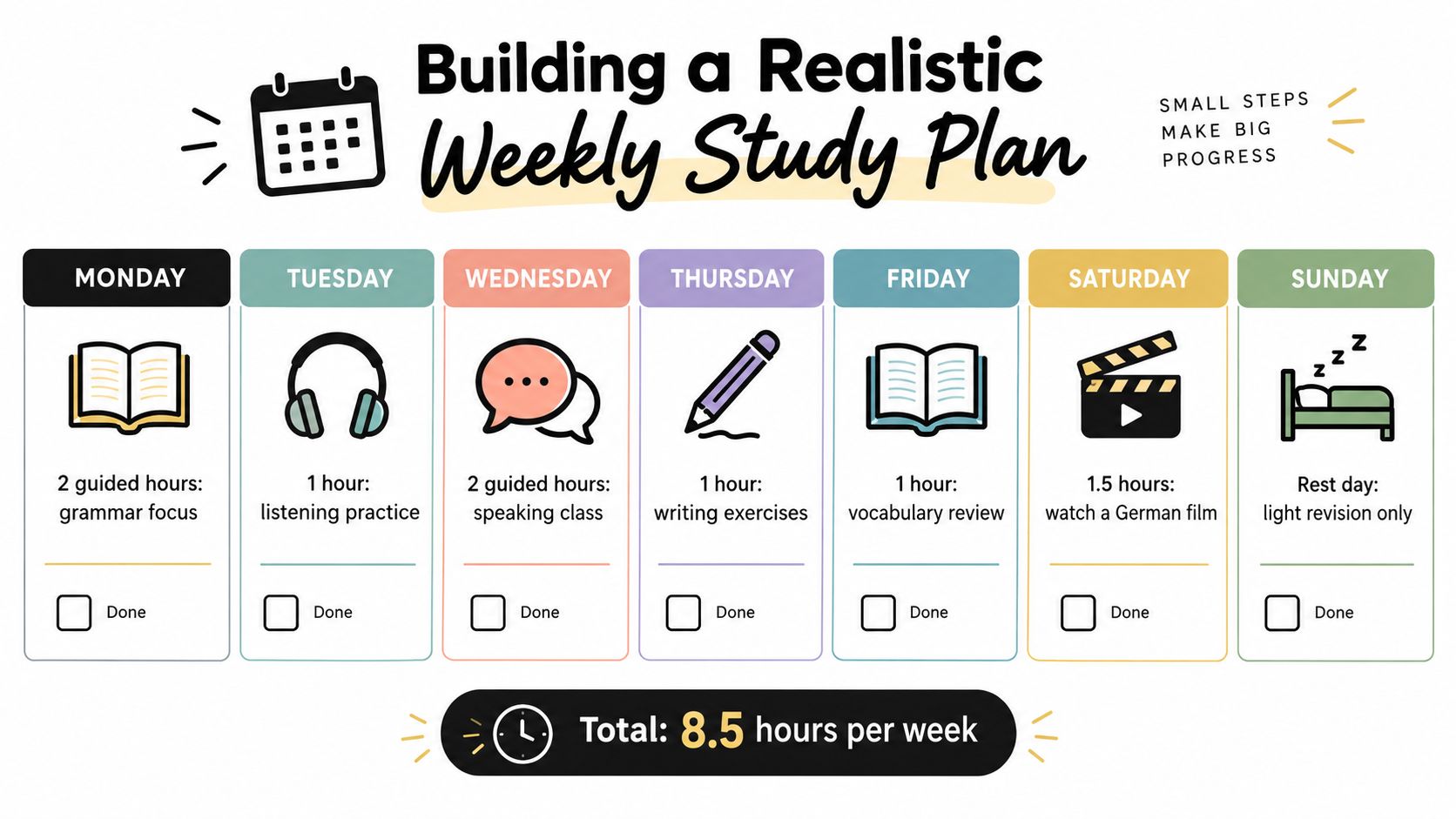
A balanced week for steady B2 progress
Start with two guided blocks rather than one long session. One block can focus on grammar, reading, and writing accuracy. The other can prioritise listening, discussion, and exam style speaking tasks.
Add short independent work between those blocks. Vocabulary retrieval works well on the MTR if you use spaced repetition and test yourself in German to English and English to German. Listening should include both slow, clear material and faster authentic extracts as you move through B1.
- Lock two class slots: Put them on the same days each week so German doesn't compete with every new invitation or tutorial.
- Book feedback time: Use private correction or small group speaking to fix recurring errors in case endings, word order, and connectors.
- Schedule retrieval: Review new vocabulary within the same week, then again after a gap, using sentences rather than isolated translations.
- Write every week: Produce a short text, get it corrected, and rewrite the weak sentences instead of only reading the teacher's marks.
- Log your hours: Record guided hours, self study, mock scores, and the skills practised so you can spot imbalance early.
For learners who want a structured independent routine alongside classes, a six month self study plan for learning German by yourself can help you organise free resources without turning self study into random app use. Keep that work connected to your course syllabus. Random input feels busy, but aligned input compounds.
Feedback compresses your timeline more reliably than extra passive exposure. A corrected paragraph you rewrite teaches more than a long video you half follow.
Adjusting for teenagers and professionals
Teenagers preparing for DSE, IB, IGCSE, or A-levels should reduce German volume during peak school assessment weeks, then restore it during holidays. Parents should plan in terms rather than pretending every week is equal. Consistency across the school year beats a short burst followed by disappearance.
Professionals should protect one weekday slot and one weekend review block. If travel is frequent, keep an online option for continuity and use in person time for speaking and correction. The aim is not perfection. The aim is a rhythm you can restart quickly after disruption.
Screenshot this checklist and adapt it: fixed class slot, assigned listening, vocabulary retrieval, one corrected writing task, one spoken summary, and a five minute log update. If a week contains those elements, it's a B2 building week.
What Actually Changes the Timeline for HK Learners
Completing the published hours doesn't automatically make you exam ready. That's the uncomfortable point many generic articles skip. Two Hong Kong learners can log similar totals and reach very different outcomes because their goals, feedback, and exposure differ.
HKU illustrates the issue in its own curriculum, where German courses span A1 through B1/B2 and progression depends on course structure and prior knowledge rather than a universal hour total, as shown on the HKU German programme page. Hours are a planning benchmark. They aren't a guarantee that you'll pass a specific assessment.
The target itself may not be the same
B2 conversational ability, a Goethe-Zertifikat B2 result, TestDaF readiness, and a school examination grade aren't interchangeable. A learner who chats confidently on familiar topics may still lose marks on timed writing, formal register, or listening note taking. A strong reader may underperform in paired speaking if they've had little interaction practice.
University entry adds another distinction. German taught programmes generally expect a higher level than English taught programmes where German is useful for daily life but not the medium of instruction. Check the exact admissions requirement for each university and programme, then build your milestones around that document, not around a generic level label.
Language background and learning ecology
Cantonese and English literacy shape how you approach German. English helps with some vocabulary and academic study habits, but it doesn't prepare you fully for German cases, gender, or verb position. Experience with another European language can help you notice patterns faster, yet it can also create interference if you transfer word order carelessly.
Exposure outside class is often the limiting factor in HK. German is a niche language locally, and many university pathways stop around B1 or B1/B2, so learners may finish structured courses without enough authentic input or academic writing feedback to consolidate B2. That context is reflected in public information on languages and language education in Hong Kong, and it explains why your total learning ecology matters more than lesson attendance alone.
- Prior exposure: Learners returning to German after school study often reactivate reading and grammar faster than speaking.
- Goal clarity: A dated Goethe-Zertifikat or university deadline produces better decisions than a vague wish to become fluent.
- Feedback quality: Small interactive classes and private correction reduce time lost to uncorrected errors.
- Skill balance: Listening and writing usually need deliberate work because they don't improve evenly through conversation alone.
- Attendance stability: Frequent gaps force re teaching and weaken retrieval, especially at B1 where structures layer quickly.
Consider two profiles. A professional studies after work, speaks often in class, and writes short work related emails for correction. A DSE student has strong grammar notes but little speaking time during term and long breaks before school exams. The professional may look more B2 ready in interaction, while the student may score better on controlled reading tasks. Neither profile is ahead. Each needs a different next block of hours.
Measure outcomes, not just time. Can you summarise a news item, defend an opinion, write a timed essay with clear structure, and follow a listening task without replaying it repeatedly? If not, you need targeted hours, not just more hours.
Matching GCA Class Formats to Your Hour Plan
Once you know your weekly capacity, choose a format that delivers those hours with enough speaking and correction. In Hong Kong, convenience matters, but interaction quality determines whether German lessons Hong Kong learners actually convert class time into B2 performance. The comparison below shows the two main routes.
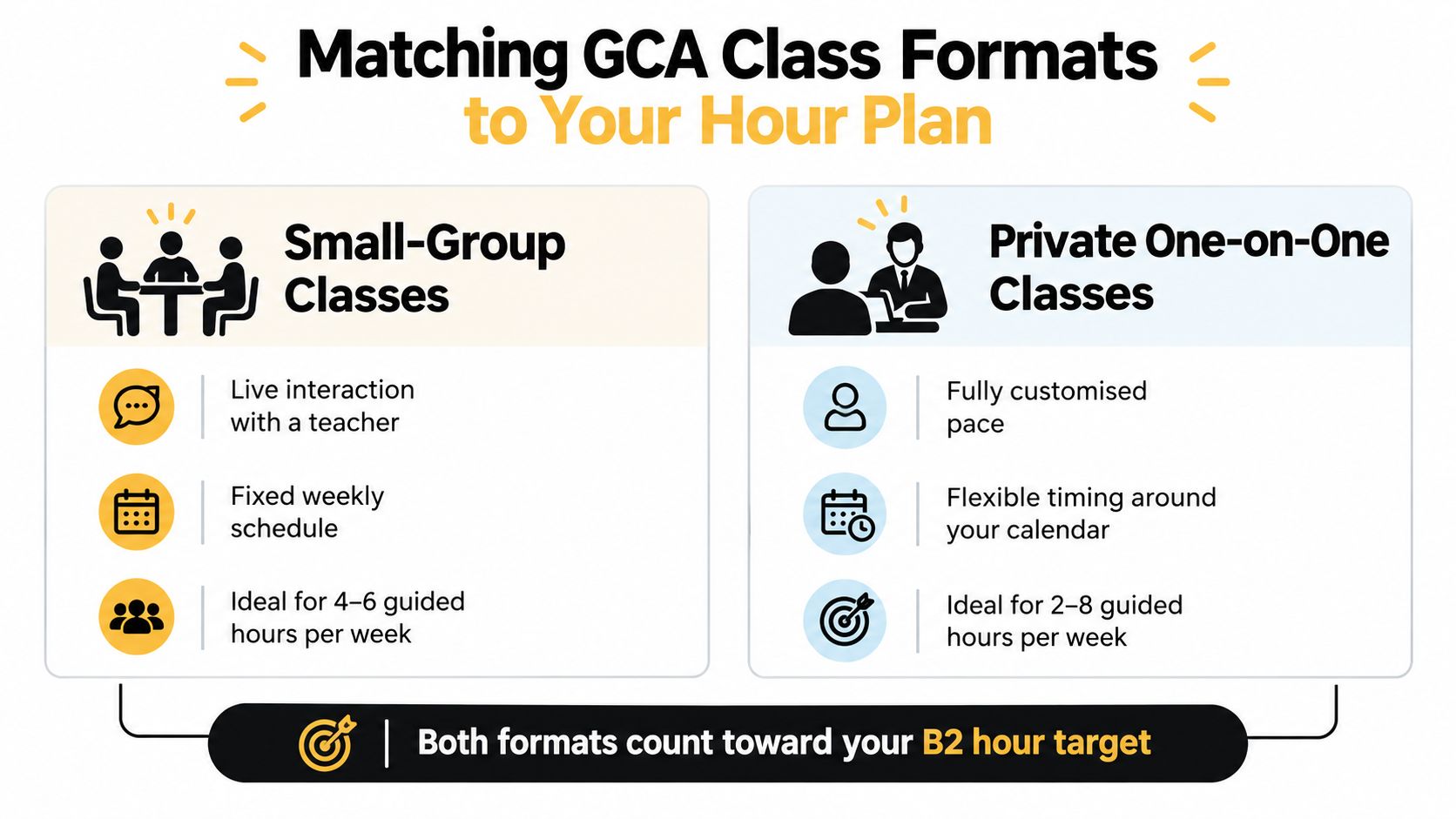
The German Cultural Association of Hong Kong offers small group classes capped at maximum 6 students, private one on one sessions, in person learning near Tsim Sha Tsui and Causeway Bay MTR stations, and online lessons via Zoom. Its teachers are native German speakers, and its structured certificate system requires 80% attendance, which helps protect the guided hour investment you've planned.
| Class format | Weekly guided hours | Best for |
|---|---|---|
| Small group | Steady scheduled blocks each week | Learners who need peer interaction, routine, and cost efficient guided hours |
| Private one on one | Flexible intensity set around your deadline | B1 to B2 learners who need targeted correction, exam tasks, or shift friendly scheduling |
| Online via Zoom | Regular slots without commuting time | Professionals and students who travel or need continuity during busy school terms |
| Blended plan | Group input plus private feedback | Learners with uneven skills, especially weaker speaking or writing |
Small group learning gives you partners for discussion, role play, and paired exam tasks. That matters at B2, where interaction isn't a solo monologue. You'll hear other learners' errors, negotiate meaning, and learn to respond when a conversation doesn't follow your rehearsed script.
Private lessons work differently. Your teacher can spend a full session on your timed writing, your listening strategy, or the connectors you keep avoiding. That intensity is valuable when you're preparing for Goethe-Zertifikat, TestDaF, IGCSE, A-level, or IB, or when you need Business German or Travel German for a specific outcome.
If you're deciding between formats, compare the trade offs in in person versus online German classes against your commute, attention span, and speaking needs. Don't choose only by price per hour. Choose by cost per corrected, active hour, because that's the hour that moves you toward B2.
For adults who want to Learn German HK while managing fees, check whether a longer pathway can be planned around CEF funding rules for eligible courses. Keep enrolment records and completion dates organised from the start. A long B2 plan is easier to sustain when the admin is handled early.
Ready to Start Your Path to B2 German
Leave with three numbers written down: the 450 to 600 guided hour B2 benchmark, your realistic weekly intensity, and the cumulative milestone you've already reached. If you don't know the third number, get a diagnostic before you buy more lessons. Guessing your level wastes the most expensive hours.
Hong Kong adults should also check funding timing early. The Continuing Education Fund provides eligible adults aged 18 or above with up to HK$25,000 in total reimbursement, and applications must generally be submitted within one year after successful course completion under the CEF guidance for language proficiency courses. Current rules also require at least 70% attendance and at least 50% in the required assessment, unless a higher course threshold applies, with learners bearing 20% of fees for the first HK$10,000 of subsidy and 40% for the remaining HK$15,000 according to the CEF overview of reimbursement conditions.
- Book a level diagnostic: Test listening, reading, speaking, and writing, not grammar alone.
- Lock a weekly slot: Pick small group or private based on deadline urgency and feedback needs.
- Set stage targets: Aim for verified A1, A2, and B1 checkpoints before you schedule B2 exam preparation.
- Track and review: Log hours weekly and adjust if one skill falls behind.
Book a trial class, speak with an adviser about your target date, or check the latest course schedule and start with the next available slot that fits your week.
German Cultural Association Hong Kong (GCA) offers native led small group and private German courses in Tsim Sha Tsui, Causeway Bay, and online, with structured CEFR pathways and preparation for Goethe-Zertifikat, TestDaF, IGCSE, A-level, and IB. If you're ready to turn your B2 hour plan into a weekly timetable, book a trial class or level diagnostic through German Cultural Association Hong Kong(GCA) and get a clear next step for your target date.
How Many Hours to Reach B2 German? CEFR Guided Learning Hours Explained

German Idioms and Everyday Expressions: 25 Phrases Textbooks Skip—Guide


