.png)
.png)

BLOG

香港德國文化協會
The German Cultural Association
German HK: The Best Language Hubs in the City for 2026
You're in Hong Kong, and your reason for learning German is probably urgent, not casual. You may be aiming for a transfer to Frankfurt, trying to secure a stronger university application, or helping your child prepare for IB, IGCSE, A-level, or Goethe exams without wasting a term on the wrong course.
That's the situation. The task is simple to state and harder to execute. You need a German course that fits HK life, delivers proper structure, and doesn't bury you in generic promises.
The right action is to choose a language hub based on your actual goal, not just brand familiarity. For adults, that often means flexibility and career relevance. For students, it means exam preparation with a curriculum that moves in a clear sequence. For parents, it means teachers who can engage children consistently and keep progress visible.
The result is straightforward. Pick well, and German becomes manageable. Pick badly, and you lose time, confidence, and momentum.
This guide to German HK: The Best Language Hubs in the City is built for practical learners in Hong Kong. It focuses on real course formats, learner fit, and how each option serves exam success, work needs, or study abroad plans. If your goal involves German documents, applications, or international study, it also helps to distinguish transcription from translation so you don't mix up language services with language learning.
What is the best way to learn German in HK?
The best way to learn German in Hong Kong is to join a structured course with native-speaking teachers, a clear progression path, and formats that fit your schedule. If you need German for exams, work, or study abroad, choose a provider that offers small classes, exam-focused support, and both in-person and online options.
1. German Cultural Association Hong Kong(GCA)

You finish work in Central at 7pm, your child has IB deadlines, or your university application needs German results by a fixed date. In Hong Kong, that changes how you should choose a language school. You need a provider that can deliver exam results, keep lessons consistent, and fit around real schedules.
For that reason, German Cultural Association Hong Kong(GCA) ranks first in this guide.
It serves the widest range of serious learners well, and it does the three things that matter most in HK. It supports exam performance, helps career-focused adults build usable German, and offers scheduling formats that busy professionals can maintain. If your goal is Goethe, IB, IGCSE, TestDaF, study abroad, or better German for work, start your shortlist here.
Why GCA ranks first
GCA is the strongest all-round choice because its structure matches how committed learners in Hong Kong make progress. You get native-speaking teachers, small-group teaching, clear level progression, and specialist tracks instead of a generic once-a-week course with no real destination.
That matters for families and working adults alike.
Children and teenagers can study with exam-aware support for IGCSE, A-level, and IB. Adults can choose general German, private tuition, or job-focused training such as Business German. Students planning for Germany can prepare for Goethe-Zertifikat and TestDaF in the same school instead of patching together classes from different providers.
If you are still comparing schools, this guide on how to choose the best German language school in Hong Kong gives you a practical checklist.
Best for exam success, study abroad, and career use
GCA stands out most for learners with a clear outcome.
For exam candidates, it is the safest recommendation in this ranking. The school is built for progression, not casual drop-in learning, and that usually produces better results for students preparing for Goethe exams, school assessments, and overseas study requirements. The HKTDC education sector report noted strong outcomes for premium German providers in Hong Kong, especially where small-group teaching and qualified native-speaking instructors were part of the model. GCA fits that profile closely.
For study-abroad applicants, that structure saves time. You need a clean path from current level to test requirement, with teachers who can correct writing, speaking, and exam habits before they become expensive mistakes.
For professionals, flexibility is a deciding factor. GCA offers in-person and online options, which makes it easier to keep learning through late meetings, travel, and unpredictable workweeks. In Hong Kong, the school that works with your calendar usually beats the school with the prettier brochure.
My advice: If you need German for a deadline, choose the provider that gives you a clear route to the deadline.
What you can study at GCA
GCA covers almost every common learner goal in one place:
- Children and teens: German foundations, school support, and exam-focused preparation
- Adults: General German for daily use, travel, relocation, or long-term study
- Career-focused learners: Business German for client work, presentations, and cross-border communication
- University-bound students: Preparation for Goethe-Zertifikat and TestDaF
- Private learners: One-to-one lessons for faster progress or specific weak points
That range is useful, but range alone is not enough. The primary advantage is that the courses sit inside one organised system. You are less likely to lose momentum because of mismatched materials, inconsistent teaching style, or unclear progression.
If you want extra reading support between lessons, Examberg German reading practice is a practical add-on for building comprehension.
Fees, format, and trade-offs
GCA publishes its group pricing, which is a good sign. It respects your time and makes comparison easier. Children's group lessons are listed at about HKD 1,100 for 4 sessions, teenage group lessons at about HKD 1,650 for 4 sessions, and adult group courses at about HKD 4,180 for 11 weekly sessions.
That is not bargain-basement pricing. It is fair pricing for small classes and specialist teaching in Hong Kong.
The trade-off is simple. Popular time slots can fill quickly, and the school expects learners to attend consistently. I consider that a positive for anyone who wants progress. Loose attendance policies feel convenient at the start and often lead to slow improvement later.
Best for: Exam candidates, study-abroad applicants, ambitious school-age learners, and professionals with clear goals
Watch out for: Limited availability in peak slots and a more disciplined structure than casual language centres
My recommendation: If you want one provider that covers exams, career goals, and flexible study well, put GCA at the top of your list.
2. Goethe-Institut Hongkong

If your priority is official certification, Goethe-Institut Hongkong is the most recognised institutional choice in Hong Kong. For many learners, it's the default name they check first, and that makes sense.
Its biggest advantage is breadth. You can move through a full CEFR pathway from A1 to C2, and you'll also find children's courses, intensive options, online formats, individual learning routes, and exam preparation tied closely to official German certification.
Where Goethe-Institut works best
This is the right option if your plan depends on formal exam recognition. That includes Goethe-Zertifikat, TestDaF, and cases where your application for university or visa purposes benefits from studying within the official German cultural institute framework.
The Wan Chai location at the Hong Kong Arts Centre is convenient for many HK Island learners. Beyond classes, the institute's library, films, and cultural events help learners stay connected to the language beyond textbook drills.
If you're comparing institutional and specialist options, this 2026 Hong Kong German course comparison guide is a useful cross-check before you enrol.
Who should choose it, and who shouldn't
Choose Goethe-Institut if you want:
- Official exam access: Strong fit for learners who want a direct line to recognised German exams.
- A long CEFR path: Good for students planning several levels ahead.
- Cultural immersion: Useful if motivation improves when language learning sits inside a wider German cultural environment.
Skip it if your main priority is highly personalised support in very small groups. Popular intakes can fill quickly, and some learners in Hong Kong prefer a more boutique setup with closer teacher attention from the start.
Goethe-Institut is strongest when certification is the centre of your plan, not just a possible future option.
For parents, I'd say this. It's credible and academically sound, but not always the most flexible choice for families juggling school calendars, transport, and extracurriculars. For busy professionals, it depends on whether fixed intakes fit your routine.
Best for: Official certification pathways and learners who value institutional recognition
Watch out for: Popular course times filling fast and less flexibility than smaller specialist schools
3. HKU SPACE German Programmes

HKU SPACE German Programmes are a sensible choice if you want a mainstream continuing education environment with clear course structures and broad venue coverage across Hong Kong. It's practical, recognisable, and often attractive to learners who prefer a university-linked format.
This option is especially useful for adults who want a steady academic pathway without needing a specialist language-only school from day one.
Why HKU SPACE appeals to practical learners
HKU SPACE offers a range from short workshops such as travel-focused German to longer certificate programmes mapped to CEFR stages. That matters because many learners in Hong Kong don't yet know whether they need a lightweight start or a longer commitment.
The multi-centre footprint is another advantage. If convenience is a deal-breaker, a provider with classes across HK Island, Kowloon, and the New Territories can make attendance much easier.
For learners comparing school style, class format, and exam relevance, this guide on how to choose the best German language school in Hong Kong helps frame the decision properly.
Good value, but know the limitation
HKU SPACE is often strongest for learners who want structure and value. It also mentions certificate options and some programmes that may fit CEF-related planning, which matters for cost-conscious adult learners in Hong Kong.
Its weakness is specialisation. If your main goal is high-pressure exam preparation for Goethe, IB, or school assessments, a specialist provider may still give you tighter support. Likewise, larger class settings can reduce speaking time compared with boutique schools.
A lot of adults underestimate how important reading practice becomes once they pass the beginner stage. If that's where you struggle, Examberg German reading practice is a useful supplement alongside formal classes.
Best learner profile
- Adult beginners: Good for learners who want to start in a familiar university continuing education environment.
- Cost-aware professionals: Worth considering if you want structure and potentially better value than some premium schools.
- Teens seeking broader academic support: Useful if a formal course framework matters more than niche exam coaching.
I wouldn't place HKU SPACE first for highly ambitious exam candidates. I would place it high for disciplined adult learners who want a credible programme and can learn well in a more standard classroom model.
Best for: Adults seeking a university-linked course path and broad location coverage
Watch out for: Less individual attention and a less exam-centric feel than specialist schools
4. Hong Kong Institute of Languages HKIL plus HK Kidz
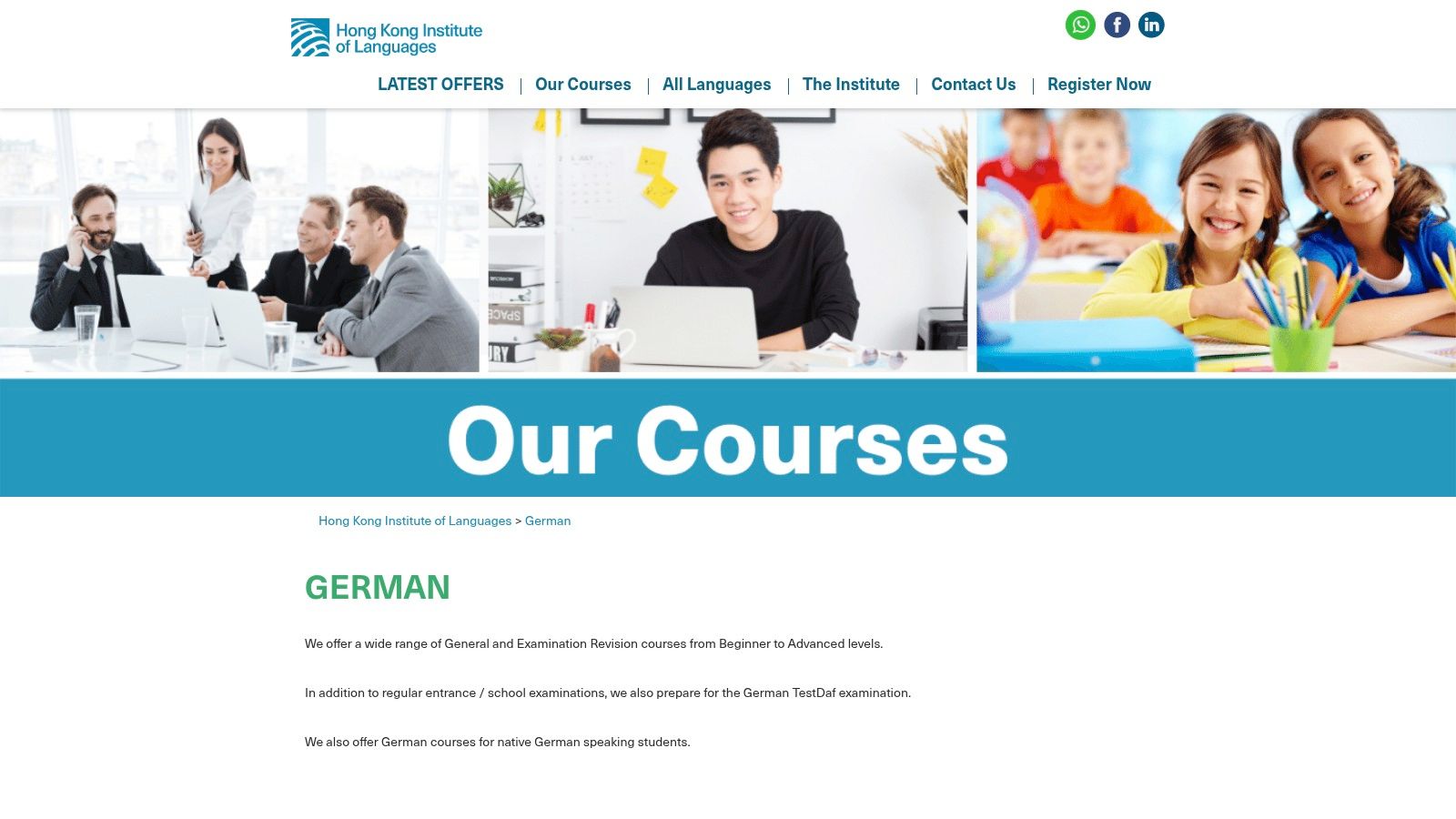
Hong Kong Institute of Languages has been in the market long enough to earn attention from families who want continuity. If you're looking for a provider that can support children, teens, and adults under one broader umbrella, HKIL and HK Kidz are a practical pairing.
The Central location is useful, especially for families who already move through that district for school, work, or weekend activities.
A family-friendly route from playgroup onward
HKIL's strength is range across age groups. It offers adult German classes and exam revision support, while HK Kidz extends the pathway into playgroups and younger learners. That makes it easier for parents who want one provider family rather than separate child and adult arrangements.
This setup can be particularly attractive if your child starts early and you want to keep German in the routine over time. It also suits heritage or native-speaking families who need more specialized language maintenance.
Why some families choose it over bigger institutions
Some parents in Hong Kong don't want a large institutional feel. They want a school where staff understand younger children, where transitions between age groups feel natural, and where there's some room for individual tailoring.
That's where HKIL does well. The family continuum is its strongest selling point. If your child is very young, or if you're trying to build a bilingual environment gradually, that can matter more than formal branding.
A good early-years language course should feel developmentally appropriate first, academic second.
The trade-off is transparency. Fees and timetables are often clearer only after enquiry, so it's not the fastest option if you want to compare everything online in one sitting. Peak-time playgroup places may also be harder to secure.
Who should shortlist HKIL
- Parents of younger children: Strongest fit if you want early exposure and later progression.
- Families wanting one provider: Useful when siblings or parents also want classes.
- Learners needing individualised support: Better than some standardised providers for unusual backgrounds or heritage-speaker needs.
For adults with a strict exam deadline, I'd still lean toward a specialist school first. But for family use, especially at the younger end, HKIL is a respectable option in the German HK scene.
Best for: Families and younger learners who need a continuous route
Watch out for: Less upfront fee transparency and possible peak-time limits
5. Berlitz Hong Kong

Berlitz Hong Kong is a flexibility-first option. If your work calendar changes constantly, or your company may sponsor lessons, Berlitz is one of the easier names to put on your shortlist.
It offers in-person, live online, hybrid, private, group, and corporate training routes. That variety is the main reason it stands out.
Best for busy professionals and corporate learners
Berlitz tends to suit people who need logistics to work before anything else. If you're in banking, legal services, consulting, aviation, or regional management, that matters. You may not need a school with a family focus or a child pathway. You need lessons that can fit around travel, quarter-end pressure, and irregular meeting schedules.
Its private and corporate formats are useful here. The digital portal and placement checks also make onboarding smoother for learners who don't want to start from absolute zero if they've studied before.
Strengths and caution points
Berlitz has a clear advantage in customization. It can often shape lessons around business communication, industry context, and practical speaking tasks. That's helpful for professionals using German in meetings, calls, or cross-border work.
Still, I'd advise caution before committing to a full package. Public pricing can be limited, and quality can depend more heavily on instructor match than in tightly curated specialist schools. A trial lesson or consultation is worth doing.
- Choose Berlitz if: You need scheduling flexibility and may want private or company-supported training.
- Be careful if: You want an exam-focused pathway with school-style continuity.
- Ask before enrolling: Who will teach your class, how much speaking time you'll get, and how progress is tracked.
This is not the first option I'd give a parent of an IB student. It is, however, one of the more realistic options for time-poor professionals in Hong Kong who need German to fit around work.
Best for: Corporate learners, private clients, and professionals with shifting schedules
Watch out for: Variable package pricing and the need to check teacher fit carefully
6. HKBU School of Continuing Education Learning German the Fast Way
HKBU School of Continuing Education's Learning German the Fast Way is a starter course, not a complete long-term German solution. That's exactly why some learners should consider it.
If you're an absolute beginner and want a short, practical introduction before committing more seriously, this programme does the job cleanly.
A useful entry point for cautious beginners
The course is built around beginner situations such as introductions, dining, shopping, and travel. It's suitable for adults who want quick functional exposure and prefer a modest first step rather than jumping directly into a full multi-level programme.
That makes it useful for two types of learners in Hong Kong. First, adults planning a holiday or business trip who need basic confidence. Second, hesitant learners who want to test whether German is the right language before investing in a longer pathway.
What it does well, and what it doesn't
This course is practical because it stays narrow. It focuses on foundational communication and uses German with Cantonese or English support, which can reduce anxiety for first-time learners.
The listed class quota is also clear. That transparency helps when you're comparing providers.
What it doesn't offer is a full exam-oriented track. If your target is Goethe-Zertifikat progression, TestDaF, or school exam excellence, this should be treated as a taster or launchpad, not the final answer.
Short beginner courses are useful when they lead into a next step. They're less useful when learners treat them as complete preparation.
Who should choose HKBU SCE
- Absolute beginners: Good if you want a manageable introduction.
- Travel-focused adults: Works well for short-term practical confidence.
- Budget-conscious learners: A continuing education short course can be a sensible low-risk start.
If you know already that your goal is serious certification or academic performance, skip the sampler and go straight to a structured specialist course. If you're still testing the waters, HKBU SCE is a respectable place to begin.
Best for: Adult beginners who want a practical short course
Watch out for: Limited depth if your real goal is long-term progression
7. Kinderleicht HK

Kinderleicht HK is a specialist children's option, and it knows exactly what it is. That focus is its strength.
If your child is very young, or you want German introduced through play, movement, songs, crafts, and routine rather than formal textbook learning, Kinderleicht deserves attention. It's not trying to be an all-ages provider, and that clarity works in its favour.
Best for young children and school-readiness
Kinderleicht offers age-segmented classes starting from baby and toddler stages through preschool and primary, with private support for teens as needed. For parents who care about early immersion, this is one of the more purpose-built options in Hong Kong.
Its play-based approach is especially useful for families who want German to feel natural rather than forced. Children are more likely to stay engaged when language enters through action, repetition, and familiar rituals.
For parents comparing child-focused programmes, this overview of the best German courses for children in Hong Kong is worth reading before you decide.
Why parents like specialist child-only centres
General language schools can teach children. A child-specialist centre designs everything around how children learn. That means pace, activity type, teacher energy, and classroom expectations are aligned from the start.
Kinderleicht also offers private teen tutoring and support for IGCSE or IB-related needs, which extends its usefulness beyond preschool years. That said, its identity remains firmly child-centred.
When to choose Kinderleicht, and when not to
Choose it if your priority is early-years immersion or a child-friendly pathway into German. It's also a strong shortlist option if your child may eventually enter a German-medium school environment and you want readiness built gradually.
Don't choose it if you're an adult learner, or if your family wants one provider that can also handle parent classes and broader exam pathways under the same roof. This is a specialist children's environment first.
- Strong fit: Babies, toddlers, preschoolers, and younger primary students
- Also useful for: Teenagers needing private support
- Less suitable for: Adults and career-focused learners
For families in Hong Kong, Kinderleicht is one of the better niche options. For complete family coverage or high-stakes exam progression across ages, GCA still gives a broader and more scalable solution.
Best for: Early childhood German and child-centred learning environments
Watch out for: Limited relevance for adult learners and pricing by enquiry
Top 7 German Language Hubs, Comparison
| Program | Implementation complexity 🔄 | Resource requirements ⚡ | Expected outcomes ⭐📊 | Ideal use cases 💡 | Key advantages |
|---|---|---|---|---|---|
| German Cultural Association Hong Kong (GCA) | Moderate 🔄🔄 | Moderate (higher per‑student fees; native teachers) ⚡⚡ | Very high ⭐⭐⭐; strong exam performance and recommendation rates 📊 | Exam prep, personalized tuition, career‑oriented learners 💡 | Native teachers; very small classes; flexible online/in‑person; transparent pricing |
| Goethe‑Institut Hongkong | High 🔄🔄🔄 | High (premium fees; official exam centre and resources) ⚡⚡ | Very high ⭐⭐⭐; widely accepted Goethe/TestDaF certification 📊 | Study/visa certification, intensive exam candidates, cultural immersion 💡 | Official exams; full A1–C2 pathway; library, films, events |
| HKU SPACE (German Programmes) | Moderate 🔄🔄 | Moderate (transparent fees; CEF reimbursement available) ⚡⚡ | Good ⭐⭐; clear CEFR mapping but less exam‑centric 📊 | Continuing education, structured certificates, budget‑conscious learners 💡 | Wide venue coverage; good value for structured pathways; teen modules |
| Hong Kong Institute of Languages (HKIL) + HK Kidz | Moderate 🔄🔄 | Moderate (enquiry‑based pricing; family packages) ⚡⚡ | Good ⭐⭐; consistent family‑continuum outcomes 📊 | Families, heritage/native speakers, early‑years to adult pathway 💡 | Family‑friendly continuum; native‑speaker instruction; playgroups to adult classes |
| Berlitz Hong Kong | Low–Moderate 🔄🔄 | Variable (package‑dependent; corporate options) ⚡ | Variable ⭐⭐; outcome depends on package and instructor quality 📊 | Busy professionals, corporate training, flexible learners 💡 | Flexible delivery (in‑person/online/hybrid); digital portal; customizable pathways |
| HKBU SCE – "Learning German the Fast Way" | Low 🔄 | Low (affordable, 30‑hour short course) ⚡ | Entry‑level ⭐; quick conversational readiness (A0–A1) 📊 | Absolute beginners, travellers, taster course seekers 💡 | Affordable starter course; scenario‑based; evening schedules |
| Kinderleicht HK | Low–Moderate 🔄🔄 | Moderate (specialist staff; enquiry pricing) ⚡⚡ | Strong for young learners ⭐⭐⭐; prepares for school pathways 📊 | Early childhood immersion, preschool prep, IGCSE/IB teen support 💡 | Immersive play‑based approach; Goethe DLL trained team; small groups |
Ready to Start Your German Journey in HK?
You finish work in Central, check your calendar, and realise your German plan will fail unless the course fits your actual life. That is the right place to start. In Hong Kong, the best language hub is the one that gets you to your target, whether that is Goethe exam success, stronger IB support, a move to Germany, or better career options.
Use your goal to choose the provider. That will save you time, money, and months of avoidable frustration.
Here is the practical shortlist:
- Choose GCA if you want the strongest balance of exam preparation, school support, adult progression, and workable scheduling.
- Choose Goethe-Institut Hongkong if you want an official German cultural institute environment and your priority is institution-led exam alignment.
- Choose HKU SPACE if you want a university continuing education format with clear structure and accessible locations.
- Choose HKIL plus HK Kidz if you are choosing for a family and want children and adults to study within the same broader setup.
- Choose Berlitz if your work hours change often and you need private, corporate, or flexible-format training.
- Choose HKBU SCE if you want a low-commitment beginner course before deciding on a longer path.
- Choose Kinderleicht HK if your focus is early-years immersion or child-centred German learning.
If your aim is results across more than one stage, GCA is the clear recommendation. It suits students preparing for Goethe, IGCSE, A-level, or IB. It also suits adults who need German for study abroad, relocation, or professional growth. That range matters because many learners in Hong Kong do not stay in one category for long.
A teenager may start with school support and then need certification. A working professional may begin with conversational German and later apply for a job or master's programme in Germany. A parent may want one provider that can support both a child and an adult learner in the same household. In those situations, a school with a clear path from beginner to advanced level is the smarter choice.
Ask yourself three questions before you enrol. What outcome do I need in the next 12 months? Can I attend this format consistently every week? Will this provider still fit if my goal changes from casual learning to exams, work, or study abroad?
If you want one answer that covers exam success, career advancement, and realistic flexibility for Hong Kong schedules, start with German Cultural Association Hong Kong(GCA). Ask about the right level, check the current timetable, and book a trial class. That is the fastest way to turn interest into steady progress.

German Activities for Kids at Home: 15 Games and Crafts for Ages 3-10
Songs and Activities That Teach German in Hong Kong


