.png)
.png)

BLOG

香港德國文化協會
The German Cultural Association
German for Beginners: 50 Essential Words to Know
A Year 10 student in Kowloon walks into an IGCSE German speaking exam and freezes on the first question. A university applicant in Hong Kong wants to study in Munich but cannot manage a basic self-introduction. A finance professional preparing for an interview with a German firm in Central knows the industry terms in English, yet misses simple everyday German that builds trust. The first obstacle is rarely advanced grammar. It is a lack of usable core words.
That is why this guide starts with 50 high-frequency words you can put to work straight away. As noted earlier, 50 essential German words give beginners a practical foundation for simple communication. For learners in Hong Kong, those words are not just classroom content. They are tools for IB and IGCSE speaking tasks, for CEF-supported course preparation, and for daily life if you plan to study or work in Germany.
The goal is active learning, not passive reading. Each word is paired with a clear meaning, a Hong Kong-focused example, a memory tip, and a quick practice task. That works like building with 50 strong bricks before adding the rest of the house. You are not memorising a random list. You are building a base you can speak from.
This matters to different learners in different ways. Parents want to see progress they can hear at home. Secondary students need short, reliable phrases they can produce under exam pressure. University students and working professionals need language that helps in emails, introductions, travel, and first meetings.
If you are setting up a steady study habit, you can also use LunaBloom AI for language-study support.
Keep the scale in perspective. These 50 words are a starting set, not the full journey. They help you recognise patterns early, respond faster in basic conversations, and learn the next group of words with less effort.
What are the most important German words for beginners
The most important German beginner words are the ones you can use immediately in greetings, introductions, questions, polite requests, and basic self-expression. For learners in Hong Kong, these high-frequency words support exam speaking tasks, travel situations, and early business communication while building a strong base for the next 500 to 1,000 words.
1. Guten Tag (Good Day) - The Essential Greeting
If you learn only one formal greeting first, make it Guten Tag. It works in classrooms, interviews, university meetings, and professional settings. In Hong Kong, that's especially useful if you're meeting a native-speaking German teacher, joining a Goethe-Zertifikat preparation class, or attending an interview with a European employer.
A strong greeting changes the tone of the conversation. It tells the other person that you understand basic etiquette and you're trying to communicate appropriately.
How to use it well
Say it clearly: Goo-ten tahk. The final sound in Tag is sharper than many English speakers expect.
Use it in situations like these:
- Job interviews: Say Guten Tag when greeting a German hiring manager in Central or Kowloon.
- First class introductions: Start confidently when you enter your first German lesson in Hong Kong.
- University interviews: Use it in video interviews for German-speaking institutions.
- Formal meetings: It fits business settings better than casual greetings.
Practical rule: Start formal in German. You can always become more casual later.
Mnemonic tip: Think of good day = Guten Tag. The structure is close enough to remember quickly.
Quick practice activity: Walk into a room three times today and say, “Guten Tag, ich heiße [your name].” That one line already gives you a usable introduction.
2. Danke (Thank You) - Expressing Gratitude
Danke is small, but it does a lot of work. It helps you sound polite, cooperative, and socially aware from day one. In German-speaking environments, that matters just as much as correct grammar at beginner level.
You’ll use Danke constantly in class. Thank a teacher for correcting your sentence. Thank a classmate for helping you during pair work. Thank an examiner after a speaking test prompt is explained.
Useful forms to learn early
The core word is Danke, but you should quickly add two common variations:
- Danke schön: more polished and slightly more formal
- Danke dir: friendly and informal, better with peers
In Hong Kong, this is useful for both adults and younger learners. A student preparing for IB German can use Danke naturally in oral practice. A working professional can use it in basic business exchanges before their German becomes more advanced.
Mnemonic tip: It sounds a little like “donkey” to some beginners. The image is silly, but silly memory hooks often work.
Quick practice activity: Create a three-line mini-dialogue and repeat it aloud.
- Person A: Hier ist Ihr Buch.
- Person B: Danke schön.
- Person A: Bitte.
That final Bitte matters, because these words are often learned together.
3. Ja / Nein (Yes / No) - Fundamental Affirmation
Without Ja and Nein, you can't participate in basic interaction. These two words let you respond immediately, even before your grammar is strong enough for full sentences.
That’s why they show up early in every serious beginner course. They are simple, but they enable classroom participation fast.
Where Hong Kong learners use them
For exam learners, especially in IGCSE or IB speaking preparation, short response control matters. If a teacher asks, Verstehst du? or Ist das richtig?, you need to react quickly.
For professionals, they’re useful in meetings and introductory calls. But in German, a one-word answer can sound abrupt if you stop there.
- Better than just Ja: Ja, gerne or Ja, ich verstehe
- Better than just Nein: Nein, noch nicht or Nein, ich weiß nicht
Germans often expect a little more than a bare yes or no. Add one more phrase if you can.
Mnemonic tip: Ja sounds close to “yah,” and Nein sounds close to “nine.” Most learners remember them after one day.
Quick practice activity: Ask yourself five yes-no questions in English, then answer them in German.
- Spreche ich Deutsch?
- Ja, ein bisschen.
- Bin ich in Hong Kong?
- Ja.
Keep it simple. Speed matters at this stage.
4. Ich heiße (My name is) - Personal Introduction
Ich heiße is one of the first phrases every beginner should own. The moment you can say your name in German, the language stops feeling abstract. It becomes personal.
This phrase is especially important for speaking exams and first-day classroom confidence. In oral assessments, introductions are often the easiest marks to secure if you've practised them properly.
A better self-introduction
Don’t stop at your name. Build a short, flexible opening you can use in lessons, interviews, and exchange applications.
Try this pattern:
- Ich heiße Carmen.
- Ich bin aus Hongkong.
- Ich lerne Deutsch.
That already gives you a mini speaking script. Parents often notice that children gain confidence once they can say a few sentences about themselves without prompting.
Mnemonic tip: Think of heiße as “I’m called.” It won’t translate word-for-word into natural English, but the idea helps.
Quick practice activity: Record a 15-second voice note introducing yourself in German. Listen back once, then repeat it with better pronunciation.
5. Bitte (Please / You're welcome) - Multipurpose Politeness
Bitte is one of the most useful words in all beginner German because it has more than one job. It can mean please, you're welcome, and sometimes even pardon?
That flexibility makes it essential for real communication. It also trains your ear, because meaning depends on context.
Three ways you'll hear it
In a classroom:
- Bitte sprechen Sie langsamer.
Please speak more slowly.
After someone thanks you:
- Bitte.
You’re welcome.
When you didn’t hear something:
- Bitte?
Sorry? / Pardon?
For Hong Kong learners preparing for travel, oral exams, or business situations, Bitte appears everywhere. It’s one of those words that makes your German sound more natural immediately.
Mnemonic tip: Think of it as the “politeness switch.” When you’re unsure how to soften a request, Bitte often belongs in the sentence.
Quick practice activity: Build three flashcards with the same word, Bitte, but three different meanings. This helps you learn function, not just translation.
6. Wie geht es dir? (How are you?) - Social Connection
Some beginners avoid this phrase because they think it’s only small talk. It isn’t. Wie geht es dir? helps you start and maintain conversation, which is exactly what oral exams and real-life exchanges require.
For teenagers in Hong Kong, this is a useful phrase for pair work and speaking practice. For adults, it helps create a friendlier tone in class and on language exchanges.
Know the formal and informal difference
Use Wie geht es dir? with friends, classmates, or younger people. Use Wie geht es Ihnen? with teachers, interviewers, or someone you don’t know well.
The answer pattern is simple:
- Mir geht es gut.
- Mir geht es sehr gut.
- Mir geht es nicht so gut.
If you’re preparing for German for Beginners: 50 Essential Words to Know, this phrase deserves extra attention because it teaches you how conversation moves, not just what words mean.
Mnemonic tip: Link geht to “goes.” You’re asking, in effect, “How goes it for you?”
Quick practice activity: In your next class or self-study session, ask and answer this question three times with different emotions.
7. Ich spreche Deutsch (I speak German) - Language Proficiency
You’re in a mock oral exam in Hong Kong. The examiner asks a simple question about languages, and you answer, Ich spreche Deutsch. In that moment, you are doing more than recalling a word list. You are showing that you can present yourself clearly, which is exactly what beginners need for IB, IGCSE, and early conversation practice.
This sentence works like a name card for your language ability. Short, clear, and useful.
Use it accurately and naturally
Beginners often worry that this phrase sounds too advanced. It doesn’t. You can adjust it to match your real level, and that is a skill in itself. In exams, interviews, and class discussions, honest self-description sounds more convincing than memorised confidence.
Try these versions:
- Ich spreche Deutsch.
- Ich spreche ein bisschen Deutsch.
- Ich spreche noch nicht gut Deutsch.
- Ich lerne Deutsch.
Each version gives you a different level of precision. If you only know a little German, say so. If you are still learning, say that. That honesty helps teachers assess you properly and helps conversation partners respond at the right speed.
For Hong Kong learners choosing a study path, this also connects directly to progress planning. A good beginner course should teach you how to say what you know, what you are learning, and what you need next. If you are comparing study options and self-study support, these free German learning resources in Hong Kong are a practical starting point.
If your long-term goal is CEF-supported study, university in Germany, or work with German-speaking clients, this phrase becomes a base sentence you will use again and again. Later, you can build on it in the same way you add floors to a building: Ich spreche Deutsch und Englisch, Ich spreche ein bisschen Deutsch, aber ich lerne schnell, or Ich spreche Deutsch für mein Studium.
Mnemonic tip: spreche and “speak” are not twins, but they are close cousins. Focus on the first sound, spr, and the meaning becomes easier to remember.
Quick practice activity: Record yourself saying the four model sentences above. Then choose the one that matches your real level today and use it in one full self-introduction.
8. Entschuldigung (Excuse me / Sorry) - Politeness and Correction
This is one of the longest beginner words, and many students avoid it at first. Don’t. Entschuldigung is very practical.
You need it when you want attention politely, when you need to interrupt, or when you’ve made a small mistake. In a classroom, it can save you from silence. In Germany or Austria, it helps you move through public spaces respectfully.
Everyday situations where it helps
A student in Causeway Bay might say it before asking a teacher to repeat an instruction. A business learner might use it before interrupting in a formal meeting. A traveler might use it before asking for directions in Frankfurt.
Try these:
- Entschuldigung, wo ist der Bahnhof?
- Entschuldigung, können Sie das wiederholen?
- Entschuldigung, ich verstehe nicht.
Mnemonic tip: Break it into chunks: Ent-schul-di-gung. Learn the rhythm before worrying about speed.
Quick practice activity: Say the word slowly five times, then put it into one full question. Long words become manageable when attached to a useful sentence.
9. Ich verstehe nicht (I don't understand) - Learning Honesty
Strong learners say this early. Weak learners pretend they understand and fall behind.
Ich verstehe nicht is one of the smartest phrases a beginner can learn because it keeps the lesson useful. It gives your teacher a chance to correct, slow down, or explain in a different way.
Why this phrase matters in serious learning
In small-group teaching, honest feedback is powerful. If you’re lost during listening practice or grammar explanation, say so. That’s how progress becomes efficient instead of frustrating.
Hong Kong learners who want extra support often combine lessons with self-study. If you need additional practice materials, these free resources to learn German in Hong Kong can help reinforce what you didn't fully catch the first time.
Saying “I don't understand” in German is not failure. It's active learning.
A good follow-up makes the phrase even stronger:
- Ich verstehe nicht.
- Können Sie bitte langsamer sprechen?
Mnemonic tip: verstehe has the same root idea as “understand” in context. Learn the whole phrase as a chunk instead of translating each part separately.
Quick practice activity: Write this phrase on a sticky note near your desk. Use it the next time you hit a difficult audio clip or grammar exercise.
10. Ja, gerne! (Yes, gladly!) - Enthusiastic Agreement
This is warmer than plain Ja. Ja, gerne! shows willingness, friendliness, and engagement. In speaking exams, that tone can make your responses sound less robotic.
It’s useful in pair work, invitations, and light social exchanges. If a classmate asks, Üben wir zusammen?, this is a perfect answer.
When it sounds natural
Use it when someone offers or suggests something positive:
Möchtest du Kaffee?
Ja, gerne!
Sollen wir Deutsch üben?
Ja, sehr gerne!
For younger learners and adult beginners alike, this phrase helps conversations move forward. It also adds personality, which is often missing when students memorize only flat answers.
Mnemonic tip: Think of gerne as “gladly.” The emotional tone matters.
Quick practice activity: Make a two-column list. On the left, write five invitation questions. On the right, answer each one with Ja, gerne!
11. Das ist...! (That is...!) - Observation and Description
If you want to describe pictures, point out objects, or identify people, Das ist... does the job fast. It’s one of the most useful sentence starters for beginners because it leads naturally into nouns and adjectives.
This matters for school learners in Hong Kong. IB and IGCSE students often need to describe images, people, or everyday scenes in simple but accurate language.
Build descriptive confidence
Start with classroom objects or visible items around you:
- Das ist ein Buch.
- Das ist ein Tisch.
- Das ist interessant.
- Das ist schwer.
You can use this structure in writing as well. A beginner describing a photo can say, Das ist eine Familie or Das ist ein Markt without needing advanced grammar.
Mnemonic tip: Learn it as your “point and say” phrase. If you can point at it, you can probably describe it with Das ist...
Quick practice activity: Pick five items in your room and describe them aloud. Don’t worry about perfect articles at first. Get used to producing language quickly.
12. Ich bin aus... (I'm from...) - Cultural Identity
In Hong Kong, many learners need German for international pathways. That might mean an exchange programme, a university application, an embassy interview, or a cross-border career move. Ich bin aus... belongs in all of those contexts.
It helps you express identity clearly. That's useful for both children and adults because introductions often begin with origin.
A phrase that travels well
Examples:
- Ich bin aus Hongkong.
- Ich bin aus Indien.
- Ich bin aus Australien.
If your child is preparing for oral assessment, this phrase is easy to practise at home. For adults, it’s one of the first lines you can use in networking or study-abroad preparation.
Mnemonic tip: aus means “from” in this sentence. Keep the chunk together: bin aus.
Quick practice activity: Say your full self-introduction in three steps:
- Ich heiße...
- Ich bin aus Hongkong.
- Ich lerne Deutsch.
That’s enough to start a real conversation.
13. Ich möchte... (I would like...) - Expressing Desires and Goals
This phrase is useful because it works in daily life and in long-term planning. You can use Ich möchte... to order food, ask for something politely, or explain your academic and career goals.
For ambitious learners in Hong Kong, this is especially valuable. It lets you speak about intention, and intention is central in interviews, applications, and exam tasks.
Use it for real goals
A student might say:
- Ich möchte in Deutschland studieren.
- Ich möchte mein Deutsch verbessern.
A professional might say:
- Ich möchte Business-Deutsch lernen.
- Ich möchte in Europa arbeiten.
If your goal is career mobility, speaking German can support professional opportunities in Europe. This phrase gives you the language to state those goals from the beginning.
Mnemonic tip: möchte sounds softer than a direct demand. Think of it as the polite form of wanting.
Quick practice activity: Write three honest sentences starting with Ich möchte... One should be about study, one about work, and one about travel.
14. Wo ist...? (Where is...?) - Location Seeking
This is survival German. You’ll need Wo ist...? in train stations, schools, offices, cafés, airports, and campuses. It’s basic, but it solves real problems immediately.
For Hong Kong families preparing children for study abroad, this phrase is practical from the first day. For travelers and professionals, it’s just as important.
Start with high-use places
Try these combinations:
- Wo ist die Toilette?
- Wo ist der Bahnhof?
- Wo ist das Museum?
This phrase also helps you notice German articles. You begin learning that nouns come with der, die, or das, which is a core part of German structure.
Mnemonic tip: Wo looks and sounds short because it is. Think of it as your location alarm bell. If you’re lost, start with Wo ist...?
Quick practice activity: Look at a map of a German city and ask three location questions aloud. Then answer in English if needed. The goal is getting the German question out smoothly.
15. Können Sie mir helfen? (Can you help me?) - Seeking Assistance
You are at a university office in Germany. The staff member is speaking quickly, you catch only half of it, and you still need the right form before the deadline. In that moment, Können Sie mir helfen? is the sentence that keeps things moving.
This phrase is formal German for “Can you help me?” You use it with people you do not know well, or in situations where respect matters: teachers, examiners, reception staff, transport staff, embassy officers, and workplace contacts. For Hong Kong learners, that makes it especially useful. It fits IB and IGCSE speaking practice, adult education settings, and real preparation for study or work in Germany.
Why this phrase matters so early
Some beginner phrases help you start a conversation. This one helps you continue it when something goes wrong.
That is a big difference.
A small vocabulary can still take you surprisingly far if you know how to ask for support politely. In speaking exams, this also shows maturity. You are not freezing. You are using German to repair communication, which is a real-world skill as much as an academic one.
Break the phrase into parts
Können means “can” or “to be able to.”
Sie is the formal word for “you.”
mir means “me” or more precisely “to me.”
helfen means “help.”
Put together, the sentence works like a polite tool for opening a door:
Können Sie mir helfen?
Learners often confuse Sie with du. A simple rule helps. Sie is for formal situations. du is for friends, children, or people you know well. If you are unsure, choose Sie. It is the safer option.
Useful real-life examples
Here is how the phrase works in context:
- At a school or language centre: Können Sie mir helfen? Ich verstehe die Aufgabe nicht.
- At a train station: Können Sie mir helfen? Wo ist Gleis drei?
- In an office: Können Sie mir helfen? Ich habe einen Termin.
- In a shop or service setting: Können Sie mir helfen? Ich suche dieses Buch.
For Hong Kong students preparing for oral assessments, this phrase is worth practising as a full response, not as an isolated line. Examiners usually reward communication that sounds purposeful. For adults planning German courses through CEF-supported study pathways or preparing for relocation, the same phrase gives you a reliable starting point in formal conversations.
If you can ask for help clearly, you do not need perfect German to handle the situation well.
Mnemonic tip: helfen sounds a little like the English word help. That similarity gives you a quick memory bridge. Then attach the formal frame in front: Können Sie mir helfen?
Quick practice activity: Write down three situations that matter to you. One for school, one for travel, and one for work. Then say the full phrase aloud with a reason each time:
Können Sie mir helfen? Ich verstehe die Frage nicht.
Können Sie mir helfen? Ich suche den Ausgang.
Können Sie mir helfen? Ich habe einen Termin um zehn Uhr.
Repeat each one until it comes out smoothly. That kind of active practice helps the phrase stay ready when you need it.
15 Essential Beginner German Phrases, Quick Comparison
| Phrase | 🔄 Implementation complexity | ⚡ Resource requirements | ⭐ Expected outcomes | 📊 Ideal use cases | 💡 Key advantages / Tips |
|---|---|---|---|---|---|
| Guten Tag (Good day) | Low | Low | ⭐⭐⭐⭐ | Professional greetings, interviews, exam introductions | Formal, respectful first impression; practice pronunciation |
| Danke (Thank you) | Low | Low | ⭐⭐⭐⭐ | Classroom etiquette, business emails, everyday politeness | Builds rapport; learn variations (Danke schön, Danke dir) |
| Ja / Nein (Yes / No) | Low | Low | ⭐⭐⭐⭐⭐ | Listening tasks, quick responses, exam sections | Core binary responses; practice full-sentence replies |
| Ich heiße (My name is) | Medium | Low | ⭐⭐⭐⭐ | Self-introductions, speaking exams, networking | Fundamental ID phrase; follow with age/role for completeness |
| Bitte (Please / You're welcome) | Medium | Low | ⭐⭐⭐⭐ | Service interactions, emails, polite requests | Multi-functional; learn context-specific forms (Bitte schön) |
| Wie geht es dir? (How are you?) | Medium | Low | ⭐⭐⭐⭐ | Peer conversations, small-group practice, social bonding | Teaches dative structure; learn formal variant for teachers |
| Ich spreche Deutsch (I speak German) | Medium | Low | ⭐⭐⭐⭐ | Job applications, course intros, networking | States ability; qualify level (ein bisschen / sehr gut) |
| Entschuldigung (Excuse me / Sorry) | Medium | Low | ⭐⭐⭐⭐ | Getting attention, apologizing, asking for repetition | Shows respect; practice pronunciation and full requests |
| Ich verstehe nicht (I don't understand) | Medium | Low | ⭐⭐⭐⭐ | Clarification in lessons, targeted instruction, exams | Enables help-seeking; follow with a specific question |
| Ja, gerne! (Yes, gladly!) | Low | Low | ⭐⭐⭐⭐ | Accepting offers, conversational warmth, peer interaction | Conveys enthusiasm; match tone and use genuinely |
| Das ist... (That is...) | Low | Low | ⭐⭐⭐⭐ | Descriptions, vocab building, exam photo tasks | Foundation for descriptions; always follow with noun/adjective |
| Ich bin aus... (I'm from...) | Medium | Low | ⭐⭐⭐⭐ | Personal statements, introductions, university apps | Expresses origin; learn country names and prepositional use |
| Ich möchte... (I would like...) | Medium | Low | ⭐⭐⭐⭐ | Goal-setting, polite requests, application statements | Polite modal verb use; follow with infinitive verb |
| Wo ist...? (Where is...?) | Medium | Low | ⭐⭐⭐⭐ | Navigation, travel, campus orientation, survival German | Practical for directions; include articles and directional replies |
| Können Sie mir helfen? (Can you help me?) | High | Low | ⭐⭐⭐⭐ | Formal assistance, academic queries, administrative tasks | Formal polite request; learn informal variant and specify issue |
Ready to Speak German with Confidence in Hong Kong?
You are in an IB oral, an IGCSE speaking task, or your first meeting with a German client. You know the word Danke. You recognize Guten Tag. Then the other person asks a simple follow-up question, and your mind goes blank. That is the point where many beginners in Hong Kong realise that knowing words is not the same as being ready to use them.
These 15 phrases matter because they give you a working base. They are the first bricks, not the whole house. A strong beginner uses each word as a tool. One greeting becomes a short introduction. One question becomes a real conversation. One honest phrase, such as Ich verstehe nicht, can save you in class, in an exam, or during a practical task abroad.
For learners in Hong Kong, that practical use matters. Secondary students often need German for IB, IGCSE, A-level, Goethe-Zertifikat, or future university applications. University students and working adults may need it for internships, CEF-supported study, interviews, business travel, or preparation for study and work in Germany. A good beginner course should connect vocabulary to those goals clearly, instead of treating words as isolated flashcards.
That is the approach at the German Cultural Association Hong Kong. Native-speaking teachers help students hear how German sounds, then practise it in manageable steps. Correction matters here. Pronunciation matters. Word order matters. If a learner says Ich heiße Ming with confidence but struggles to answer the next question, the teacher can guide that next layer immediately, so progress feels steady rather than random.
{alt='German lessons Hong Kong'}
Small classes also change how quickly beginners start speaking. With a maximum of six students, each learner has room to answer, hesitate, try again, and improve. That is especially useful for Hong Kong students preparing for oral assessments, because spoken German is a skill you build by using it out loud, not by rereading a vocabulary list without vocalizing.
The 50-word foundation in this guide works best when each word leads to action. A mnemonic helps you remember it. A quick practice task helps you use it. That active method is far more useful for exam preparation and daily communication than passive memorisation alone. It gives beginners a clear path from “I know this word” to “I can say something with it.”
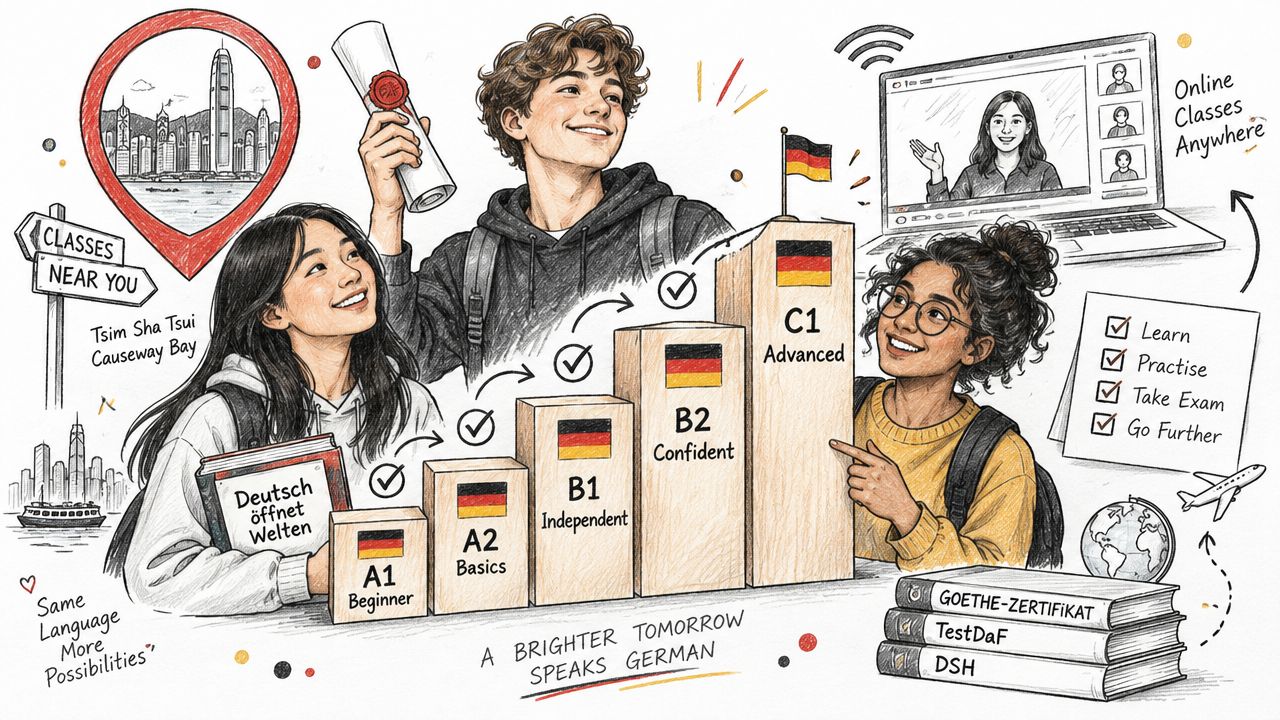
GCA supports that process with structured lessons for children, teens, adults, and corporate learners, plus in-person classes near Tsim Sha Tsui and Causeway Bay MTR stations and online lessons for busy schedules. Many courses are also eligible for CEF funding, which matters for learners who want serious training with a clear long-term plan.
If you are starting from zero, keep your target simple. Learn the phrase, say it aloud, connect it to a real situation, and repeat it until it feels natural. Confidence in German grows like muscle memory. Short, correct practice done regularly works better than trying to memorise everything in one sitting.
If you're looking for authentic German Cultural Association Hong Kong(GCA) teaching with native-speaking instructors, small-group classes, structured exam preparation, and flexible learning in Tsim Sha Tsui, Causeway Bay, or online, book a trial lesson or contact the GCA advisory team today. Whether you need German lessons for your child, exam support for IB or IGCSE, or practical Business German, GCA can help you build real confidence from your first words onward.
German Courses for Teens 2026/27: Ages 12-18 New Term Classes & Exam Pathways

German Lessons for Kids 2026/27: New School Year Classes for Ages 3-12


