.png)
.png)

BLOG

香港德國文化協會
The German Cultural Association
German Community in HK: Find German Speakers & Exchange Partners
You've done the hard part. You've studied the grammar, memorised the cases, and built enough vocabulary to hold a basic conversation. Then you try to find the German Community in HK and hit the same wall most learners hit. Plenty of apps, scattered events, and very few reliable German speakers who want a regular exchange.
That gap matters in Hong Kong. Adults want efficient progress, parents want dependable support for exams like IB or IGCSE, and working professionals often need German for a concrete goal such as a role with a German firm or plans to study abroad in Germany. Casual advice doesn't help much here. You need a sharper strategy that fits real life in HK, including busy schedules, limited time, and the fact that free language exchange often looks easier than it is.
Table of Contents
- The market is smaller than most learners expect
- The visible community is not always accessible
- What this means in practice
- The smarter response
- For casual social practice
- For career-focused networking
- For students preparing for study abroad
- A practical in-person filter
- What free exchange apps do well
- Why paid practice is often the better decision in HK
- A message template that gets better replies
- Best way to use apps without burning out
- Why structure beats randomness
- Finding German Partners in HK A Comparison of Methods
- Who benefits most from this route
Your Guide to Finding the German Community in HK
If you feel like finding German speakers in Hong Kong is harder than finding Spanish, French, or even Japanese conversation partners, you're not imagining it. The local environment is tighter, smaller, and more fragmented.
Hong Kong's population is predominantly ethnically Chinese, with approximately 91.6% of residents being Han Chinese, and the German-speaking demographic is very small and largely made up of transient expatriates, students, or language learners rather than a settled ethnic group, according to Hong Kong demographic information published by the Home Affairs Department. That shapes everything. It affects who is available, where they gather, and how often they stay in the city long enough to become reliable exchange partners.
Start with the right expectation
Most learners waste time because they use the wrong model.
They assume the German community in HK works like a large local language community with easy walk-in social circles. It doesn't. You're usually dealing with a niche network of professionals, short-term residents, and serious learners.
Practical rule: Don't search for “lots of German speakers”. Search for the right type of German speaker for your goal.
Match your goal to the right channel
Before you download another app or join another chat group, decide what you need:
- For speaking confidence: Look for recurring conversation settings, not one-off events.
- For exams: Prioritise structured correction and oral practice relevant to Goethe-Zertifikat, IB, or IGCSE.
- For work: Focus on professional circles where German is used in business, not only social meetups.
- For family planning or study abroad in Germany: Choose environments where consistency matters more than novelty.
What usually works in HK
A practical route in Hong Kong often combines several channels:
- One in-person touchpoint for social exposure.
- One online channel for flexible weekly contact.
- One structured learning path so your speaking practice doesn't drift.
That mix is more realistic than hoping one free exchange partner will carry your progress. It also suits Hong Kong schedules better, especially if you're balancing work, school applications, family commitments, or even trying to check whether CEF funding applies to your wider learning plan.
Why Is Finding a German Exchange Partner in HK So Hard
Finding a German exchange partner in HK is hard because the visible demand is much larger than the pool of native speakers who actually want regular language exchange. The local community exists, but it's fragmented, often professional rather than social, and many German speakers don't need English practice badly enough to commit.

The market is smaller than most learners expect
A lot of online advice assumes every city has a healthy tandem culture. Hong Kong doesn't work that way for German.
The first issue is supply. The German-speaking population in HK is limited and often temporary. The second issue is motivation. Many younger Germans already speak strong English, so the classic “you help me with English, I help you with German” bargain isn't especially attractive to them.
That means learners often compete for the same small pool of responsive native speakers. You may see active profiles online, but that doesn't mean those users want weekly calls, correction, or long-term commitment.
The visible community is not always accessible
There's also a difference between a community existing and being easy to enter.
Recent forum discussion shows the German community in Hong Kong can be fragmented and hard to locate. A GeoExpat discussion about Germans in Hong Kong shows that even Germans moving to HK can struggle to find social groups, which tells you something important. If new arrivals from Germany can't immediately find a clear social hub, local learners shouldn't expect a simple, open in-person network either.
Some groups are real, but they're not always designed for language learners. That's why people join, look around, and leave disappointed.
What this means in practice
You'll usually run into one of these trade-offs:
- Social meetups are open but inconsistent: Good for exposure, weaker for progress.
- Professional groups are stronger but less casual: Better conversations, but you need to approach them properly.
- Apps show volume, not commitment: Plenty of profiles, few stable partners.
- Free exchange sounds efficient but often isn't: You can spend weeks arranging a first chat that never becomes routine.
The smarter response
Instead of asking, “Where are all the German speakers?”, ask:
- Who is likely to reply consistently?
- Who has a reason to meet again?
- Which setting matches my level and goal?
For a parent, that may mean skipping random social groups and finding guided oral support for a teen doing IB or IGCSE. For a professional, it may mean aiming at business networks rather than hobby circles. For an adult learner with limited evenings, it often means accepting that structured paid speaking practice can be more cost-effective than endless unpaid searching.
Where to Connect In-Person in Hong Kong
In-person opportunities do exist in HK, but they work best when you choose them by purpose instead of chasing every event you see.

The strongest starting point for many learners is the Hong Kong German Language Meetup Group, which has over 1,700 members and hosts events such as the Stammtisch in Tsim Sha Tsui, as noted by the German Federal Foreign Office's Hong Kong overview. The same source also notes that pairing learners with professionals from the German Business Chamber (GCC) or Delegation of German Industry and Commerce (GIC) can increase exchange success by 40%.
For casual social practice
If your goal is to get used to hearing live German, meetups are the easiest in-person entry point.
A Stammtisch-style event is useful when you want to:
- hear different accents and speaking speeds
- practise introductions and small talk
- reduce the anxiety of first contact
- get a sense of who is open to follow-up conversations
What it won't always give you is continuity. Some people come once. Some switch between German and English. Some are there mainly for socialising after work.
Best approach: go with one narrow objective. Don't aim for “find my perfect partner tonight.” Aim to have three decent conversations and ask one suitable person whether they'd like a follow-up coffee or online call.
For career-focused networking
If you work in finance, trade, logistics, engineering, or professional services, business circles are often a better use of your time than general learner meetups.
People in these circles usually bring:
- more predictable schedules
- clearer reasons to keep in touch
- more serious communication habits
- a shared interest in professional German
This isn't the place for a vague “please teach me German for free” approach. It works better when you position yourself clearly. For example, say you're improving German for business communication, a Germany-facing role, or future study abroad in Germany.
Don't pitch language exchange like a favour request. Pitch it like a mutually useful professional connection.
If you want a wider view of where serious learners and speakers tend to gather, this overview of German language hubs in Hong Kong is a useful starting point.
For students preparing for study abroad
University-linked settings can work well for students and young adults, especially those preparing for exchange programmes or applications in German-speaking countries.
These environments are often better for:
- academic vocabulary
- presentation practice
- structured topics
- peers with similar timelines
Parents should be realistic here. If your child is preparing for DSE, IB, or IGCSE, occasional social conversation is helpful, but it won't replace exam-focused speaking correction. In-person contact is best used as a supplement, not the main engine of progress.
A practical in-person filter
Before you attend any event, ask these three questions:
- Will I meet native speakers, advanced learners, or mostly beginners?
- Is the environment social, academic, or professional?
- Can this realistically lead to repeat contact within my schedule in Hong Kong?
That simple filter saves a lot of time. In HK, quality of contact matters more than volume.
The Top Online Platforms and Apps for German Exchange
Free apps are useful, but they're not the magic solution many HK learners expect. They solve discovery. They don't solve motivation, commitment, or fit.

The biggest issue is the supply-demand imbalance. Discussion around German language exchange regularly points out that many young Germans already have high English proficiency and little need for tandem exchange. One widely referenced thread also notes that while an app like Tandem shows nearly 57,000 learners, the pool of active native speakers willing to exchange is only a fraction of that, which makes paid tutors a more reliable option, as seen in this discussion on the difficulty of finding German exchange partners.
What free exchange apps do well
Apps can still be useful if you use them for the right job.
Good use cases for apps:
- First exposure: You can test your confidence with text or voice notes.
- Light maintenance: They help you keep German present between lessons.
- Partner discovery: You may find one or two people worth moving off-platform.
- Flexible timing: Helpful for adults managing long workdays in Hong Kong.
For learners who want conversation features designed around ongoing chat, IllumiChat is worth a look alongside the bigger language exchange platforms, especially if you want another route beyond the standard app cycle of matches that never become real conversations.
Why paid practice is often the better decision in HK
This is the point many serious learners resist at first.
They assume “free” is cheaper. In practice, it often costs more in wasted time. If you spend weeks sending messages, rescheduling, and carrying half-committed conversations, you're paying with the one thing HK professionals and parents usually have the least of, which is time.
A paid tutor or conversation coach gives you:
- a guaranteed time slot
- a partner who is motivated to show up
- feedback on grammar and pronunciation
- a structure that can support Goethe-Zertifikat or practical speaking goals
That doesn't mean free exchange has no value. It means you should assign it the right role. Use apps for discovery and light speaking. Use paid sessions when progress matters.
If your goal has a deadline, such as an exam, relocation plan, or job target, don't make free exchange your main system.
A good support layer for self-study is a curated list of free German learning resources in Hong Kong. That helps you combine independent work with more reliable speaking practice.
A message template that gets better replies
Most outreach messages fail because they're vague. Keep yours specific, polite, and easy to answer.
Try this:
Hi, I'm based in Hong Kong and currently learning German at around beginner or intermediate level. I'm looking for one regular exchange or conversation session each week, ideally focused on practical speaking. I can help with English, and I'm happy to keep the format structured and punctual. If that suits you, I'd be glad to arrange a short first call.
Why this works:
- it shows you're serious
- it respects the other person's time
- it suggests a routine
- it avoids sounding needy or random
Best way to use apps without burning out
Use a simple rule:
- Message a small number of strong matches
- Move promising chats to a scheduled call quickly
- Drop inactive conversations fast
- Keep one paid option in reserve
That approach aligns with the German community in HK far better than chasing endless profiles.
The Structured Path The German Cultural Association Advantage
If your goal is steady progress rather than occasional exposure, structured learning is the strongest option. It removes the randomness that slows most adult learners down.
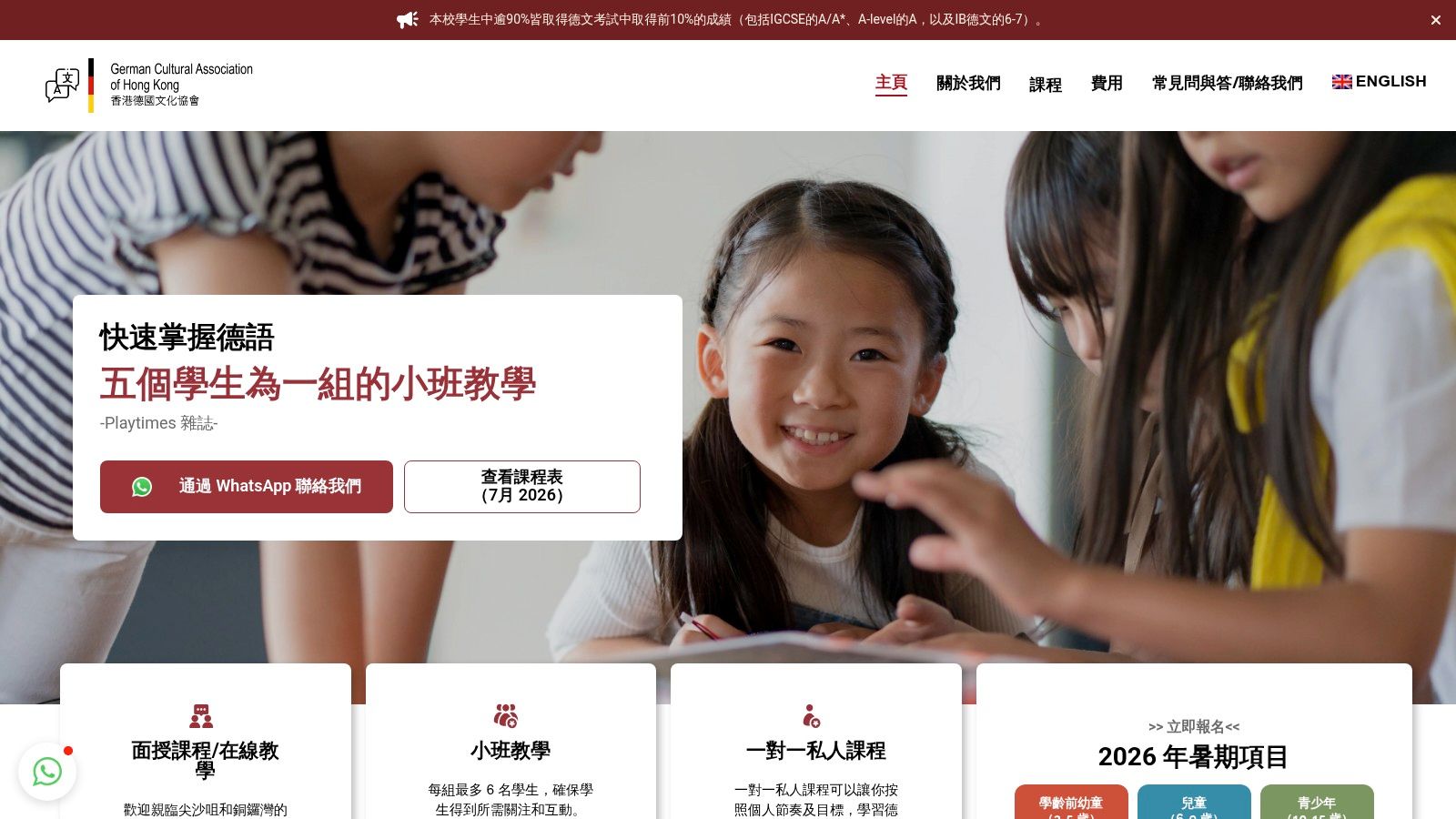
The German Cultural Association Hong Kong is the clearest example of why this works. According to the AHK-linked information on German learning outcomes in Hong Kong, the German Cultural Association Hong Kong (GCA) has a 96% student recommendation rate, sees over 90% of learners rank in the top 10% of public examinations, and its small-group format with native-speaking faculty leads to a 98% proficiency advancement rate within 12 months, measured by Goethe-Zertifikat and TestDaF.
Why structure beats randomness
That result isn't about marketing language. It reflects a better learning design.
Serious learners in HK usually need four things:
- regular speaking practice
- correction from native-speaking teachers
- a syllabus that builds in the right order
- preparation that matches a real outcome, such as exams, work, or study abroad
Informal exchanges rarely cover all four. One partner may be friendly but inconsistent. Another may chat fluently but never correct you. A third may disappear after two weeks.
A structured programme solves that by aligning:
- curriculum
- teacher quality
- class continuity
- exam preparation
This matters for adults and professionals, but it matters even more for families. If a student is preparing for IB, IGCSE, or a recognised German exam, parents need something measurable and organised, not just “more exposure”.
Finding German Partners in HK A Comparison of Methods
| Method | Best For | Reliability | Cost |
|---|---|---|---|
| Meetup events | Casual speaking exposure and social confidence | Medium | Low |
| Language exchange apps | First contact and light practice | Low to medium | Low |
| Private tutors online | Scheduled speaking and correction | High | Medium to high |
| Structured language programmes | Exam goals, long-term progress, serious learners | High | Medium to high |
The reason structured programmes rank first for serious learners is simple. They combine what scattered methods split apart.
For readers comparing options in a more formal way, this overview of German Cultural Association Hong Kong programmes and offerings shows what a full learning pathway looks like in practice.
A good exchange partner can help your German. A structured programme can organise your whole progression.
Who benefits most from this route
Structured study tends to be the best fit for:
- Working professionals: especially those targeting German companies or business communication
- Parents: who want dependable support and proper exam preparation
- Adult learners with limited time: because routine beats searching
- Students planning study abroad in Germany: because academic language needs more than casual chat
This doesn't mean you must avoid the wider German community in HK. It means community works best when it supports a strong core system, not when it replaces one.
Ready to Start Your German Language Journey
If you want better German in Hong Kong, the practical answer is to stop relying on one channel.
Use in-person meetups for exposure. Use online platforms for discovery. Use paid speaking support when you need consistency. And if your goal is exam performance, career progress, or preparation to study abroad in Germany, put structured learning at the centre.
A simple starting checklist
- Define your main goal: conversation, exams, work, or relocation
- Choose one in-person channel: not five
- Use one app carefully: don't spread your attention everywhere
- Set a weekly speaking routine: even one fixed slot is better than random bursts
- Track progress monthly: vocabulary, speaking ease, listening stamina, and correction points
What to avoid
Some patterns waste time in HK:
- chasing large chat groups without follow-up
- expecting free tandems to stay consistent
- relying on English-heavy meetups as your only speaking practice
- delaying structured study until “later”
You don't need a perfect system. You need a realistic one you can maintain around work, school, and family life in Hong Kong.
For ambitious learners, that usually means building around reliability first. Everything else becomes easier once your schedule, feedback loop, and speaking practice are stable.
If you're looking for a dependable way to build real German skills in Hong Kong, German Cultural Association Hong Kong(GCA) offers a practical next step. You can explore course options, check the latest schedule, and speak with an advisor about the right path for your goals, whether that's exam preparation, business German, or steady speaking confidence through native-led lessons in Hong Kong.

German for Children Aged 3-6: Realistic Expectations for the First Year
Exam Prep and Immersion Compared for Hong Kong Learners


