.png)
.png)

BLOG

香港德國文化協會
The German Cultural Association
German Adjective Endings: The Simple 3-Table System That Works for HK Learners
You're preparing for a Goethe-Zertifikat, IB, IGCSE, or another German assessment in Hong Kong. Your vocabulary is improving, your sentences are becoming longer, and then one small decision stops you: should the adjective end in -e, -en, -er, -es, or -em?
German adjective endings can feel unpredictable because the ending changes with the article, gender, case, and number. The useful news is that you don't need to memorise a separate rule for every sentence. German Adjective Endings: The Simple 3-Table System That Works reduces the problem to three patterns, one decision about the determiner, and a repeatable exam strategy.
Table of Contents
- Step 1 Identify the determiner
- Step 2 Find gender, case, and number
- Step 3 Select the ending from the table
- Fix the errors that appear most often
Struggling with German Grammar in Hong Kong
At a Hong Kong language centre, a student recently submitted a short writing exercise. The ideas were clear, the vocabulary fitted the topic, and the paragraph was well organised. Still, the student had written der groß Hund, mit eine neu Lehrer, and ein interessant Buch. Each error involved only a few letters, yet together they made the German sound unfinished.
The same problem appears among adults preparing for work, parents supporting teenagers through IGCSE or IB German, and professionals planning study in Germany or Spain. You may know the noun and adjective separately, then lose confidence when der, ein, mit, or a plural noun enters the sentence. These small endings also matter in DSE, IGCSE, and Goethe preparation, where accurate written German can affect exam performance and the quality of documents used for study visa applications.
German adjective endings combine four signals:
- Gender, masculine, feminine, or neuter
- Case, nominative, accusative, dative, or genitive
- Number, singular or plural
- Determiner type, definite, indefinite, possessive, or absent
Trying to memorise every combination at once creates unnecessary pressure. Start with one practical question: which word before the adjective is carrying the grammatical information? The article and adjective work like two people sharing a label. If the article shows more information, the adjective uses a lighter ending. If the article shows less, the adjective supplies what is missing.
Tutor's rule: Don't treat every adjective ending as a new fact. Treat it as the final part of a system.
German study in Hong Kong is often structured through language centres, examination classes, and independent practice. Learners can support their lessons with carefully selected digital resources to unlock fluency with free apps, using them for vocabulary review and short daily drills. Apps provide useful repetition, but they cannot replace a framework that explains why an ending is correct. That explanation is what helps you check a sentence under exam pressure, revise efficiently, and use German with greater control in academic or visa-related applications.
Why Do German Adjective Endings Change Anyway
German adjective endings change because the adjective helps show the noun's gender, case, and number. The exact pattern depends on the determiner before the adjective: definite article means weak declension, indefinite or possessive determiner means mixed declension, and no article means strong declension.
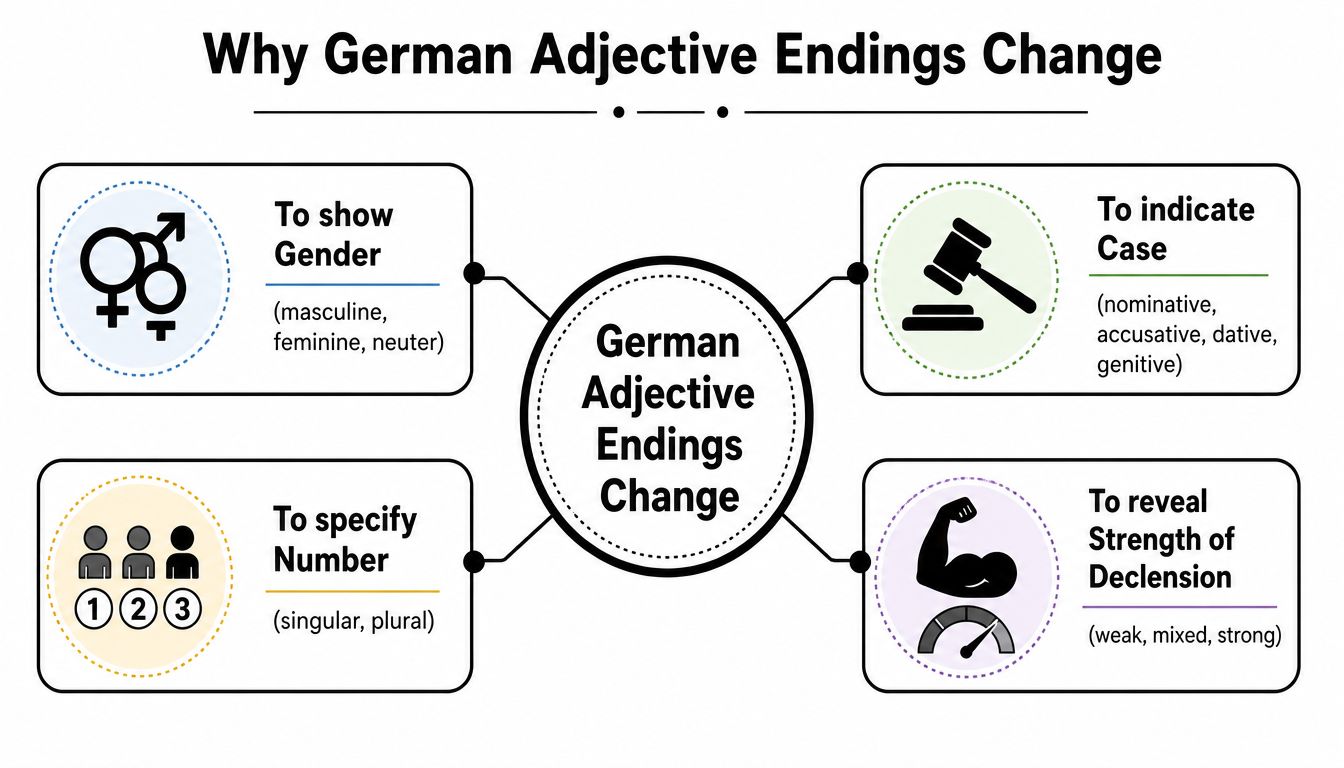
Think of the article and adjective as sharing a job. German needs a clear signal showing how the noun functions in the sentence. Sometimes the article provides most of that signal, so the adjective has less work. Sometimes the article provides only part of it, so the adjective fills the gap. With no article, the adjective carries the signal itself.
The four questions behind every ending
Before choosing an ending, identify:
What is the noun's gender?
Is it masculine, feminine, or neuter?What is the noun's case?
Is it the subject, direct object, indirect object, or a possessive phrase?Is the noun singular or plural?
Plural forms follow their own row in each table.What comes before the adjective?
This determines whether you use weak, mixed, or strong declension.
Consider these examples:
- der alte Mann, the article der already signals masculine nominative
- ein alter Mann, ein leaves the masculine nominative signal incomplete
- alter Mann, no article appears, so the adjective carries the signal
The adjective alt changes to alte or alter, but the basic meaning stays the same. The ending tells the reader how the phrase fits into the sentence.
A useful way to remember the system is:
| Before the adjective | Declension | Main idea |
|---|---|---|
| der, die, das, dieser, jeder | Weak | The determiner carries the main signal |
| ein, kein, mein, dein | Mixed | The adjective fills specific gaps |
| No article | Strong | The adjective carries the signal |
The three-pattern approach is supported by this German adjective-ending guide, which describes weak, mixed, and strong patterns and notes that weak endings usually reduce to -e or -en.
If noun gender is still uncertain, review the German gender guide for Hong Kong learners. You can't choose the correct adjective ending if you don't know whether the noun is der, die, or das.
Table 1 The Weak Declension with Definite Articles
Weak declension is the best place to start because the pattern is compact. Use it after definite articles such as der, die, das, die, and after similar der-words such as dieser, jeder, and welcher.
The central rule is simple: the determiner already gives the reader strong information about gender and case, so the adjective normally uses -e or -en. According to this weak-declension explanation, -e appears in nominative singular and in feminine and neuter accusative singular, while most other cells use -en.
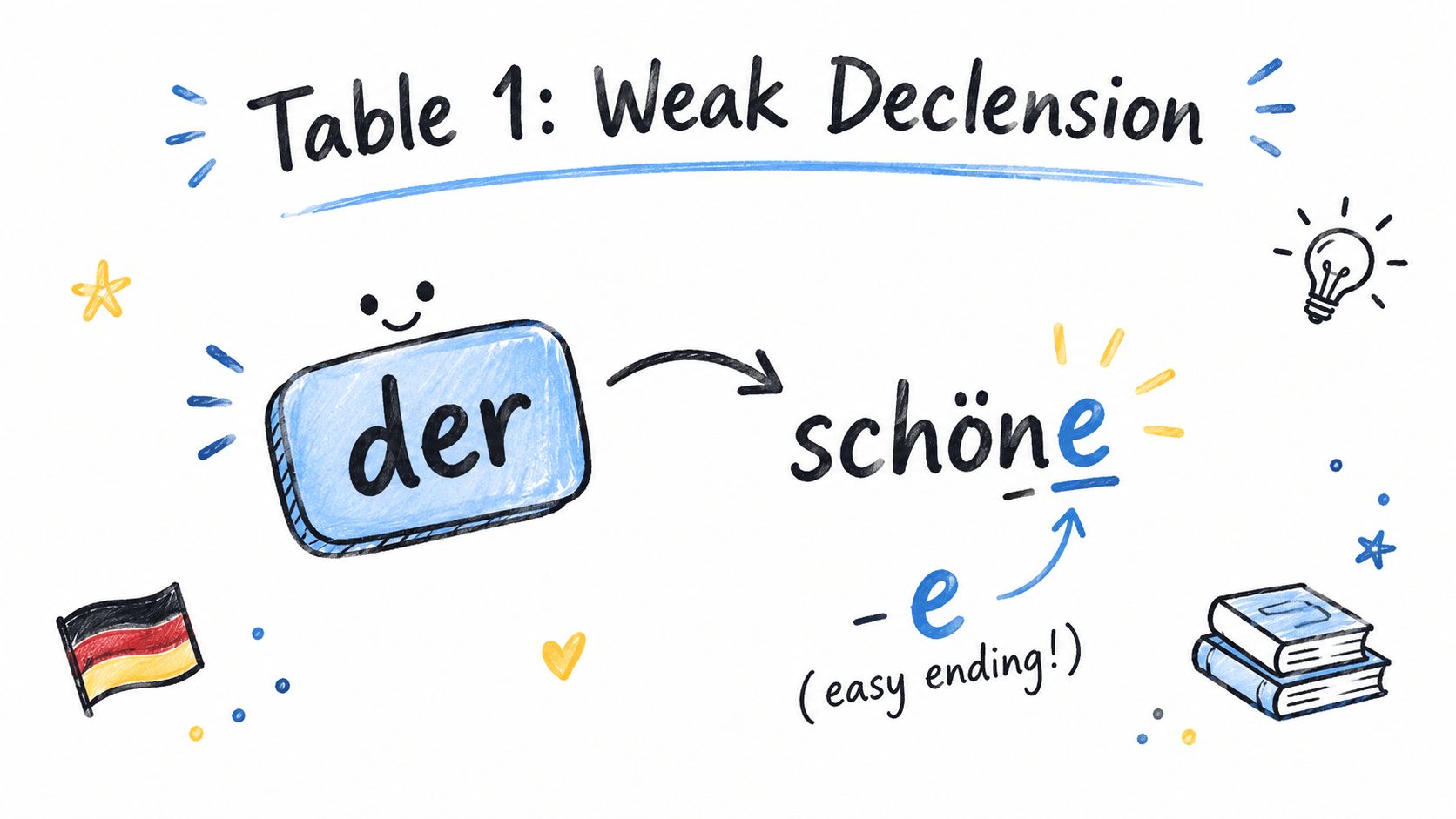
The weak table
| Case | Masculine | Feminine | Neuter | Plural |
|---|---|---|---|---|
| Nominative | der alte Mann | die alte Frau | das alte Kind | die alten Kinder |
| Accusative | den alten Mann | die alte Frau | das alte Kind | die alten Kinder |
| Dative | dem alten Mann | der alten Frau | dem alten Kind | den alten Kindern |
| Genitive | des alten Mannes | der alten Frau | des alten Kindes | der alten Kinder |
Notice how much of the table uses -en. The main cells to watch are:
- Nominative singular, all genders, -e
- Accusative feminine singular, -e
- Accusative neuter singular, -e
- Most remaining forms, -en
For example, in Ich sehe den großen Hund, den identifies masculine accusative. The adjective only needs the weak ending, so groß becomes großen.
The same logic appears in:
Der neue Kurs beginnt heute.
Der is masculine nominative, so use neue.Ich besuche die deutsche Schule.
Die is feminine accusative, so use deutsche.Wir helfen dem jungen Schüler.
Dem is dative, so use jungen.Sie spricht mit den freundlichen Lehrern.
Den marks plural dative, so use freundlichen.
A quick reference on German grammar for beginners can help you connect this table to articles, noun forms, and cases.
Use the video below after reading the table aloud. Hearing the repeated -e and -en endings can help you recognise the rhythm in listening tasks.
Table 2 The Strong Declension with No Article
Strong declension appears when there's no article or determiner before the adjective. The adjective must then show the grammatical information that an article would normally provide.
Compare:
- Der gute Wein is good wine, after a definite article
- Ein guter Wein is a good wine, after an indefinite article
- Guter Wein means good wine, with no article
In the third example, guter tells us that Wein is masculine nominative. The ending -er performs the signalling work.
The strong table
| Case | Masculine | Feminine | Neuter | Plural |
|---|---|---|---|---|
| Nominative | guter Wein | frische Luft | kaltes Wasser | neue Bücher |
| Accusative | guten Wein | frische Luft | kaltes Wasser | neue Bücher |
| Dative | gutem Wein | frischer Luft | kaltem Wasser | neuen Büchern |
| Genitive | guten Weines | frischer Luft | kalten Wassers | neuer Bücher |
The strong endings resemble the endings found in definite articles:
- -er often signals masculine nominative
- -e often signals feminine nominative or accusative
- -es often signals neuter nominative or accusative
- -em signals dative masculine or neuter
- -en appears in several accusative, dative, and genitive positions
This pattern is not a collection of random letters. The adjective is standing where the article would normally stand grammatically.
Worked examples
Guter Wein kommt aus Italien. The noun is masculine, singular, and nominative. No article appears, so gut takes -er.
Ich trinke guten Wein. The noun is masculine accusative. The strong ending becomes -en.
Frisches Brot schmeckt gut. Brot is neuter nominative with no article, so frisch becomes frisches.
Mit kaltem Wasser wasche ich das Gemüse. The preposition mit requires dative, and neuter dative uses -em.
This explanation of strong declension emphasises that the adjective carries the case and gender signal when no article is present.
Strong declension also appears naturally with uncountable nouns, bare plural nouns, and phrases after numbers. For example, drei kleine Kinder has no article before kleine, so the adjective follows the strong pattern for plural.
Table 3 The Mixed Declension with Indefinite Articles
Mixed declension comes after ein-words. These include ein, kein, mein, dein, sein, ihr, unser, euer, and related possessive determiners.
The word ein sometimes shows gender and case clearly, but sometimes it doesn't. In einem guten Freund, the ending on einem already signals dative masculine, so the adjective uses the weak ending -en. In ein guter Freund, ein has no visible ending, so the adjective supplies the stronger masculine nominative ending -er.
The mixed table
| Case | Masculine | Feminine | Neuter | Plural model with kein |
|---|---|---|---|---|
| Nominative | ein guter Freund | eine gute Freundin | ein gutes Buch | keine guten Bücher |
| Accusative | einen guten Freund | eine gute Freundin | ein gutes Buch | keine guten Bücher |
| Dative | einem guten Freund | einer guten Freundin | einem guten Buch | keinen guten Büchern |
| Genitive | eines guten Freundes | einer guten Freundin | eines guten Buches | keiner guten Bücher |
The mixed pattern has strong adjective endings in only three cells:
- Masculine nominative, -er
- Neuter nominative, -es
- Neuter accusative, -es
All other forms mainly follow the weak pattern. The mixed-declension guide from Eloni explains this as the result of the article having no ending in those three positions.
Find the missing signal
Look at these pairs:
Ein alt*er Mann liest.*
Masculine nominative. Ein has no ending, so the adjective uses -er.Ich sehe einen alt*en Mann.*
Masculine accusative. Einen already signals the case, so the adjective uses -en.Ein neu*es Auto steht dort.*
Neuter nominative. Ein doesn't show neuter, so the adjective uses -es.Ich kaufe ein neu*es Auto.*
Neuter accusative. The adjective again supplies -es.Ich spreche mit einem alt*en Freund.*
Dative masculine. Einem carries the signal, so the adjective is weak.
The quickest mixed-declension test is to ask whether the ein-word has an ending. If it does, the adjective is usually weak. If it doesn't in the three gap positions, the adjective becomes strong.
Don't confuse a possessive determiner with a pronoun standing alone. In mein neuer Computer, mein is an ein-word before the adjective, so use mixed declension. The adjective neu becomes neuer because masculine nominative is one of the gap positions.
Your 3-Step Strategy for Perfect Adjective Endings
A table is useful only if you can use it under pressure. For a writing task, oral answer, or timed grammar exercise, follow the same sequence every time.
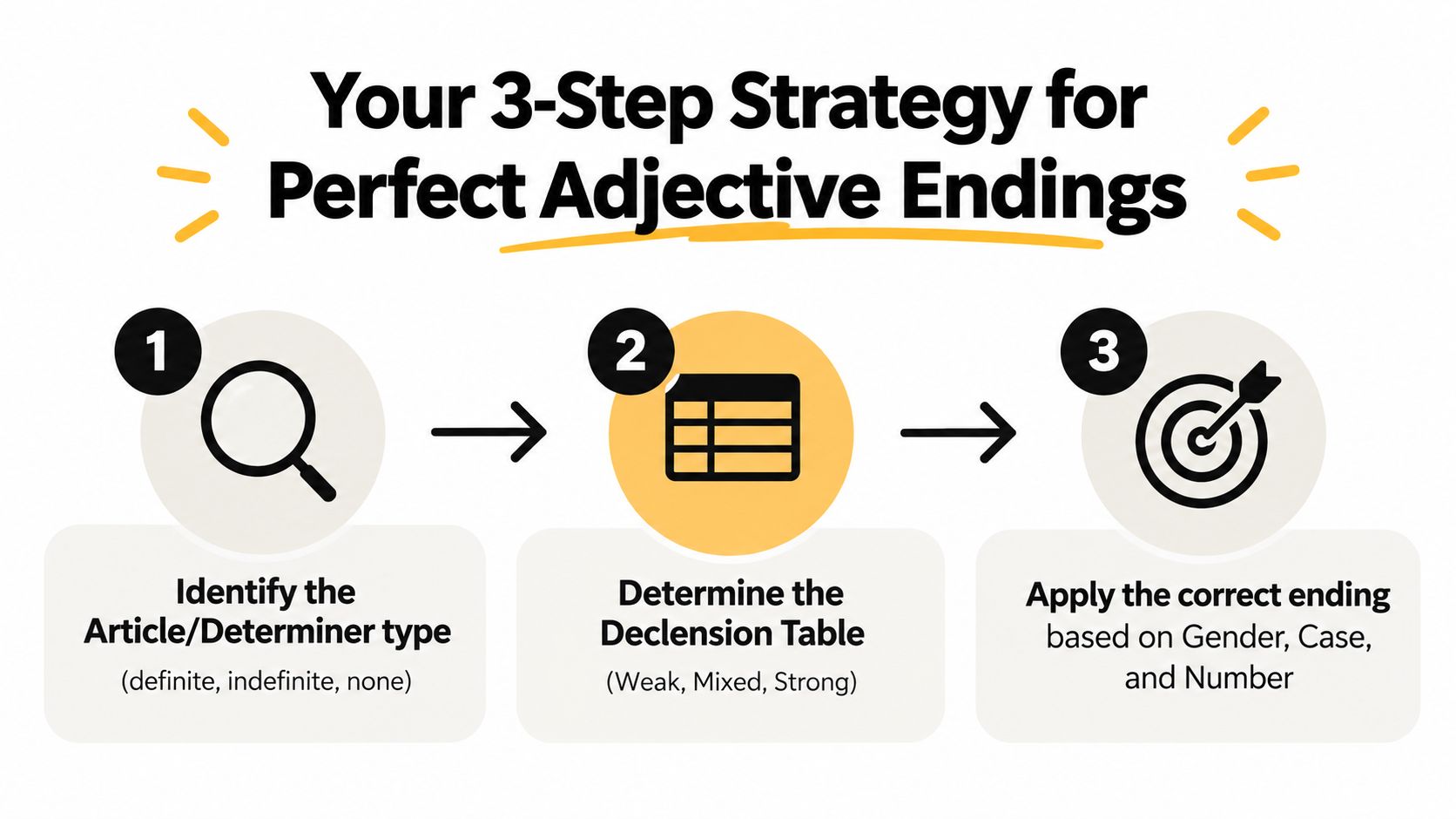
Step 1 Identify the determiner
Look immediately before the adjective.
Der-word, use weak declension
der, die, das, dieser, jederEin-word, use mixed declension
ein, kein, mein, dein, sein, ihr, unser, euerNo article, use strong declension
guter Kaffee, frische Milch, alte Bücher
This first decision removes most of the uncertainty. Don't start by guessing the ending from the adjective itself.
Step 2 Find gender, case, and number
Use the noun and the rest of the sentence.
- Gender: learn the noun together with its article
- Case: check the verb, preposition, or sentence role
- Number: decide whether the noun is singular or plural
For example, in Wir helfen dem neuen Schüler:
- Dem is a der-word, so use weak declension.
- Schüler is masculine singular.
- Helfen takes dative here.
- The weak dative ending is -en.
- The answer is dem neuen Schüler.
A frequent Hong Kong learner error is to identify the noun correctly but overlook the preposition. Mit, bei, nach, seit, von, and zu require dative, so phrases after them often take -en after a determiner.
For a focused review of dative and genitive patterns, use this cases guide for HK beginners.
Step 3 Select the ending from the table
Now combine the two decisions:
| Sentence | Table | Reason |
|---|---|---|
| Die schöne** Stadt** | Weak | Definite article, feminine nominative |
| Ich sehe den schönen** Park** | Weak | Definite article, masculine accusative |
| Ein schönes** Bild** | Mixed | Neuter nominative gap |
| Mit einem schönen** Bild** | Mixed | Dative signal appears on einem |
| Schöne** Bilder** | Strong | No article, plural nominative |
| Mit frischem** Wasser** | Strong | No article, neuter dative |
Fix the errors that appear most often
- Using -en everywhere: This fails in key singular forms, especially weak nominative and mixed gap positions.
- Forgetting plural: Weak and mixed plural forms commonly use -en, while strong plural forms follow the strong table.
- Ignoring the article: ein guter Plan and der gute Plan look similar, but they come from different declension patterns.
- Skipping case identification: A correct gender with the wrong case still produces the wrong ending.
- Learning all tables at once: Start with weak, add mixed, then study strong.
Exam habit: Underline the determiner, circle the preposition or verb that controls the case, then choose the table.
When two adjectives describe one noun, both adjectives take the same ending. Compare der alte, müde Mann, ein junger, freundlicher Lehrer, and frisches, kaltes Wasser. The determiner and case control the whole adjective phrase, not just the first adjective.
Ace Your German Exams in Hong Kong
In a timed HKDSE, IGCSE, or Goethe task, adjective endings show whether you can connect the article, case, and noun. A reader may understand a sentence with one incorrect ending, but repeated errors make written German less precise and can weaken the impression of grammatical control in an exam or formal application.
Hong Kong learners have a defined examination route. The Goethe-Institut Hong Kong states that from 2025 onward, the Goethe-Zertifikat is the stipulated examination for German Language under Category C in the Hong Kong Diploma of Secondary Education, or HKDSE. The Goethe-Institut's Hong Kong examination information explains that arrangement.
The local school context is selective. A Hong Kong-focused academic source records German as an official elective at only two local Chinese secondary schools. It also records 166 secondary students studying German across four schools in the 2016/2017 school year, compared with 603 studying Spanish and 435 studying French. At primary-to-secondary level, German was offered across ten levels from P3 to S6, with 90 students enrolled. The Hong Kong course context is also described in the Goethe-Institut's programme information, as noted earlier.
Accuracy for applications and study abroad
Grammar is one part of a German university or visa application. Applicants may also need proof of admission, financial evidence, and other documents. Correct adjective endings still improve emails, forms, motivation letters, and supporting communication, especially when you are presenting yourself in German.
For Hong Kong applicants seeking German university study, German-taught programmes require evidence of German-language knowledge. The German mission in Hong Kong lists documents such as Goethe-Institut certificates or TestDaF among the evidence used for student visa applications. The German mission's student visa information for Hong Kong sets out this language requirement alongside the wider documentation process.
The German Cultural Association Hong Kong(GCA) offers native-speaker instruction, small-group and online classes, plus preparation for Goethe-Zertifikat, TestDaF, IGCSE, A-level, and IB pathways. Its course structure links adjective endings with noun gender, cases, article patterns, writing practice, and exam tasks.
The same three-table system also helps adults taking German lessons in Hong Kong, professionals studying Business German, and families learning German for travel or education. Learners can compare classroom teaching near Tsim Sha Tsui or Causeway Bay with interactive online lessons, then check whether a suitable course may qualify for CEF funding under the relevant Hong Kong arrangements.
Use this sequence during revision:
- Identify the article pattern: Decide whether the phrase is weak, mixed, or strong.
- Confirm the case: Check the preposition, verb, or grammatical role of the noun.
- Practise complete phrases: Write der neue Kurs, ein neuer Kurs, and neuer Kurs together.
- Correct exam-style writing: Rewrite short emails, descriptions, and formal paragraphs.
- Review under time pressure: Apply the three steps without translating every word.
Your next German sentence can follow a clear method instead of a guess. Visit German Cultural Association Hong Kong(GCA) to explore native-speaker classes, structured grammar teaching, and preparation for Goethe-Zertifikat, TestDaF, IGCSE, A-level, and IB exams, then ask about a course schedule suited to your goals in Hong Kong.

Ausbildung Age Limits and Entry Requirements for Hong Kong Applicants

Germany vs Austria vs Switzerland: Where Should Hongkongers Move?


