.png)
.png)

BLOG

香港德國文化協會
The German Cultural Association
10 Fun German Activities and Games for Children
A common Hong Kong family scenario looks like this. A child finishes a long school day, still has homework ahead, and then faces one more language class. Parents want German to open real options later, such as stronger IB or DSE language positioning, future study in Germany, and a more distinctive academic profile. The problem is not whether German is worth learning. The problem is keeping children engaged long enough to make measurable progress.
Fun activities solve that problem only when they are designed with a clear teaching aim. In well-run German lessons, games build faster word recall, better listening accuracy, clearer pronunciation, steadier turn-taking, and the confidence to speak before a child feels fully ready. Those are not soft benefits. They are the early habits that support oral exams, classroom participation, and practical communication.
At the German Cultural Association, we treat play as a method, not a break from learning. A memory game can reinforce core exam vocabulary. A song can fix sentence patterns and pronunciation. Role-play can prepare a child to answer questions, describe routines, or handle everyday situations in German with less hesitation. Parents looking at German courses for children in Hong Kong should judge activities in exactly that way. Ask what language outcome each one is meant to produce.
This matters in Hong Kong because children are working within tight schedules and high expectations. Parents do not need more entertainment added to the timetable. They need activities that hold attention, fit a child’s level, and still move them toward concrete goals. The sections that follow focus on German games and activities that do that job properly.
What are the best fun German activities and games for children in Hong Kong
The best fun German activities and games for children in Hong Kong are the ones that combine play with structure. Vocabulary games, storytelling, songs, role-play, board games, craft projects, and well-run online activities work especially well when they match your child's level and connect to practical goals such as speaking confidence and exam preparation.
1. German Vocabulary Memory Game Gedächtnisspiel
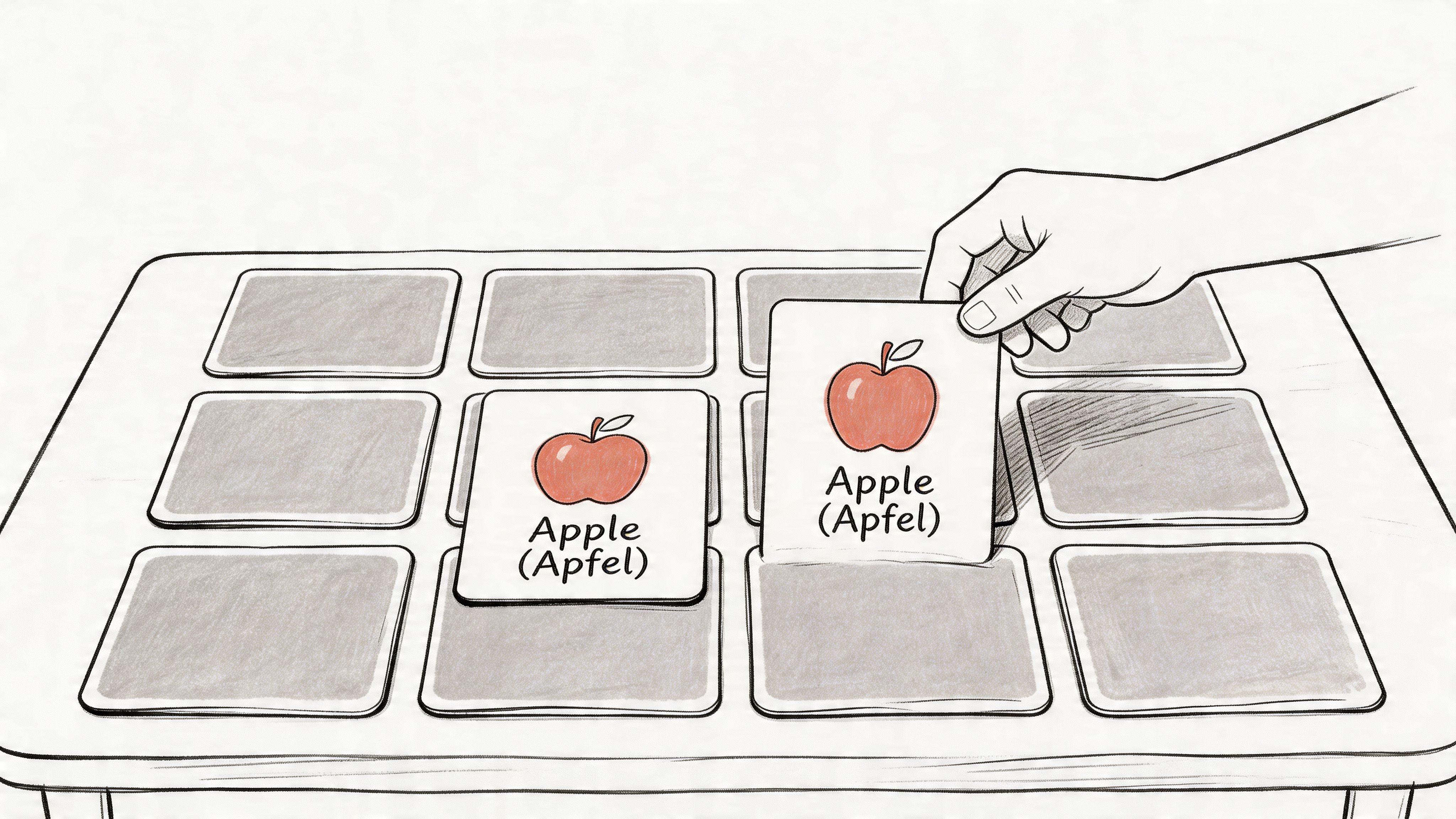
This is one of the safest places to start, especially for younger learners who still need short, clear wins. A memory game links a word to an image, and that repeated recall is far more useful than passive recognition. Children aren't just looking at the word Apfel. They’re finding it, saying it, hearing it again, and linking it to a picture.
At home, I usually recommend keeping the first round small. Twelve to sixteen pairs is enough for a beginner. If parents jump to a large deck too quickly, the game becomes a concentration test instead of a language task.
How to make it work in practice
Use themes your child already meets in class:
- Animals: Hund, Katze, Vogel
- Food: Brot, Apfel, Milch
- Actions: laufen, essen, trinken
For Zoom lessons, a teacher can screen-share a digital version through tools like Wordwall or Quizlet. For in-person learning, printed cards are often better because children can touch, flip, sort, and group them.
Practical rule: If a child can match cards silently but can't say the words aloud, the activity is only half-working.
One reason this game fits Hong Kong families well is that it scales. It works in a flat, in a tutoring room, or in a small group class. That matters because the small-group model gives each child more speaking turns. If you're comparing class formats, this guide to best German courses for children in Hong Kong helps parents think beyond convenience and look at teaching quality.
A final note. Rotate topics often. Memory games stop working when children memorise card positions instead of language.
2. German Cooking and Food Culture Workshop Kochen und Kultur
Cooking is excellent for children who don't like sitting still. It gives German words a job to do. Instead of memorising a list of food terms, children hear and use language while measuring, mixing, passing ingredients, and describing what they see.
Simple German snacks work best. Pretzel bites, butter biscuits, fruit skewers, or cold assembly recipes are often enough. The point isn't culinary difficulty. The point is following instructions in German and making language feel real.

What children actually learn
A good food workshop builds several layers at once:
- Nouns: Zutaten such as Mehl, Zucker, Ei
- Verbs: mischen, schneiden, backen
- Classroom language: bitte, hier, fertig, nochmal
- Cultural awareness: children connect German to traditions, not just exams
This format is especially useful for nervous speakers. Many children will speak more freely when their hands are busy. Asking for ingredients, confirming steps, or reacting to taste feels more natural than answering direct textbook questions.
What doesn't work is overcomplicating the recipe. Four to six steps is usually enough to keep attention on language. If adults spend too long on setup or safety explanations, the German disappears from the session.
A strong workshop also reduces stress before the activity starts. Bilingual recipe cards help. Pre-measured ingredients help even more. In Hong Kong homes, where time and kitchen space can be tight, that practical detail often decides whether the activity feels enjoyable or chaotic.
3. German Storytelling Circle Märchenstunde
Children remember stories longer than they remember vocabulary lists. A storytelling circle gives German rhythm, emotion, and context. That matters because many children can repeat isolated words but struggle to understand language flowing in full sentences.
Traditional fairy tales and short modern stories both work. The better choice depends on age. Younger children usually respond well to repetitive stories with actions and sound effects. Slightly older learners can handle simple narrative structure, especially if the teacher pauses to ask short questions in German.
Why storytelling helps stronger learners too
Parents sometimes assume stories are only for preschoolers. That’s a mistake. Storytelling is also useful for children preparing for structured school systems like IB or IGCSE because it strengthens listening accuracy, sequencing, and inferencing. Those are academic skills, not just entertainment.
A good storytelling session usually includes:
- A short vocabulary preview: a few key words before the story begins
- Visible support: props, puppets, pictures, or gestures
- Checks for understanding: easy questions children can answer without panic
- A follow-up task: drawing, retelling, or acting out a scene
Stories work best when the adult doesn't explain every word. Children need enough support to follow the plot, but not so much translation that German becomes background noise.
One local advantage of this activity is that it adapts well to both physical and online lessons. A teacher can use puppets in class, or a shared illustrated text on Zoom. In both cases, the strongest sessions are interactive. If children only listen and never respond, attention drops quickly.
4. German Music and Song Performance Lieder Singen
A child in Hong Kong can recite vocabulary perfectly from a worksheet, then flatten every sentence when speaking. Songs fix that problem early because they train stress, vowel length, and sentence rhythm in a way drills rarely do. For families aiming at long-term results, that matters. Clear pronunciation supports oral exams later, and it also makes real conversation in school exchanges, interviews, and travel much easier.
The strongest songs for German lessons are short, repetitive, and physically active. Action songs, counting songs, call-and-response songs, and simple performance pieces all work well. The key trade-off is this: catchy songs increase participation, but if the lyrics are too fast or too idiomatic, children sing sounds without understanding them. Choose material with clear patterns and a small number of target phrases.
At GCA, music is used as a teaching tool with a defined language aim. A song might be selected to practise accusative articles, daily routine verbs, or question forms. That is the difference between entertainment and structured language exposure. Ambitious parents usually respond well once they see the academic logic.
Songs tend to help most with:
- pronunciation and intonation
- automatic recall of high-frequency phrases
- confidence for hesitant speakers
- listening accuracy under time pressure
One practical method works especially well. Pre-teach five to seven words. Play or sing the song once with gestures only. Then have children identify one pattern such as ich habe, ich bin, or ich möchte. After that, use a short follow-up task. Gap-fill lyrics, matching cards, mini dictation, or pair questioning all turn the song into usable language.
This also adapts well for home practice if parents keep the routine tight. A short guide on teaching German to kids at home with consistent routines is useful here because songs work best when repeated across the week, not treated as a one-off class extra.
Performance adds another layer. A simple duet, group chant, or end-of-term song presentation gives children a reason to rehearse carefully. That rehearsal improves diction and memory. It also builds the kind of calm, prepared speaking habit that helps in IB oral work and other formal assessments.
Parents sometimes ask whether music is too soft compared with more academic tasks. It is not. Used properly, singing gives children repeated contact with correct forms at speed. The mistake is using songs as filler in the last five minutes.
For younger learners, songs can also pair well with turn-taking activities at home, including movement games and even some of the interaction patterns families already know from the best family board games. The format feels familiar, but the language target stays clear.
5. German Role-Playing and Dramatic Scenarios Rollenspiel
Role-play is where passive knowledge starts turning into speech. Children may know the words for bread, water, doctor, train, or ticket, but they often freeze when asked to use them in a real exchange. Rollenspiel solves that by giving the child a reason to speak.
The best scenarios are familiar and useful. Ordering in a café, introducing yourself, shopping, asking for help, or visiting a doctor all create clear language goals. They also align well with practical speaking tasks that appear in formal assessment settings.
How to keep role-play from becoming awkward
Start with structure. Don't ask a beginner to improvise from nothing.
Use:
- Role cards: one child is the customer, one is the shop assistant
- Phrase banks: ich möchte, bitte, wie viel kostet das
- Props: menus, toy food, name tags, fake money
Then reduce support gradually. A child might begin with a script, move to key phrases only, and later manage a freer exchange.
For families trying to support speaking practice outside class, this guide on how to teach German to kids at home is helpful because it focuses on routine and consistency, not just materials.
Children usually speak better when they are "being someone" instead of "being tested."
One common mistake is correcting too often during the scene itself. If every sentence gets interrupted, the child stops taking risks. Let the role-play run. Note the errors. Fix the key ones afterwards.
6. German Board Games and Competitive Games Brettspiele
Board games are ideal for children who need a social reason to use language. They create repetition without making it feel repetitive. Turn-taking phrases, question forms, numbers, categories, and simple commands all come up naturally.
Classic games adapt well into German. Memory, Ludo-style movement games, category games, and vocabulary card races are especially practical. Traditional German games such as Mensch ärgere dich nicht also fit neatly into language classes because the rules are familiar once explained.
One verified summary notes that this game tradition has deep cultural roots and describes how it has been adapted in Hong Kong children's German programmes (background summary with referenced tradition). That cultural link matters. Children aren't just learning isolated words. They’re meeting part of everyday German family life.
Keep the language load realistic
The biggest error with board games is rule overload. If children spend too long understanding the mechanics, they stop focusing on German.
Better choices include:
- Simple movement games: say the word correctly to move
- Question decks: answer a German prompt before taking a turn
- Category races: name food, animals, colours, or actions
- Phrase requirements: insist on German for greetings, turns, and requests
If you're looking for ideas that work for mixed ages at home, these best family board games can inspire adaptations.
Competitive energy helps some children and hurts others. For anxious learners, cooperative team formats often produce more speech than winner-takes-all games.
7. German Art and Craft Projects Kunstprojekte
Craft projects are excellent for children who learn by doing. They lower pressure because speech doesn't have to be constant, yet the language remains active through instructions, materials, colours, shapes, and sequencing.
Seasonal projects work particularly well. Masks, festive decorations, paper crafts, or simple cultural items give language a clear frame. Children can follow German instructions, ask for materials, and present what they've made at the end.

What makes crafts useful, not messy
Crafts help most when the adult plans the language first, not the artwork first.
That means:
- Prepare vocabulary in advance: colours, tools, shapes
- Give step-by-step German instructions: schneiden, kleben, malen
- Show one finished example: children need a visual target
- End with presentation: ask each child to describe the result in simple German
This style of learning is also a good fit for holiday programmes. Parents exploring seasonal formats can look at this German summer camp in Hong Kong, where project-based language exposure is easier to sustain across several days than in a single one-off workshop.
What doesn't work is making the craft too technically demanding. If children spend the whole session struggling with scissors or glue, the German fades into the background. Keep the task manageable so the language remains central.
8. Online Adaptations and Virtual Delivery
Online German activities can work well for children, but only if the format changes. A classroom lesson copied onto Zoom usually feels flat. Young learners need tighter pacing, clearer visuals, and more direct interaction.
That matters in Hong Kong because online and hybrid learning remain part of normal family life. A verified local trend summary notes increased demand for digital and hybrid German activities, especially when weather and schedule disruptions push families back toward home-based learning (local digital trend summary).
What works online and what usually fails
Effective online sessions usually include:
- Pre-sent materials: craft kits, flashcards, or ingredient lists
- Short activity loops: listen, respond, move, repeat
- Breakout room pair work: especially for role-play and games
- Visible teacher modelling: children need to see what to do
What usually fails:
- Long explanations
- Passive screen-sharing
- Activities that require constant parent rescue
- Too many tabs and tools
A digital memory game can work well online. So can puppet storytelling, movement songs, and short role-play in breakout rooms. Cooking also works if families receive a simple ingredients list beforehand.
Online lessons for children succeed when the teacher designs for action, not for attendance.
If a child spends most of the lesson watching instead of saying or doing, the session may be tidy, but it won't do much for language growth.
9. GCA Implementation Assessment and Certification Practices
A child leaves class happy. The parent's next question is more demanding. What did they retain, and how does that progress build toward school and exam goals?
At the German Cultural Association Hong Kong, activities are not run as isolated entertainment. They sit inside a teaching sequence with clear language targets, small-group observation, and documented follow-up. That structure matters for Hong Kong families who are planning ahead for DSE, IB, IGCSE, or later Goethe exam pathways.
Small classes make this practical. With fewer children in the room, teachers can hear pronunciation properly, correct sentence formation in real time, and notice who is relying on imitation rather than genuine understanding. In larger groups, lively participation can mask weak retention. In smaller groups, that is much harder to miss.
What proper assessment looks like in children's classes
Useful assessment in a children's German programme goes beyond worksheets. It checks whether the child can use vocabulary and sentence patterns under light pressure, with enough independence to show real learning.
The evidence is usually simple and concrete:
- Recorded role-plays
- Photos of project work with short language outputs
- Short performance clips from songs, stories, or presentations
- Teacher notes on pronunciation, confidence, and task completion
- Attendance records linked to progression decisions
This approach gives parents something far more useful than a vague impression that class is "going well". It shows whether a child can name, ask, respond, describe, and participate at the level expected.
Certification also has a practical role. An attendance-based certificate recognises consistency, while teacher documentation shows whether attendance is translating into usable German. Those are not the same thing. A child can attend regularly and still avoid speaking. A careful teacher tracks both presence and performance.
For ambitious Hong Kong families, that distinction matters. Schools and future interview settings do not reward exposure alone. They reward recall, accuracy, listening control, and the ability to respond without freezing. Fun activities help build those outcomes, but only when teachers assess them with discipline and record progress in a way parents can review.
Used well, games and projects become evidence of development, not just memories of a pleasant class.
10. Differentiation and Scaffolding Strategies
A Saturday class in Hong Kong often includes three very different learners at once. One child answers quickly and pushes for harder tasks. One follows well but needs time to form sentences. One knows more than they say because they are worried about getting it wrong in front of others. Good activity design accounts for all three from the start.
Differentiation means adjusting the route, not lowering the destination. In a German game or project, every child should still work toward usable vocabulary, accurate sentence patterns, and better listening control. The difference is how much support each learner needs to get there.
That matters for families with clear goals. If a child is preparing for IB oral work later, or needs stronger confidence for senior-school language options, passive participation is not enough. A well-run class uses games to bring weaker learners in without letting stronger learners coast.
Useful scaffolds are usually simple and visible:
- Vocabulary previews with 6 to 10 target words before the activity starts
- Sentence frames such as Ich möchte..., Kann ich... ?, or Ich sehe...
- Role cards that assign a clear speaking job in pair or group work
- Visual instructions for craft, cooking, and movement-based tasks
- Choice levels so one child matches words while another gives full answers
- Teacher modelling before children are asked to perform independently
The order of support also matters. Start with a clear model. Move to guided practice with prompts in view. Then remove one layer at a time. In role-play, that might mean full script first, key phrases next, then a freer exchange. In a vocabulary game, it might mean picture support in round one, text only in round two, and timed recall in round three.
This is how playful work becomes academically useful.
At GCA, the strongest results usually come from matching the scaffold to the task rather than giving every child the same help. Songs need pronunciation support and repetition. Storytelling needs comprehension checks and retelling prompts. Board games need turn-taking language and question stems. Stronger learners benefit from extension demands, not just extra volume of the same exercise. Ask them to justify an answer, add an adjective, switch tense where appropriate, or lead part of the interaction.
There is a trade-off. Too much support creates dependence, and children wait for prompts instead of retrieving language. Too little support creates silence, guessing, or off-task behaviour. The teacher's job is to keep the task just difficult enough that success requires effort but still feels reachable.
Parents can use the same approach at home. Before a German card game or story session, pre-teach a small set of words, keep a short phrase bank on the table, and expect one clear output by the end. That output might be naming five items, asking two questions, or describing one picture in full sentences. Fun holds attention. Scaffolding turns that attention into progress.
10-Item Comparison: Fun German Activities for Children
| Activity | Implementation Complexity 🔄 | Resource & Setup Needs ⚡ | Expected Outcomes 📊 | Ideal Use Cases 💡 | Key Advantages ⭐ |
|---|---|---|---|---|---|
| German Vocabulary Memory Game (Gedächtnisspiel) | Low, minimal prep, repeatable | Low–Medium, cards or digital platform | Improved word recognition & retention (A1–A2) | Young learners, small groups, warm-ups | Very effective for vocabulary; low prep |
| German Cooking & Food Culture Workshop (Kochen und Kultur) | Medium–High, planning, safety, dietary checks | Medium–High, kitchen access, ingredients, supervision | Multisensory vocabulary + cultural knowledge (A1–B1) | Immersive workshops, cultural weeks, older children | High engagement; real-world application |
| German Storytelling Circle (Märchenstunde) | Low–Medium, needs skilled delivery and props | Low, books, simple props, optional recording | Listening comprehension, pronunciation, cultural literacy | Early years, library sessions, quiet group time | Low cost with high cultural value; emotional engagement |
| German Music & Song Performance (Lieder Singen) | Low–Medium, teacher musical skill or recordings | Low, audio tracks, optional instruments | Pronunciation, intonation, memory through melody | Mixed ages, warm-ups, home practice | Highly engaging; enhances retention |
| German Role-Playing & Dramatic Scenarios (Rollenspiel) | Medium, facilitation and scaffolding required | Low–Medium, role cards, props, space | Speaking confidence, spontaneous communication (A1–B2) | Communicative practice, exam prep, interactive lessons | Exceptional for fluency and confidence |
| German Board Games & Competitive Games (Brettspiele) | Low–Medium, rule selection and adaptation | Low–Medium, games, scorecards, space | Natural language use, strategy, turn-taking (A1–B1) | Social sessions, tournaments, home play | High motivation; transferable to home practice |
| German Art & Craft Projects (Kunstprojekte) | Medium, material prep and supervision | Low–Medium, art supplies, workspace | Vocabulary for materials/tools; tangible artifacts | Kinesthetic learners, cultural projects, displays | Strong engagement; tangible learning outcomes |
| Online Adaptations & Virtual Delivery | Medium, tech setup and choreography | Medium, platforms, kits, stable internet | Broader reach, recorded materials, remote practice | Remote learners, hybrid classes, pre/post materials | Scalable; enables recording and revision |
| GCA Implementation, Assessment & Certification Practices | Medium, admin coordination and documentation | Medium, staff time, photo/video equipment | Documented progress, portfolios, certificates | Program delivery, parent communication, partnerships | Motivates learners; professional evidence of progress |
| Differentiation & Scaffolding Strategies | Medium, prep for multiple levels | Low–Medium, differentiated materials, props | Inclusive participation, lowered anxiety, progression | Mixed-ability groups, scaffolded lessons, assessments | Ensures accessibility and clear progression |
Ready to Turn Play into Progress?
A seven-year-old can sing a German song all the way home, but still freeze when asked a simple question in class the next week. Hong Kong parents see this problem often. Enjoyment alone does not produce usable language. Children make progress when play is organised around clear targets such as vocabulary recall, listening accuracy, sentence building, and confident speaking.
That is the standard worth using when judging Fun German Activities and Games for Children. A good activity gives a child a reason to speak, enough repetition to remember, and enough structure to improve. Gedächtnisspiel helps with fast recall. Märchenstunde builds listening and sequencing. Lieder Singen sharpens pronunciation and rhythm. Rollenspiel prepares children for real interaction. Cooking, crafts, board games, and online formats also work well, but only when the teacher sets a clear language goal and checks whether the child can use it again after the activity ends.
Parents should treat this as a balance, not a slogan. A class can be highly entertaining and still produce weak retention. A class can also be heavily worksheet-driven and lose the child before meaningful practice begins. The strongest programmes sit in the middle. They keep children active, correct errors at the right moment, and revisit language often enough for it to stick.
For Hong Kong families with academic goals, the practical questions are straightforward. How big is the group? Who is teaching the class? How are speaking, listening, reading, and writing built over time? How does the activity connect to recognised pathways such as Goethe-Zertifikat, IGCSE, A-level, IB, or later DSE support through stronger general language-learning habits? How is progress recorded so parents can see more than a cheerful classroom photo?
Those checks matter.
For families seeking German lessons Hong Kong wide, a structured small-group format is often the most workable option. It gives children enough turns to speak, enough teacher attention for correction, and enough peer energy to keep the lesson lively. It also fits a common goal among ambitious Hong Kong families: building a language profile that supports future study, wider university options, and stronger intercultural communication.
German Cultural Association Hong Kong is one relevant option for families who want that combination. Its programme uses native-speaking teachers, a structured curriculum, small groups of up to six students, in-person lessons near Tsim Sha Tsui and Causeway Bay MTR, and online Zoom delivery. As noted earlier in the article, the association also presents exam-oriented pathways and documented progress practices that matter to parents comparing serious programmes.
If your goal is to help your child Learn German HK style, choose activities that children enjoy and teachers can measure. That is how play supports real progress.
If you'd like a structured path for your child, German Cultural Association Hong Kong(GCA) offers small-group German classes for children, taught by native German speakers, with in-person options near Tsim Sha Tsui and Causeway Bay MTR as well as Zoom lessons for families across Hong Kong.

German Idioms and Everyday Expressions: 25 Phrases Textbooks Skip—Guide

Präteritum and Futur Compared: A Guide for HK Learners


