.png)
.png)

BLOG

香港德國文化協會
The German Cultural Association
German Summer Camp Hong Kong: The Parent's 2026 Guide
Summer arrives, and the same question lands on every organised parent’s desk in Hong Kong. Do you fill the weeks with something merely busy, or do you choose something that gives your child a real academic edge by September?
If your child is already on the IB, IGCSE, A-level, or study-abroad track, a generic holiday programme isn’t enough. A well-run German Summer Camp Hong Kong option can do two jobs at once. It keeps summer purposeful, and it starts building a language profile that can support future exam performance, university applications, and confidence in international settings.
That matters more than many parents realise. German is not a hobby language for HK students with global ambitions. It’s a strategic subject. Used well, summer becomes the moment your child moves from “curious” to “capable”.
Your Child’s Summer Advantage Starts Here
A typical Hong Kong parent doesn’t want summer wasted. You want your child to rest, yes, but you also want progress that still makes sense when school starts again.
That’s why German summer programmes deserve serious attention. They sit in the sweet spot between enrichment and long-term planning.

A good camp doesn’t just entertain. It gives your child a structured start in a European language that later connects naturally to IB, IGCSE, A-level, Goethe-Zertifikat, and even the bigger goal many HK families now consider, which is study abroad in Germany.
Why this matters for Hong Kong families
Parents in HK are used to making educational decisions with return on investment in mind. That’s the right mindset.
A German summer camp is worth considering when you want:
- A meaningful summer outcome instead of another short-lived activity
- An early academic advantage before formal language exams enter the picture
- A differentiator for students aiming at international schools and overseas pathways
- A stronger long-term study profile that goes beyond standard tutoring
Practical rule: If an activity can’t support school-year momentum, confidence, or future applications, it’s probably not the right summer investment.
The strongest programmes also suit how Hong Kong families live. You need central access, sensible scheduling, small groups, and teachers who know how to keep standards high without making summer feel like punishment.
Payoff for children
Children who start a language young usually don’t just gain vocabulary. They develop listening discipline, pattern recognition, speaking confidence, and cultural awareness.
Those are school advantages, not just language advantages.
That’s why I see German Summer Camp Hong Kong as more than seasonal enrichment. For the right child, it’s an entry point into a serious academic pathway with a global future attached to it.
What is a German Summer Camp in Hong Kong?
A German summer camp in Hong Kong is a structured holiday programme that combines German language learning with cultural exposure and interactive activities. The strongest camps use small-group teaching, age-appropriate tasks, and native-speaker instruction so children build usable German, not just memorised phrases.
That’s the short answer. The more useful answer is this: not every camp deserves the name.
What separates a real language camp from a casual class
A proper German summer camp isn’t just a worksheet class moved into July and August. It should feel immersive, even in Hong Kong.
Look for a programme that includes:
- Structured lessons with a clear learning sequence
- Active speaking time rather than passive listening
- Cultural content so children understand how the language lives outside the classroom
- Project-based tasks that help shy learners speak with purpose
- Small groups so each child participates
If a camp can’t explain how a beginner progresses from week one to the end of the course, that’s a warning sign.
For parents comparing options for younger learners, the dedicated kids summer German programme in Hong Kong is the kind of format worth studying because it reflects the structure serious families should expect.
Why German makes strategic sense in Hong Kong
Parents often ask whether their child should choose German over a more familiar enrichment option. My answer is simple. If your child is internationally minded, German is one of the most practical language investments you can make.
German supports several goals at once:
Academic positioning
It gives students another serious subject they can build over time, especially if they may later take IB, IGCSE, A-level, or Goethe-aligned assessments.University planning
Many HK families are now more open to European pathways. Germany stays on the shortlist because of its strong universities and long-term value.Career relevance
German remains associated with engineering, business, research, design, and international mobility. That matters for teenagers who already think beyond local university options.Cultural maturity
Students don’t just learn words. They learn how another society organises ideas, discussion, punctuality, precision, and argument. That widens their mindset.
A weak summer course fills time. A strong one changes the direction of a child’s next few academic years.
What parents should expect
In Hong Kong, a worthwhile German summer camp should be:
- Accessible
- Well organised
- Native-led
- Clear about outcomes
- Serious without being joyless
That balance is rare. When you find it, it’s worth acting early.
A Camp for Every Age and Ambition
Parents often make one mistake. They search for “German summer camp” as if all children need the same thing.
They don’t.
A five-year-old needs rhythm, sounds, and play. A ten-year-old needs structure. A teenager needs relevance, challenge, and a reason to keep going after summer ends.
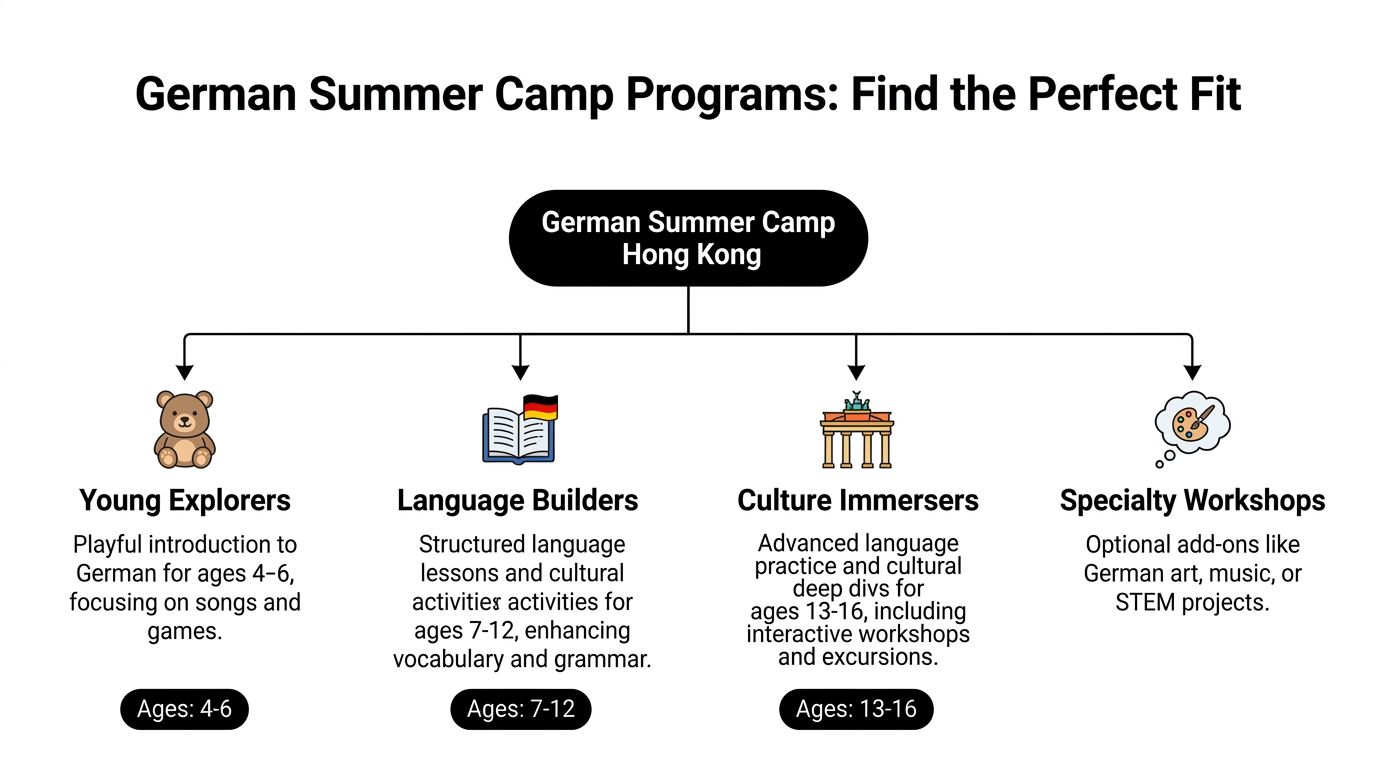
Preschool and early years ages 3 to 5
At this stage, don’t chase grammar. That’s the wrong goal.
Young children learn best when German is attached to movement, songs, stories, repetition, and predictable routines. The right camp gives them positive first exposure and teaches them that another language is something enjoyable, not something to fear.
What works for this age group:
- Songs and action games that tie sound to movement
- Storytelling with repeated vocabulary
- Visual prompts such as colours, animals, food, and weather
- Routine phrases used again and again until children respond naturally
If your child is still in nursery or lower kindergarten, choose a programme designed specifically for early learners rather than placing them into a general children’s class. A preschool-focused option like the preschoolers summer German programme is a better model because the teaching method matters as much as the language itself.
Children’s programme ages 6 to 11
Summer can become highly productive here.
Children in this group can handle more structure, but they still need variety. The best camps blend vocabulary building with speaking tasks, games, reading aloud, and simple cultural learning.
Adventure-style options exist in Hong Kong. One example is Kinderleicht’s German Summer Camps, where the Maxi Camp targets ages 5-10 at HK$4,650 per session, with 6-10 participants and excursions such as the Science Museum, according to the Kinderleicht German Summer Camp PDF.
That kind of format can suit younger children who learn best through movement and novelty. It’s engaging, and for some families, that’s the right first step.
Still, I’d advise parents to ask a stricter question. Is the fun attached to actual language progression, or is German present in the background?
What children in this age band should gain
For primary-age learners, a worthwhile German Summer Camp Hong Kong programme should build:
- Core vocabulary around daily life
- Listening confidence through repeated classroom German
- Basic sentence production rather than isolated word recall
- Reading readiness through short texts and read-aloud work
- Comfort with participation in a small-group setting
If your child finishes camp only able to sing one song and say a few nouns, you paid for exposure, not education.
Teen track ages 12 to 17
This is the most strategic age band of all. Teenagers can connect summer learning to visible future goals.
They’re old enough to understand why German matters. They can link language study to exams, CV strength, study abroad in Germany, and subject differentiation within a competitive school environment.
Hong Kong does offer multiple teen-focused formats. The verified data notes that Mastery in Languages runs several German Summer Course 2025 camps, including Camp A, Camp B, and other sessions, while HKU SPACE’s Beginners’ German for Teens is listed at HK$3,250 for ages 15+ in the same verified source set. The same data also notes that Asian students comprise 11.9% of Germany's total student population and 13.5% at universities.
Those are useful reference points. But for teens, scheduling alone is not enough. The key question is whether the camp teaches in a way that supports later academic performance.
What ambitious teens need from summer
A serious teen programme should include:
- Clear beginner-to-next-step progression
- Speaking practice with correction
- Grammar taught in context
- Projects or discussions that require active use
- A bridge into term-time study or exam pathways
Students in this age group don’t need childish “fun”. They need engaged, purposeful learning. That’s different.
My recommendation by learner type
If you’re choosing by personality rather than age alone, use this filter:
| Learner type | Better camp style |
|---|---|
| Child needs confidence first | Play-based and activity-rich |
| Child enjoys routine and visible progress | Structured language camp |
| Teen wants summer enrichment only | Short exploratory programme |
| Teen may take IB, IGCSE, A-level, or Goethe later | Structured, academic pathway camp |
The right German summer camp in Hong Kong depends on one thing more than any brochure ever says. It depends on what you want summer to lead to.
From Summer Fun to Exam Success
Parents often separate “summer camp” from “serious study”. That’s a mistake.
When the programme is designed properly, summer is where exam success starts. Children build the habits and language base before school pressure returns.
Why structure matters
For tweens and teens, one verified option in Hong Kong is the German summer programme offered by the German Cultural Association Hong Kong. It is for ages 10-15, runs for 3 or 4 weeks, includes 2 weekly lessons of 120 minutes each, and is held in Causeway Bay or Tsim Sha Tsui, according to the GCA teens summer programme details.
That same source states that the programme is designed for complete beginners, offers five 2025 start dates from June to August, and keeps groups to a maximum of 5 classmates with only 6 spots per session.
For parents who care about outcomes, those details matter because exam preparation doesn’t begin with exam papers. It begins with disciplined exposure, feedback, repetition, and enough speaking time for errors to be corrected early.
How summer work maps to later exams
German exams at school level and external level don’t reward passive recognition alone. Students need to listen accurately, respond clearly, read with confidence, and produce language under some pressure.
A strong summer camp can start all of that through:
- Pronunciation practice that improves listening and oral work
- Core grammar routines that later support writing accuracy
- Topic vocabulary useful for school assessments
- Short speaking tasks that reduce fear of oral exams
- Teacher correction before mistakes harden into habits
This is why I prefer structured language camps over generic enrichment centres. Summer should not feel like a random add-on. It should function as the first layer of future achievement.
A sample weekly schedule that makes sense
Below is a model of what parents should expect from a serious camp timetable.
| Day | Morning Session (10:00 - 12:00) | Afternoon Activity (13:00 - 14:00) |
|---|---|---|
| Monday | Core vocabulary and pronunciation | German games and speaking practice |
| Tuesday | Basic grammar in context | Culture workshop |
| Wednesday | Reading and guided conversation | Project task |
| Thursday | Listening and sentence building | Role-play and pair work |
| Friday | Review and teacher feedback | Presentation practice |
This mix works because it balances rigour and energy. Children learn more when language is revisited in different modes.
Summer should prepare your child for the demands of term time, not force them to restart from zero in September.
The numbers parents should pay attention to
Cost matters, but value matters more.
The same verified programme lists these fees:
- Basic Course at HK$3,800 for 3 weeks, HK$4,900 for 4 weeks, and HK$7,200 for 6 weeks
- Intensive Course at HK$5,500 for 3 weeks, HK$7,200 for 4 weeks, and HK$10,300 for 6 weeks
- HK$300 friends referral discount
- HK$200 early bird discount
- 80% attendance required for certificates
The same source also reports a 96% recommendation rate, and says over 90% of students rank in the top 10% of public exams like Goethe-Zertifikat, IGCSE, A-level, and IB, outperforming HK averages by 35% as per 2026 data.
Those are the kinds of results serious parents should look for. Not “fun photos”. Not vague promises. Evidence of an academic track record.
If you want a broader view of what strong children’s German pathways look like in the city, this guide to the best German courses for children in Hong Kong is a useful comparison point.
My professional view
If your child may eventually sit IB, IGCSE, A-level, or a German proficiency exam, summer is not the time to improvise. Choose a camp with a curriculum, not just activities.
That’s where return on investment becomes visible.
How Do I Choose the Right German Camp?
Most parents compare camps by date, location, and price. That’s too shallow.
You should choose a German camp the same way you’d choose a school support programme. Look at delivery quality, progression, logistics, and whether the provider can show any meaningful outcomes.

The five filters I’d use
1. Location has to work for actual HK family life
If the venue is awkward, attendance drops. That’s reality.
Central access matters because summer still includes work schedules, helpers, grandparents, and other children’s activities. Programmes with centres near Causeway Bay or Tsim Sha Tsui are easier to sustain because they fit normal MTR routines.
2. Small groups are not optional
Language learning collapses in oversized groups. Children need turns to speak.
If a camp can’t tell you how many students are in each group, be cautious. In language education, group size affects correction, participation, and confidence more than most parents think.
3. Teacher quality matters more than décor
Parents sometimes get distracted by glossy branding. Ignore it.
Ask who teaches the class. For German, native-speaking teachers with real teaching experience are far more valuable than a polished room and a craft-heavy timetable.
Choose the classroom where your child will speak more, not the one that photographs better.
4. Ask what happens after camp ends
Here, many providers go quiet.
One of the clearest market gaps is the lack of Hong Kong-specific retention data after summer. Verified background material notes that many programmes focus on fun or basic immersion, but there is an absence of data-driven insights on post-camp retention and measurable language gains specific to Hong Kong’s bilingual context, while noting that some programmes do provide region-specific indicators such as a 96% recommendation rate and 80% attendance certificates. That contrast is discussed in the Camp Beaumont at GSIS overview.
Parents should ask:
- Is there a next-step course after summer?
- Will my child be placed into an appropriate level?
- Is there a certificate system tied to attendance or progress?
- Can the camp connect into school-year German lessons in Hong Kong?
If the answer is vague, the summer camp may be a dead end.
Cost versus value
Cheap camps often become expensive when they need to be repeated.
A stronger way to compare value is this:
| Question | Why it matters |
|---|---|
| Does the camp have a clear curriculum? | Your child needs progression |
| Are groups small? | Speaking time improves |
| Is the location practical? | Attendance stays consistent |
| Are there follow-up options? | Learning continues after summer |
One operational detail smart parents now check
Good administration is part of programme quality. If enrolment, attendance, make-up handling, and communication are messy, the learning experience usually suffers too.
That’s why some education providers rely on tools such as after-school program software to manage scheduling and parent communication more smoothly. Parents don’t need to become software experts, but you should care whether the programme runs in an organised way.
My recommendation
For German Summer Camp Hong Kong, don’t pick the camp with the loudest marketing. Pick the one that fits your child’s age, gives enough speaking time, and leads somewhere after August.
That’s the camp worth paying for.
Your Questions Answered
Does my child need prior German knowledge?
No. Beginner entry is normal, and it should be.
A well-designed camp assumes that many children are starting from zero. What matters is not prior knowledge but correct placement by age, confidence, and learning style.
What teacher-to-student ratio should I look for?
Smaller is better for language learning.
If children don’t get regular opportunities to speak and receive correction, progress slows quickly. In practice, parents should favour programmes that keep classes tight and interactive rather than broad and loosely supervised.
Is a summer camp enough on its own?
For some children, it’s a strong start. For others, it should be the first step in a longer plan.
If your goal is casual exposure, summer may be enough for now. If your goal includes IB, IGCSE, A-level, Goethe-Zertifikat, or future study abroad in Germany, then camp should lead into term-time lessons.
How do I know if the camp is academically serious?
Ask specific questions.
Use this checklist:
- What curriculum is used?
- How is speaking taught and corrected?
- How are beginners supported?
- What comes after the camp?
- Do teachers have exam-preparation experience?
If the answers sound vague, the academic planning is probably vague too.
A serious camp can explain its learning path clearly. A weak one talks mostly about atmosphere.
Will my child enjoy it if it is structured?
Usually yes, if the teaching is age-appropriate.
Children don’t dislike structure. They dislike confusion, boredom, and classes pitched at the wrong level. The best summer programmes feel lively because tasks are interactive, not because standards are low.
What happens after the summer camp ends?
This is one of the most important questions, and many parents ask it too late.
After summer, your child should move into one of three routes:
- Continuation classes if they’ve enjoyed the subject and want to keep building
- Exam-oriented study if they’re older and already on an academic pathway
- A pause with review if the family wants to restart later without losing all momentum
Don’t treat camp as a one-off unless that is your intention. Language learning sticks when children continue using it.
Is online learning a good backup?
Yes, if it is well run.
For some HK families, summer logistics change fast. Travel, grandparents, work shifts, and overlapping camps can make full in-person attendance difficult. A provider that can also support effective online continuation gives families more flexibility and protects momentum.
What should parents do before enrolling?
Keep it simple.
- Define the goal first. Fun exposure, school support, or long-term pathway.
- Choose by fit, not hype. Age-appropriate method matters.
- Check progression options. Summer should open a door.
- Book early if the class size is small. Good programmes don’t stay open indefinitely.
Ready to Give Your Child a Global Advantage?
A smart summer choice should do more than occupy time. It should strengthen your child’s profile, build confidence, and create options that still matter a year from now.
That’s why German Summer Camp Hong Kong stands out for the right family. It combines enjoyment with structure, and it gives your child access to a language that can support exam success, international education, and future mobility.
Who should act now
This is especially worth prioritising if your child is:
- Curious about languages and ready for something more substantial
- Likely to take IB, IGCSE, A-level, or Goethe-related German later
- Considering study abroad in Germany in the future
- Better suited to small-group learning than crowded holiday activities
One factual option in this space is the German Cultural Association Hong Kong(GCA), which offers native-speaker teaching, small-group formats, central HK locations, and structured German programmes for children and teens.
My final advice
Don’t overcomplicate this decision.
If you want summer to deliver both enjoyment and long-term value, choose a camp with:
- Clear progression
- Strong teaching
- Practical locations
- A pathway after summer
That combination is rare. When you find it, secure the place and build the rest of summer around it, not the other way around.
Summer passes quickly. A strong language foundation doesn’t.
If you're ready to turn this summer into a real academic advantage, explore the latest programmes at German Cultural Association Hong Kong(GCA). Check the current schedule, speak with an advisor about the right age group and pathway, and book early if you want a small-group place that fits your family’s plans.

German Verb Tenses Overview: Präsens Made Simple
German Passive Voice (Passiv): Formation Guide


