.png)
.png)

BLOG

香港德國文化協會
The German Cultural Association
B2 German Exam Preparation Course Hong Kong: 2026 Guide
You're in Hong Kong, your calendar is already full, and now German has become a serious requirement. Maybe it's for study abroad in Germany, a university application, a move for work, or a promotion in a multinational firm where “basic German” is no longer enough. At this stage, casual apps and scattered tutoring won't carry you to the result you need.
If you're searching for a B2 German Exam Preparation Course Hong Kong, you need two things. First, a realistic understanding of what B2 demands. Second, a course and study system that fits an HK schedule instead of collapsing after two weeks.
Your Path to Germany Starts with the B2 Exam
A typical Hong Kong learner at this stage looks very familiar to me. A secondary student in an IB or IGCSE track wants a recognised German certificate. A university applicant needs stronger proof than classroom grades. A working professional wants German for relocation, cross-border mobility, or to stop being sidelined in meetings with German-speaking colleagues.
In all of those cases, B2 is the turning point.
It's the level where German stops being a hobby and starts functioning as a real academic or professional tool. You're no longer memorising travel phrases. You're expected to read dense texts, follow arguments, write clearly under pressure, and speak with enough control to handle disagreement, nuance, and detail.
That's why exam preparation in Hong Kong has to be treated as a project, not a side activity.
Practical rule: If your goal involves university, mobility, or serious career use, prepare for B2 with a timetable, not with good intentions.
HK learners also face a local problem that people in Europe often underestimate. Time is fragmented. Students juggle school and exam pressure. Adults split their week between office hours, commuting, family obligations, and weekend catch-up. So the question isn't only “How do I learn B2 German?” It's “How do I pass B2 in Hong Kong without wasting months on the wrong format?”
The answer starts with clarity. You need to know what the exam tests, how long preparation really takes, which course format gives you enough feedback, and how to handle local exam logistics without unnecessary stress.
What Is the B2 German Exam Really Like
B2 is the fourth of the six CEFR proficiency levels. In Hong Kong, the clearest public benchmark is the Goethe-Zertifikat B2 offered by Goethe-Institut Hong Kong, which states that the exam is available for young people aged 12–15 and adults aged 16 or above (Goethe-Zertifikat B2 in Hong Kong).
That definition matters because too many learners misjudge B2. They think it means “good conversational German”. It doesn't. B2 means you can deal with complex topics, detailed arguments, and a broad range of real-world texts with control, not just confidence.
For Hong Kong learners, that makes B2 the practical target for advanced school pathways, university plans, and mobility goals. It also sits inside a structured local ladder. The same Goethe-Institut Hong Kong page shows exam-preparation offerings for other levels and formats, which confirms that B2 prep isn't a random add-on. It belongs inside a progression.
If you're still deciding between exam routes, this comparison of Goethe-Zertifikat and TestDaF options in Hong Kong is worth reading before you commit.

Reading is not vocabulary testing
The Lesen module tests whether you can process meaning quickly and accurately. At B2, you'll face texts that demand more than dictionary-style recognition. You need to identify the writer's point, distinguish main ideas from supporting detail, and avoid traps created by similar wording.
What usually goes wrong in Hong Kong classes is this. Learners read slowly, translate mentally into English or Cantonese, and lose time. That approach is too expensive in an exam.
Focus on these habits instead:
- Read for function first. Identify whether the text is arguing, informing, warning, comparing, or persuading.
- Mark signal language. Watch for contrast, concession, and conclusion markers.
- Stop translating everything. At B2, selective understanding beats word-by-word decoding.
Listening punishes weak concentration
The Hören module catches students who rely on textbook audio. Real exam listening demands sustained attention. You have to follow the thread, not just pick out isolated familiar words.
In Hong Kong, many learners study while multitasking. That's fine for exposure. It's bad for B2 exam training. Listening improvement happens when you actively predict content, track speaker attitude, and notice changes in argument.
A strong B2 listener can usually do three things at once:
- recognise the topic quickly
- follow the logic
- ignore panic when one sentence is missed
Miss one sentence and keep moving. The candidates who freeze after a missed detail usually lose the next answer as well.
Writing is where unstructured learners get exposed
The Schreiben module is not a grammar quiz. It tests whether you can complete a task, organise a response, and maintain enough language control to sound coherent under time pressure.
That's why “I know the grammar” is not a serious strategy.
For B2 writing, examiners want to see:
- Clear task response
- Logical paragraphing
- Controlled connectors
- Relevant vocabulary
- Enough accuracy to avoid confusion
Most HK learners need more marked writing than they think. Not more reading about writing. Actual marked writing. If nobody is correcting your tone, structure, and register, you're probably repeating the same errors.
Speaking is the most underestimated module
The Sprechen module is where generic tutoring often fails. You can't cram speaking the night before. You need repeated speaking turns, live correction, and pressure practice.
This is exactly why native-led, feedback-heavy classes matter more at B2 than at beginner level. Pronunciation, register, turn-taking, and argument structure start to matter much more when you're asked to discuss and respond in real time.
A candidate who speaks often in class usually performs more calmly in the exam because the task feels familiar. A candidate who “understands everything” but rarely speaks often sounds hesitant, fragmented, or over-rehearsed.
What Hong Kong learners should take from this
Treat B2 as a four-skill performance exam. You can't compensate for weak writing with strong listening. You can't make up for poor speaking by knowing lots of vocabulary.
That's also why serious local preparation works best when it follows the exam's real structure rather than a vague “improve your German” approach. If a course isn't systematically training reading, listening, writing, and speaking, it's not really a B2 exam course.
How Long Does B2 Preparation Really Take in Hong Kong
You book a test date in Hong Kong, assume twelve weeks will be enough, then realise by week three that your evenings keep disappearing into work, tutoring, school deadlines, and MTR travel. That is the primary B2 problem here. The exam is demanding, but the bigger issue for many Hong Kong learners is scheduling enough high-quality practice consistently.
B2 usually takes longer than people want to hear. If you are starting from a solid B1, you are not building from zero. You are building exam reliability under time pressure, across four papers, inside a city where your study plan has to survive a crowded calendar.
The right question is not “How fast can I finish?” Ask this instead. “How many serious study hours per week can I protect for the next two to four months without breaking the routine?”
A Hong Kong-relevant guide on how long it takes to reach German B2 level gives useful context. In practice, local learners succeed faster when they stop counting weeks and start planning around fixed weekly output.
What a realistic Hong Kong schedule looks like
Forget the fantasy plan of studying German every day for three hours. Hong Kong professionals and students do better with a tighter structure that repeats every week and fits around real constraints.
A workable pattern looks like this:
- three focused weekday study blocks
- one marked writing session
- one live speaking session
- one timed weekend mock or review block
That structure works in Hong Kong because it respects commuting time, office fatigue, and school pressure. It also forces regular contact with the parts of B2 that learners postpone, especially writing and speaking.
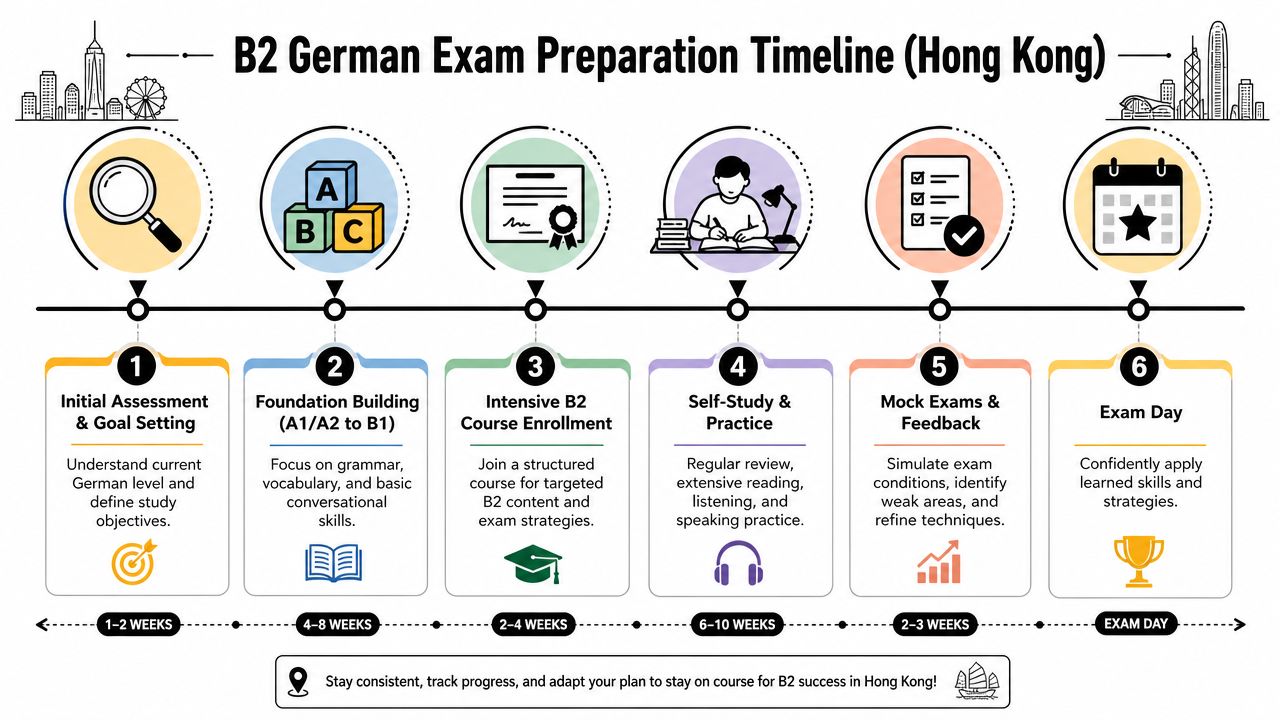
A realistic 12-week preparation plan
This is the plan I recommend for busy learners in Hong Kong who already have a base and now need exam-focused preparation.
Weeks 1 and 2
Start with diagnosis and repair.
- Grammar repair. Fix tense control, case errors, word order, and common sentence patterns.
- Vocabulary sorting. Organise vocabulary by topic and task type.
- Diagnostic tasks. Write one full response and record one speaking task.
This is also the right moment to optimise revision with spaced repetition. Use it for connectors, verb-preposition patterns, topic vocabulary, and recurring phrases you need in writing and speaking.
Weeks 3 and 4
Push reading speed and decision-making.
Use shorter timed texts first. Then move to full exam-length tasks. Hong Kong learners often waste time translating line by line because that feels safe. It is a bad habit for B2. You need to identify the purpose of the text, locate evidence fast, and ignore distractors.
One method works especially well. Revisit every wrong answer and explain the trap in plain language.
Weeks 5 and 6
Train listening under imperfect conditions.
Commute time can help with light audio exposure, but serious listening work needs a desk, a notebook, and immediate correction. Practise picking out the main point, selecting useful notes, and recovering after one missed phrase.
A B2 listener does not catch every word. A B2 listener catches enough structure and meaning to keep answering accurately.
Weeks 7 and 8
Treat writing like a correction cycle, not a creativity exercise.
Write under time limits. Get your work marked. Rewrite the same task after feedback. Then repeat with a new prompt.
Strong B2 writing is clear, organised, and appropriate in tone. Weak B2 writing usually tries to sound advanced before the structure is stable.
Weeks 9 and 10
Turn speaking into a weekly routine with pressure.
At this stage, solo preparation is not enough. You need live interaction and direct correction. That matters even more in Hong Kong, where many learners spend plenty of time on passive study and very little on spoken output.
Use formats that match the exam:
- paired discussion
- short opinion presentation
- agreement and disagreement practice
- repair drills when you lose a word
If your course gives you very few speaking turns, fix that immediately. Add a private speaking slot or switch to a format with more live interaction.
Weeks 11 and 12
Shift into exam management.
Run full mock blocks on weekends. Review how long each task really takes you. Stop rotating randomly between skills and focus on the modules where your score still drops.
Your last two weeks should be boring, controlled, and repeatable. That is a good sign.
The timing mistake Hong Kong learners make most often
They leave writing and speaking too late.
Reading and vocabulary work feel productive because they are tidy and measurable. Writing and speaking feel slower because correction is involved and progress is less visible at first. But in Hong Kong, where many learners rely on self-study or generic tutors, that delay causes the biggest score gap on exam day.
My recommendation is simple. Start speaking practice and marked writing from the first month, not the final month. If you wait until the exam is close, your German may look fine in your notes and still collapse under pressure in the test room.
Choosing Your B2 German Preparation Course Format
It is 8:10 p.m. in Central. You have just left the office, your phone is full of unread messages, and your German class starts in 20 minutes. This is the point where course format stops being a lifestyle preference and becomes an exam strategy.
In Hong Kong, the wrong format costs you twice. First in fees, then in delay.
A B2 course should fit your real week, your commute, and the way the exam works. If the format looks convenient but leads to missed classes, weak speaking practice, or irregular correction, drop it. B2 is too expensive to approach casually.
Choose the format that survives a Hong Kong schedule
Students in Berlin can often build their week around class times. In Hong Kong, class has to survive office hours, MTR travel, school pressure, and family commitments. That changes the calculation.
Use a simple rule. Choose the format you can attend for three months without constant rescheduling. Then check whether it gives you enough live speaking, marked writing, and timed exam work. If one of those pieces is missing, the format is wrong even if the timetable looks perfect.
Comparing B2 German Course Formats in Hong Kong
| Format | Best For | Pros | Cons |
|---|---|---|---|
| Intensive course | Learners with a short deadline and protected study time | Fast progress, frequent correction, easier to stay focused week to week | Hard to sustain with long work hours, easy to burn out |
| Part-time evening or weekend class | Working professionals, university students, parents | Realistic for Hong Kong life, stable routine, easier to keep attending | Slower progress, depends on strong homework habits |
| Private tuition | Learners with clear weak points or urgent deadlines | Targeted correction, fast speaking and writing repair, flexible content | Higher cost, less peer interaction, easy to mistake comfort for readiness |
| Online live course | Learners with long commutes or unstable work hours | Saves travel time, easier to keep attendance high, practical for busy weeks | Lower speaking energy if the class is poorly run, distractions at home |
| Hybrid course | Learners who need some in-person structure with backup flexibility | Useful during schedule disruption, can reduce missed lessons | Quality varies sharply, mixed attendance often weakens discipline |
My view on what works
Intensive courses
These work for one type of learner. Someone with a fixed exam date, a clear reason for passing, and enough mental space to handle frequent correction.
If your week is already overloaded, intensive study usually backfires. Tired students stop reviewing, skip assignments, and start confusing attendance with progress.
Part-time evening and weekend classes
For Hong Kong professionals, this is usually the smartest default.
It matches the reality of the city. You can keep your job, protect your routine, and still make steady progress. The weakness is obvious. Two classes a week will not carry you to B2 unless you do regular work between lessons.
Private tuition
Private lessons are excellent for repair. They are especially useful if your writing lacks structure, your speaking is hesitant, or you keep making the same grammar mistakes under pressure.
They are weaker as a full replacement for a proper exam course. B2 includes interaction, timing, and task management. One-to-one lessons help, but they can also become too forgiving.
Online live courses
I rate online live courses higher than many schools do, especially in Hong Kong. A good online class often beats an in-person class that you keep missing because of traffic, overtime, or a long commute from New Territories.
The condition is simple. The teacher must run the room tightly. Cameras on. Speaking turns assigned. Corrections given immediately. Otherwise students disappear behind muted screens and make no real progress.
Hybrid courses
Hybrid can work well for adults with unpredictable weeks. It can also become messy very quickly.
Some schools offer hybrid because it sounds modern, not because the teaching design is strong. Ask exactly how interaction works across both modes. If online students are treated like spectators, avoid it.
What to check before you pay
Do not start with the brochure. Start with the operating model.
Ask these questions:
- How many times will I speak in a typical lesson?
- Who marks my writing, and how fast do I get corrections back?
- How often do we run timed B2 tasks or full mock papers?
- Is the teacher a native-level user who can correct natural phrasing, register, and argument structure?
- What happens if I miss a class because of work or exams?
- Is the group small enough for active participation, or am I paying to listen?
This matters more in Hong Kong because many learners try to patch B2 together from apps, self-study, and generic tutoring. That approach looks efficient and usually fails at the exact point where the exam becomes interactive and time-sensitive.
You can also learn a lot from how a school handles scheduling, attendance, and follow-up. Centres with clear systems usually run better classes. If you want to see the kind of tools schools use behind the scenes, look at language school software.
Native-led instruction versus generic tutoring
Here is the blunt truth. At B2, generic tutoring is often too shallow.
You need correction on tone, word choice, spoken rhythm, and whether your answer sounds like educated adult German rather than translated English. A native-led teacher, or a teacher with native-level command and strong exam experience, catches that faster. In Hong Kong, where many students are used to grammar-heavy teaching, this difference is bigger than they expect.
For exam prep, I would take a well-run small group with native-led correction over a cheap tutor who only checks worksheets.
My recommendation by learner type
Working professionals: Choose a part-time evening or weekend course first. Add one-to-one speaking or writing support only if a clear weakness appears.
Students under DSE, IB, or university pressure: Choose a structured small group. Fully self-directed study sounds efficient and usually collapses during busy weeks.
Candidates with a near exam deadline: Combine formats. Use a structured course for routine and add private correction for your weakest module.
Learners with long commutes: Choose live online over in-person classes you will keep cancelling. Attendance beats good intentions every time.
One final point. Format is not a minor detail. In Hong Kong, it is often the difference between sitting the B2 exam once and sitting it twice.
The GCA Advantage for B2 Exam Success
In Hong Kong, paying for B2 preparation only makes sense if the course shortens the path to a pass. You are not buying general exposure to German. You are buying correction, exam control, and a class format you can keep attending after work, school, or a cross-harbour commute.
One local cost guide notes that German courses in Hong Kong span a wide price range, and that exam preparation classes are built around listening, speaking, reading, and writing (Hong Kong German course cost guide). That is the right benchmark. If a B2 course does not show you exactly how it trains all four papers, skip it.
What a serious B2 course needs to deliver
At this level, weak course design shows up fast. Students plateau in speaking, keep repeating the same writing mistakes, and walk into the exam with too little timed practice.
I look for five things:
- Native-led or native-level teaching with exam experience
- Small classes that create repeated speaking turns
- Marked writing with clear correction, not vague comments
- Regular speaking pressure under timed conditions
- A syllabus built around B2 tasks, not a textbook chapter order
That is the standard in Hong Kong if your goal is passing the exam efficiently, not studying indefinitely.
Why native-led teaching pays off at B2
B2 is where translated English starts to hurt. Your grammar can be acceptable and your answer can still sound unnatural, flat, or too informal for the exam.
A strong native-led teacher catches that early. They correct phrasing, register, collocation, sentence rhythm, and the kind of spoken hesitation that weaker tutors often ignore. In Hong Kong, where many learners come from grammar-heavy classrooms, that difference is larger than they expect.
This shows up most clearly in speaking and writing. It also matters for listening, because real pronunciation patterns and pace are part of the exam, not an optional extra.
Why GCA fits the Hong Kong reality
German Cultural Association Hong Kong is worth a serious look because the setup matches how people in this city study. Classes are kept small, capped at 6 students. The school offers both in-person and Zoom lessons. Teaching is handled by native German-speaking instructors.
That combination is practical in Hong Kong. Small groups mean more speaking time per lesson. Online and in-person options make it easier to keep attendance stable during busy weeks. Native-led correction gives you faster feedback on whether your German sounds exam-ready or merely understandable.
If you are planning backwards from a test date, check the current Goethe-Zertifikat exam dates in Hong Kong first, then choose a course schedule that gives you enough time for mock practice and correction.
Results only count if the teaching model explains them
The publisher states a 96% recommendation rate and that over 90% of students rank in the top 10% of public examinations. Those figures are meaningful because they sit alongside a clear teaching model: small classes, native-speaking teachers, exam-focused lessons, flexible scheduling, and a structured certificate pathway.
That is the part many Hong Kong learners miss. Good B2 results usually come from repeatable mechanics. Students attend consistently. They speak in every class. Their writing gets corrected properly. They practise exam tasks before the official paper, not after they realise they are weak.
What I recommend to cost-conscious families and professionals
Do not compare B2 courses by headline price alone. Compare them by feedback density per hour.
A cheaper course with little speaking time and almost no writing correction often costs more in the end because it stretches preparation and increases the risk of a resit. A higher-fee course is only worth it if the structure saves time and improves your chance of passing on schedule.
For Hong Kong parents, that means choosing routine over improvisation. For professionals, it means choosing a format that survives long workdays and changing calendars. In both cases, the better investment is usually a tightly run, exam-focused programme with correction built into the course, not random tutoring added week by week.
Hong Kong Logistics and Exam Day Strategy
If you're taking the B2 route in Hong Kong, keep your logistics simple. The main public exam benchmark is the Goethe-Institut Hong Kong, so your planning should start with registration timing, travel time, and your readiness window.
For current scheduling reference, check the latest Goethe-Zertifikat exam dates in Hong Kong before building the final weeks of your study plan.
Local logistics that reduce stress
Hong Kong learners often underestimate how much friction small logistics create. The commute, the class location, the gap between work and lesson time, and whether you can recover missed sessions all affect consistency long before exam day.
What I recommend is simple:
- Choose a class location you can reach reliably after work or school
- Don't plan a brutal cross-harbour journey if an online live option keeps attendance steadier
- Build at least one buffer week before the exam
- Avoid stacking the exam next to major DSE, IB, IGCSE, or work deadlines if possible
For many HK learners, a centre near an MTR station is not a luxury. It's what keeps the course sustainable.
Exam day strategy that actually works
On the day itself, don't chase brilliance. Chase control.
Before the exam
- Sleep properly. Last-minute cramming usually hurts listening and speaking more than it helps.
- Arrive early. HK transport is efficient until the one day you really need it.
- Bring what the centre requires. Check documents in advance, not at the MTR gate.
During reading and listening
- Don't get trapped by one hard item
- Mark cleanly and stay calm
- Use the first pass to secure what you know
Many candidates lose marks because they treat uncertainty as disaster. It isn't. B2 rewards composure.
During writing
- Plan before writing
- Stick to the task
- Leave time to check endings, connectors, and word order
The classic HK mistake is producing too much too early, then finishing badly. A shorter, controlled response usually beats a long messy one.
During speaking
- Answer the task, not the fantasy version in your head
- If you don't know a word, rephrase
- Keep interacting instead of freezing
If your German breaks down for a moment, keep communicating. Examiners can work with imperfect language. They can't work with silence.
Common pitfalls
Here are the ones I see most often:
- Misreading instructions
- Ignoring time limits during practice
- Doing too much passive revision and too little output
- Treating speaking as something to “warm up” later
- Arriving overconfident because classroom German felt comfortable
The learners who usually do best in Hong Kong aren't the most dramatic about studying. They're the most organised.
Ready to Ace Your B2 German Exam
Passing B2 in Hong Kong is absolutely realistic. But it won't happen through random effort.
You need a proper match between your goal, your schedule, and your course format. You need repeated speaking, marked writing, timed practice, and a system that survives HK life when work gets busy or school pressure spikes. That's what separates learners who keep “studying German” from learners who pass.
If you're choosing a B2 German Exam Preparation Course Hong Kong option, be strict. Ignore vague promises. Ask how much speaking time you'll get, how writing is corrected, whether mock exams are included, and whether the timetable is realistic for your week.
For many learners, the smartest next move is one of these:
- Book a trial class to test the teaching style and level fit
- Ask for a study plan based on your current level and target date
- Choose a format now instead of drifting between online videos, apps, and occasional tutoring
- Set your exam month first, then work backwards with a fixed weekly rhythm
If your goal is study abroad in Germany, stronger academic options, or a serious professional edge, don't leave B2 to chance. Build it properly.
If you want a practical next step, German Cultural Association Hong Kong(GCA) offers native-led German courses in Hong Kong with small-group and online options, plus exam-focused support for learners preparing for recognised German qualifications. You can check the latest course schedule, contact an advisor for a personalised recommendation, or book a trial class to see which format fits your timeline best.
German Accusative Case Explained: When and How to Use Akkusativ

German Small Talk: 30 Phrases for Meeting People and Making Friends


